
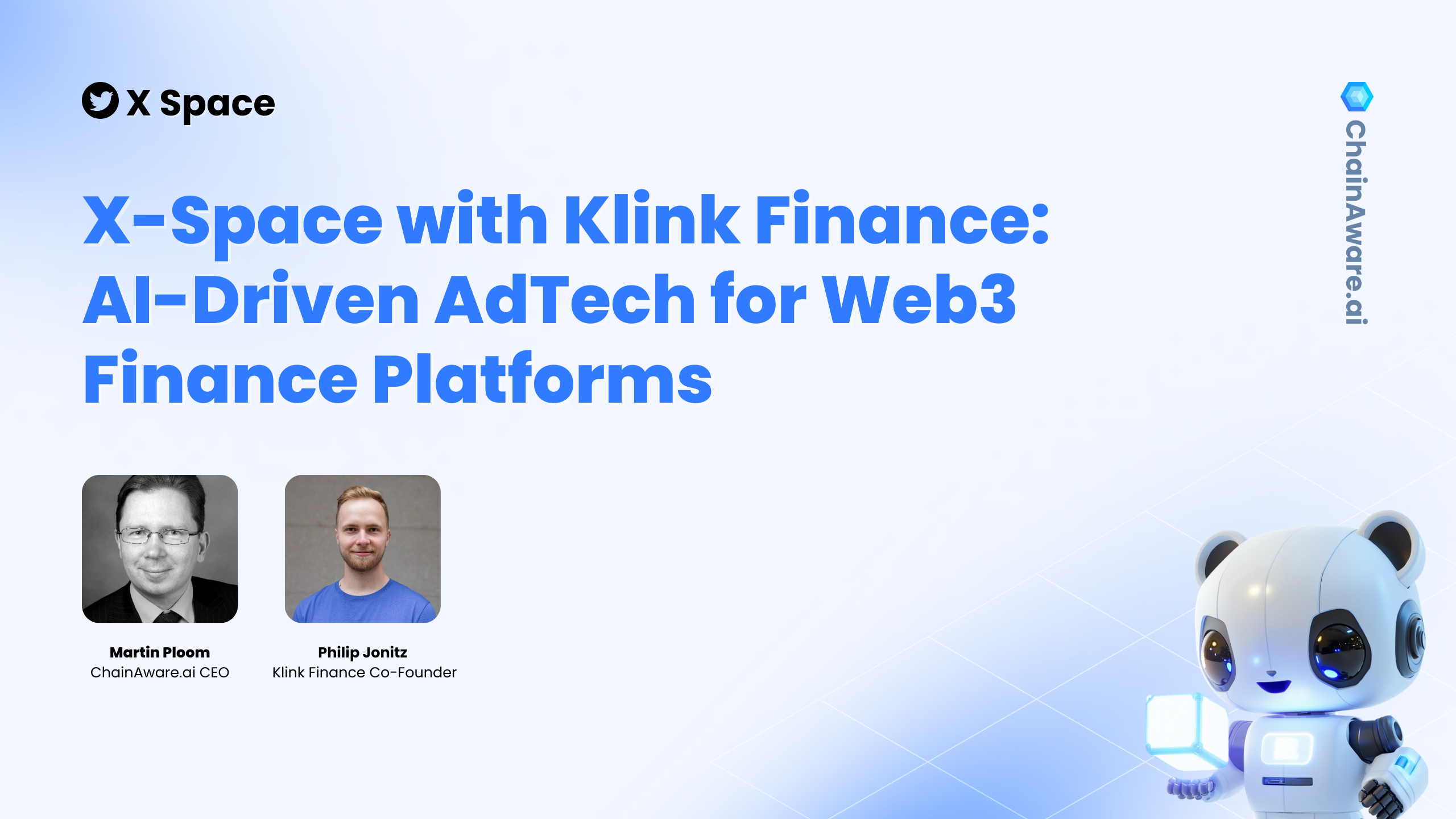
X Space with Klink Finance — ChainAware co-founder Martin in conversation with Philip, co-founder of Klink Finance, on AI-driven AdTech for Web3 finance platforms. Listen to the full recording on X ↗
Two Web3 founders with very different perspectives on user acquisition sit down to map the honest state of Web3 marketing. Philip from Klink Finance brings three years of operating a 350,000-member crypto wealth creation platform — real experience running campaigns across Twitter, Telegram, and Discord through the full cycle of channel migration and community building. Martin from ChainAware brings the data layer: behavioral analytics across 18M+ wallets, AI-powered fraud detection at 98% accuracy, and the conviction that Web3 marketing is about to undergo the same AdTech transformation that Web2 underwent in the early 2000s. Their conversation covers the gap between traffic generation and user conversion, the 15x uplift that personalization delivers over mass marketing, why AI agents are not the next evolution of prompt engineering but something structurally different, and why the wallpaper analogy explains what resonating content actually means in practice. Together, they arrive at the same conclusion from different directions: the most important unsolved problem in Web3 growth is not reaching users — it is converting the right users at sustainable cost.
In This Article
- Klink Finance: Building Crypto Wealth Creation from Zero
- Web3 Marketing in 2025: 30 Years of Web2 Practice Meets Six Years of Web3 Native
- Channel Migration: From Twitter Dominance to the Telegram Ecosystem
- Mass Marketing Generates Traffic. Personalization Converts It.
- The Email Marketing Proof Point: 1% vs 15% — a 15x Conversion Multiplier
- The Onboarding Aha Moment: How Klink Reduced CAC by Optimising the First Reward
- The User Journey from CEX to DeFi: 90%, 10%, and Why It Matters
- Address History as Trust Infrastructure: Your Best Business Card in Web3
- KOL Accountability: Why Share My Wallet Would Change Everything
- Address Clustering: Finding One Entity Across Many Wallets
- AI Agents Defined: What Separates Autonomous Agents from Prompt Engineering
- Generative AI vs Predictive AI: Two Entirely Different Engines
- The Marketing Agent in Practice: The Wallpaper Analogy
- The Transaction Monitoring Agent: Expert-Level Compliance Running 24/7
- Amazon, eBay, and the Mechanism Behind Web2 Crossing the Chasm
- Comparison Tables
- FAQ
Klink Finance: Building Crypto Wealth Creation from Zero
Philip, co-founder of Klink Finance, opens the conversation with a platform overview that immediately establishes the scale of the Web3 user acquisition challenge from the operator’s perspective. Klink Finance is a crypto wealth creation platform — specifically designed to let anyone start building a crypto portfolio from $0 of personal investment. Rather than requiring users to bring capital, Klink enables participants to earn crypto rewards through completing quests, participating in airdrops, playing games, answering surveys, and engaging with various platform activities. Rewards are distributed in stablecoins (primarily USDT) as well as newly listed tokens and other airdrop opportunities.
Since launch, Klink Finance has grown to over 350,000 community members — accessible through a mobile app, a web app, and a Telegram mini app. That multi-platform presence reflects a deliberate strategic adaptation: Klink has observed firsthand how rapidly Web3 user communities migrate between channels, and has built infrastructure to follow users wherever they concentrate. As Philip explains: “The trends are changing so quickly in the crypto space and also user interest changes rapidly. Over the course of building Clink, we had different channels that worked better or worse over time.” For more on understanding Web3 user behavior patterns, see our behavioral analytics guide.
Web3 Marketing in 2025: 30 Years of Web2 Practice Meets Six Years of Web3 Native
One of the most practically useful observations Philip makes early in the conversation concerns the false dichotomy many Web3 founders hold about their marketing approach. Early in the crypto industry’s history, a significant faction believed that Web3 marketing was fundamentally different from Web2 marketing — that it required entirely new channels, tactics, and frameworks. Experience has proven this view too simple. As Philip puts it: “If you look at how it evolved over the years, it is very much a mixture of strategies that have worked extremely well in the Web2 space and adding things on top that are very much Web3 native.”
The asymmetry of the situation is significant: Web2 marketing has 30 years of accumulated best practices, tested frameworks, conversion rate data, and channel-specific expertise. Web3 marketing has approximately six years as a serious discipline. Rather than rejecting those 30 years, the most effective Web3 marketing operators layer Web3-native elements — wallet behavioral targeting, on-chain audience segmentation, token incentive structures — on top of the proven Web2 foundation. The projects that succeed are those that understand both layers and know which tool applies in which context. For how wallet behavioral data creates a Web3-native targeting layer, see our intention-based marketing guide.
Agility as the Core Marketing Competency
Beyond the hybrid approach, Philip identifies agility as the single most valuable marketing competency for Web3 operators. The speed at which trends, user concentrations, and effective channels shift in the crypto space is dramatically faster than in Web2. A marketing strategy that worked in Q1 may be significantly less effective by Q3 — not because the product changed, but because the ecosystem migrated. The operators who sustain growth are those who monitor channel effectiveness continuously and reallocate resources quickly when the data signals a shift. Rigidity — committing to a single channel because it worked previously — is one of the fastest ways to lose momentum in Web3.
Channel Migration: From Twitter Dominance to the Telegram Ecosystem
Klink Finance’s own channel history provides a concrete illustration of why agility matters. For an extended period after launch, Twitter (now X) was their primary user acquisition channel — leveraging the platform’s dense Web3 community and its culture of crypto discussion, alpha sharing, and community building. That approach worked well. Over the course of 2024, however, Klink’s primary acquisition channel shifted decisively toward Telegram — both the broader Telegram ecosystem and the specific advertising capabilities that Telegram provides to reach its 900+ million monthly active users.
This migration reflects a broader pattern visible across the Web3 industry: community infrastructure has been moving from Discord (which dominated the 2020-2022 era as the go-to community building platform for NFT and DeFi projects) toward Telegram as both a community platform and a distribution channel. Telegram mini apps have created an entirely new product category — lightweight applications running natively within Telegram that can reach users directly inside their primary communication environment. Klink’s Telegram mini app captures this opportunity directly. As Philip explains: “We also launched the Telegram mini app to leverage advertising on Telegram directly. Because you see a lot of migration also where Web3 communities are built up from being only on Discord initially to a lot more reliance on Telegram.” For more on channel strategy and conversion optimisation, see our Web3 marketing guide.
Mass Marketing Generates Traffic. Personalization Converts It.
Martin introduces the structural distinction at the heart of ChainAware’s approach to Web3 marketing — one that Philip quickly validates from Klink’s operational experience. The distinction separates two entirely different problems that most Web3 marketing discussions conflate: traffic generation and user conversion.
Mass marketing — banner ads, KOL campaigns, Telegram ads, Twitter promotions — is reasonably effective at generating traffic to a platform. It brings visitors to the website or application. However, it is almost entirely ineffective at converting those visitors into active, transacting users. The reason is structural: mass marketing sends the same message to everyone, regardless of their behavioral profile, experience level, risk tolerance, or actual intentions. People are different. A DeFi trader who arrives at a borrowing and lending platform has completely different needs, vocabulary familiarity, and conversion triggers than a crypto newcomer who arrived through the same campaign. Sending both of them an identical onboarding experience means neither gets a particularly relevant one. As Martin frames it: “Visitors are coming to your website. Everyone is seeing the same message. People are different. We have to give to people different messages.” For the complete framework on personalized Web3 marketing, see our AI marketing for Web3 guide.
Philip adds an important operational dimension to this framework. Reducing customer acquisition cost is not only about targeting better acquisition channels — it equally requires optimising the conversion from first landing to first transacting action. As he explains: “It’s not only about spending an amount of money and driving users into your platform. Because then you actually enter the next phase of facilitating a very easy onboarding towards the user. The simpler it is to use your product and to convert from first landing into becoming an actual user, the cheaper it will get also to grow your community.” The implication is clear: personalisation is the conversion layer that makes the acquisition spend worthwhile. Without it, the traffic generated by mass marketing leaks out of the funnel before reaching the transacting stage. For how behavioral segmentation enables the conversion layer, see our user segmentation guide.
Know Who Is Landing on Your Platform
ChainAware Web3 Analytics — Free, 2 Lines of Code, Results in 24 Hours
Before you can personalise, you need to know your real users — not the marketing persona you imagined, but the actual behavioral profiles of wallets connecting to your platform today. ChainAware Analytics shows you experience level, risk willingness, intentions (trader, borrower, staker, gamer), and Wallet Rank distribution. Two lines in Google Tag Manager. Results in 24-48 hours. Free.
The Email Marketing Proof Point: 1% vs 15% — a 15x Conversion Multiplier
Martin introduces a specific data point that quantifies the personalization premium with enough precision to be immediately actionable for any Web3 founder evaluating their marketing strategy. The comparison comes from email marketing — a channel with decades of conversion rate data across millions of campaigns.
Mass email marketing achieves approximately 1% conversion across general audiences — dropping to 0.5% in the crypto sector, where inbox competition from project newsletters, airdrop announcements, and exchange promotions is particularly intense. Personalised email marketing — where message content is generated based on additional data about the recipient from LinkedIn, Twitter history, and behavioral signals — achieves open rates of approximately 15%. That is not a marginal improvement. At 15x the conversion rate of mass email, personalisation fundamentally changes the economics of every marketing investment. As Martin states directly: “Mass email marketing conversion ratio is 1%, in crypto 0.5%. Now if you go personalised, meaning the emails are generated based on additional information available about you via LinkedIn and Twitter, then you get open rates of 15%. And this shows how much personalisation impacts the conversion. 1% versus 15% — that’s 15x.” For the complete conversion framework applied to Web3 platforms, see our high-conversion Web3 marketing guide.
Blockchain Behavioral Data Outperforms LinkedIn and Twitter Signals
The 15x personalization premium in email marketing uses relatively shallow data sources — LinkedIn profile information, Twitter activity patterns, and basic demographic signals. Blockchain behavioral data is structurally richer and more reliable than any of those signals. Every on-chain transaction reflects a deliberate financial decision that cost real money (gas fees) to execute. The resulting behavioral profile captures actual financial behavior, not self-reported professional credentials or social media activity that may be entirely performative. A wallet with a three-year history of leveraged trading on multiple chains tells you far more about that person’s risk profile, experience level, and likely next action than their LinkedIn job title ever could. Consequently, the personalization premium that blockchain-based targeting enables is likely to exceed the 15x email marketing benchmark — because the underlying data quality is higher.
The Onboarding Aha Moment: How Klink Reduced CAC by Optimising the First Reward
Philip provides a concrete case study from Klink Finance’s own growth history that illustrates how onboarding optimisation directly reduces customer acquisition cost — without changing a single marketing channel or campaign budget. The concept centres on what product teams call the “aha moment” — the specific point in a new user’s first experience where they genuinely understand the product’s value, decide they like it, and commit to continued engagement.
For Klink Finance, that aha moment is precisely defined: it is when a new user earns their first crypto reward starting from zero. Not when they register. Not when they download the app. Not when they complete a profile. The specific moment they see their first crypto balance appear — earned without any prior investment — is when they truly understand what Klink is and why it is valuable. As Philip explains: “For us, this key moment of being a Klink community member is when you earn your first crypto rewards starting from zero. Over time we more and more optimise this flow of getting someone to land on the website or application and getting them to earn their first rewards. And the more you understand how to optimise this onboarding flow, that will have a direct impact on your Web3 marketing strategy and the types of users you are targeting.” For how behavioral profiling enables personalised onboarding at scale, see our DeFi onboarding guide.
Personalisation Reduces Onboarding Noise
Philip makes a specific practical observation about personalised onboarding that connects directly to ChainAware’s approach. If a platform builds a single onboarding flow suitable for both complete crypto beginners and experienced DeFi natives, both groups receive significant irrelevant content. The beginner needs education about private keys and basic wallet concepts. The experienced DeFi user finds that same education condescending and time-wasting. As Philip explains: “If you understand they have been in the crypto space for years already, you don’t need to educate them about what a private key is or how to stake tokens. But you can get straight to the point of the key benefits of your specific solution.” ChainAware’s experience level parameter (1–5 scale derived from transaction history) enables exactly this distinction to be made at wallet connection — before the user interacts with any onboarding content at all. For how ChainAware calculates experience levels, see our wallet auditor guide.
The User Journey from CEX to DeFi: 90%, 10%, and Why It Matters
The conversation surfaces a data point that has significant implications for how Web3 platforms should think about their addressable market. Philip observes that Klink Finance’s community sits at the intersection of Web2 and Web3 — serving users who interact with crypto applications but are not necessarily DeFi natives. Martin provides the broader industry context: approximately 90% of crypto users conduct their activity exclusively on centralised exchanges, with only around 10% actively using DeFi wallets and interacting with on-chain protocols.
Rather than viewing this 90/10 split as a limitation, Martin frames it as a predictable stage in a user journey that is directionally clear and commercially important. New crypto users almost universally start on centralised exchanges — the user experience is familiar, the custodial model removes the complexity of key management, and the fiat on-ramps are straightforward. Over time, as users gain experience and confidence, they begin exploring Web3 applications. Typically, they encounter rug pulls or other fraud events on platforms like PancakeSwap or pump.fun, temporarily retreat to centralised exchanges, then return to DeFi with more caution and more knowledge. Eventually, experienced users often exit centralised exchanges entirely. As Martin describes the arc: “It’s like a personal development upon every Web3 user. It was as well my journey. I started on the central exchanges. I don’t want to use central exchanges anymore.” For more on the user journey and how behavioral analytics tracks it, see our Web3 growth guide.
The Commercial Implication: Protect New Entrants or Lose Them Permanently
The user journey analysis has a specific commercial implication that Martin emphasises throughout the conversation: new users who encounter fraud in their first DeFi experiences frequently leave the ecosystem permanently. They do not pause and try again — they associate the entire Web3 space with the negative experience and return to centralised exchanges as their permanent solution. Every fraudulent interaction that drives a new user out is not just a lost transaction — it is a permanently lost ecosystem participant who will never contribute to DeFi liquidity, governance, or growth again. Reducing fraud rates therefore directly expands the addressable market for every DeFi platform by keeping new entrants in the ecosystem long enough to become genuine participants. For the full fraud reduction argument, see our fraud detection guide.
Address History as Trust Infrastructure: Your Best Business Card in Web3
Martin introduces an underappreciated use case for on-chain behavioral data that extends beyond fraud detection and marketing personalisation: address history as a trust infrastructure for peer-to-peer and business-to-business interactions in the Web3 ecosystem. The argument is both practical and elegant — blockchain’s combination of transparency and pseudonymity creates a unique opportunity to project verifiable trustworthiness without sacrificing privacy.
In a traditional business context, trust is established through credentials — CVs, references, LinkedIn profiles, company registrations. All of these can be falsified. On-chain transaction history, by contrast, is cryptographically immutable and permanently public. A wallet with a five-year history of sophisticated DeFi interactions, consistent protocol usage, and zero fraud associations tells a more reliable story about its owner than any self-reported credential. Furthermore, the history cannot be retrospectively altered — it stands as a permanent, verifiable record. As Martin explains: “Address history is a way to create trust in the ecosystem. You can stay anonymous but you can still calculate the trust level — how much you can trust other persons. Your address history is my credit score, my business card, my visit card. I don’t need to pretend to be someone — I say that’s my address, look who I am, look at the predictions, look at my behavior. I am who I am.” For the complete Share My Wallet Audit implementation, see our Share My Audit guide.
Your Wallet Is Your Reputation
ChainAware Share My Audit — Your Web3 Business Card
Connect your wallet, sign a message to prove ownership, and generate a shareable link showing your complete behavioral profile: experience level, risk willingness, fraud probability, intentions, and Wallet Rank. Share it with counterparties, partners, or investors. Stay anonymous. Prove trustworthiness. No KYC. No identity disclosure.
KOL Accountability: Why Share My Wallet Would Change Everything
The trust infrastructure argument leads Martin to a pointed application: Key Opinion Leaders (KOLs) — the influencers who shape investment decisions across the Web3 space — should be required to share their wallet audits alongside their investment calls and project promotions. The logic is direct: if a KOL claims to be an experienced trader who got into a memecoin at a specific early price, their on-chain transaction history either confirms or refutes that claim with cryptographic certainty.
Philip acknowledges the principle but highlights the practical barrier: most KOLs would resist because public wallet history would expose the gap between their public claims and their actual behavior. As Philip explains: “I think that would be beneficial but I also feel like there is still a very big barrier from creators in the economy to start sharing that. Because I personally believe that we would see a lot of false X tweets and Telegram posts of people saying I only bought it at this price, whilst they already got it a lot earlier or even didn’t even buy it but just got paid by projects to present.” The resistance to wallet-based KOL accountability is itself revealing — it confirms the extent to which the current KOL marketing ecosystem relies on unverifiable claims to function. For more on KOL marketing accountability, see our KOL marketing guide.
Address Clustering: Finding One Entity Across Many Wallets
Philip raises a challenge that represents one of the genuine technical limitations of wallet-based behavioral analytics: many sophisticated Web3 users deliberately distribute their activity across multiple wallet addresses — sometimes for privacy reasons, sometimes for tax management, and sometimes simply because different wallets serve different purposes. This multi-wallet behavior limits the completeness of behavioral profiles derived from any single address.
Martin’s response introduces address clustering — a technique that partially addresses this limitation by identifying circular dependencies between addresses that appear unrelated on the surface. Even when a user routes through centralised exchanges between DeFi interactions, or regularly creates fresh wallet addresses to separate their activity, they inevitably leave interaction patterns that connect those addresses: shared funding sources, common counterparties, timing correlations, or token flow patterns that form identifiable clusters. As Martin explains: “Even if you look on the first side that addresses are not interrelated, you will still find the circular dependencies. And then you realise — wow, it’s actually one person behind these addresses. So with the analytics, even if you have centralised exchanges between them, still many things can be calculated, much more than people think.” For more on the analytics capabilities across multi-wallet scenarios, see our blockchain analysis guide.
AI Agents Defined: What Separates Autonomous Agents from Prompt Engineering
As the conversation shifts toward AI agents — the topic Philip explicitly identifies as dominating X and generating enormous community interest — Martin provides one of the clearest definitions of what differentiates a true AI agent from the prompt engineering paradigm that preceded it. The distinction matters because “AI agent” has become one of the most overloaded terms in technology marketing, applied to everything from simple chatbot wrappers to genuinely autonomous systems.
Prompt engineering, which dominated the two years following the emergence of large language models, requires a human at every interaction. A prompt engineer designs clever input sequences that extract useful outputs from an LLM — but that process requires a person to initiate each query, evaluate the response, and decide on the next step. Furthermore, the LLMs available during that period operated on training data that was 18-24 months old, limiting their usefulness for time-sensitive applications. An AI agent, by contrast, removes the human from the loop entirely. It runs autonomously, operates continuously (24/7), learns from feedback loops without human intervention, and processes real-time data rather than static training datasets. As Martin defines it: “AI agent is not the next level of prompt engineering. Prompt engineering still needs a person who is creating the prompt. In the case of an AI agent, it means it’s autonomous, it runs from itself. You don’t need this person. There it’s continuous, it’s 24/7. It’s not like an employee who in the evening goes home. And it’s a continuous self-learning when they integrate the feedback loops.” For the complete AI agent taxonomy applied to Web3, see our Web3 AI agents guide.
How ChainAware Built Agents Without Knowing It
Martin’s account of how ChainAware arrived at its agent architecture is instructive precisely because it was not planned. The team built fraud detection, then rug pull detection, then wallet auditing, then AdTech targeting — each product emerging organically from the previous one. At some point, the combination of real-time behavioral prediction and automated content generation produced a system that ran continuously, learned from results, and required no human intervention per user interaction. That is, by any rigorous definition, an AI agent. As Martin puts it: “We got to the agent without knowing that we built an agent. We just kept building and then we realised other people are calling it AI agents and we were like — oh, we like the name, that’s great.” The organic emergence reflects both the genuineness of ChainAware’s agent architecture and the fact that most legitimate Web3 AI agents were built from solving real problems, not from top-down narrative construction.
Generative AI vs Predictive AI: Two Entirely Different Engines
Before explaining how ChainAware’s marketing agents work, Martin establishes the foundational distinction between the two types of AI that are frequently conflated in Web3 marketing discussions. This distinction is critical because the two types are not interchangeable — they solve different problems with different architectures and different value propositions.
Generative AI — the category that includes ChatGPT, Claude, Gemini, and most of the AI tools that became mainstream in 2022-2023 — is fundamentally a statistical autocorrelation engine. It processes enormous volumes of text and learns the probabilistic relationships between words, sentences, and concepts. When asked a question, it generates the statistically most probable response given its training data. This makes it extremely capable at content creation, summarisation, translation, and conversational interaction. However, it cannot make deterministic predictions about specific future events from numerical behavioral data, cannot classify fraud with 98% accuracy, and cannot calculate a specific wallet’s likelihood of borrowing in the next 30 days. As Martin explains: “Generative AI is just an autocorrelation engine. It produces the most probable answer based on the data that it has. It doesn’t think, it just gives you statistically the most probable response.” Predictive AI, by contrast, uses supervised learning on labeled behavioral data to classify future states — which wallets will commit fraud, which will borrow, which will trade. For the full generative vs predictive AI analysis, see our generative vs predictive AI guide.
The Marketing Agent in Practice: The Wallpaper Analogy
Having established the distinction between generative and predictive AI, Martin explains how ChainAware’s marketing agents use both in combination to create what he calls a “resonating experience” — a website interaction that feels personally relevant to each visitor without revealing why.
The operational sequence begins at the moment a wallet connects to a platform. If the wallet is entirely new with no transaction history, the platform shows its default messages — the same experience every user receives today. However, as soon as transaction history is available, the agent processes the wallet’s behavioral profile and generates matched content. An NFT collector arriving at a DeFi lending platform sees messages framed around the NFT ecosystem and how lending connects to it. A leverage trader arriving at the same platform sees messages about collateral usage and leveraged position opportunities. Neither visitor has explicitly requested this personalised experience — the agent inferred it from their transaction history and generated the appropriate content automatically. As Martin describes the mechanic: “You get an NFT guy at a borrowing lending platform — the NFT guy sees messages cut for him. You get a trader there — the trader gets messages like you can leverage up, you can use your funds as collateral, you can borrow more and go long trades.” For the detailed marketing agent implementation guide, see our AI marketing guide.
The Wallpaper Analogy: You Like It But You Don’t Know Why
Martin uses a memorable analogy to explain the user experience created by resonating content. Imagine walking into a living room where some guests see blue wallpaper and others see green wallpaper — each person sees the colour they prefer, but nobody explains this or draws attention to it. They simply feel comfortable in the space. Web3 marketing agents create the equivalent effect on a website: each visitor experiences content that resonates with their specific behavioral profile, generating a feeling of relevance and comfort without any explicit personalisation signal. As Martin explains: “Some people see blue wallpapers, other people see green wallpapers — they see a wallpaper what they like. And the same will be on the website. If you’re resonating with someone, you like them, you spend more time there. If you’re not resonating, probably you could have a website where you speak to someone else. It’s about resonance.” For how this resonance mechanism drives conversion, see our Web3 personas guide and our high-conversion guide.
The Transaction Monitoring Agent: Expert-Level Compliance Running 24/7
The second agent Martin describes in detail is the transaction monitoring agent — a fundamentally different use case from the marketing agent but sharing the same architectural characteristics of autonomy, real-time operation, and continuous learning. Where the marketing agent operates at the acquisition and conversion layer, the transaction monitoring agent operates at the compliance and security layer.
The agent’s function is straightforward to describe: it takes a defined set of wallet addresses — the connected users of a Web3 platform — and continuously monitors all of their on-chain transactions across every blockchain it has access to. When behavioral patterns emerge that match the fraud signature library (not just fund flow from blacklisted addresses, but forward-looking behavioral indicators of future fraud), the agent automatically flags the address and sends a notification to the relevant compliance officer via Telegram or the platform’s interface. The compliance officer then decides what action to take — shadow ban, full restriction, or further investigation. As Martin explains: “This agent is continuously, autonomously analyzing all these wallets all the time. If there’s a new transaction — not on your platform, but on any platform — it analyses these transactions and if it sees fraud patterns, it will automatically flag it. Then a compliance officer gets the notification: watch out this address, there’s a probability that something will happen there.” For the full transaction monitoring methodology and regulatory context, see our transaction monitoring guide and our AML and transaction monitoring guide.
Expert-Level Workers at a Fraction of the Cost
Martin frames both agents through an employment analogy that makes their commercial value immediately tangible. Both the marketing agent and the transaction monitoring agent perform work that would otherwise require expert human professionals — senior marketers who understand behavioral segmentation and personalisation strategy, and compliance analysts who monitor transaction activity and identify fraud patterns. Both roles typically cost significant salaries, operate only during business hours, require management overhead, and cannot physically monitor thousands of addresses simultaneously. The agents eliminate all of these constraints: they operate at expert level, run continuously 24/7, require no management beyond initial configuration, and can monitor unlimited addresses in parallel. As Martin puts it: “These are like expert workers who are doing work for you — transaction monitoring agents or marketing agents. Expert-level workers, 24/7.” For how these agents fit into the broader Web3 agentic economy, see our Web3 agentic economy guide.
Deploy Both Agents on Your Platform
ChainAware Growth Agents + Transaction Monitoring — One Integration
Marketing Agent: calculates each wallet’s behavioral profile at connection, generates resonating 1:1 content automatically. Transaction Monitoring Agent: continuously monitors your user address set, flags fraud patterns before damage occurs, alerts compliance via Telegram. Both run 24/7. Both integrate via Google Tag Manager. Both powered by 18M+ Web3 Personas across 8 blockchains.
Amazon, eBay, and the Mechanism Behind Web2 Crossing the Chasm
Martin returns in the conversation’s closing section to the historical parallel that contextualises everything ChainAware builds: the mechanism by which Web2 crossed from 50 million technical early adopters to mainstream adoption affecting hundreds of millions of users and generating trillions of dollars of commerce annually. The crossing the chasm framework, popularised by Geoffrey Moore’s influential book on technology adoption, describes the phenomenon but does not fully explain the mechanism. Martin’s argument is that the mechanism is now identifiable in retrospect and directly applicable to Web3.
Web2 companies in the early 2000s faced the same cost structure Web3 faces today: catastrophically high customer acquisition costs from mass marketing, combined with user trust being eroded by credit card fraud. The crossing of the chasm happened when two specific technologies were deployed at scale. First, AI-based fraud detection — mandated by regulators for payment processors — reduced credit card fraud to the point where consumers felt safe transacting online. Second, and more structurally transformative, was AdTech: Google’s micro-segmentation and intent-based targeting, followed by the adaptive interface infrastructure deployed by Amazon, eBay, and eventually every major Web2 platform. As Martin explains: “If you go on Amazon.com, eBay, everyone is seeing his own version of a website. No two people are seeing the same website. Everything is super personalised, super calculated for you. And people think I can personalise the color — no, no, no. The platform provider personalises it for the visitor so that every visitor is getting the most resonating experience.” For the complete Web2-Web3 parallel analysis, see our ChainAware vs Google Web2 guide and Statista’s internet industry data ↗ for AdTech growth figures.
The CAC Reduction That Made Web2 Companies Viable
The reason adaptive interfaces and micro-segmentation mattered commercially was not just better user experience — it was the reduction in customer acquisition cost to levels that made business models viable. When Web2 platforms could target users whose behavioral signals indicated genuine intent to purchase, the conversion rate per dollar of marketing spend increased dramatically. Reaching a user who has already demonstrated relevant purchase intent costs the same advertising dollar as reaching a random mass audience — but the conversion from that targeted reach is ten or twenty times higher. Consequently, the effective CAC dropped from hundreds or thousands of dollars to tens of dollars. That reduction was what made it mathematically possible for Web2 companies to acquire users profitably and, as Philip frames it, “build ventures that can sustain themselves and generate revenue.” Web3 is standing at the equivalent inflection point. For more on the CAC reduction framework for Web3, see our unit costs and AdTech guide and the IAB Internet Advertising Revenue Report ↗.
Comparison Tables
Mass Marketing vs Personalized Marketing: The Conversion Economics
| Dimension | Mass Marketing (Current Web3 Standard) | Personalised Marketing (ChainAware Approach) |
|---|---|---|
| Message | Identical to every visitor regardless of profile | Generated per wallet based on behavioral intentions |
| Email conversion rate | 1% general / 0.5% crypto | 15% personalised (15x improvement) |
| User profiling | Assumed from marketing persona (imaginary) | Calculated from on-chain transaction history (real) |
| DeFi CAC | $1,000+ per transacting user | Target $20-30 (matching Web2 benchmark) |
| Onboarding | Single flow for all users — irrelevant to many | Adapted to experience level and behavioral profile |
| Targeting data quality | Demographics, channel audience proxies | Gas-fee-filtered financial transaction history |
| Feedback loop | None — spend is unmeasurable (50/50 problem) | Real-time — behavioral segments vs conversion rates |
| Scalability | Linear — more spend = more reach (same low conversion) | Compound — better data = better targeting = lower CAC over time |
| Privacy | Requires cookies, identity, or third-party data | Public wallet address only — no KYC, no cookies |
| Web2 equivalent | 1930s broadcast advertising (same message for everyone) | Amazon/eBay adaptive interfaces (personalised per visitor) |
Prompt Engineering vs AI Agents: What Actually Changed
| Dimension | Prompt Engineering (2022-2023) | AI Agents (2024-2025) |
|---|---|---|
| Human involvement | Required for every interaction — prompt must be written per query | None per interaction — autonomous operation |
| Operating hours | When a human is available to write prompts | 24/7 continuously |
| Data currency | Training data 18-24 months old | Real-time data streams |
| Learning | Static — model does not improve from usage | Continuous — feedback loops update performance |
| Scale | One conversation at a time | Unlimited parallel processing |
| Specialisation | General purpose — same model for all queries | Domain-specific — trained on behavioral data for specific prediction tasks |
| Web3 application | Content generation, summarisation, code assistance | Fraud detection, behavioral targeting, transaction monitoring, credit scoring |
| Accuracy | Probabilistic — may hallucinate on numerical data | Deterministic — 98% fraud detection accuracy on trained domain |
| Analogy | Expert consultant who answers when called | Expert employee running 24/7 with no management overhead |
Frequently Asked Questions
What is Klink Finance and how does it relate to Web3 user acquisition?
Klink Finance is a crypto wealth creation platform that enables users to start building a crypto portfolio from $0 of personal investment by earning crypto rewards through quests, airdrops, games, and surveys. With over 350,000 community members across mobile, web, and Telegram mini app platforms, Klink operates at the exact intersection of Web3 user acquisition and retention where the challenges Martin and Philip discuss are most practically felt. Klink’s experience illustrates both the effectiveness of multi-channel agility (migrating from Twitter to Telegram as community infrastructure shifted) and the importance of onboarding optimisation in reducing effective customer acquisition cost — specifically by identifying and optimising toward the aha moment when a user earns their first crypto reward.
What is the difference between mass Web3 marketing and personalised Web3 marketing?
Mass Web3 marketing sends identical messages to every visitor regardless of their experience level, risk profile, behavioral history, or actual intentions — exactly as Web2 billboard or TV advertising did in the 1990s. Personalised Web3 marketing uses each connecting wallet’s on-chain transaction history to calculate their behavioral profile and generate matched content automatically. The conversion rate difference is substantial: mass email marketing achieves 0.5-1% conversion in crypto, while personalised email marketing achieves approximately 15% — a 15x multiplier. ChainAware’s marketing agents extend this personalisation to the full website experience: each wallet sees different content, messages, and calls-to-action based on their behavioral intentions, without requiring any identity disclosure or cookie tracking.
How do AI marketing agents differ from prompt engineering?
Prompt engineering requires a human to write an input for every query and evaluate every output. AI agents run autonomously without human intervention per interaction. The key distinctions are: autonomy (agents run continuously without a human initiating each step), real-time data (agents process live blockchain data, not 18-24 month old training sets), continuous learning (agents improve performance through feedback loops), and scale (agents can process unlimited parallel interactions simultaneously). ChainAware’s marketing agent, for example, autonomously calculates each connecting wallet’s behavioral profile, generates matched content, and serves it — all without any human involvement beyond the initial configuration.
Why does blockchain transaction history make a better behavioral dataset than Web2 data?
Every blockchain transaction requires a gas fee — a real financial cost that forces deliberate action before execution. This proof-of-work filter ensures that every data point in a wallet’s transaction history represents a genuine, committed financial decision rather than casual browsing or search activity generated at zero cost. By contrast, Google’s behavioral data derives from search queries and page visits that anyone can generate without spending anything. The financial commitment filter embedded in blockchain data produces substantially higher behavioral signal quality, which is why ChainAware achieves 98% fraud prediction accuracy from transaction history alone — an accuracy level that would be significantly harder to achieve from Web2 behavioral proxies.
What is the resonating experience and why does it improve conversion?
A resonating experience is a website interaction where the content, messages, and calls-to-action precisely match what that specific visitor is looking for — without the visitor knowing why it feels relevant. ChainAware’s marketing agents create this by analysing each connecting wallet’s behavioral profile (experience level, risk willingness, intentions) and generating matched content automatically. An NFT collector sees content framed around NFT use cases; a leverage trader sees content about collateral and position management. Neither has explicitly requested this personalisation — the agent inferred it from their transaction history. The commercial result is increased time on site, higher engagement with key actions, and improved conversion from visitor to transacting user. This is the Web3 equivalent of the adaptive interfaces Amazon and eBay built in the early 2000s to drive Web2 adoption.
This article is based on the X Space between ChainAware.ai co-founder Martin and Philip from Klink Finance. Listen to the full recording on X ↗. For integration support or product questions, visit chainaware.ai.