
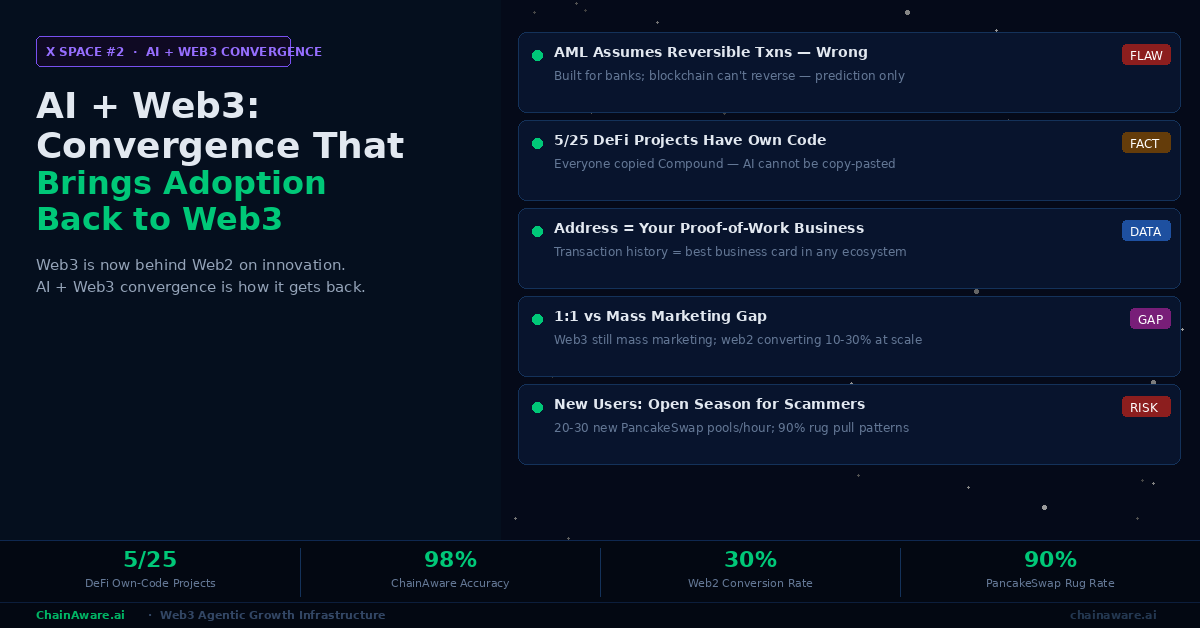
X Space #2 — AI + Web3 Convergence: How AI Brings Blockchain Adoption Back to the Innovation Curve. Watch the full recording on YouTube ↗ · Listen on X ↗
X Space #2 opens with a provocative reversal of the narrative that Web3 enthusiasts have repeated for years: Web3, supposedly the innovative future of the internet, has fallen behind Web2 on the innovation curve. Co-founders Martin and Tarmo examine why this happened — pointing to a culture of copy-pasting source code rather than building original technology — and lay out the specific AI applications that would push Web3 back ahead of where it belongs. The session covers three interconnected failures: the fraud detection paradigm built on an assumption (transaction reversibility) that does not hold in blockchain; the marketing paradigm built on mass messaging that does not match how actual conversion works; and the new-user protection gap that means every newcomer to crypto faces “open season” from professional rug pullers with no tools to defend themselves. AI applied to blockchain data — specifically predictive behavioral AI rather than generative LLMs — addresses all three simultaneously.
In This Article
- The Convergence Thesis: Why AI and Web3 Need Each Other
- Byzantine Generals and Social Psychology: The Double Trust Problem
- Proof of Work as Data Quality: Bitcoin’s Origin and the WhatsApp Lesson
- Your Address Is Your Business Card: The Best Credential in Any Ecosystem
- The Reversibility Assumption: Why AML Is the Wrong Tool for Blockchain
- Compliance Tools vs Prediction Tools: Two Fundamentally Different Jobs
- The Copy-Paste Innovation Problem: 5 Out of 25 DeFi Projects Have Original Code
- Why AI Cannot Be Copied Like Source Code
- Intention-Based Marketing: From Abstract Personas to Real One-to-One Targeting
- Google’s Data Monopoly and Why Web3 Has Something Better
- Web3 Is Still Pre-Web2 on Marketing: Mass Messaging to Everyone
- The New User Journey: Open Season for Scammers
- Clean Contracts and the Funding Chain: How to Detect What Static Analysis Misses
- Getting Back Ahead of the Curve: The Two-Part AI Strategy
- Comparison Tables
- FAQ
The Convergence Thesis: Why AI and Web3 Need Each Other
Martin opens X Space #2 with an observation that cuts against the standard Web3 narrative. Rather than celebrating blockchain’s disruption of legacy systems, he argues that Web3 has lost its innovation edge — and that recovering it requires specifically the convergence of AI with blockchain data that most DeFi projects have either ignored or implemented badly through generative AI wrappers with no genuine blockchain connection.
The convergence thesis runs as follows: blockchain produces uniquely high-quality behavioral data because every transaction requires proof-of-work (gas fees), which filters out casual and fake activity. AI can extract extraordinary predictive value from this data — predicting fraud, intentions, creditworthiness, and future behavior — in ways that neither blockchain alone nor AI alone can achieve. Applying AI to blockchain data would simultaneously solve the trust problem that prevents mass adoption and the marketing problem that prevents Web3 platforms from becoming cash-flow positive. Without this convergence, Martin argues, Web3 will continue losing ground to Web2, which is rapidly closing the automation and personalization gap through generative AI and adaptive interfaces. For the full competitive analysis, see our generative vs predictive AI guide.
Byzantine Generals and Social Psychology: The Double Trust Problem
Tarmo opens the technical discussion by returning to the Byzantine Generals Problem — the foundational computer science challenge that blockchain’s consensus mechanisms were designed to solve. However, X Space #2 frames the problem with a new layer: the social psychology dimension that amplifies blockchain’s trust challenge beyond what any algorithmic consensus mechanism can address.
The Byzantine consensus algorithms (proof of work, proof of stake, delegated proof of stake) ensure that the network reaches correct consensus on transaction validity even when some fraction of participants behave maliciously — the exact threshold depending on the specific algorithm. However, these algorithms say nothing about the behavioral intentions of the actors interacting with the system. Meanwhile, social psychology research consistently demonstrates that anonymous environments generate elevated rates of bad behaviour. Without accountability mechanisms that make bad behaviour traceable and consequential, the anonymity of blockchain creates systematic incentives for fraud. As Tarmo explains: “Blockchain is an anonymous system. Social psychology says if you have an anonymous system and you have full anonymity, actors start behaving badly. And this is what we see in blockchain. When you have anonymity, you need another mechanism to balance these bad behaviors.”
ChainAware as the Accountability Mechanism
ChainAware provides the missing accountability mechanism — not by removing anonymity, but by making behavioral patterns visible and analysable. The system does not identify who is behind an address. It identifies whether the behavior associated with that address indicates trustworthiness. Actors remain pseudonymous; their behavioral history becomes analysable. This shifts the risk calculation for potential bad actors: engaging in fraud creates a permanent, analysable behavioral signature that will follow their address and behaviorally related addresses indefinitely. For more on how this trust architecture works, see our trust restoration guide.
Proof of Work as Data Quality: Bitcoin’s Origin and the WhatsApp Lesson
Martin introduces the proof-of-work concept not in its familiar blockchain consensus role but as an explanation for why blockchain data is qualitatively superior to social media or search data for behavioral prediction. The original proof-of-work algorithm, he explains, did not emerge from cryptocurrency — it emerged from the email spam problem.
Early internet email was plagued by spam because sending an email cost nothing. The proof-of-work solution required every sender to perform a small computational task before sending — making mass spamming economically unviable without affecting legitimate single-recipient communication. Satoshi Nakamoto adapted this concept to solve the double-spending problem in digital currency. The result is that every blockchain transaction carries a real financial cost — making mass generation of fake behavioral data economically prohibitive. This cost-of-action property elevates blockchain data far above social media posts (which cost nothing to create) and even above phone call records.
Facebook Paid $70 Per WhatsApp User for Inferior Data
Tarmo makes the market valuation argument concrete with the WhatsApp acquisition. Facebook paid $19 billion for WhatsApp — approximately $70 per user — specifically to access phone call behavioral data that is more predictive than social media interaction data. Phone calls require knowing the other party, having an established relationship, and investing real time — a modest proof of work compared to zero-cost social media posts. Blockchain financial transactions require committing real capital and paying gas fees — a substantially higher proof of work than phone calls. Therefore, blockchain behavioral data is qualitatively superior to WhatsApp data, which was superior enough that Zuckerberg paid $19 billion for it. Yet blockchain data is entirely free and publicly accessible. As Tarmo states: “Saki paid $70 per user. Phone history. And what we have in blockchain is the same — proof of work blockchains — we have very high quality data. And to calculate fraud prediction at 98%, it just illustrates how high is the data quality.” For the complete data quality analysis, see our behavioral analytics guide.
Your Address Is Your Business Card: The Best Credential in Any Ecosystem
Martin and Tarmo develop a framing for blockchain addresses that reframes pseudo-anonymity from a liability into an asset. Critics of blockchain’s anonymity argue that the inability to verify identity behind addresses makes the system inherently untrustworthy. Martin’s counterargument is that a transaction history — built through proof-of-work commitments over months and years — is actually a better credential than any identity document.
A passport or ID document tells you someone’s name and country of origin. A blockchain address’s transaction history tells you their financial behavior over years — which protocols they have used, how they have managed risk, whether they have participated in suspicious activities, what their intentions appear to be, and what they are likely to do next. As Martin explains: “Your address is your business card. You have done some proof of work for your address — not over the last week, maybe over the last month, six months, five years. And this is your business card. Do you really want to destroy your business card?” The rhetorical force of this framing is significant: it transforms the incentive structure of the ecosystem. Building a good address history is costly and time-consuming. Destroying it through fraud means starting over and rebuilding credibility from scratch — a real deterrent that traditional reputation systems lack when identities can simply be discarded and recreated. For more on the wallet audit product, see our wallet audit guide.
Verify Any Address’s Business Card
ChainAware Fraud Detector — 98% Real-Time Accuracy
Every address carries a proof-of-work business card in its transaction history. ChainAware reads that business card in under 1 second and tells you whether to trust the address. 98% accuracy. Free for individual checks. The accountability mechanism that anonymous blockchain is missing.
The Reversibility Assumption: Why AML Is the Wrong Tool for Blockchain
X Space #2 presents Martin’s clearest articulation of the fundamental architectural flaw in how the blockchain industry has approached fraud detection. The argument centres on a single hidden assumption embedded in every AML-based fraud detection system — an assumption that is valid in traditional banking but categorically false in blockchain.
Banks obtain their licences on the condition that they can reverse transactions. When a bank identifies that a transaction was fraudulent — even days or weeks after it occurred — they can unwind the transfer and return the funds to the victim. This reversibility capability is what makes retrospective AML analysis genuinely protective: because the damage can be undone, identifying fraud after the fact is still useful. As Martin explains: “In a traditional finance, you can reverse the transactions. If a transaction is proven wrong, the bank has obligation as part of a banking licence. You will not have banking licence if you cannot reverse transactions. And therefore you do it. It doesn’t need to be real time. There’s no requirement to be real time.” The compliance department can take a day or two, flag the suspicious transaction, and have it reversed.
Blockchain Transactions Are Final — AML Provides Zero Protection
In blockchain, this reversibility assumption fails completely. Signed and broadcast blockchain transactions are final and irrevocable. No bank, no regulator, no exchange can undo them. Therefore, identifying fraud after a blockchain transaction has already occurred provides exactly zero protection for the user who just lost funds. The entire multi-hundred-million-dollar investment in Chainalysis, Coinfirm, TRM Labs, and similar AML platforms — built for the compliance use case in centralised finance — is architecturally misapplied when deployed as user protection in DeFi. The only tool that actually protects blockchain users is one that identifies fraud risk before the transaction executes. As Martin states: “All these huge investments — money went into chain analysis and coin firm and all the others. These are backwards-looking systems for the compliance people. Oh, there was some phishing, let’s mark this address as bad. Now we know it’s a bad address. But your funds are already transferred.” For how this connects to DeFi growth, see our Web3 security and growth guide.
Compliance Tools vs Prediction Tools: Two Fundamentally Different Jobs
The AML reversibility argument leads to a clean distinction between two types of fraud-related tools that serve entirely different purposes. Understanding this distinction explains why the blockchain industry funded the wrong category so heavily and why ChainAware’s approach is different in kind rather than degree.
Compliance tools — AML scoring, forensic fund tracing, rules-based address flagging — serve regulatory compliance departments. Their job is to document what happened after the fact, satisfy regulatory requirements, and (in traditional finance) support the transaction reversal process. They are not designed to protect users in real time. Prediction tools — ChainAware’s behavioral AI — serve users directly. Their job is to evaluate the risk profile of a potential transaction counterparty before any funds move, enabling the user to decide whether to proceed. Both tool types are valuable, but they serve completely different stakeholders. The DeFi ecosystem needed prediction tools but funded compliance tools — because the compliance tools came pre-built from traditional finance and the major investor class (centralised exchanges) had a genuine compliance need for them.
Why Centralised Finance Funded the Wrong Tools for Web3
Martin’s explanation for this misdirection is clear: centralised exchanges — Binance, Kraken, Coinbase — are the largest clients of blockchain analytics companies. These exchanges operate as custodial intermediaries, holding user assets and therefore having both the ability and the regulatory obligation to block or reverse transactions on behalf of regulators. AML compliance tools perfectly serve this customer segment. The $200-$300M+ funding rounds for Chainalysis and TRM Labs were justified by this centralised exchange customer base. The 50 million DeFi users who need pre-transaction prediction rather than post-transaction compliance analysis were not the customer — and the product built for the compliance department does not serve them. For more on the predictive AI approach, see our blockchain AI use cases guide.
The Copy-Paste Innovation Problem: 5 Out of 25 DeFi Projects Have Original Code
Martin presents a striking empirical observation about DeFi’s innovation culture that directly explains why blockchain has fallen behind Web2’s competitive position. Looking at the top 25 DeFi lending projects on Ethereum, only 5 have written their own original smart contract code. The remaining 20 have copied — or copied-and-slightly-modified — the source code of other projects.
The five original-code projects Martin identifies are Compound (the original; every other variable-rate money market protocol derives from it), SmartCredit (fixed-rate fixed-term lending — independently built), Notional Finance (fixed-rate DeFi), and two others. Aave, despite its reputation as a DeFi blue chip, copied Compound’s architecture and modified it. Uniswap, the dominant AMM, copied its core mechanism from Bancor — which Martin names explicitly. As Martin states: “Top 25 lending projects on Ethereum, only five of them have their own source code now. SmartCredit — one of them. Compound — another one. Notional — third. And there are two more. But everyone else copied source code.” The cultural implication is significant: DeFi rewarded copying more than creating, because a copied protocol with effective shilling could generate more TVL faster than an original protocol with better architecture but less marketing.
Innovation as Data Analysis, Not Source Code Copying
Martin’s definition of innovation is specific and operational: real innovation means writing algorithms, analysing data, running scripts, and building models. It does not mean forking an open-source repository, changing the UI colors, and launching a new token with aggressive shilling. The copy-paste culture was possible in DeFi because smart contract code is open source by default — anyone can read it, fork it, and deploy it. AI models, by contrast, cannot be copied. The model architecture can be published, but without the specific training data, the iterative training process, the backtesting methodology, and the production engineering decisions, another team cannot replicate the model’s performance by examining the code. This is why AI creates real competitive advantages in a way that open-source smart contracts cannot. For more on this distinction, see our generative vs predictive AI analysis.
Why AI Cannot Be Copied Like Source Code
The copy-paste culture argument leads directly to an explanation for why AI represents a qualitatively different form of competitive advantage in blockchain — one that the ecosystem’s culture cannot undermine through the usual forking mechanisms.
When a DeFi project forks Compound’s source code, they get the complete intellectual property immediately: every line of smart contract logic, every mathematical formula, every algorithm. Deploying it requires time and engineering work, but the core intellectual content is fully transferred. When a team attempts to replicate ChainAware’s fraud detection model by examining whatever public information is available about it, they get nothing of practical value. They do not have the training data — which took years to assemble and label. They do not have the specific algorithm configuration — which emerged from hundreds of iterative training cycles with many dead ends. They do not have the production engineering decisions — which required choosing between 99% accuracy with 23-second latency and 98% accuracy with sub-1-second latency in ways that required deep understanding of the use case. As Martin argues: “In AI, you cannot copy. It’s not open source source code that you go and copy. You spend a lot of time training this model. You make a lot of trade-off decisions. It takes time. And in DeFi and most of DeFi, it was copied.” For how ChainAware approaches model development, see our predictive AI guide.
Protect New Users Before They Get Burned
ChainAware Rug Pull Detector — 20-30 New Pools Per Hour on BNB
New users join BNB Chain for cheaper gas, enter a Telegram group, get shilled into a pool, and lose everything. 90% of pools follow a rug pull pattern. ChainAware traces the creator address funding chain — the signal that clean-contract rug pullers cannot hide. Free for individual pool checks.
Intention-Based Marketing: From Abstract Personas to Real One-to-One Targeting
The second major AI application Martin and Tarmo discuss is intention-based marketing — converting the behavioral intelligence embedded in blockchain transaction histories into targeted acquisition and conversion tools for Web3 platforms. This discussion breaks new ground compared to previous sessions by introducing the contrast between invented marketing personas and real one-to-one person-matched messaging.
Traditional marketing courses teach the creation of personas — fictional representative characters who embody the characteristics of a target customer segment. “Our persona is Alex, a 28-year-old software engineer in San Francisco who values financial independence and spends 3 hours per week following crypto news.” This persona is invented to guide marketing creative decisions. Every piece of content and advertising is then optimised for this fictional character, even though actual users are infinitely more varied. Web3 marketing currently operates at this level — and does not even reach it, since most Web3 projects do not segment at all but simply blast the same message to all reachable audiences.
From Invented Personas to Real Behavioral Profiles
ChainAware’s intention calculation enables a fundamentally different approach. When a wallet address connects to a Web3 platform, its complete blockchain transaction history is immediately available — and ChainAware’s models extract from that history a specific behavioral profile for that specific address. The platform does not need to guess whether this user is a borrower or a trader or an NFT collector. It knows, with high probability, what this specific user intends to do next. As Martin explains: “We have one to one Persona. It’s not anymore a Persona which is artificially created — it’s the real person. Not anymore the marketing persona, but the real person behind the address. And you know his intentions.” This is categorically superior to any persona-based approach because it responds to actual behavioral data from this specific user rather than statistical averages from a user category. For the marketing implementation framework, see our intention-based marketing guide.
Google’s Data Monopoly and Why Web3 Has Something Better
Martin dedicates significant time to explaining how Google’s AdWords system works — not to celebrate it, but to illuminate both Web2’s current advantage and Web3’s untapped superiority. Understanding Google’s system reveals why Web3’s data advantage is so dramatic and why Google’s monetisation model depends on keeping that advantage invisible to its customers.
Google collects two primary behavioral data inputs for intention calculation: search history and browsing history. The browsing history collection occurs through multiple mechanisms including reCAPTCHA completions (which transmit browsing history to Google as part of the “are you human?” verification) and the thousands of advertising tracking pixels embedded across the web. Based on these inputs, Google builds intention profiles for every user and uses them to serve behaviorally matched advertisements. However, Google does not share these profiles with advertisers — it sells advertising placements that exploit the profiles, while keeping the profiles themselves proprietary. As Martin explains: “Google has thousands of algorithms for each of us. They’re officially not committing it, but they have a lot of data. But they make publicly available a very small amount — highly clustered data. What you don’t have is one to one. And that’s the reality in Web2.” For the complete comparison of Web2 and Web3 data quality, see our Web3 targeting guide.
Web3’s Data Is Public, Free, and Higher Quality
The contrast with Web3’s data availability is stark. Blockchain transaction data — which carries higher predictive power than search or browsing history because gas fees create genuine proof-of-work behavioral signals — is entirely public and free to access. Web3 platforms do not need Google’s permission, data licensing fees, or API agreements to use it. Furthermore, unlike Google’s data, blockchain data is one-to-one by nature — it corresponds to a specific wallet address and its specific behavioral history, not to a demographic cluster. A Web3 platform that deploys ChainAware’s intention models has access to richer, more accurate, more specific behavioral data about each user than any Web2 platform can access — including Google. The irony is that most Web3 platforms are not using this data at all, while simultaneously complaining that their marketing does not work.
Web3 Is Still Pre-Web2 on Marketing: Mass Messaging to Everyone
Having established both the availability and the superiority of Web3’s behavioral data, Martin makes the damning comparison: Web3 marketing is not just behind Web2’s current state — it is behind Web1. Web3 marketing is mass marketing: the same message broadcast to the widest possible audience through paid media placements, crypto influencers, and Discord/Telegram community management, with no behavioural targeting at any stage.
The conversion consequence is arithmetically devastating. Web3 mass marketing converts approximately 0.1% of website visitors to transacting users — meaning 999 out of every 1,000 people who arrive at a Web3 platform’s website leave without transacting. Web2 platforms using one-to-one intention-based targeting achieve 10-30% conversion rates. This 100-300x gap makes Web3 businesses structurally unviable: at $5 cost per click and 0.1% conversion, acquiring one transacting user costs $5,000. At 30% conversion with matched messaging, the same $5 click budget acquires 150 potential transactors per $50 of ad spend. As Martin frames it: “Is this what web three marketing is? You pay tons of money to the influencers. You get these users to your website. And then you give them all the same message. Really?” Gartner Research projects that 70% of Web2 applications will have adaptive interfaces by end of 2025. Web3 is at approximately 0%. For the complete unit economics analysis, see our Web3 growth restoration guide.
The New User Journey: Open Season for Scammers
Martin describes the journey of a new cryptocurrency user in a way that makes the combined fraud and marketing failure concrete and emotionally immediate. The journey follows a predictable pattern that ends, for most new participants, in financial loss and permanent departure from the ecosystem.
A new user discovers crypto and wants to participate. They choose BNB Chain because transaction costs are significantly lower than Ethereum — a rational economic decision that most first-time users make. They join Telegram and Discord communities to learn and find opportunities. They encounter professional shiller operations — highly coordinated groups that promote new tokens with manufactured enthusiasm across multiple channels simultaneously. Lacking the experience to recognise the manipulation, the new user buys into a pool that was specifically designed to rug pull. The pool lasts approximately one hour. The user loses their entire investment. Repeat this experience three to five times across different projects and the conclusion is universal: “Oh, no, I don’t do it anymore. It’s enough.” As Martin describes: “This is what happens in crypto. We have technology in place which would protect newcomers from rug pulls. We have technology in place which would protect newcomers from all fraudsters. And we have technology in place which could help newcomers start using Web3 with real transacting behavior. It’s all in place.” The tragedy is not that the tools don’t exist — it is that they are not deployed at the platforms where new users encounter these risks. For how to protect your platform’s users, see our rug pull detection guide.
Clean Contracts and the Funding Chain: How to Detect What Static Analysis Misses
Martin addresses a specific technical counterargument to rug pull detection: the claim that smart contract audit tools can already identify rug pulls by scanning contract code for suspicious patterns. The counterargument reveals why static code analysis fails against sophisticated rug pullers — and how ChainAware’s behavioral approach succeeds where code analysis cannot.
A typical PancakeSwap rug pull scenario involves 20-30 new pools created per hour. Approximately 90% follow a rug pull pattern. Experienced rug pullers specifically write clean contracts — contracts that pass all static analysis checks — because they know the tools that new users and even some experienced traders use to evaluate pools. The malicious intent is not encoded in the contract; it is encoded in the behavioral history of the addresses involved. As Martin explains: “If you are a rug puller, you will do a clean contract. You are not creating a contract with bad constructs. There are ways to scam during the contract lifetime. You just do a rug pull.” The behavioral detection method traces the funding chain behind the pool creator. If the creator address has only one or two transactions, Martin follows the incoming transaction to whoever funded the creator — and evaluates that address. Multiple hops through intermediary addresses before reaching a wallet with meaningful funds is itself a red flag: “If there are multiple steps from the guy who has real funds till the pool — multiple steps, it’s already a first indication the pool is not trustable.” This is behavioral pattern matching that no amount of contract code inspection can replicate. For the complete rug pull methodology, see our rug pull detection guide.
Getting Back Ahead of the Curve: The Two-Part AI Strategy
Getting Back Ahead of the Curve: The Two-Part AI Strategy
Martin and Tarmo close X Space #2 by synthesising the fraud and marketing discussions into a unified two-part AI strategy that would restore Web3 to the innovation lead it has lost relative to Web2. Both parts are necessary, and neither alone is sufficient.
Part one is deploying real-time predictive fraud detection across the Web3 ecosystem — specifically at the wallet and application level where users interact with potentially fraudulent counterparties. This addresses the trust problem that drives new users away after their first rug pull or fraud experience. Every new user who enters the ecosystem without being victimised becomes a potential long-term participant. Every user who gets burned in their first week typically leaves forever. Part two is deploying intention-based one-to-one targeting at Web3 platforms — using blockchain behavioral data to serve each connecting wallet personalised content matched to their specific behavioral profile rather than the same generic interface served to everyone. This addresses the conversion problem that makes Web3 business models structurally unviable at current acquisition costs.
Innovation as the Path Back
Both parts require genuine AI development — proprietary models trained on blockchain behavioral data, not GPT wrappers or copied smart contracts. This is precisely the type of real innovation that DeFi’s copy-paste culture has avoided. As Tarmo closes: “By bringing in AI elements and opening these algorithms to all communities, we can transform blockchain back to the root, what was intended. Back to the roots. Back to the innovation. Back to the leading curve.” Martin adds: “Web3 should become again an innovative and leading power ahead of the curve. And with AI, AI will enable it.” For the complete roadmap, see our AI agents and Web3 acceleration guide.
Comparison Tables
Web3 vs Web2 on the Innovation Curve: Current State Comparison
| Dimension | Web3 Today | Web2 Today | Web3 with AI + Convergence |
|---|---|---|---|
| Fraud detection approach | AML forensics — retrospective, assumes reversible txns | Compliance-focused AML (also retroactive) + some real-time | Real-time behavioral prediction before transaction |
| Marketing approach | Mass marketing — same message to all, 0.1% conversion | Intention-based targeting — 10-30% conversion | One-to-one wallet behavioral targeting — target 20-30%+ |
| User interface | Static — same UI for every visitor regardless of profile | Adaptive — 70% of Fortune 2000 apps by end 2025 (Gartner) | Adaptive based on wallet behavioral profile |
| Data quality for prediction | Not used — blockchain data ignored | Search history + browsing (low quality, no proof of work) | Transaction data (high quality, proof of work) |
| Innovation culture | Copy-paste source code + shilling (20/25 DeFi protocols) | Algorithmic, data-driven product development | Proprietary AI models — cannot be copy-pasted |
| New user protection | None — open season for rug pullers and scammers | Platform-level fraud detection for own accounts | Pre-transaction behavioral fraud screening |
| On innovation curve | Behind Web2 (mass marketing era) | Ahead of Web3 (adaptive apps, intention targeting) | Ahead of Web2 (better data, blockchain-native) |
Behavioral Data Quality: Proof-of-Work Hierarchy
| Data Type | Proof-of-Work Cost | Prediction Quality | Market Value Per User | Availability in Web3 |
|---|---|---|---|---|
| Social media posts | Zero | Very low — easily faked | Near zero | Not available |
| Search history | Zero — triggered by external stimuli | Low — noisy, externally triggered | Near zero (Google keeps it) | Not available |
| Phone call records | Low — requires real relationship | Medium | ~$70/user (Zuckerberg paid $19B) | Not available |
| Bank transaction history | High — financial commitment | Very high — 12-year prediction horizon (Tarmo/Finnova) | ~$600/user (financial data licensing) | Not available — proprietary |
| Blockchain transactions | High — gas fees per transaction | Very high — equivalent to bank data | ~$600/user equivalent | ✅ Free, public, unlimited — the goldmine |
Frequently Asked Questions
Why is Web3 now behind Web2 on the innovation curve?
DeFi’s development culture has been dominated by forking — copying existing smart contract code, modifying superficial parameters, launching a token, and executing aggressive marketing campaigns. Only 5 of the top 25 Ethereum lending protocols have original source code; the other 20 copied Compound or derivatives. This culture produced rapid growth in TVL and token prices during bull markets but created no durable technological advantage. Meanwhile, Web2 companies have invested heavily in algorithmic, data-driven product development — particularly around conversion optimisation, intention-based marketing, and adaptive interfaces. Web3 is now behind Web2 on all three dimensions, despite having access to superior behavioral data for free.
Why do clean smart contracts still rug pull?
Sophisticated rug pullers specifically create clean contracts that pass all static analysis checks, because they understand that potential victims evaluate pools using these tools. The malicious intent is not encoded in the contract — it is encoded in the behavioral history of the addresses involved in creating and funding the pool. ChainAware’s approach traces the funding chain behind the pool creator: who funded the creator address, and who funded that address, until reaching a wallet with meaningful transaction history. Multiple hops through intermediary addresses is itself a red flag. If any address in the funding chain has a high fraud probability, the pool is suspect regardless of how clean the contract code appears.
How is blockchain behavioral data better than Google’s data?
Google’s primary data inputs for intention calculation are search history and browsing history — both collected at zero cost per interaction, making them easily generated, easily faked, and easily influenced by external triggers. A single recommendation from a friend can send a user’s search history in an entirely different direction without reflecting any genuine behavioral intention. Blockchain financial transactions require committing real capital and paying gas fees — a proof-of-work investment that filters out casual and performative activity. The resulting data reflects genuine committed decisions. Additionally, blockchain data is entirely public and free to access, while Google’s data is proprietary and inaccessible to third parties except through expensive and restricted advertising APIs.
Why does one-to-one marketing convert at 30% while Web3 mass marketing converts at 0.1%?
Mass marketing sends the same message to every potential user regardless of their intentions, experience, or behavioral profile. A borrower sees trading content. A conservative yield farmer sees leveraged strategy recommendations. A DeFi newcomer sees expert-level protocol documentation. None of these messages resonate with the user who receives them, so the vast majority leave without transacting. One-to-one marketing calculates each user’s behavioral intentions from their transaction history and serves matched content — a borrower sees borrowing opportunities, a trader sees trading tools, a newcomer sees accessible onboarding. The message-intent match dramatically increases the probability that the user finds what they came for and transacts.
What is the two-part AI strategy for Web3 adoption?
Part one is deploying real-time predictive fraud and rug pull detection at the platform and wallet level — protecting new users from the rug pull experience that drives permanent departure from the ecosystem. Part two is deploying intention-based one-to-one targeting and adaptive interfaces — using blockchain behavioral data to serve each connecting wallet personalised content that matches their specific behavioral profile. Both parts require proprietary AI models trained on blockchain data (not AML forensics and not GPT wrappers). Together, they address the two barriers that explain why Web3 has fallen behind Web2: the trust problem that prevents mass adoption and the marketing problem that prevents Web3 platforms from achieving viable unit economics.
The Two-Part AI Strategy — One Platform
ChainAware Prediction MCP — Trust + Growth for Web3
Real-time fraud detection + rug pull prediction (Part 1: trust) + intention calculation + one-to-one targeting + adaptive messaging (Part 2: growth). Both parts of the AI strategy that returns Web3 to the innovation lead. Proprietary models — cannot be copy-pasted. 14M+ wallets. 8 blockchains. 31 MIT-licensed agents.
This article is based on X Space #2 hosted by ChainAware.ai co-founders Martin and Tarmo. Watch the full recording on YouTube ↗ · Listen on X ↗. For questions or integration support, visit chainaware.ai.