ChainAware Investigation: Wallet Forensics and AML Reports for Compliance Teams and AI Agents

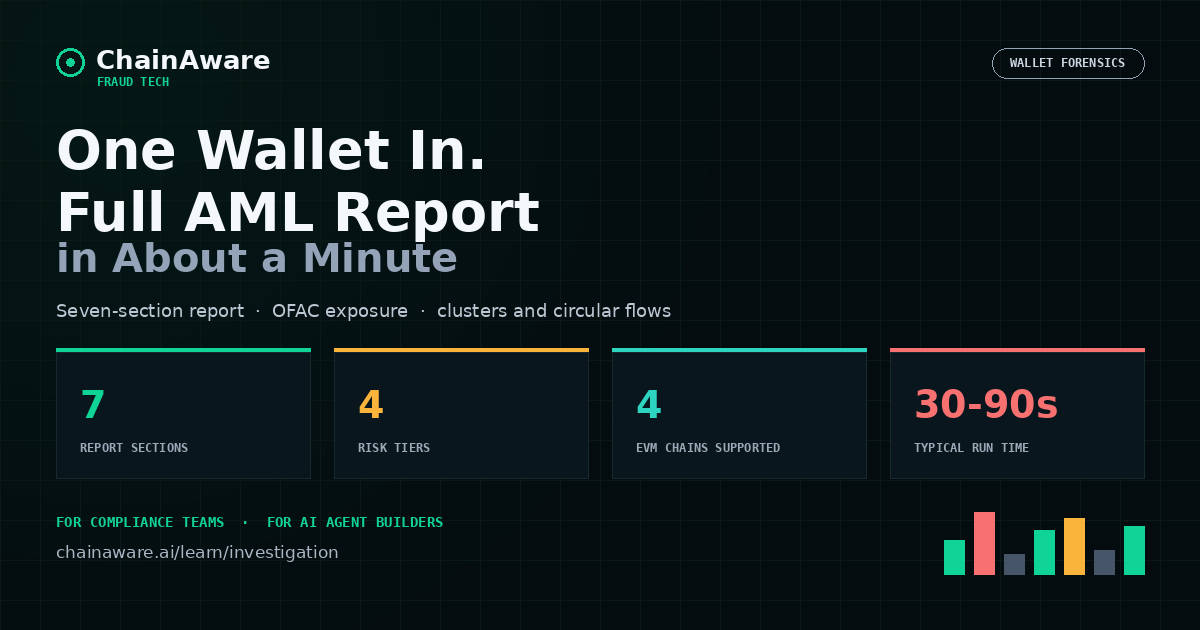
ChainAware Investigation turns a single EVM wallet address into a structured seven-section forensic report in 30 to 90 seconds. The report covers Identity and Roles, Activity Summary, Top Counterparties, Risk Assessment, Circular Flows and Clusters, AML Exposure, and a Conclusion with a combined LOW, MEDIUM, HIGH or CRITICAL risk tier. It combines ChainAware’s behavioral fraud intelligence with OFAC sanctions screening, third-party forensic signals and identity lookups across ENS, Unstoppable Domains, SPACE ID and ChainAware known-entity labels. Investigation supports externally owned accounts on Ethereum, BNB Smart Chain, Base and Polygon, and it is a point-in-time snapshot that teams rerun for monitoring. Compliance and AML teams use it for KYT due diligence, incident response, SAR preparation and pre-transaction OTC screening, while AI agent builders use the fixed structure and risk tier as a machine-readable counterparty check inside agentic pipelines. This guide explains each report section, the four risk tiers, a worked example, common wallet patterns, workflow design, responsible-use rules and the tool’s limits. ChainAware does not file SARs, and recommendations remain informational. Related tools include Agent Trust Score, the Fraud Detection API, Token Audit and the Prediction MCP. Learn more at chainaware.ai/learn/investigation/index.html.
Why Web2 Growth Playbooks Fail in DeFi

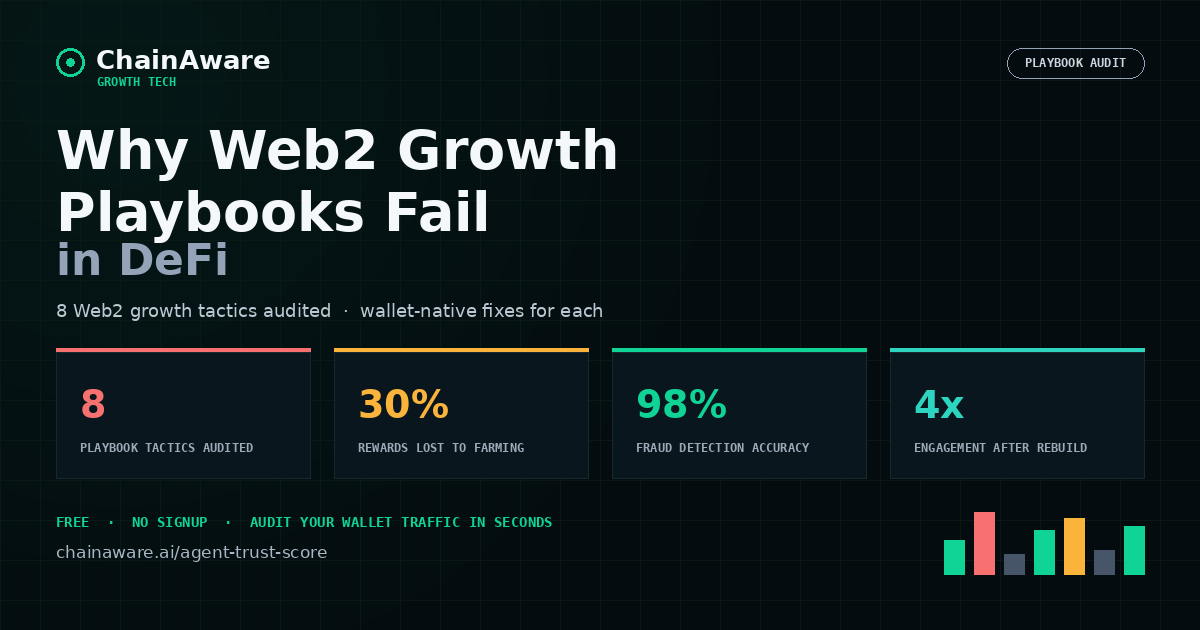
Every major Web2 growth tactic – AARRR funnel tracking, CRM and lifecycle email, paid retargeting, loyalty and gamification, referral attribution, community-led growth, cohort segmentation, and multi-touch attribution – depends on persistent user identity. DeFi’s anonymous wallet model breaks that assumption, which is why standard growth stacks underperform in Web3. This guide breaks down each of the eight tactics individually, shows exactly where the identity dependency lives inside it, and maps it to its wallet-native replacement. Airdrop farming and Sybil attacks drain a large share of incentive budgets, loyalty programs reward the wrong wallets, and referral links lose attribution at the wallet connection. ChainAware’s behavioral intelligence platform – 23M+ wallet-level profiles across 8 blockchains (ETH, BSC, Base, Polygon, TON, Tron, Solana, HAQQ), Growth Agents, the Web3 Persona and On-Chain Marketing Analytics – restores the missing layer by combining session data with wallet-level behavior. Profiling runs in under 100ms through the Prediction MCP, and wallet personalization lifts connect-to-transact to 40-60% versus an industry baseline under 10%, as seen in the SmartCredit.io case study. Learn more at chainaware.ai/learn/growth-tech/growth-agents.html.

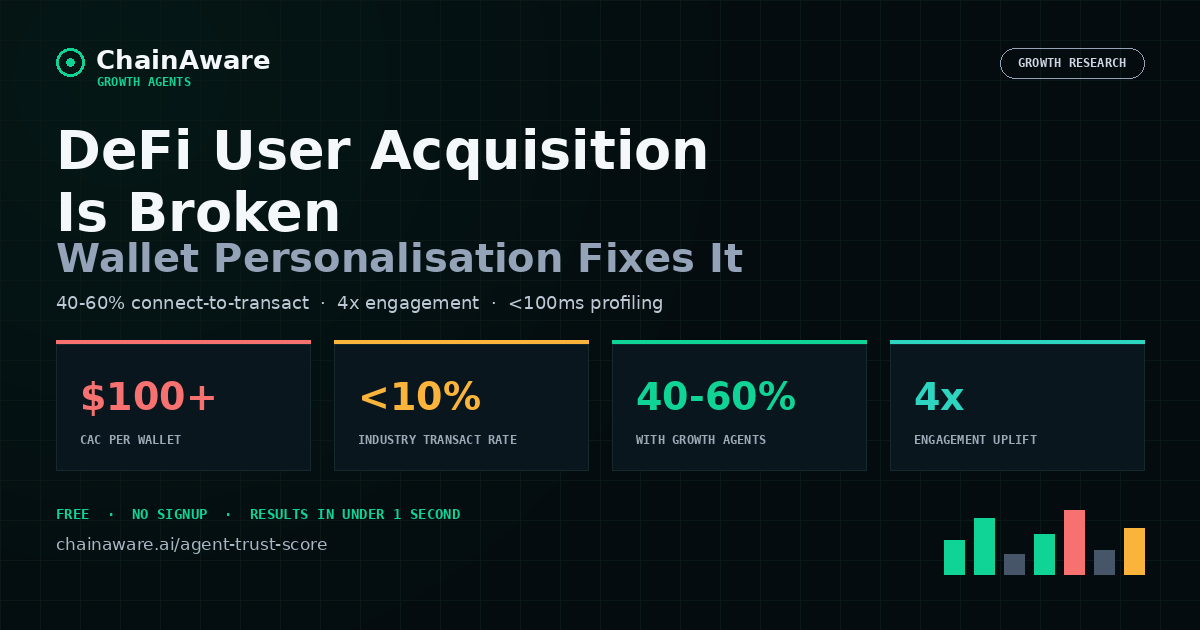
Why DeFi User Acquisition Is Broken – And How Wallet Personalisation Fixes It

DeFi teams spend more than $100 to acquire every connecting wallet, yet fewer than 10% of connected wallets ever transact, pushing real CAC above $1,000 per engaged user. This article explains why Web2 identity tools – cookies, email capture, CRM, A/B testing – cannot read wallet addresses, and how wallet-level behavioral intelligence fixes it. ChainAware’s Growth Agents combine session data with wallet data, profiling every connecting wallet in under 100ms through the Prediction MCP, using the ChainAware Web3 Persona: experience level, risk profile, intent and predicted next action. Tool-specific copy, calls to action and onboarding paths then adapt to each visitor, which lifts connect-to-transact rates to 40-60% against an industry baseline under 10%. The guide covers the cost of the connect-to-transact gap, the persona signals that drive personalization, fraud and Sybil screening in the same call, and a SmartCredit.io case study with a 4x engagement uplift. ChainAware profiles 23M+ wallets across 8 chains (Ethereum, BNB Chain, Base, Polygon, TON, Tron, Solana and HAQQ) and runs Growth Agents as part of its 34 Claude sub-agents across Fraud Tech and Growth Tech. Integration takes about 30 minutes. Learn more at chainaware.ai/learn/growth-tech/growth-agents.html.

Token Audit at Scale: 15,000 EVM Tokens Across CoinGecko + CoinMarketCap (2026)

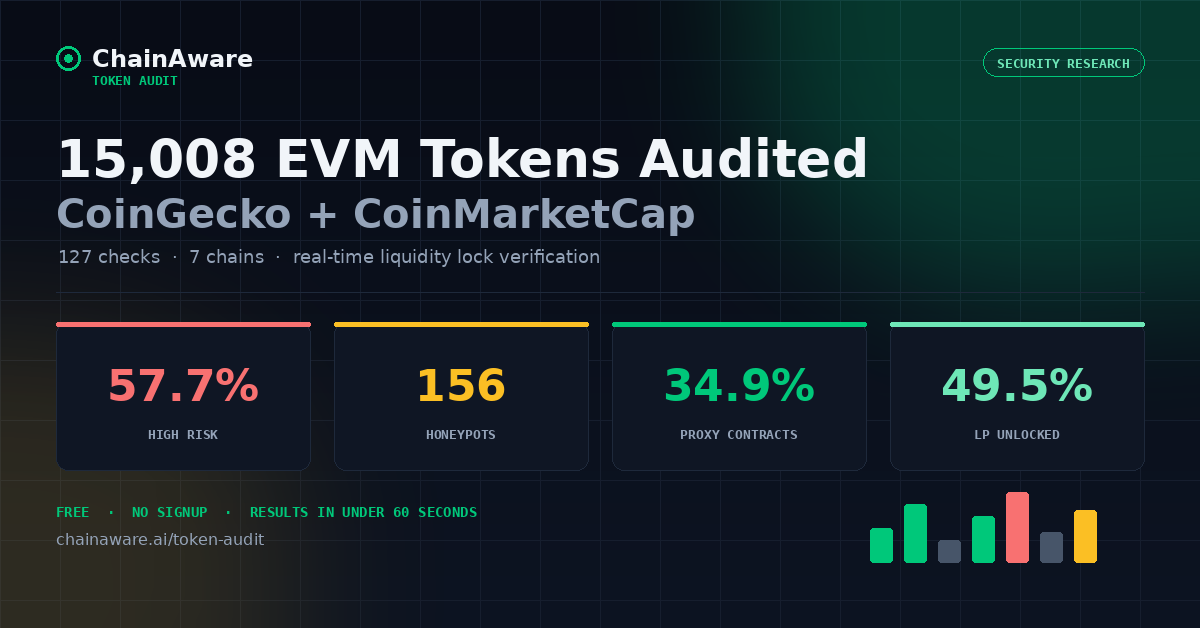
ChainAware expanded its Token Audit study from 10,000 CoinGecko tokens to 15,008 tokens combining CoinGecko and CoinMarketCap’s full EVM listings across 7 chains (Ethereum, BSC, Base, Polygon, Arbitrum, Optimism, Avalanche). Results: 57.7% high risk, 24.9% suspicious, 16.3% clean, and 156 confirmed honeypots via simulation analysis. 35.3% of tokens have no enforceable mint cap and 35.8% have no timelock on privileged functions – the two findings driving 77.4% of all risk verdicts, consistent with the original study. The biggest change is liquidity lock detection: now covering V2 and V3 pools across six chains and five DEX families (Uniswap, PancakeSwap, QuickSwap, SushiSwap, Trader Joe), with a new real-time recalculation feature that lets anyone verify current lock status on demand in under 5 minutes. Proxy contract detection also expanded to near-complete coverage, revealing 34.9% of tokens use upgradeable proxy patterns – including 118 controlled by a single private key with no multisig or timelock protection. Free Token Audit tool: 127 checks, deep code analysis, results in under 60 seconds, no signup required.

How Should Investors Evaluate AI Trading Agents? A New Study Has Answers

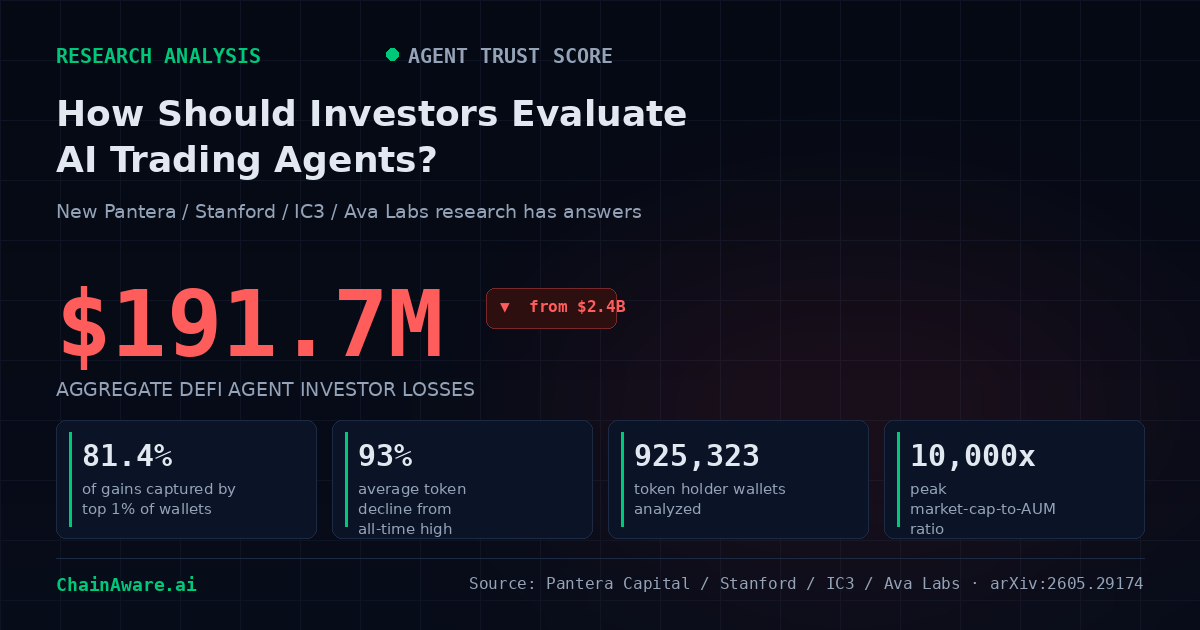
A May 2026 study from researchers affiliated with Pantera Capital, Stanford, IC3, and Ava Labs analyzed 1,900+ AI-tagged crypto projects to answer a practical question: how can investors tell a genuinely autonomous AI trading agent from a speculative wrapper? The research found even agents with fully public wallets couldn’t be verified as autonomous, and documents $191.7M in aggregate token holder losses across 925,323 wallets, with the top 1% of wallets capturing 81.4% of all gains ($1.81B). The paper’s proposed evaluation framework maps directly onto ChainAware’s Agent Trust Score, which screens both an AI agent’s wallet and its feeder wallet, giving investors a concrete way to check before they commit capital.

ChainAware Launches Agent Trust Score – On-Chain Trust Scoring for the Agentic Commerce Era

ChainAware launches Agent Trust Score – the first on-chain trust scoring system for ERC-8004 registered AI agents. Analysis of 274,792 indexed agents reveals 51.8% carry Elevated Risk or Untrusted scores, 21.1% are farm-detected Sybil operations, and 741 agents were funded by confirmed rug pull operators. Score owner wallet fraud probability, feeder address, and rug pull criminal record before granting autonomous execution access. Named in CB Insights AI Fraud Prevention Market Map. Free, no signup required.

ChainAware Token Audit Launched – We Tested 10,000 CoinGecko Tokens. Here Are the Results.

ChainAware Token Audit is live – 127 automated security checks across 9 modules, tested against the top 10,000 CoinGecko tokens by market cap. The results: 55.2% high risk, 131 confirmed honeypots, 13.2% upgradeable proxy contracts – including 139 controlled by a single private key. ChainAware catches threats invisible to GoPlus, CertiK Skynet, and TokenSniffer: transitive approve() analysis, phantom balanceOf, EIP-2612 permit correctness, reentrancy detection, and asymmetric pause – powered by behavioral intelligence across 20M+ wallet personas on 8 blockchains. Free at chainaware.ai/token-audit.

The Agent Trust Infrastructure Race: Who Is Building the Trust Layer for Agentic Commerce?

Six platforms are competing to become the trust layer for agentic commerce in 2026 – ERC-8004 native, RNWY, SkyeProfile, AXIS T-Score, DJD, and ChainAware. Each answers a fundamentally different question. This guide maps every methodology, every blind spot, and the five signals only one platform provides, with a decision matrix for DeFi builders, agent creators, and investors.

The First Step in Agentic Commerce Isn’t Integration. It’s Trust.

The ERC-8004 registry tells you an agent exists. It does not tell you whether to trust it. This guide explains why Know Your Agent (KYA) is the missing trust layer for DeFi protocol builders in 2026 – and how scoring the owner wallet, feeder address, and rug pull history closes the gap before funds move.

ChainAware.ai’s 32 Claude Sub-Agents – Fraud Tech and Growth Tech for the Agentic Economy

ChainAware.ai operates on 32 Claude sub-agents – each one a specialist wrapping ChainAware’s Prediction MCP with precise decision logic and behavioral reasoning. This article classifies all 32 agents into Fraud Tech (17 agents) and Growth Tech (15 agents), with use case and trigger conditions for every agent.