
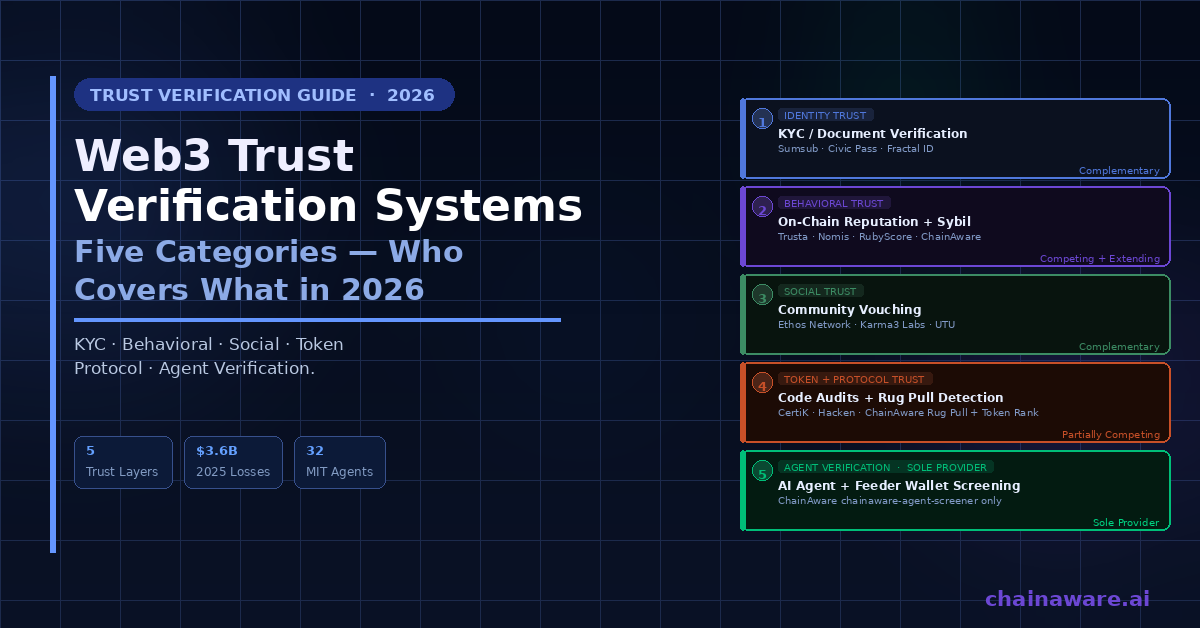
Web3 lost over $3.6 billion to fraud and exploits in the first three quarters of 2025 alone. Remarkably, 57.8% of those losses came not from smart contract bugs but from access-control failures – the humans and systems operating around the code, not the code itself. This pattern reveals the central challenge of Web3 trust in 2026: the attack surface is not one problem. It is five distinct problems, each requiring a fundamentally different solution.
Most teams pick one trust tool and assume they have coverage. They verify identity with KYC and assume that covers fraud risk. They run a smart contract audit and assume that covers rug pull risk. They check a Sybil score and assume that covers behavioral quality. Each assumption is wrong – because each of these tools addresses a different layer of the trust stack. This guide maps the complete five-category Web3 trust verification landscape, explains what each provider actually covers, and shows precisely where ChainAware addresses the attack surfaces that every other category leaves unprotected.
In This Guide
- The Five Trust Problems in Web3
- Category 1: Identity Trust – KYC and Document Verification
- Category 2: Behavioral Trust – On-Chain Reputation and Sybil Resistance
- Category 3: Social Trust – Community Vouching and Staked Endorsements
- Category 4: Token and Protocol Trust – Code Audits, Short and Long Rug Pulls
- Category 5: Agent Verification – Why Voting Fails and Creator Chain Works
- ChainAware’s Unique Position Across All Five Categories
- The Recommended Trust Stack for 2026
- FAQ
The Five Trust Problems in Web3
Trust in Web3 is not a single dimension – it is a layered stack of five distinct questions that no single provider answers completely. Conflating them leads teams to select the wrong tools, build false confidence in partial coverage, and leave entire attack surfaces unprotected.
- Identity Trust: Is this a real, unique human with verifiable identity?
- Behavioral Trust: Is this wallet genuinely active, non-Sybil, and behaviorally high-quality?
- Social Trust: Does the community vouch for this person’s credibility and track record?
- Token and Protocol Trust: Is this smart contract safe? Is this token’s community genuine, or a manufactured rug pull setup?
- Agent Verification: Is this AI agent wallet – and the wallet funding it – trustworthy before I allow autonomous interaction with my protocol?
Each question requires different data, different methodology, and different tools. Furthermore, passing one trust check says nothing about performance on the others. A wallet can pass KYC, hold a clean Sybil score, have positive Ethos vouches, and still carry a 0.87 fraud probability in ChainAware’s behavioral model – because each layer catches threats that the others are structurally blind to. For how behavioral intelligence layers into the broader Web3 intelligence stack, see our Web3 Wallet Auditing Providers guide.
Category 1: Identity Trust – KYC and Document Verification
Identity trust answers the most foundational question: is this a real, unique person with verifiable government-issued identity? KYC providers verify document authenticity, biometric liveness, sanctions and PEP exposure, and ongoing AML obligations. Their 2026 market data reveals the scale of the problem – Sumsub analyzed over 23,000 fraud attempts daily and found that 55% of crypto firms confirmed experiencing fraud at least once in 2025, while 15% were unsure whether it happened at all.
Sumsub – The Market Leader
Sumsub works with 8 out of 10 top global crypto exchanges and covers the complete verification lifecycle: document verification (14,000+ document types across 220+ countries), biometric face matching, liveness detection, AML/PEP screening, Travel Rule compliance, KYB for businesses, and ongoing transaction monitoring. Their April 2026 State of the Crypto Industry report found that 74% of crypto firms now prioritize verification accuracy over onboarding speed – a structural shift from the growth-at-all-costs approach that dominated 2021-2023. According to Sumsub’s 2026 research ↗, crypto companies are entering a phase where operational discipline matters more than momentum.
Civic Pass – Blockchain-Native KYC
Civic provides blockchain-native KYC through Civic Pass – an on-chain credential issued after off-chain identity verification. Available in 190+ countries, Civic covers liveness checks, document KYC, watchlist and PEP screening, VPN detection, and email and phone verification. The key differentiator is portability: users verify once and reuse their Civic Pass across any integrated DApp without re-submitting documents. This verify-once model significantly reduces onboarding friction while maintaining compliance. Fractal ID offers a similar Web3-native multi-chain identity stack positioned as a lighter-weight alternative for DeFi-native teams.
The Structural Limitation of KYC
Every KYC provider shares one fundamental constraint: they require active user participation. Document uploads, face scans, and liveness checks create friction that reduces conversion and makes KYC unsuitable for fully permissionless DeFi protocols. More critically, KYC verification is a point-in-time snapshot – it confirms who a wallet belonged to at verification date but says nothing about that wallet’s subsequent behavioral risk. A wallet can pass KYC completely and still develop a 0.91 fraud probability the following month based on new behavioral patterns. This gap is precisely where ChainAware’s behavioral layer operates. For how KYC connects to the broader compliance picture, see our Predictive AI for KYC and AML guide and our MiCA Compliance guide.
Free – No Signup Required
Audit Any Wallet in 1 Second – Fraud Score, AML Status, Behavioral Profile
Paste any address and get fraud probability (98% accuracy), AML/OFAC status, experience level, 12 intention probabilities, and Wallet Rank. Free, sub-second, no account needed. ETH, BNB, BASE, POLYGON, TON, TRON, HAQQ, SOL.
Category 2: Behavioral Trust – On-Chain Reputation and Sybil Resistance
Behavioral trust operates entirely on public on-chain data – no user action required, fully permissionless, privacy-preserving. Providers in this category analyze wallet transaction history to answer whether a wallet is a genuine, active participant or a bot, farmer, or coordinated Sybil attacker. Two distinct methodologies dominate this space.
Trusta Labs / TrustScan – AI/ML Graph Pattern Detection
Trusta Labs applies Graph Neural Networks (GCNs, GATs) and Recurrent Neural Networks (GRUs, LSTMs) to detect four specific Sybil attack signatures in wallet transaction graphs: star-like transfer patterns (hub-and-spoke funding), chain-like transfer patterns (sequential wallet funding), bulk operations (coordinated timing), and similar behavior sequences (identical transaction fingerprints across wallets). Founded by ex-Alipay AI leaders, Trusta has analyzed 570 million wallets and integrated into Gitcoin Passport (1.54 points per verified address) and Galxe. For the complete Sybil protection landscape comparison, see our Web3 Sybil Protection Systems guide.
Nomis, RubyScore, and ReputeX – Activity-Based Reputation
Nomis scores historical activity volume, protocol diversity, wallet age, and cross-chain engagement across 50+ chains – issuing output as a portable on-chain NFT attestation. RubyScore provides a simpler activity quality filter with faster integration, suitable for projects needing lightweight Sybil gating without deep analysis. ReputeX takes a fusion approach combining multiple behavioral paradigms, though production deployment evidence remains limited.
All behavioral trust providers share a critical structural limitation: they are reactive and binary. They describe past behavior and produce pass/fail gates. None predicts future behavior, none scores behavioral quality beyond activity volume, and none provides the downstream deployment layer that converts screened wallets into transacting users. ChainAware closes all three gaps simultaneously. For keeping airdrop and IDO distributions clean from Sybil wallets, see the Sybil-Resistant Token Distribution use case. For the full reputation score comparison including Nomis, Ethos, Cred Protocol, and UTU, see our Web3 Reputation Score Comparison.
Category 3: Social Trust – Community Vouching and Staked Endorsements
Social trust builds reputation through community mechanisms rather than on-chain transaction analysis. Where behavioral trust asks “what has this wallet done?”, social trust asks “what does the community say about this person?” These are orthogonal signals – a wallet can have strong behavioral scores and poor social reputation, or vice versa. Combining both provides significantly more robust trust assessment than either alone.
Ethos Network – Staked Social Proof-of-Trust
Ethos Network launched mainnet on Base in January 2025 and represents the most sophisticated social trust system in Web3. The core mechanism requires users to stake ETH when vouching for others – making trust claims financially consequential rather than costless clicks. Participants can also slash (penalize) others for proven bad behavior, reducing the voucher’s staked amount. Credibility scores derive from the platform’s most engaged and reputable members, creating a peer-weighted system rather than simple vote counting. Ethos.Markets launched alongside the main platform, allowing users to financially speculate on trust scores through an AMM using the LMSR algorithm. Additionally, a Chrome extension shows Ethos credibility scores directly on Twitter/X profiles – bringing social trust verification into ambient browsing. The project raised $1.75M pre-seed from 60 Web3 community angel investors.
The primary limitation of Ethos is coverage: it only scores wallets with established Ethos profiles. Anonymous wallets with no Ethos history return no signal – which describes the vast majority of wallets that connect to any DeFi protocol. Furthermore, Ethos measures social community trust among known participants, not the behavioral quality or fraud risk of a wallet. A highly vouched wallet can still carry significant fraud probability based on its transaction patterns.
Karma3 Labs / OpenRank – Algorithmic Trust Propagation
Karma3 Labs builds ranking and reputation infrastructure using the EigenTrust algorithm – originally designed to improve trust propagation in distributed systems and later applied to Google’s PageRank concept. Their $4.5M seed round came from Galaxy and IDEO CoLab. OpenRank enables developers to build personalized search, discovery, and recommendation systems on top of on-chain social graph data, with notable deployment for Farcaster social graph trust scoring. Where Ethos is community-driven (humans staking on humans), Karma3 is algorithm-driven (EigenTrust computing trust propagation through the social graph). According to Karma3 Labs’ documentation ↗, the OpenRank protocol enables context-aware trust that adapts to different application requirements.
UTU Protocol – Relationship-Context Trust
UTU Protocol builds trust through a non-transferable reputation token (UTT) and staked endorsements, with emphasis on relationship context – a user’s trusted network’s opinions carry more weight than a stranger’s. The UTT cannot be traded, only earned through genuine trust endorsements that later prove correct. Africa DeFi focus and Internet Computer deployment distinguish UTU from the other social trust providers. All three social trust systems – Ethos, Karma3, and UTU – address a genuine trust dimension that on-chain behavioral analysis cannot capture: long-standing human relationships and community standing that extend beyond wallet transaction history.
Category 4: Token and Protocol Trust – Code Audits, Short and Long Rug Pulls
This category covers two entirely different trust problems that are commonly conflated. Smart contract code audits (CertiK, Hacken) verify whether the code is technically safe. Behavioral token trust tools (ChainAware) verify whether the operator behind the code and the community around the token are genuine. CertiK’s H1 2025 Hack3d report recorded $2.47 billion lost across 344 incidents – with wallet compromise the largest category and phishing the most frequent. This confirms that the most expensive 2026 threats live around the code, not inside it. Yet most teams invest entirely in code audits while ignoring behavioral token trust.
CertiK and Hacken – Smart Contract Code Audits
CertiK is the dominant smart contract audit and security monitoring platform with 5,000+ enterprise clients, $600B+ in assets secured, and 180,000+ vulnerabilities identified. Its Skynet platform delivers real-time on-chain incident monitoring and alerting. The Spoq formal verification engine uses AI-driven automation to mathematically prove system correctness – validated at peer-reviewed venues OSDI 2023 and ASPLOS 2026. According to CertiK’s platform documentation ↗, Skynet Enterprise meets the transparency and risk visibility requirements of institutional participants and regulators. Hacken provides security audits and a TRUST Score framework evaluating protocols across transparency, security, code quality, and community metrics – their 2025 TRUST Report tracked $3.6B stolen, with 57.8% from access-control exploits.
Both CertiK and Hacken audit code at a specific point in time. Neither analyzes the behavioral history of the wallet that deployed the contract, the fraud profile of the wallets that provided liquidity, or the quality of the token’s holder community. These are not limitations of the audit providers – they are simply a different layer of the trust stack. The critical mistake is treating a clean CertiK audit as comprehensive protection when 95% of PancakeSwap pools end in rug pulls and 99% of Pump.fun tokens extract money from buyers – most of them with no code vulnerabilities whatsoever. For the complete rug pull detection landscape, see our Rug Pull Detection guide.
ChainAware Rug Pull Detector – Short Rug Pull Detection via Creator Chain Traversal
ChainAware’s Rug Pull Detector (see the complete Rug Pull Detector guide) addresses the behavioral layer that code audits structurally cannot reach. The core insight: experienced rug pullers deliberately pass code reviews. Their malicious intent is not in the contract – it is in the wallet that deployed it, the wallets that provided liquidity, and the behavioral history that accumulates before the exploit.
The methodology uses creator chain traversal – a recursive process that climbs the deployment chain until it finds the terminal human-controlled wallet:
Token Contract
  └── contractCreatorAddress
         ├── If human wallet → score with predictive_fraud (98% accuracy)
         └── If contract (factory / proxy / deployer)
                  └── creator of THAT contract
                         ├── If human wallet → score with predictive_fraud
                         └── If contract → continue traversal...
                                  └── ... until terminal human wallet found
Sophisticated rug pull operators use deployment layers – factory contracts, proxy deployers, script contracts – specifically to sever the visible link between their personal wallet history and the new token. A naive rug pull checker that looks only one level up the creator chain sees a clean contract address and reports Low Risk. ChainAware’s traversal climbs through every layer until it finds the human operator, then scores their full behavioral fraud history across 19 forensic categories.
The “New Wallet” Risk Signal
When traversal terminates at a wallet created days or weeks before the token deployment, this carries elevated risk even without active fraud indicators. Legitimate protocol developers operate from established wallets with meaningful DeFi history. A new wallet at the chain terminus scores “New Address” rather than “Not Fraud” – and that distinction matters because it means the operator deliberately created a fresh wallet to avoid being traced from prior exploits. No prior fraud record is itself the red flag when combined with brand-new wallet age and a token launch event.
Liquidity Provider Fraud Scoring – The Second Dimension
Beyond creator analysis, the Rug Pull Detector independently scores every liquidity event. The `liquidityEvent` array returns every add/remove liquidity transaction with the `from_address` scored for fraud probability. Consequently, this catches the pattern where a clean creator wallet deploys the token but mixer outputs or darknet-linked wallets provide the liquidity – making those wallets the actual economic actors who will drain the pool. Creator analysis and liquidity provider scoring together cover the behavioral attack surface that 20+ code-level risk indicators alone miss. The overall tool achieves 68% detection accuracy before pool collapse – a dynamic prediction that updates as new behavioral data arrives. For how this fits the complete token analysis workflow, see our Fake Token Identification guide.
ChainAware Token Rank – Long Rug Pull Detection via Community Quality Scoring
Short rug pulls drain liquidity and disappear quickly. Long rug pulls unfold differently – the team builds apparent traction over months or years through manufactured social followers, inflated trading volume, and partnership announcements, while the actual holder base consists predominantly of bots, farm wallets, low-quality airdrop farmers, and coordinated Sybil wallets. When the team exits, price collapses because genuine community never existed. The fraud was in the community quality, not the code – and therefore invisible to any audit.
Token Rank detects long rug pulls by computing the median Wallet Rank across every meaningful token holder. Lower median Wallet Rank means higher holder quality. A token with 50,000 holders but a median Wallet Rank dominated by near-zero scores – new, inactive, single-chain wallets – has a manufactured community. A token with 5,000 holders and a median Wallet Rank of 2-3 has a genuinely high-quality community of experienced DeFi participants who chose to hold. Token Rank covers 2,500+ tokens across Ethereum, BNB Smart Chain, and other networks, exposing `communityRank`, `normalizedRank`, `totalHolders`, and the `topHolders` list with individual wallet profiles. No code audit, no tokenomics review, and no social metric reveals this – because it requires behavioral analysis of every individual holder. Token Rank is therefore the only tool that catches long rug pulls before they execute. See the Wallet Rank learn guide for how the underlying scoring methodology works, and the complete methodology in our Wallet Rank guide.
68% Detection Accuracy Before Pool Collapse
ChainAware Rug Pull Detector + Token Rank – Catch What Code Audits Miss
Creator chain traversal to the terminal human wallet. Liquidity provider fraud scoring. Community quality analysis across all holders. Short rug pulls and long rug pulls – both detected before you lose capital. Free for individual checks. MCP-native for AI agents.
Category 5: Agent Verification – Why Voting Fails and Creator Chain Works
AI agents now execute DeFi strategies, manage DAO treasuries, run compliance pipelines, and interact with protocols autonomously – with significant capital and without any human in the loop. Worldchain noted that by some estimates 80% of blockchain transactions are already automated. As the Web3 agentic economy scales from thousands to millions of autonomous agent wallets, verifying the trustworthiness of those agents before granting them protocol access has become a critical infrastructure requirement. Every other trust category was designed for human wallets. None addresses the specific challenge of agent wallet verification. For the broader context of how AI agents are reshaping Web3 operations, see the ChainAware For AI Agents overview, our Web3 Agentic Economy guide and our 12 Blockchain Capabilities for AI Agents guide.
Why ERC-8004 and Voting-Based Agent Trust Fails
ERC-8004 and similar proposals attempt to build agent trust through on-chain reputation voting – agents vouch for each other, accumulate endorsements, and build scores based on peer consensus. The mechanism borrows from social trust systems like Ethos Network. However, it fails structurally when applied to agents rather than humans.
The manipulation attack is trivial and undetectable. A malicious operator deploys 50 agent wallets at near-zero cost. Each one votes up every other wallet in the cluster. Within days, all 50 accumulate high trust scores with zero genuine behavioral history. They then simultaneously vote down legitimate competing agents to suppress rival scores. The entire trust signal is manufactured – there is no Sybil resistance at the voting layer, no requirement for prior behavioral history, and no economic cost sufficient to deter a well-funded operator.
The deeper structural problem: AI agents have no social friction. When Ethos Network requires staked ETH behind a vouch, a human who vouches fraudulently loses money and social standing. An AI agent operator who creates 50 voting wallets and cross-vouches loses nothing – the wallets are free, the stake can be minimal, and the cluster rotates after each manipulation cycle. Voting-based agent trust is therefore not just gameable; it is machine-speed gameable by the very entities it is supposed to screen.
The Correct Approach: Creator Chain Traversal + Feeder Wallet Analysis
Agent trust does not require voting. It requires exactly the same methodology as short rug pull detection – creator chain traversal to the terminal human wallet, combined with independent feeder wallet analysis. The logic is identical:
Agent Wallet
  └── Who deployed this agent's controlling contract?
         ├── If human wallet → score with predictive_fraud
         └── If contract (factory / multi-sig / deployer)
                  └── creator of THAT contract
                         ├── If human wallet → score with predictive_fraud
                         └── If contract → continue traversal...

Feeder Wallet (who funds this agent's operations)
  └── Score independently with predictive_fraud
  └── Check: mixer interactions, darkweb, money_laundering,
             phishing, stealing_attack, sanctioned, 14 other forensic categories
This approach is manipulation-proof for a fundamental reason: blockchain history is immutable. A malicious operator cannot retroactively clean their terminal human wallet’s record of honeypot deployments, mixer interactions, or fraud associations. They cannot make a 6-day-old feeder wallet appear to have 3 years of legitimate DeFi history. They cannot remove the `honeypot_related_address` flag from a wallet that previously funded exit scams. The historical record makes creator chain analysis structurally Sybil-resistant in a way that no voting mechanism – regardless of its design – can achieve.
The Feeder Wallet – The Most Important Agent Trust Signal
Feeder wallet analysis is particularly critical because it catches the attack pattern that creator chain analysis alone misses. A sophisticated operator creates a clean deployment wallet specifically for the agent – passing creator chain analysis – while funding operations from a compromised wallet that reveals their actual risk profile. Both checks are necessary. Together they close the attack surface that any single-wallet screening approach leaves open.
ChainAware chainaware-agent-screener – The Only Agent Verification Tool
The `chainaware-agent-screener` (see Security & Fraud Agents) is the only purpose-built AI agent trust verification tool in the Web3 market. It screens both the agent wallet and the feeder wallet simultaneously, producing an Agent Trust Score from 0 to 10 (0 = confirmed fraud, 1 = new/insufficient data, 2-10 = normalized reputation). The agent uses both `predictive_fraud` and `predictive_behaviour` MCP tools and deploys via git clone and an API key – no custom engineering required.
Example output for a high-risk agent (from live documentation):
AGENT SCREENING
Agent Wallet: 0xSuspectAgent... | Network: Base
Feeder Wallet: 0xFundingSource... | Network: Base

Agent Trust Score: 2.1 / 10 ⚠️

Agent Wallet:
  Fraud verdict: Elevated risk (0.52)
  On-chain age: 6 days ⚠️
  Behaviour: Unusual - rapid fund movement, no prior agent pattern

Feeder Wallet:
  Fraud verdict: HIGH RISK (0.81) 🛑
  AML flags: Mixer interaction (Tornado Cash equivalent)
  Connected to 2 confirmed exit scams

→ 🛑 Do not allow. Feeder wallet has confirmed fraud indicators.
  Block and report to your security team.
The agent handles natural language prompts: “Is this agent wallet safe? 0xAgent… on Ethereum”, “Screen these 5 AI agents before we allow them into our protocol: [list of agent+feeder pairs]”, or “Can I trust this agent? It wants to execute trades on my behalf.” The growing adoption of multi-agent frameworks including ElizaOS, Fetch.ai, and Coinbase AgentKit makes this verification capability increasingly critical – every protocol integrating third-party agent infrastructure now requires a trust layer to screen those agents before granting access. For the complete AI agent capability reference, see our AI Agents for Web3 roadmap and our Blockchain Data Providers guide.
32 MIT-Licensed Open-Source Agents – Deploy in Minutes
Agent Screener · Governance Screener · Fraud Detector · AML Scorer – All via git clone
Screen AI agent wallets and feeder wallets before granting protocol access. Manipulation-proof via creator chain traversal – not gameable by voting clusters. Works with Claude, GPT, and any MCP-compatible LLM. No custom build required. See the full Ready-Made Agents catalogue.
ChainAware’s Unique Position Across All Five Categories
Having mapped all five categories, ChainAware’s competitive position becomes precise. Across the five trust problems, ChainAware plays a distinct role in each – complementary in some, competing and extending in others, and uniquely positioned as sole provider in two.
Category 1 (Identity Trust) – Complementary
KYC providers verify identity at a point in time. ChainAware adds ongoing behavioral fraud prediction that operates continuously after verification – catching wallets whose risk profile changes after KYC completion. Additionally, ChainAware’s permissionless approach covers the DeFi protocols that KYC is unsuitable for entirely, providing behavioral trust coverage without requiring user participation. The two layers are additive: KYC for regulatory compliance, ChainAware for continuous behavioral risk monitoring.
Category 2 (Behavioral Trust) – Competing and Extending
ChainAware operates in the same on-chain, permissionless, privacy-preserving space as Trusta, Nomis, and RubyScore – but answers fundamentally richer questions. Trusta detects coordination graph patterns. Nomis scores activity volume. ChainAware adds 22-dimension behavioral profiles, 12 forward-looking intention probabilities, 19-category forensic fraud analysis, AML/OFAC screening, governance tier classification, and 32 deployable agents. Furthermore, ChainAware is the only provider with a growth deployment layer – converting screened traffic into transacting users rather than just producing eligibility scores. For the full behavioral intelligence comparison, see our Web3 Analytics Tools Comparison.
Category 3 (Social Trust) – Complementary
Ethos, Karma3, and UTU measure what the community says about known participants. ChainAware measures what blockchain history predicts about any wallet’s future behavior. These signals are orthogonal: a highly vouched wallet can have high fraud probability, and a wallet with zero Ethos profile can have excellent behavioral quality scores. Both signals together provide more robust trust assessment than either alone. The practical combination: Ethos credibility scores for known community participants with established social standing, ChainAware behavioral intelligence for every wallet regardless of social profile.
Category 4 (Token and Protocol Trust) – Partially Competing
CertiK and Hacken own the code audit layer – ChainAware does not compete with smart contract formal verification. However, ChainAware owns the behavioral token trust layer that code audits structurally cannot reach. Rug Pull Detector (creator chain traversal + liquidity provider fraud scoring = short rug pull detection) and Token Rank (median Wallet Rank across all holders = long rug pull detection) address attack surfaces where CertiK and Hacken have no tools. A complete protocol trust stack requires both: CertiK/Hacken for code safety and ChainAware for behavioral token trust.
Category 5 (Agent Verification) – Sole Provider
No other provider has built agent wallet trust verification. ERC-8004 and voting-based proposals are manipulable at machine speed. Creator chain traversal with feeder wallet analysis – the methodology ChainAware applies through `chainaware-agent-screener` – is the only manipulation-proof approach, and ChainAware is the only provider that has implemented it. As the agentic economy scales, this category will grow from a niche capability to foundational infrastructure – and ChainAware currently has no competition in it.
The Recommended Trust Stack for 2026
No single provider covers all five trust dimensions. Consequently, the most sophisticated protocols in 2026 layer multiple tools addressing different attack surfaces. The following combinations map to the most common protocol types.
Regulated VASPs and Centralized Exchanges
Sumsub for document KYC, Travel Rule, and KYB compliance (mandatory regulatory layer) + ChainAware for ongoing behavioral fraud prediction and transaction monitoring (continuous behavioral layer) + CertiK audit for any smart contracts in the stack (code layer). Together these cover all five trust dimensions except social trust, which becomes relevant for DAO-adjacent products.
Permissionless DeFi Protocols
CertiK or Hacken for pre-launch smart contract audit (code layer) + ChainAware Rug Pull Detector pre-launch screening of the deployer wallet and liquidity setup (behavioral token trust) + Trusta or Nomis for airdrop Sybil filtering (campaign gate) + ChainAware Wallet Rank and fraud probability at wallet connection (quality and safety gate) + ChainAware Growth Agents to convert screened wallets into transacting users (deployment layer). For the complete DeFi compliance framework, see our DeFi Compliance Tools guide.
DAOs with Treasury and Governance
ChainAware `chainaware-governance-screener` before every governance vote (behavioral Sybil detection + tier classification + voting weight multipliers – the only tool that does this) + Ethos credibility scores for known community members (social layer) + Hacken TRUST Score for ongoing protocol security assessment. Additionally, ChainAware Token Rank continuously monitors holder community quality – detecting whether a coordinated low-quality holder base is accumulating governance tokens for a long-term governance attack. For the governance attack surface in depth, see our Governance Screeners guide.
Protocols Integrating Third-Party AI Agents
ChainAware `chainaware-agent-screener` for every third-party agent requesting protocol access – screening both the agent wallet and feeder wallet before granting any permissions + `chainaware-transaction-monitor` for ongoing real-time scoring of every agent transaction (ALLOW / FLAG / HOLD / BLOCK pipeline action) + ChainAware fraud detector for the agent operator wallet if known. This creates a complete agent trust perimeter: pre-access screening, real-time transaction monitoring, and operator background verification. For how AI agents integrate with Web3 protocols at scale, see our Real AI Use Cases for Web3 guide.
Token Investors and Pre-Investment Due Diligence
ChainAware Rug Pull Detector on the token contract (creator chain traversal + LP fraud scoring = short rug pull risk) + ChainAware Token Rank on the token’s holder community (median Wallet Rank = long rug pull risk) + CertiK or Hacken audit status (code risk) together provide a three-dimensional token trust assessment that no single tool delivers alone. For how to identify fake tokens using these signals, see our Fake Token Identification guide.
ChainAware.ai – Behavioral Intelligence Across All Five Trust Layers
One Platform. Five Trust Dimensions. 32 Ready-Made Agents.
Free Wallet Auditor · Rug Pull Detector · Token Rank · Governance Screener · Agent Screener · Prediction MCP · Growth Agents. No annual contract. No procurement cycle. Active in minutes.
Frequently Asked Questions
What is the difference between KYC trust and behavioral trust?
KYC trust verifies that a wallet belongs to a real, identifiable person with verified government documents at a specific point in time. Behavioral trust analyzes what that wallet has done on-chain to predict future fraud risk and behavioral quality. Both are necessary because a wallet can pass KYC and subsequently develop high fraud probability, and a wallet can have strong behavioral quality scores without any KYC verification. The two layers address different attack surfaces: KYC for regulatory compliance and identity certainty, behavioral trust for ongoing fraud risk and quality assessment.
Can a smart contract audit replace rug pull detection?
No – and this is one of the most dangerous misconceptions in Web3 security. Smart contract audits verify code correctness at audit time. Rug pull detection verifies the behavioral risk of the human operator behind the code. Experienced rug pullers deliberately write clean, auditable code – their malicious intent is in their wallet’s history, not the contract. The creator chain traversal approach catches this by climbing through every deployment layer to find the terminal human wallet and score their full behavioral fraud history. A clean CertiK audit combined with a high-risk creator wallet is a warning sign, not a green light. Running both checks is the complete picture.
What is a long rug pull and how does Token Rank detect it?
A long rug pull unfolds over months or years. The team builds apparent community through manufactured holder counts, inflated trading volume, and partnership announcements – while the actual holder base consists of bots, farm wallets, and coordinated Sybil wallets with no genuine community intent. When they exit, the price collapses because no real community existed to support it. Token Rank detects this by computing the median Wallet Rank across all meaningful holders. A high holder count combined with near-zero median Wallet Rank scores – dominated by new, inactive, single-chain wallets – signals a manufactured community before the collapse. No code audit, tokenomics review, or social metric catches this because it requires behavioral analysis of the individual holder base, not the contract.
Why is ERC-8004 voting-based agent trust inadequate?
ERC-8004 and similar proposals are trivially manipulable because AI agents have no social friction or economic consequences for false vouching. A malicious operator deploys a cluster of 50 agent wallets at near-zero cost, cross-vouches them to inflate trust scores, and simultaneously downvotes legitimate competitors – all at machine speed. The manipulation cannot be distinguished from genuine vouching because agents produce no social record, no real-world identity damage, and no economic loss when participating in a trust manipulation scheme. Creator chain traversal with feeder wallet analysis solves this problem structurally – blockchain history is immutable, making it impossible to retroactively clean a terminal human wallet’s record of prior exploits, mixer usage, or fraud associations.
What does ChainAware provide that Ethos Network does not?
Ethos Network measures social community trust among known participants with established Ethos profiles. ChainAware measures behavioral intelligence for any wallet regardless of social profile. Practically, Ethos cannot screen anonymous wallets with no Ethos history – which describes most wallets connecting to any DeFi protocol. Furthermore, Ethos does not predict future behavior, does not provide AML/OFAC screening, does not detect token rug pull risk, and does not screen AI agent wallets. The two systems address orthogonal trust dimensions: Ethos for social standing among known community participants, ChainAware for behavioral risk assessment of any on-chain address.
How does ChainAware’s credit score relate to trust verification?
ChainAware’s credit score (1-9 trust score derived from AI analysis of on-chain inflows, outflows, fraud indicators, and social graph data) addresses financial trustworthiness specifically – answering whether a counterparty can be trusted to repay in undercollateralized lending contexts. This is a trust verification use case that no KYC provider, no Sybil detection tool, and no social trust platform addresses. KYC verifies identity but not creditworthiness. Behavioral reputation scores activity quality but not repayment reliability. ChainAware’s credit score is therefore a sixth trust dimension specifically relevant to DeFi lending protocols seeking to move beyond overcollateralized models. For the complete methodology, see our Web3 Credit Scoring guide.
What is the minimum setup to get meaningful trust coverage?
For most DeFi protocols, meaningful coverage starts with two free tools requiring zero engineering: the ChainAware Wallet Auditor for individual high-stakes wallet checks, and the Rug Pull Detector for any token or liquidity pool before depositing. Adding the free Web3 Behavioral Analytics pixel via Google Tag Manager provides population-level quality assessment of every wallet connecting to your DApp – revealing experience distribution, fraud rate, and intention profiles without any engineering sprint. For protocols needing automated coverage, the Prediction MCP connects any AI agent or LLM to all six intelligence dimensions in a single natural language tool call. For the complete integration reference, see our ChainAware Complete Product Guide.
External sources: Sumsub 2026 State of Crypto Industry Report ↗ · CertiK Platform Documentation ↗ · Karma3 Labs / OpenRank ↗ · Ethos Network ↗ · ChainAware Behavioral Prediction MCP – GitHub ↗