
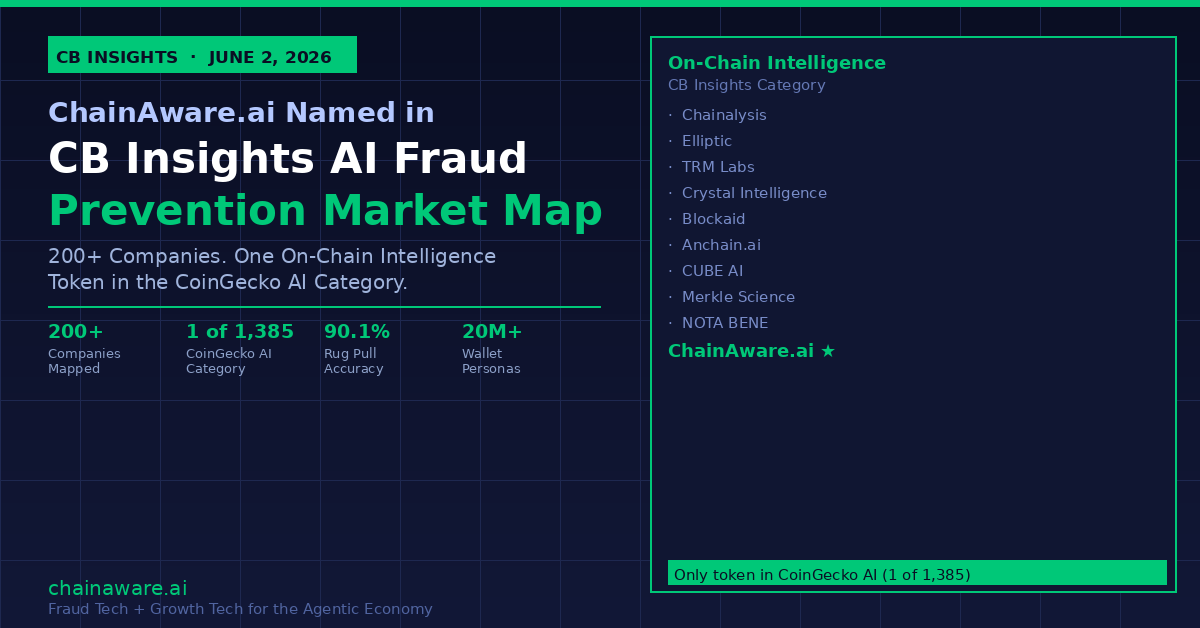
CB Insights published its AI Fraud Prevention Market Map on June 2, 2026 — mapping 200+ companies building identity, trust, and fraud prevention infrastructure for the AI era. The report covers six major categories and dozens of subcategories, from agentic trust infrastructure to biometric identity to on-chain intelligence.
ChainAware.ai appears in the On-Chain Intelligence subcategory alongside Chainalysis, Elliptic, TRM Labs, Crystal Intelligence, and Blockaid. That placement represents meaningful institutional validation — CB Insights selects companies based on Mosaic health scores above 600 and equity funding recency since 2024, filtering out thousands of projects that do not meet the bar.
One additional data point makes ChainAware’s position unique across the entire 200-company map. ChainAware is the only Web3 AI token in the full list — and the only company in the On-Chain Intelligence category with a publicly traded token listed in CoinGecko’s AI category. Among 1,385 tokens in that category, ChainAware’s AWARE token is the single representative of on-chain intelligence and behavioral fraud detection.
This article explains what that combination means, why it matters for enterprise buyers, developers, and investors — and how ChainAware’s specific products produce outcomes that no other company on the map delivers.
What Is the CB Insights AI Fraud Prevention Market Map?
CB Insights is the institutional research and intelligence platform that tracks private company health scores, funding rounds, and competitive landscapes for 100,000+ technology companies. Its market maps represent the authoritative view of emerging technology categories — used by venture capital firms, corporate development teams, enterprise procurement departments, and regulatory bodies to identify leading vendors and benchmark competitive positioning.
The AI Fraud Prevention Market Map, published June 2, 2026, covers the companies building infrastructure to detect, prevent, and manage fraud in the AI era. That framing is deliberate and significant — it separates the legacy fraud prevention market (rules-based, human-reviewed, slow) from the emerging category of AI-native fraud prevention (predictive, automated, operating at agent speed).
Why This Map Exists Now
CB Insights publishes category maps when a market reaches sufficient maturity and investment volume to justify systematic mapping. The timing of the AI Fraud Prevention map reflects three converging forces that have made fraud prevention one of the most actively funded technology categories of 2026.
First, AI-generated fraud has scaled dramatically. Deepfake video scams, synthetic identity creation, and AI-powered phishing campaigns have collectively pushed AI-based fraud losses toward the $40 billion annual mark projected by industry analysts. Traditional fraud detection tools were built for human-speed fraud — they cannot detect AI-generated attacks operating at machine speed.
Second, the agentic economy has created entirely new fraud surfaces. AI agents transacting autonomously on behalf of humans do not carry passports, credit histories, or biometric signatures. Every identity and trust system built over the last 30 years assumes the actor is human. Agents need identity and trust infrastructure built specifically for how they operate — a gap that every major new crypto VC fund has identified as their primary investment thesis.
Third, stablecoin adoption has accelerated on-chain transaction volumes toward levels that require institutional-grade compliance infrastructure. According to CB Insights, stablecoin transaction volumes in 2025 grew to double-digit trillions — approaching Visa and Mastercard combined. That volume requires fraud detection, AML screening, and behavioral intelligence that scales with it.
CB Insights Map Structure
The map organizes 200+ companies into three primary sections, each with multiple subcategories:
- Agentic Trust Infrastructure — Agent observability and evaluation, Agent authentication and authorization (KYA), Agent runtime governance and oversight
- Digital Identity and Verifiable Credentials — Decentralized identity (DID), Passwordless authentication, Post-quantum identity, Know Your Customer (KYC), Biometric identity
- Fraud Detection and Prevention — Fraud orchestration and case management, Risk scoring and signals, AML compliance, AI-generated content detection, On-chain intelligence, Transaction monitoring, Bot detection, Graph analytics and network fraud, Account takeover (ATO) protection
ChainAware sits in the Fraud Detection and Prevention section, specifically in the On-Chain Intelligence subcategory — the most directly Web3-native category on the entire map.
The On-Chain Intelligence Category — Who Made the List
The On-Chain Intelligence subcategory contains eleven companies. Understanding each one — what they do, who they serve, and where they differentiate — establishes the competitive context in which ChainAware operates.
Chainalysis
Chainalysis is the dominant forensic intelligence platform for blockchain — built originally for law enforcement agencies including the FBI, DEA, and IRS. Its Know Your Transaction (KYT) product handles VASP compliance screening, and its investigation tools reconstruct transaction graphs across chains for evidence-grade fund flow analysis. Enterprise pricing ranges from $100,000 to $500,000 annually. Chainalysis is reactive by design: it traces where funds came from after transactions have occurred, which makes it essential for post-incident investigation but structurally unable to prevent fraud before execution. According to Chainalysis’s platform documentation ↗, its clustering heuristics and entity attribution cover hundreds of major counterparties across multiple blockchains.
Elliptic
Elliptic serves a similar VASP compliance use case with a stronger European and institutional focus. Its blockchain analytics cover transaction monitoring, wallet screening, and sanctions compliance for exchanges, banks, and asset managers. Elliptic has expanded into DeFi protocol screening and NFT risk analysis — but remains fundamentally a forensic and compliance tool rather than a predictive intelligence platform.
TRM Labs
TRM Labs occupies the government and financial institution segment with the highest Mosaic score of any company in the On-Chain Intelligence category. Its platform serves FinCEN, OFAC, and major global banks — and has expanded into proactive threat intelligence that goes beyond pure reactive forensics. Spencer Bogart of Blockchain Capital invested in TRM Labs, citing the compliance infrastructure gap as one of the clearest institutional crypto needs.
Crystal Intelligence, Blockaid, and the Remaining Companies
Crystal Intelligence provides blockchain analytics and AML compliance with particular strength in European markets and cross-border transaction monitoring — covering 40+ blockchains. Blockaid approaches on-chain security from a different angle: transaction simulation and malicious dApp detection. Blockaid is now integrated into MetaMask, Coinbase Wallet, and Rainbow — but it protects at the transaction level rather than scoring the behavioral history of the parties behind transactions. Anchain.ai, CUBE AI, Merkle Science, NOTA BENE, and TestMachine occupy specialist positions serving government, institutional, and testing use cases across the category.
ChainAware.ai — The Behavioral Prediction Layer
ChainAware occupies a position in the On-Chain Intelligence category that no other company covers — behavioral prediction. While every other company answers “what has this wallet done or where did these funds come from?”, ChainAware answers “what will this wallet do next, and is this wallet likely to commit fraud before it acts?” That forward-looking prediction capability, combined with being the only Web3 AI token in the full 200-company CB Insights list, makes ChainAware uniquely positioned at the intersection of enterprise compliance and the decentralized token economy.
Why CB Insights Inclusion Matters for Enterprise Buyers
Enterprise procurement decisions for security and compliance infrastructure are significantly influenced by analyst validation. A security or compliance team evaluating on-chain intelligence vendors does not start with a Google search — they start with CB Insights, Gartner, Forrester, or IDC market maps. Inclusion in these maps is the difference between being considered and not being considered in enterprise vendor evaluations.
The Mosaic Score Gate
CB Insights selects companies based on its proprietary Mosaic score — a composite health measure incorporating funding recency, investor quality, web traffic, news sentiment, team quality, and patent activity. The AI Fraud Prevention map requires a Mosaic score above 600 and equity funding since 2024. Most projects in the blockchain space never appear on a CB Insights map because they fail either the Mosaic score threshold or the funding recency requirement. ChainAware’s inclusion confirms that its profile meets institutional investment standards — a signal that matters to the compliance officers, procurement teams, and CISOs who use CB Insights to shortlist vendors.
The Reference Check Effect
When a DeFi protocol’s compliance team receives a proposal from ChainAware, the first thing they do is verify the company’s credibility through third-party sources. The CB Insights listing now serves as that third-party validation — alongside CoinGecko’s AI category listing, the AWARE token on BSC, and ChainAware’s GitHub repository of open-source MIT-licensed agent definitions. Credibility signals compound. Each additional validation source reduces the friction of the enterprise sales cycle and increases the probability of converting enterprise interest into a signed API contract.
The CoinGecko AI Category — 1,385 Tokens, One Web3 AI Fraud Prevention Token
CoinGecko’s AI category currently lists 1,385 tokens — representing the full spectrum of AI-related blockchain projects, from Bittensor (decentralized AI compute) to Render (GPU network) to Virtuals Protocol (AI agent launchpad) to dozens of AI-themed meme coins. The category spans legitimate infrastructure projects, speculative tokens, and everything between.
Among these 1,385 tokens, ChainAware’s AWARE token is the only one building on-chain intelligence and behavioral fraud detection as its core product. None of the major forensic compliance companies — Chainalysis, Elliptic, TRM Labs, Crystal Intelligence — have tokens. None of Blockaid, Anchain.ai, Merkle Science, or NOTA BENE have tokens. They are pure SaaS companies with no token economy.
Why No Token Is the Default for Compliance Companies
Most on-chain intelligence companies avoid tokens for regulatory reasons — a tradeable token creates securities law complexity in most jurisdictions. Chainalysis, TRM Labs, and Elliptic have collectively raised over $1 billion in venture capital while deliberately remaining token-free. Their customers (banks, regulated exchanges, government agencies) cannot hold or use utility tokens as payment. ChainAware’s bifurcated model — enterprise API subscriptions for institutional clients plus the AWARE utility token for Web3 ecosystem participants — allows it to serve both audiences simultaneously without compromising either relationship.
The Unique Intersection
The combination of CB Insights validation and CoinGecko AI category listing creates a position that no competitor occupies. Companies on the CB Insights map without tokens serve institutional clients through SaaS contracts — their distribution is purely through enterprise sales cycles. Companies in the CoinGecko AI category without CB Insights validation are building token economies without institutional credibility. ChainAware sits at the intersection — credible enough for enterprise evaluation and token-native enough to participate in the decentralized economy it analyzes.
How ChainAware Differs From Every Other Company on the Map
Understanding ChainAware’s differentiation requires examining five dimensions where it diverges fundamentally from every other company in the On-Chain Intelligence category.
Dimension 1 — Prediction vs. Forensics
Every other company in the On-Chain Intelligence category is forensic — backward-looking by design. Chainalysis traces where funds came from. Elliptic reconstructs transaction graphs. TRM Labs identifies sanctioned counterparties. Crystal Intelligence monitors cross-border fund flows. All four describe the past. ChainAware predicts the future. Its behavioral ML models, trained on 20M+ wallet personas across 8 blockchains, produce probability scores for what a wallet will do next — not descriptions of what it has done. That prediction happens in milliseconds, before any transaction occurs, based on behavioral patterns that professional fraudsters cannot disguise by using clean contract code.
Dimension 2 — Fraud Tech and Growth Tech Combined
The CB Insights map treats fraud prevention as a purely defensive category — a cost center that organizations pay for to stay compliant and avoid losses. ChainAware reframes the category entirely by combining fraud prevention with growth intelligence in a single platform. ChainAware’s 20M+ wallet personas do not just tell a compliance team whether to block a wallet — they also tell a product team which content to show it, which features to surface, and which growth campaign to trigger. A wallet with high Lend intention and low fraud probability gets surfaced lending products automatically. A wallet with high fraud probability gets blocked before it enters the funnel. Both decisions come from the same behavioral intelligence layer.
Dimension 3 — MCP-Native Delivery for AI Agents
AI agents need behavioral intelligence delivered in the format they can consume — structured predictions via the Model Context Protocol (MCP), not raw blockchain data that requires further analysis. According to Anthropic’s Model Context Protocol documentation ↗, MCP is rapidly becoming the standard integration layer for AI agent tool access. ChainAware’s Prediction MCP delivers complete behavioral profiles — fraud probability, all 12 intention scores, experience level, risk appetite, AML status — in a single structured response that any AI agent can act on without blockchain expertise. For how this works in practice, see our Prediction MCP guide ↗.
Dimension 4 — Token-Native Economic Model
ChainAware’s AWARE token creates an economic flywheel that enterprise-only SaaS competitors cannot replicate. Token holders who stake AWARE unlock higher API rate limits and premium intelligence tiers. Developers who build integrations with ChainAware’s API earn AWARE rewards. As the platform’s wallet persona dataset grows — currently at 20M+ profiles — the intelligence quality improves, increasing the value of AWARE access.
Dimension 5 — The Free Entry Point
Chainalysis charges $100,000 to $500,000 annually. TRM Labs requires enterprise negotiations. Elliptic does not publish pricing. ChainAware’s Wallet Auditor delivers the complete Web3 Persona for any address — free, no signup, in under one second. Any developer, compliance officer, or investor can experience the full depth of ChainAware’s behavioral intelligence without a sales conversation. For the complete dimension-by-dimension breakdown, see our Wallet Auditor guide ↗.
Predictive Intelligence vs. Forensic Intelligence — The Critical Distinction
The most important conceptual distinction in the On-Chain Intelligence category is between forensic and predictive intelligence. Understanding this distinction explains why the entire category is funded heavily — and why ChainAware’s predictive position is structurally different from the forensic majority.
What Forensic Intelligence Does
Forensic intelligence analyzes the complete history of blockchain transactions to reconstruct fund flows, identify sanctioned counterparties, and attribute addresses to known entities. It answers: “Where did these funds come from, and who has touched them?” This capability is essential for post-incident investigation. However, forensic intelligence is structurally reactive — it requires the fraud to have already happened, or at minimum for the fraudulent address to already appear in its entity database. A professional operator using a fresh wallet that has never appeared in Chainalysis’s database is invisible to forensic tools until they commit their first recorded offense.
What Predictive Intelligence Does
Predictive intelligence analyzes behavioral patterns — not just transaction histories — to forecast what a wallet will do next and what the probability of fraud is before any transaction executes. ChainAware’s behavioral ML models train on 20M+ wallet personas — learning the behavioral signatures that distinguish legitimate DeFi users from professional fraud operators, Sybil wallets, airdrop farmers, and governance attackers. A professional fraudster can use clean contract code. They cannot mask their behavioral pattern across 20M+ training examples. The model detects the operator, not just the incident. For the complete technical comparison, see our Forensic vs AI-Powered Analytics guide ↗.
The 98% Accuracy Benchmark
ChainAware backtested its fraud detection model on CryptoScamDB — the largest publicly available database of documented crypto fraud incidents — achieving 98% prediction accuracy. The model correctly identified fraudulent wallets before they committed their recorded offense in 98 out of every 100 cases in the test set. For compliance teams operating under MiCA or similar frameworks, that accuracy level dramatically reduces the manual review burden. For the complete MiCA compliance stack, see our MiCA Compliance at 1% of Chainalysis Cost guide ↗.
ChainAware Rug Pull Detector — 90.1% Prediction Accuracy
Rug pulls represent the most damaging category of DeFi fraud by absolute dollar value. ChainAware’s Rug Pull Detector — trained specifically on PancakeSwap V2 data — achieves 90.1% prediction accuracy, identifying high-risk tokens before the rug pull occurs rather than after investors have lost funds.
The PancakeSwap V2 Dataset
ChainAware trained and validated its rug pull detection model on PancakeSwap V2 transaction data from weeks 1 through 20 of 2026 — covering $569 million in documented rug pull losses across thousands of token launches. This dataset is the largest and most recent rug pull training corpus available in the public domain for BNB Chain tokens. The training methodology uses behavioral signals from the contract deployer wallet and all LP providers — not contract code analysis. Professional rug pull operators know exactly which code patterns trigger existing contract scanners, and they code around them. Their behavioral history across 20M+ wallet personas reveals the signature of serial rug operators regardless of how clean their current contract appears.
Rug Pull Detector vs. Competing Tools
GoPlus, Token Sniffer, and Honeypot.is all analyze contract code — detecting known patterns of mint functions, blacklisting mechanisms, sell restrictions, and honeypot logic. These tools catch common scams that reuse known code patterns. They do not catch professional operators who deploy clean code specifically to evade code scanners. ChainAware’s Rug Pull Detector catches what code scanners miss — the experienced operator with a history of rugging who deploys a technically perfect contract but whose behavioral fingerprint across 20M+ personas identifies them as high risk. For the complete comparison, see our Best Web3 Rug Pull Detection Tools guide ↗.
The Agentic Economy and Why It Needs a New Fraud Layer
The CB Insights AI Fraud Prevention Market Map was explicitly timed to coincide with the emergence of the agentic economy — the structural shift from human-operated financial systems to AI-agent-operated ones. Understanding this shift explains why the on-chain intelligence category is the fastest-growing by funding momentum in 2026.
Agents Are Not Humans
AI agents transacting on behalf of humans operate 24/7, across all time zones simultaneously, at machine speed, without the cognitive friction that slows human decision-making. An AI agent does not hesitate before a suspicious transaction — it executes at the speed of the LLM inference cycle. This eliminates the natural fraud prevention that human decision-making provides. Consequently, AI agents need external fraud intelligence to substitute for the human judgment they lack. ChainAware’s Prediction MCP delivers that intelligence in the format agents can consume — structured behavioral profiles via natural language queries, sub-second response, no blockchain expertise required. For integration details, see our 12 Blockchain Capabilities Any AI Agent Can Use ↗.
Haun Ventures’ $1B Thesis — Word for Word
Katie Haun’s Haun Ventures $1 billion fund announcement, published May 4, 2026, contains the most precise description of ChainAware’s product from any institutional source: “Every supporting layer will need to be rearchitected for this world: fraud prevention, credit, insurance, identity, privacy, provenance, reputation, and verification all require native versions designed for how agents transact.” That sentence describes ChainAware’s product roadmap. Haun Ventures is not alone — Dragonfly Capital closed $650 million, a16z crypto closed $2.2 billion, ParaFi Capital raised $125 million — every major fund closing in 2026 has identified the same gap that ChainAware is building into.
The Market Signal — $6B+ in VC Funding Points at the Same Gap
The $6 billion+ deployed into crypto and Web3 infrastructure during the first five months of 2026 is the strongest institutional signal the sector has seen since 2021 — but with a fundamentally different thesis. The 2021 cycle was driven by speculation on token appreciation. The 2026 cycle is driven by infrastructure investment in the trust, compliance, and intelligence layers that the agentic economy requires.
The Fund Closing Timeline
Dragonfly Capital’s $650 million fourth fund closed February 17, 2026. ParaFi Capital’s $125 million raise closed in March 2026, focused on stablecoins, tokenization, and on-chain financial products. Haun Ventures announced $1 billion on May 4, 2026. a16z crypto’s $2.2 billion fifth fund announced May 5, 2026 — bringing its total crypto-focused assets to $9.8 billion. Blockchain Capital is actively raising $700 million. Paradigm’s rumored $1.5 billion includes an AI-plus-crypto thesis. Total confirmed capital: over $4.5 billion closed in the first five months of 2026, with another $2.2 billion in process. Every fund thesis identifies the same three investment areas: new financial infrastructure, new assets and markets, and the agentic economy.
ChainAware as Growth Tech — The Revenue Dimension of On-Chain Intelligence
The CB Insights map positions fraud prevention entirely as a defensive category. ChainAware’s growth tech layer reframes on-chain intelligence as a revenue-generating capability — where the same behavioral data that prevents fraud also drives conversion, retention, and user acquisition efficiency.
The 84% Ghost Wallet Problem
ChainAware’s analysis of 9,999 unique wallet addresses from a major Web3 marketing campaign found that 84% were ghost wallets: zero real engagement, zero meaningful transaction history, zero likelihood of converting into active protocol users. Every dollar spent acquiring ghost wallets is waste — the acquired “user” will never transact, never provide liquidity, never participate in governance, and never generate fee revenue. ChainAware’s growth intelligence layer converts this waste into signal. Before running a campaign, protocols can screen target wallet lists through the Fraud Detector and Wallet Auditor — removing ghost wallets, Sybil clusters, and airdrop farmers from the acquisition pool before spending budget on them. For the complete framework, see our DeFi Onboarding guide ↗.
The 12 Intention Scores as Growth Signals
ChainAware’s 12 behavioral intention scores — Borrow, Lend, Trade, Gamble, NFT, Stake ETH, Stake Yield Farm, Leveraged Staking, Leveraged Staking ETH, Leveraged Lending, Leveraged Long ETH, Leveraged Long Game — are not just risk signals. They are growth signals that tell a protocol exactly which products to surface to each connecting wallet. A wallet with High Lend intention should see lending products featured first. A wallet with Low Experience should see simplified onboarding. Neither wallet needs to self-identify their interests — the behavioral history already tells the protocol everything it needs to know. For the complete growth deployment architecture, see our User Segmentation guide ↗.
Full Competitive Landscape — CB Insights Map Breakdown
The full CB Insights AI Fraud Prevention Market Map covers 200+ companies across six major sections. Understanding the complete map reveals where ChainAware’s behavioral intelligence layer fits within the broader fraud prevention ecosystem — and which categories represent potential integration partners rather than competitors.
Agentic Trust Infrastructure — A Partnership Category
The Agentic Trust Infrastructure section covers agent observability and evaluation (Arize, LangChain, Patronus AI), agent authentication and authorization (xAembit, Arcade, AuthMind, Skyfire), and agent runtime governance (Ciphero, HUMAN, Witness AI). ChainAware’s Prediction MCP is a natural integration layer for all three subcategories — adding on-chain behavioral fraud detection to agent monitoring, authentication, and governance workflows that these platforms currently lack.
Digital Identity — Complementary, Not Competing
The Digital Identity section covers decentralized identity (DID), passwordless authentication, post-quantum identity, KYC, and biometric identity. Companies like Humanity Protocol, Billions, Self, and zkMe provide proof-of-personhood and verifiable credentials — confirming that a wallet is controlled by a unique human. DID systems answer “is this wallet controlled by a unique person?” ChainAware answers “is this person’s behavior consistent with fraud — and what will they do next?” These questions are complementary, not overlapping. For how ChainAware integrates with DID systems, see our Blockchain Compliance guide ↗.
AML Compliance — The Enterprise Complement
The AML compliance subcategory includes Amlyze, Comply Advantage, Fiverity, Hawk AI, Natech, and Sphinx — all providing transaction monitoring and AML reporting for regulated financial institutions. ChainAware’s AML screening and behavioral fraud detection complement these platforms rather than replacing them. Enterprise AML systems provide regulatory reporting, case management, and audit trails. ChainAware provides the pre-execution risk signal that determines which transactions require closer AML review. For the complete DeFi compliance stack, see our DeFi Compliance Tools guide ↗.
How to Use ChainAware’s Intelligence Products Today
All three ChainAware intelligence products are available without signup, without wallet connection, and without a sales conversation. The free tier delivers the complete product — not a limited preview.
Rug Pull Detector
Navigate to chainaware.ai/rug-pull-detector ↗. Paste any ERC-20 or BEP-20 token contract address. The detector returns a rug pull probability score, a breakdown of the risk factors identified, and a behavioral assessment of the contract deployer and LP providers. Results are available in under 3 seconds. No account required. Use it before buying any new token — especially on BNB Smart Chain where the $569 million PancakeSwap V2 dataset gives the model its highest accuracy.
Fraud Detector
Navigate to chainaware.ai/fraud-detector ↗. Paste any wallet address. The detector returns fraud probability (98% accuracy), AML status, OFAC screening result, and a behavioral summary. Covers ETH, BNB, BASE, POLYGON, TON, TRON, HAQQ, and SOL. Results are available in under 1 second. No account required. Use it to screen wallets before approving DeFi protocol interactions and to verify team wallet addresses published by new token projects.
Wallet Auditor
Navigate to chainaware.ai/audit ↗. Paste any wallet address. The Wallet Auditor returns the complete 22-dimension Web3 Persona: fraud probability, all 12 intention scores, experience level, risk appetite, AML status, OFAC screening, Wallet Rank, wallet age, transaction count, and balance. For the complete guide, see our Wallet Auditor guide ↗.
API Access and Prediction MCP
For teams integrating ChainAware intelligence at scale, the REST API provides full access to all intelligence products at volume. The Prediction MCP server at prediction.mcp.chainaware.ai/sse delivers complete behavioral profiles to any MCP-compatible AI agent in under 1 second. API documentation is available at swagger.chainaware.ai.
Frequently Asked Questions
What is the CB Insights AI Fraud Prevention Market Map?
The CB Insights AI Fraud Prevention Market Map, published June 2, 2026, identifies 200+ companies building identity, trust, and fraud prevention infrastructure for the AI era. CB Insights selects companies based on Mosaic health scores above 600 and equity funding since 2024. ChainAware appears in the On-Chain Intelligence subcategory — alongside Chainalysis, Elliptic, TRM Labs, Crystal Intelligence, and Blockaid — as the only Web3 AI token in the full list.
Why is ChainAware the only Web3 AI token in the CB Insights list?
Most on-chain intelligence companies — Chainalysis, Elliptic, TRM Labs, Crystal Intelligence, Blockaid — are pure SaaS businesses with no publicly traded token. They serve regulated institutional clients who cannot hold utility tokens, and they avoid tokens for regulatory complexity reasons. ChainAware’s bifurcated model — enterprise API subscriptions for institutional clients plus the AWARE utility token for Web3 ecosystem participants — allows it to appear in both institutional and decentralized discovery channels simultaneously.
How does ChainAware’s 90.1% rug pull accuracy compare to other tools?
GoPlus, Token Sniffer, and Honeypot.is analyze contract code — they do not publish accuracy statistics because they report risk flags rather than probability scores. ChainAware’s 90.1% accuracy is a backtested performance metric on the PancakeSwap V2 dataset covering $569 million in documented rug pulls from weeks 1 through 20 of 2026. The key distinction is that ChainAware’s model analyzes behavioral history of the contract deployer and LP providers — catching professional operators who deploy clean code to evade code scanners. For detailed methodology, see our Rug Pull Detection guide ↗.
What is the difference between ChainAware and Chainalysis?
Chainalysis is a forensic compliance platform designed for law enforcement and regulated exchanges — it traces where funds came from after transactions have occurred, with enterprise pricing from $100,000 to $500,000 annually. ChainAware is a predictive behavioral intelligence platform designed for DeFi protocols, AI agents, and compliance teams — it predicts fraud before transactions execute, with a free tier and accessible API pricing. The two are complementary: Chainalysis provides post-incident forensics; ChainAware provides pre-execution fraud prevention. For the complete cost comparison, see our MiCA Compliance at 1% of Chainalysis Cost guide ↗.
How does the Prediction MCP work for AI agents?
ChainAware’s Prediction MCP server is accessible at prediction.mcp.chainaware.ai/sse. Any MCP-compatible AI agent — Claude, GPT, or any other LLM — can connect to the MCP and query behavioral profiles via natural language. The agent sends a query such as “What is the fraud risk and behavioral profile of 0x2f71…?” and receives a structured response containing fraud probability, all 12 intention probabilities, experience level, risk appetite, AML status, and Wallet Rank — all pre-computed, in under one second. According to Anthropic’s MCP documentation ↗, MCP is becoming the standard for AI agent tool access. For the integration guide, see our Prediction MCP guide ↗.
Can ChainAware detect governance attacks before they execute?
Yes — governance attack detection is one of ChainAware’s most differentiated capabilities. DAO governance attacks typically use Sybil wallet clusters — coordinated addresses that each hold small token amounts and vote together to achieve disproportionate governance influence. ChainAware’s behavioral model detects these clusters by identifying wallets that share funding sources, exhibit synchronized transaction timing, and demonstrate consistent co-voting behavior across multiple governance proposals. For the complete governance attack detection framework, see our Web3 Governance Screeners guide ↗.
How does ChainAware’s behavioral intelligence help with MiCA compliance?
MiCA (Markets in Crypto-Assets Regulation) requires crypto asset service providers operating in the EU to implement transaction monitoring, AML screening, and customer risk assessment. ChainAware’s Fraud Detector and AML screening cover the pre-execution risk assessment requirement — delivering 98% accurate fraud probability and real-time AML/OFAC screening for every wallet interacting with a MiCA-covered service. According to FATF’s Virtual Assets Recommendations ↗, transaction monitoring requirements increasingly mandate real-time screening capabilities. For the complete implementation guide, see our DeFi Compliance Tools guide ↗.
What makes ChainAware’s position in CoinGecko’s AI category strategically valuable?
CoinGecko’s AI category receives millions of views monthly from users specifically searching for AI-related blockchain investments and infrastructure. Being the only on-chain intelligence and behavioral fraud detection project among 1,385 tokens creates a discovery advantage that pure enterprise SaaS competitors cannot replicate. A developer researching AI-native blockchain tools who browses the CoinGecko AI category finds ChainAware as the only fraud intelligence and behavioral scoring option — without competition from Chainalysis, Elliptic, or TRM Labs who have no token presence. The combination of institutional validation from CB Insights and retail discovery via CoinGecko creates a dual-channel visibility that no competitor in either ecosystem can match.
External Sources: CB Insights AI Fraud Prevention Market Map ↗ · CoinGecko AI Category ↗ · Anthropic Model Context Protocol ↗ · FATF Virtual Assets Recommendations ↗ · Chainalysis Platform ↗