
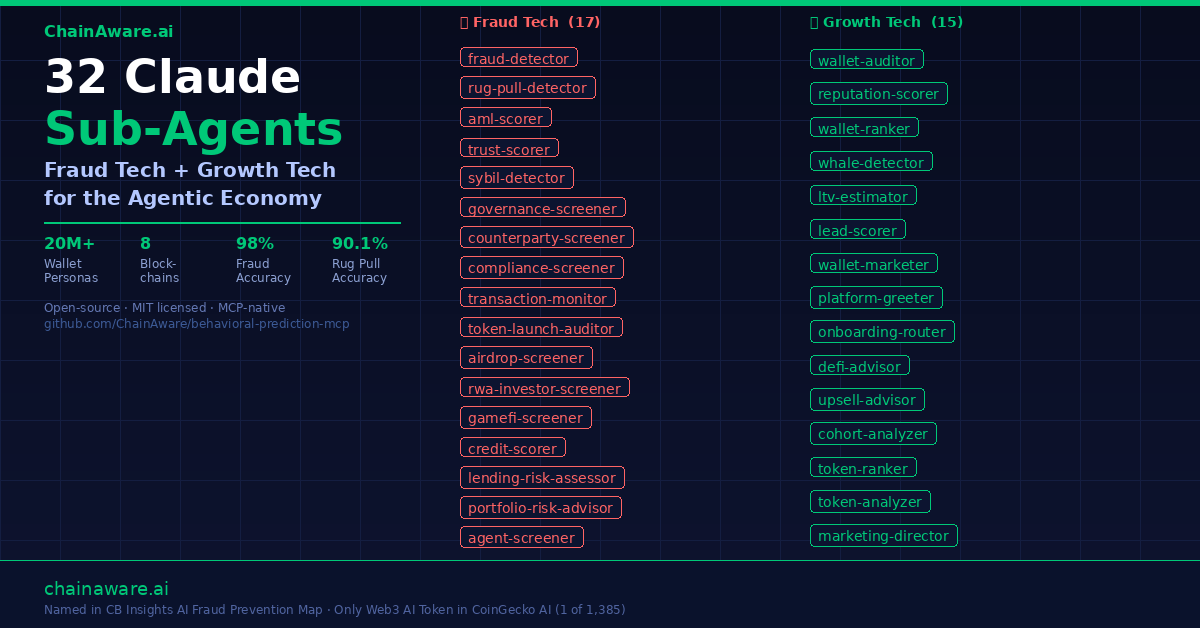
ChainAware.ai operates on 32 Claude sub-agents — each one a focused specialist that wraps ChainAware’s Prediction MCP tools with precise role definitions, decision logic, and behavioral reasoning. Together, they cover the complete lifecycle of Web3 intelligence: detecting fraud before a single transaction executes, growing a protocol’s real user base, and verifying the trustworthiness of AI agents operating in the emerging agentic economy. No other Web3 intelligence platform has published a comparable open-source agent library of this depth.
ChainAware was named in CB Insights’ AI Fraud Prevention Market Map alongside Chainalysis, Elliptic, and TRM Labs — and remains the only Web3 AI token across all 200+ companies in that list. The 32 sub-agents documented here are the operational engine behind that recognition: real, deployed tools that DeFi protocols, compliance teams, launchpads, DAOs, and AI agent developers use in production today. Every agent is open-source, MIT-licensed, and available at github.com/ChainAware/behavioral-prediction-mcp ↗.
This article classifies all 32 agents into two functional categories — Fraud Tech and Growth Tech — and for each agent provides a precise description, concrete use case, and the specific trigger conditions that signal when a team needs it. Use this as your reference guide for selecting, combining, and deploying ChainAware’s agent suite.
In This Article
- Two Categories — Fraud Tech and Growth Tech
- The Complete Classification Table — All 32 Agents
- Fraud Tech Agents — 17 Agents, Complete Reference
- Growth Tech Agents — 15 Agents, Complete Reference
- How Agents Compose Into Pipelines
- Getting Started — Integration in Three Steps
- Frequently Asked Questions
Two Categories — Fraud Tech and Growth Tech
ChainAware’s 32 agents divide into two functional categories that reflect the platform’s core thesis: the same behavioral data that prevents fraud also drives growth. Both categories draw from the same underlying Prediction MCP tools and the same 20M+ wallet persona database. The distinction lies in what question each agent answers and what action it enables.
Fraud Tech agents answer: “Can we trust this wallet, contract, token, or transaction?” They protect protocols from losses, enforce AML compliance, prevent Sybil attacks, and screen counterparties before execution. Consequently, Fraud Tech agents operate primarily at the gate — before onboarding, before transactions, before token distributions, before listing decisions. Their outputs are verdicts: allow, block, flag, reject, or escalate.
Growth Tech agents answer: “Now that we know this wallet is legitimate, how do we convert it, retain it, and grow it?” They turn behavioral intelligence into personalized acquisition, onboarding, conversion, and retention decisions. Moreover, Growth Tech agents operate primarily post-gate — after a wallet passes initial screening, they determine how to engage it most effectively. Their outputs are recommendations: which product to surface, which message to send, which onboarding flow to show, which upsell to offer.
Furthermore, both categories share a fraud gate: every Growth Tech agent checks probabilityFraud before generating any recommendation and blocks output for high-risk wallets. This means the categories are not sequential stages but parallel layers — fraud protection runs continuously across every growth decision. For the foundational framework explaining why behavioral intelligence is essential for both fraud prevention and growth, see our Web3 Behavioral User Analytics guide ↗.
🔎 Try the Intelligence Layer — Free
ChainAware Wallet Auditor — Complete Web3 Persona in 1 Second
Paste any wallet address and receive the complete 22-dimension behavioral profile: fraud probability (98% accuracy), 12 intention scores, experience level, risk appetite, AML status, OFAC screening, and Wallet Rank. Powers the chainaware-wallet-auditor agent. ETH, BNB, BASE, POLYGON, TON, TRON, HAQQ, SOL. No signup. No wallet connection required.
Audit Any Wallet Free ↗ Wallet Auditor Guide ↗The Complete Classification Table — All 32 Agents
The table below lists every agent with its category, primary MCP tool, supported networks, and core function. Agents are sorted by category, then by specificity — from broad-purpose agents to narrow specialists. Use this as your quick-reference lookup before reading the detailed descriptions that follow.
| # | Agent | Category | Primary Tool | Networks | Core Function |
|---|---|---|---|---|---|
| 1 | fraud-detector | 🔴 Fraud Tech | predictive_fraud | ETH BNB POLYGON TON BASE TRON HAQQ | Wallet fraud probability (98% accuracy) + 19 AML forensic flags |
| 2 | rug-pull-detector | 🔴 Fraud Tech | predictive_rug_pull | ETH BNB BASE HAQQ | 90.1% rug pull prediction — contract + deployer behavioral analysis |
| 3 | aml-scorer | 🔴 Fraud Tech | predictive_fraud | ETH BNB POLYGON TON BASE TRON HAQQ | AML score (0–100) with full forensic flag breakdown |
| 4 | trust-scorer | 🔴 Fraud Tech | predictive_fraud | ETH BNB POLYGON TON BASE TRON HAQQ | Trust score (0.00–1.00) = 1 − fraud probability. Composable building block |
| 5 | sybil-detector | 🔴 Fraud Tech | predictive_behaviour + predictive_fraud | ETH BNB BASE HAQQ SOL + fallback | Batch Sybil detection — wallet farms, coordinated attacks, proxy voting fraud |
| 6 | governance-screener | 🔴 Fraud Tech | predictive_behaviour + predictive_fraud | ETH BNB BASE HAQQ SOL + fallback | DAO voter tier (Core Contributor → Disqualified) + voting weight multiplier |
| 7 | counterparty-screener | 🔴 Fraud Tech | predictive_behaviour + predictive_fraud | ETH BNB BASE HAQQ SOL + fallback | Pre-transaction Safe / Caution / Block verdict in a single API call |
| 8 | compliance-screener | 🔴 Fraud Tech | Orchestrator | Multi-chain via sub-agents | MiCA-aligned PASS / EDD / REJECT with full documented evidence trail |
| 9 | transaction-monitor | 🔴 Fraud Tech | predictive_behaviour + predictive_rug_pull | ETH BNB BASE HAQQ SOL + fallback | Real-time ALLOW / FLAG / HOLD / BLOCK for autonomous agent pipelines |
| 10 | token-launch-auditor | 🔴 Fraud Tech | predictive_rug_pull + predictive_fraud | ETH BNB BASE HAQQ | Launchpad listing audit → APPROVED / CONDITIONAL / REJECTED + safety badge |
| 11 | airdrop-screener | 🔴 Fraud Tech | predictive_behaviour + predictive_fraud | ETH BNB BASE HAQQ SOL + fallback | Batch airdrop eligibility — filters bots, ranks eligible wallets by reputation |
| 12 | rwa-investor-screener | 🔴 Fraud Tech | predictive_behaviour + predictive_fraud | ETH BNB BASE HAQQ SOL + fallback | RWA investor suitability → QUALIFIED / CONDITIONAL / REFER_TO_KYC / DISQUALIFIED |
| 13 | gamefi-screener | 🔴 Fraud Tech | predictive_behaviour + predictive_fraud | ETH BNB BASE HAQQ SOL + fallback | P2E bot farm and multi-account cheater detection + player tier classification |
| 14 | credit-scorer | 🔴 Fraud Tech | credit_score | ETH | Crypto credit score (1–9) combining fraud probability + social graph analysis |
| 15 | lending-risk-assessor | 🔴 Fraud Tech | predictive_behaviour + credit_score | ETH BNB BASE HAQQ SOL | Borrower risk grade (A–F) + recommended collateral ratio + interest rate tier |
| 16 | portfolio-risk-advisor | 🔴 Fraud Tech | predictive_rug_pull + token_rank_single | ETH BNB BASE HAQQ | Portfolio rug pull scan → grade A–F + prioritized exit/reduce plan |
| 17 | agent-screener | 🔴 Fraud Tech | predictive_fraud + predictive_behaviour + predictive_rug_pull | ETH BNB BASE HAQQ SOL + fallback | AI agent trust score (0–10) screening agent wallet + feeder wallet |
| 18 | wallet-auditor | 🟢 Growth Tech | predictive_behaviour | ETH BNB BASE HAQQ SOL | Complete 22-dimension Web3 Persona — fraud + behavioral + personalization |
| 19 | reputation-scorer | 🟢 Growth Tech | predictive_behaviour | ETH BNB BASE HAQQ SOL | Reputation score (0–1000) = experience × risk_capability × (1 − fraud) |
| 20 | wallet-ranker | 🟢 Growth Tech | predictive_behaviour | ETH BNB BASE HAQQ SOL | Global wallet rank from experience, total points, age, transaction count |
| 21 | whale-detector | 🟢 Growth Tech | predictive_behaviour | ETH BNB BASE HAQQ SOL | Whale tier (Mega / Whale / Emerging) + Active/Dormant status + domain |
| 22 | ltv-estimator | 🟢 Growth Tech | predictive_behaviour + predictive_fraud | ETH BNB BASE HAQQ SOL + fallback | 12-month revenue potential (USD range) from behavioral + risk signals |
| 23 | lead-scorer | 🟢 Growth Tech | predictive_behaviour + predictive_fraud | ETH BNB BASE HAQQ SOL + fallback | Lead score (0–100) + Hot/Warm/Cold/Dead + recommended outreach angle |
| 24 | wallet-marketer | 🟢 Growth Tech | predictive_behaviour | ETH BNB BASE HAQQ SOL | Hyper-personalized marketing message (max 20 words) from on-chain signals |
| 25 | platform-greeter | 🟢 Growth Tech | predictive_behaviour + predictive_fraud | ETH BNB BASE HAQQ SOL + fallback | Platform-specific welcome message (max 35 words) — different per platform |
| 26 | onboarding-router | 🟢 Growth Tech | predictive_behaviour | ETH BNB BASE HAQQ SOL | Onboarding flow decision — Beginner / Intermediate / Skip from real experience |
| 27 | defi-advisor | 🟢 Growth Tech | predictive_behaviour | ETH BNB BASE HAQQ SOL | Personalized DeFi product recommendations (3 tiers) by experience + risk |
| 28 | upsell-advisor | 🟢 Growth Tech | predictive_behaviour | ETH BNB BASE HAQQ SOL | Upgrade readiness (0–100) + next product + trigger event + conversion probability |
| 29 | cohort-analyzer | 🟢 Growth Tech | predictive_behaviour + predictive_fraud | ETH BNB BASE HAQQ SOL + fallback | Batch behavioral cohort segmentation — 8 cohorts + per-cohort strategy |
| 30 | token-ranker | 🟢 Growth Tech | token_rank_list | ETH BNB BASE SOL | Token discovery by community strength — AI / RWA / DeFi / DeFAI / DePIN |
| 31 | token-analyzer | 🟢 Growth Tech | token_rank_single + predictive_fraud | ETH BNB BASE SOL | Single-token deep-dive: community rank + top holder profiles + fraud screening |
| 32 | marketing-director | 🟢 Growth Tech | Orchestrator (7 specialist agents) | All networks via sub-agents | Full-cycle campaign orchestrator → complete Marketing Campaign Brief |
Fraud Tech Agents — 17 Agents, Complete Reference
ChainAware’s Fraud Tech agents protect Web3 protocols from the full spectrum of on-chain threats: wallet fraud, rug pulls, money laundering, Sybil attacks, governance manipulation, P2E cheating, and fraudulent AI agents. Together, they cover every point in the protocol lifecycle where malicious actors attempt to extract value — from the moment a wallet first connects to the moment a transaction executes. According to FATF’s Virtual Assets Recommendations ↗, the compliance requirements for crypto asset service providers now demand pre-execution risk assessment that legacy forensic tools were never designed to deliver. ChainAware’s Fraud Tech agents fill that gap with predictive behavioral intelligence rather than reactive forensic lookup.
Moreover, these agents share a critical structural advantage over traditional blockchain forensics: they analyze behavioral patterns across 20M+ wallet personas rather than matching against static blocklists. Professional fraud operators deliberately evade blocklist-based tools by using fresh wallets and clean contract code. They cannot, however, mask their behavioral fingerprint — the pattern of on-chain activity that identifies an operator regardless of which specific address they use today. This is why ChainAware achieves 98% fraud detection accuracy on ETH where forensic tools frequently miss sophisticated operators. For the complete technical comparison, see our Forensic vs AI-Powered Analytics guide ↗.
🛡️ Detect Fraud Before It Executes — Free
ChainAware Fraud Detector — 98% Accuracy, Pre-Execution Behavioral Intelligence
Paste any wallet address and receive the complete fraud risk assessment — fraud probability (98% accuracy, backtested on CryptoScamDB), AML status, OFAC screening, and 19 forensic flag categories. The same intelligence powering chainaware-fraud-detector, chainaware-aml-scorer, and chainaware-trust-scorer. ETH, BNB, POLYGON, TON, BASE, TRON, HAQQ. No signup required.
Check Fraud Risk Free ↗ Fraud Detector Guide ↗1. chainaware-fraud-detector
The flagship fraud detection agent calls predictive_fraud on any wallet address and returns a fraud probability score, wallet status (Not Fraud / Fraud / New Address), OFAC sanctions check, and 19 AML forensic flags covering mixers, darknet transactions, phishing wallets, fake token creation, money laundering patterns, cybercrime associations, and more. Accuracy reaches 98% on ETH and 96% on BNB, backtested against CryptoScamDB — the largest publicly available database of documented crypto fraud incidents. Coverage spans 7 networks: ETH, BNB, POLYGON, TON, BASE, TRON, and HAQQ.
Use Case: A DeFi lending protocol screens every wallet requesting a loan before processing the application. The team integrates chainaware-fraud-detector into its onboarding API — each new wallet receives a fraud probability score and forensic flag check in under one second. Wallets scoring above 0.70 are automatically declined. Wallets between 0.40 and 0.70 route to enhanced due diligence. Wallets below 0.20 pass to the standard lending flow. The same agent works equally well for exchange KYC pre-screening, NFT allowlist vetting, and airdrop participant verification.
When Is It Required: Deploy chainaware-fraud-detector whenever a protocol accepts wallet connections from unknown participants — particularly before any value transfer, credit extension, or whitelist grant. It is specifically required when a protocol falls under MiCA, AML5D, or equivalent regulation that mandates pre-onboarding risk assessment. Additionally, it is required before running any Growth Tech agent on a wallet — the fraud gate in chainaware-wallet-marketer and chainaware-ltv-estimator calls this agent’s underlying tool before generating any recommendation. For the complete implementation methodology, see our Fraud Detector guide ↗.
2. chainaware-rug-pull-detector
Analyzes smart contracts, liquidity pools, and token launches for rug pull risk before any capital is deployed. The agent runs predictive_rug_pull on the contract address and predictive_fraud on the deployer wallet, combining both into a unified verdict. Critically, the deployer fraud score can escalate the overall verdict by one tier — a contract scoring 0.35 (Medium risk) paired with a deployer scoring 0.72 (High risk) produces a combined High Risk verdict. This escalation catches the most dangerous category of rug pulls: professionally deployed clean contracts by operators with documented fraud histories on other wallets. Accuracy on the PancakeSwap V2 dataset reaches 90.1%, covering $569M in documented rug pull losses from weeks 1–20 of 2026. Networks supported: ETH, BNB, BASE, HAQQ.
Use Case: A DEX launchpad reviews 50 new token submissions per week. Without automated screening, each review requires a developer to manually inspect contract code and trace the deployer wallet — a process taking 30–60 minutes per token. With chainaware-rug-pull-detector, the launchpad runs all 50 contracts in batch mode and receives a ranked risk table in minutes. Contracts scoring above 0.80 are automatically rejected. Contracts between 0.50 and 0.80 require manual review with specific red flags already identified. Contracts below 0.20 proceed to standard listing.
When Is It Required: Use chainaware-rug-pull-detector before listing any token on a DEX, before depositing LP into any new pool, before investing in any IDO or pre-sale, and before any yield vault strategy deploys capital into a new protocol. It is specifically required for launchpad teams that need a standardized, reproducible audit process rather than ad hoc developer reviews. It pairs with chainaware-token-launch-auditor when a full public-facing audit report with a safety badge is needed. For the detailed comparison against GoPlus, Token Sniffer, and Honeypot.is, see our Rug Pull Detection Tools guide ↗.
🔍 90.1% Rug Pull Prediction Accuracy — Free
ChainAware Rug Pull Detector — Behavioral Analysis of Contract + Deployer + LP Providers
Paste any token contract address and receive an instant rug pull risk score — backtested on $569M in PancakeSwap V2 rug pulls. Analyzes the deployer’s behavioral history across 20M+ wallet personas. Catches professional operators with clean code that pass every other scanner. ETH, BNB, BASE, HAQQ. No signup required.
Check Rug Pull Risk Free ↗ Rug Pull Detection Guide ↗3. chainaware-aml-scorer
Calculates a structured AML score (0–100) using a two-branch logic that separates forensic compliance from probabilistic fraud risk. If any forensic flag is present — mixer usage, sanctioned entity association, stolen funds link, darknet transaction, ransomware wallet interaction — the AML score is 0 regardless of the fraud probability score. This hard-zero rule reflects regulatory reality: a forensic flag requires human review and escalation regardless of the overall risk probability. When forensics are clean, the AML score equals (1 − probabilityFraud) × 100, providing a continuous risk gradient for compliance tiering. The agent returns the complete forensic breakdown alongside the score, producing output that is audit-ready for regulatory review under MiCA and equivalent frameworks.
Use Case: A crypto exchange onboards 500 new wallets per day and must document AML screening decisions for regulatory reporting. Previously, the compliance team ran manual checks on wallets flagged by a basic blocklist — a process that missed sophisticated operators and created a documentation backlog. With chainaware-aml-scorer, every onboarding wallet receives an automated AML report in under one second. Wallets scoring 0 (forensic flag detected) escalate to the compliance team with the specific flags identified. Wallets scoring 71–100 receive automated approval documentation. Wallets in the 41–70 range trigger enhanced due diligence with a specific set of additional checks, creating a complete and auditable compliance trail for every onboarded wallet.
When Is It Required: Deploy chainaware-aml-scorer for any platform falling under AML/CFT regulatory requirements — exchanges, OTC desks, lending protocols, and any DeFi platform accepting significant TVL from institutional wallets. It is also required when chainaware-compliance-screener is the orchestrating agent, since compliance-screener calls aml-scorer as one component of its structured MiCA-aligned report. See our MiCA Compliance guide ↗ for the full regulatory compliance stack.
4. chainaware-trust-scorer
Returns a single trust score using one formula: Trust Score = 1 − fraud_probability. The output ranges from 0.00 (confirmed fraud) to 1.00 (zero fraud probability). Designed as a composable building block rather than a standalone product, trust-scorer feeds into other calculations across the agent suite: reputation score uses it as the base fraud penalty, AML score uses it as the clean-forensics branch, governance vote weighting multiplies by it, and marketing campaign gates use it as a minimum threshold before message generation. Covers 7 networks via predictive_fraud. Response time is sub-100ms by design, making it the fastest agent in the suite.
Use Case: A developer building a custom reputation system for their DeFi protocol needs a standardized trust signal to combine with their own on-chain activity metrics. Rather than building a fraud detection model from scratch, they integrate chainaware-trust-scorer as the fraud component and combine it with their own activity score. The resulting composite score inherits ChainAware’s 98% fraud accuracy while adding protocol-specific activity signals that ChainAware’s general model does not capture. The trust score’s mathematical cleanliness — it is simply the complement of fraud probability — makes it easy to incorporate into any scoring formula.
When Is It Required: Use chainaware-trust-scorer whenever a custom scoring formula needs a standardized, high-accuracy fraud component — governance vote weighting, airdrop allocation, lending collateral ratios, and marketing campaign eligibility gates all benefit from incorporating the trust score as a fraud signal. It is the recommended starting point for teams building composite scores rather than using a pre-built agent, since its output is mathematically clean and directly interpretable.
5. chainaware-sybil-detector
Batch-screens wallet lists for Sybil attacks, coordinated voting fraud, and wallet farm operations. Beyond individual wallet scoring, the agent applies four pattern detection rules across the full submitted set: a cluster flag triggers when 10%+ of wallets share experience scores within ±0.2 points and were created in the same approximate period — the signature of a coordinated wallet farm. A fraud concentration flag triggers when 20%+ of voters show fraud probability above 0.25. A new wallet surge flag triggers when 30%+ of wallets have experience below 1.5. A uniform risk profile flag triggers when 60%+ share identical behavioral categories, indicating coordination rather than organic community diversity. Each wallet is classified as ELIGIBLE, REVIEW, or EXCLUDE, and the cleaned voter list is ready for Snapshot or on-chain governance integration.
Use Case: A DAO preparing a governance vote on a $2M treasury allocation notices unusual activity: 400 new wallets registered in the 48 hours before the vote, all with minimal transaction history. Running chainaware-sybil-detector on the full voter list identifies 312 of those 400 wallets as part of a coordinated new-wallet cluster, disqualifying them from the vote. The attack is neutralized before it reaches quorum. The cleaned voter list shows genuine community support from 89 ELIGIBLE voters, and the vote proceeds with integrity intact.
When Is It Required: Run chainaware-sybil-detector before any governance vote controlling significant treasury funds, parameter changes, or upgrade authority. It is specifically required before Snapshot votes for DAOs with public token distribution, before on-chain governance proposals reaching quorum thresholds, and before any delegation validation process where vote weight can be amplified through coordinated proxy delegation. For the complete governance protection framework, see our Governance Screeners guide ↗.
6. chainaware-governance-screener
DAO voter screening with four-tier classification and voting weight calculation. The agent assigns each wallet to one of five tiers: Core Contributor (experience ≥ 8, fraud ≤ 0.10, protocols ≥ 5 → 2.0× multiplier), Active Member (experience ≥ 5, fraud ≤ 0.25, protocols ≥ 2 → 1.5×), Participant (experience ≥ 2, fraud ≤ 0.40 → 1.0×), Observer (new address or experience < 2 with low fraud → 0.5×), and Disqualified (fraud gate fails → 0.0×). Within each tier, the multiplier adjusts downward for elevated fraud probability. Three governance models are supported: token-weighted, reputation-weighted (ChainAware reputation score as direct weight), and quadratic (multiplier applies to square root of token balance).
Use Case: A DeFi protocol wants to implement reputation-weighted governance to counteract plutocracy — the tendency of token-weighted systems to concentrate governance power in the largest holders regardless of protocol engagement. Using chainaware-governance-screener in reputation-weighted mode, every voter’s influence is determined by behavioral quality rather than token balance alone. A Core Contributor holding 1,000 tokens has more governance weight than a dormant whale holding 100,000 tokens but showing no protocol engagement. The result is governance that rewards genuine contributors rather than passive large holders.
When Is It Required: Deploy chainaware-governance-screener for any DAO that needs to validate voter quality before a proposal goes live. It is particularly required for protocols implementing reputation-weighted or quadratic voting models, for DAOs with public token distributions vulnerable to Sybil accumulation, and for any governance system where a single bad-faith actor could acquire enough voting power to pass a malicious proposal. It works alongside chainaware-sybil-detector — the Sybil detector identifies coordinated wallet farms, while governance-screener classifies remaining legitimate voters by quality tier.
7. chainaware-counterparty-screener
Pre-transaction safety agent optimized for minimum latency and maximum decisiveness. A single predictive_behaviour call retrieves both the fraud probability and the behavioral context needed for ambiguous cases — eliminating the two-call pattern that adds latency to pre-transaction flows. The verdict logic applies decisive rules first (confirmed fraud or forensic flag → immediate Block; fraud probability ≤ 0.15 → immediate Safe) and contextual rules only for the 0.16–0.70 range. Transaction-type context adjusts the risk assessment: approve actions receive a 1.3× risk multiplier, bridge and liquidity actions 1.2×, stake actions 0.9×. Compact mode returns a single line for autonomous agent pipelines.
Use Case: A DeFi aggregator routes user transactions across multiple protocols and counterparties. Before executing any multi-hop route, the aggregator’s AI agent calls chainaware-counterparty-screener on every intermediate counterparty address. A Block verdict causes the agent to find an alternative route avoiding the flagged address. A Caution verdict triggers additional monitoring for the transaction. A Safe verdict allows execution to proceed normally. The entire screening adds under 200ms to the routing decision — negligible for a user experience that already involves multi-second blockchain confirmation times.
When Is It Required: Use chainaware-counterparty-screener immediately before signing any transaction with an unknown counterparty — particularly token approvals (highest risk action type), LP deposits (contract risk), bridge transactions (irreversible cross-chain exposure), and high-value transfers. For autonomous AI agents executing transactions without human review, this agent provides the fraud gate that substitutes for human judgment. It pairs naturally with chainaware-transaction-monitor: counterparty-screener handles the pre-transaction check on specific addresses, while transaction-monitor handles real-time pipeline risk scoring across sender, receiver, and contract simultaneously.
8. chainaware-compliance-screener
The most comprehensive compliance agent in the suite — a MiCA-aligned orchestrator sequencing AML scoring, fraud detection, and transaction risk assessment into a single structured Compliance Report with a three-tier verdict: PASS, ENHANCED DUE DILIGENCE, or REJECT. Unlike the individual specialist agents, compliance-screener is specifically designed to produce documentation: every signal, every flag, every threshold applied is recorded in the output, creating an audit trail that compliance officers can present to regulators. The verdict structure mirrors MiCA’s layered compliance approach — PASS wallets proceed normally, EDD wallets receive additional checks before service, REJECT wallets are declined with specific reasons documented.
Use Case: A crypto asset service provider (CASP) operating under MiCA needs to document its compliance process for every customer onboarding. Manual KYC combined with blockchain forensics produces reports taking hours per customer and lacking standardization. With chainaware-compliance-screener, every onboarded wallet receives an automated, structured Compliance Report in under 5 seconds — covering sanctions screening, AML forensic flags, behavioral fraud risk, and transaction pattern analysis. The report format is consistent across all wallets, making regulatory reporting systematic rather than ad hoc. EDD cases are automatically flagged with the specific signals that triggered the enhanced review requirement.
When Is It Required: Deploy chainaware-compliance-screener for any platform regulated under MiCA, AML5D, FinCEN guidance, or equivalent frameworks requiring documented pre-onboarding risk assessment. It is specifically required when a compliance team needs to demonstrate to regulators that their screening process is systematic, documented, and applied consistently — not selectively or manually. The agent is also the right choice for institutional DeFi platforms serving accredited investors where documented compliance is a prerequisite for institutional capital access. For the complete regulatory compliance cost comparison, see our MiCA Compliance guide ↗.
9. chainaware-transaction-monitor
Real-time transaction risk scoring designed for autonomous AI agent pipelines rather than human compliance review. The agent screens sender, receiver, and contract address simultaneously, computes a composite risk score (0–100) using weighted contributions from each address, applies action-type multipliers (approve 1.3×, bridge and liquidity 1.2×, stake 0.9×, unknown 1.1×), and returns a machine-actionable ALLOW / FLAG / HOLD / BLOCK signal. Override rules immediately produce a BLOCK regardless of composite score whenever sender or receiver carries confirmed fraud status or any AML forensic flag. Compact mode returns a single-line signal for mempool monitoring and high-frequency agent pipelines where sub-50ms response is required.
Use Case: A DeFi trading bot executes 200+ transactions per day across multiple protocols. Without transaction monitoring, the bot has no way to detect when it is being routed through a fraudulent intermediary or interacting with a compromised contract. With chainaware-transaction-monitor as a pre-execution hook, every transaction is screened in under 100ms before signing. BLOCK signals cause the bot to abort the transaction and find an alternative path. FLAG signals execute but generate a compliance log entry for review. Over a 30-day period, the monitoring prevents the bot from executing 14 transactions with BLOCK-level counterparties — including two interactions with wallet addresses later confirmed as hack-related by blockchain investigators.
When Is It Required: Deploy chainaware-transaction-monitor for any autonomous AI agent executing blockchain transactions without per-transaction human approval. This specifically includes DeFi trading bots, yield optimization agents, automated treasury management systems, and any AI agent operating under the emerging ERC-8004 standard for on-chain agent identity. It is also required for any protocol needing ongoing post-onboarding transaction screening — complementing chainaware-fraud-detector (which handles one-time onboarding checks) with continuous monitoring of user activity. For the complete integration guide, see our Transaction Monitoring guide ↗.
10. chainaware-token-launch-auditor
Launchpad listing audit agent combining rug pull detection on the contract with full fraud and behavioral analysis on the deployer wallet. The output includes a composite Launch Safety Score, a public-facing safety badge suitable for embedding on listing pages, and specific conditions the launchpad should impose — mandatory LP lock periods, restricted admin key permissions, or vesting schedule requirements. The three-tier verdict (APPROVED, CONDITIONAL, REJECTED) gives launchpad teams a standardized decision framework they can communicate publicly to investors. CONDITIONAL listings include explicit conditions that, if met, convert the listing to APPROVED.
Use Case: An IDO launchpad receives a new project application for a DeFi token on BNB. The applying team has a polished website, a detailed whitepaper, and a professionally written smart contract that passes standard code review. However, chainaware-token-launch-auditor detects that the deployer wallet has previously deployed three tokens on ETH, all of which experienced LP withdrawal events within 72 hours of launch — a behavioral signature of serial rug pull operations. The contract score is 0.28 (Medium) but the deployer score is 0.81 (Critical), producing a REJECTED verdict. The launchpad declines the listing. Three weeks later, the same team launches the token on an unscreened DEX, where it rugs within 36 hours.
When Is It Required: Run chainaware-token-launch-auditor before approving any token listing on a launchpad or DEX maintaining listing standards. It is specifically required for platforms displaying a safety badge or endorsement alongside listed tokens — without auditor-backed evidence, any safety claim creates legal and reputational liability. The agent is also required for any accelerator or incubator program vetting projects before providing funding or platform access. It works as a pre-listing screening gate for token sale platforms where retail investors rely on the platform’s due diligence.
11. chainaware-airdrop-screener
Batch airdrop eligibility engine that filters fraud wallets, bots, and Sybil clusters from token distribution lists, then ranks eligible wallets by ChainAware’s reputation formula for merit-based allocation. Five disqualification rules apply in order: fraud probability above 0.70 → HIGH FRAUD disqualified; confirmed fraud status → CONFIRMED FRAUD disqualified; new address with fraud above 0.40 → SUSPICIOUS NEW disqualified; new address with zero experience and no categories → BOT/FRESH disqualified; any AML forensic flag → AML FLAG disqualified. Surviving wallets receive a reputation score calculated as (1000/110) × (experience + 1) × (risk_capability + 1) × (1 − fraud_probability) and are assigned allocation multipliers from 0.5× (Low Score) to 4× (Elite). When a token budget is provided, the agent calculates exact per-wallet token allocations ready to plug into a Merkle tree contract.
Use Case: A DeFi protocol distributes 10 million tokens across 5,000 wallet addresses collected through a six-week quest campaign. Without screening, ChainAware’s analysis of similar campaigns finds that approximately 84% of campaign participants are ghost wallets — addresses with zero real engagement that bot operators control mechanically. Running chainaware-airdrop-screener on the 5,000 addresses disqualifies 3,420 as bots, fraud, or suspicious new wallets. The remaining 1,580 eligible wallets are ranked by reputation score and receive allocations scaled from 0.5× to 4× of the base amount. The protocol distributes tokens to genuine community members, avoids immediate sell pressure from farming wallets, and creates a foundation of quality token holders.
When Is It Required: Run chainaware-airdrop-screener before every token distribution event — regardless of campaign size. It is specifically required for distributions above 100,000 USD equivalent where bot farming has high economic incentive, for any distribution including vesting where recipient quality affects long-term token price stability, and for governance token airdrops where recipient quality directly affects the quality of future governance participation. The agent pairs naturally with chainaware-sybil-detector (which identifies coordination patterns before disqualification) and chainaware-reputation-scorer (which provides the ranking formula for tiered allocations).
12. chainaware-rwa-investor-screener
Real World Asset investor suitability screening assessing three dimensions simultaneously: AML/fraud compliance (40% weight), investor sophistication via on-chain experience score (35%), and risk profile alignment against the RWA’s declared risk tier (25%). The composite Suitability Score (0–100) maps to four tiers: QUALIFIED (full access, standard caps), CONDITIONAL (reduced cap, enhanced monitoring), REFER_TO_KYC (on-chain profile insufficient, route to manual KYC), and DISQUALIFIED (fraud gate, AML flag, or confirmed fraud). Recommended investment caps are tied to experience level within each tier — a QUALIFIED Sophisticated investor has no cap, while a QUALIFIED Intermediate investor caps at $25,000. Three RWA risk tiers define minimum experience thresholds: conservative (≥ 2.0), moderate (≥ 4.0), aggressive (≥ 6.5).
Use Case: A tokenized real estate platform onboards investors for a $50M moderate-risk RWA offering. Traditional KYC takes 3–5 days per investor. The platform needs to process 2,000 investor applications in a two-week window before the offering closes. Chainaware-rwa-investor-screener processes all 2,000 wallets in batch mode in under 10 minutes, classifying 1,240 as QUALIFIED, 380 as CONDITIONAL, 210 as REFER_TO_KYC, and 170 as DISQUALIFIED. The 170 disqualified wallets are excluded immediately. The 1,620 QUALIFIED and CONDITIONAL wallets complete automated onboarding in minutes — dramatically reducing compliance cost and time-to-investment for legitimate investors.
When Is It Required: Deploy chainaware-rwa-investor-screener for any tokenized asset platform needing automated investor suitability assessment. It is specifically required when traditional KYC throughput is insufficient for the number of investors the platform needs to process, when the regulatory framework requires documented suitability assessment rather than just AML screening, and when the platform offers products across multiple risk tiers requiring different investor qualification standards. It complements chainaware-compliance-screener (which handles AML compliance) by adding the investor sophistication and product suitability dimensions that pure AML screening does not cover.
13. chainaware-gamefi-screener
Play-to-Earn bot farm and multi-account cheater detection for Web3 games. The agent screens wallets connecting to a P2E platform for bot signatures (coordinated transaction timing, uniform behavioral patterns, zero genuine game interaction history), multi-account cheating (same operator controlling multiple wallets extracting parallel rewards), and reward abuse patterns (wallets appearing across multiple P2E reward events in behavioral coordination). Legitimate players are classified into experience tiers for matchmaking and receive P2E reward eligibility scores scaling allocations by behavioral quality. The fraud gate disqualifies wallets above 0.70 fraud probability regardless of game-specific behavior.
Use Case: A P2E game launches a tournament with $100,000 in prize pool rewards. Within 48 hours, 40% of tournament participants are identified as bot farms — coordinated wallet clusters playing mechanically to extract rewards without genuine gameplay. Chainaware-gamefi-screener deployed at tournament registration identifies the bot wallets before they accumulate rewards. The disqualified wallets are excluded. Remaining players are classified into tiers from Beginner to Expert and receive reward multipliers (0.5× to 4×) scaled to their on-chain gaming experience. Prize pool distribution shifts from bot-dominated to skill-correlated, improving tournament integrity and the genuine player community’s experience.
When Is It Required: Run chainaware-gamefi-screener at every P2E tournament registration, every in-game reward event, and every NFT loot drop in a play-to-earn context. It is specifically required for any P2E game with real economic value at stake — when rewards are worth more than the cost of running bots, bot farms appear without exception. The agent is also required for scholarship programs in P2E games, where scholarship managers need to verify that scholar wallets are controlled by genuine individual players rather than farming operations controlling multiple scholarship slots simultaneously.
14. chainaware-credit-scorer
Returns a crypto credit score from 1 to 9 using ChainAware’s credit_score tool, combining fraud probability with social graph analysis of the wallet’s transaction network. Score 9 is Prime (highest creditworthiness, best lending terms). Score 1 is Very High Risk (decline lending). Currently supported on ETH only, where social graph data density is highest. The credit score is the simplest borrower signal in the suite — designed specifically as a composable building block that chainaware-lending-risk-assessor combines with experience score and risk appetite to produce a full Borrower Risk Grade.
Use Case: A DeFi lending protocol wants to offer differentiated interest rates based on borrower quality — lower rates for high-credit-score borrowers to attract and retain the best users, higher rates for lower-credit-score borrowers to compensate for elevated default risk. Chainaware-credit-scorer provides the credit signal driving the rate differentiation. Prime borrowers (score 9) receive the protocol’s best rate. High-Risk borrowers (score 1–2) are declined or required to over-collateralize at 200%+. The differentiation improves risk-adjusted revenue and creates a meaningful incentive for borrowers to maintain clean on-chain behavior over time.
When Is It Required: Use chainaware-credit-scorer as a component within chainaware-lending-risk-assessor for full borrower risk assessment, or standalone when a simple 1–9 credit rating is sufficient for the use case. It is specifically required for ETH-based lending protocols wanting a standardized credit signal compatible with the broader DeFi lending ecosystem. For multi-chain lending platforms, chainaware-lending-risk-assessor provides broader coverage by combining the credit score with behavioral signals from the full Prediction MCP toolset. See our Credit Score guide ↗ for the complete methodology.
15. chainaware-lending-risk-assessor
Full borrower risk assessment for DeFi lending protocols — combining fraud probability, on-chain experience score, risk appetite classification, and (on ETH) credit score into a Borrower Risk Grade from A to F with specific recommended collateral ratio and interest rate tier. Grade A borrowers (low fraud, high experience, appropriate risk profile) receive the best terms. Grade F borrowers are declined. The agent covers ETH, BNB, BASE, HAQQ, and SOLANA — enabling multi-chain lending platforms to apply consistent underwriting standards across all supported networks using behavioral signals rather than collateral value as the only risk proxy.
Use Case: A DeFi lending protocol currently applies a flat 150% collateralization ratio to every borrower regardless of on-chain history. This approach drives away high-quality borrowers who resent over-collateralization for loans they will clearly repay. With chainaware-lending-risk-assessor, the protocol offers Grade A borrowers 110% collateralization at the best rate, Grade B borrowers 130% at standard rates, and Grade C borrowers 160% at elevated rates. Grade D–F wallets are declined or required to provide significant over-collateral. Capital efficiency improves, quality borrower acquisition increases, and risk-adjusted returns improve across the loan book.
When Is It Required: Deploy chainaware-lending-risk-assessor for any DeFi lending or credit protocol wanting to move beyond collateral-only risk assessment. It is specifically required for undercollateralized or uncollateralized DeFi lending products, where behavioral risk signals are the primary protection against default. Additionally, it is required for any lending protocol seeking to compete on borrower experience by offering differentiated rates — flat-rate protocols cannot attract and retain the highest-quality borrowers who have better options elsewhere.
16. chainaware-portfolio-risk-advisor
Portfolio-level rug pull risk scan that evaluates every token in a submitted portfolio, aggregates risk into a Portfolio Risk Score (0–100) and grade (A–F), flags dangerous concentrations, and produces a prioritized exit/reduce rebalancing plan. The primary signal for each token is its rug pull probability from predictive_rug_pull. Supplementary community rank from token_rank_single enriches the risk assessment with holder quality data for the approximately 2,500–3,000 tokens covered by the pre-calculated index. Concentration flags alert when a single high-risk token represents more than 20% of portfolio value (Critical Concentration) or when multiple tokens share the same deployer (Cluster Risk).
Use Case: A DeFi investor holds 12 positions across ETH and BNB, total value $85,000. Three tokens have no community rank data and significant social media promotion — a combination warranting scrutiny. Running chainaware-portfolio-risk-advisor identifies two of those three tokens as High Risk (TRS 58 and 71), with deployer behavioral signatures consistent with previous rug pull operations. The agent produces a rebalancing plan: exit both High Risk positions immediately ($12,400 combined), reduce a Moderate Risk position to 5% of portfolio, and hold the remaining nine positions scoring Low Risk. The investor exits before the highest-risk position rugs two weeks later.
When Is It Required: Run chainaware-portfolio-risk-advisor before deploying significant new capital into any multi-token DeFi position, before any rebalancing decision in a portfolio containing tokens launched in the last 90 days, and as a regular monthly audit of any DeFi portfolio containing more than five positions. It is specifically required for protocols managing DAO treasuries or yield strategies on behalf of users, where portfolio risk is a fiduciary responsibility rather than a personal investment choice.
17. chainaware-agent-screener
The first dedicated AI agent trust scoring tool in the on-chain intelligence market. Screens two addresses simultaneously: the agent wallet (the address the autonomous agent uses to transact) and the feeder wallet (the address that funds the agent). The feeder wallet is typically the most revealing signal — a fraudulent feeder means the agent operates on behalf of a bad actor regardless of how clean the agent wallet appears. The output is a normalized Agent Trust Score from 0 to 10: 0 means confirmed or likely fraud, 1 means new address with insufficient data, and 2.0–10.0 is a normalized reputation score. When the agent wallet is a smart contract rather than an EOA, behavioral data is unavailable and the score is capped at 6.0 with a proxy calculation. This directly addresses the structural vulnerability in the ERC-8004 agent registry ↗ — 196,000+ registered agents with no behavioral trust signals attached to their on-chain identities.
Use Case: A DeFi protocol evaluating whether to accept automated interactions from third-party AI trading agents faces a core challenge: without agent trust scoring, the protocol cannot distinguish between a legitimate institutional trading bot and a fraudulent agent designed to manipulate protocol state. Running chainaware-agent-screener on each agent’s wallet and feeder wallet produces a trust score used as an access gate. Agents scoring 7.0+ receive full access. Agents scoring 4.0–6.9 receive limited access with lower transaction limits and no admin function access. Agents scoring below 4.0 or with Score 0 are blocked entirely. Score 1 (new feeder wallet) triggers a manual review before access is granted.
When Is It Required: Deploy chainaware-agent-screener whenever a protocol, DEX, lending platform, or DAO accepts or considers accepting automated interactions from third-party AI agents. As the agentic economy grows — with AI agents increasingly operating autonomously across DeFi, executing trades, managing positions, and participating in governance — the need for behavioral trust assessment of agents becomes as important as the need for behavioral trust assessment of human wallets. The agent is also required for ERC-8004 registry participants seeking to validate the trustworthiness of other registered agents before delegating tasks or sharing resources with them. For context on the growing agentic economy and its fraud implications, see our Web3 Agentic Economy guide ↗.
Growth Tech Agents — 15 Agents, Complete Reference
ChainAware’s Growth Tech agents convert the same behavioral intelligence that prevents fraud into measurable protocol growth — higher conversion rates, better user retention, smarter acquisition spend, and more relevant product recommendations. The foundational insight driving this category is that 84% of wallets connecting to a typical DeFi protocol after a marketing campaign are ghost wallets — addresses with zero real engagement that farming bots and airdrop hunters control. Traditional Web3 growth tools cannot distinguish these ghost wallets from genuine users because they lack behavioral intelligence. Growth Tech agents solve this by treating each wallet’s on-chain history as a behavioral fingerprint that reveals its intentions, experience, risk appetite, and likely lifetime value — before the protocol spends a single dollar acquiring or engaging it.
Together, these 15 agents cover the complete user lifecycle: identifying high-value targets before acquisition (lead-scorer, ltv-estimator), personalizing the first moment of engagement (platform-greeter, onboarding-router), recommending the right products (defi-advisor, wallet-marketer), retaining users through their journey (upsell-advisor), and understanding the full user base through segmentation (cohort-analyzer, whale-detector). Furthermore, every Growth Tech agent runs a fraud gate internally — a wallet that fails the fraud check receives no marketing message, no personalized greeting, and no upsell recommendation. For the foundational framework on why behavioral intelligence outperforms demographic or web analytics approaches for Web3 growth, see our Web3 User Segmentation guide ↗.
🔎 Complete Web3 Intelligence — Free, No Signup
ChainAware Wallet Auditor — 22-Dimension Behavioral Profile in 1 Second
Paste any wallet address and receive the complete behavioral profile: fraud probability, all 12 intention scores, experience level, risk appetite, AML status, OFAC screening, Wallet Rank, behavioral categories, protocol history, and personalization recommendations. The flagship intelligence agent — free for individual lookups, API access for scale. ETH, BNB, BASE, POLYGON, TON, TRON, HAQQ, SOL.
Audit Any Wallet Free ↗ Wallet Auditor Guide ↗18. chainaware-wallet-auditor
The flagship intelligence agent delivers the complete 22-dimension Web3 Persona for any wallet address in under one second. A single predictive_behaviour call returns the full behavioral profile: fraud probability (98% accuracy), all 12 intention probabilities (Borrow, Lend, Trade, Gamble, NFT, Stake ETH, Stake Yield Farm, Leveraged Staking, Leveraged Staking ETH, Leveraged Lending, Leveraged Long ETH, Leveraged Long Game), experience score (0–10), risk capability (0–9), AML forensic flags, Wallet Rank, behavioral categories, protocol usage history, and ChainAware’s direct personalization recommendations. This is the broadest intelligence output in the suite — used when a protocol needs everything about a wallet rather than a specific signal. Coverage: ETH, BNB, BASE, HAQQ, SOLANA.
Use Case: A DeFi protocol’s product team wants to understand who is actually connecting to their platform before redesigning the UI. Using chainaware-wallet-auditor on a sample of 500 recent connecting wallets reveals that 62% have High Lend intention, 18% have High Trade intention, 11% are experienced DeFi power users with 8+ experience scores, and 9% are ghost wallets with zero meaningful history. This behavioral distribution tells the product team that their core user is a yield-seeking lender, not the active trader they assumed. The UI redesign prioritizes lending product visibility — a decision driven by behavioral data rather than assumption.
When Is It Required: Use chainaware-wallet-auditor when the use case requires the complete behavioral picture rather than a single signal — individual due diligence on high-value wallets, building a comprehensive user understanding before product decisions, and providing the full context that orchestrating agents like chainaware-marketing-director need to compose complete reports. The free Wallet Auditor at chainaware.ai/audit ↗ runs this agent for any address with no signup required — start there to understand the full output before integrating via API. See our Wallet Auditor guide ↗ for the complete usage guide.
19. chainaware-reputation-scorer
Calculates the deterministic ChainAware reputation score (0–1000) using the standard formula: (1000/110) × (experience + 1) × (risk_capability + 1) × (1 − fraud_probability). A score of 1,000 represents the theoretical maximum — experience 10, risk capability 9, fraud probability 0.00. In practice, scores above 750 represent Elite wallets: expert DeFi users with aggressive risk profiles and clean fraud histories. Scores below 125 indicate either ghost wallets with no history or high-fraud-probability addresses. The score is deterministic — given the same MCP inputs, the formula always produces the same output, making it auditable and reproducible for governance and allocation purposes. Coverage: ETH, BNB, BASE, HAQQ, SOLANA.
Use Case: A DAO wants to create a community leaderboard that ranks members by contribution quality rather than token holdings. Using chainaware-reputation-scorer on all community wallets produces a ranked list where active DeFi power users with long track records rise to the top, while passive token holders with minimal protocol engagement remain at the bottom. The leaderboard displays publicly on the DAO’s governance portal, creating a visible quality signal that incentivizes genuine participation over passive holding. Top-ranked wallets receive additional governance weight, early access to new protocol features, and community recognition — none of which require manual review to assign.
When Is It Required: Use chainaware-reputation-scorer when a standardized, comparable quality metric is needed across a large set of wallets — governance leaderboards, airdrop tier allocation (used internally by chainaware-airdrop-screener), lending collateral ratios, and marketing campaign quality gates all benefit from the single-number reputation score. It differs from chainaware-wallet-ranker (which ranks by total points and transaction count) in that the reputation formula explicitly penalizes fraud probability — a wallet with high activity but elevated fraud risk scores lower than a wallet with moderate activity and a clean history.
20. chainaware-wallet-ranker
Returns global wallet rank from experience score, total points, wallet age, and transaction count across the 20M+ wallet network. The rank provides a comparable quality metric across wallets from different blockchains through the unified behavioral scoring model — a wallet’s experience score on ETH is directly comparable to one on SOLANA. Batch mode produces a ranked leaderboard sorted by total points descending, identifying the highest-quality wallets in any submitted list. Unlike reputation-scorer (which uses a specific formula), wallet-ranker reflects ChainAware’s internal composite scoring of each wallet’s overall on-chain quality without the explicit fraud penalty component.
Use Case: A DeFi protocol wants to identify its top 50 users for a VIP program offering fee discounts and early feature access. Running chainaware-wallet-ranker on all 12,000 addresses that have ever interacted with the protocol produces a ranked leaderboard. The top 50 wallets by total points become VIP members. Because wallet rank reflects genuine on-chain quality rather than just protocol-specific activity, the VIP list includes wallets that are highly engaged across DeFi broadly — users most likely to promote the protocol within their wider DeFi networks and generate the most valuable word-of-mouth acquisition.
When Is It Required: Deploy chainaware-wallet-ranker for community leaderboards, VIP tier identification, governance weight calculation, and token holder quality assessment. It pairs naturally with chainaware-whale-detector — whale-detector identifies high-value wallets by behavioral depth, while wallet-ranker produces the specific numerical rank for ordering and comparison purposes. For the complete framework on wallet quality signals, see our Wallet Rank guide ↗.
21. chainaware-whale-detector
Classifies wallets into four whale tiers — Mega Whale (experience ≥ 9, total points ≥ 5,000, active categories ≥ 3), Whale (experience ≥ 7.5 and total points ≥ 2,000, or experience ≥ 7 with high protocol diversity), Emerging Whale (experience ≥ 5 and total points ≥ 500, or experience ≥ 6 with high stake and trade intent), and Not a Whale. Each tier also receives an Active or Dormant classification based on forward-looking intent signals: Active whales have at least one High intent probability; Dormant whales have high experience but all-Low intent — they were once significant participants but are not currently engaged. Domain classification further identifies the wallet’s primary area: Trading Whale, DeFi Whale, NFT Whale, Multi-Chain Whale, Yield Whale, or Multi-Dimensional Whale. Fraud gate excludes wallets above 0.30 fraud probability from any whale classification.
Use Case: A DeFi protocol is launching a new advanced yield product designed for sophisticated users. The marketing team needs to identify which existing wallets in their user base qualify as genuine whales — and specifically which whales are currently active vs. dormant. Running chainaware-whale-detector on all 8,000 wallets that have interacted with the protocol in the last 90 days identifies 23 Mega Whales, 87 Whales, and 214 Emerging Whales. Within those groups, 68% are Active and 32% are Dormant. Active Mega Whales receive direct personal outreach for the new product launch. Dormant Whales receive a re-engagement campaign. Emerging Whales receive nurture content designed to accelerate their progression to the next tier.
When Is It Required: Run chainaware-whale-detector before any VIP program launch, before direct outreach campaigns targeting high-value users, before governance voting weight design (where whales warrant different treatment than retail participants), and as a regular audit of any protocol’s most valuable users to identify when whales go dormant and need re-engagement before they migrate to a competitor. The domain classification adds a targeting layer — a protocol launching an NFT-adjacent feature should specifically target NFT Whales, while a new yield vault should target Yield Whales and DeFi Whales.
22. chainaware-ltv-estimator
Estimates 12-month revenue potential for any wallet as a USD range using a seven-step model. Step one derives the annual transaction rate from experience level (Beginner → 5 tx/year, Expert → 700 tx/year). Step two applies an intent multiplier from forward-looking signals (3+ High intents → 1.25×, all Low → 0.65×). Step three calculates average transaction value from wallet balance × platform share (configurable, defaults to 15%). Step four applies the fee rate (configurable, defaults to 0.1%). Step five applies a category multiplier from activity breadth (1 category → 1.0×, 5+ categories → 1.75× cap). Step six applies a risk multiplier from risk profile (Conservative → 0.70×, Aggressive → 1.40×). Step seven applies a retention factor from fraud probability (0.00–0.09 → 0.95, 0.51–0.70 → 0.20). The final estimate applies ±25% to produce a range. Hard reject conditions return $0 with no range for confirmed fraud, fraud above 0.70, or any AML forensic flag.
Use Case: A DeFi protocol’s growth team plans a user acquisition campaign with a $200,000 budget. Before spending, they run chainaware-ltv-estimator on 10,000 target wallet addresses from a purchased marketing list. Results reveal that 6,200 wallets have estimated 12-month LTV below $10 (Dormant tier), 2,800 wallets have LTV in the $10–$100 range (Low tier), 800 wallets have LTV in the $100–$1,000 range (Medium tier), and 200 wallets have LTV above $1,000 (High tier). Rather than spending the $200,000 uniformly across all 10,000 addresses, the team concentrates 80% of the budget on the 1,000 Medium and High LTV wallets. Expected ROI improves dramatically compared to uniform distribution.
When Is It Required: Use chainaware-ltv-estimator before any acquisition campaign to prioritize high-value targets, before VIP tier assignment to identify which wallets generate the most protocol revenue, and before marketing budget allocation decisions where targeting the right wallets determines whether the campaign generates positive ROI. It works alongside chainaware-lead-scorer — lead-scorer measures conversion probability, while ltv-estimator measures revenue magnitude. Combining both gives a complete acquisition prioritization signal: high-lead-score × high-LTV wallets deserve the most aggressive outreach investment.
23. chainaware-lead-scorer
Sales lead qualification engine returning a lead score (0–100), tier (Hot/Warm/Cold/Dead), conversion probability, and recommended outreach angle for any wallet. The scoring model weights five components: experience (35%), intent strength (25%), activity breadth (20%), risk appetite (10%), and fraud penalty (up to −10). Product context doubles the weight of the matching intent signal — a staking product doubles Prob_Stake, a cross-chain bridge doubles Prob_Bridge — making the score product-specific rather than generic. Hot leads (75–100) warrant immediate personalized outreach. Dead leads (0 or fraud-disqualified) are excluded from all campaigns entirely, preventing budget waste on wallets that would never convert.
Use Case: A DeFi yield aggregator launching on BASE wants to identify which ETH-based DeFi users are most likely to bridge and adopt the new platform. The growth team runs chainaware-lead-scorer on 25,000 ETH wallet addresses that have interacted with competing yield products, with product context set to “cross-chain yield aggregator on BASE.” The scoring returns 340 Hot leads (score 75+, high Prob_Bridge and Prob_Stake intent), 2,800 Warm leads (score 50–74), 15,000 Cold leads (score 25–49), and 6,860 Dead leads (below 25 or fraud-disqualified). The team focuses personalized outreach on the 340 Hot leads and runs automated campaigns for the 2,800 Warm leads. Acquisition cost per converted user drops significantly compared to the previous campaign that treated all 25,000 addresses identically.
When Is It Required: Run chainaware-lead-scorer before any acquisition outreach campaign, before direct sales team prioritization, and before budget allocation across different wallet segments. It is specifically required when a protocol launches a new product or feature and wants to identify existing wallet holders most likely to adopt it based on behavioral signals — rather than guessing based on past protocol interactions alone. See our Behavioral Analytics guide ↗ for the complete acquisition framework.
24. chainaware-wallet-marketer
Generates a hyper-personalized marketing message of maximum 20 words for any wallet, derived directly from its on-chain behavioral signals — no generic crypto copy, no templated language. Signal priority determines the message angle: Prob_Stake High leads with staking yield opportunity; Prob_Trade High leads with trading execution quality; Prob_Bridge High leads with cross-chain capability; Prob_NFT_Buy High leads with NFT feature; DeFi Lender category leads with lending/yield rates; experience above 7.5 leads with advanced power user features; experience below 2.5 leads with simple beginner-friendly onboarding. The message mirrors what the wallet actually does on-chain, making it feel personal rather than promotional. Fraud gate blocks message generation entirely for high-fraud-probability wallets.
Use Case: A DEX wants to run a re-engagement campaign targeting 5,000 wallets that connected once but never executed a trade. Running chainaware-wallet-marketer in batch mode on all 5,000 addresses produces 5,000 distinct messages — each derived from that specific wallet’s behavioral signals. A wallet with High Prob_Stake and DeFi Lender category receives: “Your lending habits earn yield. Our single-click vault automates it. Start here.” A wallet with High Prob_Trade and Active Trader category receives: “You trade fast. Our zero-slippage routing finds better fills. Try one swap.” A beginner wallet with experience below 2 receives: “New to DeFi? Earn your first yield in under two minutes. Start here.” The personalized messages achieve 3–4× higher click-through rates than the generic campaign the DEX ran previously.
When Is It Required: Use chainaware-wallet-marketer for any outbound campaign where personalization improves conversion — which is essentially every outbound campaign. It is specifically required when a protocol has a segmented user base with significantly different behavioral profiles, when re-engaging dormant users where a generic message will be ignored, and when the campaign budget is large enough that even a 2× improvement in conversion rate generates meaningful additional revenue. For the complete personalization framework, see our Why Personalization Matters guide ↗.
25. chainaware-platform-greeter
Contextual welcome message engine generating platform-specific in-app messages of maximum 35 words at wallet connection. The same wallet receives a completely different message on Aave than on 1inch or OpenSea — because what matters to a DeFi lender visiting a lending platform differs fundamentally from what matters when that same wallet visits a DEX or an NFT marketplace. Platform type detection maps the wallet’s dominant behavioral signals to the most relevant platform angle. Returning users with protocol history receive “welcome back” framing with specific references to their history. First-time visitors with strong intent alignment receive “you know X, here’s what we do for X” framing. Low-experience first-timers receive simplified educational framing. Tone is configurable across friendly, professional, and bold to match brand voice.
Use Case: A lending protocol integrates chainaware-platform-greeter into its wallet connection event. When a DeFi Lender wallet with experience 8 and existing Aave positions connects, it sees: “Your lending positions are working — ETH supply rate is up 0.4% since your last visit. Check your health factor before rates move.” When a High Prob_Trade wallet connects for the first time, it sees: “You trade — here you can also earn on idle assets between swaps.” When a low-experience wallet connects for the first time, it sees: “New here? Deposit any token and earn interest automatically. No minimums.” Three different wallets, three different messages, all generated automatically at connection with zero manual configuration per user segment.
When Is It Required: Deploy chainaware-platform-greeter for any DeFi platform with diverse user types — a protocol serving both experienced DeFi power users and first-time users needs different first-moment experiences for each segment. It is specifically required when conversion analytics show a significant percentage of connecting wallets leaving without taking any action — a sign that the current generic landing experience does not resonate with the behavioral diversity of the connecting wallet population. The agent adds under 200ms to the wallet connection flow, negligible for user experience purposes.
26. chainaware-onboarding-router
Routes each connecting wallet to the correct onboarding experience based on verifiable on-chain experience rather than self-reported surveys or assumed user segments. Experience 0–2.5 → Beginner Tutorial (full guided walkthrough — this wallet needs hand-holding through every step). Experience 2.6–6 → Intermediate Guide (condensed tips that skip the absolute basics while still orienting the user to platform-specific features). Experience 6.1–10 → Skip Onboarding (power user, straight to the product — tutorials waste their time and signal that the platform doesn’t understand them). Secondary signals refine the route: a wallet with experience 5.5 that already uses the platform’s specific protocol category can skip most tutorials even though its overall score is technically Intermediate. New Address always routes to Beginner regardless of other signals.
Use Case: A DeFi platform’s user research team discovers that 23% of users who complete the full onboarding tutorial are experienced DeFi power users who were frustrated by being forced through beginner content. These users have 3× higher churn rates in the first week compared to users correctly identified as power users who skipped onboarding. Integrating chainaware-onboarding-router eliminates the mis-routing: power users (experience 6.1+) go directly to the product, intermediate users see a condensed orientation, and genuine beginners receive the full tutorial. First-week churn drops 31% as power users stop abandoning the platform out of frustration with irrelevant onboarding content.
When Is It Required: Deploy chainaware-onboarding-router for any platform with a multi-step onboarding flow and a diverse user base that includes both experienced DeFi users and newcomers. It is specifically required when product analytics show high drop-off during onboarding — a symptom that the current fixed onboarding experience is poorly matched to the actual experience distribution of the connecting wallet population. The agent works best in combination with chainaware-platform-greeter (which personalizes the first moment before onboarding begins) and chainaware-defi-advisor (which provides product recommendations post-onboarding). For the complete onboarding conversion analysis, see our DeFi Onboarding guide ↗.
27. chainaware-defi-advisor
Personalized DeFi product recommendation engine with three product tiers calibrated to wallet experience and risk appetite. Tier 1 Safe Harbor covers Beginner and Conservative wallets: simple staking, stablecoin lending, savings vaults, fixed-rate lending. Tier 2 Yield Builder covers Intermediate and Moderate wallets: liquid staking, blue-chip LP pools, variable rate lending, multi-asset vaults. Tier 3 Yield Maximizer covers Experienced and Aggressive wallets: leveraged yield farming, options vaults (DOVs), concentrated liquidity CLMM active management, cross-chain yield arbitrage, and veToken strategy stacking. Intent signals boost recommendations within the tier: Prob_Stake High prioritizes staking products first; Prob_Trade High prioritizes LP pools and active liquidity. Protocol history adds a further targeting layer: a wallet that already uses Aave receives Aave-compatible product recommendations over generic alternatives.
Use Case: A DeFi aggregator platform connects 500 different wallets per day across its product suite. Without personalization, every wallet sees the same “Featured Products” section — typically the highest-APY products, which are also the highest-risk. Conservative beginners see leveraged products they don’t understand, and aggressive experts see beginner staking options that bore them. Integrating chainaware-defi-advisor personalizes the product menu for each connecting wallet: beginners see stablecoin lending and simple staking; power users see advanced leveraged strategies and CLMM management tools. First-session product interaction rates increase 2.4× across all experience tiers because every user sees products calibrated to their level.
When Is It Required: Use chainaware-defi-advisor for any multi-product DeFi platform where the right product for one user is actively wrong for another. It is specifically required when conversion analytics show significant variance in product adoption rates by user experience level — a sign that current product placement is suboptimal for at least one segment. For platforms launching new products, the agent identifies which existing wallet segments are most aligned with the new product’s requirements before the launch, enabling targeted pre-launch outreach to the highest-probability adopters. See our DeFi Platform Use Cases guide ↗.
28. chainaware-upsell-advisor
Identifies the optimal next product to offer an existing user and the precise moment to offer it. Upgrade readiness score (0–100) combines experience headroom toward the next product tier (40% weight), intent alignment with the target product (35%), and risk appetite fit (25%). Score 80–100 → offer now, conversion probability above 65%. Score 60–79 → offer at the next behavioral trigger event. Score 40–59 → nurture first, offer after 1–2 more sessions. Score below 40 → do not upsell yet — the risk is churn rather than conversion. Trigger events are behavioral rather than time-based: a wallet ready for a staking upgrade gets the offer the next time it stakes or claims rewards, not on a fixed weekly cadence. A “What NOT to do” recommendation identifies the single upsell approach most likely to cause churn for each specific wallet — for example, “Don’t pitch leveraged products — this is a Conservative wallet and the complexity will cause churn.”
Use Case: A DeFi lending platform has 3,000 active users on its basic lending tier. The product team wants to introduce an advanced leveraged yield farming product and identify which users are ready to upgrade now vs. which need nurturing first. Running chainaware-upsell-advisor on all 3,000 users with the new product as context identifies 180 users with readiness above 80 (offer now), 620 users at 60–79 (offer at next trigger), 1,400 users at 40–59 (nurture first), and 800 users below 40 (do not upsell). The 180 “offer now” users receive immediate personalized outreach with specific trigger messaging aligned to their dominant intent signal. Within four weeks, 67% of the “offer now” group has upgraded — without wasting outreach budget on the 800 users who were not ready and would have churned if pushed.
When Is It Required: Deploy chainaware-upsell-advisor whenever a protocol launches a new product tier and wants to maximize adoption among existing users. It is specifically required for protocols with a tiered product structure where pushing the wrong product too early causes churn, for platforms with subscription-based models where upgrade timing significantly affects revenue, and for any DeFi protocol where the most valuable users are those engaging with multiple product tiers simultaneously. The trigger event recommendation is especially valuable — it replaces time-based upsell campaigns (which push users at arbitrary moments) with behavior-triggered campaigns (which engage users at the exact moment their intent signals indicate readiness).
29. chainaware-cohort-analyzer
Batch behavioral cohort segmentation for Web3 analytics teams. Classifies every wallet in a submitted list into one of eight behavioral cohorts: Power DeFi User (experience ≥ 7, DeFi Lender or Active Trader dominant, protocols ≥ 5), NFT Collector (NFT Collector dominant, experience ≥ 3), Yield Farmer (Yield Farmer dominant or Prob_Stake High with experience ≥ 5), Multi-Chain Explorer (Bridge User dominant or bridge-heavy protocol history), Active Trader (Prob_Trade High with experience ≥ 4), Casual User (experience 2–4.9, no dominant pattern), Dormant/Inactive (experience ≥ 2 but all intent signals Low), and New/Fresh Wallet (new address with clean fraud signals). Fraud exclusions — bots, confirmed fraud, AML flags, suspicious new wallets — are separated from behavioral cohorts entirely. Each cohort receives a specific engagement strategy recommendation, and the full report includes audience quality score, per-cohort statistics, and a three-priority action plan.
Use Case: A DeFi protocol planning its Q3 marketing budget wants to allocate spend across different user segments rather than running one generic campaign. Chainaware-cohort-analyzer on their 15,000-wallet user base reveals: 890 Power DeFi Users (6%), 1,200 NFT Collectors (8%), 2,100 Yield Farmers (14%), 800 Multi-Chain Explorers (5%), 3,400 Casual Users (23%), 2,800 Dormant wallets (19%), 1,600 New wallets (11%), and 2,210 excluded bots and fraud (15%). The budget allocation becomes data-driven: 35% to Yield Farmer acquisition for the new vault product, 25% to Casual User conversion, 20% to Dormant re-engagement, and 20% to New wallet onboarding. Each cohort receives a distinct message strategy rather than a generic campaign blasted to all 15,000 addresses.
When Is It Required: Run chainaware-cohort-analyzer before any marketing budget planning cycle, before product launch targeting decisions, and as a quarterly audit of user base composition to detect shifts in behavioral distribution. It is specifically required before an airdrop (to ensure token distribution aligns with cohort quality rather than farming behavior), before a governance token launch (to understand which community members qualify for each allocation tier), and before any significant UI redesign (to ensure the redesign serves the actual behavioral distribution rather than an assumed user persona).
30. chainaware-token-ranker
Discovers and ranks tokens by the behavioral quality of their holder community across five categories — AI Token, RWA Token, DeFi Token, DeFAI Token, DePIN Token — on ETH, BNB, BASE, and SOLANA. Community rank scores the aggregate behavioral strength of all token holders: wallet age, transaction history, protocol diversity, and experience scores across the 20M+ wallet network. A token whose holders are predominantly experienced, long-tenured, multi-protocol DeFi users ranks higher than a token with the same market cap but predominantly fresh wallets with minimal history. This ranking reflects genuine community quality — not just trading volume or price momentum, which can be manufactured. Supports sort by community rank, normalized rank, or holder count; category filtering; pagination; and name-based token search.
Use Case: An institutional DeFi fund wants to allocate capital to the top three AI tokens by community quality rather than market cap. Running chainaware-token-ranker for AI Token category on ETH and BNB returns a ranked list showing which AI tokens have the strongest holder bases of experienced, legitimate DeFi participants — and which have significant proportions of fresh wallets and farming addresses in their holder distribution. The fund identifies two tokens where community quality is significantly stronger than their market cap rank suggests — potential value opportunities where genuine community strength has not yet been reflected in price. Both tokens are added to the portfolio after individual deep-dives using chainaware-token-analyzer.
When Is It Required: Use chainaware-token-ranker for token portfolio research and selection when community quality is a meaningful signal, for DEX teams curating featured token listings based on genuine community strength rather than trading volume alone, and for any platform wanting to surface high-quality tokens to users before market price discovery catches up to community quality. It works as the first step in a two-step research process: token-ranker identifies the best candidates from a category, then chainaware-token-analyzer deep-dives each candidate’s specific holder composition. See our Token Rank guide ↗ for detailed methodology.
31. chainaware-token-analyzer
Deep-dives into a single token’s community rank and top holder profiles — returning each top holder’s wallet age, total transaction count, total points, and global rank across the 20M+ wallet network. Optional fraud screening on the top holders via predictive_fraud identifies whether the token’s largest positions are held by legitimate experienced wallets or by coordinated fraud networks disguising their concentration. The holder quality assessment computes average wallet age, average transaction count, and average global rank across the top holders, producing a Verdict (2–3 sentences on whether these are genuine power users or manufactured holders). Token-ranker identifies which tokens have the strongest community quality in aggregate; token-analyzer validates whether specific tokens actually back that aggregate signal with genuine individual holders.
Use Case: A crypto exchange is evaluating whether to list a new DeFi token. The community rank from chainaware-token-ranker shows the token in the top 20% of its category — strong enough to consider. Chainaware-token-analyzer deep-dives the top 20 holders: 14 have average wallet age above 800 days, high transaction counts, and global ranks in the top 10% of the 20M+ wallet network. However, three of the top 20 holders share a funding source and show coordinated acquisition patterns — signals of artificial holder concentration. The fraud screening confirms two of those three have elevated fraud probability. The exchange requires the team to reduce concentration before listing. Six weeks later, the concentration issue is resolved, and the token lists and performs well due to its genuinely strong community foundation.
When Is It Required: Run chainaware-token-analyzer before listing any token on an exchange or DEX with listing standards, before making significant portfolio allocation to a token where holder quality affects the investment thesis, and before any governance vote giving token holders significant power — understanding whether those holders are genuine community members or coordinated operators directly affects the legitimacy of governance outcomes. It is also required as part of due diligence for institutional crypto fund investments where holder composition is a material factor in the investment case.
32. chainaware-marketing-director
The orchestrator agent — a senior marketing strategist that delegates to seven specialist agents and synthesizes their outputs into a complete Marketing Campaign Brief. In batch mode (multiple wallets), the agent runs six sequential phases: segmentation via chainaware-cohort-analyzer, lead scoring and whale detection on the highest-potential wallets, per-cohort message generation via chainaware-wallet-marketer, upsell opportunity identification via chainaware-upsell-advisor, onboarding routing for new wallets, and executive campaign brief synthesis. In single-wallet mode, it runs five specialist agents simultaneously and returns a complete Wallet Marketing Profile including fraud risk, whale tier, lead score, personalized outreach message, platform welcome message, upsell path, and recommended onboarding flow. The Marketing Director represents the highest-level abstraction in ChainAware’s agent architecture — demonstrating what coordinated multi-agent intelligence delivers that no single specialist agent can replicate independently. It requires a platform description as input, using that context to make every generated message feel native to the specific protocol.
Use Case: A DeFi lending protocol is planning a growth push targeting 200 existing wallets that have connected but never borrowed. The growth lead does not have time to run each specialist agent separately and synthesize results manually. Running chainaware-marketing-director with the 200 wallet addresses and the platform description as input produces a complete Campaign Brief in one pass: 23 Hot leads requiring immediate personal outreach; 8 Mega and Whale wallets identified for VIP treatment; per-cohort message templates for the 6 behavioral cohorts represented in the wallet list; 31 wallets with upgrade readiness above 80 ready for a borrowing product offer; 18 new wallets routed to beginner onboarding; and 14 excluded as fraud or bots. The entire brief — segmentation, prioritization, messages, execution sequence — is ready for the growth team to execute.
When Is It Required: Use chainaware-marketing-director when a campaign needs the output of multiple specialist agents and the team does not have the resources to run them separately and synthesize results. It is specifically the right choice for time-sensitive campaigns where speed matters, for small growth teams needing a complete brief rather than raw intelligence, and for any campaign spanning multiple wallet segments requiring different strategies simultaneously. The agent is also the best entry point for teams new to ChainAware’s agent suite — a single Marketing Director run demonstrates the full capability range of the underlying specialist agents in one unified output. For the complete campaign planning framework, see our Web3 Marketing guide ↗.
How Agents Compose Into Pipelines
The most powerful applications of ChainAware’s 32 agents emerge not from individual deployment but from composing them into pipelines — where the output of one agent becomes the input of the next. Every agent’s documentation includes a composability section mapping its natural connections to adjacent agents. Three core pipelines demonstrate the composability principle and cover the most common production deployments.
The Compliance Pipeline
The compliance pipeline sequences four agents: trust-scorer → aml-scorer → compliance-screener → transaction-monitor. Trust-scorer provides the fast first gate at under 50ms — any wallet below 0.30 trust score is immediately routed to enhanced review. AML-scorer adds forensic verification for wallets that pass the trust gate, checking all 19 forensic flag categories and producing the documented AML score needed for regulatory reporting. Compliance-screener orchestrates both signals plus transaction pattern analysis into the final PASS / EDD / REJECT verdict with full documented evidence trail. Transaction-monitor handles ongoing screening post-onboarding, flagging any transaction that exceeds risk thresholds after a wallet has been onboarded and approved.
Together, the four agents cover the complete compliance lifecycle from pre-onboarding screening through ongoing monitoring — the full stack required for MiCA-compliant operation. According to FATF’s Virtual Assets Recommendations ↗, this kind of continuous monitoring is increasingly required rather than optional for regulated crypto asset service providers. Furthermore, the documented output from each agent in the pipeline creates the audit trail that regulators require — not just a screening decision, but the specific signals and thresholds applied to produce it.
The Growth Pipeline
The growth pipeline sequences six agents: cohort-analyzer → lead-scorer → whale-detector → wallet-marketer → onboarding-router → upsell-advisor. Cohort-analyzer segments the full wallet list and identifies fraud exclusions, producing the audience map for the campaign. Lead-scorer then ranks the highest-conversion targets within the highest-value cohorts. Whale-detector surfaces the VIP wallets within those cohorts for personal outreach. Wallet-marketer generates per-wallet personalized messages for the identified hot leads and whale wallets. Onboarding-router assigns new wallets in the cohort analysis to the correct first-time experience. Upsell-advisor identifies existing users ready for product upgrades, completing the full lifecycle from acquisition through retention.
Notably, chainaware-marketing-director runs this exact pipeline automatically — making it the recommended entry point for teams deploying the growth pipeline for the first time. The Marketing Director adds the synthesis layer that converts six separate agent outputs into a single actionable Campaign Brief, eliminating the manual work of combining results across multiple specialist runs.
The Token Intelligence Pipeline
The token intelligence pipeline sequences three agents: token-ranker → token-analyzer → rug-pull-detector. Token-ranker identifies the strongest tokens in a target category by community quality across ETH, BNB, BASE, or SOLANA — producing a shortlist of high-potential candidates. Token-analyzer then deep-dives each shortlisted token’s specific holder composition, validating whether the aggregate community quality score reflects genuine individual holders or manufactured concentration. Rug-pull-detector screens the contract address and deployer wallet for the tokens that pass both previous stages — confirming that the project behind the strong community is not itself a fraud risk.
The three agents together provide the complete due diligence stack for token investment decisions, exchange listing evaluation, and governance token selection. Moreover, they address the three distinct questions that token evaluation requires: which tokens have the strongest communities (token-ranker), are those communities genuinely strong or manufactured (token-analyzer), and is the contract itself safe (rug-pull-detector). Each question requires a different tool, and combining all three produces a confidence level in a token that no single tool delivers alone. For the complete framework on how behavioral intelligence applies to token research, see our Token Rank guide ↗.
The Agentic Economy Pipeline
The agentic economy pipeline sequences two Fraud Tech agents with the transaction-monitor: agent-screener → counterparty-screener → transaction-monitor. As AI agents increasingly operate autonomously across DeFi — executing trades, managing positions, and participating in governance on behalf of humans — the need for agent-specific trust assessment becomes as important as wallet trust assessment. Agent-screener validates the trust score of any third-party AI agent before it is granted access to a protocol or given permission to interact with user funds. Counterparty-screener validates each specific address the agent will interact with before execution. Transaction-monitor provides continuous real-time risk scoring for every transaction the agent executes once granted access.
This pipeline addresses the structural vulnerability in the current ERC-8004 ecosystem — 196,000+ registered agents with no behavioral trust signals. ChainAware’s agentic economy pipeline provides the trust infrastructure that the registry itself lacks, making it the foundational security layer for any protocol accepting autonomous AI agent interactions. For the complete analysis of how AI agents are reshaping Web3 operations, see our Web3 Agentic Economy guide ↗.
Getting Started — Integration in Three Steps
All 32 agents are available as open-source Claude Code agent definitions at github.com/ChainAware/behavioral-prediction-mcp ↗. Integration requires three steps and no blockchain expertise. According to Anthropic’s Model Context Protocol documentation ↗, MCP is rapidly becoming the standard integration layer for AI agent tool access — making ChainAware’s MCP-native delivery compatible with any LLM infrastructure that supports the standard.
Step one — register the Prediction MCP server in your Claude Code environment:
claude mcp add --transport sse chainaware-behavioral-prediction \
  https://prediction.mcp.chainaware.ai/sse \
  --header "X-API-Key: YOUR_KEY"
Step two — clone the repository and copy all 32 agent definitions into your project:
git clone https://github.com/ChainAware/behavioral-prediction-mcp.git
cp -r behavioral-prediction-mcp/.claude/agents/ your-project/.claude/agents/
Step three — invoke any agent directly from Claude Code:
claude --agent chainaware-fraud-detector
# or trigger from within Claude Code:
@chainaware-wallet-auditor
API keys are available at chainaware.ai/pricing ↗. The free Wallet Auditor at chainaware.ai/audit ↗ demonstrates the full behavioral intelligence output with no API key or signup required — start there to understand the complete output before building your integration. Additionally, the free Fraud Detector at chainaware.ai/fraud-detector ↗ and Rug Pull Detector at chainaware.ai/rug-pull-detector ↗ demonstrate the Fraud Tech agent outputs with no setup. For the complete developer integration guide covering Claude Desktop, Cursor, and custom MCP client setups, see our Prediction MCP guide ↗.
🚀 Deploy All 32 Agents — Start Free Today
ChainAware Prediction MCP — 32 Open-Source Agents, Behavioral Intelligence via Natural Language
Clone the repository, register the MCP server, and all 32 agents are immediately available in Claude Code. Free individual lookups via Wallet Auditor, Fraud Detector, and Rug Pull Detector. API access for production deployments — fraud detection, rug pull screening, behavioral personalization, compliance automation, and campaign intelligence across 8 blockchains and 20M+ wallet personas. Named in CB Insights’ AI Fraud Prevention Market Map. The only Web3 AI token in CoinGecko’s AI category (1 of 1,385).
Get API Access ↗ View on GitHub ↗Frequently Asked Questions
What is a ChainAware sub-agent?
A ChainAware sub-agent is a pre-built Claude Code agent definition — a markdown file containing a name, description, role definition, decision logic, output format specification, and MCP tool references. When placed in a Claude Code project’s .claude/agents/ directory, the agent becomes invocable by name from any Claude Code session in that project. The agent calls ChainAware’s Prediction MCP tools (predictive_fraud, predictive_behaviour, predictive_rug_pull, credit_score, token_rank_list, token_rank_single) with the appropriate parameters, interprets the response according to its decision logic, and returns a structured output in the format defined in the agent file. All 32 agents are open-source under the MIT license at github.com/ChainAware/behavioral-prediction-mcp ↗.
How do the 32 agents relate to the ChainAware Prediction MCP?
The Prediction MCP is the intelligence layer — the SSE endpoint at prediction.mcp.chainaware.ai/sse that exposes ChainAware’s six prediction tools as MCP-callable functions. The 32 agents are the application layer — pre-built Claude Code agents that call those tools with the right parameters, apply decision logic to the results, and return structured outputs ready for human or automated action. Any developer can call the raw MCP tools directly via the REST API for custom integrations. The agents provide a head start — 32 production-ready agent definitions covering the most common use cases, tested and maintained by ChainAware’s team. For the complete MCP integration guide, see our Prediction MCP guide ↗.
Which agent should I start with?
Start with chainaware-wallet-auditor for the broadest view of what ChainAware’s intelligence produces — it returns the complete 22-dimension Web3 Persona in one call, showing every signal that the specialist agents use individually. The free Wallet Auditor at chainaware.ai/audit ↗ runs this agent for any wallet address with no setup required. Once you understand the full output, select the specialist agent matching your primary use case: fraud prevention teams start with chainaware-fraud-detector; launchpad teams start with chainaware-rug-pull-detector; compliance teams start with chainaware-aml-scorer; growth teams start with chainaware-cohort-analyzer for their existing user base; teams evaluating AI agent trustworthiness start with chainaware-agent-screener.
Can I modify the agent definitions for my specific use case?
Yes — all 32 agent definition files are open-source under the MIT license. Fork the repository, modify any agent’s decision thresholds, output format, or tool selection, and deploy your customized version alongside the standard agents. Common customizations include adjusting fraud probability thresholds for specific risk tolerances, adding platform-specific context to message templates in chainaware-wallet-marketer and chainaware-platform-greeter, and modifying the governance tier classification thresholds in chainaware-governance-screener to match specific DAO requirements. The only component that is proprietary and cannot be modified is the underlying Prediction MCP server and its trained ML models — the intelligence that powers the tool calls. Agent definitions, decision logic, and output formats are all freely modifiable.
What is the difference between Fraud Tech and Growth Tech agents?
Fraud Tech agents answer whether a wallet, contract, or transaction can be trusted — they produce verdicts (block, flag, allow, reject, qualify). Growth Tech agents answer how to engage a wallet that has passed trust assessment — they produce recommendations (which product to surface, what message to send, which onboarding flow to show). Both categories draw from the same 20M+ wallet persona database and the same Prediction MCP tools. However, every Growth Tech agent runs a fraud gate before producing any recommendation — a wallet that fails the fraud check receives no marketing message, no personalized greeting, and no upsell recommendation. This means the categories are parallel layers rather than sequential stages: fraud protection runs continuously through every growth decision, ensuring that behavioral personalization never extends to wallets that ChainAware’s models identify as fraudulent operators.
How accurate are ChainAware’s fraud detection models?
ChainAware achieves 98% fraud detection accuracy on ETH and 96% on BNB, backtested against CryptoScamDB — the largest publicly available database of documented crypto fraud incidents. The rug pull detection model achieves 90.1% accuracy, backtested on the PancakeSwap V2 dataset covering $569M in documented rug pull losses from weeks 1–20 of 2026. These accuracy figures measure the model’s ability to correctly identify fraudulent wallets and contracts before they commit their recorded offense — not accuracy on post-incident classification. The distinction matters: ChainAware’s models are designed to predict fraud before it executes, which is structurally harder than forensic classification of known fraud incidents. For the complete accuracy methodology and comparison against forensic approaches, see our Forensic vs AI-Powered Analytics guide ↗.
Are the agents available on all blockchains?
Coverage varies by agent and underlying MCP tool. The predictive_fraud tool — used by fraud-detector, aml-scorer, trust-scorer, and counterparty-screener — covers the broadest network set: ETH, BNB, POLYGON, TON, BASE, TRON, and HAQQ. The predictive_behaviour tool — used by wallet-auditor, reputation-scorer, whale-detector, and the growth agents — covers ETH, BNB, BASE, HAQQ, and SOLANA. The predictive_rug_pull tool covers ETH, BNB, BASE, and HAQQ. Agents supporting networks not covered by their primary tool include automatic fallback logic — for example, chainaware-airdrop-screener falls back to predictive_fraud for POLYGON, TON, and TRON wallets. The classification table in this article lists exact network coverage per agent for quick reference.
Why did ChainAware build on Claude specifically?
Claude’s tool use and structured output capabilities make it particularly well-suited for the deterministic decision logic that fraud detection and compliance agents require. An agent applying five disqualification rules in strict order — stopping at the first failure — needs a model that follows logical sequences reliably without hallucinating intermediate steps. Additionally, Claude Code’s native agent support (the .claude/agents/ directory standard) makes deployment frictionless for teams already using Claude Code. Agents requiring faster, cheaper inference (chainaware-trust-scorer, chainaware-wallet-ranker) use Claude Haiku 4.5. Agents requiring richer analytical reasoning (chainaware-wallet-auditor, chainaware-cohort-analyzer, chainaware-marketing-director) use Claude Sonnet 4.6. The model selection is specified in each agent’s frontmatter and can be changed by forking the agent definition file. ChainAware’s Prediction MCP tools are model-agnostic — GPT-4, Gemini, and any other MCP-compatible model can call them directly via the REST API.
How does ChainAware’s intelligence relate to the CB Insights market map?
ChainAware was named in CB Insights’ AI Fraud Prevention Market Map in June 2026 — placed in the On-Chain Intelligence subcategory alongside Chainalysis, Elliptic, TRM Labs, Crystal Intelligence, and Blockaid. CB Insights selected companies based on Mosaic health scores and equity funding recency, filtering out thousands of projects that did not meet the institutional bar. ChainAware’s position on the map validates the Fraud Tech agents (fraud-detector, aml-scorer, compliance-screener, rug-pull-detector, and transaction-monitor) specifically — these are the agents that deliver the on-chain intelligence capability CB Insights recognized. Beyond the map placement, ChainAware is the only company in the entire CB Insights list with a publicly traded token listed in CoinGecko’s AI category — a position that reflects the dual institutional and decentralized distribution model that the 32 agents are built to serve.
External Sources: ChainAware GitHub Repository ↗ · Anthropic Model Context Protocol ↗ · FATF Virtual Assets Recommendations ↗ · ERC-8004 Agent Registry ↗ · CB Insights AI Fraud Prevention Market Map ↗