
X Space #6 — Generative AI vs Predictive AI on Blockchain: Where Is the Competitive Edge? Watch the full recording on YouTube ↗ · Listen on X ↗
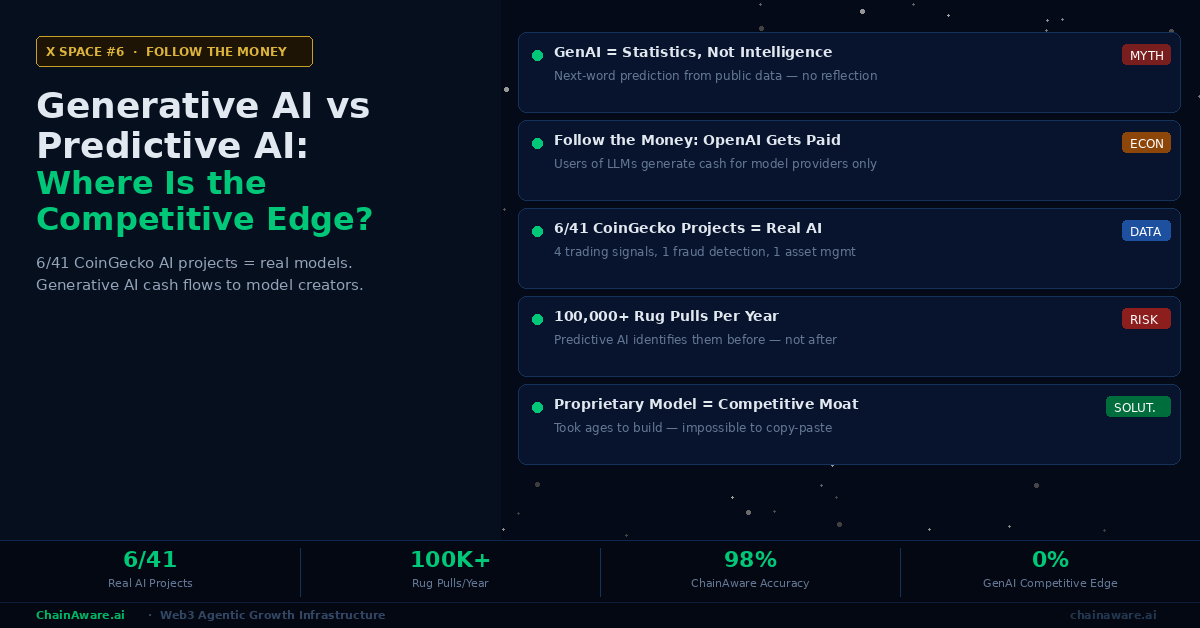
X Space #6 asks the question that most blockchain AI investors have never seriously examined: where does competitive advantage actually come from in AI, and which type of AI creates it? Co-founders Martin and Tarmo apply their combined backgrounds in banking, data science, and product development to dissect the generative AI narrative that currently dominates crypto markets. Their conclusion — backed by a systematic analysis of the CoinGecko AI list — is specific: only 6 out of 41 AI projects in the list at the time had real blockchain AI models. The remaining 35 were either generating NFT images, building chatbots, producing smart contract templates, or simply using OpenAI APIs — none of which creates competitive advantage, none of which generates cash flow for the company using the AI, and none of which has any meaningful connection to blockchain. The session explains why generative AI is structurally incapable of producing competitive advantage, what predictive AI requires to generate it, and why the DeFi copy-paste wave is the perfect historical template for understanding what the current generative AI wave will ultimately deliver to investors.
In This Article
- Generative AI Is Not Intelligence — It Is Statistics
- Level One Thinking: Why Generative AI Cannot Reflect
- Generative AI as Google Search 2.0
- Follow the Money: Who Actually Gets the Cash Flow from Generative AI
- The DeFi Copy-Paste Parallel: Compound, Uniswap, and Now LLMs
- The CoinGecko Analysis: 6 Real AI Projects Out of 41
- NFT Generation, Smart Contracts, Chatbots: No Blockchain Connection
- Why Generative AI Cannot Do Fraud Detection or Rug Pull Prediction
- What Predictive AI Actually Requires
- The 100,000+ Rug Pull Industry: Scale of the Protection Gap
- 10-15 Transactions: Predicting Full User Intentions from Blockchain Data
- Ethereum Gas Fees as Proof of Work: Superior Behavioral Data
- Trading Use Cases: Zug, Bitfinex, and Medium-Term Portfolio AI
- MBA 101: No Competitive Advantage = Risk-Free Rate Returns
- Comparison Tables
- FAQ
Generative AI Is Not Intelligence — It Is Statistics
Tarmo opens X Space #6 with a definitional argument that sets the analytical foundation for everything that follows. The argument is not a subtle technical point — it is a direct challenge to the most widely repeated claim in the current AI narrative. Generative AI, as deployed in large language models, is not artificial intelligence in any meaningful sense. It is statistical prediction dressed in the language of intelligence.
The mechanism is specific: LLMs are trained on the entirety of publicly crawlable internet text — billions of web pages, articles, books, conversations, and forum threads. During training, the model learns which word or token most probably follows any given sequence of preceding tokens, across the full range of contexts present in the training data. At inference time, when a user submits a query, the model identifies the most statistically probable continuation of that query based on everything it learned during training. The output looks like a reasoned response. In reality, it is the statistically most probable next sequence of tokens for that input. As Tarmo explains: “Generative AI is like subconscious. It is programmed that it just answers like this. If you ask why generative AI answers a certain question how it answers, it can’t reply. Something that we call self-reflection — I answer, but why did I answer what I answered? I can’t explain it.” This inability to explain its own outputs is not a limitation that larger models will overcome. It is the architectural consequence of autoregression.
Why Bigger Models Do Not Create Intelligence
Martin extends the argument to address the standard rebuttal: that scaling LLMs with more parameters and more training data produces increasingly intelligent systems. This framing misunderstands what scaling actually achieves. Increasing parameter count improves the model’s ability to predict the next word in more complex and nuanced contexts. Expanding the training dataset improves coverage of the statistical patterns the model can draw on. Neither improvement adds the capacity for reasoning, reflection, or self-correction. As Martin states: “Very well — if you increase parameter size in your neural network, in LLM, and if you increase your training dataset, you get better results. The bigger the model is, the more it can predict which word would be the best next word. But this is not intelligence. Intelligence is when you reflect, you say a sentence, you reflect it, you make a second iteration, you reflect it, you make a third iteration. What we see in generative AI is just a statistically probable answer.” For the deeper analysis of level one versus level two thinking, see our AGI vs LLM guide.
Level One Thinking: Why Generative AI Cannot Reflect
The level one versus level two framework Tarmo introduces distinguishes two qualitatively different modes of cognition that operate on entirely different principles and serve entirely different purposes. Understanding this framework is essential for evaluating any claim about what AI can and cannot do.
Level one thinking is automatic, fast, and pre-programmed. It operates from the subcortical brain — the structures that evolved before the cortex and that handle pattern recognition, habituation, and automatic responses. When you instinctively brake at a red light, complete a familiar sentence, or recognise a face, you are using level one thinking. The output is fast, requires minimal energy, and follows established patterns. Critically, level one thinking cannot explain itself — it just produces outputs.
Level Two Thinking: Iteration, Reflection, and Self-Correction
Level two thinking engages the cortex. It is slow, deliberate, and iterative — it involves forming an output, evaluating that output against criteria, identifying weaknesses, revising, and repeating until the result meets the standard. Writing, mathematical reasoning, strategic planning, and any creative work that requires genuine novelty all depend on level two thinking. The defining property is self-reflection: the ability to evaluate and correct one’s own outputs. Generative AI operates entirely at level one. It produces outputs by pattern matching from training data. It cannot evaluate its own outputs, cannot identify when they are wrong, and cannot revise them through reflection. As Tarmo puts it: “Level one thinking — you are in a kind of zombie mode and you just speak, but it is programmed in your subconsciousness. Level two thinking, you use your cortex, you analyze different options, you evaluate different options, you go through trees and graphs, and you come to conclusions. Current large language models are level one thinking.” For the direct connection to blockchain AI use cases, see our Vitalik AI paper analysis.
Generative AI as Google Search 2.0
Martin introduces a framing device that cuts through the intelligence narrative and describes what LLMs actually are in practical terms: an improved search engine. The comparison is not dismissive — search engines are extraordinarily valuable products. However, the comparison is precise about the nature of the capability.
Google’s original search engine took a query and returned a ranked list of documents from the web that were statistically likely to contain the answer. The user then read those documents and extracted the relevant information themselves. A large language model takes a query and returns a generated text response that is statistically likely to represent a synthesis of relevant content from its training corpus. The user receives a formatted answer rather than a list of source documents. The underlying mechanism — statistical retrieval and ranking from a large corpus — is similar. The presentation is dramatically different. As Martin observes: “There was a Google search engine when you entered the query, and it gives you the documents where it’s listed. Now it’s a search engine where it says to you which are the next words for this query. It’s Google search 2.0. We can say improved Google search. It is not intelligence. Intelligence is that if you have a question, you answer — these are real alternatives, you evaluate them, you reflect, you know why you answer this question this way.” For more on the distinction between retrieval and reasoning, see our AGI vs LLM deep dive.
Real Predictive AI — Not a Wrapper Around Someone Else’s Model
ChainAware Fraud Detector — Proprietary Model, 98% Accuracy
ChainAware built its own fraud detection model — trained iteratively on blockchain transaction patterns, backtested on CryptoScamDB, deployed in real time. No OpenAI API. No generative AI. A proprietary predictive model that others cannot copy-paste. 98% accuracy in under one second. Free for individual address checks.
Follow the Money: Who Actually Gets the Cash Flow from Generative AI
Tarmo applies one of the most reliable analytical frameworks in economics to the generative AI landscape: follow the money. Regardless of the narrative, the competitive dynamics of an industry are revealed by tracing where cash flows actually go. In the generative AI ecosystem, the answer is unambiguous and has profound implications for every company and investor participating in the space.
Cash flow from generative AI accumulates at model creators — OpenAI, Google (Gemini), Microsoft (Azure OpenAI Service), and Anthropic. These companies spent billions training their models on enormous compute infrastructure. Every API call, every subscription, and every enterprise licence generates revenue for them. Companies that build applications on top of these models — chatbots, content generators, customer service tools, image generators — pay per query to the model providers. They may earn a margin on the service they provide to their customers, but the structural value capture sits with the infrastructure layer. As Tarmo frames it: “Who gets the profit from generative AI? These are not companies who use generative AI. These are companies who offer generative AI. This is OpenAI, this is Google with Gemini. These are companies who get profit. Profit is not by companies who use it. Profit is by companies who have built the models.”
Why API Users Have No Sustainable Competitive Advantage
Beyond the cash flow question, Tarmo identifies the structural reason why API-dependent businesses cannot build durable competitive advantages: anyone else can access exactly the same model with the same API. If a company builds a crypto chatbot using OpenAI’s GPT-4 API, any competitor can build an identical crypto chatbot using the same API in days. There is no moat. There is no proprietary technology. There is only the product wrapper and the marketing — neither of which constitutes a durable competitive advantage in a market where the underlying capability is freely available to all. As Tarmo states: “If you use generative AI, you don’t have competitive advantage. Everybody can copy it. And the money remains by those who provide the tools. Those who have models get the cash flow.” For more on why this matters for investment decisions, see our blockchain AI investment analysis.
The DeFi Copy-Paste Parallel: Compound, Uniswap, and Now LLMs
Martin introduces a historical parallel from DeFi’s own development that makes the generative AI dynamic immediately recognisable to anyone who lived through the DeFi wave. The parallel is not just illustrative — it reveals the same underlying market structure operating in a new context.
In the DeFi lending sector, Compound developed and deployed original smart contract code that enabled decentralised lending and borrowing. Within months of Compound’s success, approximately 20 of the top 25 lending protocols on Ethereum had copied Compound’s source code, built their own marketing campaigns, launched tokens, and attracted TVL. Uniswap faced a similar dynamic — its AMM mechanism was widely copied. Martin notes that Uniswap itself copied Bancor’s AMM concept, adding a further layer to the copy-paste chain. The result of all this copying was a predictable cycle: TVL up, token up, TVL down, token down. The companies that captured durable value were not the copy-paste protocols. The beneficiary was Ethereum, which collected transaction fees on every interaction regardless of which protocol users were engaging with.
OpenAI Is the New Ethereum
The parallel maps precisely onto the generative AI landscape. Today, hundreds of blockchain AI projects are building applications on top of OpenAI, Google, and other LLM providers’ APIs. Just as copying Compound’s source code created no competitive advantage for the 20 copy-paste protocols (the value went to Ethereum), building on OpenAI’s API creates no competitive advantage for the applications (the value goes to OpenAI). As Martin explains: “In AI, generative AI, the same pattern. In DeFi there was no competitive advantage — you create competitive advantage via your source code or via your proprietary models. In generative AI there is none. So very similar to the DeFi wave that we had — we had a huge DeFi wave up. Now very similar, we have a generative AI wave.” For the broader context of blockchain industry cycles, see our Web3 market structure analysis.
The CoinGecko Analysis: 6 Real AI Projects Out of 41
Martin presents the most empirically specific analysis in X Space #6: a systematic examination of the CoinGecko AI project list conducted approximately eleven months before the recording. This analysis cuts through the narrative with concrete data about what blockchain AI projects are actually doing versus what they claim to be doing.
Starting from the 41 projects listed in CoinGecko’s AI category (sorted by market cap, with ChainAware at approximately position 40), Martin applied a multi-stage filter. Of the 41 projects, 28 had some kind of running product beyond a website. Of those 28, 15 had products that were in some way AI-related. Of those 15, only 6 had real AI products with a genuine connection to blockchain. The breakdown of those 6 was as follows: 4 were providing trading signals using predictive AI models, 1 was a fraud detection system (ChainAware), and 1 was an AI-driven asset management platform offering portfolio rebalancing and long-term trading signals.
The List Has Grown — But the Ratio Has Not Improved
By the time of the recording, the CoinGecko AI list had approximately tripled in size — from 41 to around 120 projects. ChainAware had moved from position 40 to approximately position 115-120 despite having real, deployed AI products. Martin’s projection: applying the same ratio (6/41 ≈ 15%) to the expanded list suggests approximately 18 projects out of 120 have genuine AI models with blockchain relevance. Over 100 projects in the list appear to have no real AI connection to blockchain at all. As Martin observes: “From 120, maybe 18 have real AI products, meaning models — they have real AI models. But those others have nothing. And what we see is a kind of globally orchestrated campaign about technology where the cash flow lands by three, four, five companies — OpenAI, Microsoft, Google.” For more on how to identify real AI projects, see our Vitalik AI use-case reality check.
NFT Generation, Smart Contracts, Chatbots: No Blockchain Connection
Martin examines the specific generative AI use cases that appear most frequently in the CoinGecko AI list and applies a single diagnostic question to each: what is the inherent connection between this application and blockchain? In every case, the connection is absent or purely superficial.
NFT image and video generation uses generative AI models (typically image diffusion models like Stable Diffusion or DALL-E) to produce digital art. The resulting images are then minted as NFTs on a blockchain. However, the image generation itself has no relationship to blockchain data, blockchain infrastructure, or blockchain’s unique properties. Any generative AI image tool can produce the same images. The blockchain connection is simply the distribution mechanism — the token standard. As Martin states: “There is no inherent connection there. You are generating images or videos — what is the relation of these NFT videos with the blockchain? Let’s be honest and frank, we don’t see any relation there except they are putting this word on their website.”
Smart Contract Generation and Chatbots: Similarly Disconnected
Smart contract generation using AI involves prompting an LLM to produce Solidity or similar code for token contracts. Martin’s assessment is pointed: “Token code is pretty standard code. It’s just copy-paste them. Why do you need generative AI to generate token code? Just use it.” The LLM adds no value that a developer could not achieve with a template and five minutes of editing. Chatbots placed on blockchain project websites or in Telegram groups face the same connection problem: they are conversational interfaces built on LLM APIs. The user asks questions. The LLM produces answers. No blockchain data is involved in the responses. No blockchain-specific capability is being exploited. As Martin observes: “How can a chatbot be related to the blockchain? Is it speaking with other addresses? Is it doing transactions? No. It’s a human interaction, chatbots, where you can ask questions — why is the world round or why is the sky blue.” Digital twins — AI-generated chatbot representations of specific people — fall into the same category: no genuine blockchain connection, no proprietary model, easily replicated by any developer with API access. For more on the realistic intersection of AI and blockchain, see our AI blockchain winning use cases guide.
Why Generative AI Cannot Do Fraud Detection or Rug Pull Prediction
Martin identifies a specific claim made by at least one project in the CoinGecko AI list at the time: the use of generative AI for blockchain fraud detection. His response is both technically precise and unambiguous: this is impossible in principle, not just difficult in practice.
Generative AI models are trained on linguistic data — text, code, and structured language from the public internet. The statistical patterns they learn relate to how words and sentences follow each other in human-generated text. Blockchain transaction data is not linguistic data. It is numerical data representing addresses, amounts, timestamps, function calls, and contract interactions. The two data types are architecturally incompatible as training inputs for the same model architecture. An LLM trained on internet text has learned nothing about behavioral patterns in Ethereum transaction histories. As Martin frames it: “How can they use another LLM to do fraud detection on the blockchain? It is trained with data which is probably two years old and there is no reference to reality. You can’t train generative AI for fraud detection or rug pull detection or price predictions — because you have to create a model and train it with relevant data. But if the models are trained with publicly available linguistic data, how do you want to use generative AI for fraud detection? Very simple. You cannot do it.” For how ChainAware’s actual fraud detection model works, see our fraud detection methodology guide.
What Predictive AI Actually Requires
Having established what generative AI cannot do, Tarmo defines what predictive AI actually is and what it requires to produce the competitive advantage that generative AI cannot. The definition is practical rather than theoretical — grounded in the specific work ChainAware has done building its own models.
Predictive AI starts with a domain-specific problem — fraud prediction, rug pull detection, intention calculation, price movement forecasting. The developer then selects model architectures appropriate to the data type and problem structure, assembles domain-specific training data, trains initial models, evaluates their accuracy against held-out backtesting data, identifies failure modes, modifies the training approach, and iterates. This process repeats for hundreds of iterations. The output is a model with a specific, verifiable accuracy rate on a specific, defined prediction task. As Tarmo defines it: “Predictive AI — I build my own model. It is very domain specific. You make exact predictions. What will happen if your input is following, what will be the output? And we can say probability — 99% or 97% or exact percentage — the result is correct. It is domain specific. It gives you actionable results.” The key words are “actionable” and “verifiable.” Unlike LLM outputs — which may sound plausible but cannot be verified against ground truth — predictive AI outputs carry explicit probability statements that can be independently tested.
The Full Stack from Research to Real-Time
Building a predictive model is only the first stage. Deploying it as a production system that delivers predictions in real time at scale requires a completely different set of engineering work. ChainAware’s fraud detection model, for example, runs at sub-second latency — responding to address queries in half a second to one second — while simultaneously processing the full blockchain interaction history of the queried address. Getting from a research-stage model with acceptable accuracy to a production system with real-time performance required as much engineering work as the model development itself. As Martin notes: “To get it real time, it’s even more work to get it from a research-based model over to a real-time applicable model. And then after real time, to get it scalable.” This full stack — model development, backtesting, real-time deployment, and scaling — represents the intellectual property that competitors cannot copy-paste. For how this applies in practice, see our predictive AI guide.
Predictive AI Before You Invest — Not After You Lose
ChainAware Rug Pull Detector — Built on Real Blockchain Behavioral Data
100,000+ rug pulls per year. PancakeSwap pools with 30-minute to 2-hour lifetimes. ChainAware’s rug pull model is trained on blockchain transaction interaction patterns — not linguistic data, not LLM wrappers. Proprietary model. Real-time. Predicts before the rug pull happens. ETH, BNB, BASE. Free for individual checks.
The 100,000+ Rug Pull Industry: Scale of the Protection Gap
Martin quantifies the rug pull problem in a way that makes ChainAware’s rug pull detection use case immediately concrete. The figure is not ten rug pulls per year or even a thousand. The estimated annual number of rug pulls across blockchain ecosystems is over 100,000. Each one represents an investor who lost not 20% or 50% of their position but 100% — because rug pulls by definition eliminate all value from the affected token.
The mechanism Martin describes applies primarily to PancakeSwap on BNB Chain — one of the most active environments for early-stage token launches and a correspondingly active environment for rug pulls. A team deploys a token contract and a liquidity pool. Automated troll factories begin shilling the token across Telegram channels, Twitter, and Discord — creating artificial excitement and FOMO. New investors enter the pool. The price rises as buying pressure increases. At the moment of maximum FOMO, the pool creators either withdraw all liquidity directly or mint and sell an overwhelming supply of tokens, collapsing the price to zero. Investors who bought at any point during the campaign lose everything. As Martin describes: “The guys who created this token, they just take out all liquidity. Or they inflate tokens to unlimited and sell all the tokens against the existing liquidity. The result — all these guys who had FOMO, who wanted to be the next Vitalik Buterin, they lost not like half or 30%. No. They lost everything. Everything.” For how to use ChainAware’s rug pull detector against this specific threat, see our rug pull detection guide.
10-15 Transactions: Predicting Full User Intentions from Blockchain Data
Tarmo introduces one of the most striking empirical observations in X Space #6, drawing on his experience as chief architect of Finnova — the banking platform running more than 251 Swiss banks. The observation relates to how little data is needed to make accurate behavioral predictions when the data quality is high enough.
At Finnova, Tarmo worked with bank-grade financial transaction data covering millions of customers. The platform’s predictive models required only 10-15 transactions from a new customer to predict that customer’s full behavioral profile with high accuracy — when they would take a car lease, which investment products they would choose, whether they were a borrower or a lender, and what their risk appetite was. The reason so few data points sufficed is that financial transactions are costly and deliberate. Each transaction reflects a genuine decision that reveals the person’s priorities, capabilities, and intentions more precisely than hundreds of social media posts or search queries. As Tarmo explains: “Based on a really small set of transactions, what a customer has done — maybe 10, 15 — you can predict his intentions, what the customer really wants. Does he want to play Russian roulette in blockchain? Or is he an NFT type? Or is he DeFi lending? You can just take transactions and say what the real intentions of a user are.”
Applying This to Blockchain: Every Wallet Carries Its Behavioral Profile
The same principle applies to blockchain transaction data, with additional advantages. Every wallet address carries its complete transaction history publicly and immutably on-chain. ChainAware’s intention models analyse this history and produce specific behavioral predictions: is this user a DeFi borrower? A high-frequency trader? An NFT collector? A newcomer? A potential fraudster? Each prediction derives from the statistical patterns in the wallet’s transaction graph. The predictions enable Web3 platforms to serve each user content and interfaces matched to their actual intentions rather than a generic message designed for a hypothetical average user. For the complete intention prediction framework, see our intention-based marketing guide and our behavioral analytics guide.
Ethereum Gas Fees as Proof of Work: Superior Behavioral Data
Martin makes a data quality argument that explains why blockchain financial data produces better predictions than the behavioral data that Web2 giants like Google have built their advertising businesses on. The argument hinges on a property unique to proof-of-work blockchains like Ethereum: every transaction costs real money in the form of gas fees.
Google’s intention prediction infrastructure operates on search queries and browsing history — data that costs nothing to generate. A user can search for anything in response to a momentary curiosity, a social media trigger, or simple boredom. The resulting data reflects what captured the user’s attention at a given moment, not what they are genuinely committed to doing with their money or time. Browsing history is similarly noisy — it reflects where external triggers directed the user, not their internal priorities. Blockchain transactions, by contrast, require deliberate decision-making and real financial cost. Every Ethereum transaction the user executes represents a choice they were willing to pay for. Gas fees are, in effect, a commitment signal that filters out casual and accidental behavior. As Martin explains: “We like Ethereum because there’s a gas fee and gas fee is a proof of work. This means cost involved. And this cost involved means people are doing on Ethereum really what they want to do. So the predictive power of Ethereum data is huge on the intentions.” Furthermore, this superior data is free — accessible to anyone with a blockchain reader, no licensing agreement required. For the complete data quality analysis, see our Web3 targeting guide.
Trading Use Cases: Zug, Bitfinex, and Medium-Term Portfolio AI
Beyond fraud detection, rug pull prediction, and intention calculation, Tarmo identifies two additional established predictive AI use cases in blockchain that represent genuine competitive advantages for those with the technical capability to implement them.
Low-latency trading leverages the physical proximity of trading algorithms to exchange compute infrastructure. In Zug, Switzerland — the city known as Crypto Valley — over 100 hedge funds focus specifically on short-term crypto trading strategies built around direct cable connections to Bitfinex’s computer centre. Tarmo brings personal experience here: before Credit Suisse, he worked at Man Investments, the largest independent hedge fund, where he observed these short-term trading strategies operating at scale. The competitive advantage in this domain is primarily physical: the shorter the network cable between the trading algorithm and the exchange’s matching engine, the faster the execution, and the more reliably the strategy captures microsecond-level price differentials. As Tarmo notes: “The guy who has the shortest internet connection line — this guy wins.”
Medium and Long-Term Portfolio AI: Deep Data Science Required
Medium and long-term portfolio management AI operates on a different competitive basis. Here, the advantage comes from the depth of data science expertise applied to multi-asset portfolio optimisation: when to rebalance, how to adjust asset ratios based on predicted price movements, how to identify correlation changes between assets, and how to manage downside risk while maximising risk-adjusted returns. Tarmo notes that well-built systems in this category can achieve strong Sharpe ratios and Sortino ratios, but the bar for competence is high: “You have to be really expert in machine learning, in statistics, in mathematics, to play medium-term and long-term trading with artificial intelligence.” Critically, the first question for any AI trading claim is identical to the first question for any other AI claim: do you have your own model, or are you using someone else’s? For more on AI-powered portfolio management in DeFi, see our AI blockchain use cases guide.
MBA 101: No Competitive Advantage = Risk-Free Rate Returns
Tarmo closes the substantive analysis with an economic framework from his MBA training that reduces the entire generative AI vs predictive AI question to its investment implications. The framework is foundational to competitive strategy and directly applicable to every investment decision in the blockchain AI space.
In competitive markets, economic theory holds that in the absence of competitive advantages — unique capabilities, proprietary technology, or other barriers to imitation — companies earn returns equal to the risk-free rate. Without something that competitors cannot easily replicate, price competition drives margins to zero and investors earn only what they could have earned from risk-free assets like government bonds. Companies with genuine competitive advantages earn returns above the risk-free rate — the “excess return” that justifies the investment risk. This framework applies directly to blockchain AI companies. A company building an application on OpenAI’s API has no competitive moat. Any competitor can build the same application. Price competition will eliminate margins. Returns will converge to the risk-free rate — or worse, given the additional risk of operating in volatile blockchain markets. As Tarmo states: “If you want a company which generates money, look for companies who do predictive AI. These are companies who can generate money. Companies who use generative AI cannot have competitive advantage, cannot generate positive cash flow. So better invest in US treasuries than in generative AI user companies.” For the complete investment framework, see our unit cost and competitive advantage guide.
Comparison Tables
Generative AI vs Predictive AI: Competitive Advantage Analysis
| Dimension | Generative AI (LLMs) | Predictive AI (Domain Models) |
|---|---|---|
| Core mechanism | Next-token prediction from public training data | Domain-specific probability scoring from proprietary training data |
| Thinking level | Level one — unconscious pattern matching | Trained for specific verifiable prediction tasks |
| Self-reflection capability | None — cannot explain own outputs | Backtestable — accuracy verified against ground truth |
| Training data | All public internet text — available to anyone | Proprietary domain-specific blockchain transaction data |
| Who gets the cash flow | Model creator (OpenAI, Google, Microsoft) | Model owner (e.g. ChainAware) |
| Copy-paste risk | Extremely high — same API accessible to all | Extremely low — model took months/years to build |
| Competitive advantage | None — returns converge to risk-free rate | Strong — proprietary model creates durable moat |
| Blockchain data compatibility | None — trained on linguistic not transaction data | Native — transaction patterns are the input |
| Fraud detection feasibility | Impossible in principle | 98% accuracy (ChainAware deployed) |
| Rug pull detection feasibility | Impossible in principle | Deployed — real-time, before it happens |
| DeFi parallel | Copy-paste protocols (Compound forks) — value went to Ethereum | Original protocols (Compound, Uniswap) — had actual IP |
| Investment implication | Worse than US treasury bonds (risk + no alpha) | Sustainable cash flow if model is deployed and real |
CoinGecko AI List Reality: Real vs Narrative Projects
| Category | Count (of 41 projects, 11 months pre-recording) | Has Real AI Model? | Has Blockchain Connection? | Competitive Advantage? |
|---|---|---|---|---|
| Trading signal AI | 4 | ✅ Yes — proprietary predictive models | ✅ Yes — trained on blockchain price/volume data | ✅ Yes — proprietary models |
| Fraud detection AI | 1 (ChainAware) | ✅ Yes — 98% accuracy, real-time | ✅ Yes — trained on blockchain transaction patterns | ✅ Yes — months of iterative training |
| Asset management / portfolio AI | 1 | ✅ Yes — ML portfolio models | ✅ Yes — crypto asset data | ✅ Yes — proprietary models |
| NFT image / video generation | ~6 | ❌ No — using OpenAI / Stable Diffusion APIs | ❌ No — token on blockchain, content is not | ❌ None — anyone can replicate in days |
| Smart contract generation | ~3 | ❌ No — LLM API wrapper | ⚠️ Marginal — output is a contract, not AI insight | ❌ None — token templates are free anyway |
| Chatbots / digital twins | ~4 | ❌ No — LLM API wrapper | ❌ No — conversational AI with no blockchain data | ❌ None — any developer can replicate |
| Other / unclear | ~22 | ❌ No clear AI model | ❌ No clear connection | ❌ None |
Frequently Asked Questions
Why does generative AI have no competitive advantage?
Competitive advantage requires something that competitors cannot easily replicate. Generative AI applications built on LLM APIs (OpenAI, Google, Anthropic) use models that are accessible to everyone via public APIs. Any product built on these APIs can be replicated by any developer with API access in days or weeks. There is no proprietary technology, no unique data, and no durable differentiation. As a result, price competition eliminates margins, and returns converge to the risk-free rate — or worse, given the operational risks. In contrast, proprietary predictive AI models built on unique domain-specific training data cannot be copy-pasted. They represent months or years of iterative development work that competitors must replicate from scratch.
What questions should investors ask blockchain AI companies?
Tarmo identifies two essential due diligence questions. First: do you have your own model, or are you using someone else’s model? If the answer is “we use OpenAI’s API,” the company has no competitive advantage and likely no sustainable cash flow. Second: with what data did you train your model? For blockchain AI applications, the training data must be blockchain transaction data — not public internet text. A fraud detection model trained on internet text is architecturally impossible to deploy effectively. If a company cannot answer both questions with specifics, it is almost certainly a narrative project rather than a real AI company. For the full assessment framework, see our blockchain AI reality check.
Why can generative AI not detect blockchain fraud?
Generative AI models are trained on linguistic data — text in natural language from the public internet. Blockchain fraud detection requires identifying behavioral patterns in transaction data: the sequence, timing, counterparty relationships, and amounts of on-chain interactions. These two data types are architecturally incompatible. An LLM trained on internet text has learned statistical patterns in human language. It has learned nothing about the behavioral signatures that precede fraudulent blockchain transactions. Additionally, LLM training data is typically at least one to two years old, while fraud patterns evolve continuously. ChainAware’s fraud detection model is trained specifically on blockchain transaction patterns, iteratively updated, and verified with 98% backtested accuracy. There is no shortcut using generative AI to achieve this result.
What is the DeFi copy-paste parallel to generative AI?
In DeFi’s development, Compound created the original smart contract code for decentralised lending. Within months, approximately 20 protocols had copied Compound’s source code and launched with aggressive marketing campaigns. None of these copy-paste protocols created durable value — the only beneficiary was Ethereum, which collected transaction fees on every interaction. The generative AI wave follows the same pattern: hundreds of blockchain projects are building applications on top of OpenAI, Google, and Microsoft’s LLM APIs, creating no proprietary technology and no competitive advantage. The only beneficiaries are the model providers, who collect API fees on every interaction. The investments in copy-paste DeFi protocols ultimately returned nothing to investors who bought narratives over substance. The same outcome awaits most blockchain generative AI projects.
How many real AI projects exist in blockchain?
Based on ChainAware’s systematic analysis of the CoinGecko AI list approximately eleven months before X Space #6, only 6 out of 41 listed projects had real AI models with genuine blockchain connections: 4 trading signal systems, 1 fraud detection platform (ChainAware), and 1 asset management platform. Applying the same ~15% ratio to the expanded list of approximately 120 projects at the time of recording suggests roughly 18 projects had real AI models. The remaining 100+ projects either used generative AI APIs (no blockchain connection, no competitive advantage) or had no meaningful AI component at all despite being listed in CoinGecko’s AI category.
Real Proprietary Models — Not API Wrappers
ChainAware Prediction MCP — The 1 in 41 That Actually Built Models
Fraud detection (98%), rug pull prediction, intention calculation, credit scoring — all proprietary models trained on blockchain transaction data. Months of iterative development. Cannot be copy-pasted. Generate real cash flow. 14M+ wallets. 8 blockchains. 31 MIT-licensed agents. The competitive advantage that generative AI cannot replicate.
This article is based on X Space #6 hosted by ChainAware.ai co-founders Martin and Tarmo. Watch the full recording on YouTube ↗ · Listen on X ↗. For questions or integration support, visit chainaware.ai.