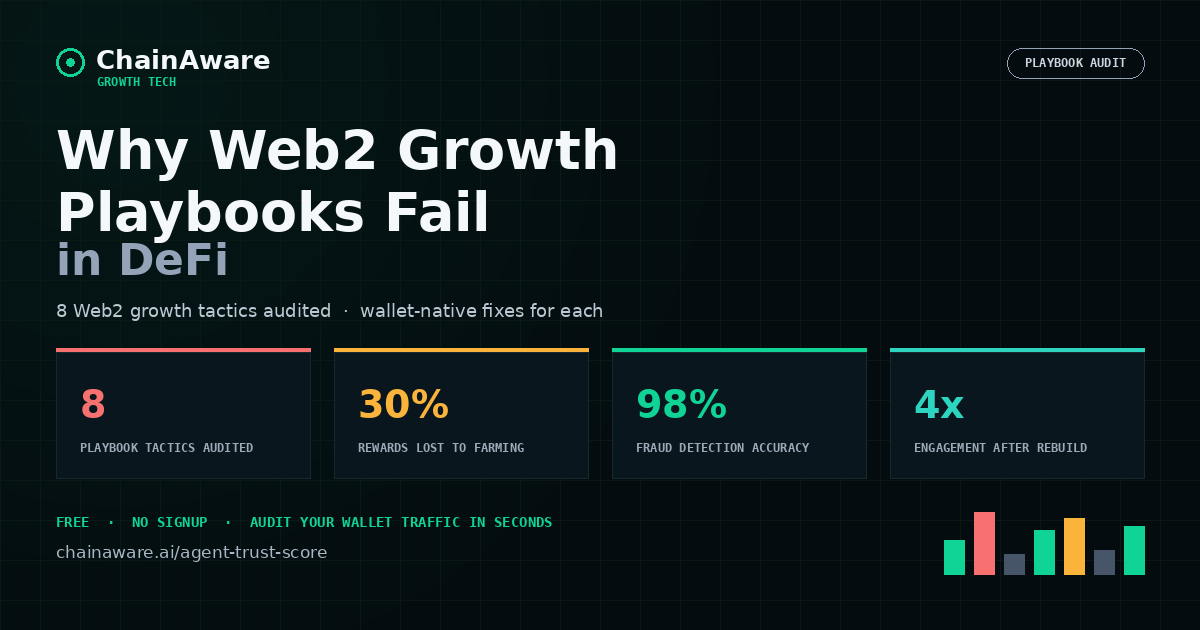
Why Web2 Growth Playbooks Fail in DeFi

Every major Web2 growth tactic – AARRR funnel tracking, CRM and lifecycle email, paid retargeting, loyalty and gamification, referral attribution, community-led growth, cohort segmentation, and multi-touch attribution – depends on persistent user identity. DeFi’s anonymous wallet model breaks that assumption, which is why standard growth stacks underperform in Web3. This guide breaks down each of the eight tactics individually, shows exactly where the identity dependency lives inside it, and maps it to its wallet-native replacement. Airdrop farming and Sybil attacks drain a large share of incentive budgets, loyalty programs reward the wrong wallets, and referral links lose attribution at the wallet connection. ChainAware’s behavioral intelligence platform – 23M+ wallet-level profiles across 8 blockchains (ETH, BSC, Base, Polygon, TON, Tron, Solana, HAQQ), Growth Agents, the Web3 Persona and On-Chain Marketing Analytics – restores the missing layer by combining session data with wallet-level behavior. Profiling runs in under 100ms through the Prediction MCP, and wallet personalization lifts connect-to-transact to 40-60% versus an industry baseline under 10%, as seen in the SmartCredit.io case study. Learn more at chainaware.ai/learn/growth-tech/growth-agents.html.
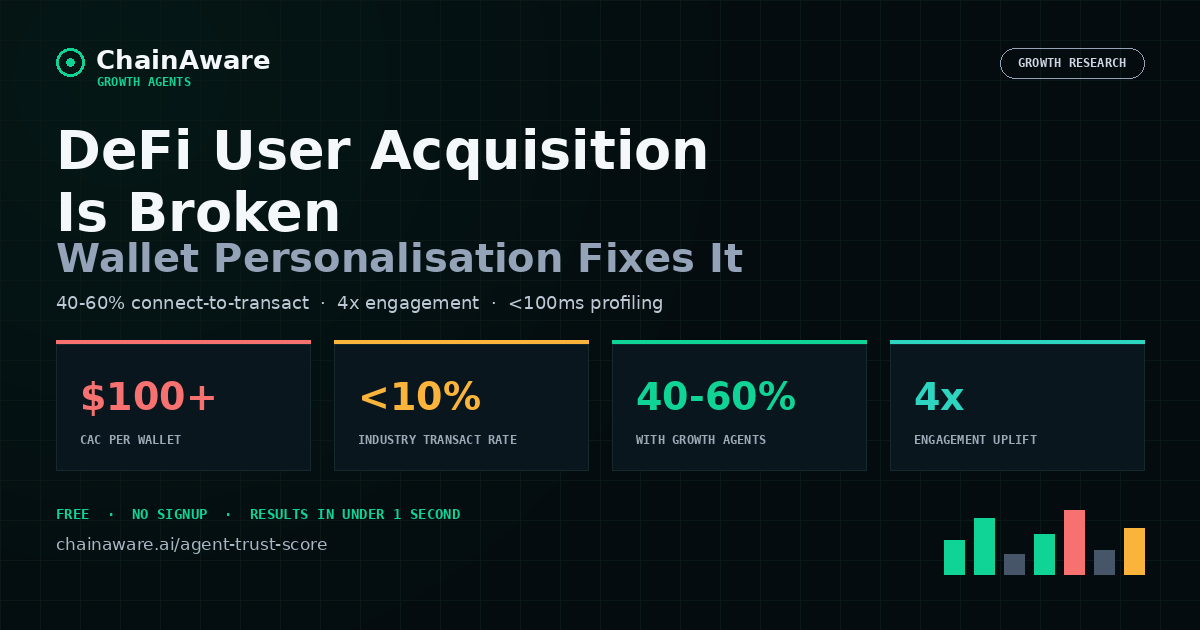
Why DeFi User Acquisition Is Broken – And How Wallet Personalisation Fixes It

DeFi teams spend more than $100 to acquire every connecting wallet, yet fewer than 10% of connected wallets ever transact, pushing real CAC above $1,000 per engaged user. This article explains why Web2 identity tools – cookies, email capture, CRM, A/B testing – cannot read wallet addresses, and how wallet-level behavioral intelligence fixes it. ChainAware’s Growth Agents combine session data with wallet data, profiling every connecting wallet in under 100ms through the Prediction MCP, using the ChainAware Web3 Persona: experience level, risk profile, intent and predicted next action. Tool-specific copy, calls to action and onboarding paths then adapt to each visitor, which lifts connect-to-transact rates to 40-60% against an industry baseline under 10%. The guide covers the cost of the connect-to-transact gap, the persona signals that drive personalization, fraud and Sybil screening in the same call, and a SmartCredit.io case study with a 4x engagement uplift. ChainAware profiles 23M+ wallets across 8 chains (Ethereum, BNB Chain, Base, Polygon, TON, Tron, Solana and HAQQ) and runs Growth Agents as part of its 34 Claude sub-agents across Fraud Tech and Growth Tech. Integration takes about 30 minutes. Learn more at chainaware.ai/learn/growth-tech/growth-agents.html.
ChainAware.ai’s 32 Claude Sub-Agents – Fraud Tech and Growth Tech for the Agentic Economy

ChainAware.ai operates on 32 Claude sub-agents – each one a specialist wrapping ChainAware’s Prediction MCP with precise decision logic and behavioral reasoning. This article classifies all 32 agents into Fraud Tech (17 agents) and Growth Tech (15 agents), with use case and trigger conditions for every agent.

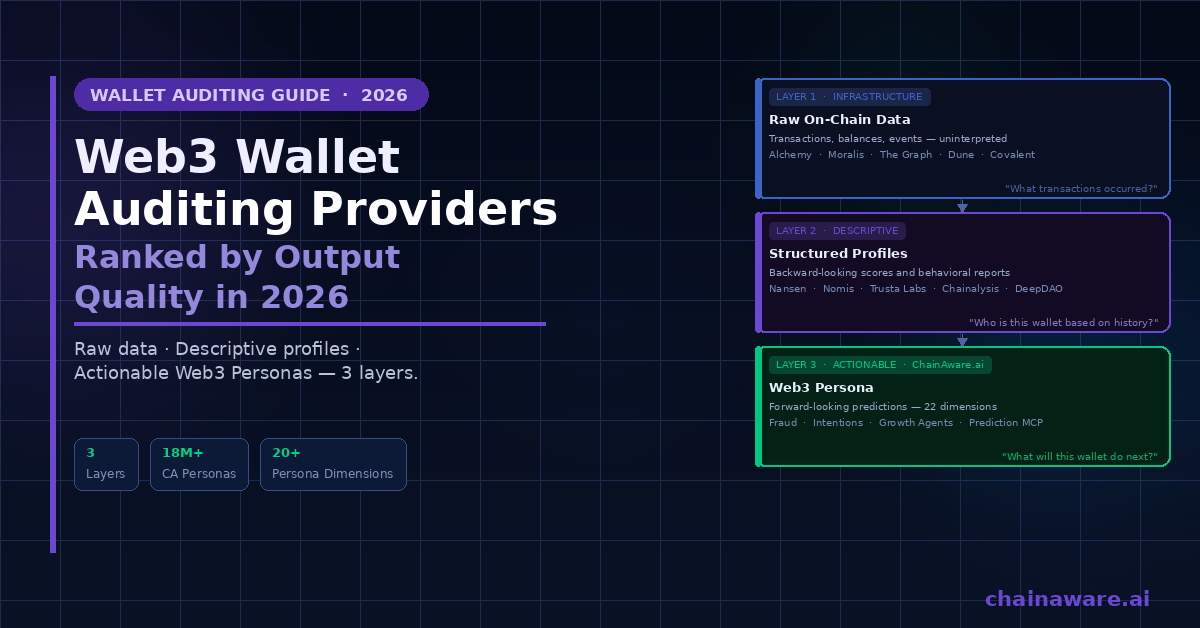
Web3 Wallet Auditing Providers in 2026 – From Raw Blockchain Data to Actionable Web3 Personas

Every wallet address that connects to your DApp carries a complete behavioral history. In 2026, three distinct layers of wallet auditing infrastructure have emerged – raw data, descriptive profiles, and actionable predictions – and confusing them leads to selecting the wrong tools for the job.

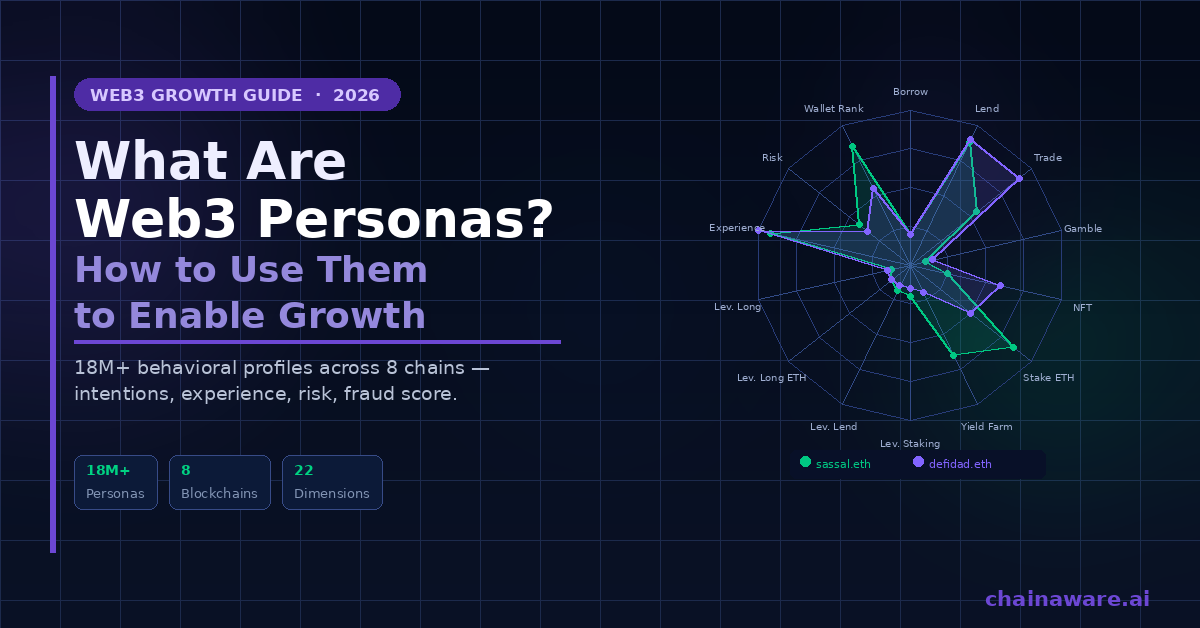
What Are Web3 Personas? How to Use Them to Enable Your Growth – Complete Guide 2026

A Web3 Persona is a calculated behavioral profile of who is behind any wallet address – their intentions, experience level, risk appetite, and predicted next actions. This guide explains what they are, how ChainAware builds 18M+ of them across 8 blockchains, and how DApps use them to enable real growth.

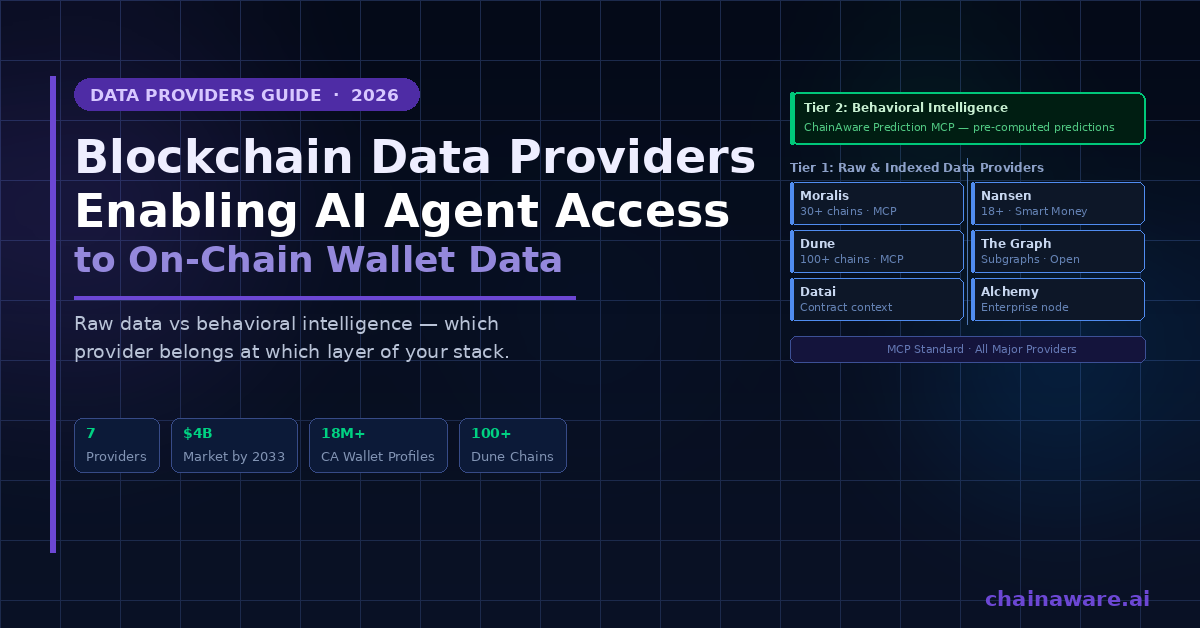
Blockchain Data Providers Enabling AI Agent Access to On-Chain Wallet Data – Complete Guide 2026

AI agents need on-chain wallet data to make intelligent decisions – but most blockchain data providers were built for human analysts, not autonomous systems. This guide maps every major provider enabling AI agent access to wallet data in 2026, from raw indexers to pre-computed behavioral intelligence layers.

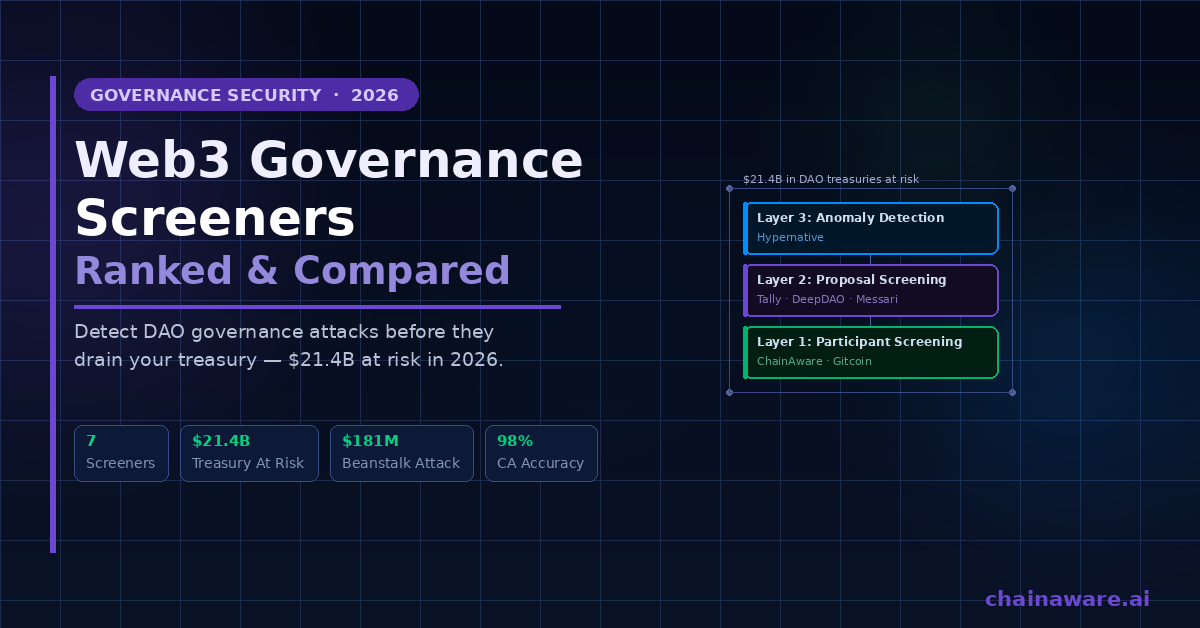
Best Web3 Governance Screeners in 2026 – Detect DAO Governance Attacks Before They Drain Your Treasury

$21.4 billion in liquid DAO treasury assets sits exposed to governance attacks. One malicious proposal can drain a treasury in a single block – as Beanstalk proved with $181M lost in 2022. This guide covers every major Web3 governance screener in 2026 and how to detect attacks before they execute.

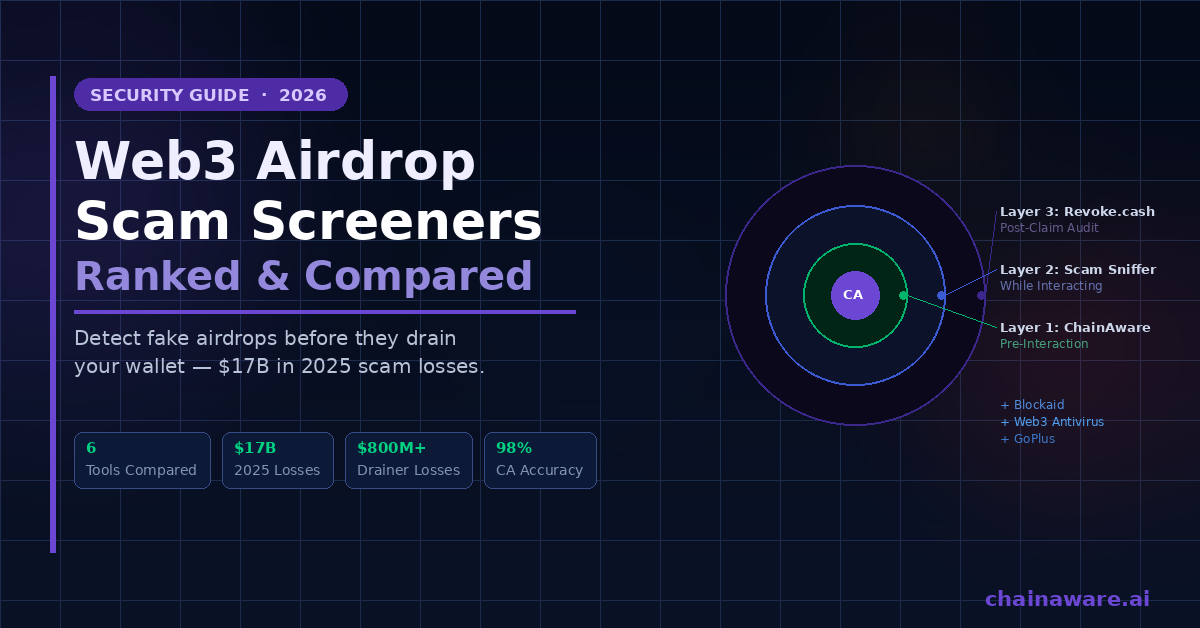
Best Web3 Airdrop Scam Screeners in 2026 – How to Detect Fake Airdrops Before They Drain Your Wallet

Crypto scam losses hit $17 billion in 2025, with fake airdrops among the fastest-growing attack vectors – impersonation scams grew 1,400% year-over-year. This guide covers every major airdrop scam screener in 2026 and how to detect fake airdrops before they drain your wallet.

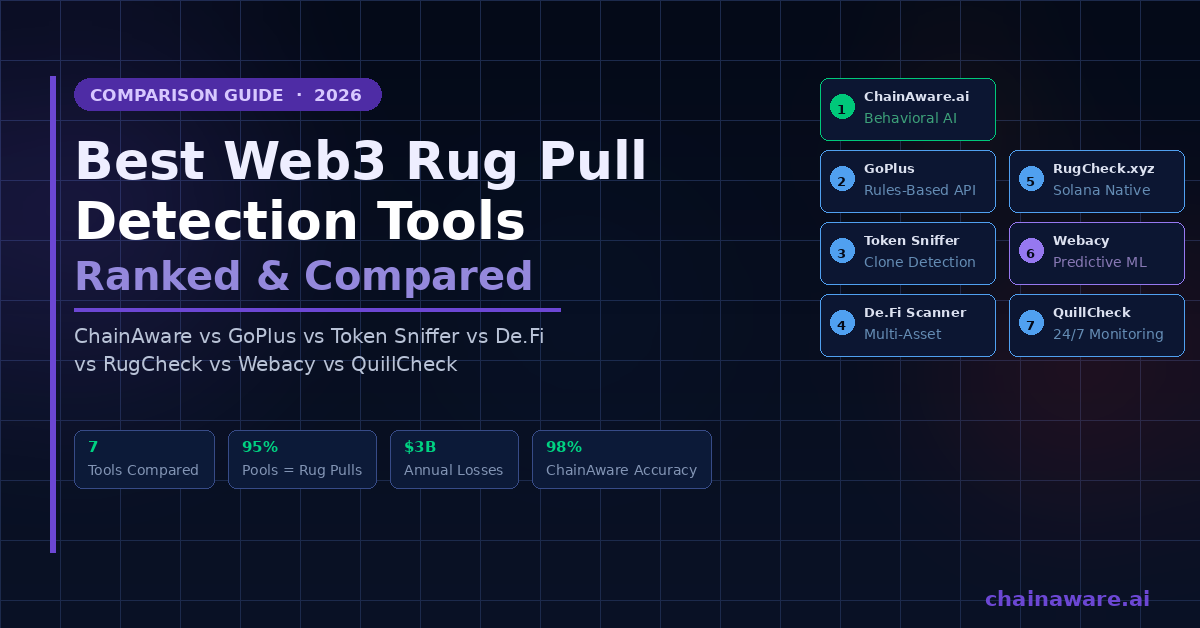
Best Web3 Rug Pull Detection Tools in 2026 – Ranked & Compared

Rug pulls cost investors $3 billion annually. 95% of PancakeSwap pools end in rug pulls. 99% of Pump.fun tokens extract money from buyers. This guide ranks and compares every major Web3 rug pull detection tool in 2026 – ChainAware, GoPlus, Token Sniffer, De.Fi Scanner, RugCheck, Webacy, and QuillCheck.

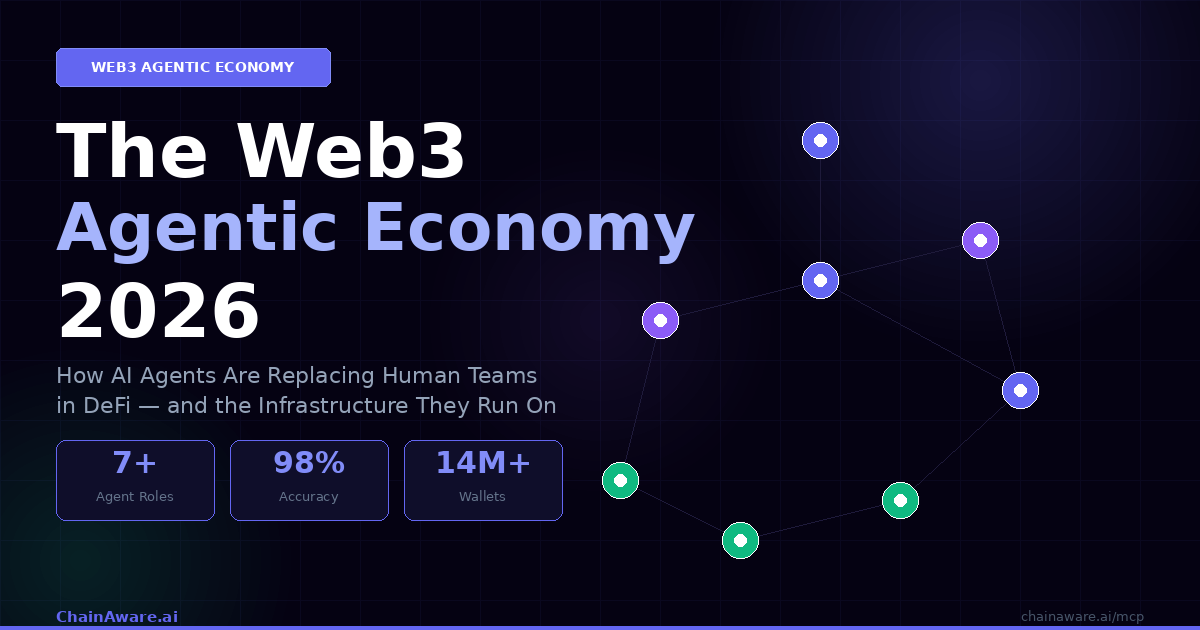
The Web3 Agentic Economy: How AI Agents Are Replacing Web3 Growth Teams

AI agents are replacing compliance officers, growth teams, and fraud analysts across Web3. This guide covers how the agentic economy works, which human functions are being automated first, and how ChainAware’s 32-agent infrastructure – fraud detection, AML scoring, rug pull detection, wallet ranking, growth targeting – powers the shift on 8 blockchains.