
If you’ve built or run a DeFi platform, you know the paradox: the blockchain generates more behavioral data than any other technology in history, yet most DeFi protocols make decisions as if they’re operating blind. Liquidity is managed reactively. Risk is assessed on stale snapshots. Every user gets the same interface regardless of whether they’re a whale lender or a first-time swapper.
The gap between the data that exists and the decisions being made is the opportunity. And the ChainAware.ai Behavioral Prediction MCP is the tool that closes it.
By connecting any DeFi platform or AI agent to a continuously updated behavioral intelligence layer — 14M+ wallet profiles across 8 blockchains, updated in real time — the Prediction MCP transforms raw on-chain activity into actionable predictions your protocol can act on immediately.
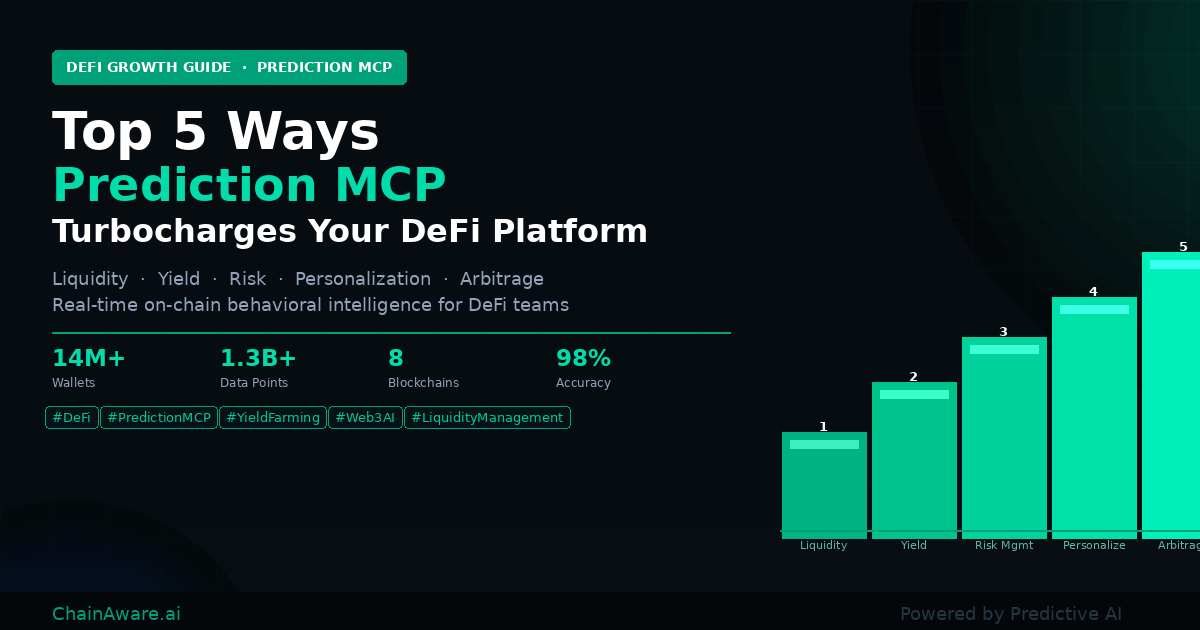
Here are the 5 highest-impact ways DeFi platforms are already using it.
Why DeFi Platforms Need Predictive Behavioral Context
Traditional DeFi analytics tools answer one question: what happened? They show you token balances, historical trade volumes, TVL trends, and past liquidations. This is useful for reporting — but useless for real-time decision-making.
The question that actually drives value is: what is about to happen? Which wallets are about to add liquidity? Which are about to withdraw? Which high-value borrowers are most likely to repay on time? Which wallets showing unusual behavior patterns are likely bad actors?
Answering these questions requires predictive behavioral analytics trained on the full history of on-chain activity across millions of wallets — not just the data from your own protocol. ChainAware.ai has built exactly this: a Web3 Predictive Data Layer processing 1.3 billion+ data points across 14M+ wallet profiles on 8 blockchains. The Behavioral Prediction MCP makes this layer available to any DeFi platform or AI agent through a single endpoint connection.
According to McKinsey’s research on data-driven personalization, platforms that act on behavioral signals in real time generate 40% more revenue than those relying on historical averages. In DeFi, where yield differentials are measured in basis points and user acquisition is expensive, that margin is the difference between growth and stagnation.
For the full technical architecture of the MCP, see our complete Prediction MCP developer guide.
For DeFi Developers & Protocol Teams
Add Predictive Intelligence to Your DeFi Platform
Connect to 14M+ wallet behavioral profiles in real time. The Behavioral Prediction MCP delivers live intent signals, risk scores, and wallet rankings to your protocol — via a single endpoint, in minutes.
#1: Optimize Liquidity Management with Predictive Capital Flow Signals
Liquidity is the lifeblood of any DeFi protocol. Too little and you can’t fill orders, support borrowers, or maintain competitive yields. Too much sitting idle and you’re wasting capital efficiency. The challenge is that liquidity needs shift constantly — and traditional protocols only see the shift after it happens.
Predicting Liquidity Movements Before They Occur
The Behavioral Prediction MCP delivers real-time add_liquidity_probability and withdraw_probability scores for every wallet interacting with your protocol. When a cluster of high-value wallets begins showing elevated withdrawal intent scores, your protocol has advance warning — minutes or hours before the actual transactions hit the mempool.
With that warning, your AI agent or automated strategy engine can:
- Temporarily boost APRs on at-risk pools to discourage outflows
- Pre-position reserves to cover anticipated withdrawals without disrupting active positions
- Alert governance or treasury teams to large predicted capital movements
- Redirect incentive rewards toward wallets predicted to add liquidity, maximizing their effectiveness
Targeting the Right LPs Before Your Competitors Do
The MCP also identifies wallets with high add_liquidity_probability scores who haven’t yet interacted with your protocol. Your AI agent can reach out to these wallets proactively — through personalized in-app messaging, targeted campaigns, or automated on-chain incentives — before competing protocols do. This is a fundamental shift from reactive LP recruitment to proactive capital acquisition.
The result: healthier TVL, more stable pool depths, and lower impermanent loss exposure for your existing LPs — which in turn makes your protocol more attractive to the next wave of liquidity providers.
#2: Automate Yield Farming Strategies with Intent-Based Routing
Yield farming is one of DeFi’s most competitive activities. Farmers constantly scan for the best risk-adjusted returns, and they move capital within minutes when better opportunities emerge. Platforms that can identify yield-seeking wallets before they move gain a decisive first-mover advantage.
Routing Capital to High-Yield Pools at the Right Moment
The Behavioral Prediction MCP provides stake_intent and farm_preference signals that classify each wallet’s current yield-seeking posture. When a wallet’s signals indicate it’s actively scanning for new farming opportunities, your platform can surface the most relevant pools — personalized to that wallet’s historical risk tolerance and preferred asset types.
This turns your protocol from a passive destination into an active guide: instead of waiting for yield farmers to discover your pools, you meet them at the moment of intent with exactly the opportunity they’re looking for.
Minimizing Gas Costs with Timing Intelligence
The MCP also captures gas_price_tolerance signals that indicate how sensitive each wallet is to transaction costs. For gas-sensitive wallets, your AI agent can time transaction suggestions for periods of lower network congestion, improving net yield. According to Ethereum’s gas documentation, gas costs can vary by 5-10x across a single day — timing-aware routing can recover substantial value for yield farmers operating at scale.
Early Entry into New Farms Before TVL Spikes
By combining stake intent signals with protocol monitoring, your system can identify wallets most likely to be early movers into new yield opportunities — and position them before TVL surges compress returns. Early entry consistently delivers 2-5x better APY than joining after a farm reaches peak TVL.
#3: Enhance Risk Management with Real-Time Behavioral Scoring
Risk management in DeFi has historically meant two things: overcollateralization requirements and liquidation bots. Both are blunt instruments. Overcollateralization excludes legitimate high-quality borrowers. Liquidation bots react to events that have already happened, often at the worst possible moment for market stability.
The Behavioral Prediction MCP adds a third layer: predictive risk assessment that identifies high-risk behavior patterns before they result in losses.
Real-Time Fraud and Anomaly Detection
Every wallet queried through the MCP receives a fraud probability score from ChainAware.ai’s Predictive Fraud Detector, which achieves 98% accuracy on Ethereum and 96% accuracy on BNB Smart Chain. Wallets showing suspicious behavioral patterns — sudden large transfers, unusual contract interaction sequences, connections to known exploit addresses — are flagged before they can execute damaging transactions.
Your DeFi protocol can automatically route high fraud-score wallets to additional verification, restrict access to high-value features, or alert your security team — all without manual monitoring. For the full technical breakdown of how this works, see our article on AI-based predictive fraud detection in Web3.
Behavioral Credit Scoring for Smarter Lending
Beyond fraud, the MCP delivers ChainAware.ai’s Credit Score — a behavioral reputation metric for borrowers built from their full on-chain history across all supported chains. Unlike simple collateral ratios, the Credit Score reflects actual repayment behavior, protocol track record, and cross-chain financial responsibility.
DeFi lending protocols using Credit Scores can offer differentiated terms: lower collateral requirements for high-credit wallets, better interest rates for proven borrowers, and tighter restrictions for wallets with poor repayment histories. This is already live in production at SmartCredit.io — read the full case study in our SmartCredit.io conversion and risk case study.
Preemptive Anomaly Detection at the Protocol Level
When multiple wallets within a short time window show correlated anomalous behavior — a classic signal of coordinated exploit preparation — the MCP flags the pattern at the protocol level. Your governance system can automatically pause affected pools, notify multisig signers, or trigger circuit breakers before a loss event occurs rather than after.
According to Chainalysis’s 2024 crypto crime report, DeFi protocols lost over $1.8 billion to hacks and exploits — the vast majority of which showed detectable on-chain precursor signals before the attack executed. Predictive behavioral monitoring is the missing layer that turns those signals into protection.
Protect Your Protocol Before Losses Occur
Add 98%-Accurate Fraud Detection to Your DeFi Platform
Every MCP query includes a real-time fraud score powered by ChainAware.ai’s Predictive Fraud Detector. Flag high-risk wallets before they execute — no separate integration required.
#4: Personalize Vault and Pool Recommendations for Every Wallet
DeFi interfaces have historically treated every user identically. Every wallet that connects sees the same TVL leaderboard, the same featured pools, the same generic APY tables. This is the Web3 equivalent of a bank showing every customer the same mortgage offer regardless of their credit history, income, or risk appetite.
Personalization changes this fundamentally — and the Behavioral Prediction MCP makes it possible at scale, without cookies, logins, or CRM data.
Behavioral Segmentation Without User Registration
The moment a wallet connects to your protocol, the MCP returns its full behavioral profile: risk tolerance category, preferred asset types, historical protocol usage, experience level, and predicted next action. Your AI agent uses this context to immediately personalize the interface — before the user has even scrolled.
A conservative stablecoin holder sees USDC and DAI yield strategies front and center. An aggressive leverage trader sees your highest-APY leveraged vaults and advanced order types. A new wallet sees a simplified onboarding flow with educational tooltips. Each user experiences a platform that seems to understand them — because it does.
1:1 Vault Recommendations That Convert
Generic “Top Pools” lists have low conversion because most of the options shown are irrelevant to any given user. Personalized recommendations — “Based on your trading history, here are 3 pools you’re most likely to find valuable” — convert dramatically better because they match user intent.
The MCP’s behavioral_category and prediction scores give you everything needed to build these recommendations without any additional data collection. Salesforce research shows that 73% of consumers expect personalized experiences and actively disengage when they don’t receive them. DeFi users are no different — and the protocols that deliver personalization will capture the users that generic interfaces are losing.
Continuous Portfolio Rebalancing
For protocols with portfolio management features, the MCP enables continuous automated rebalancing based on each wallet’s evolving behavioral signals. When a wallet’s risk profile shifts — from active trader to passive holder, for example — the rebalancing engine automatically adjusts the portfolio composition to match the new profile. Users get a living portfolio that adapts to them, not one they have to manually adjust every time their circumstances change.
For a broader look at how personalization drives DeFi growth, see our piece on why personalization is the next big thing for AI agents in Web3.
#5: Seize Arbitrage Windows Before the Market Catches Up
Arbitrage opportunities in DeFi are measured in seconds. Price discrepancies across DEXes, cross-chain spread windows, and momentary liquidity imbalances all close faster than any human can react. Most arbitrage today is dominated by MEV bots operating at the mempool level.
But there’s a class of slower arbitrage — measured in minutes or hours — where behavioral intelligence provides a genuine edge. When predictive signals show that a large coordinated capital movement is imminent, platforms that pre-position assets capture the spread. Those that react after the movement has occurred do not.
Cross-Chain Arbitrage with Intent Signals
The MCP’s cross_chain_swap_intent signals identify wallets preparing to bridge assets between networks. When a significant cluster of wallets shows elevated bridge intent toward a specific destination chain, that’s a leading indicator of price pressure on that chain’s major trading pairs.
Your system can pre-position assets on the destination chain before the capital arrives, capturing the spread that the incoming volume will create. This is behavioral arbitrage — a fundamentally different strategy from mempool-level MEV, and one that doesn’t require the same ultra-low latency infrastructure.
Liquidation Anticipation
The MCP’s risk scoring can identify wallets approaching liquidation thresholds before their collateral ratios formally trigger liquidation events. Protocols that can predict liquidations in advance can pre-position liquidation capital more efficiently, reducing the price impact of large liquidation events on their own pools and capturing better liquidation bonuses.
Coordinated Incentive Timing
Token incentive campaigns — liquidity mining, governance votes, farming rewards — are most effective when they reach wallets at the moment of highest intent. The MCP lets you time campaign launches to coincide with peaks in relevant behavioral signals across your target wallet segments, maximizing participation rates and TVL impact per token spent.
Ready to Build These Capabilities?
Integrate the Behavioral Prediction MCP Today
Connect your DeFi protocol to 14M+ wallet behavioral profiles in minutes. Liquidity signals, yield intent, fraud scores, credit scores, and personalization data — all via a single MCP endpoint.
How to Integrate the Prediction MCP with Your DeFi Platform
Getting these five capabilities live in your protocol is a straightforward integration process. Here’s the practical path.
Step 1: Audit Your Target Wallets First
Use the free Wallet Auditor to inspect behavioral profiles for a sample of your protocol’s most valuable wallets. This immediately shows you which MCP signals are most relevant for your specific use case — before you write a line of integration code.
Step 2: Review the API Documentation
The full MCP endpoint documentation is at swagger.chainaware.ai. Review the Web3 Persona response schema, authentication requirements, supported chains, and rate limits. The endpoint is designed for sub-200ms response times, making real-time integration practical for interactive protocol interfaces.
Step 3: Define Signal-to-Action Mappings
Before building, map out which behavioral signals drive which protocol actions for each of the five use cases. For example:
- Liquidity:
withdraw_probability > 0.7→ boost APR by 2%, alert governance - Yield:
stake_intent == "high"→ surface newly launched high-yield pools first - Risk:
fraud_score > 0.6→ restrict large transactions, flag for review - Personalization:
behavioral_category == "conservative"→ show stablecoin vaults only - Arbitrage:
cross_chain_swap_intent > 0.65→ pre-position on destination chain
Step 4: Build and Test
Connect your AI agent or smart contract logic to the MCP endpoint. Test with real wallet addresses across different behavioral profiles. Validate that your signal mappings produce the expected protocol behaviors before going live.
Step 5: Measure, Iterate, Expand
Start with one or two of the five use cases, measure the impact (see KPIs below), and expand to the others once you’ve validated the ROI. The integration is modular — each use case can be added independently without disrupting existing protocol logic.
Measuring the Impact: KPIs for Each Use Case
According to Gartner’s research on AI-driven personalization, organizations that establish clear measurement frameworks achieve 2–3x better outcomes than those that deploy without structured measurement. Here are the KPIs to track for each of the five use cases.
Liquidity Management
- TVL stability score — standard deviation of pool TVL before vs. after MCP integration
- LP retention rate — percentage of LPs who remain in pools after 30 days
- Withdrawal prediction accuracy — how often the MCP’s withdrawal signals match actual outflows
Yield Farming Automation
- Average net yield improvement — APY after gas costs for MCP-routed positions vs. manual farming
- Early entry rate — percentage of new farm entries made within the first 10% of TVL growth
- Farm participation conversion — percentage of wallets shown personalized farm suggestions that act on them
Risk Management
- Bad debt rate — percentage of loans that go to default, segmented by Credit Score tier
- Fraud prevention rate — percentage of flagged wallets confirmed as malicious vs. false positives
- Anomaly response time — minutes between MCP flag and protocol protective action
Personalization
- Vault recommendation CTR — click-through rate on personalized recommendations vs. generic lists
- Deposit conversion rate — percentage of wallets that deposit after seeing a personalized recommendation
- Session depth — number of protocol interactions per session for personalized vs. generic users
Arbitrage & Incentive Timing
- Capture rate on predicted spreads — percentage of predicted arbitrage windows captured vs. missed
- Incentive campaign participation rate — for behavior-timed campaigns vs. fixed-schedule campaigns
- TVL impact per token spent — liquidity added per incentive token distributed, timed campaigns vs. broadcast
Conclusion: From Reactive to Predictive DeFi
The DeFi protocols that will dominate the next cycle are not the ones with the highest advertised APY — it’s the ones that use behavioral intelligence to serve each user better, manage risk more precisely, and act on opportunities before competitors even see them.
The ChainAware.ai Behavioral Prediction MCP gives your protocol all five of these capabilities through a single integration: predictive liquidity management, intent-based yield routing, real-time behavioral risk scoring, personalized vault recommendations, and proactive arbitrage signals. All backed by 14M+ wallet profiles, 1.3B+ data points, and 8-chain coverage.
The data is already there. The predictions are already being made. The only question is whether your protocol is connected to them.
For broader context on where DeFi AI is heading, see our piece on real utility AI meets DeFi and our full overview of ChainAware.ai’s complete product suite.
ChainAware.ai Behavioral Prediction MCP
Turbocharge Your DeFi Platform with Predictive Intelligence
Liquidity signals, fraud scores, credit scores, behavioral categories, yield intent, and wallet rankings — all delivered to your protocol via one MCP endpoint. 14M+ wallets. 8 blockchains. Real time.