
X Space #11 — Vitalik’s AI and Crypto Paper: A Use-Case Reality Check. Watch the full recording on YouTube ↗ · Listen on X ↗
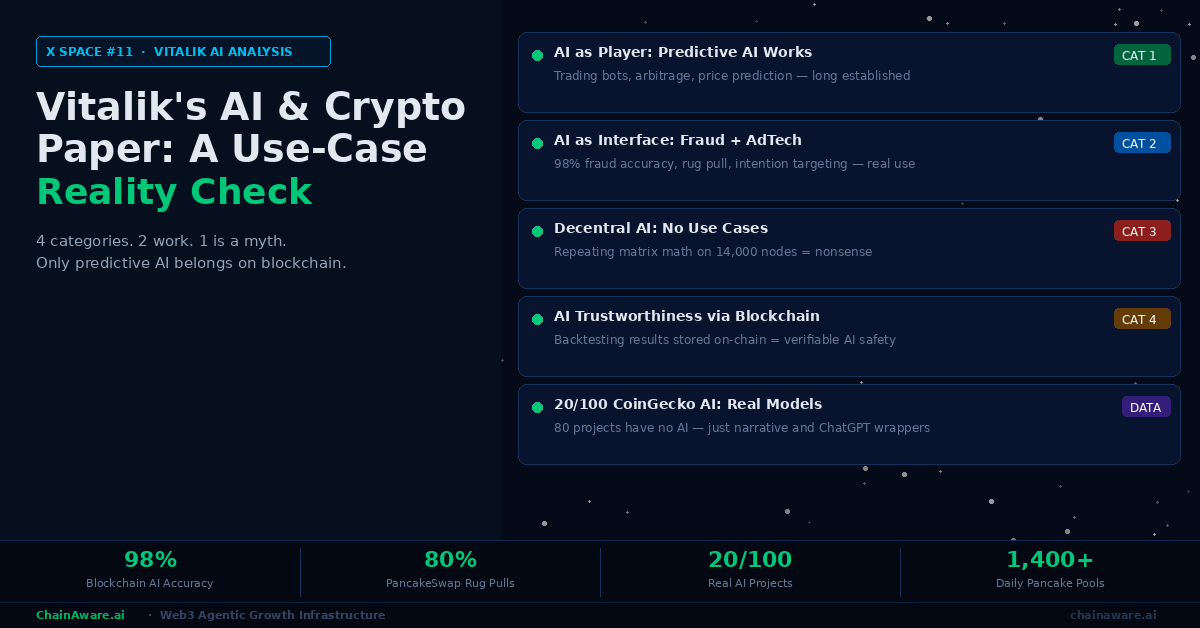
X Space #11 is ChainAware’s most technically rigorous session, dedicated to a detailed use-case analysis of Vitalik Buterin’s essay on AI and crypto. Co-founders Martin and Tarmo work through all four of Vitalik’s categories — AI as player, AI as interface, AI as rules, and AI as objective — evaluating each against practical implementation reality. Their conclusion is specific: two categories describe genuine, already-deployed use cases built on predictive AI; one category (decentralised AI) is an oxymoron with no coherent use case; and one category (AI trustworthiness) is a brilliant idea that remains premature because too few real AI models currently exist in crypto to compare. Throughout, the session reinforces a theme that ChainAware has argued across every X Space in this series: the only AI that belongs on blockchain is predictive AI, and the absence of the phrase “generative AI” from Vitalik’s entire essay is not an accident.
In This Article
- Predictive AI vs Generative AI: The Foundational Distinction
- Level One vs Level Two Thinking: Why LLMs Cannot Reason
- Blockchain Data: The Goldmine That Google Dreams About
- Category 1 — AI as Player: Predictive AI Has Been Here for Years
- Category 2 — AI as Interface: Fraud Detection, Rug Pulls, and AdTech
- 1,400 Pools Per Day: The PancakeSwap Rug Pull Statistics
- The Bidirectional Interface: Ad Technology as Category 2
- Category 3 — AI as Rules: Why Decentralised AI Is an Oxymoron
- Why AI Models Must Be Closed Source — The DeFi Parallel That Does Not Apply
- The CoinGecko Reality: 20 Real Models Out of 100 AI Projects
- Category 4 — AI as Objective: Blockchain as AI Safety Infrastructure
- Backtesting Is AI Safety: A Practical Solution to a Research Problem
- The Absent Phrase: Why “Generative AI” Does Not Appear in Vitalik’s Paper
- Comparison Tables
- FAQ
Predictive AI vs Generative AI: The Foundational Distinction
Before engaging with Vitalik’s four categories, Martin and Tarmo establish the technical foundation that makes the entire analysis coherent. The distinction between predictive AI and generative AI is not a matter of degree — it is a fundamental architectural difference that determines which type belongs in blockchain applications and which does not.
Generative AI, in its current dominant form as large language models, is an autoregressive text predictor. Given a sequence of tokens (words or word fragments), it predicts the most statistically probable next token, and then treats that output as part of the sequence to predict the next one. This process repeats until the model produces a complete response. The training data is the entirety of publicly available text on the internet, plus curated private datasets. As Martin explains: “ChatGPT emerged from chat tools. Instead of expensive humans, you use chat tools. It gets some text input and now it generates the most probably respond to this text input without understanding what it’s generating. It’s just generating in an autoregressive model the most probably answer — without understanding, and without being capable of the reason how it came to these conclusions.”
Predictive AI: Models You Build, Train, and Backtest
Predictive AI operates on an entirely different basis. Rather than training a general model on all available text, predictive AI starts with a specific problem domain, constructs or selects appropriate model architectures, trains those models on carefully chosen domain-specific data, and iteratively evaluates their performance against backtesting data they have never seen during training. The output is not a text sequence but a verifiable prediction with a stated accuracy: “This wallet will commit fraud with 98% probability.” As Tarmo explains: “Predictive AI gets its power from the model. You build a model, you train the model, you backtest it, and you have accuracy. You can say what is the percentage of your answers’ accuracy. It is actionable intelligence.” For how ChainAware applies this distinction in practice, see our predictive AI for Web3 guide.
Level One vs Level Two Thinking: Why LLMs Cannot Reason
Tarmo introduces a cognitive framework that cuts to the heart of why generative AI cannot serve as a reliable foundation for blockchain applications: the distinction between level one and level two thinking. This framework, explored in depth in X Space #13, appears here in its initial formulation and explains why the statistical fluency of LLMs is fundamentally different from the reasoning capability that functional AI applications require.
Level one thinking is automatic, pattern-driven, and inarticulate. It produces responses from established associations without deliberate reasoning and cannot explain the basis of those responses. Tarmo offers a deliberately provocative illustration: “Person who’s drinking too much alcohol, he’s drunk and he starts to speak. That’s level one thinking — uncontrolled speaking of something. In the case of LLMs, of course we appreciate the LLMs, it’s this uncontrolled speaking of something that is statistically relevant. And if you are listening to this and you think there’s some higher intellect, some AGI behind — sorry guys, it’s not. Just statistics.”
Level Two Thinking: Iteration, Reflection, and Explainability
Level two thinking is deliberate, iterative, and explainable. It involves forming a hypothesis, testing it against evidence, refining it through iteration, and arriving at a conclusion that can be articulated and justified. When asked “why did you conclude this?”, a level two thinker can explain the chain of reasoning. LLMs cannot. As Tarmo states: “Level two thinking is when you really reason, when you reflect, when you iterate your thoughts, and when you can explain why you think how you think. Level two thinking is completely missing in generative AI.” Predictive AI models trained on domain-specific data, by contrast, produce outputs that can be traced to specific model weights, training patterns, and backtesting results — an explainability that enables the trust and safety evaluation that AI applications require. For the complete AGI vs LLM analysis, see our AGI vs LLM guide.
Level Two Thinking Applied to Blockchain — Free
ChainAware Fraud Detector — 98% Accuracy, Verifiable, Backtested
ChainAware’s fraud detection model is predictive AI — trained on domain-specific blockchain behavioral data, backtested against CryptoScamDB, delivering 98% accuracy with verifiable methodology. Not an LLM. Not a hallucination. Actionable intelligence with a stated confidence level. Free for individual address checks.
Blockchain Data: The Goldmine That Google Dreams About
A central argument threading through the entire session is that blockchain data is uniquely valuable for predictive AI — not merely useful, but fundamentally superior to the data sources that Web2 AdTech giants spend billions to collect and protect. Understanding this superiority requires understanding what makes data valuable for behavioral prediction.
Google’s AdTech — which generates approximately 95% of Alphabet’s revenue — runs on search history and browsing data. Facebook’s AdTech runs on social interaction and content engagement data. Both platforms have built enormous infrastructure to collect, process, and model this data. However, both face a fundamental data quality limitation: the signals they collect are cheap to generate. A user can search anything, browse anywhere, and “like” anything without any cost or commitment. The resulting data reflects incidental triggers — a friend’s recommendation, a news story, a moment of curiosity — rather than genuine behavioral intentions. As Tarmo explains: “Search history is not predicting your behavior. You just have some triggers, some inputs. Someone is calling you, you read something. These inputs trigger your behavior. So search history is kind of misleading — it tells you something, but it’s low accuracy.”
Why Proof-of-Work Data Is Qualitatively Different
Blockchain financial transactions carry real financial cost. Every Ethereum transaction requires gas fees. Every DeFi position requires capital. Every on-chain action represents a deliberate, committed decision rather than casual digital activity. This cost-of-action property makes blockchain data qualitatively different from search or browsing data in prediction power. Furthermore, this high-quality data is completely free and publicly accessible — no platform relationships, no licensing fees, no reCAPTCHA data collection agreements required. Martin captures the competitive implication: “Google is streaming about this high quality data — they don’t have it. They have just search data which can be arbitrary. Blockchain data is a manifestation of your behaviour. And this blockchain data, the users are giving it to you free. $0. You only need a blockchain reader.” For more on how ChainAware uses this data advantage, see our behavioral analytics guide.
Category 1 — AI as Player: Predictive AI Has Been Here for Years
Vitalik’s first category covers AI systems that participate directly in blockchain ecosystems as active agents — making trades, managing positions, executing arbitrage, and generally acting as automated participants in on-chain markets. Martin and Tarmo assess this category as entirely accurate and well-established. More importantly, they note that it has been established for a long time — before the current LLM wave started, before “AI” became a marketing term, and before 80 projects started calling themselves AI companies without having any AI models.
Trading bots, portfolio rebalancing algorithms, automated market makers, and arbitrage systems have used predictive AI techniques since blockchain markets existed. These systems analyse price feeds, order book dynamics, liquidity patterns, and cross-exchange differentials to predict short-term price movements and execute trades accordingly. As Tarmo confirms: “These are use cases where AI is just participating in the blockchain ecosystem. It’s happening already quite a long time in trading. We have trading bots, prediction markets. It’s all using predictive AI algorithms already for many, many years — serious arbitrage happening before with taxes. It’s all with predictive AI algorithms, predictive algorithms. And these use cases are already quite a long time.”
Models Are Closed Source — Not DeFi-Style Open Source
A critical distinction within Category 1 is that the AI models powering these applications are not and should not be open source. DeFi’s dominant philosophy — pioneered partly by a16z and the broader crypto VC ecosystem — holds that open-source code is a virtue and that forking an existing protocol is a legitimate form of participation. This philosophy cannot apply to AI models. A trading algorithm’s value is precisely its predictive edge, which disappears the moment competitors can study and replicate it. As Tarmo notes: “If you’re making your model open source — billions — you are giving away your trading algorithm. The models are closed source. It’s not generative AI. It’s all predictive AI. And the higher prediction power the models have, these are the better players in the game.” For the full analysis of why this matters across all blockchain AI use cases, see our predictive AI guide.
Category 2 — AI as Interface: Fraud Detection, Rug Pulls, and AdTech
Vitalik’s second category — AI as an interface to the blockchain game — is where ChainAware’s core product portfolio sits. This category covers AI systems that help users navigate the blockchain ecosystem by providing intelligent assessments of addresses, contracts, and interactions. Martin and Tarmo assess it as not only realistic but already deployed and producing verified results.
The core problem that Category 2 addresses is the trust problem in an anonymous, permissionless ecosystem. Any address can interact with any other address or contract without identification requirements or reputational accountability. This makes blockchain both powerful and dangerous: the same openness that enables permissionless financial innovation also enables permissionless fraud. As Martin frames it: “Which address do you want to trust? Do I want to have incoming transactions from this address? Maybe I don’t want that. Maybe I want outgoing transactions to this address — maybe if the address has a bad score, a high fraud score, it’s better not to interact.”
Addresses and Contracts: The Two Trust Dimensions
Category 2 splits into two trust dimensions. The first is address trust: among the millions of active Ethereum, BNB, and other blockchain addresses, which ones have behavioral patterns suggesting fraudulent intent? ChainAware’s fraud detection model answers this question with 98% accuracy by identifying specific behavioral patterns in wallet transaction histories that reliably precede fraudulent activity. The second is contract trust: among the thousands of smart contracts deployed daily, which ones are safe to interact with? ChainAware’s rug pull detection model addresses this by identifying behavioral signatures in liquidity pool contracts that precede liquidity withdrawal events. Both represent predictive AI applied to the real-time trust assessment problem that every blockchain user faces on every transaction. For the implementation details, see our wallet audit guide and our fraud detection guide.
1,400 Pools Per Day: The PancakeSwap Rug Pull Statistics
Martin provides one of the most concrete illustrations of the Category 2 problem with a specific data point from PancakeSwap on BNB Chain. The numbers make the scale of the trust problem unmistakable — and explain why predictive AI as an interface is not a theoretical future application but an urgent practical necessity.
PancakeSwap creates approximately 1,400 new liquidity pools per day. Each pool represents a new token pair that traders can interact with. Of those 1,400 daily pools, over 80% will end in a rug pull — the liquidity provider withdrawing all funds from the pool, leaving token holders with assets worth zero. Martin describes the mechanism: “A rug pull means the token value on the end is zero, non-existent. Either the projects are just withdrawing the liquidity — here we are, there’s no liquidity, there’s no price — or they’re just minting over-minting the asset and selling it against the pool.” Faced with 1,400 new pools per day and an 80%+ failure rate, no human trader can make informed decisions about which pools to enter. Predictive AI that identifies rug pull risk before liquidity withdrawal happens is not a convenience — it is the only viable protection mechanism at this scale.
Solana: Even More Extreme
PancakeSwap’s statistics represent a mid-range case. Solana’s pool creation rate and rug pull incidence both exceed BNB Chain’s figures significantly — though Martin notes that ChainAware has not yet published Solana-specific pool creation statistics at the time of this recording. The direction is clear: the problem is systemic and growing rather than marginal. Martin states directly: “If you’re going on Solana, that’s even more crazy.” The Category 2 opportunity — predictive AI as interface — scales with the problem, making the blockchain data goldmine increasingly valuable as on-chain activity grows. For the complete rug pull detection product, see our rug pull detection guide.
The Bidirectional Interface: Ad Technology as Category 2
Martin introduces an extension of Category 2 that Vitalik identifies but does not fully develop: the reverse direction of the AI interface. While fraud detection and rug pull prediction represent the user-to-blockchain direction (users using AI to evaluate what they interact with), ad technology represents the blockchain-to-user direction (platforms using AI to understand and engage with their users).
This bidirectional framing is significant because it connects the security use cases (fraud, rug pull) to the growth use cases (marketing, user acquisition) under a single technical architecture. Both directions use the same underlying asset: high-quality blockchain behavioral data that enables accurate prediction of user intentions. As Martin explains: “It’s not you towards the blockchain — it’s vice versa. It’s the platforms towards you. And that’s as well AI as an interface in the game. It’s the prediction power about your future actions.” ChainAware’s marketing agent product sits in this reverse direction: calculating wallet behavioral profiles when users connect and serving them personalised messages matched to their predicted intentions. For the full bidirectional AdTech framework, see our Web3 AdTech guide and our AI marketing guide.
Category 2 Applied: Interface to Web3 Growth
ChainAware Rug Pull Detector — Predict Before You Lose
1,400+ PancakeSwap pools per day. 80%+ end in rug pulls. ChainAware’s rug pull detector identifies which pools will fail before it happens — analysing liquidity provider behavior, contract properties, and on-chain patterns. Predictive AI, not reactive statistics. Free for individual pool checks. ETH, BNB, BASE.
Category 3 — AI as Rules: Why Decentralised AI Is an Oxymoron
Vitalik’s third category — AI as the rules of the game — covers the concept of blockchain smart contracts calling directly into AI models to determine on-chain outcomes. Martin and Tarmo acknowledge that Vitalik himself flags this category as highly ambitious and not very realistic. Their assessment is more direct: decentralised AI on blockchain has no coherent use cases, and the technical reasons why are fundamental rather than incidental engineering challenges.
The starting point for any AI application is a model. Without a model, there is no AI — only marketing language. Building a model requires three things: training data, a training algorithm, and backtesting against held-out data. None of these three components can be meaningfully decentralised on a blockchain without creating computational absurdity. As Tarmo explains: “Blockchain means you repeat the same calculation on every node. In Ethereum we have today 14,000 nodes in mainnet. When I do matrix multiplications and I multiply the same matrix 14,000 times — it’s nonsense.” The fundamental architecture of blockchain is state consensus through computation replication. The fundamental requirement of AI model training is massive parallel computation on specialised hardware. These architectural requirements are not just different — they are opposed.
The Decentralised AI Questions Nobody Can Answer
Martin and Tarmo press the decentralised AI concept with a series of specific implementation questions that expose its incoherence. Which part of the AI is decentralised? Is the model decentralised — meaning its weights are distributed? Then model inference requires reconstituting those weights on each query, creating enormous communication overhead. Is the training data decentralised? Then training requires moving terabytes of data across a distributed network on every training iteration. Is the backtesting decentralised? Then every participating node reruns the same evaluation computation redundantly. Martin drives the point home: “In a very short term we can ask so many questions about decentralised AI — but we don’t know the answers. And actually there are no answers.” The concept emerged, Tarmo suggests, because DeFi-era investors wanted to apply the open-source fork-and-ship model to AI — and when they realised there is nothing to copy (AI models are necessarily proprietary), they invented a new vocabulary rather than developing real products. For the contrast between real and narrative AI projects, see our AI agents acceleration guide.
Why AI Models Must Be Closed Source — The DeFi Parallel That Does Not Apply
One of the session’s most practically important arguments addresses the open-source ideology that pervades the blockchain ecosystem and explains why it cannot apply to AI. DeFi’s success was built partly on composability through open-source smart contracts: Uniswap publishes its contract code; anyone can fork it, modify it, and build on it. This openness created an innovative ecosystem of protocols building on each other’s work.
AI models cannot work this way, for reasons that are economic rather than ideological. An AI model’s value is its predictive accuracy. That accuracy comes from proprietary choices of training data, algorithm selection, hyperparameter tuning, and iterative refinement over months of development work. Making the model open source immediately enables competitors to clone the predictions without doing any of the development work. As Martin puts it: “Some funny guys asked us on Twitter, please tell us which training data you’re using. Laughing about this — unbelievable. Of course we are not exposing which training data we’re using. Otherwise you’re like in DeFi where everyone copied Uniswap or everyone copied Compound.”
Training Data Is Intellectual Property
The same logic applies to training data. Blockchain data is public — anyone can read it. But the specific selection of which data to train on, which time periods to include, which behavioral patterns to label as fraud versus legitimate, and how to structure the training process — these choices are the intellectual property that enables ChainAware’s 98% accuracy. “It’s not defined — you’re just taking someone else’s AI and then… or maybe that’s the reason why they’re speaking of decentral AI,” Martin observes. “They tried to deploy DeFi in the blockchain AI world but they realised there’s nothing to copy. So they invented a new word called decentral AI.” For how ChainAware’s closed-source models work in practice, see our behavioral analytics guide.
The CoinGecko Reality: 20 Real Models Out of 100 AI Projects
The decentralised AI critique connects directly to an empirical observation ChainAware has made by systematically analysing the CoinGecko AI category. The analysis reveals a stark gap between projects that call themselves AI and projects that actually operate AI models — and the gap is overwhelming in scale.
Martin defines what an AI project should mean: “AI product means you have developed your own model. Not use someone else’s model. Not using LLM models or some open-source image recognition tools. No — you have to have your own AI model. This model must have backtesting. And there have to be some numbers available: what is the accuracy of this AI?” Applying this definition to the top 100 CoinGecko AI projects by market cap produces a striking result: approximately 20 have developed their own models. The remaining 80 either use third-party AI via API (most commonly OpenAI’s ChatGPT), use generic open-source models with minimal customisation, or have no functional AI component at all. ChainAware itself, which launched the first AI-based blockchain credit score in 2022 and has been building and refining predictive models since, has declined from approximately position 20 to approximately position 140 in this list — a direct consequence of the narrative projects’ higher Twitter Scores attracting more investment and therefore higher market caps.
The Investment Misallocation Consequence
Martin and Tarmo frame the 80/20 split as a serious investor misallocation problem. Retail investors and many institutional investors look at CoinGecko’s AI category, see 100 projects, and assume they are evaluating AI companies. In reality, they are evaluating 20 AI companies and 80 narrative projects that have successfully positioned themselves as AI companies. As Martin states: “It is complete misinformation for investors, misinformation for users. If investors don’t require that you have an AI model — meaning AI model, training data, back testing algorithm, and hopefully they’ll publish the accuracy — then it’s too early to speak about the category.” For analysis of the real vs narrative AI project divide, see our AGI vs LLM guide.
Category 4 — AI as Objective: Blockchain as AI Safety Infrastructure
Vitalik’s fourth category proposes using blockchain infrastructure to address one of the most pressing problems in AI development: how to establish trust in AI systems when their internal workings are opaque to most users. Martin and Tarmo assess this category as genuinely brilliant in concept while premature in practice — a future-pointing vision that cannot be realised until the first three categories have been more fully developed.
The core question Vitalik raises — which AI algorithms can be trusted, and how do we distinguish trustworthy AI from untrustworthy AI — is precisely the question that Jack Dorsey raised around the same period when commenting on algorithm choice. The conventional approach to AI safety in research settings involves extensive red-teaming, capability evaluation, and alignment testing. Martin and Tarmo propose a more concrete mechanism: backtesting with cryptographically secured datasets published on-chain.
Why This Is Still Premature
The practical limitation is that meaningful AI trustworthiness comparison requires multiple models in the same domain to compare against each other. Currently, for most blockchain AI applications, there are not enough deployed, backtested models to make this comparison meaningful. As Martin explains: “We can come to the discussion of trustworthiness when the instances of models are there, when they’re in production. And if the set on the market is very little — we are speaking of 20 AI models — if investors are not looking at whether this AI product actually has its own AI model, meaning AI model, training data, backtesting algorithm, and hopefully published accuracy, then it’s too early to speak about trustworthiness.” The 80/20 CoinGecko reality means Category 4 requires a precondition — many more real AI models deployed and operating — that the current market has not yet met. For ChainAware’s own published accuracy metrics, see our fraud detection guide.
Backtesting Is AI Safety: A Practical Solution to a Research Problem
Martin and Tarmo offer a specific, implementable proposal for how blockchain can serve as AI safety infrastructure — a proposal that differs substantially from the abstract “AI safety” discourse that dominates research discussions. The proposal reduces AI safety to its practical core: verifiable accuracy comparison.
The mechanism works as follows. A neutral third party — potentially a blockchain-based smart contract — maintains a cryptographically secured backtesting dataset. This dataset is encrypted so that AI developers cannot train on it (preventing autoregressive inflation of accuracy scores). Any AI model claiming to perform a specific task — fraud detection, rug pull prediction, intention calculation — can submit to evaluation against this shared dataset. The accuracy results are published on-chain as a timestamped, immutable record. Users can then select which AI model to use based on independently verified performance data rather than marketing claims.
ChainAware Already Does This Unilaterally
ChainAware has already adopted the transparency principle unilaterally, without waiting for an industry-wide standard. The fraud detection model’s 98% accuracy figure is published openly, with the backtesting methodology referenced (CryptoScamDB as the evaluation dataset) so that anyone can independently verify the claim. As Martin notes: “We are publishing all accuracy. Our accuracy is 98. We are speaking loud about this and we are always saying we are backtested on this data. Actually I think we are the only one speaking about our backtesting accuracy.” The observation that no other projects in the CoinGecko AI list publish comparable accuracy statements is itself informative — it reflects the 80% who have no models to evaluate, and the 20% who may have models but have not yet adopted this transparency standard. For the full technical approach, see our predictive AI guide.
The Absent Phrase: Why “Generative AI” Does Not Appear in Vitalik’s Paper
Martin closes the substantive analysis with an observation that is simple in form but significant in implication: the phrase “generative AI” does not appear anywhere in Vitalik’s AI and crypto essay. This absence, given that the essay was published at the peak of the LLM hype cycle in early 2024, is clearly deliberate rather than an oversight.
Vitalik’s four categories describe prediction systems (trading algorithms, fraud detection), interface systems (trust assessment, navigation), rule systems (smart contract logic), and evaluation systems (AI trustworthiness). None of these categories has a coherent generative AI implementation. Generative AI cannot be used to predict fraud with verifiable accuracy. It cannot be used to assess contract trustworthiness with backtestable results. It cannot serve as smart contract logic due to hallucination risk. It cannot serve as a trustworthiness evaluation target because it has no measurable accuracy metric. Every viable AI use case in blockchain is a predictive AI use case.
The Investment Implication for Generative AI Blockchain Projects
The implication for the 80 narrative AI projects on CoinGecko — many of which are primarily “generative AI on blockchain” projects — is stark. As Martin addresses investors directly: “For all investors who have been investing in AI projects being the decentral AI projects or the generative AI projects, spend some time in Vitalik’s paper and think what did Vitalik want to tell you.” The investment thesis behind generative AI blockchain projects either requires a use case that Vitalik’s analysis does not identify, or it is a narrative investment betting on sentiment rather than technical viability. Martin and Tarmo are clear about which category they believe most of these investments fall into. For the complete analysis of which AI approaches create real value in Web3, see our Web3 AI agents guide.
Comparison Tables
Vitalik’s Four AI Categories: Assessment and Use Cases
| Category | Vitalik’s Definition | AI Type Required | Martin & Tarmo Assessment | ChainAware Use Cases |
|---|---|---|---|---|
| 1 — AI as Player | AI participates as active agent in blockchain markets | Predictive AI — closed source, proprietary models | ✅ Fully valid — established for years before LLM wave | Intention prediction for portfolio management |
| 2 — AI as Interface | AI helps users and platforms navigate blockchain safely | Predictive AI — address/contract/intent models | ✅ Fully valid — deployed and producing verified results | Fraud detection (98%), rug pull prediction, AdTech targeting |
| 3 — AI as Rules | Smart contracts call AI to determine outcomes | “Decentralised AI” — no coherent architecture exists | ❌ No viable use cases — repeating matrix math on 14,000 nodes is nonsensical | N/A — not a viable category |
| 4 — AI as Objective | Blockchain verifies AI trustworthiness and safety | Any — backtesting framework is model-agnostic | ⏳ Brilliant concept but premature — too few real models exist yet | Unilaterally publishing backtesting accuracy (98%) |
Predictive AI vs Generative AI: Blockchain Compatibility
| Property | Generative AI (LLMs) | Predictive AI (Domain Models) |
|---|---|---|
| Core mechanism | Autoregressive next-token prediction | Domain-specific trained models with accuracy targets |
| Thinking level | Level one — statistical, cannot explain outputs | Level two — iterative, explainable, backtestable |
| Accuracy measurable? | No — hallucination rate is not a fixed number | Yes — 98% fraud detection, stated and verified |
| Training data | All public internet text — open access | Domain-specific closed-source datasets |
| Model open source? | Some (Llama) — but no unique predictive edge | No — proprietary models are core IP |
| Blockchain data advantage | None — same LLM works everywhere | High — proof-of-work data is highest-quality behavioral signal |
| Vitalik paper mention | Never — phrase not in essay | Implicitly throughout all four categories |
| Category 3 feasibility | Theoretically possible — still nonsensical at scale | Still computationally absurd on 14,000 nodes |
| Category 4 feasibility | Evaluatable — but hallucination is inherent limit | Evaluatable and improvable — accuracy is measurable |
| ChainAware AI type | Not used | All products — fraud, rug pull, intentions, credit |
Frequently Asked Questions
What are Vitalik’s four AI and crypto categories?
Vitalik Buterin’s AI and crypto essay identifies four categories of AI-blockchain interaction. Category 1 (AI as player) covers AI systems that participate directly in blockchain markets — trading bots, arbitrage algorithms, portfolio management. Category 2 (AI as interface) covers AI systems that help users and platforms navigate blockchain safely — fraud detection, rug pull prediction, intent calculation. Category 3 (AI as rules) covers the concept of smart contracts calling AI to determine outcomes — decentralised AI. Category 4 (AI as objective) covers using blockchain to verify AI trustworthiness through on-chain backtesting. Martin and Tarmo assess Categories 1 and 2 as fully valid, Category 3 as technically incoherent, and Category 4 as promising but premature.
Why does blockchain data produce better AI predictions than Google’s data?
Google’s AdTech data — search history, browsing history — reflects cheap, low-commitment digital activity easily influenced by external triggers. A user can search anything or browse anywhere at zero cost, making this data noisy with respect to genuine behavioral intentions. Blockchain financial transactions require deliberate decisions and real financial cost (gas fees). This cost-of-action property filters out casual and incidental activity, leaving only genuine behavioral signals. The result is data with substantially higher prediction power for modeling human intentions and future actions. ChainAware’s 98% fraud detection accuracy from this data, using no off-chain sources, demonstrates the prediction quality available. Google itself does not have access to this data — it is free and public on the blockchain.
Why is decentralised AI technically impossible?
Blockchain achieves decentralised consensus by having every node independently verify every computation — Ethereum mainnet runs approximately 14,000 nodes. AI model training and inference require massive matrix multiplication operations. Running these operations independently on 14,000 nodes means performing the same enormous computation 14,000 times, which is computationally nonsensical and orders of magnitude more expensive than centralised computation. Additionally, AI models require closed-source training data to protect their predictive edge; blockchain’s transparency is incompatible with closed-source data. The concept of decentralised AI emerged from DeFi investors trying to apply the open-source fork-and-ship model to AI and discovering that there was nothing to copy.
How can blockchain enable AI trustworthiness (Category 4)?
The mechanism Martin and Tarmo propose: a neutral third party maintains a cryptographically encrypted backtesting dataset — encrypted so developers cannot train on it (which would inflate accuracy scores artificially). Any AI model claiming to perform a specific task submits to evaluation against this shared dataset. Accuracy results are published on-chain as timestamped, immutable records. Users and investors can then compare models across vendors based on independently verified performance rather than marketing claims. This approach makes AI safety concrete and measurable rather than abstract. The precondition is that many more real AI models must be deployed first — currently only approximately 20 out of 100 CoinGecko AI projects have real models to evaluate.
Why are AI models necessarily closed source?
An AI model’s value is its predictive accuracy, which derives from proprietary choices of training data selection, algorithm architecture, hyperparameter tuning, and iterative refinement. Making a model open source immediately enables competitors to clone the predictions without investing in any of the development work. This is fundamentally different from DeFi smart contracts, where open-source code enables composability and innovation. For AI, open-sourcing the model is equivalent to open-sourcing a trading algorithm — it destroys the competitive advantage that made the model valuable. Training data is similarly proprietary: it encodes the specific selection decisions that enable high accuracy, and exposing it enables competitors to replicate the approach. ChainAware maintains both its model architecture and training data as closed source.
Real Predictive AI — Category 1 and 2 of Vitalik’s Framework
ChainAware Prediction MCP — Fraud, Rug Pull, Intentions. One API.
Domain-specific predictive models trained on blockchain behavioral data. 98% fraud detection. Rug pull prediction before it happens. Wallet intention calculation for 1:1 targeting. Closed-source models with published accuracy. 14M+ wallets. 8 blockchains. 31 MIT-licensed agents.
This article is based on X Space #11 hosted by ChainAware.ai co-founders Martin and Tarmo. Watch the full recording on YouTube ↗ · Listen on X ↗. For questions or integration support, visit chainaware.ai.