
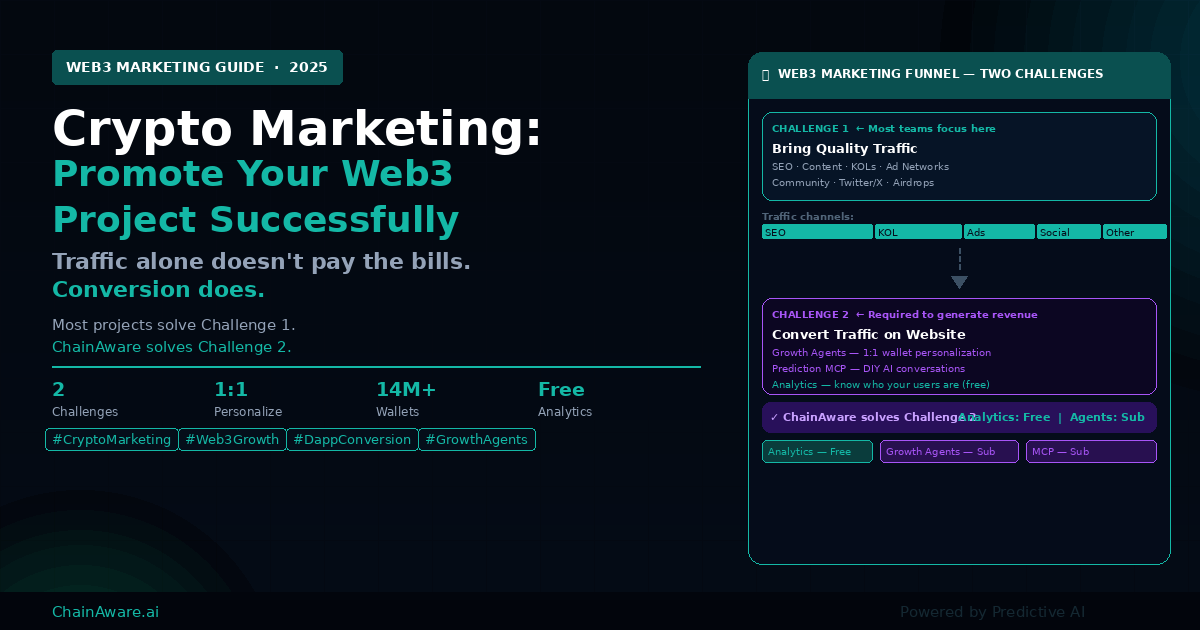
Crypto marketing in 2026 is simultaneously more sophisticated and more competitive than at any point in Web3’s history. The global crypto market surpassed $4 trillion in market cap in 2025. There are now 741 million crypto owners worldwide. And yet the gap between projects that successfully build lasting user bases and those that burn budget on noise has never been wider. The difference is almost never the product – it is the marketing strategy. Specifically, whether a team has solved both of the two fundamental challenges that every Web3 marketing effort must address.
Most guides cover one challenge. This guide covers both – in depth. First, every proven channel and strategy for building visibility and driving quality traffic to your project. Second, and this is the half that generates actual revenue, how to convert that traffic into transacting users once it arrives. The projects that win in 2026 are those that treat both challenges with equal seriousness.
In This Guide
- The Two Challenges of Web3 Marketing
- Channel Comparison: All 10 Channels at a Glance
- SEO and Content Marketing
- Community Building: Discord, Telegram, and Governance
- Twitter/X: The Crypto-Native Channel
- KOL + KOC Marketing: What Works in 2026
- Crypto Ad Networks and Paid Acquisition
- Email Marketing: The Underused High-ROI Channel
- Airdrops, Tokenomics, and Incentive Design
- PR, Media, and Thought Leadership
- Web3 Marketing Tools for 2026
- RWA and DePIN Marketing: The 2026 Playbooks
- MiCA and Regulatory Compliance in Marketing
- Budget Allocation Framework by Stage
- Challenge 2: Converting Traffic – The Revenue Gap
- Why 1:1 On-Chain Personalization Is the Missing Layer
- Growth Agents: Automated Conversion at Scale
- Prediction MCP: DIY Personalized AI Interactions
- Web3 Behavioral Analytics: On-Chain Attribution
- The Full-Funnel Web3 Marketing Framework
- FAQ
The Two Challenges of Web3 Marketing
Before any tactic, it is worth naming the strategic architecture that every Web3 marketing effort must navigate. There are two distinct challenges, and conflating them is the most expensive mistake teams make.
Challenge 1: Bring Quality Traffic to Your DApp
This is the visible half – the campaigns, content, community, KOL deals, and ad spend. Everything in this category is designed to get relevant users to your platform: to connect their wallet, explore your product, and engage. The ecosystem for Challenge 1 is mature and well-documented. SEO, Twitter/X growth, Discord communities, KOL partnerships, crypto ad networks, airdrop campaigns – all of these are reasonably well understood. They are covered in depth throughout this guide.
Challenge 2: Convert That Traffic into Transacting Users
This is the invisible half – and the one where revenue is actually made. A wallet that connects to your DApp but never transacts generates no value. The conversion problem in Web3 is structural: most DApp interfaces are identical for every visitor. According to McKinsey’s personalization research ↗, companies that personalize effectively generate 40% more revenue than those that don’t. In Web3, where generic interfaces are the norm and conversion rates sit under 3%, this gap represents an enormous untapped opportunity. ChainAware.ai’s mission is specifically to solve Challenge 2. For the deeper case, see our DeFi onboarding guide.
Start With Who Your Users Are
Before Optimizing Traffic – Measure Its Quality
Web3 Behavioral Analytics aggregates the behavioral profile of every wallet connecting to your DApp – intentions, experience, risk willingness, Wallet Rank distribution. Free, Google Tag Manager setup. Know your baseline before your next campaign.
Channel Comparison: All 10 Channels at a Glance
Different channels serve different stages of growth. The table below maps each channel against the dimensions that matter most for strategic planning – budget level, time to results, user quality, and best use case.
| Channel | Budget Level | Time to Results | User Quality | Best For | Challenge Solved |
|---|---|---|---|---|---|
| SEO / Content | Low-Medium | 6-18 months | ⭐⭐⭐⭐⭐ Highest | Long-term organic growth, authority building | Challenge 1 |
| Twitter/X Organic | Low (time-intensive) | 3-6 months | ⭐⭐⭐⭐ High | Narrative, community, token launches | Challenge 1 |
| Community (Discord/TG) | Low-Medium | 2-4 months | ⭐⭐⭐⭐ High | Retention, governance, protocol advocates | Challenge 1 + 2 |
| KOL + KOC | Medium-High | Immediate | ⭐⭐⭐ Medium (varies) | Launch awareness, product education | Challenge 1 |
| Crypto Ad Networks | Medium ($1K-$50K+) | Immediate | ⭐⭐⭐ Medium | Volume traffic, awareness, retargeting | Challenge 1 |
| Email Marketing | Low | 1-2 months | ⭐⭐⭐⭐ High | Retention, lifecycle, re-engagement | Challenge 1 + 2 |
| Airdrops / Incentives | High (token cost) | Immediate | ⭐⭐ Low (if poorly designed) | Bootstrap community when designed correctly | Challenge 1 |
| PR / Media | Medium | 1-3 months | ⭐⭐⭐⭐ High | Credibility, milestone amplification | Challenge 1 |
| Tokenomics | Design cost only | Long-term | ⭐⭐⭐⭐⭐ Highest | Protocol-native growth loops | Challenge 1 + 2 |
| On-Chain Attribution | Free (ChainAware) | 24-48 hours | Measurement layer | Proving which channels drive quality users | Both |
SEO and Content Marketing
Search engine optimization remains the highest-ROI long-term marketing channel for Web3 projects – not because crypto users search like traditional consumers, but because the educational content that ranks well also builds the trust and authority that drives genuine adoption. Organic traffic compounds over 12-24 months and consistently delivers higher-quality users than any paid channel.
The most consistently successful content formats in Web3 are educational explainers, comparative analyses, and data-driven insights. Long-form pillar content – 5,000+ word definitive guides on core topics in your protocol’s space – typically outperforms shorter posts for organic authority building. According to Content Marketing Institute research ↗, brands with documented content marketing frameworks achieve 33% higher ROI than those without. For how ChainAware approaches content-driven product discovery, see our complete product guide.
Community Building: Discord, Telegram, and Governance
Community is the closest thing Web3 has to a sustainable product moat. A genuinely engaged community of protocol users, token holders, and advocates creates compounding network effects that competitors cannot easily replicate. Building community quality rather than community size is the 2026 standard.
Discord remains the primary community platform for serious DeFi and NFT projects. A 500-member server with high daily active participation and genuine protocol discussion is more valuable than a 50,000-member server filled with airdrop farmers. According to Harvard Business Review’s research on brand communities ↗, genuine community engagement directly correlates with customer retention and lifetime value.
For protocols with on-chain governance, governance participants consistently have higher Wallet Ranks, longer wallet ages, and stronger protocol engagement than passive holders. For how governance participant quality connects to behavioral intelligence, see our Governance Screeners guide.
Twitter/X: The Crypto-Native Channel
Twitter/X occupies a unique position in the crypto marketing ecosystem – simultaneously the most important platform for narrative formation, the primary channel for project discovery, and the venue for ecosystem conversations that shape perception, trust, and adoption.
The most durable Twitter/X growth in Web3 comes from consistent, technically credible communication over time. Thread-based content performs exceptionally well: educational threads breaking down protocol mechanics, data analysis threads on on-chain metrics, and narrative threads explaining product decisions all reward genuine expertise.
KOL + KOC Marketing: What Works in 2026
The fundamental challenge with KOL marketing in crypto is verification. Follower counts, engagement rates, and claimed audience demographics are all easily inflated. The most reliable verification method available for crypto KOLs is on-chain: does the KOL’s wallet history actually reflect the DeFi expertise they claim? Before signing any KOL deal, audit their wallet – the on-chain behavioral record is unfakeable. For a deeper look at the KOL credibility problem, see our KOL Marketing analysis.
Key Opinion Consumers (KOCs) – genuine users of the protocol who have built small but highly credible audiences through authentic product experience – consistently outperform traditional KOL campaigns on a cost-per-acquired-user basis. The combination of KOLs (reach and awareness) with KOCs (grassroots trust and conversion) is the 2026 standard for protocols serious about sustainable community growth.
Crypto Ad Networks and Paid Acquisition
Crypto-native advertising networks allow DeFi and Web3 projects to reach relevant audiences without the compliance restrictions of mainstream ad platforms. For a comprehensive breakdown of every major network with targeting details and minimum spend levels, see our dedicated guide: Best Crypto Advertising Networks in 2026.
The key networks to know: Blockchain-Ads (programmatic, 23M+ wallet profiles, 37 chains, $1,000/month minimum) for precision DeFi targeting; Coinzilla (1B+ monthly impressions) for broad brand awareness; HypeLab and Slise for in-DApp placements reaching active DeFi users mid-session; Bitmedia ($20/day entry, AI fraud filtering) for flexible mid-size campaigns. The most important 2026 principle: measure behavioral quality of incoming traffic, not just volume.
Email Marketing: The Underused High-ROI Channel
Email marketing is the most consistently underestimated channel in Web3. Users who voluntarily subscribe to a protocol’s email list are among the highest-intent, highest-quality audience segments available. Email performs best in Web3 for retention and lifecycle use cases: governance vote notifications, yield update alerts, position status reminders, and protocol milestone updates. See how behavioral profiling connects to personalized communication in our User Segmentation guide.
Measure Which Channels Bring the Best Users
On-Chain Attribution: Know Your Channel Quality
After every campaign, check your Behavioral Analytics dashboard. Did new users improve your Wallet Rank distribution? Your experience level breakdown? Your intention alignment? Quality compounds. Volume without quality is noise. Free, 2-line GTM setup.
Airdrops, Tokenomics, and Incentive Design
Airdrops and token incentive campaigns have been both the most powerful and most abused user acquisition tools in Web3. When designed well, they bootstrap genuine communities of aligned token holders. When designed poorly, they attract waves of mercenary farmers who dump immediately.
The most effective Sybil countermeasures combine: a Wallet Age requirement, a Wallet Rank threshold (genuine DeFi participants consistently have higher Wallet Ranks than farmers), and protocol usage depth requirements that are expensive to fake at scale. For how to design Sybil-resistant token distributions, see the Sybil-Resistant Token Distribution use case. For how Wallet Rank identifies low-quality wallets and airdrop farmers, see our Wallet Rank guide.
PR, Media, and Thought Leadership
Earned media – coverage in CoinDesk, The Block, Decrypt, Cointelegraph, and mainstream financial media – remains one of the highest-trust user acquisition channels in Web3. Effective Web3 PR in 2026 is less about press releases and more about data and narratives. Journalists and editors consistently favor two types of stories: data-driven insights (original on-chain data analysis revealing something non-obvious about the market) and milestone narratives (genuine product launches and ecosystem partnerships that represent real progress).
Web3 Marketing Tools for 2026
ChainAware Behavioral Analytics (free) – the on-chain attribution layer that shows the behavioral profile of every wallet connecting to your DApp. Full reference at the DeFi Business Analytics learn guide. Dune Analytics – SQL-queryable blockchain datasets. Nansen – smart money wallet labeling and token flow analysis. LunarCrush – social listening platform across Twitter/X, Reddit, and Telegram. Zealy – quest-based community engagement. Galxe – Web3 campaign and credential platform that enables on-chain quests and targeted airdrop distribution.
RWA and DePIN Marketing: The 2026 Playbooks
Two of the most significant Web3 narratives in 2026 – Real-World Asset (RWA) tokenization and Decentralized Physical Infrastructure Networks (DePIN) – require fundamentally different marketing approaches than traditional crypto projects. On-chain tokenized RWAs grew from approximately $5.5 billion to $18.6 billion during 2025.
RWA marketing must be utility-first, data-driven, and compliance-aware. Yield transparency, regulatory clarity, counterparty risk disclosure, and institutional-grade reporting are the pillars. Major players including BlackRock and Franklin Templeton are actively building on-chain – their presence sets the credibility bar that RWA marketing must meet.
DePIN marketing faces a dual audience challenge: attracting hardware contributors (who deploy and maintain the physical infrastructure) and attracting service consumers (who use the network’s output). These two audiences have almost completely different needs and communication preferences. Effective DePIN marketing maintains parallel tracks for each audience while connecting them through the token economics that align their incentives.
MiCA and Regulatory Compliance in Marketing
The EU’s Markets in Crypto Assets (MiCA) regulation took full effect in 2025, establishing clear rules for crypto asset marketing language across the European Union. Key MiCA marketing compliance requirements include: accurate and non-misleading descriptions of the crypto asset, clear disclosure of risks, no guarantees of returns, no claims that past performance predicts future results, and proper regulatory status disclosure for issuers. For the full regulatory compliance framework including AML and KYT, see our DeFi Compliance guide.
Budget Allocation Framework by Stage
| Channel | $5K/month (Early Stage) | $20K/month (Growth Stage) | $50K+/month (Scale Stage) |
|---|---|---|---|
| SEO / Content | 40% – foundational investment | 25% – compounding base | 15% – sustained authority |
| Community | 20% – core moat building | 15% – maintenance + growth | 10% – systematized |
| Twitter/X Organic | Time investment (no budget) | Time investment | Time + $2K paid amplification |
| KOL / KOC | 15% – 1-2 micro KOLs | 25% – mix of KOL + KOC program | 20% – scaled KOC program |
| Crypto Ad Networks | 0% – too early for scale | 20% – test 2-3 networks | 35% – multi-network at scale |
| Email Marketing | 5% – build list foundation | 5% – lifecycle automation | 5% – advanced segmentation |
| PR / Media | 10% – 1 agency retainer | 10% – milestone PR | 10% – ongoing coverage |
| Conversion (Challenge 2) | 10% – ChainAware Analytics free + Growth Agents | 0% extra – already running | 5% – advanced personalization |
The most important allocation principle that most teams get wrong: ensure at least 10-20% of marketing investment goes toward understanding and converting existing traffic (Challenge 2) before adding more acquisition spend. The SmartCredit.io case study documents exactly this dynamic – see the full case study here.
Challenge 2: Converting Traffic – The Revenue Gap
Here is the number that most crypto marketing teams prefer not to examine too closely: the average DeFi protocol converts fewer than 3% of wallet connections into active transacting users. For many projects, the figure is below 1%. The industry spends hundreds of millions annually on Challenge 1 and almost nothing on Challenge 2. This is a structural misallocation that represents one of the most significant competitive advantages available to Web3 teams willing to address it.
No user data. Pseudonymous wallets don’t come with registration forms, demographic data, or stated preferences. Extreme audience heterogeneity. The gap between your most sophisticated and least sophisticated users is wider in DeFi than in almost any other product category. Generic interfaces. Every Web3 website shows every visitor the same content. According to Salesforce research ↗, 73% of customers expect personalized experiences and 62% will lose loyalty to brands that don’t deliver them. In Web3, zero platforms deliver personalization at scale – this is the gap ChainAware closes.
Why 1:1 On-Chain Personalization Is the Missing Layer
The solution to the Web3 conversion problem is not a better homepage – it is personalization based on verifiable on-chain behavioral data. When a wallet connects to your DApp, it carries a complete behavioral record: every protocol it has interacted with, every type of transaction it has made, how long it has been active, how much risk it has historically taken, and what it is most likely to do next.
This record is public, verifiable, and available the instant the wallet connects. Acting on this data in real time is what separates a DApp converting at 8-10% from one converting at under 1%. For the complete case for on-chain personalization, see our Personalization guide and our Behavioral User Segmentation guide.
Growth Agents: Automated Conversion at Scale
ChainAware Growth Agents automate the entire personalization workflow without requiring code changes to your DApp. Full documentation at the Growth Agents learn guide. When a wallet connects to your platform, the Growth Agent immediately reads its behavioral profile from ChainAware’s 18M+ wallet database: experience level, risk willingness, predicted intentions, protocol history, and Wallet Rank. Using this profile, the agent determines which of your products is most relevant, generates a message that resonates with this specific user’s background, and delivers a personalized CTA matched to what this wallet is most likely to do next.
Growth Agents are available on subscription. See the real-world results in the SmartCredit.io case study – 8x engagement and 2x conversions from the same traffic after Growth Agents were deployed. Additionally, see the Intention-Based Marketing guide for how personalization drives conversion without requiring KOL spend.
Convert the Traffic You’re Already Paying For
Growth Agents: Every Wallet Gets a Personalized Experience
Right message, right product, right CTA – matched to each wallet’s on-chain behavioral profile. Automatically. No code changes. No manual segmentation. Subscription plan.
Prediction MCP: DIY Personalized AI Interactions
For development teams who want programmatic control over the personalization layer, ChainAware’s Behavioral Prediction MCP exposes the full wallet intelligence API as a real-time tool for AI agents and LLMs. Full documentation at the Prediction MCP learn guide. When a user connects their wallet, your system calls the Prediction MCP with the wallet address and receives the complete behavioral profile in response – risk willingness, experience, all 12 intention probabilities, protocol history, Wallet Rank. Your LLM or AI agent then uses this profile as context for every subsequent interaction. For the complete integration guide, see our Prediction MCP developer guide. Available on subscription.
Web3 Behavioral Analytics: On-Chain Attribution
On-chain attribution is the 2026 measurement standard for Web3 marketing. ChainAware’s Web3 Behavioral Analytics aggregates the behavioral profile of every wallet connecting to your DApp and presents it in a daily-updated dashboard: Wallet Intentions, Experience Distribution, Risk Willingness, Protocol Categories, Top Protocols, Predicted Fraud Probabilities, Wallet Rank Distribution, and Wallet Age Distribution. Full methodology at the Web3 User Analytics learn guide.
Setup is through Google Tag Manager – no engineering required. Web3 Behavioral Analytics is free via the starter plan at chainaware.ai/subscribe/starter. For the full platform guide, see our Web3 Behavioral Analytics complete guide.
The Full-Funnel Web3 Marketing Framework
Bringing both challenges together into a unified growth strategy requires a disciplined measurement framework. Here is the six-step approach that produces compounding results.
Step 1 – Establish your behavioral baseline. Install the free ChainAware Analytics pixel via Google Tag Manager. Run for two weeks without any campaign changes. Document your baseline: who are your users today in terms of experience, risk willingness, intentions, and Wallet Rank?
Step 2 – Prioritize SEO and content for durable organic traffic. Invest in 3-5 high-quality pillar content pieces targeting your core protocol category. Organic traffic compounds over 12-24 months and typically brings higher-quality users than paid channels.
Step 3 – Build community before scaling paid. Discord and Telegram communities, when built genuinely, create multiplier effects on every subsequent paid campaign.
Step 4 – Layer paid and KOL campaigns on the organic base. Once organic content is live and community is established, use ad networks and KOL/KOC partnerships to amplify reach during high-intent moments.
Step 5 – Measure campaign quality after every activation. After each campaign, your Analytics dashboard shows whether new users improved or degraded your baseline quality metrics. Reallocate budget toward the channels consistently producing high-quality users. According to Gartner’s research on behavioral marketing ↗, teams that measure user quality alongside volume make systematically better channel allocation decisions.
Step 6 – Deploy Growth Agents or Prediction MCP for conversion. With quality traffic arriving, activate the conversion layer. Growth Agents deliver 1:1 personalized content and CTAs to every connecting wallet automatically (subscription). The Prediction MCP gives AI Agents and developers programmatic personalization control (subscription). For the full platform integration playbook, see our Web3 Growth Platforms comparison.
ChainAware.ai – Solve Both Challenges
Traffic Is Challenge 1. Revenue Is Challenge 2.
Web3 Behavioral Analytics is free – start today. Growth Agents and Prediction MCP (subscription) convert that traffic with 1:1 wallet-based personalization. No code changes required.
Frequently Asked Questions
What is the most important Web3 marketing channel in 2026?
For most projects, organic Twitter/X presence combined with quality SEO and content delivers the best long-term ROI. Paid channels and KOLs amplify an organic base but rarely substitute for it. The most consistently overlooked channel is conversion optimization – improving what happens after users arrive, which directly multiplies the ROI of every acquisition channel without requiring additional ad spend.
How do I verify a KOL’s actual influence before paying?
Three checks: engagement rate authenticity, audience composition, and on-chain verification (does the KOL’s wallet history match their claimed expertise?). The on-chain check is the most uniquely powerful for crypto – use the free Wallet Auditor to verify any KOL’s on-chain credentials before committing budget. A DeFi influencer whose wallet shows no meaningful DeFi engagement is promoting your protocol to an audience that doesn’t use DeFi.
What conversion rate should I expect for my DApp?
Industry average for wallet connection to first meaningful transaction is under 3%. With behavioral personalization via Growth Agents, top-performing protocols achieve 8-12% conversion from wallet connection to first meaningful action. The SmartCredit.io case study documents 2x conversion improvement after deploying Growth Agents from the same traffic volume – alongside 8x engagement improvement.
What is the fastest way to improve Web3 project marketing results today?
The fastest improvement with no additional budget is installing ChainAware Behavioral Analytics (free, 2-line GTM snippet) and running it for two weeks before your next campaign. Understanding the behavioral profile of who is currently connecting transforms your ability to evaluate campaign effectiveness and make better targeting decisions. The second fastest improvement is deploying Growth Agents (subscription) to personalize the experience for every connecting wallet, converting more of the traffic you are already paying to acquire.