
In Web3, a wallet address is the closest thing to an identity. But a raw address tells you almost nothing. Is it a sophisticated DeFi veteran or a bot farm? A trustworthy business partner or a money laundering relay? A genuine community member or a sybil attacker gaming your airdrop?
Answering those questions traditionally required hours of manual on-chain research — scrubbing transaction histories, checking AML databases, cross-referencing protocol activity across multiple chains. Most people don’t do it. And that gap between the information that exists and the decisions being made costs the Web3 ecosystem billions every year in fraud, bad investments, and low-quality user bases.
Wallet Rank is ChainAware.ai’s answer to that problem: a single, consolidated reputation score that summarizes every meaningful dimension of a wallet’s quality into one number. If you could only know one thing about a wallet, Wallet Rank is what you’d want to know.
This guide explains exactly how Wallet Rank is calculated, what makes it go up or down, how to read it correctly, and — most importantly — the real-world situations where checking Wallet Rank before acting gives you a decisive edge.
What Is Wallet Rank?
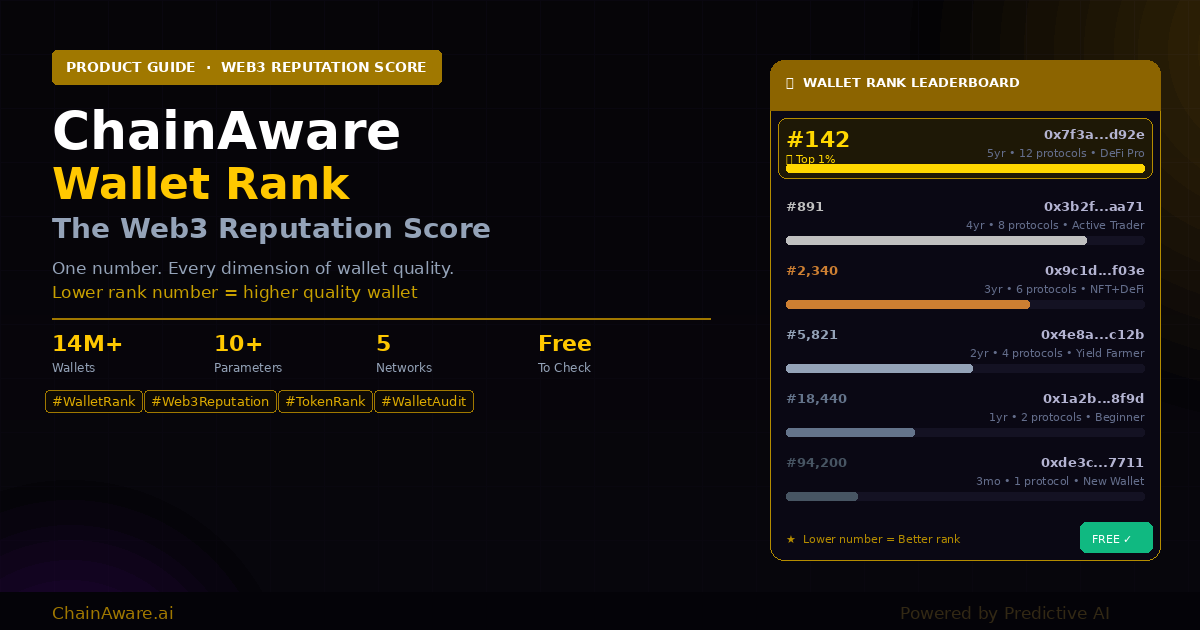
Wallet Rank is a unified, single-number reputation score assigned to every wallet in ChainAware.ai’s Web3 Predictive Data Layer — currently covering 14M+ wallets across Ethereum, BNB Smart Chain, Solana, Base, and Haqq.
It works like a leaderboard: every wallet in the database is ranked relative to all others, from #1 (the highest-quality wallet in the database) upward. The lower the Wallet Rank number, the better. A wallet ranked #500 is significantly higher quality than one ranked #50,000 — just as the #1 athlete in the world outranks the #1,000th.
The key distinction from simpler metrics — balance, transaction count, age alone — is that Wallet Rank is consolidated. It doesn’t measure one dimension of wallet quality. It synthesizes ten distinct parameters into a single score, weighted and combined by ChainAware.ai’s predictive AI models trained on 14M+ wallets. No single parameter dominates. A wallet with enormous balance but zero protocol experience doesn’t score well. A wallet with years of experience but fraud signals doesn’t either. Wallet Rank is the holistic picture.
As the foundational output of the Wallet Auditor — ChainAware.ai’s free due diligence tool — Wallet Rank is available instantly for any supported address, at no cost.
Free — No Signup Required
Check Any Wallet Rank Right Now
Paste any Ethereum, BSC, Solana, Base, or Haqq address into the free Wallet Auditor and see the full profile — Wallet Rank, risk parameters, AML status, and predicted intentions.
The 10 Parameters That Determine Wallet Rank
Wallet Rank is calculated from ten distinct parameters. Understanding each one — and how it contributes to the overall score — helps you interpret Wallet Rank results correctly and understand what drives high-quality wallet behavior.
1. Risk Willingness — The More, The Better Rank
Risk Willingness measures how psychologically ready the wallet owner is to engage with financial risk on-chain — derived entirely from behavioral evidence, not self-reporting. Wallets that consistently engage with volatile assets, experimental protocols, leverage, and high-stakes DeFi positions demonstrate high risk willingness through their actions.
Higher Risk Willingness contributes positively to Wallet Rank because it correlates with active, engaged participation in the Web3 ecosystem. A wallet that never takes any risk tends to be passive, low-engagement, and often bot-adjacent. A wallet willing to participate boldly — while maintaining other quality signals — is more likely to be a genuine, active human participant.
2. Experience — The More, The Better Rank
Experience captures the depth and breadth of the wallet’s on-chain history: how long it has been active, how many distinct protocol types it has engaged with, the complexity of its transaction patterns, and its demonstrated understanding of Web3 mechanics across chains.
Experience is one of the hardest parameters to fake quickly — it requires genuine sustained activity over time. A wallet that has been navigating DeFi, NFTs, governance, and cross-chain bridges for four years has an Experience score that cannot be replicated by a new wallet regardless of its balance. This makes Experience one of the most reliable signals of genuine human engagement.
3. Risk Capability — The More, The Better Rank
Risk Capability measures the wallet’s financial ability to absorb risk — its financial resilience. This is calculated from asset size, portfolio diversification, historical drawdown tolerance, and the relationship between the wallet’s risk-taking behavior and its underlying financial capacity.
A wallet that engages in high-risk DeFi strategies while maintaining substantial reserves and diversified holdings demonstrates genuine Risk Capability. A wallet that is over-leveraged relative to its assets, or that has historically been wiped out by volatility, shows lower capability even if its willingness is high.
4. Predicted Trust — The More, The Better Rank
Predicted Trust is the fraud and trustworthiness score calculated by ChainAware.ai’s Predictive Fraud Detector — the same model that achieves 98% accuracy on Ethereum. It assesses connections to known fraud addresses, behavioral patterns consistent with exploit preparation, wash trading, sybil attacks, and AML red flags.
Predicted Trust is a hard gate on Wallet Rank: a wallet can excel on every other parameter but a low Predicted Trust score will significantly drag down the overall rank. This ensures that sophisticated bad actors — who might accumulate genuine experience and balance while engaged in fraud — cannot achieve a misleadingly high Wallet Rank. For deeper fraud analysis beyond the Wallet Auditor, the dedicated Predictive Fraud Detector provides forensic-level detail.
5. Intentions — Higher Positive Intentions, Better Rank
Intentions captures the wallet’s predicted near-term behavioral trajectory: what it is most likely to do next. Wallets with strong, positive action intentions — high probability of staking, lending, contributing to governance, or other constructive on-chain behaviors — score better than wallets with unclear or concerning predicted next actions.
Intentions contribute to Wallet Rank because they reflect the wallet’s current engagement posture. An active wallet with strong forward-looking signals is more valuable to any platform or counterparty than a dormant one or one showing exit behavior.
6. Transaction Categories — More Categories Used, Better Rank; More Transactions Within Categories, Better Rank
Transaction Categories measures how diverse the wallet’s on-chain activity is across different behavioral types: DeFi lending, DEX trading, NFT activity, bridging, staking, governance participation, payment transactions, and more.
Two dimensions matter here: breadth (how many different categories the wallet has engaged with) and depth (how many transactions within each category). A wallet that has done thousands of DEX trades but nothing else scores lower than a wallet with a more balanced distribution across lending, staking, governance, and payments. Human beings in Web3 tend to diversify their on-chain activity naturally. Bots tend to be narrow and repetitive.
7. Protocols — More Diverse Protocols Used, Better Rank
Protocol usage measures how many distinct protocols the wallet has meaningfully interacted with and how diverse those protocols are across categories (DEX, lending, staking, NFT, bridge, etc.).
Protocol diversity is one of the strongest signals of genuine Web3 sophistication. A real DeFi participant naturally ends up using Uniswap for trading, Aave for lending, Lido for staking, LayerZero for bridging, and Snapshot for governance — because each protocol is best in class for its use case. A bot or low-quality wallet typically interacts with one or two protocols repeatedly. The more diverse the protocol footprint, the more human and sophisticated the wallet.
8. AML Analysis — Clean AML Status Is Required for Good Rank
AML Analysis checks the wallet’s connections to sanctioned addresses, darknet market wallets, mixer services, exploit wallets, and other AML red flag categories, drawing from multiple on-chain data sources.
AML exposure — even indirect, through several hops — negatively impacts Wallet Rank. A wallet that received funds from a mixer or has transacted with a sanctioned address carries AML risk regardless of how clean the rest of its behavior appears. For platforms with compliance obligations, this parameter is non-negotiable. According to FATF’s guidance on virtual assets, businesses in the crypto space are expected to conduct AML due diligence — Wallet Rank’s AML parameter makes that assessment instant.
9. Wallet Age — The Older, The Better Rank
Wallet Age measures how long the wallet has been active on-chain, from its first transaction to the present. Age is one of the most powerful anti-bot signals in the dataset because it cannot be manufactured: a wallet created yesterday cannot have a two-year history regardless of how much money is deposited or how many transactions are made.
Longer wallet age correlates strongly with genuine human participants who have been in Web3 through multiple market cycles, protocol evolutions, and chain migrations. These wallets have demonstrated sustained commitment to the ecosystem — a quality signal that no amount of recent activity can replicate.
10. Wallet Balance — The More, The Better Rank
Wallet Balance contributes positively to Wallet Rank but is intentionally weighted as a supporting factor rather than a dominant one. A high balance alone does not make a good Wallet Rank — as the examples below illustrate. But balance matters because it demonstrates skin in the game, financial capability, and real economic participation in the ecosystem.
The minimum meaningful balance threshold is approximately $1,000 USD equivalent. Wallets below this threshold score significantly lower on balance contribution, as they typically represent dust wallets, test wallets, or bot accounts rather than genuine participants.
See Your Full Wallet Profile
Check Your Wallet Rank and All 10 Parameters
The free Wallet Auditor shows your Wallet Rank alongside every parameter that shapes it: risk willingness, experience, predicted trust, protocols, AML status, intentions, and more.
Reading Wallet Rank Correctly: 3 Instructive Examples
The interplay between parameters means that Wallet Rank sometimes produces results that are surprising if you think of it as a simple wealth or activity metric. These three examples illustrate how the scoring logic works in practice.
Example 1: New Wallet with $1M+ in Funds → Bad Wallet Rank
Imagine a wallet created three months ago with $1.2 million in ETH, USDC, and other blue-chip tokens. It has made 15 transactions — mostly transfers in and out. No DeFi protocol interactions. No NFT activity. No governance participation. No cross-chain bridges.
Wallet Rank result: Poor.
Why? Despite the enormous balance, this wallet scores low on Experience (minimal protocol history), Transaction Categories (almost no diversity), Protocols (none used meaningfully), Wallet Age (three months), and Intentions (unclear, no behavioral trajectory established). The high balance contributes positively but cannot compensate for complete absence of the behavioral signals that characterize a genuine, sophisticated Web3 participant.
This profile is common among: newly onboarded institutional buyers who transferred crypto but haven’t engaged with it, wallets recently created for specific transactions, and — critically — money laundering relay wallets that hold large balances temporarily. Wallet Rank correctly flags this profile as low quality regardless of the dollar amount.
Example 2: 10-Year-Old Wallet with Good Experience but Fraud Signals → Bad Wallet Rank
Now consider a wallet that has been active since 2015. It has used 20+ protocols, participated in dozens of governance votes, bridged across 6 chains, and accumulated a rich transaction history across every category. By most metrics it looks excellent — until you check its Predicted Trust score, which flags connections to known exploit preparation patterns and a mixer service interaction two years ago.
Wallet Rank result: Poor despite strong history.
Why? Predicted Trust acts as a quality gate. A wallet with demonstrated fraud signals cannot achieve a good Wallet Rank regardless of its other merits. This design is intentional: sophisticated actors who have built genuine on-chain history while also engaging in fraudulent behavior should not receive a high reputation score. The fraud signal overrides the positive experience metrics.
This example also illustrates why Wallet Rank is more reliable than simple on-chain history checks. An analyst who only looked at transaction count, protocol usage, and age would give this wallet a clean bill of health. Wallet Rank doesn’t.
Example 3: 5-Year-Old Wallet with Rich Protocol Diversity → Good Wallet Rank
Finally: a wallet active since 2020. It holds $8,000 across ETH, stablecoins, and a few governance tokens. It has used 14 distinct protocols — Uniswap, Aave, Compound, Lido, Curve, MakerDAO, Snapshot, LayerZero, and several others. Its transactions span all major categories: trading, lending, staking, bridging, governance, and regular payment activity. Transactions occur at human cadence — spread across days and weeks, not all within seconds. AML status: clean. No fraud signals.
Wallet Rank result: Excellent — top percentile.
Why? This wallet scores well on every parameter: solid Experience from five years of diverse activity, good Protocol diversity across 14 different protocols, strong Transaction Category breadth, clean AML and Predicted Trust, meaningful Wallet Age, and positive active Intentions. The balance is modest compared to Example 1 but sufficient. The holistic picture is unmistakably that of an engaged, genuine, sophisticated Web3 participant.
How to Improve Your Wallet Rank
Wallet Rank is designed to reward genuinely human, engaged, diverse on-chain behavior. Improving it is not about gaming a metric — it’s about becoming a more active and sophisticated Web3 participant. Here’s what moves the needle:
Use More Protocols — Especially Across Different Categories
The single highest-impact action for improving Wallet Rank is expanding your protocol footprint. Don’t just trade on one DEX — also explore lending on Aave, staking on Lido, governance on Snapshot, and bridging on LayerZero. Each new protocol category you engage with meaningfully improves both the Protocol and Transaction Categories parameters.
Transact Like a Human, Not a Bot
Transaction timing is one of the most reliable bot detection signals. Bots execute hundreds of transactions within seconds or minutes. Human beings transact sporadically — multiple times per day on active days, then quiet for a week, then active again. Wallet Rank’s models are trained on 14M+ wallets and are highly sensitive to bot-like transaction timing patterns. Spread your activity naturally across time rather than concentrating it in automated bursts.
Include Payment Transactions Alongside Protocol Interactions
Real humans use crypto for actual payments — sending to friends, paying for services, contributing to crowdfunds. Wallets whose transactions are exclusively protocol interactions (pure DeFi bots) score lower on Transaction Categories than wallets that also include genuine payment activity. Adding regular payment transactions alongside your DeFi activity strengthens the human-behavior signal.
Maintain a Balance of $1,000+ USD Equivalent
The minimum threshold for meaningful balance contribution to Wallet Rank is approximately $1,000. If your wallet consistently holds less than this, the Balance parameter contributes negatively to your rank. This doesn’t require large holdings — just enough to demonstrate real economic skin in the game.
Build Wallet Age Organically
Wallet Age is the one parameter you genuinely cannot accelerate — it requires real time. The implication is that starting to build your on-chain reputation now matters, even if you’re not yet deeply engaged with DeFi. A wallet with two years of modest, genuine activity scores significantly better on Age than a brand-new wallet with twice the balance and activity.
Keep AML Clean
Avoid interacting with mixer services, unverified bridges that route through sanctioned addresses, or wallets with AML flags. Once AML exposure appears in your wallet’s history, it’s permanent and difficult to overcome regardless of subsequent clean behavior. When in doubt about the AML status of a counterparty before transacting, run a quick check with the Predictive Fraud Detector.
Participate in Governance
Governance participation — voting on proposals via Snapshot, participating in DAO decisions, delegating votes — is a strong signal of genuine community membership. It’s an activity that bots almost never do and that meaningfully diversifies your Transaction Categories.
According to Harvard Business Review’s research on behavioral signals, behavioral data derived from genuine sustained activity consistently outperforms static profile metrics in predicting trustworthiness and engagement quality. Wallet Rank applies this principle to on-chain data — rewarding genuine sustained participation above all else.
Real-World Use Cases for Wallet Rank
Wallet Rank’s value becomes most visible in situations where you need a fast, reliable signal about the quality of an unknown wallet. Here are the highest-impact applications.
Airdrop and Whitelist Sybil Defense
Sybil attacks — where a single actor controls dozens or hundreds of wallets to claim multiple airdrop allocations — are one of the most expensive and reputation-damaging problems in Web3 launches. Manual sybil detection is labor-intensive and error-prone. Wallet Rank provides an automated, objective quality gate.
Setting a minimum Wallet Rank threshold for airdrop eligibility immediately filters out the low-quality, newly created, bot-adjacent wallets that characterize sybil attacks. These wallets consistently score poorly on Age (created recently for the attack), Transaction Categories (narrow activity), Protocol diversity (none), and Balance (often funded with exact amounts for gas only). High-rank thresholds can be combined with AML checks to create a multi-layer sybil defense without alienating genuine early community members.
For DeFi platforms building automated defenses, the 5 ways Prediction MCP turbocharges DeFi platforms guide covers how to integrate Wallet Rank gating directly into your protocol logic.
Investor and Allocator Quality Screening
Not all investors are equal, and in Web3 the quality of your investor base has direct consequences for your token’s secondary market performance, governance quality, and community health. Wallets with high Wallet Rank — low numbers, rich protocol history, long age, diverse activity — tend to be long-term holders who contribute to governance and provide liquidity. Wallets with poor Wallet Rank tend to dump on TGE day.
Before accepting allocations in a private round, whitelist, or IDO, check the Wallet Rank of every applicant. A simple Wallet Rank threshold provides an objective quality screen that complements your qualitative evaluation process — and helps you build an investor base that supports long-term price stability rather than undermining it.
Due Diligence on Business Partners and Counterparties
When a Web3 business relationship involves someone you’ve met online — a potential co-founder, investor, KOL, or service provider — their wallet’s Wallet Rank provides a fast, non-gameable credentialing signal. A high-quality Wallet Rank from an established address is evidence that this person has been a genuine, active Web3 participant for years. It can’t be faked retroactively.
Asking for a wallet address and running a quick Wallet Rank check should be as standard in Web3 due diligence as checking a LinkedIn profile in Web2. It takes 30 seconds and provides information that is far more verifiable than any claim made in a pitch deck. See our full due diligence use cases in the Wallet Auditor complete guide.
DeFi Lending: Risk-Tiered Product Access
DeFi lending protocols can use Wallet Rank as the foundation for risk-tiered product access: offering lower collateral requirements, better interest rates, or higher borrowing limits to wallets above a Wallet Rank quality threshold. This is the DeFi equivalent of a credit score — but one derived entirely from verifiable on-chain behavior rather than self-reported financial history.
This approach is already live in production at SmartCredit.io, where ChainAware.ai’s behavioral scores power differential lending terms. The result: higher conversion among high-quality borrowers and lower default rates across the loan book. Read the full details in our SmartCredit.io case study.
Community Access Gating and Reputation Systems
DAOs, Web3 communities, and governance systems increasingly need a way to distinguish between genuine long-term participants and short-term opportunists. Wallet Rank provides an objective, non-gameable reputation layer that can be used to gate access to premium community tiers, weight governance votes, or prioritize early access to new products.
Unlike token-weighted governance — which simply privileges large holders regardless of quality — Wallet Rank-weighted access privileges genuine, experienced participants regardless of their token balance. This creates stronger alignment between governance power and actual ecosystem contribution.
NFT and GameFi Anti-Bot Protection
Mint bots and gaming bots systematically exploit NFT launches and GameFi reward systems, crowding out genuine participants and distorting economies. Wallet Rank’s bot-detection signals — particularly transaction timing patterns and protocol diversity — are highly effective at distinguishing bot wallets from human ones.
Requiring a minimum Wallet Rank for mint eligibility, game participation, or reward claims filters out the vast majority of bot activity without creating friction for genuine users, who naturally accumulate high Wallet Ranks through normal human behavior.
Talent and Contributor Screening for Web3 Projects
When hiring a smart contract auditor, onboarding a DAO contributor, or selecting a technical advisor, their wallet’s Wallet Rank provides an objective measure of their actual Web3 engagement. A developer who claims 5 years of DeFi experience but whose wallet was created 18 months ago and has interacted with only 2 protocols has misrepresented their experience. A wallet with 6 years of diverse protocol engagement, strong governance participation, and a top-percentile Wallet Rank backs up the claimed expertise with verifiable evidence.
According to McKinsey research on skills-based hiring, behavioral evidence of capability consistently outperforms credential-based screening. In Web3, on-chain behavioral evidence — summarized by Wallet Rank — is the most verifiable form of credential available.
Check Before You Engage
Audit Any Wallet’s Rank in 30 Seconds
Business partner, investor, KOL, airdrop applicant — audit the wallet first. Wallet Rank, AML status, predicted trust, and full behavioral profile. Free, instant, no account required.
Wallet Rank and Token Rank: How They Connect
Wallet Rank is the atomic unit of ChainAware.ai’s Token Rank product — and understanding the connection helps you see why Token Rank is a genuinely novel and powerful investment research signal.
Here’s how Token Rank works:
- ChainAware.ai identifies every holder of a given token on supported chains
- The Wallet Auditor runs a full Wallet Rank calculation for every holder
- All holder Wallet Ranks are collected into an array
- The median Wallet Rank of the holder array becomes the Token Rank
- The lower the median Wallet Rank, the better the Token Rank
The result is an objective measure of a token’s holder quality that is entirely independent of price, volume, market cap, or marketing. A token whose median holder Wallet Rank is #2,000 has a dramatically better Token Rank than one whose median is #80,000 — even if the latter has higher daily volume, because that volume may be dominated by bot activity and wash trading.
Why Token Rank Matters for Investors
The quality of a token’s holder base is one of the most underused signals in crypto investment research. High-quality holders — wallets with good Wallet Ranks, long history, diverse protocol engagement — tend to be long-term conviction holders who understand the project, participate in governance, and provide stable demand. Low-quality holder bases tend to be dominated by airdrop farmers, bots, and speculators who exit at the first sign of price weakness.
A token with excellent fundamentals but a poor Token Rank (high median Wallet Rank) is likely to face significant sell pressure as its low-quality holders exit. A token with strong Token Rank (low median Wallet Rank) has a holder base that will likely hold through volatility and support the project’s long-term development.
According to Chainalysis’s research on crypto market structure, bot-dominated trading activity and low-quality holder bases consistently precede price collapse events. Token Rank provides an early warning signal for exactly this risk pattern — before it shows up in price.
For a full overview of how Wallet Rank connects to the broader ChainAware.ai product ecosystem, see our complete ChainAware.ai product guide.
How to Check Any Wallet Rank — Free
Checking a Wallet Rank takes under 60 seconds and requires no account, no payment, and no API key.
- Go to chainaware.ai/audit
- Select the network: Ethereum, BNB Smart Chain, Solana, Base, or Haqq
- Paste the wallet address
- Click Audit — the full Wallet Audit report appears, with Wallet Rank prominently displayed alongside all 10 contributing parameters
For addresses where fraud or AML risk is your primary concern, the dedicated Predictive Fraud Detector provides deeper forensic analysis across 7 chains (Ethereum, BSC, Base, Polygon, TON, Haqq, Tron) — also completely free.
For developers and platforms wanting to integrate Wallet Rank into their own applications, the Behavioral Prediction MCP exposes Wallet Rank and all 10 parameters as a real-time API endpoint. See the Prediction MCP developer guide for integration instructions.
Frequently Asked Questions
Does a lower Wallet Rank number always mean a better wallet?
Yes — Wallet Rank works like a leaderboard position. Rank #1 is the best wallet in the database. Rank #100,000 is significantly lower quality. A wallet ranked #500 is better than one ranked #5,000.
Can I buy a better Wallet Rank by depositing more money?
No. Balance is just one of ten parameters, and it’s intentionally not the dominant factor. Depositing $1 million into a wallet that was created last week and has never used a protocol will not give it a good Wallet Rank. The parameters that most strongly differentiate high-rank from low-rank wallets — Experience, Protocol diversity, Transaction Categories, Wallet Age — cannot be purchased. They require genuine sustained on-chain activity over time.
How often is Wallet Rank updated?
Wallet Rank is recalculated continuously as new on-chain data becomes available. For wallets with recent activity, the rank reflects their current behavioral state rather than a static historical snapshot.
What’s the difference between Wallet Rank and a credit score?
Both are consolidated reputation scores, but they measure different things. A traditional credit score measures creditworthiness for fiat debt repayment, based on loan history, payment records, and credit utilization. Wallet Rank measures overall Web3 participation quality — experience, protocol sophistication, behavioral trustworthiness, and financial capability in the on-chain context. They’re complementary, not interchangeable.
Is Wallet Rank available for all blockchains?
Wallet Rank is currently available for Ethereum, BNB Smart Chain, Solana, Base, and Haqq via the free Wallet Auditor. The Predictive Fraud Detector (which powers the Predicted Trust parameter) covers additional networks including Polygon, TON, and Tron.
How do I integrate Wallet Rank into my platform?
Via the Behavioral Prediction MCP for AI agent and LLM integration, or via the Enterprise REST API documented at swagger.chainaware.ai. For no-code integration options including Google Tag Manager deployment, see our guide on how to use ChainAware.ai as a business.
ChainAware.ai — Free Web3 Reputation Intelligence
Know the Quality of Any Wallet Instantly
Wallet Rank, risk profiles, AML analysis, fraud scores, protocol history, and predicted intentions — all free, no account required, for any address on Ethereum, BSC, Solana, Base, or Haqq.