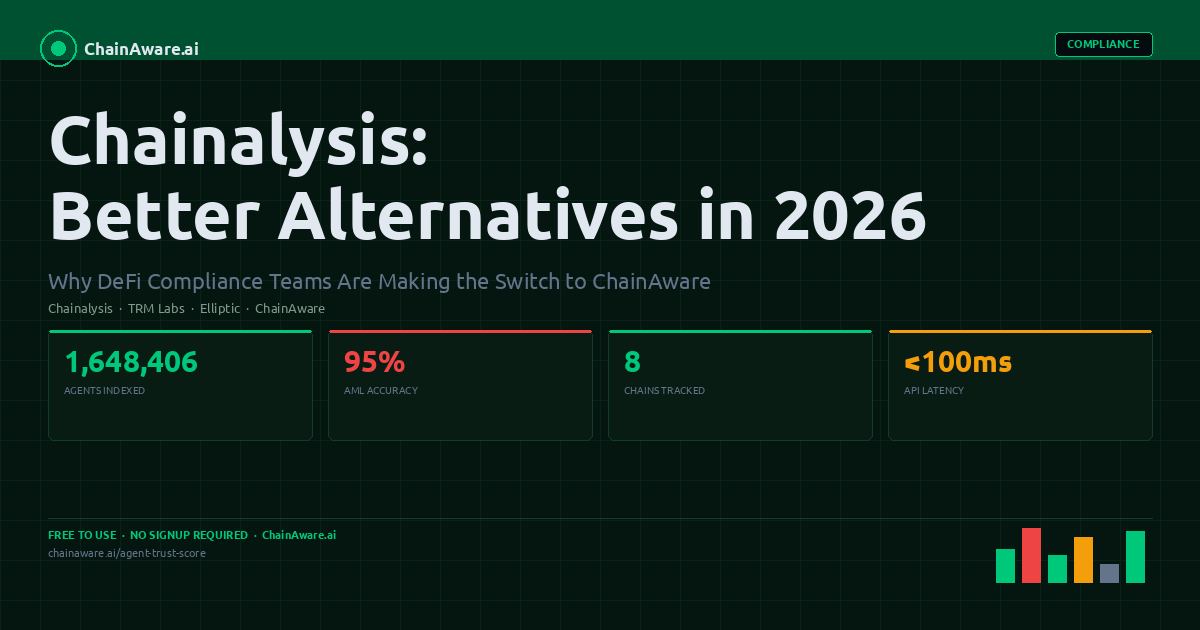
Chainalysis alternatives for DeFi compliance teams 2026 — ChainAware.ai

Chainalysis Alternatives Exposed: The Full Truth for DeFi Compliance Teams in 2026

Chainalysis, TRM Labs, and Elliptic were built for a different era—one where compliance meant chasing stolen Bitcoin through darknet markets. But DeFi teams in 2026 face fundamentally different challenges: autonomous AI agents interacting with your pools, thousands of daily transactions across eight or more chains, and MiCA compliance obligations with real teeth. Legacy address blacklists are reactive by design, incapable of scoring behavioral patterns in real time or evaluating agent trustworthiness. ChainAware’s behavioral intelligence platform bridges this gap with predictive fraud detection and real-time KYT scoring that legacy tools simply weren’t built for. Discover how the four leading compliance platforms stack up against your actual operational needs, where each excels, and which might leave your DeFi protocol exposed to emerging risks.
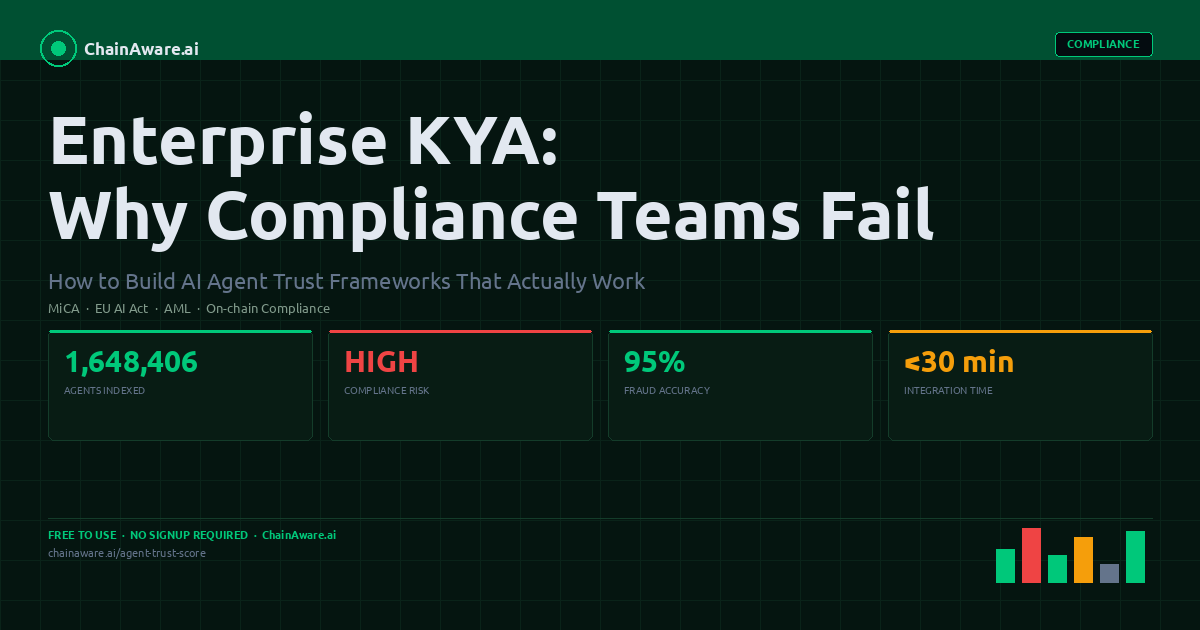
Enterprise KYA compliance teams building AI agent trust frameworks — ChainAware.ai

Enterprise KYA: Proven Truth About Why Compliance Teams Fail to Build Agent Trust

Compliance teams face an uncomfortable truth: the 1.6 million autonomous agents operating on-chain today are screened by exactly zero compliance tools built for the purpose. When an AI agent initiates a payment or executes a smart contract, legacy KYC infrastructure treats it as either a human user or an anonymous API call—neither assessment captures the agent’s on-chain identity, funding provenance, operator history, or behavioral fingerprint. Know Your Agent (KYA) represents a categorical shift from static identity verification to continuous behavioral trust assessment using on-chain evidence. ChainAware’s indexed data reveals the scale of this exposure, but also what production KYA stacks actually look like. Discover how forward-thinking compliance teams are building defensible risk decisions before regulatory mandates arrive—and why waiting puts you 18 months behind peers who moved early.

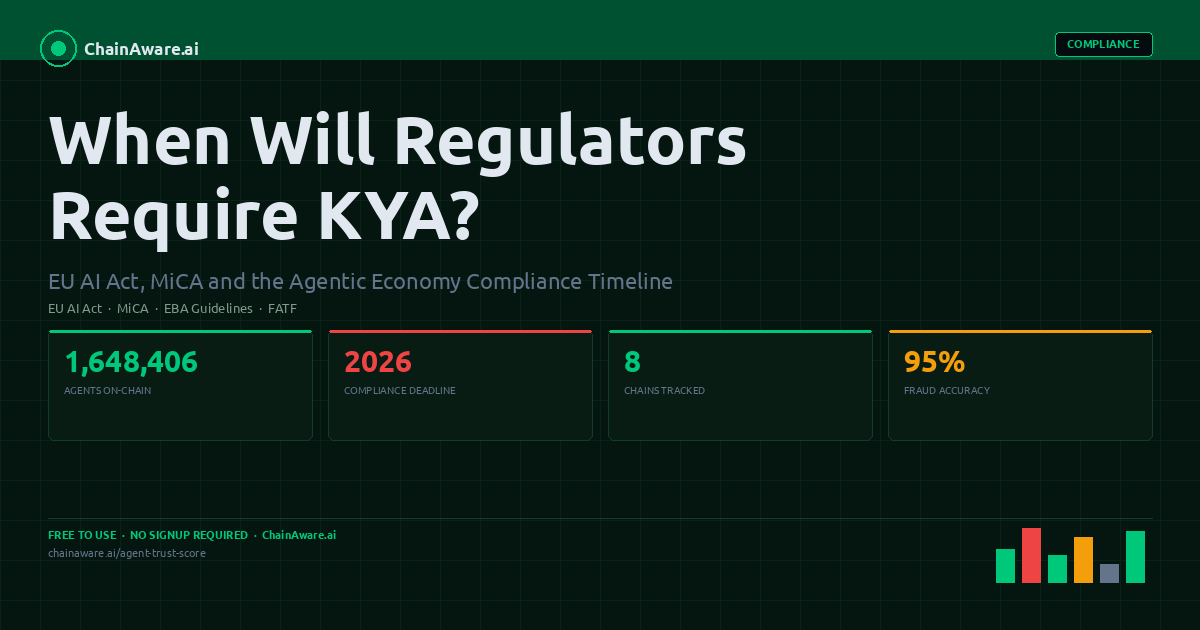
KYA regulations EU AI Act MiCA agentic economy compliance timeline — ChainAware.ai

KYA Regulations Exposed: Proven Truth About the EU AI Act, MiCA and Agentic Economy

Regulators haven’t yet mandated Know Your Agent protocols — but three separate regulatory frameworks are converging to make it inevitable. The EU’s MiCA Article 68 is creating screening gaps for AI agent wallets, whilst the EU AI Act Article 50 establishes identity disclosure as a legal requirement. Meanwhile, the FATF Travel Rule is closing in on the agent originator problem. With 1.6 million ERC-8004 agents already indexed on-chain and funding chains traceable to known bad actors, compliance teams face enforcement exposure today, long before formal agent-specific rules land. This article maps the three regulatory tracks, identifies the grey areas where agents currently operate, and provides a realistic timeline for when mandatory agent registration becomes law. Learn what your team needs to do now to stay ahead of the curve — and why ChainAware’s agent behaviour scoring is becoming essential compliance infrastructure.

KYC to KYA identity verification evolution for AI agents — ChainAware.ai agent trust score

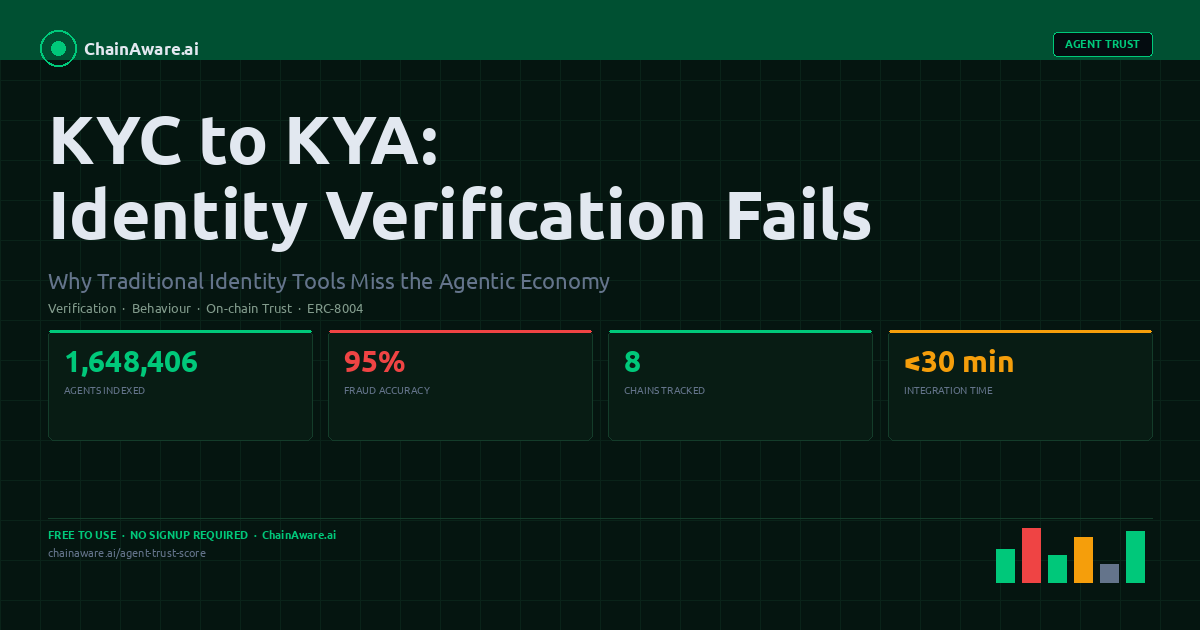
KYC to KYA Exposed: Proven Truth About Identity Verification in the Agentic Economy

Traditional Know Your Customer protocols were built for humans—but AI agents operating autonomously across blockchains expose three critical gaps that KYC cannot close alone. When software holds wallets and executes transactions without human oversight for each action, the delegation chains, behavioral drift and fleet Sybil attacks multiply compliance blind spots. ChainAware’s analysis of the ERC-8004 agent ecosystem reveals the scale: 1.6 million registered agents across eight chains, with 82.5% of scored agents showing elevation risk signals that static identity checks never catch. This article explains precisely where KYC breaks under agent volume, what Know Your Agent adds to close those gaps and what on-chain behavioral intelligence reveals about the agentic economy’s real compliance challenge. Discover why continuous behavioral scoring, not point-in-time verification, is now essential for Web3 compliance teams.

Verifying AI agents at checkout tokens mandates and behavioural trust — ChainAware.ai

Verifying AI Agents at Checkout Exposed: The Full Truth About Tokens and Behavioural Trust

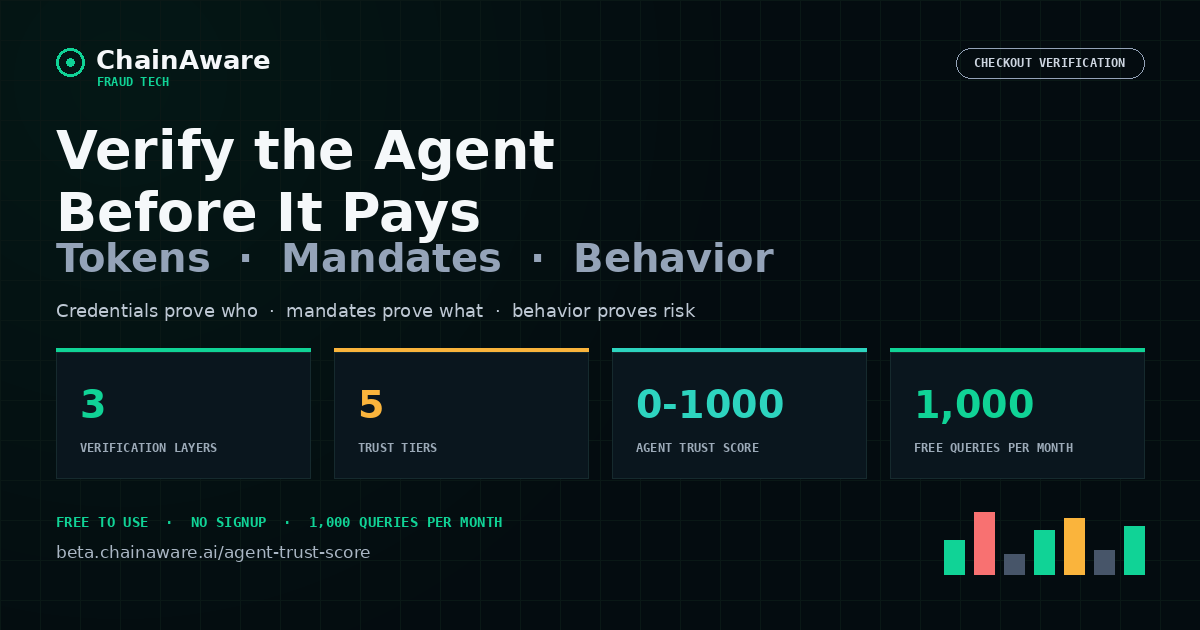
A checkout page used to ask one question: is this customer who they say they are? With AI agents, it must ask three. Who is this agent, what did the user allow it to do, and how risky is the operator behind it? This guide walks merchants, payment providers and platforms through the three-layer verification stack for AI agents at checkout. Layer one – credentials and payment tokens (OpenAI/Stripe Agentic Commerce Protocol, Google AP2, Trulioo Digital Agent Passport, ERC-8004) – proves who the agent is and how it pays. Layer two – signed mandates – proves what the user allowed, covering AP2 intent, cart and payment mandates and what to check at authorization time. Layer three – behavioral evidence – is the only layer that separates a trustworthy agent from a well-documented bad one: owner wallet fraud probability, feeder funding chain, creator rug pull and honeypot history, and fleet-level farm detection. At launch, 51.8% of 274,792 indexed ERC-8004 agents sat in the Elevated Risk or Untrusted tiers despite holding valid credentials. ChainAware’s Agent Trust Score supplies the behavioral layer as a 0 to 1,000 score with five tiers and named flags. The guide includes a six-step decision flow, a flag reference table, attack scenarios, merchant-type playbooks and a 60-day rollout plan. Free tier covers 1,000 queries per month with no signup.

Agentic commerce fraud four-party card model who bears the loss — ChainAware.ai

Agentic Commerce Fraud Exposed: The Full Truth About Who Bears Loss in Four-Party Payments

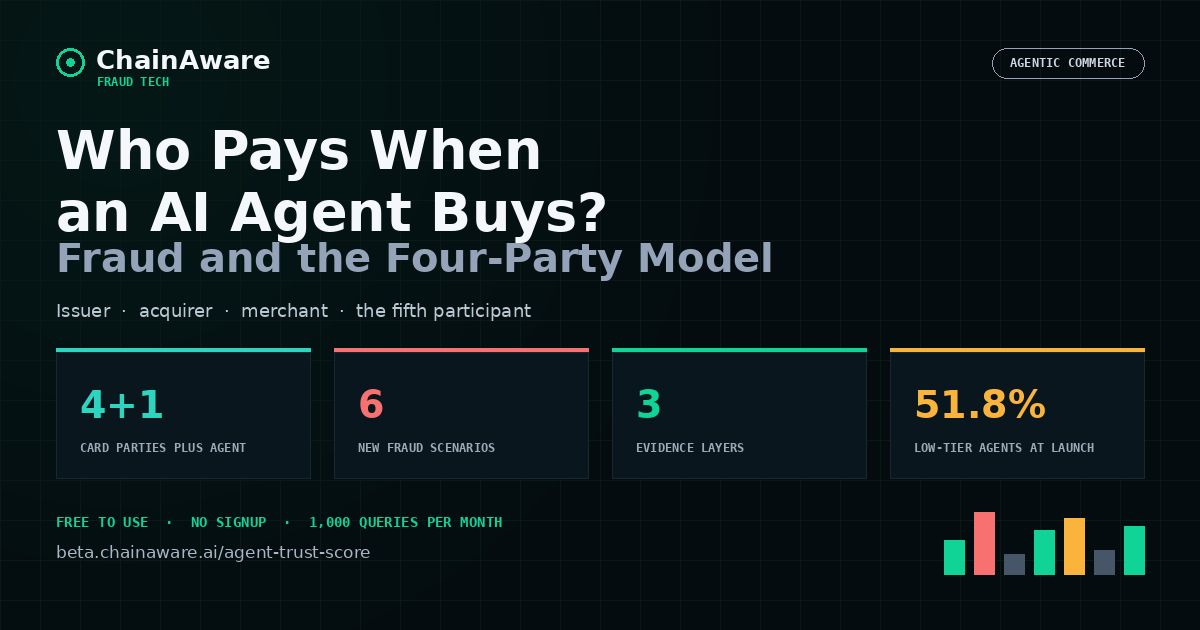
The four-party card model assumes a human at checkout – device fingerprints, typing rhythm and session history feed every fraud engine on that assumption. AI agents remove all of it. This guide explains what agentic commerce fraud looks like inside the issuer-acquirer-merchant-network model, why liability for agent-initiated transactions is still unsettled, and what a behavioral trust layer adds to the credential and mandate rails already being built by OpenAI, Stripe, Google AP2, Visa and Mastercard. Six new fraud scenarios follow from the lost human signal: agent impersonation, mandate abuse, agent drift, fleet abuse, friendly-fraud alibi disputes and compromised agents. McKinsey estimates agent-mediated commerce could reach $3-5 trillion by 2030, yet the open ERC-8004 registry already shows what happens without behavioral scoring: 51.8% of 274,792 indexed agents sat in the two lowest tiers, 21.1% carried the farm flag, and the Week 41 median trust of new registrations fell to a record-low 101. ChainAware’s Agent Trust Score supplies the behavioral layer for on-chain agents – owner wallet fraud probability, feeder funding chain, creator rug pull and honeypot history, and fleet-level farm detection – as a 0 to 1,000 score with five tiers and named flags. Free tier covers 1,000 queries per month with no signup.

Funding-chain risk feeder wallet as the real AI agent trust signal — ChainAware.ai

Funding-Chain Risk Exposed: Why Security Teams Fail to Catch the Feeder Wallet Threat

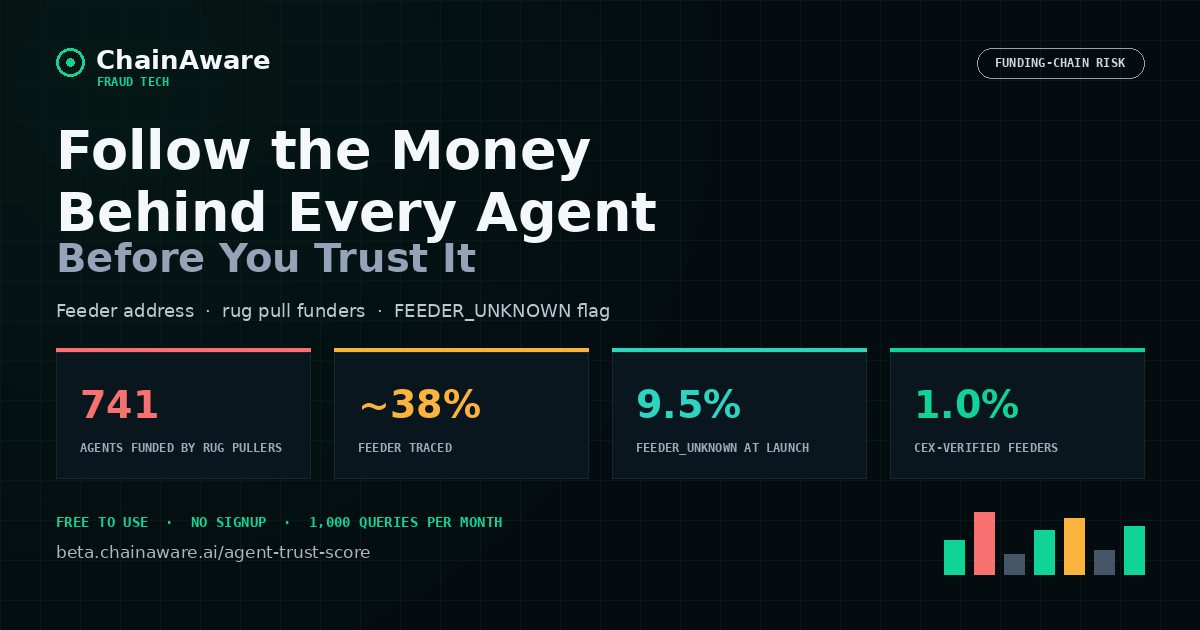
Every AI agent has an owner, and every owner wallet has a first source of money. That source, the feeder wallet, sits on a public ledger that nobody can edit after the fact – and it predicts risk better than any agent description. This guide explains funding-chain risk for ERC-8004 agents, defines the full feeder signal spectrum from FEEDER_CEX_VERIFIED to FEEDER_RUG_HISTORY, and shows how to build feeder flags into access policies, compliance reviews and automated agent flows. At launch, only 1.0% of 274,792 indexed agents carried a verified-exchange feeder, while 9.5% had an unknown feeder and 741 were funded by confirmed rug pull operators. By Week 41 of 2026, the unknown-feeder share had nearly doubled to 12.84% across 568,590 indexed agents. Shared feeders also expose Sybil fleets: farm detection flagged 21.1% of agents at launch because one funding source behind many owner wallets is the clearest fleet signal available. ChainAware traced a feeder for roughly 38% of indexed agents. The Agent Trust Score uses the feeder as one of three core pillars – alongside owner wallet fraud probability and creator rug pull and honeypot history – with a fraud-history feeder hard-suppressing the score regardless of other signals. Free tier covers 1,000 queries per month with no signup.

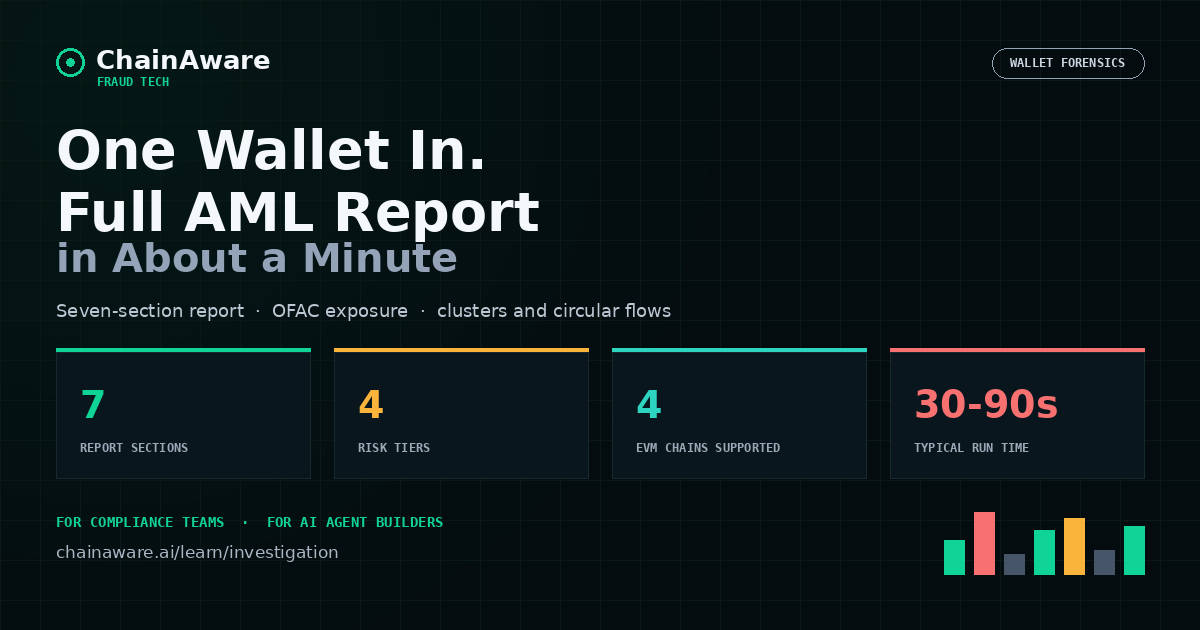
Wallet forensics dashboard tracing crypto transactions for AML compliance review — ChainAware.ai

Wallet Forensics Exposed: The Full Truth About AML Reports for Compliance Teams

ChainAware Investigation turns a single EVM wallet address into a structured seven-section forensic report in 30 to 90 seconds. The report covers Identity and Roles, Activity Summary, Top Counterparties, Risk Assessment, Circular Flows and Clusters, AML Exposure, and a Conclusion with a combined LOW, MEDIUM, HIGH or CRITICAL risk tier. It combines ChainAware’s behavioral fraud intelligence with OFAC sanctions screening, third-party forensic signals and identity lookups across ENS, Unstoppable Domains, SPACE ID and ChainAware known-entity labels. Investigation supports externally owned accounts on Ethereum, BNB Smart Chain, Base and Polygon, and it is a point-in-time snapshot that teams rerun for monitoring. Compliance and AML teams use it for KYT due diligence, incident response, SAR preparation and pre-transaction OTC screening, while AI agent builders use the fixed structure and risk tier as a machine-readable counterparty check inside agentic pipelines. This guide explains each report section, the four risk tiers, a worked example, common wallet patterns, workflow design, responsible-use rules and the tool’s limits. ChainAware does not file SARs, and recommendations remain informational. Related tools include Agent Trust Score, the Fraud Detection API, Token Audit and the Prediction MCP. Learn more at chainaware.ai/learn/investigation/index.html.

Diagram of 32 Claude sub-agents split into fraud tech and growth tech for the agentic economy — ChainAware.ai

ChainAware.ai’s 32 Claude Sub-Agents Exposed: The Full Truth About Fraud Tech and Growth Tech

ChainAware.ai operates on 32 Claude sub-agents – each one a specialist wrapping ChainAware’s Prediction MCP with precise decision logic and behavioral reasoning. This article classifies all 32 agents into Fraud Tech (17 agents) and Growth Tech (15 agents), with use case and trigger conditions for every agent.

AI fraud prevention market map featuring ChainAware.ai in the CB Insights landscape — Web3 fraud detection — ChainAware.ai

Web3 Fraud Exposed: The Full Truth About ChainAware.ai’s Place on CB Insights’ Map

CB Insights named ChainAware.ai in its AI Fraud Prevention Market Map – placing it in the On-Chain Intelligence subcategory alongside Chainalysis, Elliptic, and TRM Labs. 200+ companies selected. One mission: building the trust and intelligence infrastructure the worldwide AI revolution demands.