
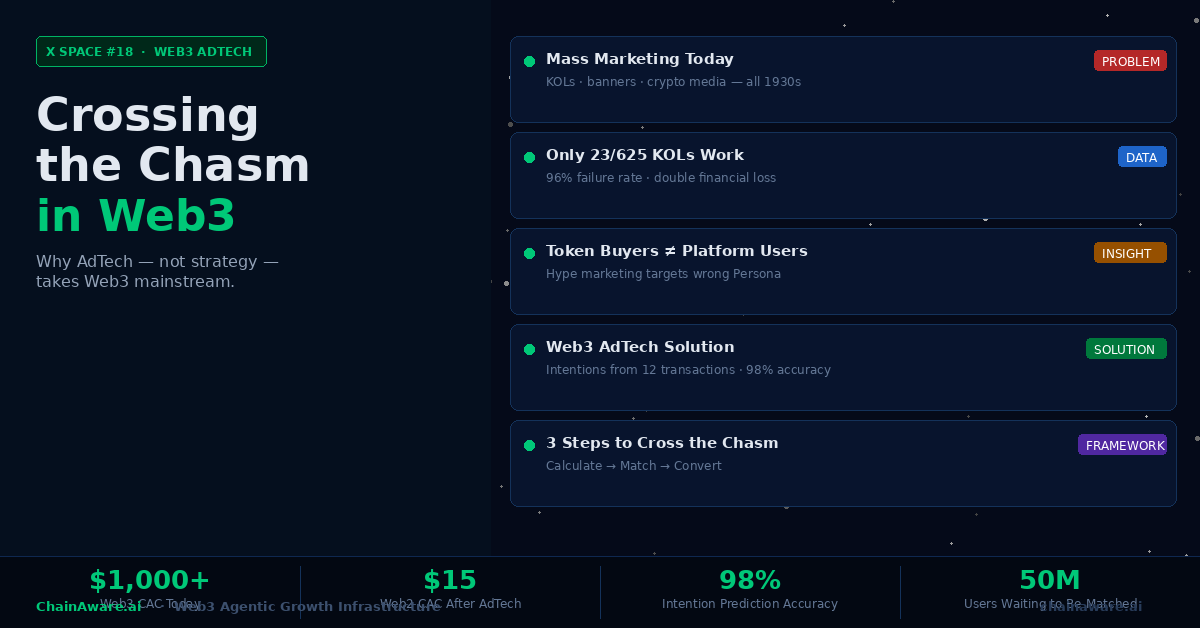
X Space #18 — Crossing the Chasm in Web3: How AdTech Will Take Web3 Mainstream. Watch the full recording on YouTube ↗ · Listen on X ↗
X Space #18 opens with a title borrowed from one of the most famous business books ever written: Geoffrey Moore’s Crossing the Chasm. Martin and Tarmo use the framework not to summarise it — they use it to critique it. Moore described the transition from early adopters to mainstream users in stunning detail across hundreds of pages, but he never explained the mechanism through which that transition actually happens. X Space #18 is ChainAware’s answer to that unresolved question — and the answer has direct, operational implications for every Web3 project struggling with user acquisition costs that make sustainable business building mathematically impossible.
In This Article
- The Web3 Paradox: 8x Better Unit Economics, 50x Worse Acquisition Costs
- The 1,000 Users Per Project Problem
- Crossing the Chasm: The Question Geoffrey Moore Never Answered
- The Technology Adoption Lifecycle: Why Different Users Need Different Messages
- The KOL Reality: 23 Out of 625 Produce Positive Returns
- The Three Mass Marketing Channels — All Fundamentally the Same
- Hype Marketing vs User Acquisition: Two Completely Different Personas
- How Web2 AdTech Actually Worked: The Google Innovation
- Microsegmentation: What Happens Behind the Simple Ad Interface
- The $1B Growth Landscape Problem: Attribution Instead of Intention
- Why Blockchain Data Produces Better Targeting Than Google or Facebook
- The Three Steps to Crossing the Chasm in Web3
- Why Web3 Will Take Over Web2 Once AdTech Arrives
- Comparison Tables
- FAQ
The Web3 Paradox: 8x Better Unit Economics, 50x Worse Acquisition Costs
The central paradox of Web3 in 2024 is stark and almost universally unacknowledged: Web3 platforms have dramatically better unit economics than their Web2 equivalents, yet they cannot scale. The business process innovation in DeFi is genuine and enormous. Lending, borrowing, trading, and financial settlement through smart contracts costs approximately 8 times less per transaction than equivalent operations in traditional finance. Web3 is 100% digitalized — there are no massive back offices processing manual steps between client interactions. The product quality is real.
However, Web3 user acquisition costs completely erase this advantage. In Web2, acquiring a transacting user costs approximately $15-30. In DeFi, acquiring a transacting user costs over $1,000. This is not a minor gap — it is a structural impossibility. As Martin explains: “You can build these extreme innovative solutions, optimise business processes to completely new business models, fully digitalised. But you can’t acquire users. It’s very costly to acquire users with current Web3.” The product-level advantage is irrelevant if the unit economics of customer acquisition make cash flow positive mathematically unachievable. For the full acquisition cost calculation, see our intention-based Web3 AdTech guide.
The Revenue Concentration Evidence
DeFi Llama provides empirical confirmation of this dynamic. Sorting DeFi protocols by revenue reveals an extreme power-law distribution: a handful of established protocols capture the vast majority of revenue, while a long tail of thousands of projects generates minimal revenue insufficient for sustainability. Martin identifies the cause: “There is innovation coming to the market, but innovation is not coming to the users. The reason is we are not getting right users to the right platforms.” The network effects explanation that incumbents typically offer is, in his view, a symptom rather than a cause. The actual cause is missing matching infrastructure between users and projects. For more on the power law distribution and how AdTech addresses it, see our AI marketing for Web3 guide.
The 1,000 Users Per Project Problem
Martin presents a back-of-napkin calculation that reframes the Web3 user acquisition problem in a striking way. If there are approximately 50,000 Web3 projects and 50 million Web3 users, the mathematical distribution allocates roughly 1,000 users per project. For most DeFi, GameFi, or NFT platforms, 1,000 dedicated transacting users would generate sufficient revenue for sustainability — potentially even profitability.
The problem is not scarcity of users relative to projects. The problem is matching inefficiency. Those 50 million users are not evenly distributed across 50,000 projects based on how well each project serves their specific needs — they are distributed based on visibility, marketing spend, and the network effects of early incumbents. Innovative new projects that could deliver more value to specific user segments cannot reach those users because no efficient matching mechanism exists. As Martin notes: “Every project could get 1,000 users which are matching perfectly with them. These 1,000 users bring enough revenues. Everyone is happy. Users will be happy, projects will be happy, the industry will be blooming. But this is not happening.” For context on why the current distribution is so concentrated, see our guide to why fraud compounds this problem.
Understand Your 1,000 Users — Free
ChainAware Free Analytics — Who Is Actually Connecting to Your DApp?
Before you can match users to your platform you need to know who they are. ChainAware’s free analytics pixel shows the intentions distribution of every wallet connecting to your DApp — borrowers, traders, newcomers, gamers. 2-minute setup. Free forever.
Crossing the Chasm: The Question Geoffrey Moore Never Answered
Geoffrey Moore’s Crossing the Chasm became one of the defining business books of the Internet era. Published in the early 1990s and updated multiple times since, it describes the pattern of technology adoption with analytical sophistication: why technologies struggle to move from early adopters to mainstream users, and what strategic postures help companies make that transition. Martin read it during the original Internet boom: “I was so excited. I remember reading this book even during the night because it was so cool.”
However, Moore describes the outcome without explaining the mechanism. He identifies that a chasm exists between early adopters and the early majority, and he offers strategies for crossing it — but he doesn’t explain the underlying market infrastructure that enables crossing to happen at scale. His framework attributes the crossing to strategic positioning, niche targeting, and bowling-pin market entry. These are necessary but insufficient. As Martin observes: “Geoffrey Moore in his wonderful book described it all. It happened out of something. It just happened. I just walked on the street and then it happened. Why? What was the reason? What was behind this? What was the trigger?” The trigger, which Moore’s book doesn’t name, was AdTech.
The Technology Adoption Lifecycle: Why Different Users Need Different Messages
Tarmo extends Moore’s framework to address a specific failure mode in Web3 marketing: the assumption that one message serves all user segments. Moore’s technology adoption lifecycle identifies five distinct user groups — innovators, early adopters, early majority, late majority, and laggards — each with fundamentally different motivations, risk tolerances, and decision criteria.
Innovators are technology enthusiasts who want to understand how things work. Early adopters evaluate applications — what can this do? Early majority users want demonstrated enterprise capability before adopting. Late majority adopters want established solutions. Laggards adopt only when forced to. Each group responds to entirely different messages. As Tarmo explains: “Innovators need a message about how cool the technology is. Early adopters need a message about how good the application is. Early majority needs a message about how I benefit from this application.” Delivering the same message to all five groups simultaneously — which is what mass marketing does — achieves resonance with none of them.
Web3’s Bitcoin Cycle Pattern
Martin traces this lifecycle through Web3’s own history. The 2017-2018 ICO cycle attracted innovators — people who read white papers, evaluated technical architecture, and were excited by the technology itself regardless of product quality. The 2021 DeFi and NFT cycle attracted early adopters — people who looked for working applications and tried products that delivered actual functionality. The current cycle requires reaching the early majority — users who want clear personal benefit, demonstrated safety, and sustainable platforms. Each transition demands a complete overhaul of marketing messaging. Continuing with the same technical/hype-focused messaging from previous cycles actively prevents reaching the next user cohort. For how ChainAware addresses this user segmentation problem, see our behavioral user analytics guide.
The KOL Reality: 23 Out of 625 Produce Positive Returns
Martin cites a specific, verifiable data point that quantifies KOL marketing ineffectiveness with precision. AlphaScan, which tracks the performance of 625 listed KOLs (key opinion leaders) in Web3, showed at the time of recording that only 23 had produced positive 30-day returns for the tokens they promoted. That is a 96.3% failure rate — meaning that for every 100 KOL campaigns a Web3 project funds, approximately 96 produce neutral or negative outcomes, and just 4 generate any positive return.
The economics are worse than the failure rate suggests because projects pay KOLs regardless of outcome. The typical KOL fee structure is upfront payment for posts or videos, with no performance accountability. A project paying $5,000 for a KOL campaign that produces negative price action loses both the $5,000 fee and suffers the reputational damage of association with a failed promotion. As Martin notes: “You pay the calls and the impact was negative. You get negative results. It’s a double hit. So if you had not paid the calls, you would have saved the money — and maybe the negative result would have been even bigger, we don’t know.” For the complete KOL effectiveness analysis, see our AdTech vs mass marketing guide.
The Three Mass Marketing Channels — All Fundamentally the Same
Martin systematically identifies the three dominant Web3 marketing channels and argues that despite their surface differences, all three are structurally identical in their core failure mode: they deliver the same message to everyone regardless of individual intentions.
KOL campaigns are the most obvious mass marketing channel — a Twitter thread, YouTube video, or Telegram post reaches an influencer’s entire audience with identical content regardless of whether any specific follower has the behavioral profile of a potential user for the project.
Banner advertising on CoinGecko, Etherscan, and CoinMarketCap delivers identical creative to every visitor regardless of their DeFi experience level, their current intentions, or their likelihood to convert. An NFT collector visiting CoinGecko sees the same DeFi lending banner as an experienced yield farmer. Both see content designed for neither of them specifically.
Crypto Media and Guerrilla Marketing
Crypto media (Cointelegraph, CoinDesk, Bitcoin.com) provides awareness and trust delegation — the publication’s credibility transfers to the featured project through association. However, every reader sees the same article regardless of their individual profile. The media placement creates broad awareness but zero personalisation. Martin also addresses the “guerrilla marketing” label that agencies use to rebrand standard mass marketing activities: “Four or five years ago we learned about guerrilla marketing. They’re still doing guerrilla marketing because the cool stuff is you don’t need to explain to the clients what you’re doing. Let’s just — I’m doing guerrilla marketing. And the clients are giving you money.” Guerrilla marketing, in this usage, is mass marketing with a more exciting name — it doesn’t change the structural absence of intention-based targeting. For how this compares across historical marketing eras, see our Web3 AI marketing complete guide.
Hype Marketing vs User Acquisition: Two Completely Different Personas
One of X Space #18’s most analytically important contributions is Tarmo’s distinction between two fundamentally different Personas that Web3 marketing currently conflates: token holders (investors) and platform users. These are not variations on a single type — they are psychologically and behaviorally distinct categories that require completely different acquisition strategies.
Token holders are investors. Their primary motivation is financial return on their token investment. They have high risk tolerance — they are speculating on appreciation. Their interest in the platform’s actual functionality is secondary or entirely absent. They evaluate projects based on hype narratives, team credibility, market sentiment, and tokenomics. Converting a token holder into a platform user requires an entirely different value proposition and communication approach from what attracted them to the token in the first place.
Platform Users Are a Different Persona
Platform users are functional participants. They want the platform to deliver a specific utility at a cost and experience level that makes it worthwhile relative to alternatives. A DeFi borrower evaluates loan terms, collateral requirements, and protocol security. A yield farmer evaluates APY stability, liquidity depth, and smart contract risk. Neither of these considerations is what drives token purchase decisions. Tarmo is explicit: “Hype marketing will not convert your token buyers, token holders, into the users. Probably it will not. Users will come via resonance — users’ intentions have to resonate with what you’re offering.” The implication is that the vast majority of Web3 marketing spend is directed at acquiring a Persona (the token investor) that is irrelevant to the metric that determines whether a project succeeds (revenue from transacting users). For the full Persona analysis framework, see our personalisation guide.
Target Platform Users, Not Token Buyers
ChainAware Marketing Agents — Intention-Based 1:1 Targeting
Stop paying for token buyers when you need platform users. ChainAware calculates each connecting wallet’s behavioral intentions — borrower, trader, yield farmer, NFT collector — and delivers resonating messages for each Persona automatically. 4 lines of JavaScript. Enterprise subscription.
How Web2 AdTech Actually Worked: The Google Innovation
To understand what Web3 needs to build, Martin reconstructs the specific mechanism through which Web2 solved its analogous user acquisition problem. Web2 in its early phase had thousands of competing platforms, approximately 50 million early users, and mass marketing as the only acquisition channel — the exact situation Web3 faces today. The transition to mainstream happened through a specific technological innovation, not through strategic positioning or niche market entry as Moore’s framework suggests.
Google’s initial insight was deceptively simple: search queries reveal user intentions with a precision that no demographic or geographic data could match. When a user types “fixed-rate DeFi lending” into a search engine, they are revealing a current, specific, high-intent behavioral state. That query tells an advertiser far more about what the user will do next than knowing their age, location, or income bracket. Martin explains: “The search history tells much more about you than people think. Because if you search, you search something based on your internal needs, interests, the intentions. And based on this, Google started to categorise people and create micro-targeting, micro-sequences, collect data about every individual.”
The Captcha Connection
Martin notes an often-overlooked mechanism through which Google extended its data collection beyond search: the reCAPTCHA system. Every time a user completes a CAPTCHA verification, their browsing history gets transmitted to Google as part of the bot-detection process (the verification requires a real browsing history to confirm human behaviour). This gives Google intention signals not just from its own search engine but from the broader browsing activity of users across the entire web. Tarmo adds: “Google earns the revenues via the ads. Twitter — how does Twitter monetise? Via the ads. Facebook — via the ads. Now all three of them are ad technology platforms. They calculate user intentions using different data sources.” The critical insight is that Google, Facebook, and Twitter are not fundamentally search, social, or communication companies — they are intention calculation and targeting businesses that use different data sources to achieve the same core function. For more on this framing, see our guide on how ChainAware is doing for Web3 what Google did for Web2.
Microsegmentation: What Happens Behind the Simple Ad Interface
When advertisers interact with Google Ads or Facebook Ads Manager, they see a simplified targeting interface: age ranges, geographic regions, broad interest categories. This surface-level interface creates the impression that Web2 targeting is only slightly more sophisticated than mass marketing — a few demographic filters applied to a broad audience.
The reality is far more sophisticated. Behind the simple advertiser interface, Google maintains thousands of attributes per user — behavioural patterns, purchase intent signals, content consumption history, device usage patterns, and countless others. These attributes enable microsegmentation: the creation of very precise audience definitions that match a specific intersection of characteristics. Martin gives an example: “Give me all technologists who are interested in Linux and who have used intersection.” This level of specificity — targeting a tiny, precisely defined segment rather than broad demographics — is what drives the conversion rates that make Web2 acquisition economics viable at $15-30 per user. Mass marketing approximations at demographic level achieve none of this precision.
The $1B Growth Landscape Problem: Attribution Instead of Intention
Martin and Tarmo examine the Web3 growth landscape — the ecosystem of companies building user acquisition and growth tools for Web3 projects. At the time of X Space #18, approximately 100+ companies in this landscape had collectively received over $1 billion in funding. The scale of investment suggests the problem is well-understood. However, the approach taken by the vast majority of these companies reveals a fundamental misdirection.
Most Web3 growth tools focus on attribution: recording and analysing which protocols a wallet has used in the past, which tokens it holds, and what transaction patterns characterise its history. Attribution data is descriptive — it tells you what a wallet has done. This is valuable for analytics but insufficient for acquisition, because acquisition requires prediction of what a wallet will do next — its intentions.
The Token Holder Attribution Problem
Furthermore, much of the attribution work in the Web3 growth landscape focuses specifically on token holdings: identifying who holds the governance token of a given protocol and targeting them for related protocols. Tarmo identifies why this is the wrong Persona: “Token holders versus users of the platform — fully different Personas. Token holders are risk-takers, speculators, investors, maybe just mathematical approach to take profit. The other is the user. Fully different Personas.” Targeting based on token holdings reaches investors, not users. The $1 billion invested in this category is largely building more sophisticated tools for the wrong problem — more accurate mass marketing rather than the qualitative jump to intention-based targeting. For how ChainAware differs from the attribution-focused landscape, see our full AI agents roadmap.
Why Blockchain Data Produces Better Targeting Than Google or Facebook
Having established that Web3 needs intention-based AdTech, Martin and Tarmo address the obvious question: what data source does Web3 AdTech use to calculate intentions? The answer reveals a significant advantage over Web2 — blockchain data is actually a higher-quality intention signal than anything Google or Facebook has ever accessed.
Web2 AdTech calculates intentions from search queries (what you looked up), browsing history (what you passively consumed), and social behaviour (what you shared and engaged with). These signals carry meaningful information but have significant noise: searches reflect momentary curiosity as much as genuine intent, browsing is often passive and incidental, and social behaviour is shaped by presentation effects and peer influence.
Financial Transactions as Pure Intention Signal
Blockchain transactions are financial decisions. Every transaction required deliberate evaluation and real financial commitment. Tarmo specifies the precision this enables: “In Web3 we have public data, very accurate data, financial transactions. When you have maybe 12 financial transactions of a wallet from a public blockchain, you can calculate intentions of a wallet owner and you get prediction accuracy over 98%.” Twelve transactions from a blockchain wallet produces higher-confidence behavioral predictions than years of Google search history — because each transaction represents a considered financial decision rather than a casual information request. Furthermore, the data is completely public, requiring no data licensing agreements or platform relationships to access. As Tarmo observes: “All Facebook value — if you look on the S&P, you see the value of Facebook is actually the value of Facebook data, which is private data. In blockchain, this data is public.” For the full data quality analysis, see our predictive AI for Web3 guide.
The Three Steps to Crossing the Chasm in Web3
Martin distils the entire framework into three sequential steps that define how Web3 projects cross the chasm from early adoption to mainstream — the same three steps that drove Web2’s crossing, now applicable to Web3 with blockchain data as the input.
Step one is calculating user intentions from blockchain history. This is the foundation — without knowing what a user is likely to do next, all subsequent targeting is guesswork. ChainAware’s intention calculation engine processes a wallet’s full transaction history across thousands of protocols and produces a behavioral profile: is this wallet a likely borrower, trader, yield farmer, gamer, NFT collector? What is their experience level? What is their risk tolerance? These predictions achieve over 98% accuracy from as few as 12 transactions.
Steps Two and Three: Matching and Converting
Step two is bringing the right users to the right platforms — the matching function. Intention data enables targeted outreach that reaches only users whose predicted behavioral profile matches the platform’s value proposition. A DeFi lending platform should target wallets with high borrowing-intent scores and appropriate experience levels — not wallets with gaming or NFT profiles who will never convert to lending users regardless of how compelling the messaging is. Step three is converting visitors on the platform through intention-responsive messaging. When users arrive at a platform, their intentions determine what content resonates with them. A borrower-profile visitor responds to loan terms and collateral information. A first-time DeFi user responds to educational safety content. As Martin summarises: “We bring right users to the platforms, and then we resonate with the users on these platforms. That’s how we create this liking that users start to like this platform. And that’s how we create the crossing of the chasm — not out of nothing.” For the implementation guide, see our behavioral user analytics guide.
Why Web3 Will Take Over Web2 Once AdTech Arrives
The session closes with a prediction that follows logically from the analysis: when Web3 AdTech closes the acquisition cost gap, Web3 doesn’t just become competitive with Web2 — it takes over. The reasoning is straightforward and rests on the 8x operating cost advantage that Web3 already has.
Web2 platforms have lower-quality products at higher operating cost than Web3 equivalents. A Web2 lending platform has more overhead, more intermediaries, slower settlement, and less transparency than a DeFi equivalent — and these differences translate directly into worse terms for users. The reason users still choose Web2 financial products is not because they prefer them. It is because they don’t know Web3 equivalents exist, can’t find them efficiently, or don’t trust them due to fraud exposure. All three of these are solvable with AdTech — bringing the right users to relevant platforms, and building trust through reduced fraud rates. Tarmo states the conclusion directly: “If Web3 would have now AdTech comparable to Web2 AdTech — then Web3 will just take over the market. Chain Aware has AdTech technology which can be a catalyst for this transformation.” For the full ecosystem transformation analysis, see our guide to why AI agents will accelerate Web3 and our Web3 Agentic Economy guide.
Comparison Tables
Web3 Mass Marketing vs Intention-Based AdTech
| Dimension | Web3 Mass Marketing (Current) | Intention-Based AdTech (ChainAware) |
|---|---|---|
| KOL effectiveness | 23/625 positive returns (3.7%) | Not required — direct wallet targeting |
| Persona targeted | Token buyers and investors | Platform users by behavioral intention |
| Acquisition cost (DeFi) | $1,000+ per transacting user | Target $15-50 per transacting user |
| Data source | Social following, demographics | On-chain transaction history |
| Personalization | Zero — same message for everyone | 1:1 — unique message per wallet profile |
| Historical era equivalent | 1930s Madison Avenue | Google AdWords (Web2 mainstream era) |
| Revenue concentration result | Power law — top 1% captures most revenue | Distributed — matching enables long tail |
| Token holders vs users | Conflated — same campaigns for both | Separate — distinct Personas, distinct targeting |
| Crossing chasm potential | None — cannot scale Web3 mainstream | High — closes the missing coordination layer |
Web2 AdTech Data vs Blockchain Intention Data
| Property | Web2 AdTech Data (Google, Facebook) | Blockchain Intention Data (ChainAware) |
|---|---|---|
| Primary data source | Search history, browsing, social behaviour | On-chain financial transaction history |
| Data quality | Medium — much noise from passive browsing | High — deliberate financial decisions only |
| Prediction accuracy | Variable — improves with volume of data | 98%+ from as few as 12 transactions |
| Data ownership | Private — owned by Google/Facebook | Public — anyone can access |
| Financial commitment required | None — searching is free | Yes — every transaction costs gas |
| Behavioral signal strength | Weak — arbitrary searches, passive scrolling | Strong — deliberate financial decisions |
| Access cost | High — must buy from platform or use ad system | Zero — public blockchain data |
| Manipulation risk | Medium — social signals can be gamed | Low — financial history is immutable |
Frequently Asked Questions
What does “crossing the chasm” mean in Web3?
Crossing the chasm refers to the transition from early adopter usage (technology enthusiasts and innovators) to mainstream use by the early and late majority. Geoffrey Moore’s original book described this challenge in technology markets but didn’t identify the specific mechanism that enables crossing. In Web2, the mechanism was AdTech — intention-based targeting that matched users to relevant products efficiently. In Web3, the equivalent mechanism is blockchain-based AdTech that calculates wallet behavioral intentions and delivers personalised acquisition campaigns at a fraction of current mass marketing cost.
Why does Web3 have such high user acquisition costs despite better unit economics?
Web3’s operating costs are 8x lower than Web2 — the product economics are genuinely superior. However, user acquisition relies on mass marketing (KOLs, banners, crypto media) that delivers the same message to everyone regardless of individual behavioral profiles. This produces very low conversion rates — approximately 1 transaction per 200 website visitors — resulting in over $1,000 per transacting user. Web2 solved an identical problem with AdTech that matched users to relevant platforms based on calculated intentions, reducing acquisition costs to $15-30. Web3 needs the same solution built on blockchain data. For the full calculation, see our AdTech guide.
What is the difference between attribution and intention in Web3 marketing?
Attribution records what a wallet has done in the past — which protocols it used, which tokens it held, what transaction patterns characterise its history. Intention predicts what the wallet will do next — its behavioral forward-looking state. Attribution is useful for analytics. Intention is what drives acquisition. Most of the $1B+ Web3 growth landscape focuses on attribution, because it is technically simpler. ChainAware focuses on intention — calculating from blockchain history what each wallet is likely to do as its next action — which is what enables genuine personalisation and efficient acquisition.
Why are token holders and platform users different Personas?
Token holders are investors — they bought the token to profit from price appreciation. Their decision was driven by investment psychology: expected return, risk tolerance, market sentiment, and tokenomics. Platform users are functional participants — they use the platform because it delivers a specific service better than alternatives. Their decision is driven by utility: loan terms, yield rates, trading conditions, UX quality. The messaging, channels, and value propositions that convert token investors are completely different from those that convert platform users. Hype marketing optimised for token buyers actively fails at acquiring platform users, because the two groups respond to entirely different signals.
How accurate is blockchain data for predicting user intentions?
ChainAware achieves over 98% prediction accuracy for behavioral intentions from as few as 12 on-chain transactions. This exceeds the prediction accuracy available from Google search history or Facebook social data for equivalent sample sizes, because blockchain transactions represent deliberate financial decisions rather than passive browsing or incidental search queries. The public availability of blockchain data also means ChainAware can build intention profiles for any wallet without requiring platform relationships, data licensing agreements, or user consent processes. For the full methodology, see our predictive AI guide.
The Web3 AdTech That Crosses the Chasm
ChainAware Prediction MCP — Intentions, Fraud, Credit. One API.
Intention calculation + 1:1 targeting + fraud detection + credit scoring — all via one MCP API. 98% accuracy. 31 MIT-licensed open-source agent definitions. ETH, BNB, BASE, POLYGON, TON, TRON, HAQQ, SOLANA. The coordination mechanism Web3 has been missing.
This article is based on X Space #18 hosted by ChainAware.ai co-founders Martin and Tarmo. Watch the full recording on YouTube ↗ · Listen on X ↗. For questions or integration support, visit chainaware.ai.