
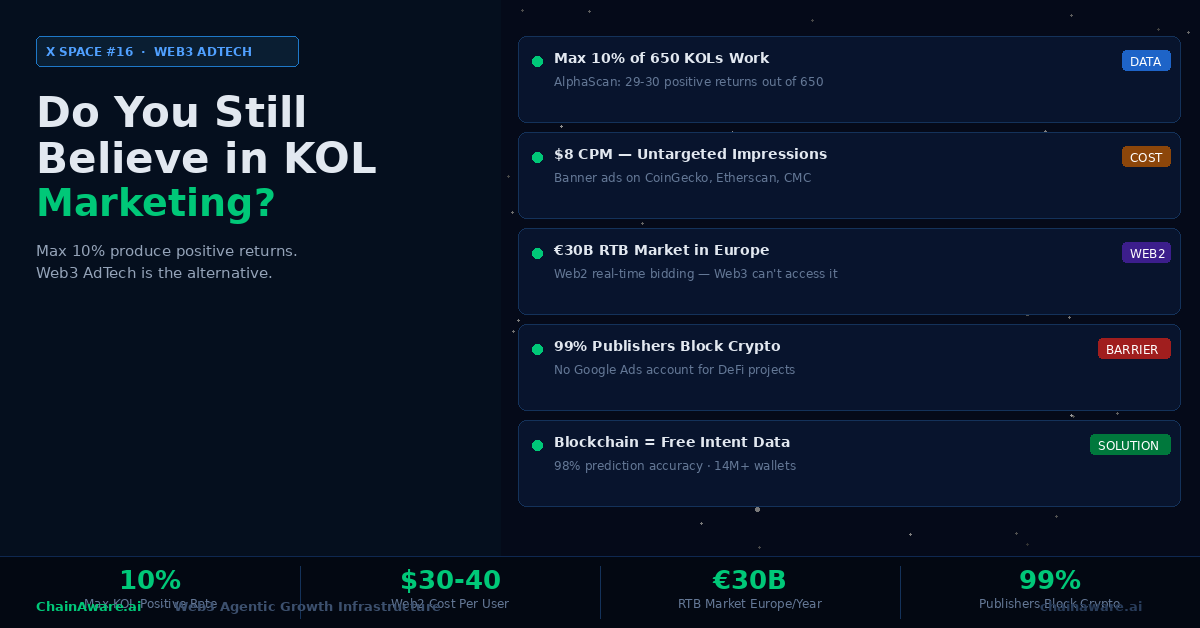
X Space #16 — Do You Still Believe in Web3 KOL Marketing? Why Mass Marketing Fails and Web3 AdTech Wins. Watch the full recording on YouTube ↗ · Listen on X ↗
X Space #16 is ChainAware co-founder Martin’s most comprehensive solo breakdown of the Web3 marketing crisis. With Tarmo experiencing connection difficulties, Martin delivers an extended analysis covering every major Web3 marketing channel, the data on KOL effectiveness from AlphaScan, a deep dive into how Web2 real-time bidding actually works, why Web3 projects cannot access Web2 advertising infrastructure, and precisely how blockchain history enables the Web3 AdTech alternative. The session frames everything around one central question: if the goal of marketing is to reduce user acquisition cost, are any of the tools Web3 projects currently use actually achieving that?
In This Article
- The Purpose of Marketing: User Acquisition, Not Hype
- The KOL Landscape: Why Call Marketing Dominates Web3
- The AlphaScan Reality: Max 10% of KOLs Produce Positive Returns
- The Hype Addiction: Why KOL Spend Compounds Without Compounding Results
- All Web3 Marketing Is Mass Marketing — KOLs, Media, Banners, Guerrilla
- The Banner Problem: $8 CPM for Untargeted Impressions
- How Web2 AdTech Actually Works: RTB, Microsegmentation, and €30B Markets
- Web2’s $30-40 Per User: What Microsegmentation Achieves
- Why Web3 Projects Cannot Use Web2 Ad Technology
- The Twitter Exception: When Web3 AdTech Access Is Possible
- Blockchain History as the Web3 Data Source for Microsegmentation
- The Two-Step Web3 AdTech Framework: Calculate and Target
- Persona Examples: NFT Collector, Gamer, Leverage Staker on a Lending Platform
- ChainAware On-Site Targeting: Personas from Blockchain History
- The Unit Cost Conclusion: Why Personalisation Is Not Optional
- Comparison Tables
- FAQ
The Purpose of Marketing: User Acquisition, Not Hype
Martin opens X Space #16 by establishing the single purpose that all marketing should serve — a definition that most Web3 founders never explicitly articulate but that determines whether any marketing activity is money well spent or money wasted.
Marketing is not a purpose in itself. It is a tool for user acquisition. Every channel, every campaign, and every budget allocation should be evaluated against one question: does this activity bring down the cost of acquiring a transacting user? As Martin states: “It’s not just marketing — this is not self-glorification. It’s all about user acquisition. We need to acquire users. We need to get users to the platform. Marketing is a tool for user acquisition.” The implication is immediate and uncomfortable: if a marketing activity generates impressions, engagement, and community noise without producing transacting users at an acceptable cost, it is not marketing — it is an expensive entertainment purchase.
The Two Unit Costs Every Project Must Optimise
Martin connects marketing purpose to unit economics. Every sustainable business has two critical unit costs that must both be optimised: the cost of the business process itself, and the cost of customer acquisition. DeFi protocols have achieved extraordinary innovation on the first — smart contracts eliminate intermediaries, automate settlement, and reduce transaction costs to a fraction of traditional finance equivalents. However, achieving near-zero business process costs is irrelevant if the cost of acquiring users who actually transact remains prohibitively high. As Martin explains: “You need both. You need both processes and you need to bring your user acquisition cost down. That is the challenge for most Web3 founders.” For the full unit economics framework, see our intention-based Web3 marketing guide.
The KOL Landscape: Why Call Marketing Dominates Web3
Understanding why KOL marketing became Web3’s dominant promotional approach requires understanding the structural constraints that pushed projects toward it. Martin identifies the core issue: Web3 projects cannot access the marketing infrastructure that Web2 companies use, so they built a parallel universe of alternatives — with KOLs at the centre.
KOL marketing, as it currently operates in Web3, involves paying influencers to post messages about a project to their followers. The project pays upfront, the influencer broadcasts promotional content, and the project hopes that a percentage of the influencer’s audience visits the platform and transacts. This model became standard because it is one of the few options available: crypto advertising is banned from most mainstream publisher platforms, DeFi projects cannot obtain Google ad accounts, and the Web2 targeting infrastructure that enables microsegmentation is entirely inaccessible for non-compliant financial services.
The False Security of KOL Ubiquity
Because every Web3 project uses KOL marketing, its use creates a false sense of legitimacy. Launch pads offer special KOL packages. VCs ask about KOL relationships. Exchanges evaluate project Twitter scores partly based on which influencers engage with the project. This systemic embedding of KOL marketing in Web3’s evaluation infrastructure makes opting out feel dangerous even when the data shows it is ineffective. Tarmo — before his connection issues — frames it precisely: “It is a kind of escape from reality. It is wishful thinking. It is the last hope. People think that if they cannot use real AdTech, then let’s use this virtual call marketing. It is the last hope for all Web3.” The problem is not that founders are irrational. The problem is that the rational-seeming alternative — doing what everyone else does — is collectively destroying value across the entire ecosystem. For more on why the ecosystem is trapped in this cycle, see our crossing the chasm in Web3 analysis.
The AlphaScan Reality: Max 10% of KOLs Produce Positive Returns
Rather than relying on qualitative critique, Martin checks AlphaScan — a KOL performance tracking tool — immediately before X Space #16 and reports the results live. AlphaScan tracks 650 crypto influencers and measures the average token return for projects they promote within a defined measurement window. Sorting all 650 by 30-day positive return reveals a striking data point.
Of 650 tracked KOLs, 29-30 produced positive 30-day token returns at the time of the session. That represents approximately 4.5% of the total. Martin notes that he checks AlphaScan regularly and that the positive count fluctuates between 30 and 60 — meaning the upper bound is approximately 10% of tracked influencers producing positive outcomes. As he explains: “Max 10% of them are producing positive returns for you. So projects are paying money, paying quite some money. But somehow it is standard now in Web3 that everyone is doing call marketing. Everyone is doing call marketing.”
The 90% Problem
The inverse of the 10% positive rate is a 90% neutral-or-negative rate. Projects that hire KOLs from the majority of the tracked pool are paying upfront fees for campaigns that produce either no measurable positive effect on token price or an actively negative effect. Martin notes that AlphaScan uses a 10-day delay in its free version, making the data slightly lagged but still directionally reliable. The key takeaway is not that all KOLs are ineffective — 10% genuinely produce positive results. Rather, without the analytical tools to identify which 10%, projects default to hiring from the full pool and get the weighted average outcome: mostly negative, occasionally positive, never reliably predictable. For the deeper analysis of KOL economics, see our comprehensive KOL vs AdTech comparison.
Stop Guessing — Measure What Your Users Actually Intend
ChainAware Free Analytics — Intentions Profile of Every Connecting Wallet
KOL campaigns give you traffic with unknown intent. ChainAware’s free analytics pixel shows the full intentions profile of every wallet connecting to your DApp — borrowers, traders, yield farmers, gamers, newcomers. Know who you are actually reaching. 2-minute GTM setup. Free forever.
The Hype Addiction: Why KOL Spend Compounds Without Compounding Results
Beyond the static performance data, Martin identifies a dynamic problem with KOL marketing that makes it structurally unsustainable even for the minority of projects that see initial positive results: hype is an addiction that requires ever-increasing doses to maintain the same effect.
Hype, by definition, is a temporary elevation above baseline attention. Generating it requires novelty — the first announcement of a project creates hype; the third announcement of the same project creates considerably less. Maintaining elevated attention therefore requires escalating inputs: more KOLs, more frequent posts, larger paid promotions. As Martin explains: “For hype to become stronger, you need more of hype, and then you need again more of hype, and then you need even more hype. It is a drug, it is an addiction. So that means if you start, you have to do it more and more and more.”
The Herd Movement Problem
KOL followings behave as herds — they move as a collective toward the most engaging current narrative and away from yesterday’s story. A project that paid for KOL promotion in month one has no residual audience attention by month three. The influencer’s followers have moved on to four other narratives since then. Stopping KOL payments means immediate disappearance from the herd’s attention entirely. As Martin observes: “One day you stop. One day you stop paying. And the KOLs, they have their own followers — this herd is going somewhere else. They were one day following you and next day they will follow someone else.” This means KOL marketing produces no compounding value: every month of spend delivers exactly one month of attention, with nothing carrying forward into subsequent months. The economics are permanently linear — while the goal of user acquisition requires compounding growth. For the broader strategic analysis, see our Web3 AI marketing guide.
All Web3 Marketing Is Mass Marketing — KOLs, Media, Banners, Guerrilla
Martin’s most important structural argument is that KOL marketing is not a unique problem — it is just the most expensive symptom of a broader disease. Every major Web3 marketing channel shares the same fundamental failure: it is mass marketing that delivers one message to many recipients regardless of their individual needs, intentions, or likelihood to convert.
Crypto media — CoinDesk, Bitcoin.com, Cointelegraph, and dozens of others — charges projects for articles that reach the publication’s entire readership. Every reader receives the same content regardless of whether they are a DeFi power user, a complete newcomer, or someone whose interests have no overlap with the featured project. The publication’s credibility transfers to the project through association — a genuine but fleeting benefit that fades without ongoing spend. Martin’s assessment is direct: prices are “ridiculous, especially for startups.”
Guerrilla Marketing: A Nice Term for the Same Problem
Beyond KOLs and media, agencies sell “guerrilla marketing” to Web3 projects — a term that Martin identifies as primarily a rebranding exercise. “Some agencies are selling guerrilla marketing, whatever it means. It is always a nice term to sell. Like — we do guerrilla marketing. It is a guerrilla. And some projects are paying for this in the hope they get results.” Guerrilla marketing in this context typically means creative social media stunts, community infiltration, and non-conventional promotional activities — all of which share the mass marketing flaw: undifferentiated audiences receiving undifferentiated messages. Martin’s recommendation is memorable: “If you hear guerrilla marketing, you better run — not do guerrilla marketing, but away.” For the full landscape analysis of what does and doesn’t work, see our crossing the chasm in Web3 guide.
The Banner Problem: $8 CPM for Untargeted Impressions
Banner advertising on crypto platforms — Etherscan, CoinGecko, CoinMarketCap, BSCScan — represents the clearest illustration of what Web3 mass marketing costs relative to what it delivers. Martin provides a specific price point that frames the inefficiency precisely.
The standard banner CPM (cost per thousand impressions) on major crypto platforms is approximately $8. This means a project pays $8 for every 1,000 times its banner appears to a visitor — regardless of whether that visitor is a DeFi power user, a trader looking for price data, a developer checking a contract, or someone who accidentally clicked a link. Every visitor to Etherscan or CoinGecko sees the same banner creative regardless of their individual profile, current needs, or likelihood of ever using the advertised platform. Martin describes the pricing directly: “The banner prices are like $8 CPM — $8 per 1,000 impressions — which are, using an English word, ridiculous, very high prices.”
Why $8 CPM Is Actually Expensive
At first glance, $8 per 1,000 impressions might seem affordable. However, the cost-per-acquisition calculation reveals the problem. If a banner generates a 0.1% click-through rate (optimistic for an untargeted banner), $8 CPM produces approximately 1 click per $8 spent — or $8 per click. From those clicks, if 5% connect a wallet (generous), and 20% of those transact (also generous), the effective acquisition cost is $8 / (0.001 × 0.05 × 0.20) = $8,000 per transacting user. Mass marketing economics make the nominal CPM irrelevant — what matters is conversion rate, and untargeted mass marketing achieves conversion rates that make every apparent cost metric misleading. For the complete acquisition cost calculation showing how Web3 compares to Web2’s $30-40, see our user acquisition cost breakdown.
How Web2 AdTech Actually Works: RTB, Microsegmentation, and €30B Markets
To understand what Web3 AdTech needs to build, Martin explains how Web2 actually reduced user acquisition costs — not through better creative or more media spend, but through a technological infrastructure that most Web2 marketers themselves don’t fully understand.
The foundation of Web2 AdTech is microsegmentation: the division of users into extremely precise audience clusters based on thousands of behavioural attributes. As Martin explains: “Microsegmentation means that when I am sending messages to my users, I am sending to specific segments. The segments are very, very specifically calculated — like the company shows Nike shoes to a lot of technology companies. We are speaking like zillions of different segments and people are assigned to these segments.”
Real-Time Bidding: The €30B Market Most Marketers Don’t Know About
On top of microsegmentation sits RTB — Real-Time Bidding — the technology that determines which advertiser’s creative reaches which user in real time. When a user visits a publisher website, an automated auction runs in milliseconds: multiple advertisers simultaneously bid to show their ad to that specific user based on their segment membership. The advertiser willing to pay the most to reach that specific microsegment wins the impression. The entire auction completes before the page finishes loading. Martin emphasises that this market is enormous and almost invisible to most practitioners: “RTB is a real-time bidding market — Europe alone, annual 30 billion euro. 30 billion euro. That is this market. It is a data market where technology is running. It is an ad technology. That is where it is decided which customer is getting which ad. You probably never heard about it.” The implication is that Web2’s $30-40 per user acquisition cost was not achieved by better banners or smarter KOL choices — it was achieved by a technological infrastructure that matches specific users to specific offers at the millisecond level. For the broader historical context, see our Web3 crossing the chasm guide.
Web2’s $30-40 Per User: What Microsegmentation Achieves
The concrete output of Web2’s microsegmentation and RTB infrastructure is a user acquisition cost that makes sustainable business building possible. Martin cites the Web2 benchmark: $30-40 per transacting user. This compares directly with Web3’s current reality of hundreds to thousands of dollars per transacting user from mass marketing approaches.
The mechanism behind the Web2 cost advantage is precision: showing the right message to the right user at the right moment dramatically increases conversion probability. A user who searches “DeFi lending rates” and then sees a targeted lending platform ad is far more likely to click, visit, connect their wallet, and transact than a user who sees the same ad banner while checking their portfolio value on CoinGecko. The same ad creative, the same landing page, and the same product produces radically different conversion rates depending entirely on how well the targeting matches the message to the recipient’s current intentions.
Where Web2 Gets Its Intention Data
Web2’s microsegmentation relies on three main data inputs. Google uses search history and browsing history — the latter collected partly through reCAPTCHA, which transmits browsing data to Google as part of bot verification. Facebook uses social interactions, content consumption patterns, video watch time, and the explicit data users provide through their profiles. Twitter uses engagement patterns and dwell time. Each platform builds a virtual identity for every user consisting of hundreds to thousands of behavioural attributes, which then feeds both the microsegmentation and the RTB bidding logic. As Martin notes: “In Web2, we have browsing history, search history. Google is using a lot of browsing history. This identity — some virtual identity somewhere — with the microsegmentation and with the intention calculations, with hundreds slash thousands attributes about each of us.” For how blockchain data compares to these sources, see our predictive AI for Web3 guide.
Get Web2-Level Targeting Using Web3-Native Data
ChainAware Marketing Agents — Microsegmentation from Blockchain History
Stop paying $8 CPM for untargeted impressions. ChainAware calculates each connecting wallet’s behavioral persona from on-chain history and delivers personalised messages in real time. The same microsegmentation Web2 achieves with browsing data — powered by financial transaction data that is far more accurate. 4 lines of JavaScript. Enterprise subscription.
Why Web3 Projects Cannot Use Web2 Ad Technology
The natural question following any description of Web2’s superior targeting infrastructure is: why don’t Web3 projects simply use it? Martin addresses this directly, explaining two structural barriers that prevent Web3 DeFi projects from accessing Web2 ad platforms — barriers that are not technical limitations but regulatory and policy constraints.
The first barrier is publisher access. Approximately 99% of Web2 publishers — news sites, content platforms, social networks outside of Twitter — do not accept cryptocurrency advertising. The closed ecosystem of “crypto media” that Web3 projects use for banner advertising and sponsored content exists precisely because mainstream publishers reject crypto ad spend. Martin frames it clearly: “The number of publishers who accept crypto ads at all is very limited. The amount of publishers is limited, plus you need an ads account.”
The Google Ad Account Problem for DeFi
The second barrier is the ad account requirement. Google Ads requires financial service advertisers to hold a relevant license — a reasonable requirement for consumer protection in regulated financial markets. Centralised exchanges like Binance, OKX, and Coinbase can obtain these licenses and therefore qualify for Google ad accounts. Decentralised Finance protocols, by contrast, have no legal entity operating the protocol in most cases and therefore cannot obtain the required financial services licence. No licence means no Google ad account. No ad account means no access to Google’s targeting infrastructure, RTB participation, or search advertising. As Martin explains: “If you want to get an ads account from Google, of course you can make some little steps, but Google is probably telling you to show them a licence. But there is no licensing for DeFi. There is only licensing for centralised finance companies.” The result is that the most powerful and cost-effective marketing infrastructure ever built is structurally inaccessible to the most innovative financial sector currently operating.
The Twitter Exception: When Web3 AdTech Access Is Possible
Within the broadly inaccessible Web2 ad landscape for crypto projects, Twitter/X represents a meaningful exception — with important conditions that determine which Web3 projects can benefit. Martin notes that ChainAware itself uses a Twitter ad account, using it to promote X Space announcements.
Twitter’s policy on crypto advertising is more permissive than Google’s or Facebook’s, but it still draws a line at financial services. Projects that are not classified as financial service providers — AI tools, developer infrastructure, analytics platforms, community tools — can obtain Twitter ad accounts and use Twitter’s targeting capabilities. Projects that provide direct financial services — lending, borrowing, trading, or investment products — face the same licence requirements that block Google access. As Martin explains: “In Twitter, it is a little bit easier if you are not doing financial transactions. If you are doing advertisements for AI and Web3, you can — you will get an answer from Twitter, and in ChainAware we have an ads account. We are using it and it is very effective.” For Web3 projects that qualify, Twitter’s targeting represents a genuine partial alternative to the fully closed mainstream ad infrastructure.
Blockchain History as the Web3 Data Source for Microsegmentation
With Web2 ad infrastructure inaccessible, Martin establishes the data source that makes Web3-native microsegmentation possible: blockchain transaction history. This data source is not only accessible — it is public, free, and arguably more accurate for predicting financial behaviour than anything Google or Facebook has ever collected.
Web2 AdTech uses browsing history, social interactions, and search queries to infer what a user is likely to do next. These are indirect signals — someone who searches “DeFi lending” might be a researcher, a journalist, a curious student, or an active lender looking for better rates. The signal is noisy because the same query serves many different purposes. Blockchain transaction history, by contrast, records actual financial decisions made with real money at stake. A wallet that has borrowed on Aave, provided liquidity on Uniswap, and staked on multiple protocols over two years is not ambiguously interested in DeFi — it is an active, experienced DeFi participant with a specific behavioral profile that predicts future actions with high confidence.
Pattern Matching at Scale Enables Prediction
ChainAware’s approach to intention calculation from blockchain history mirrors the pattern-matching methodology behind all predictive AI: train models on historical data from wallets with known outcomes, identify the patterns that reliably preceded those outcomes, and apply the identified patterns to new wallets to predict their likely next actions. Martin explains the process: “You create the models, you train them with your data, training with negative data, training with positive data. It is a very iterative process. Most interestingly — we can predict fraud 98% before it happens, because there are some patterns in addresses which are saying there are other addresses with the same patterns that committed fraud. This address here, which has not yet committed fraud, probably will commit fraud.” The same pattern-matching logic applies to non-fraud intentions: borrower patterns, trader patterns, gamer patterns, NFT collector patterns — all extractable from transaction history with high confidence. For the full methodology, see our behavioral user analytics guide.
The Two-Step Web3 AdTech Framework: Calculate and Target
Martin distils the entire Web3 AdTech approach into a two-step framework that mirrors the structure Web2 AdTech already uses — but replaces Web2’s browsing and social data with blockchain transaction history as the input.
Step one is calculating user intentions from blockchain history. This produces a behavioral profile for each wallet address: what is the wallet owner likely to do next? Are they a likely borrower? A potential liquidity provider? An active NFT trader considering their next purchase? A newcomer who has never used DeFi protocols? Each profile represents a different set of needs, motivations, and messages that will resonate. As Martin explains: “What is the web three AdTech? It is the same as we have in Web2. From one side, we need to predict user behavior. We have to do this microsegmentation. And from the other side, we have to place messages for the users.”
Step Two: Matching Messages to Intentions
Step two is connecting the calculated intentions to a targeting system that delivers matched messages to each persona. This is the component that transforms static user profiles into dynamic, conversion-optimised interactions. A project defines which messages to show each persona — not a single message for all visitors, but a matrix of persona-message pairings that ensures every user receives content relevant to their specific behavioral profile and likely next action. Martin describes the mechanics: “From one side, we calculate who is this user, what is his behavior. And from the other side, we are connecting the calculated intentions with the messaging. Two parts: we calculate user intentions, and we connect it with a targeting system so that you can target users with proper messages.” For the implementation guide, see our personalisation in Web3 guide and the Web3 AI agents guide.
Persona Examples: NFT Collector, Gamer, Leverage Staker on a Lending Platform
To make the abstract framework concrete, Martin walks through a specific scenario that illustrates why persona-based messaging produces fundamentally different conversion outcomes than mass messaging. The scenario involves a lending and borrowing platform — one of the most common DeFi product types — receiving three different types of visitors.
Visitor type one is an NFT collector. Their blockchain history shows active trading in NFT marketplaces, token holdings associated with NFT communities, and minimal interaction with lending protocols. The right message for this visitor is not the lending platform’s general interest rate — it is the possibility of borrowing against NFT collateral to fund new purchases without selling existing holdings. Without personalised targeting, this visitor sees a generic lending pitch that doesn’t connect to their actual use case. Consequently, they leave without converting.
Gamer and Leverage Staker
Visitor type two is a gamer whose blockchain history shows GameFi token holdings, in-game asset transactions, and play-to-earn protocol interactions. Their lending platform use case is different from the NFT collector’s: they may want to borrow stablecoins against GameFi assets to fund game purchases or amplify in-game earnings. Generic lending messaging misses this framing entirely. Visitor type three is a leverage staker — an experienced DeFi participant whose history shows repeated loop borrowing strategies on multiple protocols. For this visitor, the technical details of the platform’s leverage mechanics, collateralisation ratios, and yield optimisation features are exactly what they need to see. As Martin states: “For all these three personas, you give fully different messages. If he is an NFT dealer on the borrowing platform, we give him fully different messages. If he is a gamer, fully different. If he is a leverage taker, of course — then it is easy, he is used to borrow-lend and looping.” For more on persona calculation and marketing strategy, see our behavioral analytics guide.
ChainAware On-Site Targeting: Personas from Blockchain History
ChainAware implements the two-step framework as a live product that Web3 platforms can integrate in minutes. When a user connects their wallet to a platform running ChainAware’s targeting system, their blockchain address is immediately evaluated against ChainAware’s behavioral models to generate a persona assignment. The platform then displays messaging configured for that specific persona rather than the generic content every other visitor sees.
Martin describes the persona development process as iterative: “You calculate, you start maybe five personas, you get more experience, you have ten personas, you get even more experience, twenty personas. And you just define which messages you are showing to different personas.” Projects begin with a small number of broad persona categories and refine them over time as more conversion data accumulates. Each iteration produces more precise persona definitions and better-performing message variants, creating a compounding improvement cycle that mass marketing can never achieve.
The Conversion Impact
The conversion impact of switching from generic messaging to persona-matched messaging is significant. When each visitor sees content that matches their behavioral profile and addresses their specific use case, the proportion who take the target action increases substantially. Martin frames the outcome: “Then the wonders will happen because the conversion starts to change. It is not anymore that one magic message is converting every possible user. One magic message is converting the NFT dealer and the gamer and the leverage taker. No — if you are this platform, everyone is getting his own magic message. And that is how you start to convert the users.” For the specific conversion rate benchmarks — and how Web3 personalisation compares to Web2’s 10-15% AI-segmented conversion — see our full AdTech comparison guide.
The Unit Cost Conclusion: Why Personalisation Is Not Optional
Martin closes X Space #16 by returning to the unit economics framework that opened the session, tying the entire analysis together into a conclusion about business sustainability.
Innovation in the business process — the technology that powers a DeFi protocol, the smart contracts, the automated settlement — is necessary but not sufficient for sustainable business building. Every innovative Web3 project also needs innovation in user acquisition. Without both, the business process innovation produces value that cannot reach the users who need it, the project burns through capital, and the logical outcome is closure regardless of product quality. As Martin states: “You need both. One is your cost of business process, other is cost of user acquisition. You need both processes and you need to bring your user acquisition cost down. And that is the challenge for most Web3 founders.”
The Web2 Crossing of the Chasm — Repeated for Web3
The transition Martin describes is not unprecedented. Web2 faced the identical situation: thousands of innovative platforms, limited user budgets, and mass marketing as the only available tool. The moment Web2 solved user acquisition through AdTech — microsegmentation, RTB, intention-based targeting — was the moment Web2 crossed from niche technology to mainstream adoption. As Martin summarises: “Web two had exactly the same situation. There were all these technology innovators who created all these beautiful new platforms. But how do you get the right people to the right platforms? We have two steps: get the right people to the right platform, and then on the platform, convert them. When Web2 solved this, that was the moment when Web2 crossed the cosmos.” Web3 is at the same inflection point now, and blockchain data provides the foundation for the same transition. For the complete historical analysis and what it means for Web3 in 2025, see our crossing the chasm in Web3 guide.
Comparison Tables
Web3 Mass Marketing Channels vs Web3 AdTech (ChainAware)
| Dimension | KOLs | Banners (CoinGecko, Etherscan) | Crypto Media | ChainAware AdTech |
|---|---|---|---|---|
| Message type | Mass — same tweet to all followers | Mass — same creative to all visitors | Mass — same article for all readers | 1:1 — unique per wallet persona |
| Positive outcome rate | Max 10% (AlphaScan) | Unknown — no attribution | Unknown — awareness only | 4x+ conversion uplift |
| Cost structure | Upfront, no performance guarantee | $8 CPM — pay per impression | Upfront per article | Subscription — aligned with outcomes |
| Loyalty generated | Zero — followers move monthly | Zero — passive impression | Temporary awareness spike | High — resonance creates returning users |
| Compounding value | None — stops when payment stops | None — stops immediately | Minimal | Yes — improving with each user interaction |
| Data source | Follower counts (often fake) | Raw traffic volume | Publication readership | On-chain transaction history |
| Targeting precision | None beyond follower demographics | None — all visitors | None — all readers | High — behavioral microsegments |
Web2 AdTech Data vs Blockchain Intention Data
| Property | Web2 AdTech (Google, Facebook, Twitter) | Web3 Blockchain Data (ChainAware) |
|---|---|---|
| Primary data source | Search history, browsing, social likes/shares, video watch time | On-chain financial transaction history |
| Data access model | Private — platforms own and monetise the data | Public — free for anyone to read and analyse |
| Signal quality | Medium — browsing/searching doesn’t confirm intent | High — financial decisions with real money committed |
| Noise level | High — casual curiosity looks the same as genuine intent | Low — gas fees filter out accidental or passive actions |
| Historical depth | Variable — depends on cookie retention and account age | Complete — full wallet history immutably on-chain |
| Prediction accuracy | Variable by segment | 98%+ for fraud; high for behavioral intentions |
| Real-time availability | Yes — for platforms with data access | Yes — blockchain state accessible in real time |
| Cost to access | High — must buy via ad platform or data marketplace | Zero — public blockchain data is free |
Frequently Asked Questions
Why do only 10% of KOLs produce positive returns?
Because KOL marketing is mass marketing — the same message delivered to an undifferentiated audience regardless of individual intentions, needs, or likelihood to convert. The 10% who produce positive results likely have audiences with higher concentrations of users whose profiles happen to match the promoted project, or the timing of their promotion coincides with positive broader market sentiment. Without a systematic way to identify which KOLs have relevant, authentic audiences for a specific project, the majority of campaigns will miss their target entirely. AlphaScan’s data — 29-30 positive outcomes out of 650 tracked — reflects this structural mismatch. For the full analysis, see our KOL vs AdTech comparison.
Why can’t DeFi projects use Google Ads?
Google requires financial services advertisers to hold a relevant jurisdiction-specific licence. Centralised exchanges and regulated crypto brokers can obtain these licences. Decentralised Finance protocols — which typically operate without a central legal entity and are not regulated as financial services in most jurisdictions — cannot obtain them. Without the required licence, DeFi projects cannot get a Google Ads account, which means no access to Google’s search advertising, display network, or YouTube targeting infrastructure. Twitter/X is more permissive for non-financial-service Web3 projects.
What is Real-Time Bidding and why does it matter for Web3?
Real-Time Bidding (RTB) is the auction technology that determines which advertiser’s creative reaches which specific user when they load a web page. Advertisers bid simultaneously for each impression in milliseconds, with the highest bidder’s ad displayed. RTB operates on top of microsegmentation — advertisers bid specifically for users in defined micro-audience segments rather than for generic page impressions. This combination produces the $30-40 per transacting user acquisition cost that makes Web2 businesses sustainable. Europe’s RTB market alone is €30 billion annually. Web3 projects are currently structurally excluded from this infrastructure — which is why blockchain-based Web3 AdTech is the necessary alternative. For more, see the RTB Wikipedia overview.
How does ChainAware create user personas from blockchain data?
ChainAware’s AI models analyse a wallet’s complete transaction history across 2,000+ Ethereum protocols and 800+ BNB Smart Chain protocols to identify behavioral patterns that reliably predict future actions. Pattern matching against known outcomes — the same technique that achieves 98% fraud detection accuracy — produces behavioral profiles: NFT collector, gamer, leverage staker, yield farmer, newcomer, experienced DeFi user. These profiles are then connected to a targeting system that delivers matched messages for each persona when users connect their wallets to integrated platforms. The entire process runs in real time at wallet connection. For the implementation guide, see our behavioral user analytics guide.
Is blockchain data actually better than Google’s data for targeting?
For Web3 use cases, yes — substantially. Google’s data reflects browsing and search behaviour, which includes passive curiosity, research, and incidental exposure. A user who searches “DeFi lending rates” might be a journalist, a student, or an active DeFi participant — the search query alone doesn’t distinguish them. Blockchain transactions are financial decisions made with real money, requiring deliberate evaluation and action. They leave behind high-confidence behavioral signals that predict future financial actions with far greater precision than browsing history. Additionally, blockchain data is completely public and free to access — it doesn’t require building a massive data collection platform or paying licensing fees to a data marketplace.
The Web3 AdTech Alternative — Live and Available Now
ChainAware Prediction MCP — Intentions, Fraud, Credit. One API.
Intention calculation + 1:1 targeting + fraud detection + credit scoring — all via one MCP API. The microsegmentation and persona targeting Web2 achieves with billions in infrastructure — now available for Web3 using free public blockchain data. 98% accuracy. 14M+ wallets. 8 blockchains.
This article is based on X Space #16 hosted by ChainAware.ai co-founder Martin. Watch the full recording on YouTube ↗ · Listen on X ↗. For questions or integration support, visit chainaware.ai.