
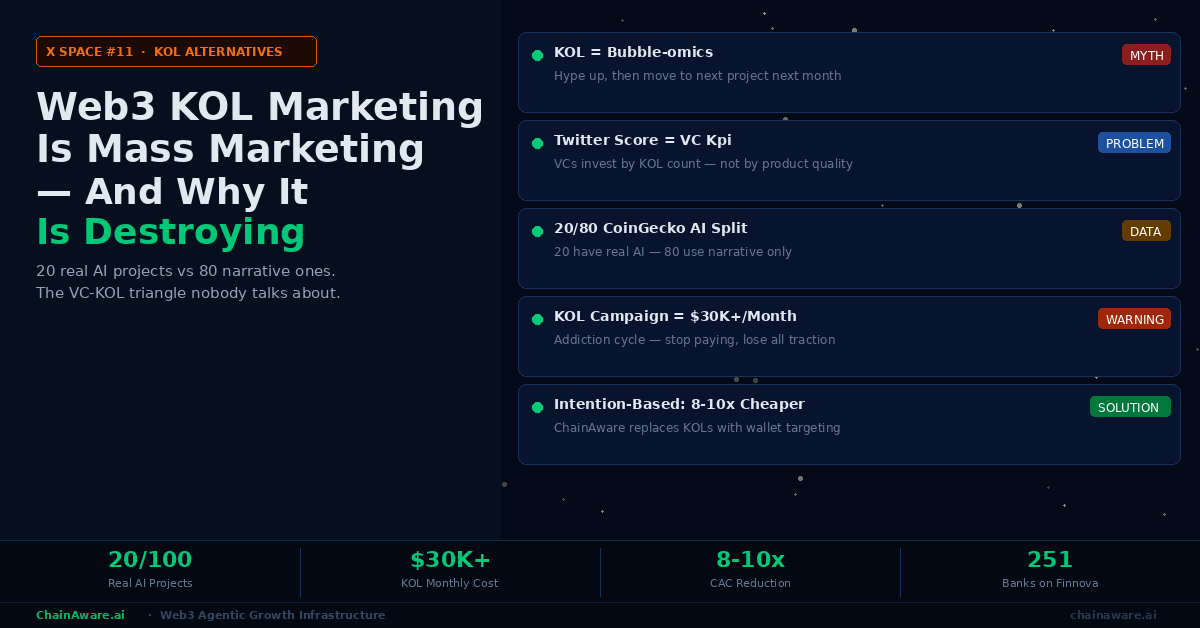
X Space #10 — Web3 KOL Marketing Is Mass Marketing: And Why It Is Destroying Your Project. Watch the full recording on YouTube ↗ · Listen on X ↗
X Space #10 is the session where ChainAware co-founders Martin and Tarmo take apart the KOL marketing system at its roots — not just as an ineffective tactic, but as a structural economic trap that actively destroys value for the founders and innovators who use it while concentrating wealth in the hands of KOLs, marketing agencies, and narrative-creating VCs. The session introduces what Tarmo calls “bubble-omics,” documents the VC-KOL triangle that locks projects into unsustainable spending, presents a striking CoinGecko AI list analysis that reveals exactly how the system has distorted the entire crypto AI sector, and outlines the alternatives that ChainAware believes will define the next era of Web3 marketing. The core message is direct: Web3 marketing is operating at Web1 maturity — and the revolutionary situation that will displace it already exists.
In This Article
- KOL Is Just Influencer Rebranded — The Trust Delegation Mechanism
- Bubble-Omics: How KOL Campaigns Build Hype That Always Collapses
- Web3 Marketing Is Web1 Marketing: Every Channel Is Mass Broadcast
- Quest Systems: The “Innovation” That Is Still Mass Marketing
- The KOL Black Box: Bots, No Geolocation, No Intention Data
- The KOL Addiction: $30,000 Per Month with No Exit
- The VC-KOL Triangle: Who Actually Makes Money in Web3 Marketing
- The Twitter Score: How VCs Choose Investments Without Evaluating Products
- The CoinGecko AI Analysis: Two Clusters That Should Not Both Exist
- The LLM Parallel: Why KOL Followers and LLMs Both Lack Critical Thinking
- How the System Destroys Genuine Innovators
- The Two-Step Alternative: Narrow Targeting and One-to-One Personalisation
- Why Blockchain Wallets Tell You More Than Any Social Media Profile
- The Revolutionary Situation: After Rain Comes Sunshine
- Comparison Tables
- FAQ
KOL Is Just Influencer Rebranded — The Trust Delegation Mechanism
Tarmo opens X Space #10 with a piece of terminology archaeology that immediately frames the entire session. The word “influencer” accumulated negative connotations in the crypto space precisely because the pay-to-promote business model became widely understood — audiences started recognising that influencer content was purchased endorsement rather than genuine recommendation. The industry’s solution was not to change the business model but to change the name. “Key Opinion Leader” sounds authoritative, analytical, and merit-based. The mechanism is identical. As Tarmo states: “KOL is just a new word for influencer. Everyone became an influencer and the word influencer, it got a very negative context in a crypto. So there was a creative idea: let’s call it the key opinion leader business model. And let’s do the same stuff. The business model is still the same, but just the name is different.”
Trust Delegation at Scale
The psychological mechanism that makes KOL marketing work at all is what Tarmo calls trust delegation. People operating in information-saturated environments — and Web3 is one of the most information-saturated environments that exists — cannot independently evaluate every claim, every project, and every technical assertion. Instead, they identify individuals they trust and delegate their evaluation to those individuals’ judgements. When a trusted KOL promotes a project, followers treat this as evaluated endorsement rather than paid advertising. The trust delegation mechanism works until the audience recognises the pattern — at which point the credibility collapses and the cycle restarts with new branding. For more on how Web3 marketing compares to Web2’s intention-based approach, see our Web3 AdTech deep dive.
Bubble-Omics: How KOL Campaigns Build Hype That Always Collapses
Tarmo introduces a concept that precisely names the dynamic underlying KOL-driven token marketing: bubble-omics. The term captures the complete lifecycle of a KOL campaign — from coordinated narrative creation through peak attention to inevitable collapse — and explains why the cycle is structurally impossible to escape within the KOL framework.
A bubble-omics campaign works as follows. A project pays 10-15 KOLs simultaneously to promote the same narrative. Coordinated promotion from multiple sources amplifies the signal — what appears to be widespread organic enthusiasm is actually purchased synchronised broadcasting. The token price rises as retail investors, interpreting coordinated KOL attention as evidence of genuine value, buy in. The KOLs fulfil their contractual obligations — a defined number of tweets or posts — and then move to their next paying client. Attention disappears as rapidly as it appeared because it was never organic. As Tarmo explains: “On which month we have in May, they will speak that the sky is blue. And then in June, when they have a new client, they will speak that the sky is gray. It’s a bubble, and you have to run before the bubble passes.”
The Structural Collapse Problem
The fundamental problem with bubble-omics is that the attention generated is rented rather than owned. A project that builds a community through genuine product value retains that community when marketing spend stops. A project that generates attention through KOL campaigns loses that attention the moment payment stops — because the attention was never the project’s; it was the KOLs’, temporarily pointed at the project for a fee. Martin makes this explicit: “If calls are not speaking, the hype will go down. The port is lost. Attention is lost.” This structural dynamic makes KOL campaigns fundamentally different from brand-building — they are attention-renting with a guaranteed expiry. For the full analysis of why this fails to create sustainable business, see our unit cost guide.
Own Your Audience — Stop Renting Attention
ChainAware Free Analytics — Understand Who Is Actually Connecting
KOL campaigns give you rented attention that disappears when payment stops. ChainAware’s free analytics pixel shows the real behavioral intentions of every wallet that connects to your DApp — borrowers, traders, gamers, NFT collectors. Build on data you own. 2-minute GTM setup. Free forever.
Web3 Marketing Is Web1 Marketing: Every Channel Is Mass Broadcast
Martin provides a comprehensive audit of every major Web3 marketing channel and demonstrates that all of them share a single structural property: mass broadcast with zero receiver personalisation. This is not a problem specific to KOLs — it characterises the entire Web3 marketing landscape, which Martin classifies as operating at Web1 maturity despite running on Web3 infrastructure.
Crypto media (CoinDesk, Bitcoin.com, and others) distributes identical articles to the entire readership. Banner advertising on CoinGecko, Etherscan, and similar platforms serves the same creative to every page visitor regardless of behavioral profile. Community management on Telegram and Discord broadcasts the same messages to all community members. KOLs broadcast identical content to all their followers. Each channel makes one sender communicate identically with multiple undifferentiated receivers. As Martin summarises: “Web three marketing is very simple. You need a lot of money. You make mass marketing. It is something that happened 1930s, 100 years ago. You don’t do segments. The only thing you choose is channels. You push into your selected channels the same message and everybody gets the same message.”
Web Two Already Solved This Twenty Years Ago
The contrast with Web2 marketing is stark. While Web3 operates at Web1 maturity, Web2 has spent two decades building intention-based targeting infrastructure that routes the right messages to the right people at the right moment. Google AdWords, Facebook Ads, and Twitter’s advertising platform all calculate each user’s behavioral intentions from their activity data and match advertisements to predicted next actions. Tarmo notes that he wrote his master thesis on one-to-one marketing before the internet era — and what he described theoretically then has been standard Web2 marketing practice for fifteen years. Web3 has not begun the transition. For how this comparison applies specifically to acquisition cost, see our conversion without KOLs guide.
Quest Systems: The “Innovation” That Is Still Mass Marketing
Martin addresses one category of Web3 marketing that presents itself as innovative — quest systems — and demonstrates that it shares the same fundamental flaw as every other Web3 marketing channel. Quest platforms like Magic Square and Taskon incentivise specific user actions (following a Twitter account, connecting a wallet, retweeting content) by awarding points convertible to token rewards. At first glance, this seems more targeted than banner advertising or KOL promotion.
However, quest systems are still mass marketing because the incentive structure attracts everyone regardless of relevance. Users who complete quests do so for the token reward, not because they have any genuine interest in or intention to use the platform. The resulting “users” have no behavioral alignment with the platform’s value proposition — they are airdrop farmers who connected a wallet and followed an account to earn points, with zero probability of becoming transacting users. As Martin states: “Quest systems — this is kind of mass marketing. We are still the same mass marketing. Mass marketing to everyone. Mass marketing to community management, mass marketing to KOLs, we are buying articles in the crypto media, we are doing banners, we are doing the quest system. Everywhere is a mass marketing — Web1 marketing level.”
The KOL Black Box: Bots, No Geolocation, No Intention Data
When a project pays a KOL to promote its product, it receives essentially no information about who it is reaching. Martin identifies five specific information gaps that make KOL campaigns impossible to evaluate or optimise — gaps that would be unacceptable in any other advertising context but have been normalised in Web3 through industry-wide acceptance of the mass marketing paradigm.
The first gap is intention: there is no data about what any of the KOL’s followers intend to do — what blockchains they use, what protocols they interact with, what financial goals they pursue. The second gap is authenticity: follower counts are easily manipulated through purchased bot accounts. Twitter’s documented bot problem means that a KOL with 50,000 followers might reach 500 genuine humans. Martin highlights a specific tell: accounts with 50,000 followers consistently receiving 10 likes per post. The third gap is geolocation: no demographic information exists about follower geographic distribution, which matters if the project operates in specific regulatory jurisdictions. The fourth gap is protocol history: no information reveals which protocols or blockchains the followers actually use. The fifth gap is blockchain behavioral data: unlike ChainAware’s intention calculation, KOL marketing provides zero data about what followers are likely to do next.
The Evaluation Paradox
The evaluation paradox compounds the black box problem. Projects cannot accurately evaluate a KOL’s effectiveness before engaging them because the conversion data (how many of their followers became actual users) is never shared. Tools like AlphaScan, Twitter Score, and Tweet Scout exist specifically to help projects navigate this opacity, but they measure proxies (reach, engagement rates, follower authenticity) rather than the ultimate metric — conversion of followers into transacting users. The entire secondary industry of KOL evaluation tools exists because the primary industry (KOL marketing) lacks the basic accountability that every Web2 advertising channel takes for granted. For how ChainAware solves the measurement problem with verifiable behavioral data, see our behavioral analytics guide.
The KOL Addiction: $30,000 Per Month with No Exit
Martin and Tarmo use the addiction metaphor deliberately and precisely. KOL marketing creates dependency not through any psychological mechanism in the project team but through the structural economics of attention-renting: every month without KOL spend is a month of declining visibility in an ecosystem where dozens of competitors are maintaining their KOL spend.
The cost structure of a functional KOL campaign requires a minimum of 10-15 influencers to create the appearance of widespread discussion. Each KOL package — typically three to four tweets spread across a week or month — starts at approximately $1,200 per package, with higher-tier KOLs charging significantly more. The minimum campaign budget for 10-15 KOLs therefore starts at $30,000 per month. Marketing agencies that coordinate these campaigns take their own cut on top of KOL fees, pushing effective monthly spend higher. As Martin explains: “If you start to do the call based marketing, after you finish the campaign, what happens? The hype will go down. Attention span is gone. You have to use them again. You have to pay them again. If you start, you have to continue. We are not speaking of creating a real traction. The traction is away. The truck is away.”
The Hope-for-Editorial Trap
Underneath the addiction dynamic lies what Martin calls the hope-for-editorial trap: the belief that eventually a high-value KOL will choose to promote the project organically — not for payment but because they genuinely find it compelling. This “editorial KOL” is the holy grail that every project running paid campaigns secretly pursues. The problem is that editorial KOL attention is extremely rare, occurs entirely at the KOL’s discretion, and cannot be reliably generated by any amount of paid campaign activity. Projects therefore keep paying in the hope of eventually earning something they cannot buy — while the payment itself continues to drain the treasury that would fund the genuine product development that might eventually attract editorial attention. For the full sustainability analysis, see our crossing the chasm guide.
The VC-KOL Triangle: Who Actually Makes Money in Web3 Marketing
Martin introduces a structural analysis that explains why the KOL marketing system persists despite its obvious ineffectiveness for the founders who pay for it: the system is not ineffective for everyone. It is highly effective for the specific parties whose interests it actually serves. Understanding the triangle of incentives between founders, KOLs, and VCs reveals why market forces have not corrected a system that destroys value for two of the three parties involved.
Founders occupy the worst position in the triangle. They pay the KOL fees, absorb the marketing agency cuts, and receive in return temporary token price attention that usually collapses before generating any sustainable user base or revenue. KOLs occupy the best position: they receive consistent fee income regardless of conversion outcomes, face no accountability for results, and move continuously between paying clients. Marketing agencies occupy a comfortable middle position: they charge coordination and management fees on top of KOL costs while similarly facing no accountability for conversion outcomes.
VCs and the Token Dump Mechanism
VCs complete the triangle. Token-focused VCs invest in projects specifically because KOL campaigns create token price appreciation opportunities — they invest before the campaign, benefit from the coordinated price spike, and exit during the peak. The VC’s interest is exclusively in the token price multiple, not in any sustainable business outcome. As Martin states: “It’s a partnership — projects pay calls, calls push the price up, VCs will sell their tokens. They make their two, five, ten times, they’re gone, and they will take the next one. They repeat the cycle.” Notably, narrative-creating VC firms like a16z have perfected their own version of this system at scale — creating industry narratives that attract both other VCs and retail investment, positioning themselves for exits while the narrative is hot. For the broader economic context, see our Web3 CAC guide.
Break the KOL Cycle — 8-10x Cheaper
ChainAware Marketing Agents — Intention-Based 1:1 Targeting
Stop funding the VC-KOL triangle. ChainAware calculates each connecting wallet’s behavioral intentions from on-chain history and delivers matched messages that convert. 8-10x reduction in customer acquisition cost for the same result. No KOL fees. No agency cuts. No bubble-omics. 4 lines of JavaScript.
The Twitter Score: How VCs Choose Investments Without Evaluating Products
Martin reveals a specific tool that makes the VC-KOL dependency loop self-reinforcing: Twitter Score. The Twitter Score platform allows anyone to enter a project’s Twitter handle and receive a relative index score based on how many high-value influencers (not just any followers, but specifically accounts categorised as influential) follow that account. The score does not measure product quality, team credentials, revenue, users, or any other business fundamental. It measures KOL interest.
VCs use this score as a primary signal in their investment evaluation process. The reasoning is simple: if high-value KOLs follow a project, those KOLs are likely to promote the project (because they follow projects they are paid to follow), which means the token price will be supported during the investment period. As Martin explains: “VCs are then looking — if you have calls, they think: this guy understood the game. We don’t need to teach them the game. They understood the game. They will use the calls, they will pay the calls, the calls will create the hype, and the token is pumped up. And every time it’s pumped up, the VCs will sell it.”
The Perverse Incentive
The perverse incentive created by the Twitter Score-as-investment-metric is that projects which build genuine products with real users but do not spend on KOL campaigns will score lower than projects with no products but extensive KOL relationships. The investment evaluation metric actively filters for projects that participate in the bubble-omics system and against projects that do not. This explains why ChainAware — which launched the first AI-based blockchain credit score three years ago and has been building real AI products continuously since — declined in the CoinGecko AI list ranking from approximately position 20 to approximately position 130, while narrative projects with no AI products rose to the top of the list. The market signal is inverted: lower Twitter Score often correlates with higher genuine product quality. For more on identifying real vs narrative AI projects, see our predictive AI guide.
The CoinGecko AI Analysis: Two Clusters That Should Not Both Exist
X Space #10 introduces one of ChainAware’s most striking empirical observations: a systematic analysis of the top 100 projects on CoinGecko’s AI list by market capitalisation that reveals two completely distinct clusters — and raises serious questions about whether markets are correctly allocating capital in the crypto AI space.
ChainAware analysed each project and evaluated whether it actually operates its own AI models. The result is stark: approximately 20 of the top 100 AI projects on CoinGecko have genuine, proprietary AI models. These real AI projects typically analyse blockchain data — transaction patterns, fraud signals, behavioral intentions — using trained machine learning models. The remaining 80 either use someone else’s AI (typically a wrapper around OpenAI’s API) or don’t use any meaningful AI at all. Their AI list membership is narrative-based, not technology-based.
The Inversion: Products Without Followers, Followers Without Products
The analysis reveals an alarming pattern when Twitter Score and market cap are overlaid on the product reality data. The 20 genuine AI projects — the ones with real models, real data pipelines, and real use cases — cluster in the lower Twitter Score and lower market cap ranges. The 80 narrative projects — those with ChatGPT wrappers or no real AI — cluster in the higher Twitter Score and higher market cap ranges. As Martin describes: “It’s very interesting patterns. Two clusters. One cluster is companies which have products and they have a low Twitter score. Other cluster: companies which don’t have products, they have a lot of calls and have high Twitter score and high market value.” The market has systematically overvalued narrative projects and undervalued genuine technology companies because the evaluation metric (Twitter Score, KOL count) rewards participation in the bubble-omics system rather than product development. For how to identify and work with real AI in Web3, see our AI agents guide.
The LLM Parallel: Why KOL Followers and LLMs Both Lack Critical Thinking
One of X Space #10’s most intellectually distinctive moments is Tarmo’s parallel between KOL follower behaviour and LLM functioning — two apparently unrelated phenomena that share a deeper cognitive similarity. The parallel connects the marketing discussion to ChainAware’s broader analysis of AI limitations covered in X Space #13.
Tarmo frames KOL followers as exhibiting level-one thinking: they receive a message from a trusted source, process it at a pattern-matching level (“this person I trust says this is good”), and act without reflective evaluation of the underlying claims. This is not a criticism of individual followers — it is a description of a cognitive shortcut that is rational when information overload makes independent evaluation impossible. The parallel with LLMs is structural: LLMs also produce outputs at the pattern-matching level, generating statistically likely sequences of words without understanding or evaluating the content. Both KOL followers in a bubble-omics campaign and LLMs completing prompts are doing level-one processing — generating responses based on pattern matching rather than independent evaluation. As Tarmo observes: “People who follow KOLs and KOL-based marketing — it’s not that you reflect and you think. You just listen and the KOL says, sky is blue or sky is red. And generative AI doesn’t have this critical thinking either. It is just a kind of unconsciousness which just produces this next word.”
How the System Destroys Genuine Innovators
Martin frames the personal cost of the KOL-VC system in terms that make the human stakes concrete. Web3 founders who are building genuine technological innovations — products that automate business processes 10x more efficiently than Web2 equivalents, that bring full digitisation to financial services that remain partially manual in the best Web2 implementations — face a marketing environment that has been designed around a completely different kind of project.
Tarmo’s background illustrates the genuine innovation potential at stake. As chief architect of the Finnova platform — the banking infrastructure that powers more than 251 Swiss banks — he has direct experience of the complexity and cost of traditional financial services architecture. The 1:8 front-to-back office ratio at Credit Suisse (one front-office employee supported by eight back-office staff) represents the structural cost that Web3’s smart contract automation eliminates. Genuine Web3 financial products can cut business process costs by a factor of eight or more. That is an extraordinary innovation. However, when that innovation is taken to market through the KOL system, the founders competing with narrative projects on Twitter Score metrics, the genuine technology advantage becomes nearly invisible.
The Sustainability Paradox
The sustainability paradox is particularly cruel: genuine innovators who spend $30,000 per month on KOL campaigns are depleting the treasury that would fund the continuous product development required to maintain their technological edge. As Martin argues: “These innovators have massive issues. They created a web three, they optimised business processes. But now they have the cost of acquisition and their acquisition cost is massive because their hands are bound. On one side, geniuses creating these process automations. On the other side, they are trying to grow the user base in an extremely complicated environment.” For how ChainAware addresses this directly, see our Web3 AI agents guide.
The Two-Step Alternative: Narrow Targeting and One-to-One Personalisation
Having built the case for why mass marketing fails at every level, Martin and Tarmo describe the specific alternative — not as a theoretical vision but as a deployed technology that ChainAware has been operating and refining. The alternative consists of two sequential components, both of which are required: neither alone produces the conversion improvement that both together achieve.
The first component is narrow targeting on the acquisition side — bringing only relevant users to the platform rather than broadcasting to everyone and hoping for conversion. In Web2, this is implemented through behavioral targeting based on search history and browsing data. In Web3, ChainAware implements it through wallet behavioral history: calculating each potential user’s intentions from their on-chain transaction record and routing only those whose profile matches the platform’s value proposition. A DeFi lending platform should attract users with borrower intentions — not gamers, NFT speculators, or airdrop farmers who have no borrowing history and no borrowing intention.
One-to-One Personalisation on the Platform
The second component operates once the user arrives: personalised messaging matched to the individual’s calculated intention profile. Rather than showing every visitor the same interface and hoping it resonates, the platform serves different messages, different feature highlights, and different calls-to-action depending on what ChainAware’s behavioral models identify as the user’s most likely next action. An NFT collector visiting a lending platform sees collateral borrowing opportunities. A leverage trader sees margin strategies. An experienced DeFi user sees advanced features. A newcomer sees guided onboarding. As Martin frames it: “Bring users to your website with narrow targeting. On the website, convert them with one-to-one targeting. Based on blockchain history, because the beauty in a Web3 is users drag their wallets with them. And wallets tell much more about users than users themselves are thinking.” For the full implementation guide, see our personalisation guide.
Why Blockchain Wallets Tell You More Than Any Social Media Profile
The reason ChainAware’s intention calculation works with high accuracy — and why the alternative to KOL marketing is genuinely superior rather than just cheaper — lies in the data quality of blockchain transaction history compared to any Web2 data source. Martin and Tarmo make this argument at several points in X Space #10, grounding it in their direct experience building predictive models on blockchain data.
ChainAware’s fraud detection achieves 98% accuracy — predicting whether a wallet will commit fraud before it happens, based purely on the wallet’s transaction history with no off-chain data. This result is possible because blockchain financial transactions encode genuine behavioral intentions with high signal quality. Every transaction required a deliberate decision and real financial cost. Users cannot accidentally transact on a blockchain the way they accidentally browse a web page or click a social media notification.
The Wallet as Behavioral Fingerprint
A Web3 user’s wallet is, in effect, a complete behavioral fingerprint of their financial life on-chain. The protocols they have interacted with reveal their financial sophistication level. The transaction types they have executed reveal their risk tolerance. The asset categories they have held reveal their investment thesis. The frequency and size of their transactions reveal their engagement level and financial capacity. This data is richer, more reliable, and more predictive than anything available from social media activity or search history — and it is completely free to access. As Martin summarises: “In chain aware, we calculate user intentions based on blockchain history. If you know someone’s intentions, it’s much easier to target them. If you know what someone is interested about, what is their prior intention, you know what to offer them.” For the complete technical explanation, see our predictive AI guide.
The Revolutionary Situation: After Rain Comes Sunshine
Tarmo frames the current state of Web3 marketing as a “revolutionary situation” — a moment where the status quo has become so obviously unsustainable that disruption is not merely possible but inevitable. The term is specific and deliberate: revolutionary situations are characterised not by the strength of the incumbent system but by its exhaustion, and by the emergence of an alternative that demonstrably outperforms it.
The Web2 transition provides the historical template. When Web2 marketing began with the same mass-media model that Web3 uses today — marketing agencies, banner advertising, mass broadcast — the status quo seemed entrenched. AdTech changed everything by making targeting data-driven and intention-based, and the marketing agencies that resisted this shift lost their dominant position to the platforms that built it (Google, Facebook, Twitter). Web3 is at an equivalent inflection point: the KOL-agency-media mass marketing status quo is exhausting founders, producing no sustainable conversions, and enabling a VC-KOL system that actively harms genuine innovators.
The Next Generation of VCs
Martin and Tarmo predict that the disruption will affect not just marketing channels but VC evaluation frameworks. The current generation of token-focused VCs uses Twitter Score as a primary investment signal — effectively betting on which projects have the best KOL infrastructure. Martin predicts the emergence of a next generation of VCs who evaluate business models, product reality, and sustainable unit economics instead. As Tarmo closes: “After rain comes sunshine. After calls, we will have alternate Web3 marketing which transfers Web3 companies over to sustainable businesses. After VCs who use Twitter Score, we will get next-generation VCs who start really looking into business models of companies.” ChainAware’s 8-10x cost reduction in customer acquisition — for the same result as KOL campaigns — represents the sunshine that follows. For the complete framework, see our crossing the chasm guide.
Comparison Tables
KOL Marketing vs ChainAware Intention-Based Targeting: Full Comparison
| Property | KOL / Mass Marketing | ChainAware Intention-Based |
|---|---|---|
| Marketing model | 1930s mass broadcast — same for all | Web2-equivalent — 1:1 intention matched |
| Monthly cost | $30,000+ for 10-15 KOLs minimum | Enterprise subscription — no KOL fees |
| Cost reduction vs KOL | Baseline | 8-10x lower for same result |
| Audience data available | Black box — bots, unknown geolocation, no intentions | Full wallet behavioral profile — protocols, intentions, risk profile |
| Conversion rate | Below 1% — non-resonating audience | Target 10-30% (Web2 benchmark) |
| Effect when payment stops | Immediate collapse — attention disappears | Permanent — database and profiles accumulate |
| Token price vs users | Primarily token price (temporary) | Real transacting users (sustainable) |
| VC Twitter Score impact | Inflates Twitter Score — attracts token VCs | Doesn’t inflate score — attracts business-model VCs |
| Suitable for shillers | Yes — perfect for pump-and-dump | No — requires real product and genuine users |
| Accountability | None — KOLs paid regardless of results | Full — conversion measured per intention-message pair |
The CoinGecko AI Two-Cluster Analysis
| Property | Cluster A: Real AI Projects (20%) | Cluster B: Narrative AI Projects (80%) |
|---|---|---|
| AI model status | Proprietary AI models trained on specific data | No AI, or ChatGPT API wrapper only |
| Data source | Blockchain transaction data — high quality | General internet / OpenAI training data |
| Twitter Score | Low — minimal KOL investment | High — extensive KOL campaigns |
| Market capitalisation | Lower — not inflated by narrative | Higher — inflated by KOL-VC system |
| VC investment type | Equity-focused, long-term oriented | Token-focused, exit-oriented |
| Product reality | Live products with real use cases and users | Mostly conceptual — products missing or basic |
| Sustainability | High — revenue from real product usage | Low — dependent on continuing narrative hype |
| ChainAware cluster | Yes — real fraud detection, rug pull, intentions | No |
| Future outlook | Survives when narrative cycle ends | Disappears when KOL budget runs out |
Frequently Asked Questions
What is “bubble-omics” and why is it dangerous for Web3 projects?
Bubble-omics is the KOL-driven hype cycle in which coordinated influencer promotion artificially inflates token attention and price, followed by inevitable deflation when the campaign ends and KOLs move to their next paying client. The danger is threefold: the attention generated is rented rather than owned (disappearing immediately when payment stops); the market signal it creates is false (encouraging retail investors to buy based on paid promotion rather than genuine value); and the cost is unsustainable (requiring continuous monthly spend of $30,000+ to maintain the illusion of momentum). Projects that rely on bubble-omics accumulate treasury costs without building any lasting user base, brand equity, or product adoption that would remain after the campaign ends.
How does the VC-KOL triangle work and who benefits?
The VC-KOL triangle is a three-party economic system in which token-focused VCs, KOLs, and marketing agencies collaborate in a way that benefits all three at the expense of founders and retail investors. VCs invest in projects with high KOL involvement (measured via Twitter Score), anticipating that KOL campaigns will drive token price appreciation. Projects must therefore pay KOLs to attract VC investment — creating compulsory KOL dependency. KOLs receive fees regardless of conversion outcomes. When the token price spikes from coordinated promotion, VCs exit during the peak. Founders are left with depleted treasury, no sustainable user base, and a token price that collapses after the campaign ends. The system is most efficient for KOLs and token VCs, destructive for genuine founders and real innovations. For the alternative, see our conversion without KOLs guide.
What did the CoinGecko AI list analysis reveal?
ChainAware analysed the top 100 projects on CoinGecko’s AI list by market capitalisation and found two distinct clusters. Only 20 of the 100 projects operate proprietary AI models — typically training machine learning systems on blockchain transaction data for specific predictive use cases (fraud detection, behavioral intention calculation, price prediction). The remaining 80 use no meaningful AI, use third-party AI through API wrappers, or are pure narrative projects. The striking finding is that the 20 real AI projects cluster at lower Twitter Scores and lower market caps, while the 80 narrative projects cluster at higher Twitter Scores and higher market caps. The Twitter Score-VC investment loop has systematically overvalued projects without products and undervalued genuine AI innovators.
What is the 8-10x cost reduction ChainAware achieves vs KOL marketing?
ChainAware’s customer acquisition cost reduction comes from replacing mass marketing (which delivers everyone the same non-personalised message, producing below-1% conversion) with intention-based targeting (which routes users whose behavioral profiles match the platform to it and serves them personalised messages, producing conversion rates approaching Web2’s 30% benchmark). The 8-10x cost reduction for the same result reflects the efficiency difference between spending $30,000+ per month on KOL campaigns that generate minimal qualified users and spending a fraction of that on intention-based targeting that generates significantly more transacting users per dollar spent. The calculation also assumes no agency fees, no KOL package minimums, and full measurement visibility. For the unit cost analysis, see our unit costs guide.
Why is quest-based marketing still mass marketing?
Quest systems incentivise specific user actions (wallet connection, Twitter follow, retweet) with token rewards. They attract users who perform these actions to earn rewards — not users who have genuine interest in or intention to use the platform. The resulting database of quest completers has zero behavioral targeting — the only thing known about them is that they will perform simple tasks for token incentives. This is mass marketing because the incentive structure broadcasts equally to everyone regardless of whether they are a relevant potential user. The quest-completion audience is dominated by airdrop farmers whose behavioral profile explicitly signals low conversion probability for any specific DApp. For genuine targeting that identifies high-probability users before they connect, see our analytics guide.
The Alternative to the KOL-VC Triangle
ChainAware Prediction MCP — Intentions, Fraud, Credit. One API.
Intention calculation + 1:1 targeting + fraud detection + credit scoring. Free public blockchain data. 98% accuracy. Replace $30K+/month KOL spend with wallet behavioral targeting that delivers 8-10x lower acquisition cost for the same result. 14M+ wallets. 8 blockchains. 31 MIT-licensed agents.
This article is based on X Space #10 hosted by ChainAware.ai co-founders Martin and Tarmo. Watch the full recording on YouTube ↗ · Listen on X ↗. For questions or integration support, visit chainaware.ai.