
X Space #7 — Generative AI Is for Web2. Predictive AI Is for Web3. Watch the full recording on YouTube ↗ · Listen on X ↗
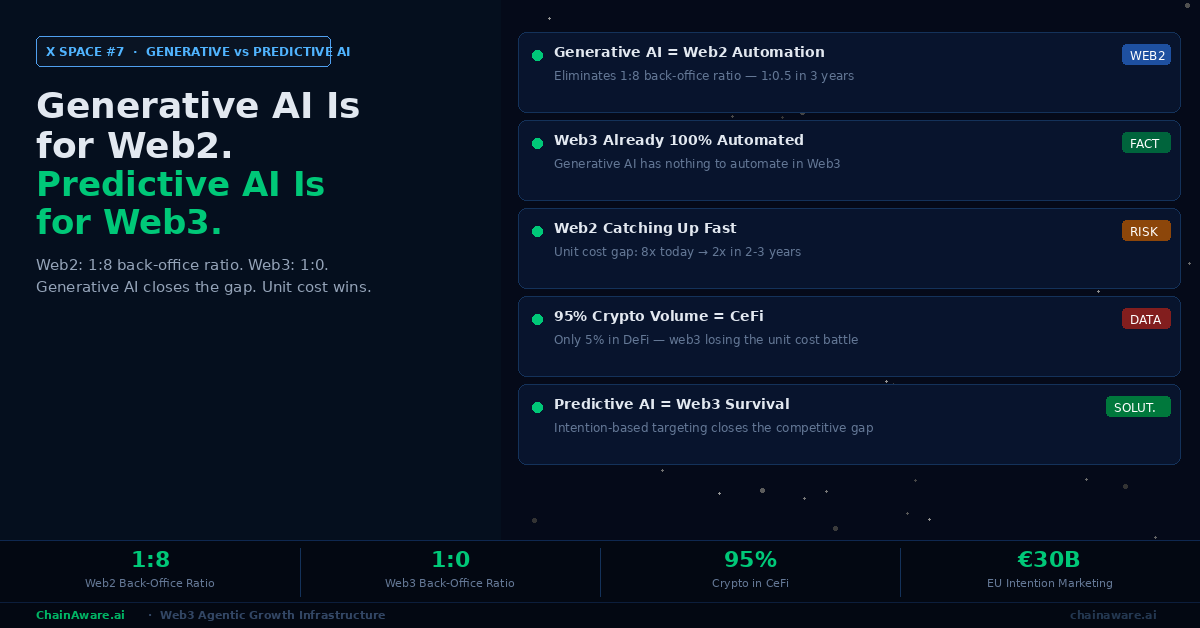
X Space #7 opens with a question that sounds simple but has implications most Web3 founders have never fully thought through: what does generative AI actually do, and where does it belong? Co-founders Martin and Tarmo spend the session dismantling the assumption that the current AI wave is relevant to Web3 companies. Their conclusion is precise and uncomfortable: generative AI is a Web2 technology. It automates the manual back-office work that Web2 companies have not yet automated. Web3, by architectural definition, already operates at 100% automation. Generative AI therefore has nothing to offer Web3 — and the companies claiming to combine blockchain with generative AI are almost certainly not genuine Web3 companies. The session then turns to what this means for the competitive future between Web2 and Web3, and why unit cost economics — not technology narrative — will determine which paradigm survives the next five years.
In This Article
- What Generative AI Actually Is: Unconscious Thinking at Scale
- Level One vs Level Two Thinking: Why Reflection Is Missing
- The Web2 Back Office Problem: The 1:8 Credit Suisse Ratio
- The BPO Wave and What Comes Next
- How Generative AI Eliminates the Web2 Back Office
- Web3 Is Already 100% Automated — Generative AI Has Nothing to Do
- The Closing Gap: Web2 Is Catching Up Fast
- The Three-Tier Funnel: Web2, CeFi, and DeFi
- 95% of Crypto Volume Is CeFi: The User Migration Problem
- What Web2 Already Does with Predictive AI
- The €30B Intention Marketing Market Nobody Talks About
- What Web3 Is Missing: Predictive AI for Growth and Retention
- Every Wallet Is a Complete CRM — Web3 Companies Are Not Using It
- Innovate or Disappear: The Darwinian Unit Cost Equation
- Comparison Tables
- FAQ
What Generative AI Actually Is: Unconscious Thinking at Scale
Tarmo opens the technical discussion with a definition of generative AI that strips away the marketing language and describes the actual computational mechanism. The definition is deliberately unflattering — not because generative AI lacks value, but because understanding its true nature is the prerequisite for understanding where it belongs and where it does not.
Generative AI, in its dominant form as large language models, predicts the next most probable word given a preceding sequence of words. It does this without understanding, without reasoning, and without the ability to explain why it chose any particular output. As Tarmo explains: “Generative AI predicts in a given context the next word. It is like our unconscious thinking. We just speak. We don’t know exactly what the next word is which I speak. And this is what is generative AI. It is unconscious speaking. It is not reflecting. It is just giving out words in a sequence.” The model was trained on the entirety of publicly available internet text, learning statistical patterns about which words follow which contexts. When a prompt arrives, it identifies the most statistically probable continuation. That is all it does.
Pattern Matching, Not Intelligence
Tarmo is specific about the nature of this capability: it is pattern matching, not intelligence. The distinction matters because people regularly mistake the fluency of LLM outputs — their grammatical correctness, their apparent coherence, their ability to produce plausible text on almost any topic — for understanding. The appearance of intelligence is an artefact of training on an enormous corpus of human-written text. An LLM that produces accurate medical information is not reasoning about medicine; it is reproducing statistical patterns from medical texts. Consequently, when the patterns break down — when reasoning is required to navigate a novel situation — the LLM produces text that sounds plausible but may be completely wrong. This is not a bug that larger models will fix. It is the architectural nature of autoregression. For the deeper technical analysis, see our AGI vs LLM guide.
Level One vs Level Two Thinking: Why Reflection Is Missing
Tarmo introduces a cognitive framework that places generative AI’s limitations in a broader context of how intelligence actually functions. The framework distinguishes two modes of cognition that have very different computational properties and serve very different purposes.
Level one thinking is automatic, fast, and pattern-driven — it operates like what neuroscience calls the subcortical brain or what cognitive psychologists describe as System 1. When you automatically brake at a red light, complete a familiar phrase, or recognise a face, you are using level one thinking. This mode produces outputs very quickly with minimal cognitive energy, but it reproduces learned patterns rather than creating new ones. Level two thinking is slow, deliberate, and iterative — it engages the cortex and requires reflection, self-correction, and the ability to evaluate one’s own reasoning. Writing an essay involves level two thinking: you produce a draft, reflect on it, identify weaknesses, revise, reflect again, and iterate until the output meets your criteria.
Why Reflective Thinking Is Where Creativity Lives
The critical asymmetry is that creativity — the generation of genuinely new ideas, approaches, and solutions — requires level two thinking. Level one thinking reproduces; level two thinking creates. As Tarmo explains: “Reflective thinking is this where you create new things. Unconscious thinking is you repeat something. Reflective thinking is you start thinking, what is what I really want to say? How can I say it? Where you go over into creativity where you create new things.” Generative AI is entirely level one. It reproduces statistical patterns with great fluency. However, it cannot reflect, cannot identify weaknesses in its own outputs, and cannot generate genuinely new ideas — only novel recombinations of patterns from its training data. For a detailed technical extension of this framework, see our level one vs level two thinking analysis.
The Web2 Back Office Problem: The 1:8 Credit Suisse Ratio
Having established what generative AI is, Martin and Tarmo turn to the specific problem it is best positioned to solve — a problem that exists in Web2 and not in Web3. The problem is the back office: the enormous workforce of non-client-facing employees that Web2 companies require to run their operations.
Martin draws on his decade at Credit Suisse to make the ratio concrete. At Credit Suisse, for every one front-office employee who directly served clients and generated revenue, there were approximately eight back-office employees — in compliance, IT, operations, HR, legal, and other support functions. This 1:8 ratio means the single front-office employee must generate enough revenue to cover their own salary, the salaries of eight back-office colleagues, all infrastructure costs, and the profit margin required by shareholders. As Martin explains: “That means we have one person who has to create so much value with his work that he pays as well the salaries of these eight people in the back office, plus the profit for the shareholders.”
Google and the Web2 Ratio
The 1:8 ratio is specific to traditional banks like Credit Suisse — which Martin describes as closer to a “pre-Web2” or Web1 company in its digitalization level. More digital-native Web2 companies like Google have better ratios, perhaps 1:4 or even 1:3. However, even these more optimised companies carry substantial back-office overhead. Tarmo confirms: “Considering Google, if you look at numbers of employees in Google, then you can be sure there is a huge back office.” The universal presence of back-office overhead across all Web2 companies, regardless of how technologically sophisticated they are, creates the opportunity that generative AI is now positioned to address. For more on how back-office automation affects the competitive dynamics between Web2 and Web3, see our unit cost analysis.
Web3 Already Has the Automation Advantage — Now Add Predictive AI
ChainAware Free Analytics — Know Your Users Before Web2 Catches Up
Web3 back-office ratio: 1:0. Web2 back-office ratio: 1:8 (closing fast with generative AI). Your cost advantage is real but shrinking. Add the predictive AI layer Web2 uses — starting with free behavioral analytics for every connecting wallet. 2-minute setup. Free forever.
The BPO Wave and What Comes Next
Martin situates generative AI as the latest step in a continuous corporate cost optimisation trajectory that has been running for decades. Understanding this trajectory clarifies why the current AI investment wave is so large and so concentrated in enterprise applications: it represents the most significant opportunity to reduce labour costs since the Business Process Outsourcing wave of the 1990s and 2000s.
The BPO wave moved back-office operations from expensive Western headquarters locations to lower-cost countries, primarily India and Southeast Asia. Cost reductions of 2-4x were achievable through this geographic arbitrage. The quality tradeoffs were sometimes significant, but the cost improvements were substantial enough to drive the entire outsourcing industry. Now generative AI offers the next step: replacing the remaining human workers — wherever they are located — with AI systems that can handle support tickets, process emails, manage call centre inquiries, perform compliance checks, and analyse log files, all without human intervention. As Martin explains: “There is no mess with this business process outsourcing. There is no mess like controlling a business partner, setting up SLAs — which creates a highly static, unfranchised organisation which is not moving. So if someone is trying to change some business process in some corporations, very difficult to change. And now it’s more profitable to go over to the next technology — which is to use generative AI to solve these repetitive tasks.”
How Generative AI Eliminates the Web2 Back Office
Martin and Tarmo enumerate the specific Web2 back-office functions that generative AI is directly positioned to automate. Each represents a category of work that was previously human-dependent and can now be handled by LLM-based systems with full automation.
Support ticket automation represents the most immediate application. Companies accumulate years of historical support ticket data — questions, responses, resolution paths, escalation patterns. Fine-tuning an LLM on this proprietary corpus creates an agent that handles support queries with the same accuracy as trained human agents, at zero marginal cost per ticket. As Tarmo explains: “All you have to do is take your own support tickets, add it as additional training data, retrain the large language model, and you have an AI agent which can solve support tickets. And you have full automation.”
Phone, Email, Compliance, and Log File Processing
Service channel automation extends the same principle to voice. Speech-to-text technology converts customer calls to text; the LLM processes the text and generates a response; text-to-speech technology converts the response back to voice. The result is a call centre that requires no human agents for routine inquiries. Email processing follows the same pattern. Letter processing adds OCR to convert paper documents to text before LLM processing. Compliance automation applies the most transformative potential: hundreds or thousands of pages of compliance documentation can be ingested as LLM training data, enabling automated compliance checks that previously required human specialists. Beyond all of these, log file analysis enables AI automation of everything that happens within a Web2 company’s systems — every transaction, every user interaction, every system event leaves a trace that an LLM trained on historical patterns can monitor and respond to automatically. As Martin summarises: “What is going to happen is that in Web2 companies, everything what is happening is in log files. You can take these log files and train your AI agent on these log files. And what it means is we can automate everything what happens in your Web2 company’s back office.”
Web3 Is Already 100% Automated — Generative AI Has Nothing to Do
The insight that follows from the Web2 back-office analysis is simple but profound: if generative AI’s value is in automating work that is currently done manually by humans, and if Web3 companies have no human back-office workers because their business logic runs entirely on smart contracts, then generative AI has no application in genuine Web3 companies. You cannot automate something that is already automated.
As Tarmo states directly: “In Web three, we have already full automation. Web three is fully automated. It is fully digitalized. And if you now want to automate it even more, you can’t automate it. It’s already 100% automated. You can’t automate something 101%.” Martin extends the logical implication: “So all this automation potential is already done. Web three business models are built in a way that everything is fully automated. This is now the big difference to Web two.” The consequence for companies claiming to combine blockchain with generative AI is uncomfortable but unavoidable.
If You’re Using Generative AI in “Web3” — You’re Probably Not Web3
Tarmo makes the definitional implication explicit: “What can we then optimise with generative AI in a Web three? The answer is obvious. There is nothing you can optimise anymore in Web three with generative AI because it is fully automated. And there are so many words now — generative AI and Web three. But then it means these companies are not Web three. Web three companies are fully automated. 100% automated. Fully digitalized. If you are doing generative AI on the Web three, then the question is — are you a Web3 company? Maybe you are a Web two company who just wants to make some cool branding in Web three.” This is not an academic distinction. Investors who allocate capital to blockchain AI projects on the basis of the LLM + blockchain narrative should ask which specific back-office function the AI is automating — and why that function requires a blockchain. For more on the realistic intersection of AI and blockchain, see our Vitalik AI paper analysis.
The Closing Gap: Web2 Is Catching Up Fast
The most strategically significant argument in X Space #7 is not about what generative AI can or cannot do. It is about what generative AI’s Web2 deployment will do to the competitive relationship between Web2 and Web3 over the next 2-3 years.
Currently, Web3 companies hold an approximately 8x unit cost advantage over traditional Web2 financial services companies like Credit Suisse, because Web3’s fully automated smart contract operations require no human back-office staff while traditional banks maintain 1:8 front-to-back-office ratios. This cost advantage is Web3’s primary competitive case. Tarmo’s projection: “In coming two, three years, Web two will catch up. Web three, they will automate everything. And this cost advantage, what we have emphasised so many years — why Web three has competitive advantage over Web two — it’s going to disappear because of full automation in Web two companies.” More specifically: “It will be not like eight times more expensive than Web three. It will be maybe only twice more expensive than Web three in two, three years.”
Why This Changes the Competitive Calculus
An 8x cost advantage is the kind of structural difference that overcomes user inertia — people switch from familiar services when the new option is dramatically more efficient. A 2x cost advantage is much weaker at driving switching behaviour, especially when the familiar option has the trust, brand recognition, and UX refinement that Web2 companies have built over decades. Tarmo frames the implication starkly: “If web three wants now to stay competitive compared to web two, then web three has to take over what web two has better today — predictive AI. Web two has better customer acquisition. Web two has better reduced customer acquisition cost. And this is what web three is not doing.” For the broader economic framework, see our unit cost Web3 guide and our crossing the chasm analysis.
Add the Predictive AI Layer Before Web2 Closes the Gap
ChainAware Marketing Agents — Intention-Based 1:1 Targeting
Web2 has been using predictive AI for client acquisition and lifecycle management for years. Web3 is using 1930s mass marketing. The gap is not technical — it is a decision. ChainAware Marketing Agents calculate each wallet’s behavioral intentions and deliver matched messages that convert. 4 lines of JavaScript. Enterprise subscription.
The Three-Tier Funnel: Web2, CeFi, and DeFi
Martin introduces a structural model for the crypto user ecosystem that reframes the competitive challenge Web3 faces. Rather than a binary Web2 vs Web3 comparison, he describes a three-tier funnel through which users progress — and where most of them stop well short of genuine decentralised Web3.
Tier one is traditional Web2 finance: banks, investment platforms, and financial services operating on centralised infrastructure with partial automation and large human workforces. Tier two is centralised crypto finance (CeFi): Binance, Coinbase, OKex, and similar centralised exchanges. These platforms provide crypto asset exposure within a familiar centralised structure — not true Web3, but not traditional Web2 either. Tier three is genuine Web3: Uniswap, Aave, and the DeFi ecosystem of smart-contract-automated protocols where users maintain custody of their assets. As Martin explains: “We have traditional finance, traditional Web two. Then we have centralised finance. Like a lot of people, all the people are trying out crypto, trying to get to centralised finance. And then we have Web three, okay, 50 million, maybe now 80 million people. So pretty small.” The funnel metaphor is apt: the numbers thin dramatically at each transition, with the greatest drop happening between CeFi and genuine DeFi.
95% of Crypto Volume Is CeFi: The User Migration Problem
The three-tier model leads directly to a sobering statistic: approximately 95% of all crypto trading volume flows through centralised exchanges. Only 5% flows through decentralised protocols. Despite years of growth in the DeFi ecosystem, despite the technological innovation that makes Web3’s smart contract automation possible, despite the genuine unit cost advantages that DeFi protocols offer — the overwhelming majority of crypto users remain in the second tier, interacting with centralised intermediaries rather than directly with on-chain protocols.
Martin observes the analogy with the broader crypto adoption pattern: “In fact, 90% of them — of crypto users — are in centralised finance. They are on Binance. They are on OKex. They are on Coinbase. They are on these kind of platforms which are just traditional finance with another asset class.” The point is not that DeFi has failed. It is that the unit cost advantage of Web3 protocols has not been sufficient to overcome user inertia and drive the migration from CeFi to DeFi at scale. If generative AI closes the Web2-Web3 automation gap from 8x to 2x over the next few years, and if Web3 still has not adopted the predictive AI tools that would reduce its acquisition costs and improve its conversion rates, the migration case for DeFi weakens further. For more on why this matters for Web3 growth, see our Web3 targeting guide.
What Web2 Already Does with Predictive AI
While Web3 debates which generative AI narrative to adopt, Web2 has been running massive predictive AI infrastructure for over a decade. Martin and Tarmo explain the scale and sophistication of this existing investment — which most Web3 founders are entirely unaware of, because it operates entirely in the background.
Every bank in the world runs transaction monitoring AI. Tarmo notes that this is not optional — it is mandatory: “In every bank in Switzerland, there are 251 banks. In Europe, 7,000. Worldwide, 23,000 banks. Every bank has to do, for every incoming transfer, the AML. And they have to do transaction monitoring. This is always with an AI. It’s a pattern matching, a predictive pattern matching.” This regulatory mandate means that predictive AI is not an advanced capability in banking — it is a baseline requirement. Every single bank in the world runs it continuously on every transaction.
Client Acquisition, Cross-Selling, and Lifecycle Management
Beyond mandatory compliance, Web2 corporations use predictive AI aggressively for revenue generation. The full client lifecycle — from initial acquisition through conversion, retention, and cross-selling — runs on predictive models that calculate each customer’s behavioral intentions and optimise every interaction accordingly. As Martin describes the Credit Suisse example: “If you pick up the phone, you know what you tell this client. You know when the phone is ringing, you know it. Then you know what you have to ask the client. It’s not shown in Credit Suisse, it’s shown everywhere. And this is not some CRM. This is calculated — the algorithms calculate to whom we are sending which messages, to whom we are not sending any messages.” The calculation happens automatically, invisibly, and continuously for every customer at every touchpoint. For more on how this translates to Web3, see our Web3 AdTech analysis.
The €30B Intention Marketing Market Nobody Talks About
Martin introduces a market size figure that makes the scale of Web2’s predictive AI investment concrete: the European intention marketing market alone is approximately €30 billion annually. This figure represents just one component of Web2’s predictive AI ecosystem — the advertising and targeting part — in one geographic region. The global scale of Web2’s predictive AI investment is multiples larger.
Intention marketing is distinct from demographic or behavioural advertising in that it targets users based on calculated predictions of their next actions rather than their past actions or static characteristics. Google’s AdTech — which generates approximately 95% of Alphabet’s revenue — runs on intention calculations derived from search history, browsing history, and the thousands of behavioral attributes that Google maintains for each user. As Martin notes: “Google has, how many attributes does Google have about each one of us — 2,000, 3,000. Facebook the same. And these are not just attributes like he lives in some area or he eats ice cream — no, no, these are his intentions. Because the market is based on intentions. What do you do as next? What are your internal motivations? Intentions.” Crucially, this enormous intention marketing infrastructure is completely absent from Web3. No DeFi protocol routes users to their platform via targeted intention-based advertising. No smart contract application shows different users different interfaces based on their behavioral intentions. The entire sophistication of Web2’s acquisition and retention machinery simply does not exist in Web3 yet. For more on this gap, see our high conversion without KOLs guide.
What Web3 Is Missing: Predictive AI for Growth and Retention
Web3’s current marketing approach is what Martin and Tarmo call “1930s marketing” — the same mass-broadcast model that defined advertising before targeted media existed. Every user sees the same message. Every visitor to a DeFi protocol sees the same website. Every wallet that connects gets the same onboarding experience regardless of their specific history, intentions, and behavioral profile.
Martin draws the comparison explicitly: “1930s. You put some article in the newspaper, everyone sees the same ad. Okay, assumed they’re buying the same newspaper. Now they go to your shop, on the shopping floor, and the shopping floor, they get the same message. Everyone sees the same shop. So same message to everyone in the media. Same message to everyone on the shopping floor. Now Web three marketing is fully the same.” The consequence is the 0.1% vs 30% conversion rate gap between Web3 mass marketing and Web2 intention-based targeting. Every dollar spent on Web3 mass marketing produces results 300 times less effective than the equivalent dollar spent on Web2 intention-based targeting. For the full conversion rate analysis, see our one-to-one targeting guide.
Every Wallet Is a Complete CRM — Web3 Companies Are Not Using It
The irony that Martin and Tarmo highlight is striking: Web3 companies are sitting on the best behavioral data source in the world and ignoring it. Every wallet that connects to a DeFi protocol carries its complete financial history — a record of every protocol interaction, every asset held, every transaction executed across years of activity. This data reveals the user’s experience level, risk tolerance, investment preferences, and predicted next actions with far more precision than anything Google can infer from browsing history.
As Martin explains: “In the moment when the client connects his wallet, you see his full address history. You can calculate so many things. We know what he wants, we know that he doesn’t want.” Furthermore, this data requires no data collection infrastructure, no user registration, no privacy agreements, and no licensing fees — it is free and publicly available on the blockchain. As Martin summarises: “The blockchain is beautiful. We see all his previous purchase history — which other platforms he has used, which NFTs he has bought, which gaming he has done, which borrow-lend he has done. The full client history is there. The moment when he connects his wallet, he’s taking his client history with him. So no one needs to type in a CRM system what the client did. He takes it with him.” Despite this extraordinary data availability, most Web3 companies show every wallet-connected user the same generic interface with the same generic messages. For how ChainAware operationalises this data, see our behavioral analytics guide and our personalisation guide.
Innovate or Disappear: The Darwinian Unit Cost Equation
Tarmo closes the substantive discussion with a framing that connects the entire analysis to its ultimate competitive consequence. The decision facing Web3 companies is not a marketing decision or a technology decision — it is an evolutionary one. As generative AI closes the automation cost gap between Web2 and Web3, the unit cost advantage that made Web3 economically compelling will erode. If Web3 responds by adopting the predictive AI capabilities that Web2 already uses for client acquisition, lifecycle management, and retention, it can maintain and potentially expand its competitive position. If it does not, it will gradually lose the cost case for adoption, and the user migration from CeFi to DeFi will slow or reverse.
Tarmo frames this in evolutionary terms: “Innovate or disappear. You know. And if Web three just stays in its current technology paradigm and avoids using predictive AI, Web three will disappear. And the main reason is the unit cost. The unit cost will equalize between the Web two corporations and Web three companies. And every new technology requires a little jump. People go to a new technology if the unit costs are really more effective in the new technology. If there is a non-significant advantage, it is not coming. So it is Darwinistic. Web three companies that start using predictive AI — high chance to survive. Web three companies that don’t — Darwinistic chips.” For the complete strategic framework, see our crossing the chasm guide.
Comparison Tables
Generative AI vs Predictive AI: Technology Fit Comparison
| Property | Generative AI (LLMs) | Predictive AI (Domain Models) |
|---|---|---|
| Core mechanism | Autoregressive next-token prediction | Domain-specific pattern recognition and probability scoring |
| Thinking level | Level one — unconscious, pattern matching | Level two — trained for specific prediction tasks |
| Reflective capability | None — cannot evaluate own outputs | Backtestable — accuracy is verifiable |
| Primary Web2 use case | Back office automation — support, email, compliance | Client acquisition, lifecycle management, fraud detection |
| Web3 use case | None — Web3 is already 100% automated | Fraud detection, rug pull, intentions, AdTech |
| Data source | All public internet text | Domain-specific blockchain transaction history |
| Impact on unit cost | Reduces Web2 back-office ratio (1:8 → 1:0.5) | Reduces Web3 client acquisition cost (300x conversion improvement) |
| ChainAware use | Not used | All products — fraud, rug pull, intentions, credit |
| Vitalik’s assessment | No mention in AI and crypto paper | All four categories use predictive AI |
Web2 vs Web3: Unit Cost and Automation Comparison — Today vs 2027
| Dimension | Web2 Today | Web2 in 2-3 Years (Post-GenAI) | Web3 Today | Web3 in 2-3 Years (With Predictive AI) |
|---|---|---|---|---|
| Back-office ratio | 1:4 to 1:8 | 1:0.5 to 1:1 | 1:0 (fully automated) | 1:0 (unchanged) |
| Automation level | 70-85% | ~100% (via generative AI) | 100% | 100% (unchanged) |
| Unit cost advantage vs Web2 | Web3 8x cheaper | Web3 only ~2x cheaper | 8x advantage | Maintained + extended via lower CAC |
| Client acquisition approach | Advanced — intention-based AI targeting | Even more optimised | 1930s mass marketing — 0.1% conversion | Intention-based — target 30%+ conversion |
| Adaptive user interfaces | Standard — 70% of Fortune 2000 by 2025 | Universal | Almost absent | Deployed via ChainAware |
| Predictive AI usage | Massive — mandatory for banks, standard elsewhere | Extended to all functions | Minimal — only fraud detection pioneers | Full suite if adoption occurs |
| Competitive position | Closing automation gap | At parity on automation | Strong today | Strong if predictive AI adopted; vulnerable if not |
Frequently Asked Questions
Why does generative AI not belong in Web3?
Generative AI’s core value is automating manual, repetitive, text-based tasks that humans currently perform in back offices. Web3 companies are built on smart contracts that execute business logic automatically, 100% of the time, without human involvement. There is no back office to automate. You cannot automate something that is already 100% automated. Companies claiming to combine blockchain with generative AI for “automation” are almost certainly not genuine Web3 companies — they are Web2 companies with blockchain branding. For the detailed technical analysis, see our Vitalik AI paper use-case analysis.
How fast is Web2’s automation advantage closing?
Tarmo’s projection is 2-3 years. Currently, Web3 holds approximately an 8x unit cost advantage over traditional Web2 financial services (the Credit Suisse 1:8 back-office ratio means Web2 needs 8x the human infrastructure for equivalent operations). As generative AI automates Web2 back-office functions, this ratio will shrink from 1:8 toward 1:0.5 or better. The unit cost gap between Web2 and Web3 will drop from approximately 8x to approximately 2x within a few years. This 2x advantage is insufficient to drive mass user migration from Web2 to Web3, especially when Web2 has dramatically better UX, trust, and brand recognition.
What predictive AI should Web3 companies be deploying?
Web3 needs the same two-category predictive AI deployment that Web2 already uses. Category one is defensive: fraud detection and rug pull prediction to protect users and build ecosystem trust. Category two is offensive: client acquisition via intention-based targeting and adaptive user interfaces, plus client lifecycle management that uses blockchain behavioral data to personalise every user’s experience. ChainAware provides both categories — fraud detection (98% accuracy), rug pull prediction, and marketing agent technology that calculates wallet behavioral intentions and delivers matched messages. The data source — free public blockchain transaction history — is actually superior to anything Web2 uses, meaning Web3 can achieve even better conversion rates than Web2 once it deploys these tools.
Why do 95% of crypto users stay in centralised exchanges?
Centralised exchanges (CeFi) provide the familiar UX of traditional finance with a crypto asset class. They handle custody, provide customer support, offer simple interfaces, and protect against user error. DeFi requires users to manage their own keys, understand smart contracts, navigate complex interfaces, and absorb the risk of rug pulls and hacks. The 8x unit cost advantage of Web3 has not been compelling enough to overcome this friction differential for the 95% of crypto users who remain in CeFi. If Web2 closes the automation gap to 2x via generative AI while Web3 continues with mass marketing and no adaptive interfaces, the migration case for DeFi weakens further. Predictive AI adoption by Web3 — reducing acquisition costs and improving conversion — is the mechanism for reversing this trend.
How is blockchain data better than Google’s data for predictive AI?
Google’s data — search history and browsing history — is low quality for behavioral prediction because it is triggered by external inputs (social media feeds, conversations, recommendations) rather than reflecting genuine internal intentions. It costs nothing to generate, so the signal is noisy. Blockchain financial transaction data requires deliberate decisions and real financial costs (gas fees). The pattern of someone’s actual financial decisions is far more predictive of their future behavior than their search or browsing activity. Additionally, blockchain data is free and publicly accessible, while Google’s data is proprietary and worth tens of billions in market value. Web3 companies have access to a superior data source for free — they simply are not using it yet.
The Predictive AI Layer Web3 Is Missing
ChainAware Prediction MCP — Fraud, Rug Pull, Intentions, Credit
Everything Web2 does with predictive AI — fraud detection, client acquisition, intention-based targeting, lifecycle management — now available for Web3 via free public blockchain data. 98% accuracy. 14M+ wallets. 8 blockchains. 31 MIT-licensed agents. The tool that keeps Web3’s competitive advantage alive.
This article is based on X Space #7 hosted by ChainAware.ai co-founders Martin and Tarmo. Watch the full recording on YouTube ↗ · Listen on X ↗. For questions or integration support, visit chainaware.ai.