
X Space #5 — How AI Restores Web3 Growth: AI Audiences and Adaptive User Interfaces. Watch the full recording on YouTube ↗ · Listen on X ↗
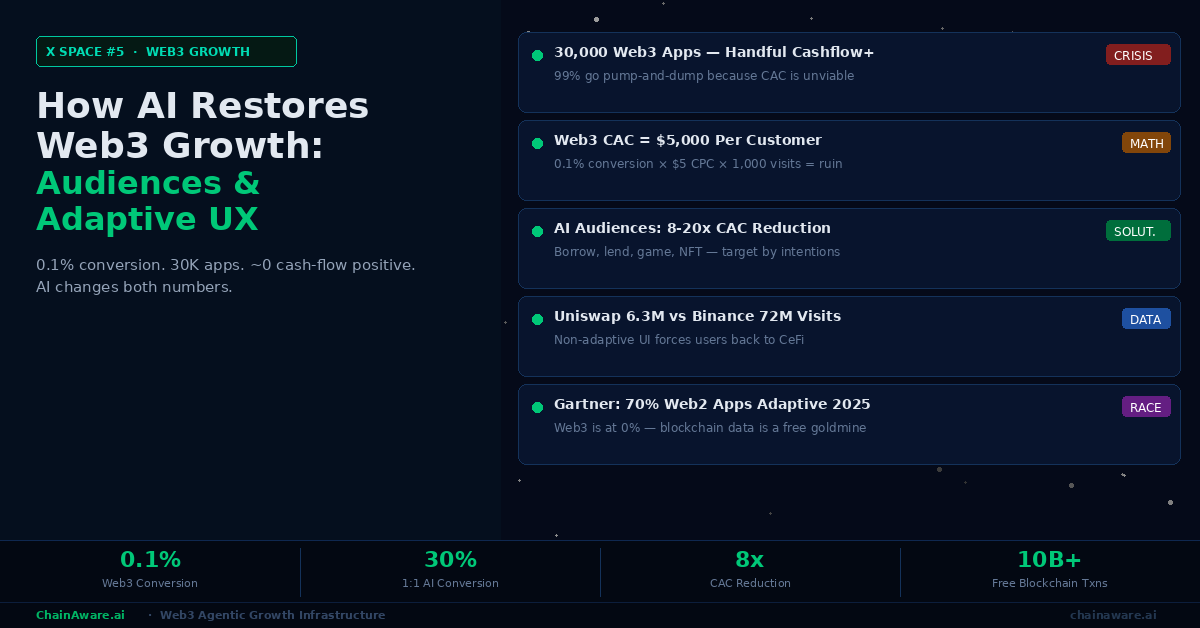
X Space #5 confronts the question that every Web3 founder eventually faces but few discuss openly: why are 30,000 Web3 applications competing for users while almost none of them are cash-flow positive? Co-founders Martin and Tarmo trace the problem to a single structural cause — Web3 marketing still operates like a 1920s newspaper campaign, sending the same message to everyone regardless of their intentions — and present the two-part solution: AI-powered audience targeting and adaptive user interfaces. Both components already exist. Both are built on the free, high-quality behavioral data sitting in every blockchain. The only obstacle is the mental model that treats mass marketing as the only option available to Web3 projects. This session explains why that mental model is wrong, what the correct approach looks like in practice, and why blockchain’s data quality advantage over Web2 means that once Web3 adopts intention-based marketing, it will be more competitive than any Web2 platform.
In This Article
- 30,000 Web3 Apps — Why Almost None Are Cash-Flow Positive
- The Token Trap: Why Pump-and-Dump Is a Rational Response to an Irrational CAC
- The CAC Mathematics: $5 CPC × 1,000 Clicks = $5,000 per Customer
- 1920s Marketing in a 2025 Ecosystem: The Same Message for Everyone
- The Conversion Ladder: From 0.1% to 30% in Four Steps
- Step 1 — AI Audiences: Targeting Borrowers, Lenders, Gamers, and NFT Holders
- The Free Goldmine: Why Blockchain Data Beats Google, Facebook, and WhatsApp
- Gas Fees as Proof of Work: The Data Quality Advantage
- Step 2 — Adaptive User Interfaces: Why Uniswap Loses to Binance on Resonance
- The Google Minimalism Trap: How 23 Words Became Web3 Orthodoxy
- Gartner Says 70% of Web2 Apps Will Be Adaptive by 2025 — Web3 Is at 0%
- Why Web3’s Data Advantage Exceeds Web2’s Once AI Is Applied
- The 500 Million User Opportunity: Converting CeFi Users to DeFi
- Comparison Tables
- FAQ
30,000 Web3 Apps — Why Almost None Are Cash-Flow Positive
Martin opens X Space #5 with a statistic that frames the entire discussion: the Web3 ecosystem has over 30,000 applications, but only a handful generate revenue, and the subset that achieve positive cash flow is even smaller. DeFi Llama alone lists approximately 3,500 Web3 protocols. Despite this apparent abundance of building activity, the ecosystem has a fundamental business model problem that persists across the vast majority of projects.
Cash-flow positive means outgoing costs are smaller than incoming revenue — the foundational condition for business sustainability. Token issuance creates an illusion of funding: projects issue tokens, receive initial capital, and use that capital to subsidise liquidity and user incentives. However, token-funded liquidity is not recurring revenue. Subsidised usage is not genuine demand. As Tarmo frames it: “What we have in Web three are currently applications which don’t create a sustainable revenue or which don’t create cash flow. They’re issuing a token, they’re receiving some funds for the token, and then they get the liquidity. But they are paying with a token for the liquidity. And the anticipation is that one day there will be so many users that they don’t have to pay anymore. But usually this anticipation is not working.” The cycle continues: projects raise, subsidise, attract mercenary users who leave when incentives expire, and then either raise again or pivot to the next narrative.
Why Real Revenue Is Harder in Web3 Than Web2
Founders entering Web3 with genuine intentions to build sustainable businesses quickly discover that the constraints are real. Customer acquisition costs are dramatically higher than Web2 equivalents because the marketing ecosystem is immature, the audience is fragmented, and — most importantly — the tools for cost-efficient targeted acquisition simply do not yet exist at scale in Web3. Retention is difficult because generic interfaces fail to create personalised connections with users. Cross-selling is near-impossible because protocols have no mechanism for serving matched product recommendations to individual wallets. As Tarmo observes: “The focus is not on customer and especially not on customer lifetime value. And the methods which are used in Web three to do customer acquisition and cross selling are stone time from 1920 or 1930 — 100 years old methods.” For how this compares to Web2’s evolved approach, see our one-to-one targeting guide.
The Token Trap: Why Pump-and-Dump Is a Rational Response to an Irrational CAC
Martin and Tarmo make a point that is uncomfortable but analytically precise: pump-and-dump is not primarily a moral failure. It is a rational economic response to a cost structure that makes legitimate business models unviable. When founders discover how expensive Web3 customer acquisition truly is, many conclude — correctly, given the tools currently available — that sustainable cash flow is mathematically impossible. The next logical step is to optimise for what is achievable: token price appreciation followed by exit.
As Tarmo explains: “When people are in Web three, they understand that to become a cash flow positive company it’s more difficult than in Web two. They are more constrained. And when they understand it, then they go over to pump and dump schemas. And then we are all surprised — why are there so many frauds, so many rug pulls? It’s because there are two alternatives: you manage to become a cash flow positive company, which is difficult, or you go over to pump and dump.” Martin extends this point: “99.5% of Web three systems going into pump and dump means users will not come to Web three. The only way that Web three becomes successful is when users start using it. And users start using it when Web three business models become cash flow positive.” Solving the CAC problem does not just fix individual project economics — it addresses the root cause of the ecosystem’s trust deficit. For more on the rug pull ecosystem, see our rug pull detection guide.
The CAC Mathematics: $5 CPC × 1,000 Clicks = $5,000 per Customer
Martin quantifies the customer acquisition cost problem with specific numbers that make the economic impossibility of current Web3 marketing concrete. The calculation is simple arithmetic, but most Web3 founders have never performed it explicitly.
Cost per click (CPC) in Web3 advertising runs approximately $5. At a 0.1% conversion rate — meaning one visitor in a thousand becomes a transacting customer — acquiring a single transacting customer requires 1,000 clicks. The customer acquisition cost is therefore $5 × 1,000 = $5,000 per transacting customer. For a DeFi lending protocol that earns perhaps $20-50 in annual fees from a typical user, this CAC makes the unit economics permanently negative. As Martin states: “Very simple calculation. There is a cost per click in Web three, we’re speaking of $5 easily. Now if you have to get 1,000 clients to your website — meaning 1,000 CPC, 1,000 times $5 — that’s $5,000 CAC. That’s quite a high customer acquisition cost. That means the way of doing it: same message for everyone means business models will not work.”
How 1:1 Marketing Changes the Equation
The same $5 CPC with a 30% conversion rate (achievable with proper intention-based targeting) produces a radically different CAC. At 30% conversion, acquiring one transacting customer requires approximately 3.3 clicks — a CAC of approximately $17. The difference between $5,000 CAC and $17 CAC is not an incremental improvement. It is a fundamental change in whether Web3 business models are viable. ChainAware’s conservative estimate is an 8x CAC reduction — Martin personally believes 20x or more is achievable. Even the conservative 8x reduction would bring the $5,000 CAC down to approximately $625, which is meaningful progress toward viable unit economics. For the full conversion rate analysis across marketing approaches, see our unit cost guide.
Stop Paying $5,000 Per Customer
ChainAware Free Analytics — See Who Is Actually Visiting
Before you can reduce CAC, you need to understand your current audience. ChainAware’s free analytics pixel shows the behavioral profile of every connecting wallet — borrower, trader, gamer, NFT collector, newcomer. Know who you’re attracting before spending another dollar on acquisition. Free forever. 2-minute setup via Google Tag Manager.
1920s Marketing in a 2025 Ecosystem: The Same Message for Everyone
Martin and Tarmo return repeatedly to a single characterisation of Web3’s current marketing approach: 1920s marketing. The comparison is not metaphorical — it is structural. Mass marketing, as practiced in the 1920s, meant printing a single advertisement in a newspaper that every reader received identically, then welcoming every customer to a shop floor that presented the same products and messages to everyone regardless of who they were or what they wanted.
Web3 marketing in 2025 replicates this structure exactly. Crypto influencers broadcast identical promotional content to their entire follower base. CoinDesk article placements (at $3,000-$6,000 per sponsored article) deliver the same content to all readers. Banner advertising serves identical creatives to every visitor on crypto media sites. On-chain incentive campaigns use the same reward structure for every participant. When a user arrives at a Web3 protocol’s website, they see the same homepage, the same product description, and the same call-to-action regardless of whether they are an experienced DeFi borrower or a first-time wallet owner. As Tarmo summarises: “In Web three, we are like 1920s or 1930s — 100 years old. We don’t use AI to reduce customer acquisition cost. We don’t use AI for customer retention. We don’t use AI for cross selling. And then we are surprised, oh, I don’t become cash flow positive.” For more on the contrast with Web2’s approach, see our Web3 KOL marketing analysis.
The Conversion Ladder: From 0.1% to 30% in Four Steps
Martin presents a specific conversion rate progression that maps the journey from Web3’s current mass marketing baseline to 1:1 AI-driven marketing. Each step represents a distinct level of audience targeting sophistication, and each step delivers measurably higher conversion rates.
Mass marketing, which defines current Web3, produces approximately 0.1% conversion — one transacting customer per thousand visitors. Basic macro-segmentation — dividing the audience into broad categories like “DeFi users” or “NFT users” — improves conversion to roughly 1-1.5%. Proper micro-segmentation — creating detailed audience profiles based on behavioral patterns — pushes conversion to approximately 10%. Finally, one-to-one marketing — serving each individual user content matched precisely to their calculated behavioral intentions — achieves conversion rates above 30%. As Martin explains: “In mass marketing, your conversion ratio is around one per mil, around 0.1%. When you do some macro segmentation, you get maybe 1%, maybe 1.5%. You go over to microsegmentation, your conversion ratio goes to 10% already. And when you go over now to one to one marketing, your conversion ratio is over 30%.” The jump from Web3’s current 0.1% to 30% via 1:1 targeting represents a 300x improvement in marketing efficiency — a transformation in unit economics rather than an incremental gain. For the supporting analysis, see our high conversion guide.
Step 1 — AI Audiences: Targeting Borrowers, Lenders, Gamers, and NFT Holders
The first component of the solution is AI-powered audience building — the creation of narrow, behaviorally defined segments of blockchain users whose transaction histories indicate specific intentions that match a particular Web3 application’s value proposition. This replaces the mass marketing approach of broadcasting to everyone with the targeted approach of broadcasting only to people whose on-chain behavior suggests they are likely to transact.
ChainAware pre-calculates specific audiences from blockchain transaction data. Past borrowers — wallets that have previously borrowed on DeFi protocols — are a clear target audience for lending products. Future borrowers — wallets whose transaction patterns indicate approaching borrowing behavior, even though they have not yet borrowed — represent an even more valuable segment because they can be reached before competitors do. Similarly, the platform identifies past and future lenders, NFT collectors, active gamers, yield farmers, and high-frequency traders. As Martin explains: “We have audiences like past borrowers and future borrowers. Future borrowers have not yet borrowed, but they will be borrowing in the future. We have audience lenders — past lenders and future lenders. Future lenders have not yet lent, but they will lend in the future.” The critical insight is that “future borrower” as an audience segment is only possible because blockchain transaction history reveals behavioral intentions 10-15 transactions before the borrowing event. Serving a lending platform’s advertisements to future borrowers — rather than to the general crypto population — focuses spend on the highest-probability prospects. For the complete audience building methodology, see our AI marketing guide.
The Free Goldmine: Why Blockchain Data Beats Google, Facebook, and WhatsApp
Tarmo introduces the data quality argument that makes Web3’s AI marketing potential superior to Web2’s — not just equivalent to it. The argument requires understanding what makes behavioral data valuable for prediction and why different data sources produce different prediction quality.
Google’s behavioral data comes from search queries and browsing history. These signals are externally triggered — a social media post, a conversation, an advertisement causes a search or page visit that has nothing to do with the user’s genuine intentions. Facebook’s social media data reflects how users want to be perceived rather than who they actually are. Mark Zuckerberg understood this limitation well enough to spend $19 billion acquiring WhatsApp — paying approximately $35 per user specifically for data that reflected real behavioral connections between real people making real phone calls, rather than curated social media personas. As Tarmo notes: “Zuckerberg had to pay $19 billion for WhatsApp — $35 per real user — to get real phone call history. Real phone calls history between real users.” Even WhatsApp data, however, reflects conversations rather than financial commitments. The most predictive behavioral data is financial transaction data — and blockchain makes 10 billion transactions worth of it freely available to anyone.
The Free Equivalent of Hundreds of Billions in Bank Data
Tarmo frames the value of blockchain transaction data by comparison to the cost of equivalent data from traditional financial institutions. Bank transaction records — the gold standard for behavioral prediction in traditional finance — are proprietary, regulated, and would cost hundreds of billions of dollars to license across all major institutions. Blockchain makes comparable data freely accessible to anyone with a blockchain reader and the technical capability to process it. As Tarmo states: “If you want to buy such data from Citibank or whoever could sell you this data, you have to pay hundreds of billions for it. And what we have in blockchain is all this data is there — just go and use it. It is free. All you have to do is build models.” For how ChainAware uses this data advantage, see our behavioral analytics guide.
Gas Fees as Proof of Work: The Data Quality Advantage
Tarmo explains the specific property of proof-of-work blockchains — the gas fee structure — that makes their behavioral data qualitatively superior to search and social media data. The mechanism is straightforward: every blockchain transaction costs real money. This cost filters out casual, accidental, and performative behavior, leaving only deliberate, financially committed actions.
On Twitter, Tarmo can claim to be the King of England at zero cost. The social media data records this self-presentation as if it were genuine behavioral information. On Ethereum, claiming to be the King of England while executing a DeFi transaction would require paying gas fees for the transaction regardless — and the transaction itself would reflect the user’s actual financial behavior regardless of their social media persona. The data records what people do with their money, not what they say about themselves. As Tarmo summarises: “You can pretend to be anything on social media at only the cost of photoshopping. But on Ethereum and other chains, gas is proof of work. And this proof of work means the data is telling much more about you than search history or social media. Financial data in blockchains is free — just read it, use it. And we are sitting on this enormous goldmine and people don’t recognise it.” For more on how blockchain data quality translates to prediction accuracy, see our predictive AI guide.
Step 2 — Adaptive User Interfaces: Why Uniswap Loses to Binance on Resonance
The second component of the solution addresses what happens after an AI-targeted user arrives on a Web3 platform. Currently, every visitor — regardless of their experience level, risk appetite, or specific intentions — sees exactly the same interface. Adaptive user interfaces change this by serving each visitor content matched to their behavioral profile.
Martin introduces a specific data point that makes the cost of non-adaptive interfaces concrete: in February, Uniswap received 6.3 million monthly visits while Binance received 72 million monthly visits. Uniswap is ranked 17th by DEX volume despite being the most technically sophisticated decentralised exchange on Ethereum — which suggests the gap is not a product capability gap. The gap is an experience gap. Binance’s centralised interface resonates with its users. It provides contextually relevant information, personalised recommendations, and clear navigation that adapts to user behavior. Uniswap’s interface offers a minimalist token swap screen that treats every user identically. As Martin observes: “Uniswap is positioned 17th by its exchange stats. Why? Because they go with a stone or bronze time approach where they offer an absolutely reduced and non-usable interface. Why should customers use Web three applications which don’t resonate with you? Why should I do it? I’ll go to Binance — I’m getting more information which is resonating with me.” For the adaptive interface implementation framework, see our personalisation guide.
Step 1 + Step 2 in One Platform
ChainAware Marketing Agents — Audiences + Adaptive Messages
AI-calculated audiences (borrowers, lenders, gamers, NFT holders) and adaptive on-site messaging — both in one platform. When a wallet connects, ChainAware calculates their intentions and serves matched messages automatically. Reduce CAC 8-20x. Increase conversion toward 30%. 4 lines of JavaScript.
The Google Minimalism Trap: How 23 Words Became Web3 Orthodoxy
Martin traces the origin of Web3’s non-adaptive interface philosophy to a specific historical moment in Web1: Google’s creation of the minimalist search interface. The Google search homepage famously contained approximately 21-23 words — a blank text field, a search button, and almost nothing else. This design philosophy was genuinely innovative in the pre-web era when it emerged, because the alternative was cluttered portal pages that confused users and buried the search function.
However, the Google search ideology was specific to a search input interface in 1998. It was never a general principle about how all digital products should look. Unfortunately, as Google became the defining model of successful web design, Web3 protocol developers absorbed the minimalism ideology and applied it universally. Uniswap’s token swap interface, 1inch’s aggregator, and many other DeFi protocols offer interfaces that would have been at home in the late 1990s web — stripped of personalisation, context, and the resonating content that experienced users want. As Martin explains: “This Google philosophy — you had a 23-word blank screen that’s all — transferred into Web three applications. Oversimplified user interface, no personalisation, no resonating with the users. But if you know your users, if you know their intentions, why do you give them this oversimplified user interface?” For more on how adaptive interfaces work in practice, see our Web3 AdTech guide.
Gartner Says 70% of Web2 Apps Will Be Adaptive by 2025 — Web3 Is at 0%
Tarmo introduces a Gartner Research projection that quantifies the urgency of Web3’s adaptive interface gap. According to Gartner, by end of 2025, 70% of Fortune 2000 companies’ customer-facing applications will be adaptive — meaning they dynamically adjust their content, layout, and recommendations based on the individual user’s behavioral profile and intentions.
This projection reflects the culmination of a decade-long trend in Web2 toward personalisation at scale. Amazon has served different homepages to different users since the early 2000s. Netflix personalises every user’s content recommendations in real time. Spotify generates custom playlists based on behavioral patterns. These are not cutting-edge experiments — they are standard product features that users expect. Web3 protocols, by contrast, universally present identical interfaces to every user regardless of their history, intentions, or preferences. As Tarmo observes: “Gartner says 2025 — 70% of Web two applications are adaptive applications. It means you go to a website, the website is presented to you so that it will resonate with you. We are talking about Web two, something what was non-innovative because we thought innovation is Web three. And now we see Web two — end of next year, 70% of applications will become adaptive. Web three: we are at 0%.” For how to implement adaptive interfaces in Web3, see our personalisation guide.
Why Web3’s Data Advantage Exceeds Web2’s Once AI Is Applied
The session’s most forward-looking argument is that Web3’s data quality advantage means that once intention-based marketing and adaptive interfaces are deployed, Web3 will be more competitive than Web2 rather than merely equivalent to it. This is not a claim about blockchain’s technical superiority in other dimensions — it is specifically about the behavioral prediction quality that blockchain transaction data enables.
Web2’s AdTech infrastructure has been refined over 20+ years and currently achieves approximately 30% conversion rates with intention-based targeting based on search and browsing data. Blockchain financial transaction data is qualitatively superior to search and browsing data for behavioral prediction — because gas fees create commitment signals that search clicks do not. The prediction accuracy from 10-15 blockchain transactions exceeds what Web2 can achieve from hundreds of browsing data points. As Tarmo states: “In Web three, the prediction power of intentions is significantly better than in Web two, because we have better data sources. We have financial data with proof of work. Web three can leverage blockchain data, which is free. And because predictive power of financial data is significantly better, we can have in Web three better business models than in Web two.”
The Implications for Web2 vs Web3 Competition
Currently, Web2 applications outcompete Web3 applications in user experience and user acquisition because they use intention-based marketing and adaptive interfaces while Web3 does not. The moment Web3 begins using these tools — on data that is both free and higher quality than Web2’s data — the competitive advantage reverses. Web3 applications built on this data quality foundation will be able to serve users experiences that are more personalised, more relevant, and more resonating than anything Web2 can produce from its inferior data sources. As Tarmo concludes: “Web three has competitive advantage over all Web two models because Web three can leverage this data that is free, that Web two doesn’t have. And this means Web three has a higher competitive advantage than Web two.” For the full competitive dynamics analysis, see our generative AI vs predictive AI analysis.
The 500 Million User Opportunity: Converting CeFi Users to DeFi
Martin closes the analysis with the scale of the opportunity that AI-powered growth infrastructure unlocks. The current state of the ecosystem: approximately 500 million crypto users globally, of whom roughly 50 million have DeFi wallet addresses, and of whom perhaps 10 million actively use genuine Web3 applications. The remaining 490 million crypto users interact with blockchain assets exclusively through centralised intermediaries — Binance, Coinbase, OKex — because centralised platforms offer better, more personalised experiences than their decentralised equivalents.
This is not a cryptography problem or a consensus mechanism problem. It is a marketing and user experience problem. Centralised exchanges resonate with their users because they apply intention-based targeting and personalised interfaces. Decentralised protocols do not. The solution is available and deployable today. As Martin explains: “If the marketing costs are going down in Web three, if you’re creating the adaptive user interfaces which are resonating with the end users — Web three becomes much more competitive. It’s not anymore this basic 1920s marketing in Web three with silly messages. Creating adaptive user interfaces with narrow targeting marketing. It will become more competitive than Web two. And then all these 500 million users — as Web three applications become better and applications resonate with them — people come from Web two over to Web three.” For more on the CeFi-to-DeFi user migration, see our AI agents and Web3 adoption guide.
Comparison Tables
Web3 Mass Marketing vs AI-Powered 1:1 Targeting: Full Comparison
| Dimension | Web3 Mass Marketing (Today) | AI Audience Targeting + Adaptive UX (ChainAware) |
|---|---|---|
| Marketing era equivalent | 1920s newspaper + shopping floor | Web2 AdTech 2025 + superior data |
| Message targeting | Same message to everyone | Intention-matched message per wallet segment |
| Conversion rate | 0.1% (1 per 1,000 visitors) | Target 30%+ (1 per ~3 targeted visitors) |
| CAC at $5 CPC | ~$5,000 per transacting customer | ~$17-625 per transacting customer (8-20x reduction) |
| Data source | None — undifferentiated channel audiences | Free blockchain transaction history (10B+ txns) |
| Audience segments available | None — all users same | Past/future borrowers, lenders, gamers, NFT holders, rug pull targets |
| User interface | Same for every visitor (Google minimalism) | Adaptive — resonating snippets matched to intentions |
| User retention approach | Token incentives (mercenary users) | Intention-matched cross-selling and lifecycle management |
| Cash flow outcome | Negative — founders pivot to pump-and-dump | Positive — sustainable business model viable |
| Data cost | $500+ per influencer tweet; $3,000+ per article | Free — blockchain data requires only compute |
| Data quality vs Web2 | Same as Web2 (pays for same channels) | Higher — gas fees = proof of work = committed behavior |
The Conversion Ladder: Four Marketing Sophistication Levels
| Marketing Level | Approach | Conversion Rate | CAC at $5 CPC | Web3 Status |
|---|---|---|---|---|
| Mass Marketing (1920s) | Same message to all audiences on all channels | 0.1% | ~$5,000 | ✅ Standard today |
| Macro Segmentation | Broad categories: DeFi vs NFT vs gaming | 1-1.5% | ~$333-500 | ⚠️ Rare in Web3 |
| Micro Segmentation | Detailed behavioral profiles per segment | ~10% | ~$50 | ❌ Almost absent |
| 1:1 Intention Marketing | Individual wallet intention matched message + adaptive UI | 30%+ | ~$17 | ❌ ChainAware only |
Frequently Asked Questions
Why are almost no Web3 applications cash-flow positive?
The primary cause is unsustainably high customer acquisition costs driven by mass marketing. At a 0.1% conversion rate and $5 CPC, acquiring one transacting customer costs approximately $5,000 — which exceeds the lifetime value of most DeFi users. Token incentives mask this problem temporarily by attracting mercenary users who leave when rewards expire, but do not solve the underlying unit economics. Founders who recognise this eventually conclude that sustainable cash flow is impossible given available tools, and many pivot to token price manipulation (pump-and-dump) as the only achievable positive return. The solution is AI-powered intention-based targeting (8-20x CAC reduction) combined with adaptive user interfaces (30%+ conversion rates) — both built on free blockchain behavioral data.
What are AI audiences in Web3?
AI audiences are pre-calculated behaviorally defined segments of blockchain wallet addresses whose transaction histories indicate specific intentions. ChainAware’s audience segments include past borrowers (wallets that have borrowed on DeFi), future borrowers (wallets whose patterns indicate upcoming borrowing behavior), past and future lenders, active gamers, NFT collectors, and rug pull targets. Rather than advertising a lending product to all 500 million crypto users, a protocol using AI audiences can target only the 5-10% whose on-chain behavior indicates genuine borrowing intent — dramatically improving conversion rates and reducing wasted ad spend. For more on the methodology, see our AI marketing guide.
Why is blockchain data better than Google’s data for predicting user intentions?
Google’s data consists of search queries and browsing history — both of which are externally triggered and cost nothing to generate. A user can search for anything in response to a momentary external stimulus (a social media post, an advertisement, a conversation) without that search reflecting any genuine behavioral intention. Blockchain transactions cost gas fees — a real financial commitment that filters out casual behavior. The resulting data reflects what users actually do with their money, not what they casually click on. Additionally, financial transaction patterns predict future financial behavior with far higher accuracy than browsing patterns: 10-15 blockchain transactions are sufficient to predict a user’s full intention profile, while hundreds of browsing data points may not achieve equivalent accuracy.
What are adaptive user interfaces in Web3?
Adaptive user interfaces dynamically adjust their content, messaging, and calls-to-action based on the individual user’s behavioral profile rather than displaying identical content to every visitor. When a wallet connects to a Web3 application using ChainAware, the platform identifies the wallet’s intentions (borrower, lender, gamer, NFT holder, newcomer) and serves that user resonating snippets, relevant product information, and matched calls-to-action. A first-time user sees beginner-friendly guidance. An experienced DeFi borrower sees advanced leveraged strategies. A conservative staker sees stable yield options. Gartner projects that 70% of Fortune 2000 applications will be adaptive by end of 2025 — Web3 is currently at approximately 0%.
How does ChainAware reduce customer acquisition costs?
ChainAware reduces CAC through two mechanisms working together. First, pre-calculated AI audiences enable Web3 projects to target only wallets whose behavioral profile matches their product’s value proposition — converting 30%+ of targeted visitors rather than 0.1% of mass-reached visitors. Second, adaptive on-site messaging ensures that targeted users who arrive on the platform see content that resonates with their specific intentions rather than a generic interface that fails to engage them. The conservative estimate is an 8x reduction in CAC; Martin’s own estimate is 20x or more for well-matched audience segments. At an 8x reduction, the $5,000 CAC under current mass marketing drops to approximately $625. At 20x, it drops to $250 — reaching viable unit economics for most DeFi business models.
The Full Web3 Growth Stack
ChainAware Prediction MCP — Audiences, Intentions, Fraud, Rug Pull
AI audience building + intention calculation + adaptive messaging + fraud detection + rug pull prediction — all from the same free blockchain behavioral data. 14M+ wallets. 8 blockchains. 31 MIT-licensed agents. The complete infrastructure for Web3 cash-flow-positive business models.
This article is based on X Space #5 hosted by ChainAware.ai co-founders Martin and Tarmo. Watch the full recording on YouTube ↗ · Listen on X ↗. For questions or integration support, visit chainaware.ai.