
AI agents are only as smart as the context they receive. Give an agent generic data and it produces generic decisions. Give it a real-time behavioral profile of the specific wallet it’s talking to — and everything changes.
That’s the core promise of the ChainAware.ai Behavioral Prediction MCP: a single protocol endpoint that delivers deep, continuously updated on-chain intelligence to any AI agent or LLM, the moment it needs it. No blockchain indexers to build. No models to train. No data pipelines to maintain.
This guide covers everything developers and Web3 product teams need to understand: what the Prediction MCP is, how it works architecturally, what it unlocks in practice, and how to integrate it step by step.
Why On-Chain Context Is the Missing Layer for AI Agents
Most Web3 AI agents today suffer from the same blind spot: they know nothing about the specific wallet they’re interacting with. They serve every user the same prompt, the same interface, the same call-to-action — regardless of whether that wallet has $50 or $5 million in assets, whether it’s a seasoned DeFi lender or a first-time bridge user.
The consequences are predictable. Conversion rates are low. Users disengage. The agent’s “intelligence” is largely performative — it can generate fluent text, but it’s guessing at what the user actually wants.
The fix is not a better language model. It’s better context. And in Web3, the richest possible context comes from the blockchain itself.
Every wallet tells a detailed story: which protocols it uses, how frequently it trades, its risk appetite, its experience level across chains, and — critically — what it is likely to do next. According to McKinsey’s personalization research, companies that use behavioral data to personalize interactions generate up to 40% more revenue than those that don’t. The same principle applies in Web3 — and the blockchain provides richer behavioral data than any cookie or CRM record.
The challenge has always been delivery: how do you get that on-chain behavioral intelligence into an AI agent, in real time, without building a massive data infrastructure from scratch? That’s exactly what the Model Context Protocol solves.
For a broader look at how AI and Web3 are converging, see our piece on real AI use cases for every Web3 project and our analysis of attention AI vs. real utility AI.
What the Behavioral Prediction MCP Is
The Model Context Protocol (MCP) is an open standard — pioneered by Anthropic — that defines a unified interface for delivering structured context to AI models. It’s the equivalent of a universal connector: instead of each AI agent needing custom integrations with every data source, MCP provides a single, standardized channel through which any compliant data provider can deliver context to any compliant agent.
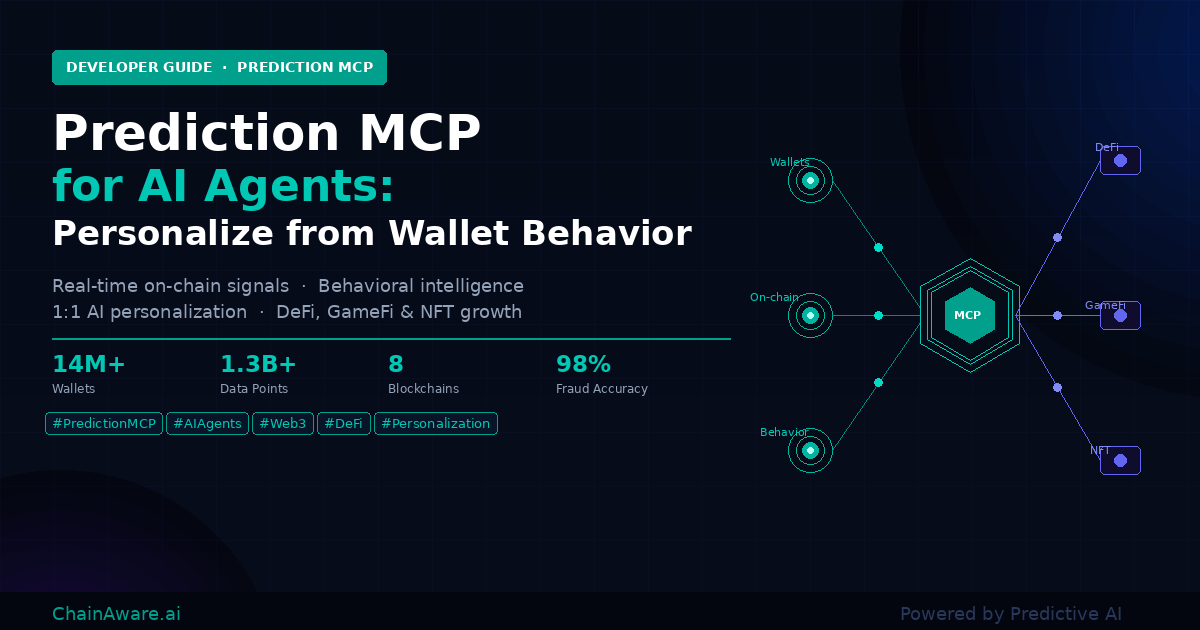
The ChainAware.ai Behavioral Prediction MCP is the implementation of this standard for Web3 behavioral intelligence. It connects any LLM or AI agent framework to ChainAware.ai’s Web3 Predictive Data Layer — a continuously updated database of 14M+ Web3 wallet profiles across 8 blockchains, built from 1.3 billion+ predictive data points.
When an AI agent connects via the MCP endpoint and passes a wallet address, it receives back a complete, structured behavioral profile — the wallet’s Web3 Persona — including risk scores, behavioral categories, predicted next actions, Wallet Rank, and protocol usage history. The agent can immediately use this context to personalize its response, without any additional processing.
This is a fundamentally different architecture from traditional analytics. Traditional tools tell you what happened. The Behavioral Prediction MCP tells your agent what is about to happen — and lets it act accordingly.
For AI Developers & Agent Builders
Connect Your Agent to 14M+ Web3 Personas
One MCP endpoint. Real-time behavioral intelligence for any wallet across 8 blockchains. No indexing, no model training, no infrastructure required.
Architecture: How the Behavioral Prediction MCP Works
Understanding the architecture helps you integrate faster and design better personalization logic. Here’s how data flows from the blockchain to your AI agent.
Layer 1: The Web3 Predictive Data Layer
ChainAware.ai’s engine runs 24/7 across 8 blockchains — Ethereum, BNB Smart Chain, Base, Polygon, Haqq, Solana, TON, and Tron — ingesting on-chain events in real time. Every swap, stake, borrow, bridge, NFT purchase, and contract interaction is captured and fed into predictive AI models.
These models produce a Web3 Persona for every wallet: a continuously updated behavioral fingerprint that goes far beyond raw transaction history. The Persona captures risk profile, protocol affinity, experience level, behavioral category (DeFi lender, NFT trader, bridge user, etc.), and predicted next actions — all expressed as structured, queryable data.
Layer 2: The MCP Endpoint
The MCP endpoint exposes the Web3 Predictive Data Layer through the standardized Model Context Protocol interface. When your AI agent sends a wallet address to the endpoint, it receives back a complete, schema-validated behavioral context payload — ready for immediate injection into the agent’s decision logic or system prompt.
The endpoint is designed for low latency and high availability. Responses are typically returned in under 200ms, making real-time personalization practical even in interactive Dapp environments where user experience depends on instant feedback.
Layer 3: Your AI Agent
Your agent — whether it’s built on GPT-4, Claude, Llama, or any other LLM framework — receives the behavioral context payload and uses it to make better decisions. The integration is framework-agnostic: if your agent supports MCP (and most modern frameworks do), you connect once and gain access to the full data layer.
According to Anthropic’s MCP documentation, the protocol is designed specifically to eliminate the M×N integration problem — where M agents each need custom integrations with N data sources. MCP reduces this to M+N, making it dramatically more scalable.
The Data Payload: What Your Agent Receives
When your agent queries the Behavioral Prediction MCP with a wallet address, the response payload includes the following structured data:
Behavioral Categories
High-level descriptors that classify the wallet’s primary on-chain behavior patterns: DeFi Lender, Active Trader, NFT Collector, Governance Participant, Bridge User, New Wallet, and more. These categories map directly to personalization segments.
Prediction Scores
Numeric probability scores for the wallet’s most likely next actions: probability of staking (0–1), probability of borrowing, probability of trading, probability of bridging to another chain, and more. Your agent can use these scores to surface the most relevant product or content at the right moment.
Wallet Rank
A unified reputation score derived from the wallet’s full behavioral history across all supported chains. Wallet Rank is extremely difficult to game — it’s based on genuine on-chain activity, not social metrics. It can be used as a quality gate, a personalization tier, or a basis for differential product offerings.
Risk & Fraud Score
A fraud probability score calculated by ChainAware.ai’s Predictive Fraud Detector, which achieves 98% accuracy on Ethereum and 96% on BNB Smart Chain. Your agent can use this score to flag suspicious sessions, require additional verification, or adjust feature access in real time — without any separate fraud detection integration.
Credit Score
A borrowing-specific reputation score for wallets, ideal for DeFi lending protocols. Wallets with high Credit Scores can be automatically offered better loan terms — lower collateral, higher limits, better rates. Already deployed in production at SmartCredit.io. Read the full outcome in our SmartCredit.io conversion case study.
Protocol Usage History
Which protocols the wallet has interacted with, how recently, and how frequently. This allows your agent to reference the user’s actual experience — “I see you’ve been using Aave” — creating interactions that feel genuinely personalized rather than generic.
See the Data for Any Wallet — Free
Check the Behavioral Profile Before You Integrate
Use the free Wallet Auditor to see exactly what behavioral data the MCP delivers for any wallet address — Wallet Rank, behavioral categories, risk score, protocol history and more. No signup required.
Use Cases Across DeFi, GameFi, NFT & Support
The Behavioral Prediction MCP is not a single-use tool — it’s a behavioral intelligence layer that unlocks dozens of use cases across every major Web3 vertical. Here are the highest-impact applications.
DeFi Lending: Risk-Adjusted Personalization
A lending protocol integrated with the MCP instantly knows whether a connecting wallet is a creditworthy borrower, a first-timer, or a high-risk address. The AI agent can then:
- Offer the high-credit wallet a pre-approved loan at preferential rates — automatically
- Guide the first-timer through a conservative onboarding flow with educational content
- Flag the high-risk wallet for additional verification before allowing large positions
This is not hypothetical — it’s live in production at SmartCredit.io. The result is measurably higher conversion among creditworthy borrowers and lower default rates across the loan book.
DEX & Trading: Interface Personalization
Trading platforms that integrate the MCP can dynamically adapt their interface based on each wallet’s trading history:
- High-frequency traders see advanced order types, leverage tools, and analytics dashboards
- Passive holders see yield opportunities, staking pools, and conservative allocation suggestions
- New wallets see simplified onboarding flows with educational tooltips
This mirrors how Amazon and Netflix personalize their interfaces — but applied to pseudonymous wallet identities, with no cookies or logins required.
GameFi: Dynamic Difficulty & Reward Tuning
GameFi platforms can use wallet behavioral data to personalize the game experience itself. A player whose on-chain history shows high risk tolerance gets more challenging content and higher-variance rewards. A conservative wallet gets a more structured progression. In-game economy events can be targeted to wallets predicted to make purchases in the next 48 hours — dramatically improving in-game conversion.
According to Harvard Business Review’s research on AI-driven customer experience, real-time behavioral context is the single most impactful variable in AI-powered personalization outcomes. GameFi is no exception.
NFT Marketplaces: Discovery Personalization
An NFT marketplace integrated with the MCP can surface collections most likely to match each wallet’s past buying patterns, price range, and category preferences. Instead of a generic trending feed, every user sees a personalized discovery page — collections they’re statistically likely to engage with. This reduces bounce rate and significantly increases listing-to-purchase conversion.
AI Support Agents: Context-Aware Assistance
A Web3 project’s AI support agent normally knows nothing about the user asking for help. With the Behavioral Prediction MCP, it instantly knows whether the user is a veteran DeFi participant or a newcomer, which protocols they use, what their risk profile looks like, and what they’re most likely trying to accomplish. The result is support that feels like a knowledgeable advisor, not a FAQ bot.
We explored this vertical in depth in our piece on 5 ways Prediction MCP will turbocharge your DeFi platform.
Personalized Marketing Campaigns
Instead of blanket email or in-app campaigns, the MCP enables surgical targeting: send a borrowing offer only to wallets predicted to borrow in the next 24 hours. Send a staking promotion only to wallets with idle assets and high staking probability scores. This level of precision reduces acquisition costs dramatically while improving campaign ROI.
For a full breakdown of how this changes crypto marketing strategy, see our guide on Web3 marketing strategy and our analysis of why influencer marketing is failing in Web3.
Step-by-Step Integration Guide
Getting started with the Behavioral Prediction MCP is designed to take minutes, not weeks. Here’s the practical path.
Step 1: Review the API Documentation
Start at swagger.chainaware.ai for the full API reference. The MCP endpoint is documented with request/response schemas, authentication details, supported chains, and example payloads. Familiarize yourself with the Web3 Persona response structure before writing any integration code.
Step 2: Test with the Free Wallet Auditor
Before writing a single line of code, use the free Wallet Auditor to inspect behavioral profiles for several wallet addresses relevant to your use case. This lets you validate the data quality and understand which fields matter most for your personalization logic.
Step 3: Connect to the MCP Endpoint
Configure your AI agent or LLM framework to connect to the ChainAware.ai MCP endpoint. Pass your API key in the request headers and the target wallet address in the request body. The endpoint returns the full Web3 Persona payload in a structured JSON format ready for immediate use.
Step 4: Define Your Personalization Mappings
Map behavioral signals to agent actions. Keep it explicit and testable:
- If
predicted_stake_probability > 0.7→ surface staking products prominently - If
wallet_rank > 75th_percentile→ unlock premium features or better terms - If
fraud_score > 0.6→ require additional verification before high-value actions - If
behavioral_category == "new_wallet"→ trigger onboarding flow - If
credit_score > 80→ offer preferential borrowing conditions automatically
Step 5: Inject Context into Agent Prompts
Include the behavioral payload in your agent’s system prompt or context window. A simple injection pattern looks like: “The user connecting has Wallet Rank 82/100, is categorized as an Active DeFi Lender, and has a 78% probability of staking in the next 14 days. Tailor your response accordingly.” The LLM uses this context to generate genuinely personalized responses without any rule-based templates.
Step 6: A/B Test and Iterate
Run A/B tests comparing personalized agent flows against your existing generic experience. Measure conversion rate, session depth, and 7/14/30-day retention for each cohort. Use the results to refine your signal mappings and progressively expand the set of behavioral variables you act on.
For Web3 Product Teams
Integrate the Behavioral Prediction MCP Today
Connect your Dapp, DeFi protocol, or AI agent to 14M+ wallet behavioral profiles. Real-time on-chain intelligence via a single MCP endpoint — no infrastructure required.
Business Impact: Conversion, Retention & Fraud Reduction
Personalization via the Behavioral Prediction MCP doesn’t just improve UX — it drives measurable business outcomes across three dimensions.
Conversion Rate Uplift
When an AI agent surfaces the right product to the right wallet at the right moment, conversion rates increase substantially. Salesforce research shows that 73% of consumers expect companies to understand their unique needs — and disengage immediately when they don’t feel understood. In Web3, where anonymous wallets have no second-chance remarketing, first-impression conversion is everything.
DeFi platforms that segment users by behavioral category and serve each segment a tailored call-to-action consistently see higher conversion on primary actions — deposits, borrows, stakes — compared to generic funnels.
Retention and Lifetime Value
Retention in DeFi is notoriously low. Users are yield-mercenaries, constantly hunting the best rates across dozens of protocols. Personalization creates a moat: when your platform consistently surfaces opportunities that match each wallet’s specific behavior pattern, users stop hunting elsewhere. The platform becomes their default.
For a deep dive into how personalization drives retention in Web3 AI contexts, see our full guide on why personalization is the next big thing for AI agents.
Fraud Reduction as a Revenue Driver
The fraud score embedded in every MCP payload means your AI agent functions as a real-time fraud screener without any separate integration. A wallet flagged with a high fraud score can be automatically routed to additional verification, blocked from high-value transactions, or shown a restricted interface — all before any transaction occurs.
At 98% accuracy on Ethereum, this is not a marginal improvement over manual review — it’s a fundamentally different risk posture. Fraud reduction protects platform reputation, reduces regulatory exposure, and maintains the trust of legitimate high-value users. For the full technical breakdown, see our article on the ChainAware.ai fraud detection approach.
Measuring Performance: KPIs That Matter
According to Gartner’s research on AI personalization, organizations that establish clear measurement frameworks for personalization achieve 2–3x better outcomes than those that deploy personalization without structured measurement. Here are the KPIs to track for your MCP integration.
Conversion Metrics
- Wallet-to-action conversion rate — personalized vs. generic cohorts, measured on primary actions (deposit, borrow, stake, trade)
- Time-to-first-action — how quickly after wallet connection does the user complete a meaningful action?
- CTA click-through rate by behavioral segment — which Web3 Persona segments respond best to which offers?
Retention Metrics
- 7/14/30-day wallet return rate — do personalized users come back more often?
- Session depth — number of protocol interactions per session, personalized vs. generic
- Protocol stickiness score — is personalization keeping users on your platform rather than spreading to competitors?
Prediction Quality Metrics
- Behavioral forecast accuracy — how often does the MCP’s predicted next action match the wallet’s actual next action?
- Segment stability rate — how stable are behavioral categories over time, and does your agent adapt when they shift?
- Fraud score precision — what percentage of flagged wallets are confirmed as fraudulent vs. legitimate?
The Future of Agent-Native Web3
The Behavioral Prediction MCP represents something larger than a useful developer tool — it’s a preview of the architecture that Web3 is converging toward: one where AI agents are the primary interface layer between users and protocols, and where those agents have real-time access to the behavioral intelligence they need to act well.
Several trends are accelerating this future:
- MCP standardization is accelerating. As MCP becomes the dominant protocol for AI context delivery, the ecosystem of compliant agents and data providers is growing rapidly. Building on MCP today means your integration remains forward-compatible as the standard matures.
- Multi-chain user behavior is the norm. Users increasingly operate across 3, 5, or 8 chains simultaneously. Single-chain behavioral views are increasingly incomplete. ChainAware.ai’s 8-chain coverage provides a holistic view that single-chain analytics tools fundamentally cannot match.
- Regulatory requirements are converging with personalization. Knowing who your users are — their behavioral history, risk profile, and fraud score — is becoming mandatory for AML compliance, not just optional for personalization. The same MCP integration serves both purposes.
- Agent-to-agent workflows are emerging. The Behavioral Prediction MCP is uniquely positioned for the next wave: multi-agent systems where one agent queries another for behavioral context, enabling complex automated workflows with genuine user-level personalization at every step.
We explored the broader trajectory in our pieces on how AI agents are revolutionizing Web3 and real utility AI meets DeFi.
Conclusion: Context Is the Competitive Advantage
Generic AI agents are a commodity. Any team can deploy one in an afternoon. The competitive advantage in Web3 AI is not the agent — it’s the context that agent operates with. Real-time on-chain behavioral data, delivered via the Behavioral Prediction MCP, is the context layer that separates agents that guess from agents that know.
ChainAware.ai has spent years building the Web3 Predictive Data Layer that makes this possible: 14M+ wallet profiles, 1.3B+ data points, 8 chains, continuously updated. The Behavioral Prediction MCP makes all of that intelligence accessible to any AI agent or LLM through a single endpoint connection.
The wallets are talking. The behavioral signals are there. The only question is whether your AI agent is listening.
ChainAware.ai Behavioral Prediction MCP
Give Your AI Agent Real On-Chain Intelligence
Connect to 14M+ Web3 Personas across 8 blockchains. Real-time behavioral predictions, Wallet Ranks, fraud scores, credit scores, and protocol history — delivered to your agent via MCP in minutes.