
Every tool on this list will show you a chart. Only one of them will convert the wallet behind it.
That is the central distinction in Web3 analytics in 2026, and it matters more than any feature comparison.
For context on how behavioral data translates into measurable growth, see our piece on Web3 business intelligence and behavioral analytics for growth.
Spindl, Cookie3, and Formo are attribution and reporting platforms — they tell you where your users came from, what they did, and how your campaigns performed. That data is real and useful. But at the end of a Spindl dashboard session, you still have to go figure out what to do with the insights. The chart is not the product. The conversion is the product. And charts do not convert wallets.ChainAware is built on a different premise: analytics without conversion is just expensive reporting. The 90% of wallets that connect to your DeFi protocol and never transact are not a data problem
The scale of this drop-off is covered in detail in our guide to why most connected DeFi wallets never transact and how AI agents fix onboarding.
— they are an action problem. The data is available. What is missing is a system that acts on it in real time, at the moment of wallet connectTailoring that moment to the visitor is the core of persona-driven Web3 marketing that actually converts.
, before the user leaves. That system is Growth Agents.A full walkthrough of how these behavioral signals are generated and used is available in our ChainAware Web3 behavioral user analytics guide for DApp teams.
This comparison covers what each tool does well and where each one stops — including an honest assessment of when the reporting tools are sufficient and when the conversion layer matters. For a broader comparison of Web3 analytics platforms across more dimensions, see our
Readers evaluating tooling more broadly can also consult our full Web3 analytics tools comparison for DApps in 2026.
complete Web3 analytics tools comparison.What DApp Teams Actually Need From Analytics
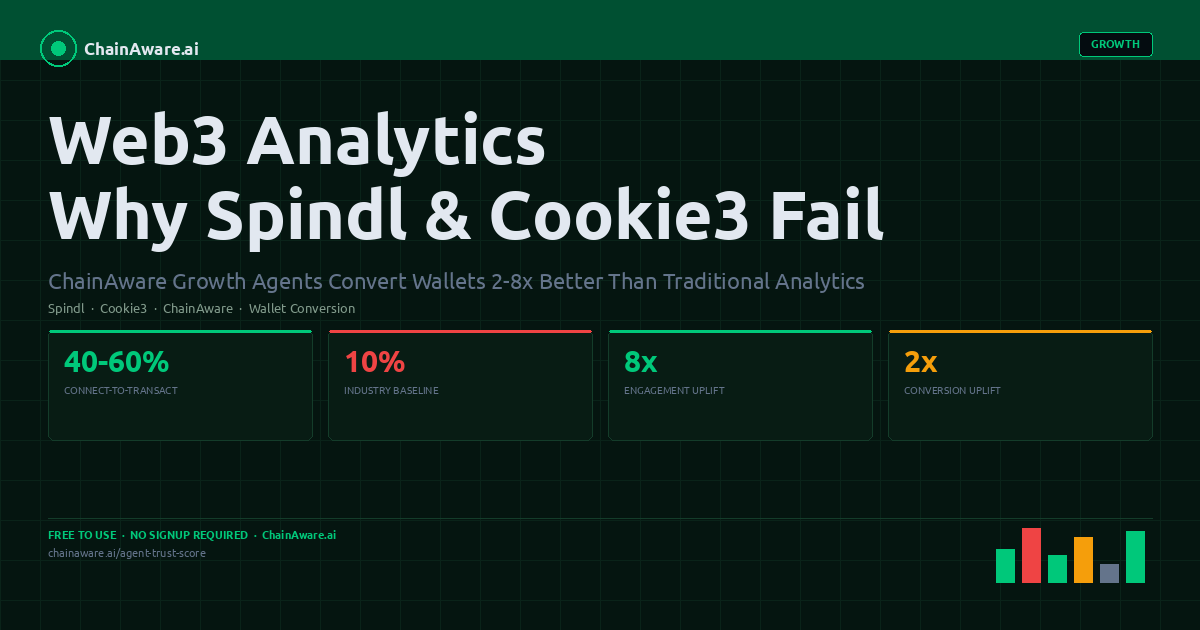
The industry-wide connect-to-transact rate is approximately 10%. For every 100 wallets that connect to your protocol, 90 leave without executing a single transaction. This is the most expensive problem in Web3, and every dollar spent on paid campaigns is 90% wasted on wallets that will never convert.
An attribution platform tells you which campaign drove those 100 connections. That is useful for budget allocation — you can stop spending on the channels that drive low-quality wallets. But it does not solve the 90% conversion problem. Attribution optimises the top of the funnel. The 90% problem lives in the middle of the funnel, at the exact moment when a wallet has connected and has not yet decided whether to transact.
What actually converts wallets is relevance at the moment of decision. A seasoned yield farmer and a DeFi newcomer who both connected to your protocol at 14:00 UTC have completely different motivations, risk tolerances, and conversion triggers. Showing them the same generic landing page — which is what every protocol does without wallet-level behavioural intelligence — means the yield farmer’s sophisticated questions go unanswered and the newcomer’s anxiety about complexity is unaddressed. Both leave.
The data needed to solve this already exists: 23M+ on-chain wallet profiles across 8 blockchains, available in under 100ms. The question is what you do with that data at the moment it matters.
Head-to-Head Comparison
| Feature | Spindl | Cookie3 | Formo | ChainAware |
|---|---|---|---|---|
| Attribution tracking | ✅ Core product | ✅ Core product | ✅ Core product | ✅ Included |
| Wallet scoring / personas | ❌ | Partial (badges) | ❌ | ✅ 5 personas, 23M+ profiles |
| Real-time personalisation at connect | ❌ | ❌ | ❌ | ✅ <100ms |
| Growth Agents / conversion layer | ❌ | ❌ | ❌ | ✅ AI-generated per-wallet copy |
| Fraud exclusion from campaigns | ❌ | ❌ | ❌ | ✅ Built into every call |
| Airdrop farmer suppression | ❌ | ❌ | ❌ | ✅ Automatic |
| Chains supported | Multi-chain | Multi-chain | Multi-chain | 8 chains (ETH, BNB, BASE, HAQQ, SOL +) |
| Integration time | Hours | Hours | Hours | Under 30 min (pixel) |
| Pricing model | Paid | Freemium | Paid | Freemium + Enterprise |
Spindl: Best-in-Class Attribution, No Conversion Layer
Spindl is the most rigorous Web3 attribution platform available. It does for DApps what UTM tracking does for Web2: connects campaign spend to wallet activity with onchain verification, so you can see which marketing channels actually drove protocol interactions rather than just clicks. This is real value — knowing that your Telegram campaign drove high-value wallets while your Twitter spend drove airdrop farmers lets you reallocate budget intelligently.
What Spindl does not do: once a wallet connects, Spindl’s job is done. The attribution data tells you the wallet is there and where it came from. It does not tell you who that wallet is behaviorally, what they need to convert, or what message would turn this connection into a transaction. The 90% problem is entirely downstream of Spindl’s scope.
When Spindl is the right choice: You need to attribute campaign ROI across channels and optimise acquisition spend. You have a separate conversion strategy in place and do not need a conversion layer embedded in your analytics stack.
Cookie3: Attribution + Badge System, Still Stops at the Dashboard
Cookie3 extends standard attribution with a badge and scoring system for Web3 marketing — wallets can earn credentials based on their on-chain behaviour, and protocols can use those credentials for targeting. This is a step toward wallet-level intelligence, and the badge mechanic creates useful engagement loops for community-driven protocols.
The limitation is that Cookie3’s scoring is designed for credential display and gamification, not for real-time conversion personalisation. A wallet with a Cookie3 badge still sees the same page as a wallet without one — the badge is information the user holds, not a signal that your protocol acts on at the moment of connection. It informs segmentation retrospectively; it does not drive personalisation prospectively.
When Cookie3 is the right choice: Your protocol has an active community engagement programme where on-chain credential display is a user-facing feature. You are running loyalty or referral campaigns where badge mechanics are part of the product.
Formo: Web3-Native Forms and Attribution, No Behavioural Intelligence
Formo fills a specific gap: Web3 protocols need forms that understand wallet connects — for whitelist applications, KYC flows, governance participation, and campaign sign-ups. Formo provides Typeform-style UX with native wallet connect and onchain attribution. If you are running an NFT whitelist or a governance participation campaign that requires structured user input, Formo is the right tool for that job.
What Formo is not: a behavioural intelligence or personalisation layer. It captures structured user input with wallet context. It does not analyse the wallet’s onchain history to understand who that user is behaviorally, and it does not act on that analysis to personalise the experience.
When Formo is the right choice: You need structured data collection from wallet-authenticated users — whitelist sign-ups, governance votes, structured feedback. The form is the product, not a touchpoint in a conversion funnel.
ChainAware: Wallet Scoring + Growth Agents = Conversion
ChainAware starts where the others stop. Attribution, wallet scoring, and behavioural personas are inputs. The output is a converted user — a wallet that connected and transacted, rather than connected and left.
The mechanism is Growth Agents. When a wallet connects to your protocol, ChainAware profiles it against 23M+ on-chain behavioural records in under 100ms and classifies it into one of five personas: Power Trader, Yield Farmer, DeFi Curious, Long-Term Holder, or Institutional/Whale. That persona, combined with the specific tool or page the user is on, is passed to Claude Haiku, which generates a personalised headline and CTA specific to this wallet — not a pre-written template from a message library, a live-generated response to this wallet’s actual history and current context.
The results at SmartCredit.io, a DeFi lending platform, demonstrate what this conversion layer delivers at scale: 4x increase in user engagement and 2x improvement in primary conversions over six months, with the integration completed in under 30 minutes via a single pixel tag. The industry baseline connect-to-transact rate is 10%. With Growth Agents, SmartCredit.io achieves 40–60%.
The same pixel call that drives personalisation also runs fraud exclusion. High-fraud-risk wallets are suppressed from conversion flows automatically — no additional integration, no separate fraud check. Airdrop farmers are identified and excluded from incentive programmes before a single token is distributed. For the full Growth Agents integration documentation, see the Growth Agents Learn docs.
When ChainAware is the right choice: You care about converting wallets, not just counting them. You have a connect-to-transact problem. You are spending on acquisition and want that spend to produce revenue, not just dashboards. For a broader breakdown of how ChainAware compares across the full Web3 growth stack, see our Web3 growth platforms comparison.
The Honest Verdict: When You Need Each Tool
These tools are not all competing for the same job. The clearest way to think about them:
- Spindl — if your primary need is accurate campaign attribution and channel ROI measurement, Spindl does that better than the others. Pair it with a conversion layer if you also want to act on what it finds.
- Cookie3 — if your protocol has a community engagement programme where on-chain badge credentials are a user-facing product feature, Cookie3’s badge mechanics serve that specific use case.
- Formo — if you need wallet-authenticated structured data collection (whitelists, governance, KYC), Formo is purpose-built for that.
- ChainAware — if you want to convert the wallets you are already acquiring, not just measure them. The 10% → 40–60% connect-to-transact improvement is not a reporting change; it is a revenue change.
Analytics without conversion is just expensive reporting. If your protocol is spending on acquisition and tolerating a 90% falloff between connection and transaction, the problem is not your attribution data — it is the absence of a system that acts on it. For the full case on why the 90% problem persists and how behavioral personalisation addresses it, see our DeFi onboarding 90% problem analysis.
ChainAware
Predictive Analytics for Web3
Score wallets in real time. Segment by behaviour. Personalise every touchpoint — before the user clicks.
Explore Predictive Analytics →ChainAware Growth Agents
Stop Measuring the 90% Problem. Start Solving It.
40–60% connect-to-transact with real-time wallet scoring and AI-generated personalisation. SmartCredit.io: 4x engagement, 2x conversions in 6 months. Integration under 30 minutes.
Book a Growth Demo →