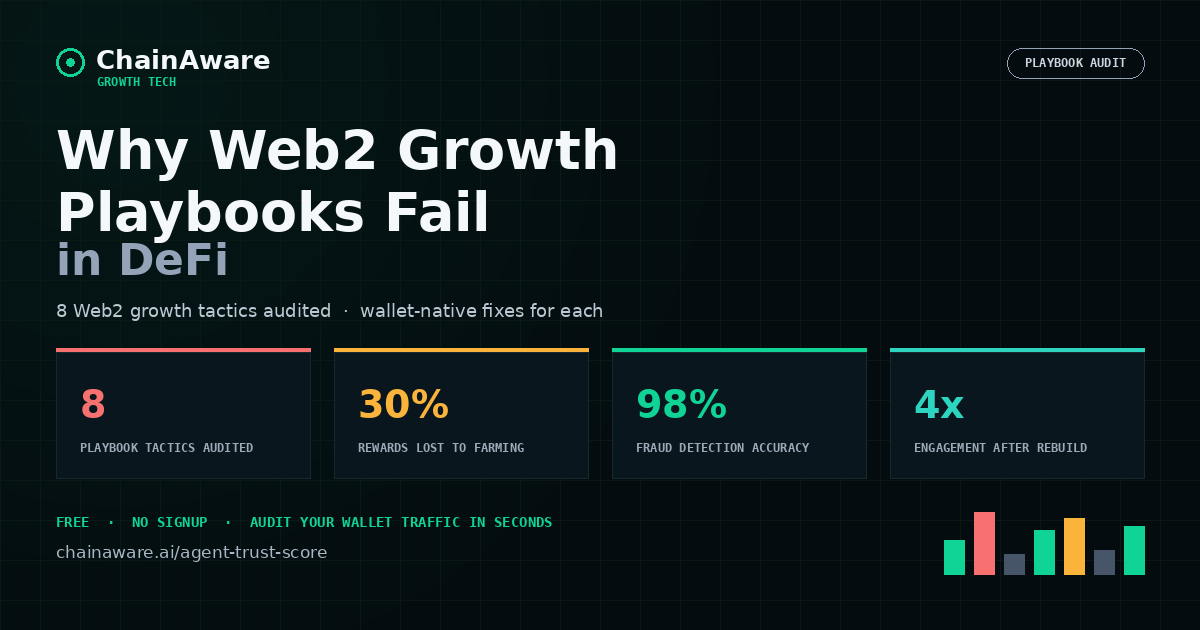
Why Web2 Growth Playbooks Fail in DeFi

Every major Web2 growth tactic – AARRR funnel tracking, CRM and lifecycle email, paid retargeting, loyalty and gamification, referral attribution, community-led growth, cohort segmentation, and multi-touch attribution – depends on persistent user identity. DeFi’s anonymous wallet model breaks that assumption, which is why standard growth stacks underperform in Web3. This guide breaks down each of the eight tactics individually, shows exactly where the identity dependency lives inside it, and maps it to its wallet-native replacement. Airdrop farming and Sybil attacks drain a large share of incentive budgets, loyalty programs reward the wrong wallets, and referral links lose attribution at the wallet connection. ChainAware’s behavioral intelligence platform – 23M+ wallet-level profiles across 8 blockchains (ETH, BSC, Base, Polygon, TON, Tron, Solana, HAQQ), Growth Agents, the Web3 Persona and On-Chain Marketing Analytics – restores the missing layer by combining session data with wallet-level behavior. Profiling runs in under 100ms through the Prediction MCP, and wallet personalization lifts connect-to-transact to 40-60% versus an industry baseline under 10%, as seen in the SmartCredit.io case study. Learn more at chainaware.ai/learn/growth-tech/growth-agents.html.
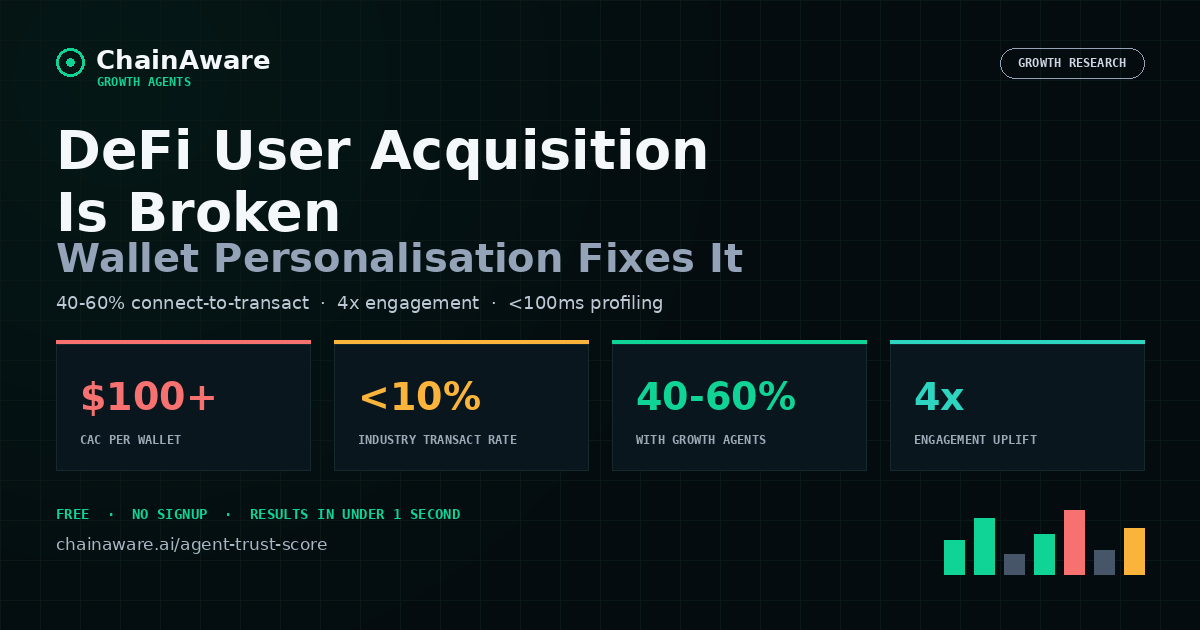
Why DeFi User Acquisition Is Broken – And How Wallet Personalisation Fixes It

DeFi teams spend more than $100 to acquire every connecting wallet, yet fewer than 10% of connected wallets ever transact, pushing real CAC above $1,000 per engaged user. This article explains why Web2 identity tools – cookies, email capture, CRM, A/B testing – cannot read wallet addresses, and how wallet-level behavioral intelligence fixes it. ChainAware’s Growth Agents combine session data with wallet data, profiling every connecting wallet in under 100ms through the Prediction MCP, using the ChainAware Web3 Persona: experience level, risk profile, intent and predicted next action. Tool-specific copy, calls to action and onboarding paths then adapt to each visitor, which lifts connect-to-transact rates to 40-60% against an industry baseline under 10%. The guide covers the cost of the connect-to-transact gap, the persona signals that drive personalization, fraud and Sybil screening in the same call, and a SmartCredit.io case study with a 4x engagement uplift. ChainAware profiles 23M+ wallets across 8 chains (Ethereum, BNB Chain, Base, Polygon, TON, Tron, Solana and HAQQ) and runs Growth Agents as part of its 34 Claude sub-agents across Fraud Tech and Growth Tech. Integration takes about 30 minutes. Learn more at chainaware.ai/learn/growth-tech/growth-agents.html.

ChainAware Launches Agent Trust Score – On-Chain Trust Scoring for the Agentic Commerce Era

ChainAware launches Agent Trust Score – the first on-chain trust scoring system for ERC-8004 registered AI agents. Analysis of 274,792 indexed agents reveals 51.8% carry Elevated Risk or Untrusted scores, 21.1% are farm-detected Sybil operations, and 741 agents were funded by confirmed rug pull operators. Score owner wallet fraud probability, feeder address, and rug pull criminal record before granting autonomous execution access. Named in CB Insights AI Fraud Prevention Market Map. Free, no signup required.

The Agent Trust Infrastructure Race: Who Is Building the Trust Layer for Agentic Commerce?

Six platforms are competing to become the trust layer for agentic commerce in 2026 – ERC-8004 native, RNWY, SkyeProfile, AXIS T-Score, DJD, and ChainAware. Each answers a fundamentally different question. This guide maps every methodology, every blind spot, and the five signals only one platform provides, with a decision matrix for DeFi builders, agent creators, and investors.

The First Step in Agentic Commerce Isn’t Integration. It’s Trust.

The ERC-8004 registry tells you an agent exists. It does not tell you whether to trust it. This guide explains why Know Your Agent (KYA) is the missing trust layer for DeFi protocol builders in 2026 – and how scoring the owner wallet, feeder address, and rug pull history closes the gap before funds move.

ChainAware.ai Named in CB Insights AI Fraud Prevention Market Map – The Only Web3 AI Token in the List

CB Insights named ChainAware.ai in its AI Fraud Prevention Market Map – placing it in the On-Chain Intelligence subcategory alongside Chainalysis, Elliptic, and TRM Labs. 200+ companies selected. One mission: building the trust and intelligence infrastructure the worldwide AI revolution demands.

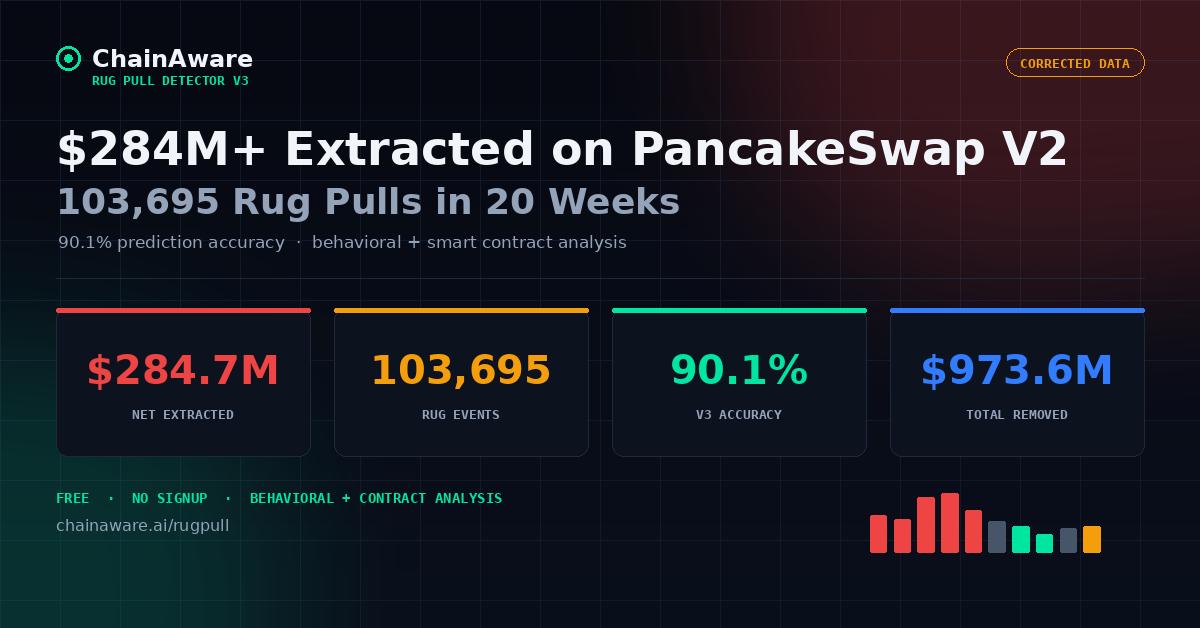
$284M+ in Rug Pulls on PancakeSwap V2 in 20 Weeks – Rug Pull Detector V3 Launched With 90.1% Accuracy

$284,694,192. That is not a headline from a dramatic DeFi hack. No Twitter threads trended. No security firms issued emergency advisories. No mainstream crypto media ran front-page coverage. That is the total value extracted from retail investors on PancakeSwap V2 alone – across just 20 weeks in 2026 – through a mechanism so normalized it barely registers as news: the rug pull. 103,695 separate rug pull events. $973,588,405 removed. $688,894,213 added before removal. ChainAware simultaneously launches Rug Pull Detector V3, combining behavioral analysis of contract creators with full smart contract inspection to reach 90.1% prediction accuracy, up from 68% in V2.

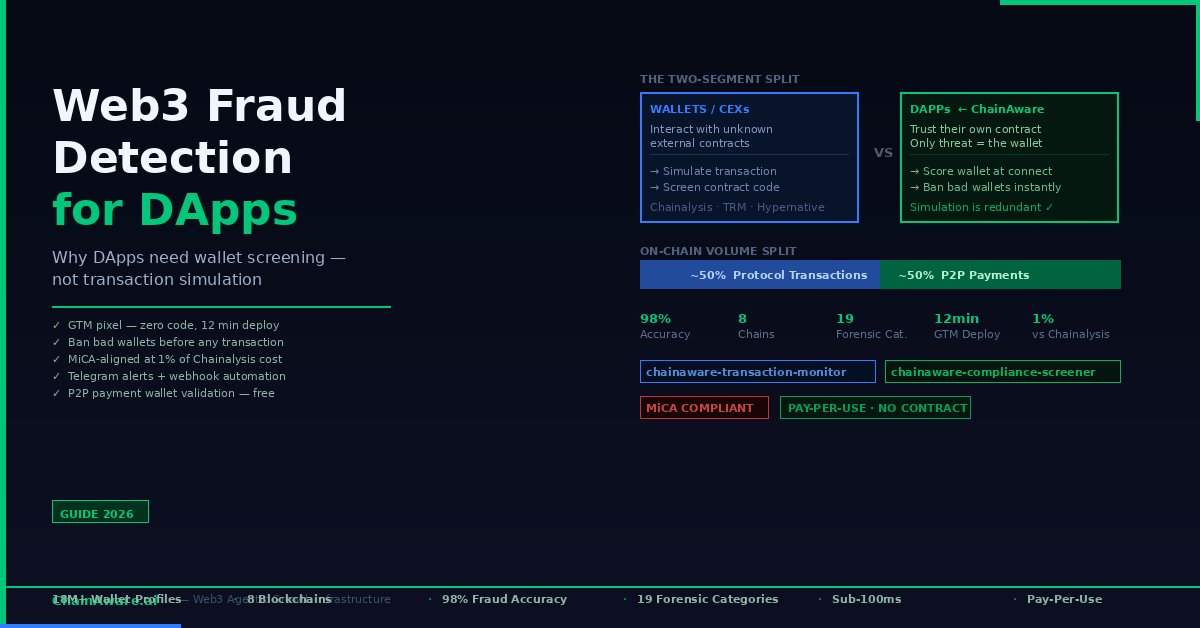
Web3 Fraud Detection for DApps in 2026 – Why Wallet Screening Beats Transaction Simulation

Web3 lost $4 billion to fraud in 2025. Most fraud detection tools were built for wallet providers and CEXs – not DApps. ChainAware is the only platform purpose-built for DApps: behavioral wallet screening at connection, zero-code GTM deploy, 98% fraud accuracy, MiCA-aligned at 1% of Chainalysis cost.

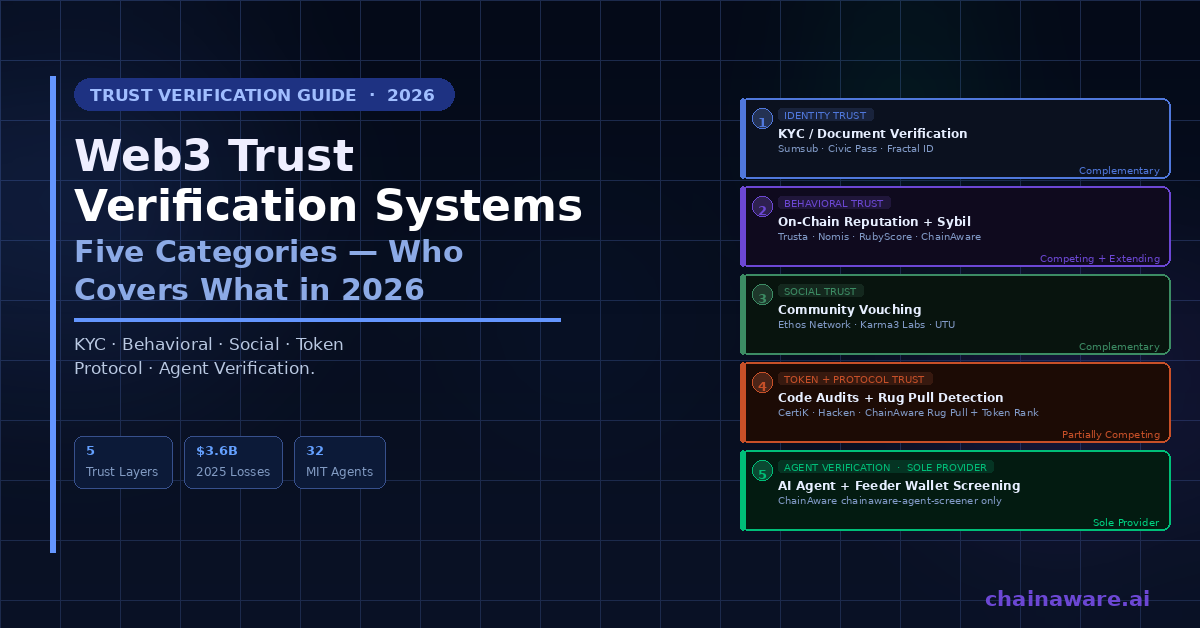
Web3 Trust Verification Systems in 2026 – The Complete Five-Category Landscape

Web3 lost over $3.6 billion to fraud in the first three quarters of 2025 – and 57.8% of those losses came not from smart contract bugs but from access-control failures. Trust in Web3 is not one problem. It is five distinct problems requiring five distinct solutions, and most protocols are only covering one.

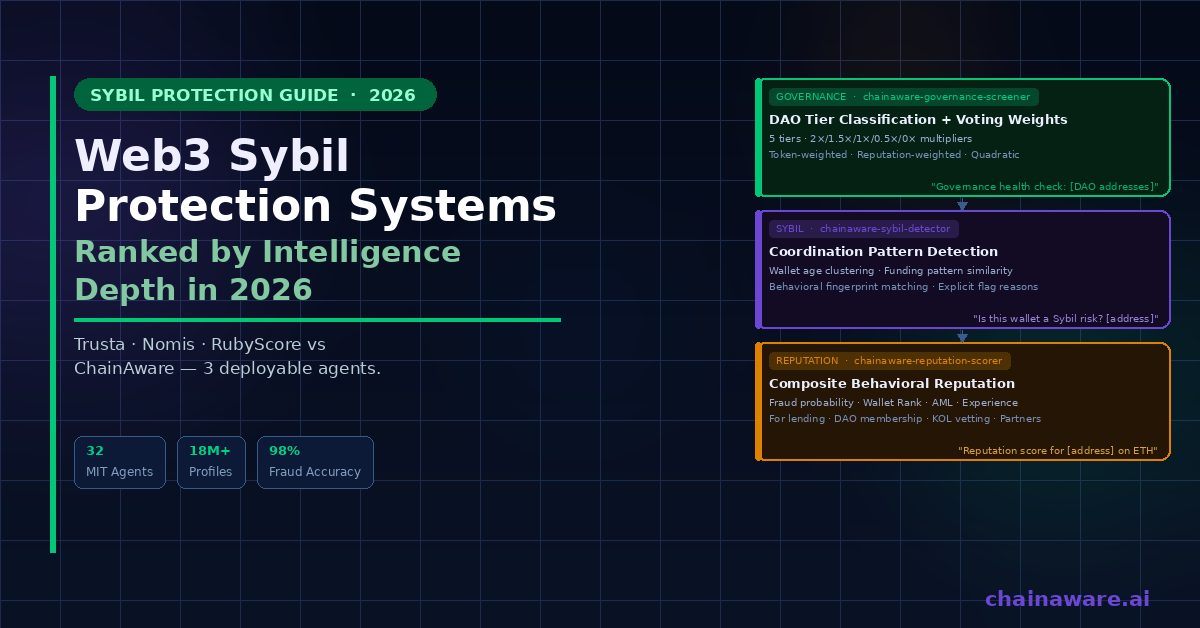
Web3 Sybil Protection Systems in 2026 – On-Chain Behavioral Providers Ranked and Compared

Sybil attacks cost Web3 protocols billions annually in fake airdrop claims, manipulated governance votes, and inflated engagement metrics. This guide ranks and compares every major on-chain behavioral Sybil protection provider in 2026 – from GNN/RNN graph detection to behavioral scoring – and explains where each approach works and where it falls short.