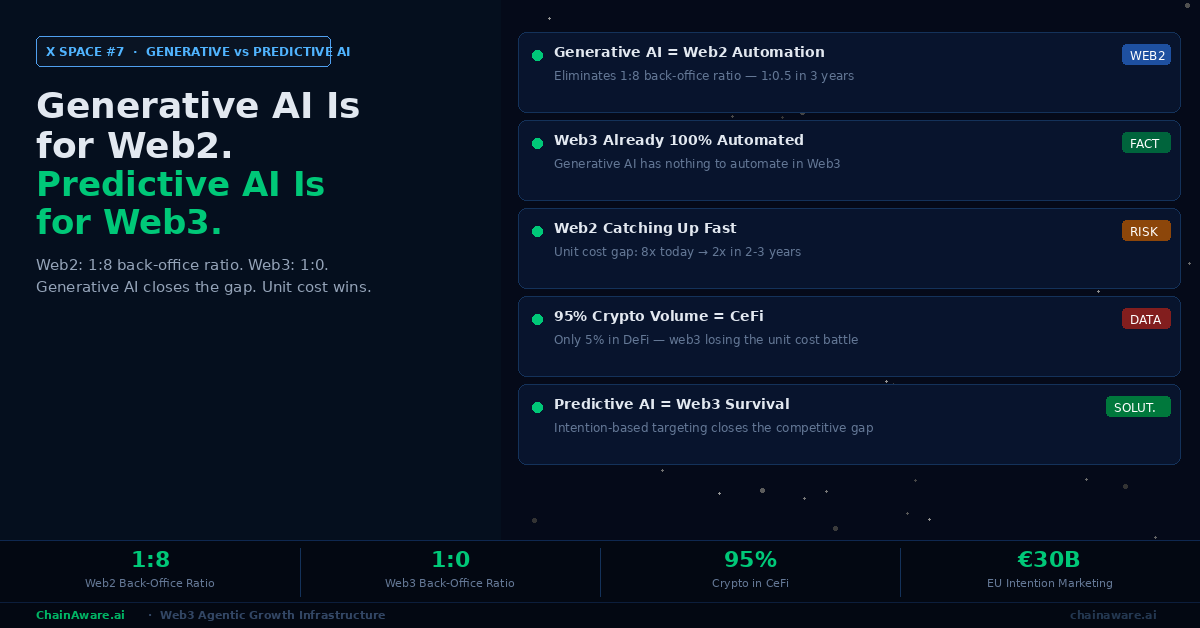
Crossing the Chasm in Web3: How AdTech Will Take Web3 Mainstream

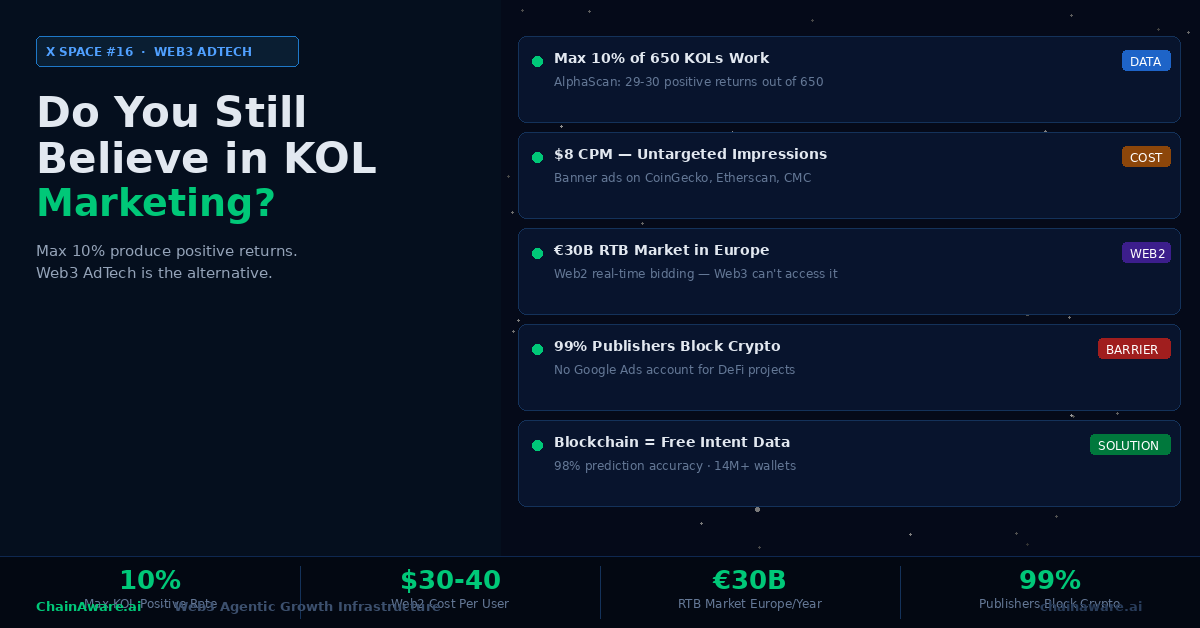
X Space recap: Web3 KOL marketing vs Web3 AdTech. Is KOL marketing still effective in Web3? ChainAware.ai and guests compare: KOL marketing (mass reach, untrackable ROI, airdrop farmer traffic) vs Web3 AdTech (wallet-behavioral targeting, trackable conversion, quality user acquisition). The sustainable path: identify wallet intentions before spending, use behavioral data to target high-value segments, measure ROI by wallet quality not click volume. ChainAware products: Web3 Behavioral Analytics, Growth Agents, Prediction MCP. chainaware.ai.

AI-Based Web3 AdTech: How to Cross the Chasm and Slash Customer Acquisition Costs

X Space #15: AI-Based Web3 AdTech — How to Cross the Chasm and Slash Customer Acquisition Costs. ChainAware co-founders Martin and Tarmo. Core thesis: Web3 AdTech built on blockchain behavioral data is structurally superior to Web2 AdTech (cookies/search history) and is the specific mechanism that will take Web3 from 50 million to mainstream adoption. Key insights: global AdTech market is $180 billion annually ($30B in Europe alone) — built entirely on intention-based behavioral targeting; Web2 AdTech reduced CAC from $500-2,000 to $15-30 by matching advertisements to users’ stated behavioral intentions; Web3 has not built this infrastructure despite having higher-quality data than Google (gas-fee-filtered financial transactions vs zero-cost search queries); blockchain behavioral data advantage: every transaction is a deliberate financial commitment — produces 98%+ prediction accuracy on behavioral classification; real-time bidding (RTB) Web2 parallel: programmatic ad serving based on behavioral profiles; Web3 equivalent: ChainAware Growth Agents serve personalised messages at wallet connection based on 18M+ Persona profiles; attribution vs intention: current Web3 analytics describe past behavior (attribution), ChainAware predicts future behavior (intention); no cookies, no identity, no privacy risk — public wallet data only. ChainAware Prediction MCP enables any developer to build Web3 AdTech applications. 32 open-source agents · 8 blockchains · chainaware.ai

Unit Costs: The Formula That Wins Markets — Why Web3 Must Solve Acquisition Cost to Survive

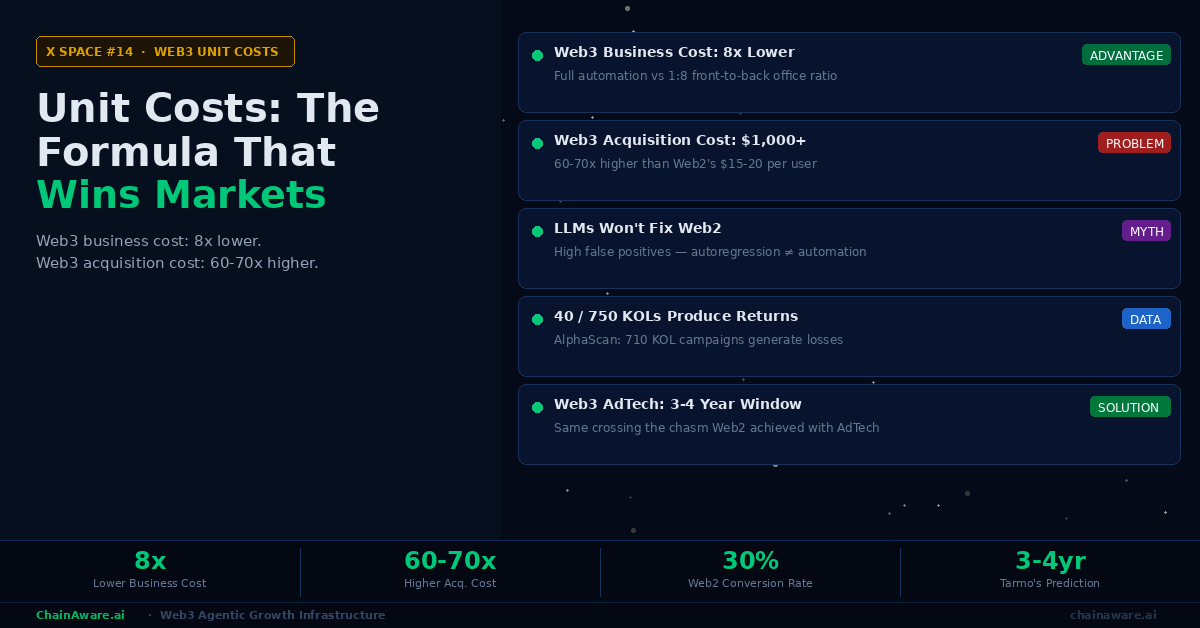
X Space #14: Unit Costs — The Formula That Wins Markets and Why Web3 Must Solve Acquisition Cost to Survive. ChainAware co-founders Martin and Tarmo. Core thesis: every Web3 project has two unit costs that determine whether it can survive — unit cost of business process (DeFi has solved this brilliantly) and unit cost of customer acquisition (nobody is solving this). Web3 acquisition math: $5 CPC × 200 website visitors × 5% wallet connection rate × 10% transaction rate = $1,000+ per transacting user; to become cash-flow positive, revenue per user must exceed $1,000 — structurally impossible for most DeFi protocols at current volumes. Web2 parallel: same dual problem in early 2000s — credit card fraud destroying trust + $500-2,000 CAC from mass marketing; Web2 solved it with AI fraud detection (mandated by regulators) + Google AdTech (microsegmentation). Web3 AdTech solution: behavioral wallet targeting reduces CAC from $1,000+ to $20-30 by reaching only wallets whose intention profile matches the product. LTV must be 3x CAC: current Web3 unit economics are inverted — LTV/$200 vs CAC/$1,000+. ChainAware Growth Agents + Behavioral Analytics: same budget, 8x more transacting users, 3x LTV/CAC ratio achievable. Free analytics tier · 2-line GTM integration · Prediction MCP · 18M+ Web3 Personas · chainaware.ai

AGI vs LLM: Why Bigger Models Won’t Get Us to Artificial General Intelligence

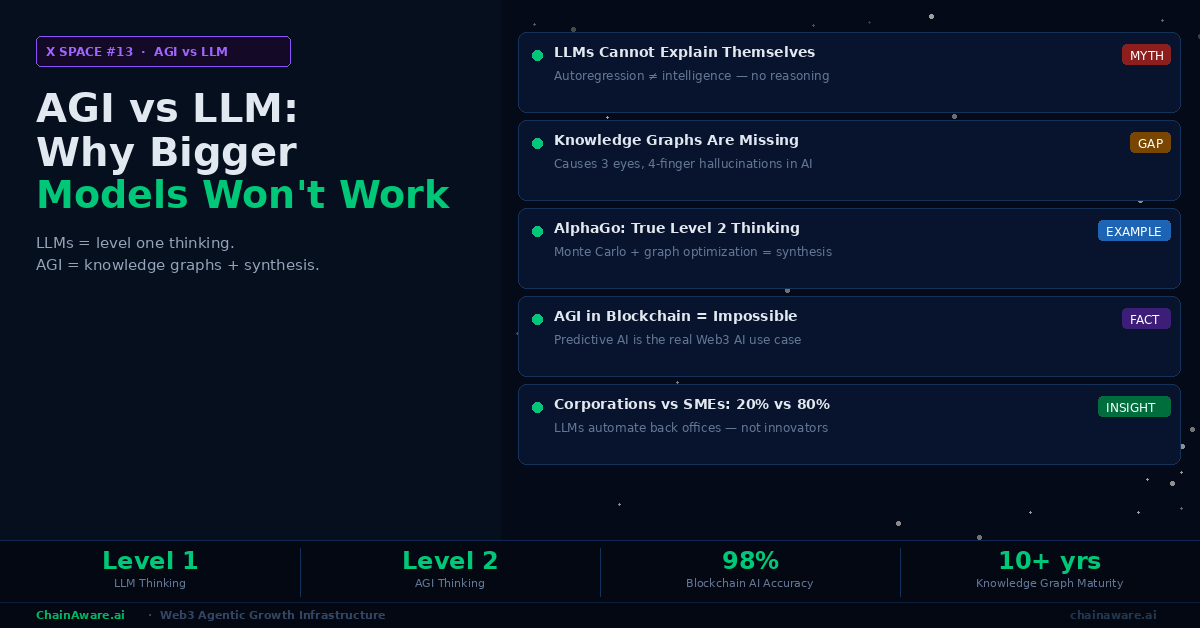
X Space: AGI vs LLM — Why Bigger Models Won’t Get Us to Artificial General Intelligence. ChainAware co-founders Martin and Tarmo. Core thesis: AGI (Artificial General Intelligence) does not exist and scaling LLMs will not produce it — Web3 founders and investors must understand this distinction to evaluate which AI projects have real utility vs narrative. Key distinctions: AGI = AI with human-level reasoning across all domains (does not yet exist); LLM = large language model trained on text prediction (statistical autocomplete, not reasoning); narrow predictive AI = purpose-built models for specific classification tasks (fraud detection, behavioral prediction); LLMs hallucinate on numerical on-chain data, cannot make deterministic fraud classifications, run at 1-5 second latency (100x too slow for real-time); real competitive advantage in Web3 AI requires: proprietary training data, domain-specific model architecture, iterative accuracy improvement; the diagnostic question for any Web3 AI project: what specifically does it predict? If it cannot answer with a metric (98% accuracy, sub-second response) it is narrative AI not utility AI. ChainAware uses narrow predictive AI: ML models trained on 14M+ on-chain wallet behavioral histories, 98% fraud prediction accuracy, real-time response, 8 blockchains. Not ChatGPT. Not a wrapper. Proprietary. Prediction MCP · 32 open-source agents · chainaware.ai

High Conversion Without Paying KOLs: How Intention-Based Marketing Transforms Web3 Growth

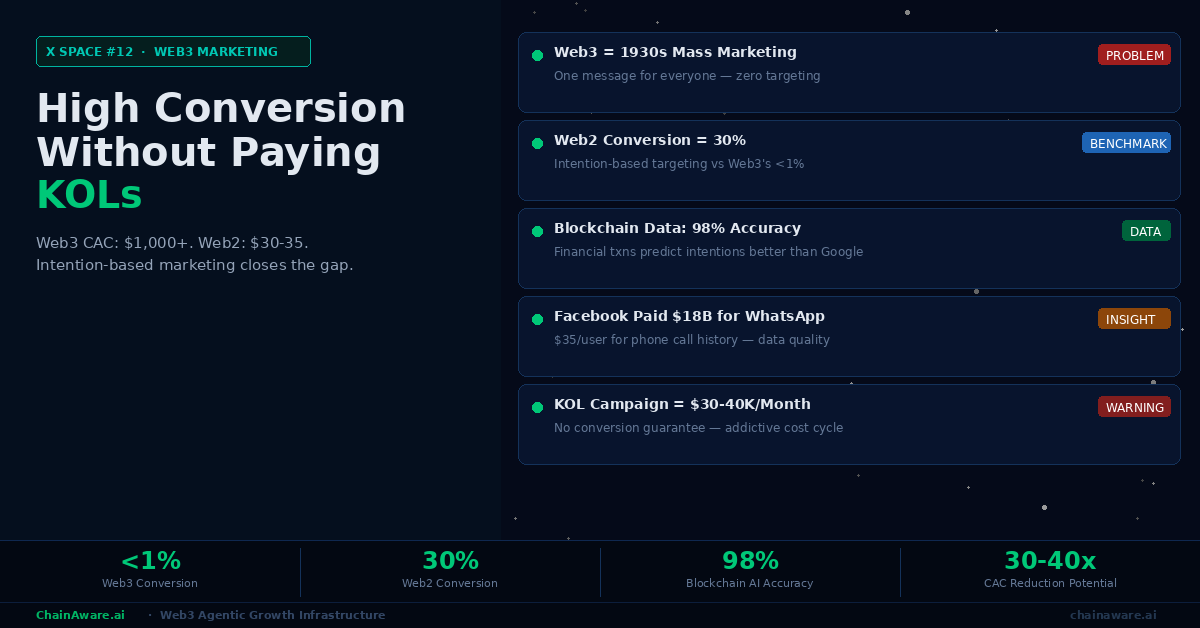
X Space #12 (est.): High Conversion Without Paying KOLs — How Intention-Based Marketing Transforms Web3 Growth. ChainAware co-founders Martin and Tarmo. Core thesis: the only way to achieve 20-30% conversion rates in Web3 without KOL spend is to replace mass marketing with wallet-behavioral intention targeting. Key insights: KOL campaigns bring airdrop farmers (reward optimisers) not transacting users; cost per KOL campaign: $250+ per tweet, $25K+ per campaign — with fewer than 4% positive 30-day return rate; the 50/50 problem: 50% of marketing budget wasted but you don’t know which half (same as Web2 pre-AdTech era); user identification at wallet connection: every connecting wallet gets scored in real-time — Wallet Rank, experience (1-5), risk willingness, intentions (borrower, trader, staker, gamer); high-value wallets receive personalised activation messages matched to their behavioral profile; airdrop hunters get filtered before consuming acquisition budget; feedback loop: ChainAware analytics shows which behavioral segments actually convert — enabling marketing spend optimisation against real transacting user data, not click metrics. ChainAware Growth Agents: 2-line Google Tag Manager integration, no code changes, results in 24-48 hours. Free analytics tier. Same budget. 8x more transacting users. 3x LTV/CAC ratio. Prediction MCP · 18M+ Web3 Personas · chainaware.ai

Vitalik’s AI and Crypto Paper: A Use-Case Reality Check — What Actually Works on Blockchain

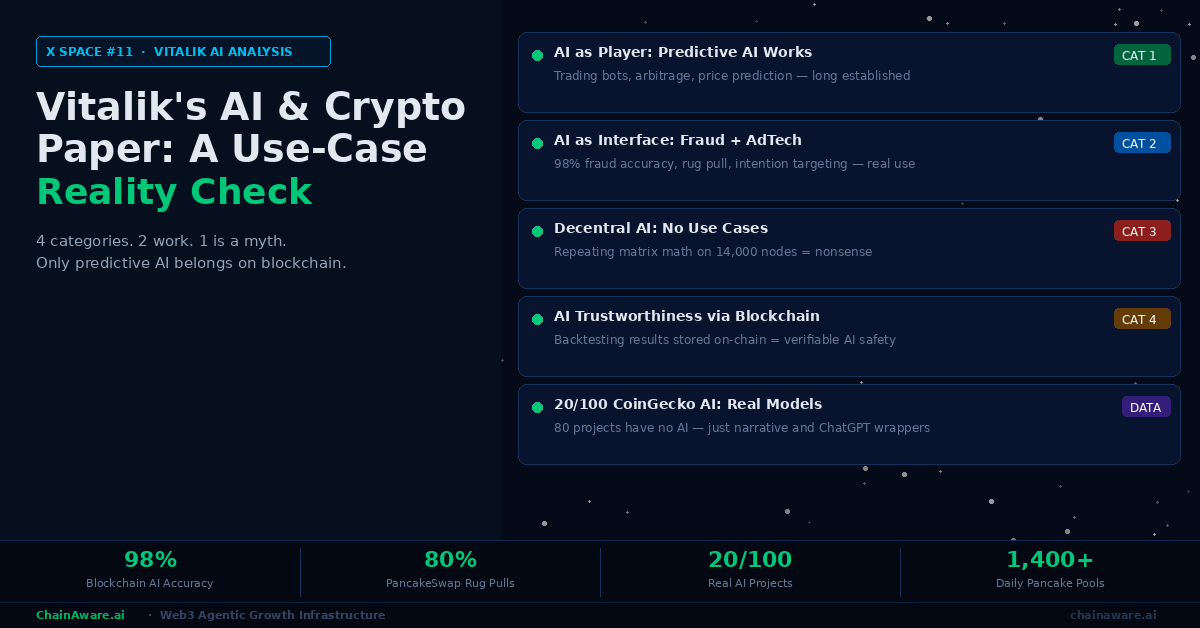
X Space #11: Vitalik’s AI and Crypto Paper — A Use-Case Reality Check. ChainAware co-founders Martin and Tarmo analyse Vitalik Buterin’s essay on AI and blockchain convergence. Core thesis: Vitalik correctly identifies fraud detection and on-chain security as the highest-value AI+blockchain convergence — but underestimates what is already live and deployable today. Key analysis: Vitalik’s four categories — AI as participant in games, AI for security, AI for governance, AI for DeFi optimisation; fraud detection use case: fully validated — ChainAware 98% accuracy, real-time, 8 chains in production; governance AI: premature — LLMs hallucinate on governance decisions, not deployable at protocol level; DeFi optimisation: promising but requires deterministic models, not generative AI; key distinction: predictive AI (behavior classification) vs generative AI (text generation) — only predictive AI is useful for on-chain applications; blockchain data quality advantage: financial transactions filtered by gas fees are higher quality than any Web2 behavioral dataset; ChainAware Prediction MCP enables any developer or AI agent to access fraud scores, rug pull detection, wallet behavioral profiles via natural language queries; 32 open-source agents on GitHub. Web3 needs predictive AI, not LLM wrappers. Prediction MCP · 18M+ Web3 Personas · 8 blockchains · chainaware.ai

Web3 KOL Marketing Is Mass Marketing — And Why It Is Destroying Your Project

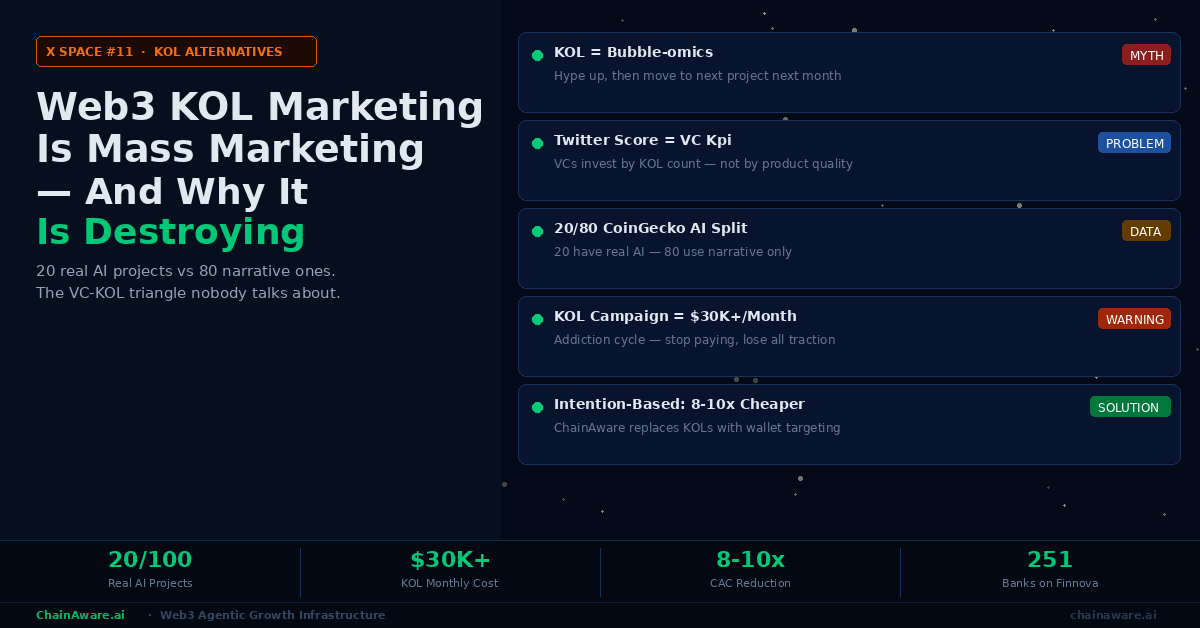
X Space #9: Web3 KOL Marketing Is Mass Marketing — And Why It Is Destroying Your Project. ChainAware co-founders Martin and Tarmo. Core thesis: KOL marketing is structurally identical to 1930s mass marketing — same message to undifferentiated audience, untrackable ROI, and it is actively destroying Web3 project cash flows. Key stats: fewer than 4% of KOL campaigns generate positive 30-day returns; KOL-driven traffic consists primarily of airdrop farmers who connect wallets and never transact; average DeFi customer acquisition cost: $1,000+ per transacting user (vs $15-30 in Web2 with AdTech); marketing spend is 30-50% of Web3 project treasury with no measurable outcome. Why KOL marketing fails: no user intention profiling; no behavioral segmentation; no feedback loop between spend and transacting user acquisition; airdrop hunters are rational actors optimising for rewards, not product usage. The alternative: wallet-behavioral targeting using on-chain intention profiles (borrower, trader, staker, gamer) — reaches only users who match the product’s value proposition. ChainAware Growth Agents deliver personalised 1:1 messages at wallet connection based on behavioral profile calculated from 18M+ Web3 Personas across 8 blockchains. Same budget. 8x more transacting users. 3x LTV/CAC ratio. Prediction MCP · 32 open-source agents · chainaware.ai

Out-of-the-Box Web3 Marketing: How 1:1 Targeting Transforms Conversion

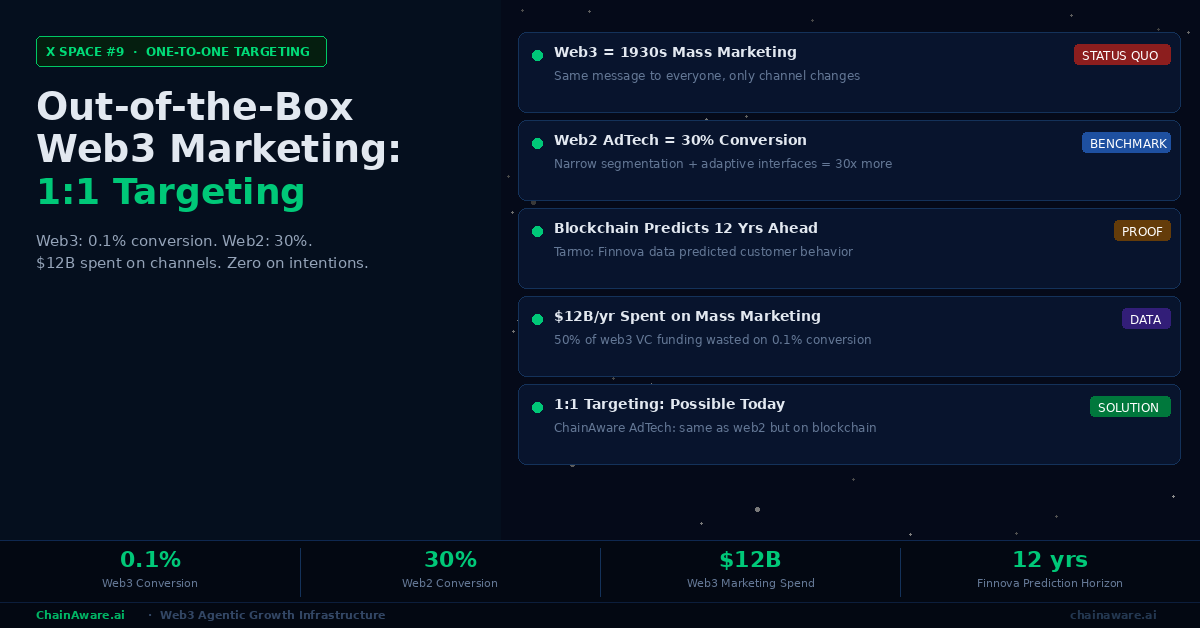
X Space #8: Out-of-the-Box Web3 Marketing — What About 1:1 Targeting? ChainAware co-founders Martin and Tarmo. Core thesis: Web3 mass marketing (KOLs, banners, media placements) delivers 0.1% conversion because it sends the same message to everyone — 1:1 wallet-behavioral targeting achieves 20-30% conversion by matching message to individual intention profile. Key insights: mass marketing = 1930s technology; same message to every wallet regardless of behavioral profile; airdrop farmers dominate KOL-driven traffic — they connect wallets, claim rewards, never transact; KOL reality: fewer than 4% of KOL campaigns generate positive 30-day returns (Alphascreener data); 1:1 targeting uses each wallet’s on-chain transaction history to predict next action — borrower, trader, staker, gamer, NFT collector; Gartner: 70% of Web2 applications will be adaptive by 2025 — Web3 is at 0%; adaptive UI adapts content, colors, fonts, calls-to-action to individual wallet behavioral profile; no cookies, no identity disclosure — only wallet address and public transaction history required; ChainAware Growth Agents: pixel via Google Tag Manager (2 lines of code), behavioral profile calculated at wallet connection, resonating message delivered automatically; same budget, 8x more transacting users. Prediction MCP · 32 open-source agents · 18M+ Web3 Personas · chainaware.ai

AI + Blockchain: Winning Use Cases That Actually Work

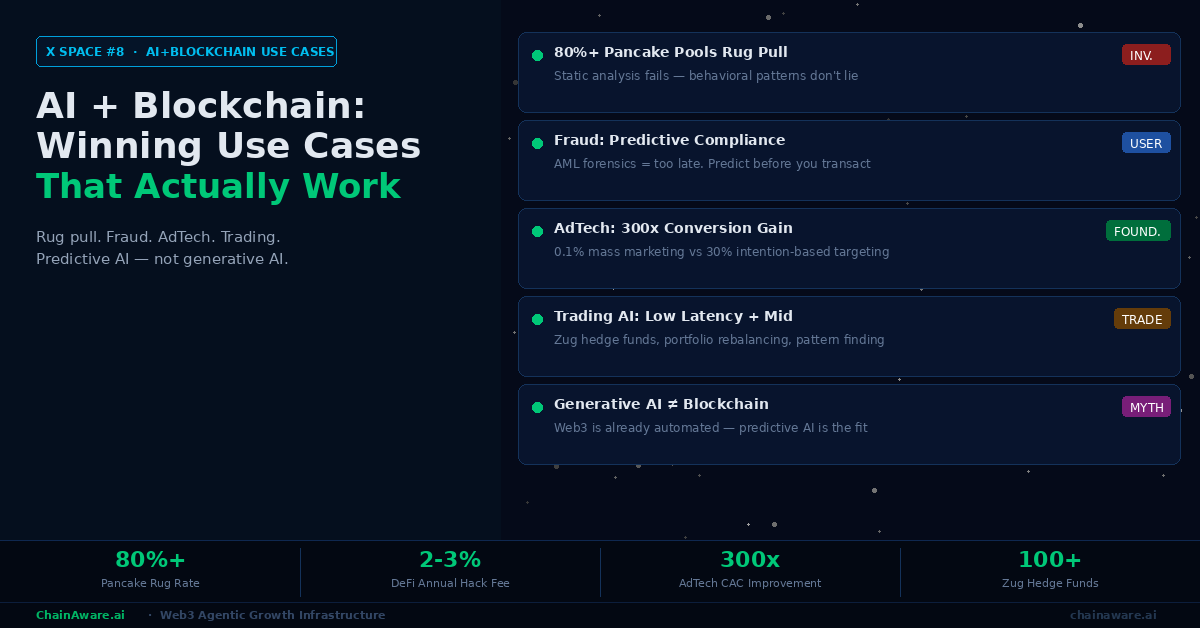
X Space #7: AI + Blockchain — Winning Use Cases That Actually Work. ChainAware co-founders Martin and Tarmo. Core thesis: the intersection of AI and blockchain has six high-value use cases — all require predictive AI trained on on-chain data, none can be solved with generative AI wrappers. Six winning use cases: (1) fraud detection — 98% accuracy, real-time, behavioral neural network on transaction history; (2) rug pull detection — traces contract creator funding chain and liquidity provider history; (3) Web3 AdTech — 1:1 behavioral targeting from wallet intention profiles, replaces mass KOL marketing; (4) trading signals — predictive models on on-chain flow patterns; (5) credit scoring — on-chain cash flow + fraud probability for DeFi underwriting; (6) smart contract vulnerability analysis — AI pattern matching on code structure. Key insight: blockchain data is the highest-quality behavioral dataset in the world — every transaction is a deliberate financial decision (proof-of-work filter). $300B data goldmine: 500M users × $600/user bank data equivalent — free and public on-chain. 95% of CoinGecko AI projects are LLM wrappers with no production models. ChainAware covers use cases 1-3 in production today: 14M+ wallets, 8 blockchains, 98% fraud accuracy. Prediction MCP · 32 open-source agents · chainaware.ai

Generative AI Is for Web2. Predictive AI Is for Web3.

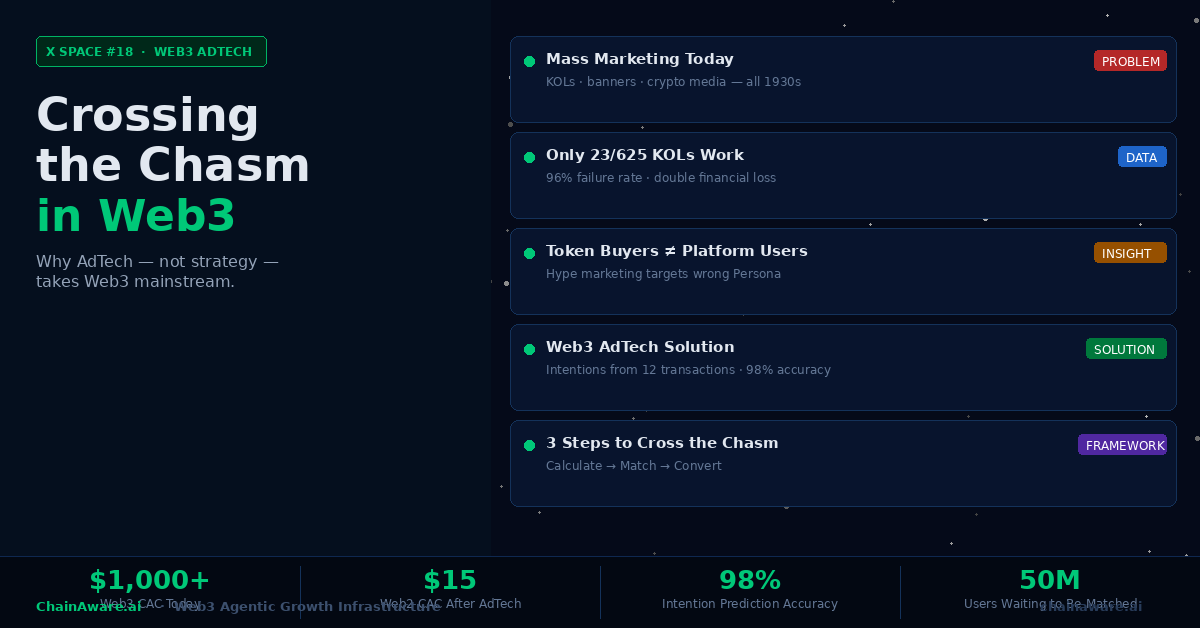
X Space #6: Generative AI Is for Web2. Predictive AI Is for Web3. ChainAware co-founders Martin and Tarmo. Core thesis: generative AI and predictive AI serve completely different purposes — only predictive AI trained on on-chain behavioral data can solve Web3’s core problems of fraud and mass marketing. Key distinctions: generative AI creates content (text, images, code) — it is a one-time tool used by human employees; predictive AI predicts outcomes from behavioral patterns — it runs continuously as an autonomous agent; generative AI cannot detect fraud, predict rug pulls, segment wallets, or power marketing agents; using an LLM API for blockchain security is not AI — it’s a wrapper; competitive advantage requires proprietary training data, custom model architecture, and iterative refinement (not plugging into OpenAI); blockchain data produces higher-quality behavioral predictions than Web2 data because gas fees filter casual transactions; Web3 is at the same inflection point as Web2 in the early 2000s — 50 million users, horrific CAC, widespread fraud; the same two technologies that brought Web2 to mainstream (AI fraud detection + AdTech) are now available for Web3 in superior form. ChainAware products: Fraud Detector (98% accuracy, real-time), Rug Pull Detector, Marketing Agents, Transaction Monitoring Agent. Prediction MCP · 32 open-source agents · chainaware.ai