Payment networks agent trust stack fails — ChainAware.ai fraud detection for AI agents

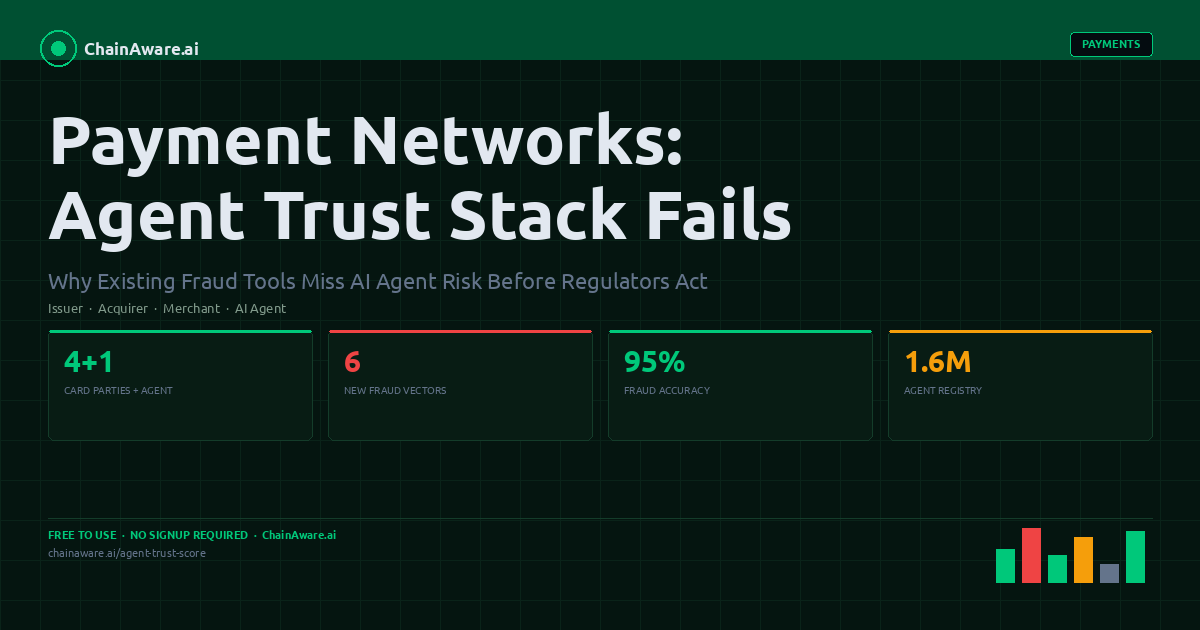
Payment Networks Exposed: The Full Truth About Why the Agent Trust Stack Fails

Payment networks built their fraud defences on a single assumption: humans are on the other side of every transaction. But Gartner estimates that 15 percent of enterprise transactions will be agent-initiated by 2027, and AI agents are already transacting today—booking travel, purchasing API credits, settling invoices and triggering recurring orders. The problem is urgent: velocity rules flag legitimate high-frequency agent activity as fraud, device fingerprinting loses all signal on shared cloud infrastructure, and behavioral biometrics has nothing to measure when software is the buyer. ChainAware’s research reveals how payment networks can retrofit their fraud stacks before agentic volume scales to levels that make retrofitting prohibitively expensive. Discover the three critical failure modes breaking today’s detection frameworks and what a practical fix looks like for acquirers and infrastructure architects.
KYA regulations EU AI Act MiCA agentic economy compliance timeline — ChainAware.ai

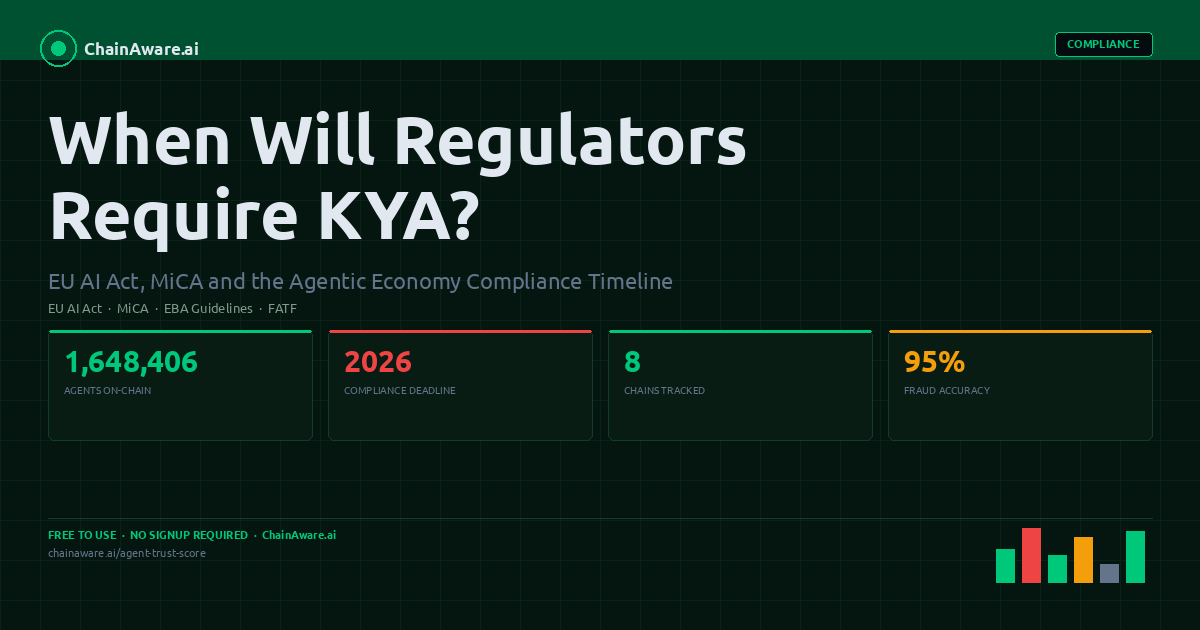
KYA Regulations Exposed: Proven Truth About the EU AI Act, MiCA and Agentic Economy

Regulators haven’t yet mandated Know Your Agent protocols — but three separate regulatory frameworks are converging to make it inevitable. The EU’s MiCA Article 68 is creating screening gaps for AI agent wallets, whilst the EU AI Act Article 50 establishes identity disclosure as a legal requirement. Meanwhile, the FATF Travel Rule is closing in on the agent originator problem. With 1.6 million ERC-8004 agents already indexed on-chain and funding chains traceable to known bad actors, compliance teams face enforcement exposure today, long before formal agent-specific rules land. This article maps the three regulatory tracks, identifies the grey areas where agents currently operate, and provides a realistic timeline for when mandatory agent registration becomes law. Learn what your team needs to do now to stay ahead of the curve — and why ChainAware’s agent behaviour scoring is becoming essential compliance infrastructure.

KYC to KYA identity verification evolution for AI agents — ChainAware.ai agent trust score

KYC to KYA Exposed: Proven Truth About Identity Verification in the Agentic Economy

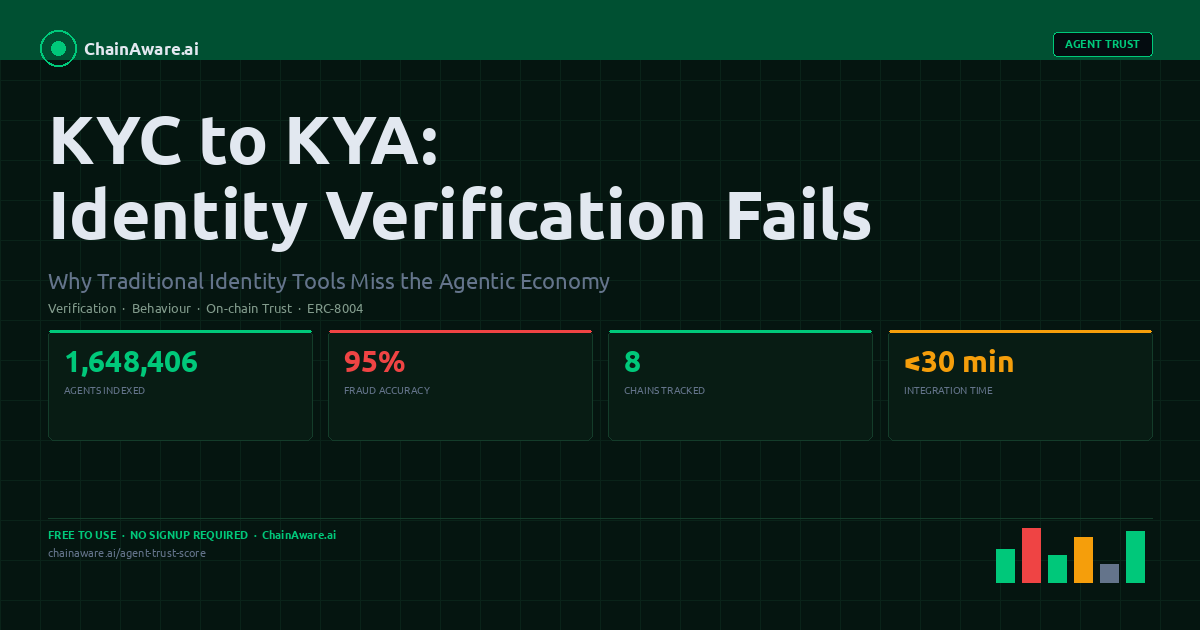
Traditional Know Your Customer protocols were built for humans—but AI agents operating autonomously across blockchains expose three critical gaps that KYC cannot close alone. When software holds wallets and executes transactions without human oversight for each action, the delegation chains, behavioral drift and fleet Sybil attacks multiply compliance blind spots. ChainAware’s analysis of the ERC-8004 agent ecosystem reveals the scale: 1.6 million registered agents across eight chains, with 82.5% of scored agents showing elevation risk signals that static identity checks never catch. This article explains precisely where KYC breaks under agent volume, what Know Your Agent adds to close those gaps and what on-chain behavioral intelligence reveals about the agentic economy’s real compliance challenge. Discover why continuous behavioral scoring, not point-in-time verification, is now essential for Web3 compliance teams.

Security stack built for human attackers fails against AI agent adversaries — ChainAware.ai

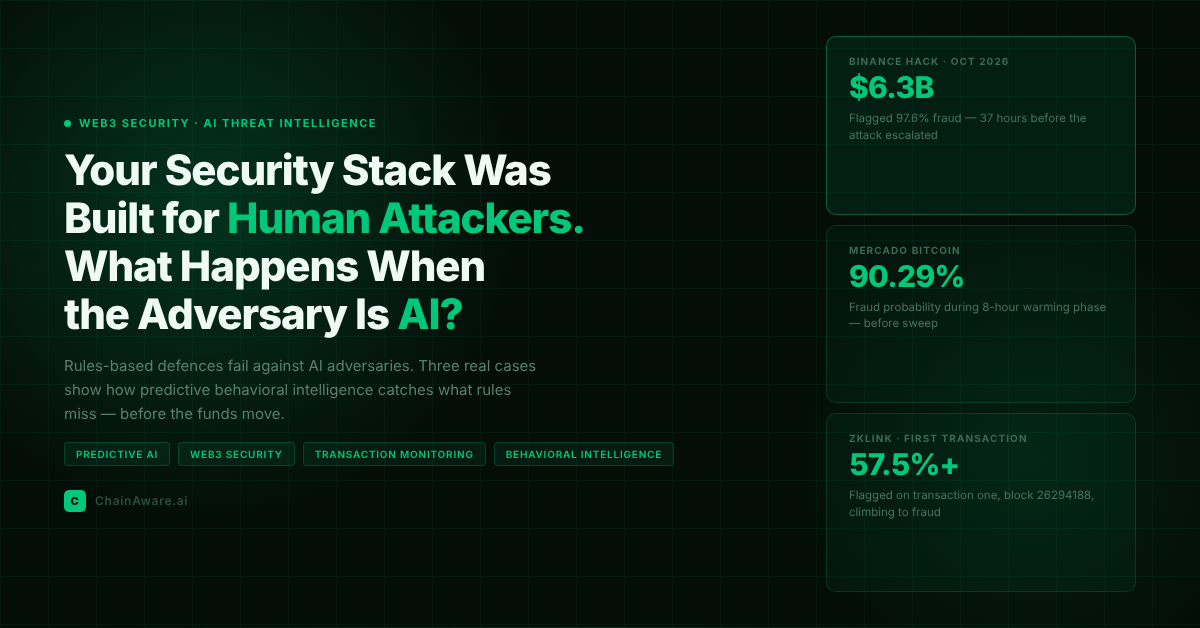
Your Security Stack Was Built for Human Attackers. What Happens When the Adversary Is AI?

Rules-based security frameworks were built for a specific adversary: a human being operating at human speed, exploiting known vulnerability classes, and constrained by cognitive limits. NIST, WAFs, smart contract audits — every major framework assumes the attacker can be caught by rules written in advance. That assumption held for three decades. It no longer does.

AI adversaries generate novel attack vectors at machine speed, build warming phases that evade every threshold rule, and chain hundreds of smart contract interactions in sequences no human auditor reviewed. The $6.3 billion Binance hack of October 2026 moved funds across 10 blockchains in 20 minutes. ChainAware’s predictive model had flagged the attacker wallet at 97.6% fraud confidence 37 hours earlier — at the moment of first Binance interaction. The warming phase at Mercado Bitcoin ran for eight hours; the model scored it at 90.29% fraud probability throughout. The zkLink attacker was flagged on the first transaction, block 26294188, before any exploit executed.

The spam filter analogy is exact: rule-based email filters collapsed when spammers adapted, and only statistical behavioral classifiers won. Web3 is at the same inflection point. Behavioral models learn the statistical shape of threat-actor activity and generalise to novel attacks — warming phases change the surface, not the shape. This article explains the mechanics, documents the three cases with on-chain block numbers, and sets out a practical transition roadmap from signature-based detection to pre-transfer behavioral screening.

AI fraud prevention market map featuring ChainAware.ai in the CB Insights landscape — Web3 fraud detection — ChainAware.ai

Web3 Fraud Exposed: The Full Truth About ChainAware.ai’s Place on CB Insights’ Map

CB Insights named ChainAware.ai in its AI Fraud Prevention Market Map – placing it in the On-Chain Intelligence subcategory alongside Chainalysis, Elliptic, and TRM Labs. 200+ companies selected. One mission: building the trust and intelligence infrastructure the worldwide AI revolution demands.

Rug pull detection dashboard showing PancakeSwap V2 scam data and 90.1% accuracy metric — ChainAware.ai

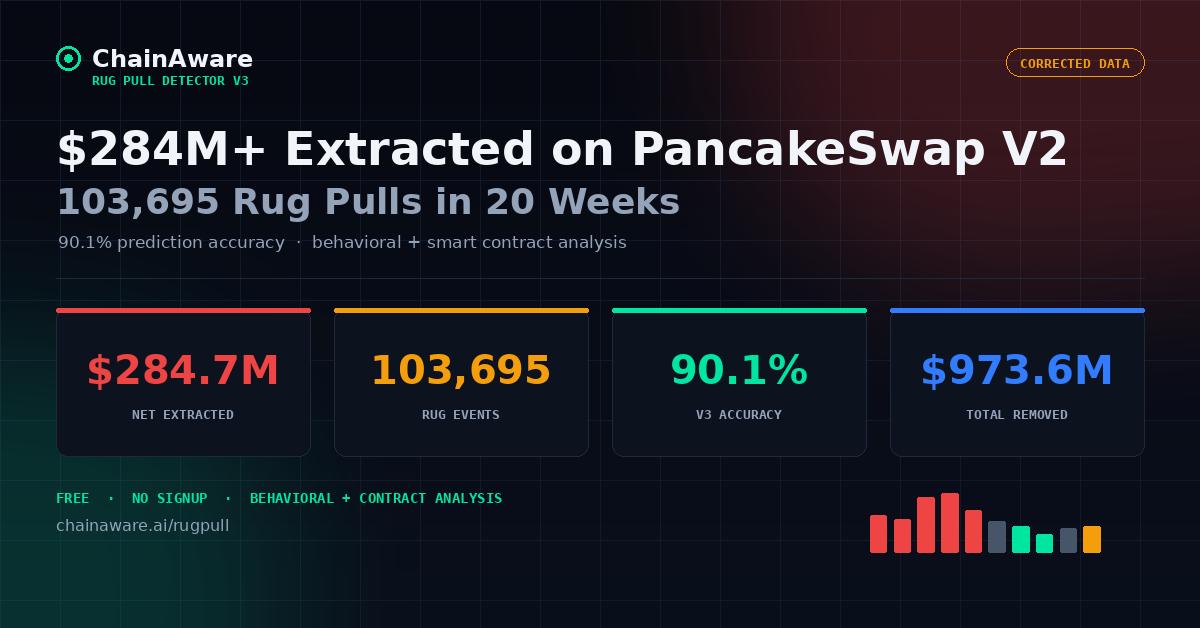
Rug Pulls Exposed: The Full Truth Behind $284M+ Lost on PancakeSwap V2

$284,694,192. That is not a headline from a dramatic DeFi hack. No Twitter threads trended. No security firms issued emergency advisories. No mainstream crypto media ran front-page coverage. That is the total value extracted from retail investors on PancakeSwap V2 alone – across just 20 weeks in 2026 – through a mechanism so normalized it barely registers as news: the rug pull. 103,695 separate rug pull events. $973,588,405 removed. $688,894,213 added before removal. ChainAware simultaneously launches Rug Pull Detector V3, combining behavioral analysis of contract creators with full smart contract inspection to reach 90.1% prediction accuracy, up from 68% in V2.

Wallet screening vs transaction simulation for DApp fraud detection in 2026, illustrated with blockchain security graphics —

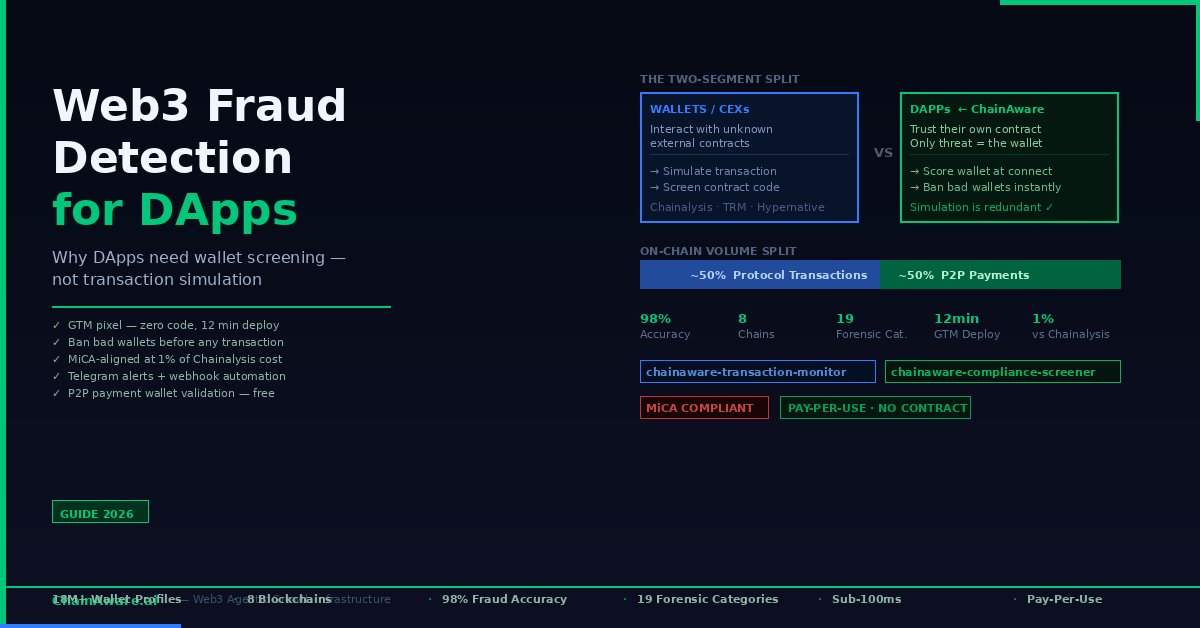
Web3 Fraud Detection Exposed: The Full Truth About Wallet Screening for DApps

Web3 lost $4 billion to fraud in 2025. Most fraud detection tools were built for wallet providers and CEXs – not DApps. ChainAware is the only platform purpose-built for DApps: behavioral wallet screening at connection, zero-code GTM deploy, 98% fraud accuracy, MiCA-aligned at 1% of Chainalysis cost.

Web3 wallet auditing dashboard turning raw blockchain data into wallet persona profiles — Web3 wallet auditing providers 2026

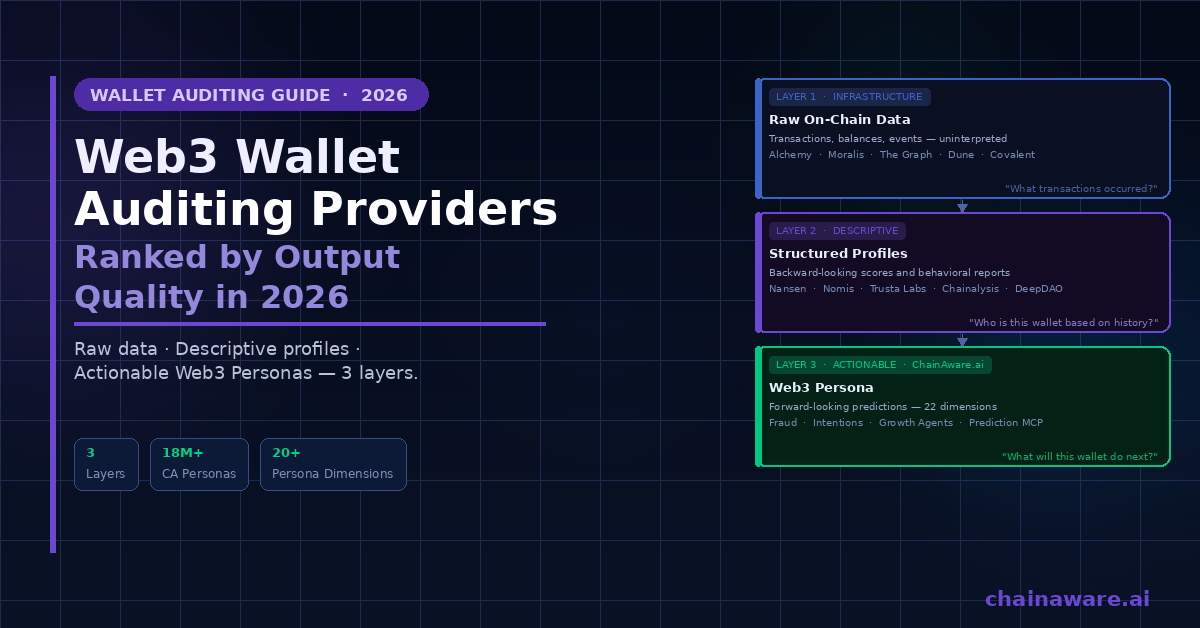
Web3 Wallet Auditing Exposed: The Full Truth About 2026 Providers

Every wallet address that connects to your DApp carries a complete behavioral history. In 2026, three distinct layers of wallet auditing infrastructure have emerged – raw data, descriptive profiles, and actionable predictions – and confusing them leads to selecting the wrong tools for the job.

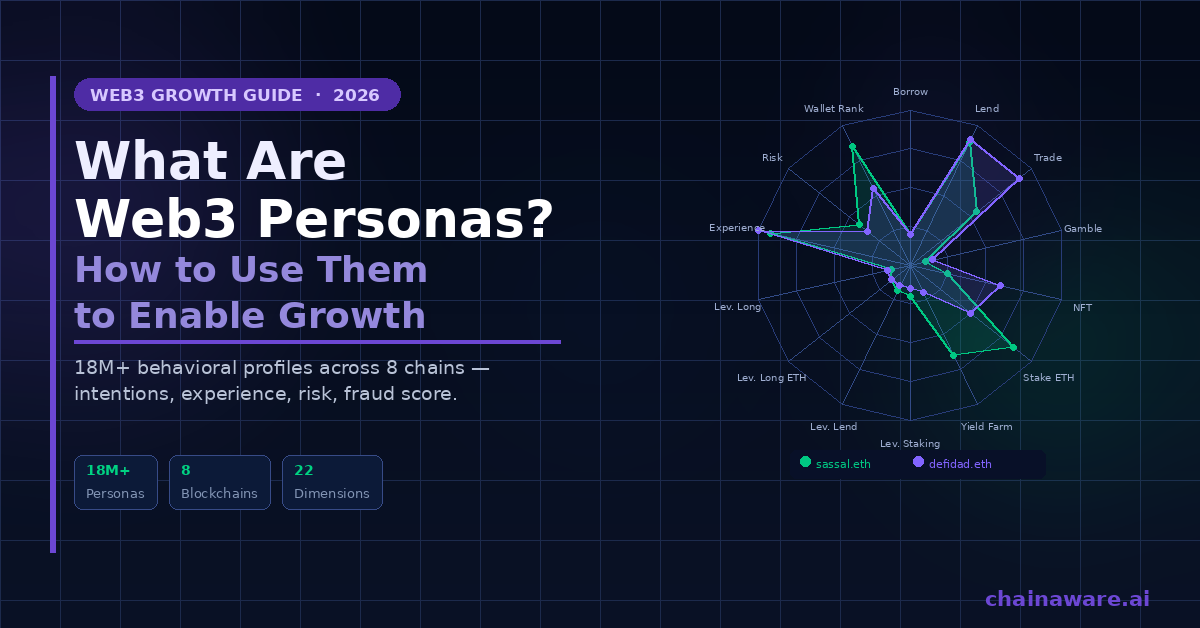
Abstract illustration of Web3 persona profiles linked to wallet nodes for growth — Web3 personas guide — ChainAware.ai

What Are Web3 Personas? How to Use Them to Enable Your Growth – Complete Guide 2026

A Web3 Persona is a calculated behavioral profile of who is behind any wallet address – their intentions, experience level, risk appetite, and predicted next actions. This guide explains what they are, how ChainAware builds 18M+ of them across 8 blockchains, and how DApps use them to enable real growth.

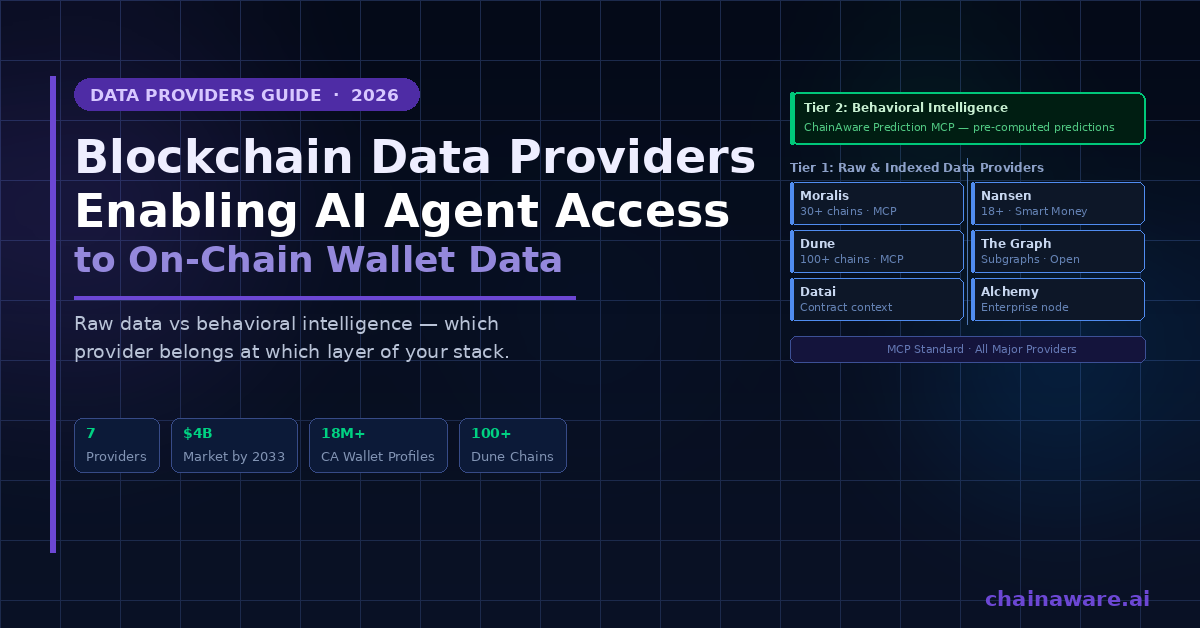
Diagram of AI agents querying on-chain wallet data via blockchain data providers — Complete Guide 2026 — ChainAware.ai

Blockchain Data Providers Fail AI Agents? The Complete Security Truth for 2026

AI agents need on-chain wallet data to make intelligent decisions – but most blockchain data providers were built for human analysts, not autonomous systems. This guide maps every major provider enabling AI agent access to wallet data in 2026, from raw indexers to pre-computed behavioral intelligence layers.