
Last Updated: 2026
Every Dapp team eventually asks the same question: who is actually using my platform?
They can see wallet connections in their dashboard. They can see transaction counts. But they cannot see the person behind the wallet — their experience level, their intentions, whether they are a genuine long-term user or a bot farming rewards, whether they are likely to transact or churn in 24 hours, whether they passed through sanctioned addresses six months ago.
In 2026, a cluster of platforms has emerged claiming to answer this question. They carry similar names: Web3 analytics, wallet intelligence, on-chain behavioral data. But they are not the same product. They address fundamentally different problems, operate at different points in the user lifecycle, and serve different teams with different needs.
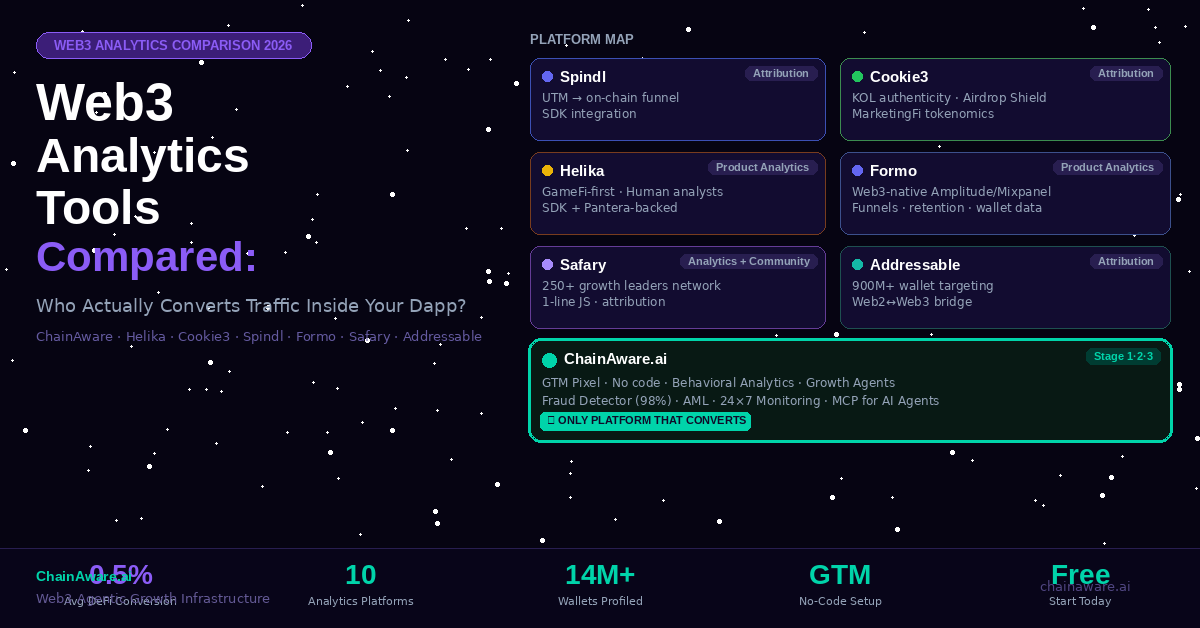
This article maps the 10 most-discussed Web3 analytics platforms for Dapp teams in 2026 — ChainAware, Helika, Cookie3, Spindl, Snickerdoodle, Myosin, Web3Sense, Formo, Safary, and Addressable — with an honest framework for which tool wins which job, and where ChainAware’s predictive intelligence stands apart from the rest.
In This Article
- The Four Jobs of Web3 Analytics
- 10 Platforms at a Glance
- Marketing Attribution: Spindl, Cookie3, Addressable
- Product Analytics: Helika, Formo, Safary, Web3Sense
- Privacy / User-Owned Data: Snickerdoodle, Myosin
- Predictive Intelligence: ChainAware
- Head-to-Head Comparison Table
- Which Platform Wins Each Use Case
- The Analytics Trap: Why Measuring Traffic Won’t Fix Your Conversion Problem
- Conclusion
- FAQ
The Four Jobs of Web3 Analytics
Before comparing platforms, you need a framework. Web3 analytics tools are not interchangeable — each category solves a different job. Choosing the wrong category means paying for answers to questions you never asked.
Job 1 — Where did my users come from? (Attribution)
This is the marketing measurement problem. You ran a KOL campaign, a Twitter ad, an airdrop, a quest. Which one drove which wallet connections? Which drove actual on-chain transactions? Attribution tools answer this question. They are built for growth marketers and performance teams. Spindl, Cookie3, and Addressable are attribution-first tools.
Job 2 — What are my users doing inside my Dapp? (Product Analytics)
This is the product intelligence problem. Once a user connects, how far do they get in the onboarding flow? Where do they drop off? Which features retain users and which lose them? Product analytics tools answer this question. They are built for product managers and growth engineers. Helika, Formo, Safary, and Web3Sense are product analytics tools.
Job 3 — How do I give users control over their own data? (Privacy Infrastructure)
This is the data ownership problem. Instead of a platform extracting data from users, these tools flip the model: users consent to share their own wallet data with projects, and potentially earn from it. Snickerdoodle and Myosin operate in this category. This is a fundamentally different product — less a Dapp analytics tool and more a data marketplace infrastructure.
Job 4 — Who is this wallet, and what will they do next? (Predictive Intelligence + Conversion)
This is the behavioral prediction and conversion problem — and it is categorically different from the first three. Rather than measuring what users did inside your Dapp, predictive intelligence tells you who a wallet is before they connect, scores their fraud risk, predicts their likely next on-chain action, and then acts on that intelligence to convert them. ChainAware is the only platform in this comparison that operates at this layer. The distinction is not subtle: Jobs 1–3 require a user to be in your Dapp before any intelligence is generated. Job 4 starts before the user arrives and keeps running after they leave.
10 Web3 Analytics Platforms at a Glance (2026)
| Platform | Category | Primary Job | Key Differentiator |
|---|---|---|---|
| Spindl | Marketing Attribution | Job 1 | Web3-native UTM → on-chain funnel tracking |
| Cookie3 | Marketing Attribution + KOL | Job 1 | KOL authenticity scoring, Airdrop Shield, MarketingFi tokenomics |
| Addressable | Marketing Intelligence | Job 1–2 | Web2↔Web3 attribution bridge, 900M+ wallet targeting |
| Helika | Product Analytics | Job 2 | GameFi-first, in-game + on-chain unified, human analyst layer |
| Formo | Product Analytics | Job 2 | Web3-native Amplitude/Mixpanel: funnels, retention, wallet intelligence |
| Safary | Analytics + Community | Job 2 | “Google Analytics for Web3” + elite 250+ operator network |
| Web3Sense | Analytics Intelligence | Job 2 | On-chain + social signals for GTM and growth strategy |
| Snickerdoodle | Privacy Infrastructure | Job 3 | User-consented wallet data sharing with projects |
| Myosin | Data Cooperative | Job 3 | Decentralized data co-op, users own and monetize behavioral data |
| ChainAware | Predictive Intelligence + Conversion | Job 4 | Pre-connection wallet profiling, Growth Agents that convert, fraud detection, 24×7 monitoring, MCP |
Marketing Attribution: Spindl, Cookie3, Addressable
Spindl
What it is: Spindl is the Web3 equivalent of what AppsFlyer and Adjust do for mobile — a measurement and attribution platform that answers: where did this on-chain conversion come from? Founded by Antonio García Martínez (ex-Facebook AdTech), Spindl tracks the full journey from Twitter post, Discord link, or ad click through to on-chain action — NFT purchase, token stake, protocol deposit.
How it works: Spindl uses fingerprinting, UTM-style tagging, and signed wallet messages to link off-chain marketing touchpoints to on-chain events. Their “Flywheel” protocol automates the attribution cycle, from identifying valuable on-chain events to rewarding contributors. Their ads now run natively in Base’s super app, enabling wallet-targeted campaigns with performance-based payment.
Limitations: Attribution-only — tells you where users came from, not who they are behaviorally or what they’ll do next. No fraud detection, no behavioral profiling, no in-Dapp personalization. Requires SDK/developer implementation.
Best for: Dapp teams running performance campaigns that need to close the attribution loop from ad spend to on-chain conversion. Strong fit for GameFi studios running hybrid mobile/on-chain products.
Cookie3
What it is: Cookie3 is a Web3 marketing analytics platform that adds two capabilities no other attribution tool offers: KOL authenticity scoring (separating real Web3 communities from bot-inflated followings) and Airdrop Shield (Sybil detection for airdrop campaigns). The $COOKIE token creates a MarketingFi incentive layer where data contributors are rewarded.
Strengths: KOL scoring is genuinely unique — identifying whether an influencer’s community actually holds tokens, engages on-chain, and has real DeFi history vs. inflated follower counts. Airdrop Shield is directly valuable for any protocol running incentive campaigns. According to Messari’s State of Web3 Marketing 2025, KOL campaigns represent 30–40% of Web3 acquisition budgets — Cookie3’s authenticity scoring directly addresses the ROI uncertainty in this channel.
Limitations: Like all attribution tools, tells you about acquisition quality — not conversion behavior inside the Dapp. No in-Dapp personalization, no continuous monitoring.
Best for: Projects that rely heavily on KOL and influencer campaigns and need to verify whether influencer audiences have genuine on-chain engagement. Also strong for airdrop-heavy protocols that need Sybil protection at campaign level.
Addressable
What it is: Addressable is a Web3 marketing intelligence platform that links on-chain wallet data with off-chain social and web behavior. The core capability is bridging the attribution gap between Web2 ad spend (X/Twitter, Reddit, display) and Web3 on-chain conversions — letting growth teams finally answer: which campaign drove which on-chain actions?
Strengths: 900M+ wallet profiles across 7 blockchains. Wallet-based retargeting on X, Reddit, and display networks. Their analysis of 245 campaigns found wallet owners are 7× more likely to transact than generic click traffic, and retargeting reduces cost-per-wallet by 40%. Clients include Coinbase, Polygon, eToro, Polkadot.
Limitations: Intelligence ends when the wallet connects to the Dapp. No in-Dapp capabilities, no fraud screening at the point of connection, no behavioral profiling of what users will do next. API-gated — requires sales demo to access.
Best for: Growth teams running paid campaigns across X/Twitter, Reddit, and display who need Web2-style attribution applied to Web3 conversions.
Product Analytics: Helika, Formo, Safary, Web3Sense
Helika
What it is: Helika is a Web3 product analytics platform built first for GameFi — unifying in-game event data, on-chain transaction data, and social signals into a single dashboard. Backed by Pantera Capital ($12.5M raised), it differentiates with a human analyst layer: weekly meetings with data analysts who interpret results and tell you what to do with them. Clients include Axie Infinity, Animoca Brands, and several top-10 GameFi protocols.
Strengths: The human analyst layer is genuinely differentiated — most analytics platforms give you data, Helika gives you interpretation. Strong for complex GameFi data environments where event schemas are custom and require expert setup. According to a16z’s State of Crypto 2025 report, GameFi protocols with professional analytics infrastructure show 3× better retention than those relying on basic on-chain tracking.
Limitations: Premium pricing and SDK integration requirement — not accessible for early-stage or non-GameFi teams. No fraud detection, no pre-connection intelligence, no compliance tooling.
Best for: Funded GameFi studios and complex DeFi protocols that need unified in-game + on-chain analytics with expert human interpretation.
Formo
What it is: Formo is Web3’s closest equivalent to Amplitude or Mixpanel — a privacy-first product analytics platform that replaces cookie-based tracking with wallet-native event tracking. Funnel analysis, cohort retention, A/B testing, feature adoption metrics — all rebuilt for pseudonymous Web3 users. Their privacy-first architecture means no PII is collected.
Strengths: The most complete Web3-native product analytics stack for non-GameFi teams. Works with any EVM chain. Strong cohort analysis and funnel visualization. Privacy architecture is a genuine enterprise differentiator. SDK integration enables deep event customization.
Limitations: Analytics and measurement only — intelligence is derived from what users do on your platform, not from who they are before they arrive. No fraud detection, no pre-connection behavioral profiling, no compliance tooling.
Best for: DeFi protocol teams and Dapp builders who need a modern product analytics stack without Web2’s invasive tracking infrastructure.
Safary
What it is: Safary occupies a unique dual position: simultaneously a marketing attribution platform (“Google Analytics for Web3”) and the leading community for crypto’s top growth operators. The Safary Club is an invitation-only network of 250+ growth leaders from Berachain, Magic Eden, Ledger, dYdX, and CoinMarketCap.
Strengths: The community is genuinely differentiated — no other platform offers access to what’s working across 250+ protocols. One-line JS setup is among the lowest-friction integrations in this comparison. X follower ↔ on-chain wallet sync enables unique cross-channel intelligence.
Limitations: Measurement and intelligence tool — does not personalize the in-Dapp experience, run ads, screen for fraud, or provide compliance tooling. Community access is invitation-only.
Best for: Growth teams who want to benchmark their approach against 250+ top Web3 protocols and access peer intelligence alongside tooling.
Web3Sense
What it is: Web3Sense delivers a combination of on-chain data and social media analytics for Web3 GTM and growth teams. The platform focuses on the intersection of on-chain behavioral data and social signal intelligence — tracking community sentiment, KOL activity, and protocol metrics together.
Best for: Growth and marketing teams at protocols that need competitive intelligence alongside their own analytics — particularly useful during token launches, ecosystem campaigns, or competitive positioning decisions.
Privacy / User-Owned Data: Snickerdoodle, Myosin
Snickerdoodle is a consent-based data platform — users build a data profile from their wallet history and choose which projects to share it with, typically in exchange for rewards. Myosin is a decentralized data cooperative where users collectively own and monetize behavioral data. Both represent a fundamentally different category: they are not tools for Dapp teams to understand their users — they are infrastructure for users to choose how they share data. Best for protocols building trust with privacy-conscious user bases around data sovereignty.
Predictive Intelligence: ChainAware
ChainAware’s USP: Every other platform in this comparison analyzes and describes. ChainAware converts.
The DeFi funnel reality, based on ChainAware’s first-party data across protocols: 200 visitors → 10 connect their wallet → 1 actually transacts. A 0.5% conversion rate. The other 9 connected wallets leave without doing anything.
Every analytics tool in this comparison — Helika, Formo, Safary, Spindl, Cookie3, Addressable — tells you where those 9 wallets dropped off. They measure the problem. They describe it. They attribute it to a channel. They show you a funnel chart with a red bar. None of them fix it.
ChainAware is the only platform in this comparison that operates at the moment of conversion — when a wallet connects — and actively changes what happens next.
The Data Layer
ChainAware maintains behavioral profiles on 14M+ wallets across 8 blockchains (ETH, BNB, BASE, POL, SOL, TON, TRX, HAQQ). These are not just transaction records — they are predictive profiles including: fraud probability (98% accuracy), experience level, risk willingness, predicted intentions (Prob_Trade, Prob_Stake, Prob_Bridge, Prob_Lend), AML/OFAC status, Wallet Rank, and protocol categories.
What ChainAware Does That Nobody Else Does
1. GTM Pixel integration — no engineering required. The ChainAware Pixel deploys via Google Tag Manager, the same container most Dapp teams already use for Google Analytics and other tracking. No SDK installation, no smart contract changes, no backend work, no engineering sprint. A marketer or product manager can go live in under 30 minutes — and immediately gain access to everything below. Compare this to Helika and Formo (SDK required), Spindl (developer implementation), and Addressable (API-gated behind a sales demo).
2. Behavioral Analytics dashboard — see who is actually using your Dapp. Once the pixel is live, the Behavioral Analytics dashboard aggregates the behavioral profiles of every connecting wallet into a real-time view of your entire user base: experience distribution, intentions, risk willingness, fraud probability distribution, and Wallet Rank quality. This is the onboarding intelligence layer that tells you not just how many users connected, but whether you’re attracting the right ones — and why they’re not converting.
3. Growth Agents — the only analytics tool that converts. This is the decisive differentiator. ChainAware’s Growth Agents calculate each wallet’s predicted behavior — what they are likely to do next, based on their full on-chain history — and generate personalized, resonating content and re-engagement messages for each one automatically. No manual segmentation. No mass blasts. Wallet-aware conversion nudges that actually convert.
The ready-made agents deploy from the open-source GitHub repository with no custom build required:
onboarding-router— Routes every connecting wallet into the right onboarding flow in under 100ms. DeFi veterans skip the tutorial and land on the pro interface. Newcomers get guided onboarding. High-risk wallets get additional verification. Onboarding completion improves from ~35% to 62–67%.wallet-marketer— For wallets that connected but didn’t convert, generates personalized re-engagement messages tailored to each wallet’s behavioral profile, experience level, risk tolerance, and predicted intentions. 10,000 personalized messages instead of one mass blast.whale-detector— Continuously monitors your connected wallet base for large holders and flags unusual movement patterns before they execute. Alerts fire before the liquidity event, not after.analyst— Synthesizes multiple ChainAware data points into narrative intelligence reports for product teams, compliance officers, and investment committees. The expert analyst that runs 24/7 without a salary.
Combined, these agents represent the answer to the question every Dapp team eventually asks: we have the data — what do we actually do with it? Every other analytics platform answers with a dashboard. ChainAware answers with agents that act.
4. Fraud detection at the point of connection. None of the other 9 platforms have any fraud detection capability. ChainAware’s Fraud Detector screens every connecting wallet with 98% accuracy. Sophisticated fraudsters use clean funds — they pass every AML check — but their behavioral patterns are identifiable through predictive AI. According to TRM Labs’ 2026 Crypto Crime Report, illicit crypto volume reached $158 billion in 2025 — fraud screening at the point of connection is no longer optional for serious protocols.
5. Continuous 24×7 transaction monitoring. Fraud risk is not static. ChainAware’s Transaction Monitoring Agent continuously re-screens every wallet in your connected user base, sending Telegram alerts when a Trust Score drops below threshold. No other tool in this comparison monitors your existing user base for risk changes after connection.
6. AML and compliance screening. ChainAware’s behavioral intelligence layer covers both AML and transaction monitoring under an increasing number of regulatory frameworks — see the complete KYT/AML guide for DeFi. None of the other 9 platforms address compliance at all.
7. MCP integration for AI agents. ChainAware is the only platform in this cluster with a published Model Context Protocol (MCP) server — meaning any AI agent (Claude, GPT, or custom LLM) can query fraud scores, behavioral profiles, AML status, and wallet intelligence in natural language, without custom API integration. 12 open-source agent definitions on GitHub. As detailed in The Web3 Agentic Economy, the protocols deploying agentic infrastructure now have structural advantages that compound over years.
8. Free tools with no account required. Wallet Auditor (full behavioral profile, free, no signup), Fraud Detector (98% accuracy, free), and Wallet Rank — all free. The Behavioral Analytics starter plan is free via Google Tag Manager. No other platform in this comparison offers comparable free access to this depth of wallet intelligence.
Head-to-Head Comparison Table: All 10 Platforms (2026)
| Capability | Spindl | Cookie3 | Addressable | Helika | Formo | Safary | Web3Sense | Snickerdoodle | Myosin | ChainAware |
|---|---|---|---|---|---|---|---|---|---|---|
| Integration method | SDK / code | Pixel + API | API + ad platforms | SDK + analyst setup | SDK / code | 1-line JS | API | User-side app | Cooperative | ✅ GTM Pixel — no code |
| Marketing attribution | ✅ Core | ✅ Strong | ✅ Best-in-class | ✅ Partial | ✅ Partial | ✅ Partial | ✅ Partial | ❌ | ❌ | ✅ Via pixel |
| KOL / influencer analytics | ❌ | ✅ Unique | ❌ | ❌ | ❌ | ❌ | ✅ Partial | ❌ | ❌ | ❌ |
| Airdrop / Sybil protection | ❌ | ✅ Airdrop Shield | ❌ | ❌ | ❌ | ❌ | ❌ | ❌ | ❌ | ✅ Via Trust Score |
| Aggregated user analytics dashboard | ❌ | ❌ | ❌ | ✅ GameFi | ✅ Behavioral | ✅ Basic | ✅ Partial | ❌ | ❌ | ✅ Experience, intentions, risk, fraud |
| Product funnels / session analytics | ✅ | ❌ | ❌ | ✅ GameFi | ✅ Best-in-class | ✅ | ✅ Partial | ❌ | ❌ | ❌ |
| Cohort & retention analysis | ✅ | ❌ | ❌ | ✅ | ✅ | ✅ | ✅ | ❌ | ❌ | ❌ |
| Social + on-chain intelligence | ❌ | ✅ | ✅ | ✅ | ❌ | ✅ | ✅ | ❌ | ❌ | ❌ |
| Pre-connection wallet profiling | ❌ | ❌ | ❌ | ❌ | ❌ | ❌ | ❌ | ❌ | ❌ | ✅ Only |
| Predictive behavioral AI | ❌ | ❌ | Historical only | ❌ | Historical only | Historical only | ❌ | ❌ | ❌ | ✅ Only |
| Growth Agents (wallet-personalized conversion) | ❌ | ❌ | ❌ | ❌ | ❌ | ❌ | ❌ | ❌ | ❌ | ✅ Only |
| Ready-made open-source agents | ❌ | ❌ | ❌ | ❌ | ❌ | ❌ | ❌ | ❌ | ❌ | ✅ Only (12 agents) |
| Fraud detection (98% accuracy) | ❌ | ❌ | ❌ | ❌ | ❌ | ❌ | ❌ | ❌ | ❌ | ✅ Only |
| AML / compliance screening | ❌ | ❌ | ❌ | ❌ | ❌ | ❌ | ❌ | ❌ | ❌ | ✅ Only |
| 24×7 continuous monitoring | ❌ | ❌ | ❌ | ❌ | ❌ | ❌ | ❌ | ❌ | ❌ | ✅ Only |
| AI agent / MCP integration | ❌ | ❌ | API only | ❌ | API only | API only | ❌ | ❌ | ❌ | ✅ Native MCP |
| Expert analyst service | ❌ | ❌ | ❌ | ✅ Human | ❌ | ❌ | ❌ | ❌ | ❌ | ✅ AI agents |
| Growth community / network | ❌ | ❌ | ❌ | ❌ | ❌ | ✅ 250+ leaders | ❌ | ❌ | ❌ | ❌ |
| Free tools | ❌ | Partial | ❌ | ❌ | ✅ Free tier | ✅ Basic free | ❌ | ❌ | ❌ | ✅ Full free tools |
Which Platform Wins Each Use Case
“I need to know which campaign drove which on-chain conversions”
→ Addressable for Web2 channel attribution (X, Reddit, display). Spindl for on-chain funnel attribution from Web3 channels. Cookie3 if you rely heavily on KOL campaigns and need to verify influencer audience quality.
“I need product funnel analytics and cohort retention”
→ Formo is the most complete Web3-native product analytics stack for DeFi protocols. Helika for GameFi. Safary if you want a community peer-network alongside tooling.
“I want to understand who is connecting to my Dapp — their experience, intentions, risk profile”
→ ChainAware Behavioral Analytics. Set up the GTM Pixel in 30 minutes, free. See the complete Behavioral Analytics guide for all 8 dashboard dimensions.
“I want to convert more of the wallets that connect but don’t transact”
→ ChainAware Growth Agents. The only platform operating at the conversion moment, inside the Dapp. The onboarding-router routes each wallet into the right experience. The wallet-marketer re-engages the 90% who connected but didn’t act. See the complete DeFi onboarding guide and the SmartCredit case study: 8× engagement, 2× conversions.
“I want to screen out airdrop farmers and Sybil wallets before they drain my incentive budget”
→ ChainAware Fraud Detector for in-Dapp fraud screening at connection time (98% accuracy). Cookie3 Airdrop Shield for campaign-level Sybil protection before users reach your Dapp.
“I need AML compliance and continuous transaction monitoring”
→ ChainAware. Exclusively. See the complete KYT/AML compliance guide and the Transaction Monitoring Agent guide. No other platform in this comparison offers compliance tooling.
“I want my AI agents to call blockchain intelligence in natural language”
→ ChainAware MCP. The only platform with a published MCP server. 12 open-source agent definitions. API key at chainaware.ai/mcp. See 12 blockchain capabilities any AI agent can use.
The Analytics Trap: Why Measuring Traffic Won’t Fix Your Conversion Problem
Here is the uncomfortable truth that sits underneath every conversation about Web3 analytics: most Dapp teams are measuring the wrong thing.
They track wallet connections. They optimize for traffic. They run campaigns to drive more visitors. And when growth stalls, they look for better analytics tools to measure the traffic they’re already failing to convert. The problem is not the measurement. The problem is that traffic was never the bottleneck.
Based on ChainAware’s analysis across DeFi protocols, the structural reality is this: for every 200 visitors who reach a protocol, around 10 will connect their wallet — and only 1 will actually transact. Teams are spending their entire acquisition budget and analytics attention on the top of a funnel that converts at 0.5%.
Better attribution (Spindl, Addressable) tells you which campaign drove those 10 wallet connections. Better product analytics (Formo, Helika) shows you where in the funnel the 9 non-transacting connections dropped off. Both are valuable. Neither fixes the underlying problem.
The underlying problem is what happens at the moment of connection — and every analytics platform in this comparison except ChainAware has left the building by then.
When a wallet connects to your Dapp, one of several things is usually true:
- They are a first-time DeFi user overwhelmed by your default interface — and they leave
- They are a reward hunter who will drain your incentive program and churn in 48 hours
- They are a sophisticated DeFi veteran who finds your onboarding condescending and disengages
- They are a whale who gets no special treatment and decides the platform isn’t worth their time
- They are a fraud operator with a 78% fraud probability score that your analytics platform will never surface
Your Formo funnel will show you where each of them dropped off. Your Spindl attribution will tell you which campaign brought them. Your Helika dashboard will show you their retention curve. None of them will tell you who they were — or let you do anything different for each of them at the moment that mattered.
The art in building a successful Dapp is not in bringing more visitors to the website. It is in converting the visitors you already have — and that requires knowing who each wallet is before the first interaction, not reporting on where they dropped off afterward.
According to McKinsey’s research on personalization ROI, companies that get personalization right at the individual level generate 40% more revenue than average players — and 5–8× better conversion rates than segment-level personalization. Web3 has been operating without personalization entirely. That is the opportunity ChainAware’s Growth Agents unlock. For the complete economic case for personalized onboarding, see Web3 Marketing Analytics: Measure ROI & Optimize Campaigns 2026.
Conclusion
Web3 analytics tools are not interchangeable. The right answer depends entirely on which problem you are trying to solve.
For marketing attribution — Spindl, Cookie3, or Addressable, depending on your primary channels. Spindl for on-chain funnel tracking, Cookie3 for KOL campaign ROI and airdrop integrity, Addressable for full Web2↔Web3 attribution across paid channels.
For product analytics — Formo is the most complete Web3-native product analytics stack for DeFi. Helika for GameFi with an expert analyst layer. Safary for growth community intelligence alongside attribution tooling.
For privacy-first data ownership — Snickerdoodle or Myosin, depending on whether you want a consent-based sharing model or a decentralized cooperative infrastructure.
For predictive behavioral intelligence and user conversion — ChainAware, exclusively. This is the only platform in the comparison that does not just describe what happened — it acts on it. Growth Agents calculate each wallet’s predicted behavior and generate personalized, resonating content and re-engagement messages for each one automatically. The ready-made agents (onboarding-router, wallet-marketer, whale-detector, analyst) deploy from the open-source GitHub repository with no custom build required — routing wallets into the right onboarding flow, sending wallet-aware conversion nudges to the 90% who connected but didn’t transact, flagging whale exit signals before they execute, and synthesizing behavioral data into actionable reports, all without a human analyst in the loop. Fraud detection (98% accuracy), 24×7 continuous transaction monitoring, AML compliance screening, and native MCP integration for AI agents complete the stack. Free tools — Wallet Auditor, Fraud Detector — require no account and deliver immediate value for any Dapp team.
The most effective growth stacks in 2026 combine both layers: attribution and product analytics to understand and measure — ChainAware to convert. The protocols that discover this combination early are the ones compounding growth while their competitors keep asking why wallets aren’t transacting.
The traffic was never the problem. It was never the solution either.
Frequently Asked Questions
What is the best Web3 analytics platform for Dapps in 2026?
There is no single best platform — the right answer depends on which problem you are solving. For marketing attribution, Spindl, Cookie3, or Addressable. For product analytics and funnels, Formo or Helika. For understanding who your users are and converting the ones who connect but don’t transact, ChainAware is the only platform that operates at the conversion moment with predictive behavioral intelligence and ready-made Growth Agents.
How is ChainAware different from Helika, Formo, and Safary?
Helika, Formo, and Safary are analytics platforms — they measure and describe what happened inside your Dapp. ChainAware is a conversion platform — it acts at the moment a wallet connects, using pre-computed behavioral profiles from 14M+ wallets, to route users into the right experience, re-engage those who didn’t convert, screen for fraud, and monitor continuously for risk. ChainAware also integrates in minutes via GTM with no code changes — the lowest-friction setup of any platform in this comparison.
What are ChainAware Growth Agents?
Growth Agents are ChainAware’s ready-made AI agents that calculate each connecting wallet’s predicted behavior and generate personalized conversion actions automatically. The onboarding-router classifies each wallet and routes them to the right onboarding flow in under 100ms. The wallet-marketer generates personalized re-engagement messages based on each wallet’s predicted intentions and experience. The whale-detector monitors for large holder exit signals. The analyst synthesizes behavioral intelligence into readable reports. All available from the open-source GitHub repository.
Does ChainAware require engineering resources to set up?
No. The ChainAware Pixel deploys via Google Tag Manager — the same container most Dapp teams already use. No SDK, no smart contract changes, no backend work. A marketer or product manager can go live in under 30 minutes. This makes it the only platform in this comparison that non-technical team members can deploy independently.
What is the typical DeFi conversion rate from visitor to transaction?
Based on ChainAware’s first-party analysis across DeFi protocols: for every 200 visitors, approximately 10 connect their wallet and only 1 actually transacts — a 0.5% visitor-to-transaction rate. CoinLaw’s 2025 Web3 Wallet Statistics confirm that only 5–10% of users become repeat Dapp users within 30 days. ChainAware’s Growth Agents are specifically designed to improve this conversion rate by personalizing the experience at the moment of wallet connection.
Which Web3 analytics platforms are free?
ChainAware offers the most comprehensive free tools in this comparison: Wallet Auditor (full behavioral profile, no signup), Fraud Detector (98% accuracy, no signup), and the Behavioral Analytics starter plan via GTM. Formo and Safary offer limited free tiers. Spindl, Helika, Addressable, and Myosin require paid plans or sales demos. Cookie3 has partial free features.
What is MCP and why does it matter for Web3 analytics?
Model Context Protocol (MCP) is the open standard introduced by Anthropic that allows AI agents to call external tools in natural language. ChainAware is the only Web3 analytics platform with a published MCP server — meaning any AI agent (Claude, GPT, or custom LLM) can query behavioral intelligence, fraud scores, AML screening, and wallet ranking without custom API code. As covered in The Web3 Agentic Economy, protocols deploying agentic infrastructure in 2026 have structural advantages that compound over years. According to a16z’s State of Crypto 2025, the infrastructure window for agentic protocols is open now.