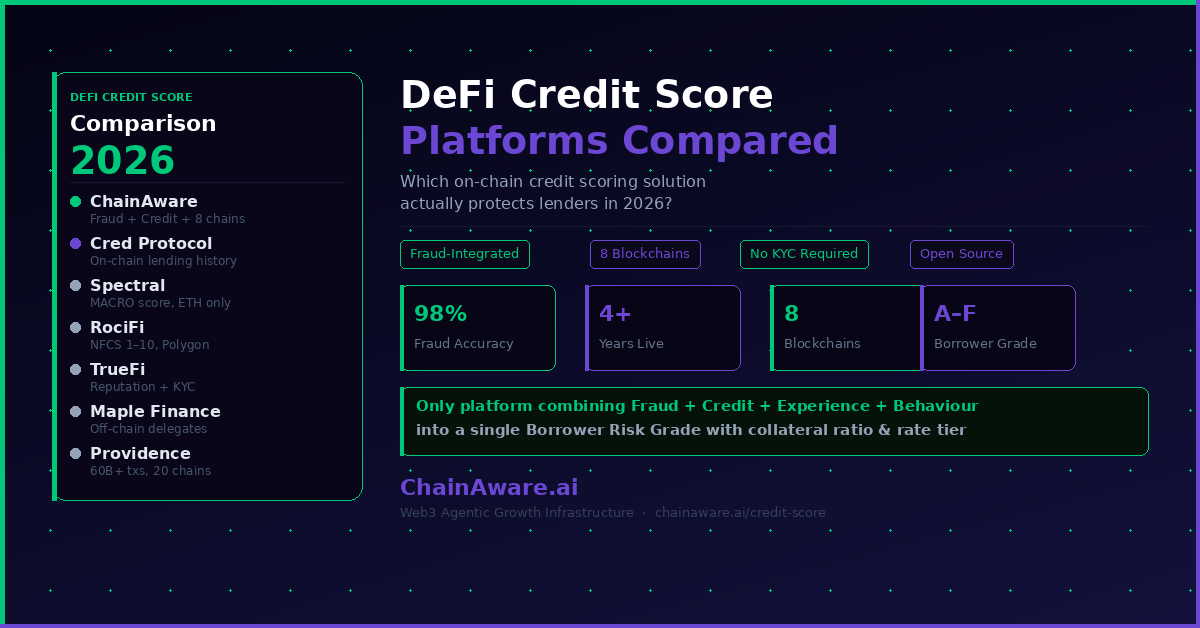
DeFi Credit Score Platforms Compared: ChainAware vs Cred Protocol vs Spectral vs RociFi vs TrueFi vs Maple vs Providence

90%+ of DeFi loans are still overcollateralized — locking trillions in capital that on-chain credit scoring could unlock. This guide compares every major DeFi credit score platform in 2026: ChainAware, Cred Protocol, Spectral Finance, RociFi, TrueFi, Maple Finance, and Providence — covering methodology, chain coverage, and where each fits in the lending stack.
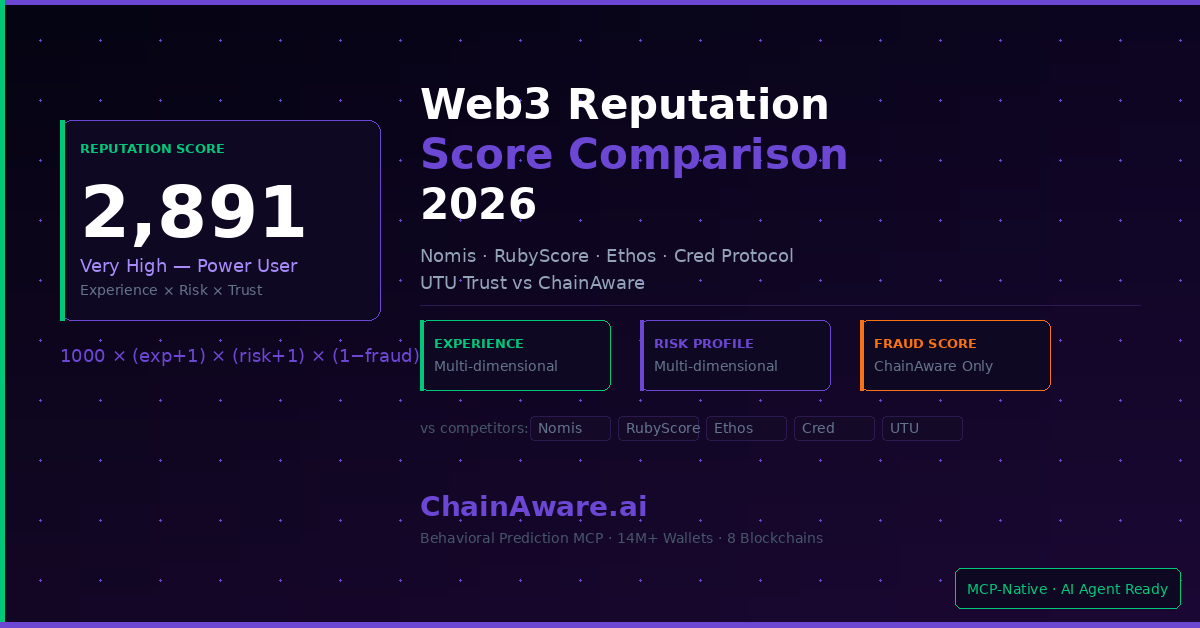
Web3 Reputation Score Comparison 2026: Nomis vs RubyScore vs Ethos vs Cred Protocol vs UTU vs ChainAware

Web3 reputation scoring in 2026 compared across 7 platforms: Nomis, RubyScore, Ethos Network, Cred Protocol, UTU Trust, Whitebridge, and ChainAware. Most platforms measure activity. ChainAware is the only one that incorporates predictive fraud probability into the formula — producing an actionable 0–4000 score requiring no user action and callable by any smart contract or AI agent.

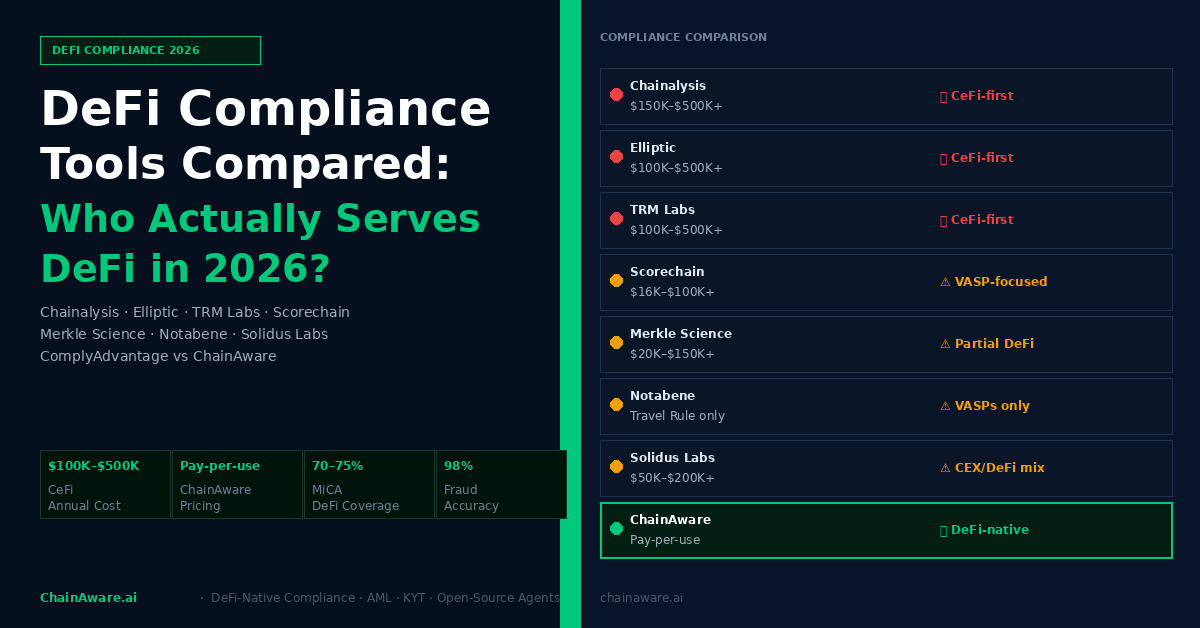
DeFi Compliance Tools for Protocols: The Complete Comparison 2026

DeFi protocols are being sold CeFi compliance stacks at $100K–$500K+/year — built for banks, not smart contracts. This 2026 comparison covers every major DeFi compliance tool — Chainalysis, Elliptic, TRM Labs, Scorechain, and ChainAware — and explains which obligations actually apply to DeFi protocols and which tools deliver real MiCA coverage at a fraction of the cost.

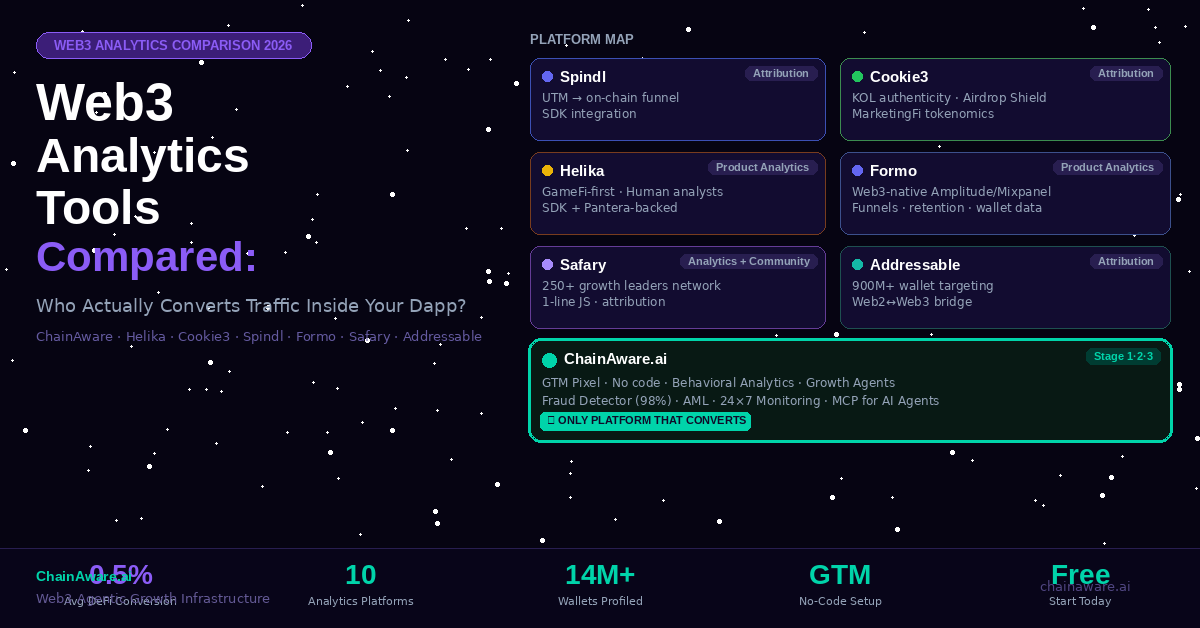
Web3 Analytics Tools for Dapps: The Complete Comparison 2026

A complete comparison of the 10 most-discussed Web3 analytics platforms for DApp teams in 2026 — ChainAware, Helika, Cookie3, Spindl, Formo, Safary, Addressable, Snickerdoodle, Myosin, and Web3Sense. Covers the Four Jobs framework, a 19-row head-to-head table, and why measuring traffic alone won’t fix a 0.5% conversion rate.

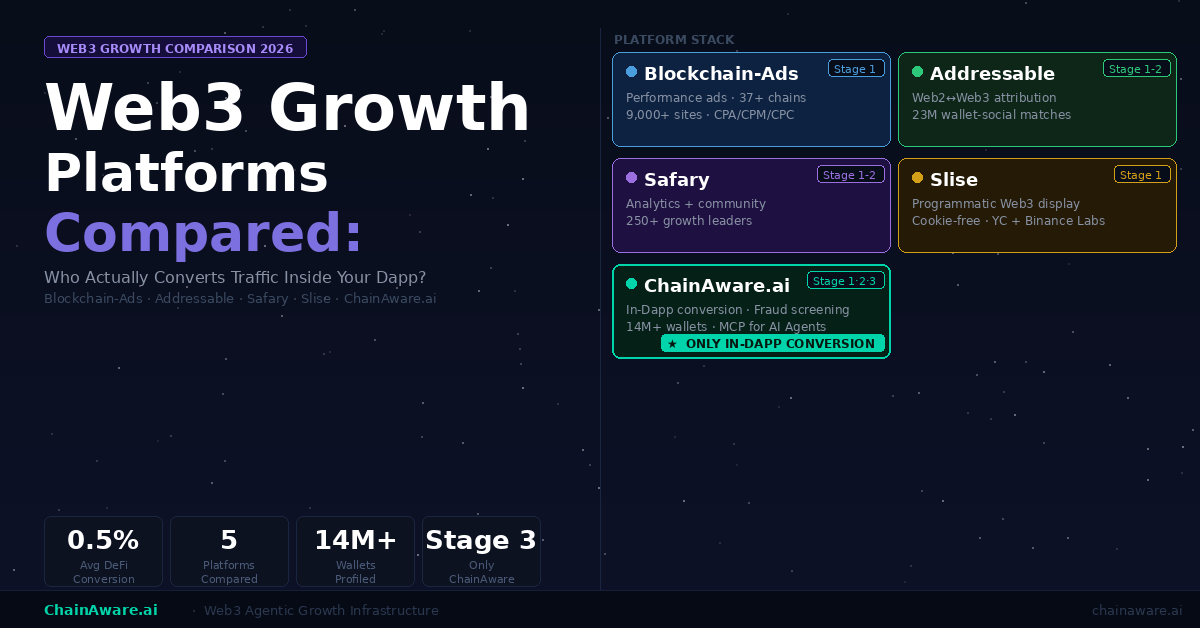
Web3 Growth Platforms Compared: Blockchain-Ads vs Addressable vs Safary vs Slise vs ChainAware.ai (2026)

Comparing the five leading Web3 growth platforms in 2026: Blockchain-Ads, Addressable, Safary, Slise, and ChainAware. Built around a three-stage funnel framework — Find, Understand, Convert — this guide maps each platform to the stages it actually covers and explains why most Web3 growth spending fails at Stage 3.

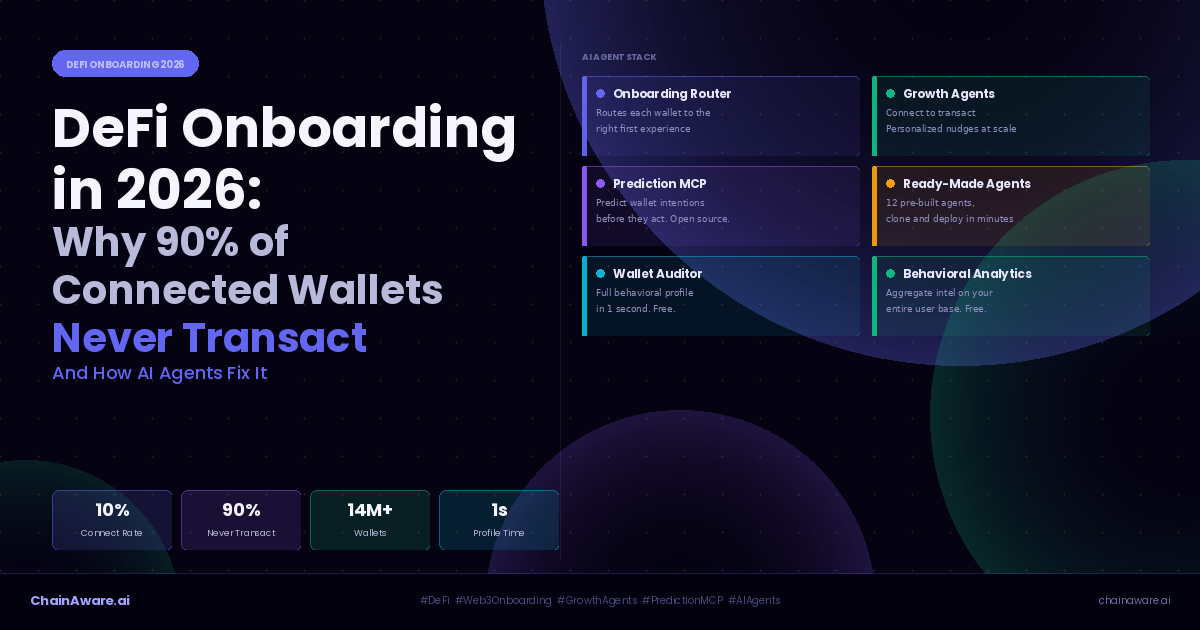
DeFi Onboarding in 2026: Why 90% of Connected Wallets Never Transact (And How AI Agents Fix It)

90% of wallets that connect to a DeFi protocol never transact. This guide explains why — and how AI agents fix it by reading each wallet’s behavioral history at connection and routing, nudging, and re-engaging users with full personalization. The end of generic onboarding flows that treat every wallet the same.

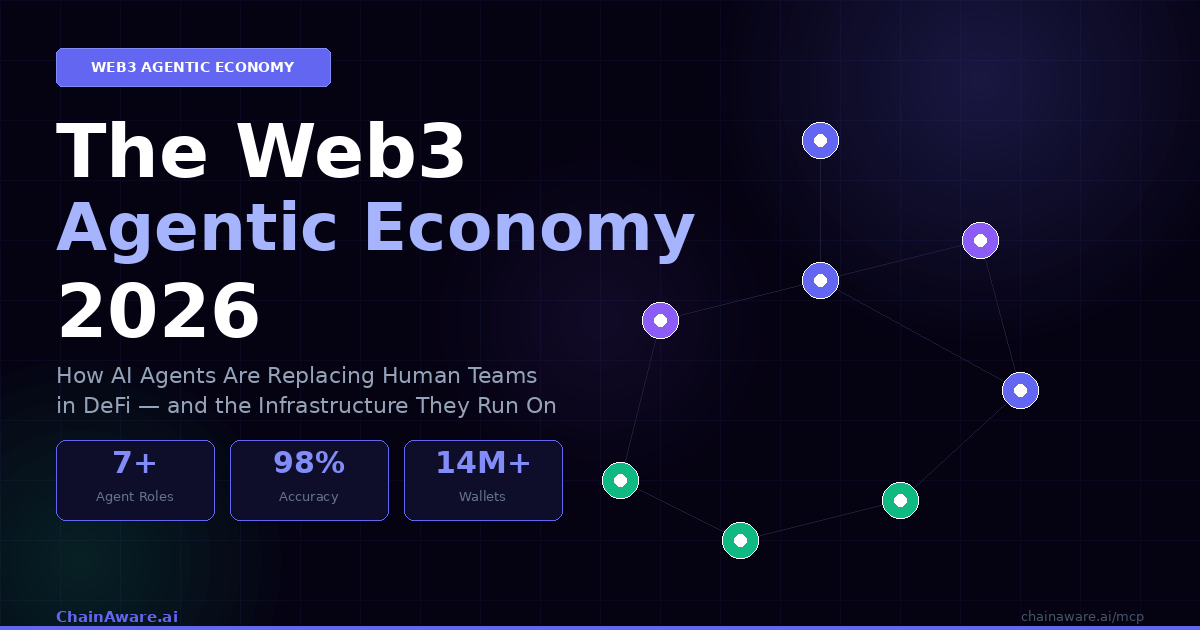
The Web3 Agentic Economy: How AI Agents Are Replacing Web3 Growth Teams

AI agents are replacing compliance officers, growth teams, and fraud analysts across Web3. This guide covers how the agentic economy works, which human functions are being automated first, and how ChainAware’s 32-agent infrastructure — fraud detection, AML scoring, rug pull detection, wallet ranking, growth targeting — powers the shift on 8 blockchains.

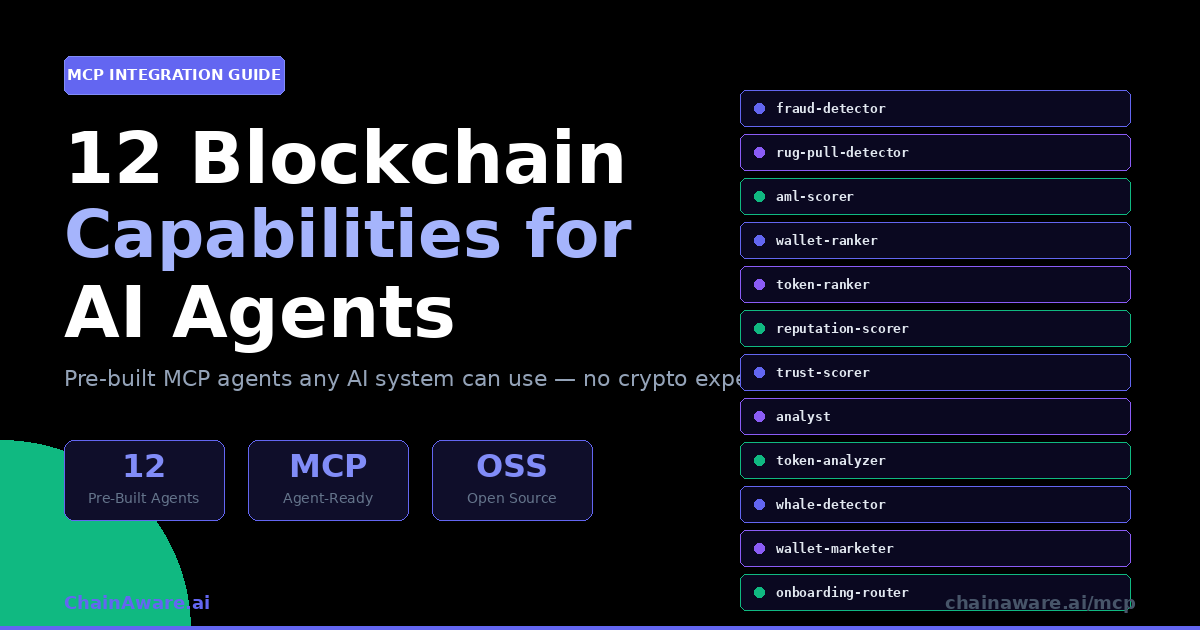
12 Blockchain Capabilities Any AI Agent Can Use (MCP Integration Guide)

Any AI agent — Claude, GPT, or custom LLM — can access 20M+ wallet behavioral profiles, 98% fraud prediction, real-time AML screening, and token holder analysis via ChainAware’s MCP integration. This guide covers all 12 blockchain capabilities, how to connect in minutes, and which agent definition to use for each use case.

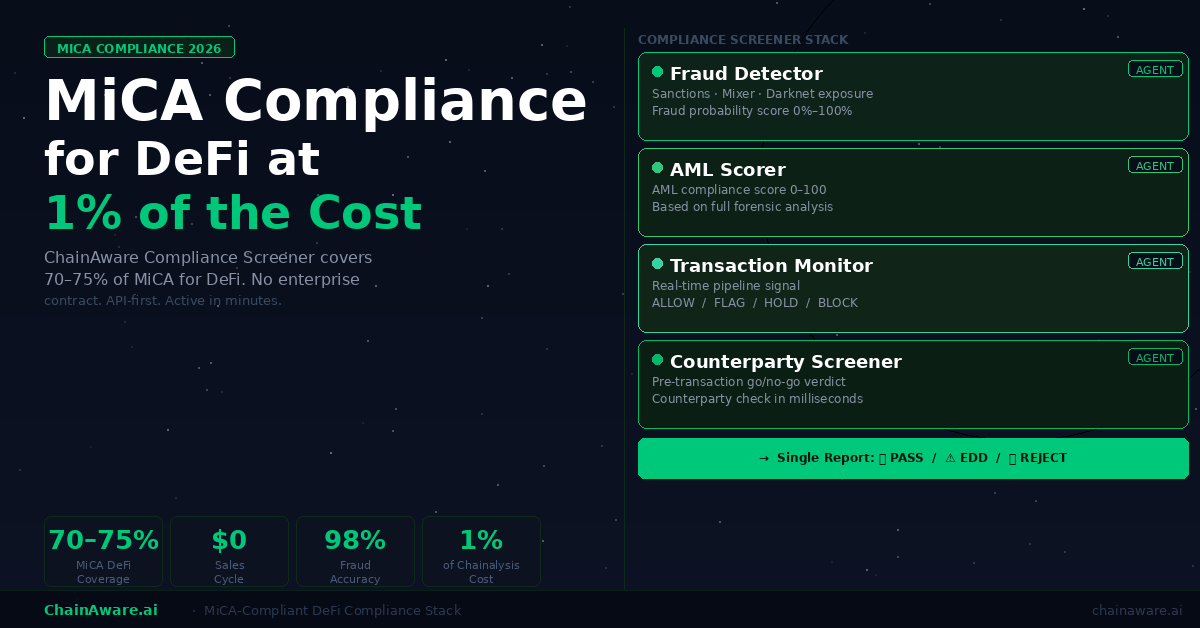
MiCA Compliance for DeFi at 1% of the Cost of Chainalysis

MiCA is live and most DeFi protocols are being quoted $100K–$500K+/year for compliance tools built for banks. This guide explains what MiCA actually requires from DeFi protocols, what it doesn’t, and how ChainAware delivers 70–75% MiCA coverage at 1% of the cost of Chainalysis — pay-per-use, no annual contract.

Real AI Use Cases for Web3: What to Integrate via API

Which AI can every DApp actually integrate via API continuously, with measurable accuracy? Based on X Space #32 with ChainAware co-founders Martin and Tarmo. The core framework: generative AI is a one-time tool used by humans; predictive AI runs continuously in the background — and it’s predictive AI that delivers real, measurable Web3 use cases.