
X Space #12 — High Conversion Without Paying KOLs: How Intention-Based Marketing Transforms Web3 Growth. Watch the full recording on YouTube ↗ · Listen on X ↗
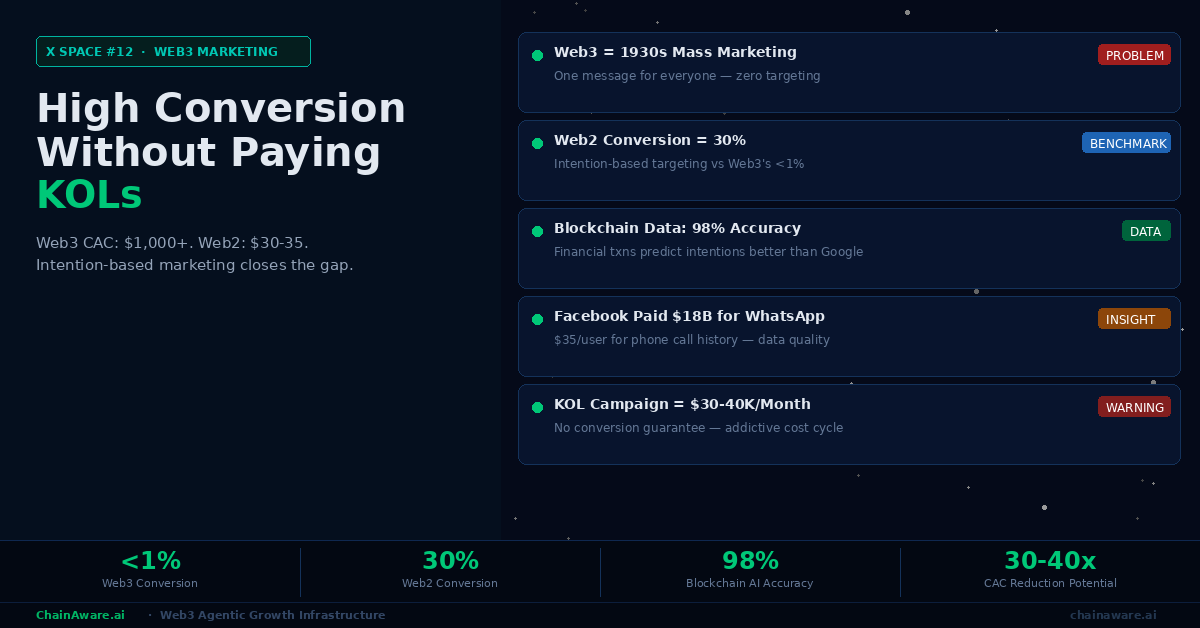
X Space #12 asks the question that most Web3 founders are afraid to ask out loud: is there a path to high user conversion that doesn’t require paying KOLs $30,000-$40,000 per month? Co-founders Martin and Tarmo answer with a framework they’ve been developing since Tarmo wrote his master thesis on one-to-one marketing in 1997 — before the Internet era. The session dismantles every major Web3 marketing channel as a variant of the same 1930s mass marketing model, explains why blockchain financial transaction data is actually superior to Google’s data for intention prediction, and describes precisely what the alternative looks like in practice. The conclusion is specific and actionable: the same mechanism that took Web2 from spray-and-pray advertising to 30% conversion rates is available in Web3 right now, built on free public blockchain data.
In This Article
- What KOL Marketing Actually Is — and What It Is Not
- Web3 Is Entirely Mass Marketing: KOLs, Banners, Media, Communities
- The Nightclub Analogy: Why One Message for Everyone Always Fails
- How Web2 Achieved 30% Conversion: Intention-Based Targeting
- The Three-Step Web3 Conversion Funnel — Where Mass Marketing Fails at Every Step
- The $1,000 vs $30 Gap: Why Web3 Cannot Survive Current Acquisition Costs
- Why Blockchain Data Is Superior to Google’s Data for Intention Prediction
- The Facebook $18B WhatsApp Lesson: Data Quality Determines Targeting Quality
- The KOL Addiction Cycle: Why Projects Cannot Stop Once They Start
- The VC-KOL Collusion System: Who Actually Benefits
- Shilling Projects vs Real Projects: Two Completely Different Goals
- The Intention-Based Solution: How ChainAware Calculates User Intentions
- Marketing Operationalised: The End of Mad Men, the Start of Data Science
- Speed of Diffusion: Why More Web3 AdTech Competition Is Good
- Comparison Tables
- FAQ
What KOL Marketing Actually Is — and What It Is Not
Tarmo opens the analysis with an observation about language: the word “influencer” developed negative connotations as its association with paid promotion became widely understood, so the industry rebranded the same category of person as a “KOL” (Key Opinion Leader). The rebrand changed nothing about the underlying mechanism. As Tarmo explains: “KOL is just a new abbreviation, not to use the word influencer. Influencers got bad taste. And now we speak about calls which have apparently good taste.”
KOL marketing works on a simple psychological mechanism: people in information-saturated environments delegate opinion formation to trusted sources rather than independently evaluating every claim. Because evaluating every new Web3 project independently would require enormous time and expertise, followers rely on KOLs to filter and interpret. The KOL posts promotional content about a project; followers perceive this as an endorsement from someone they trust; some percentage take action based on that perceived endorsement. The problem, as Tarmo notes, begins immediately with the trust question: “Which calls to trust? Trust a call who has 100,000 bots listening to him, or trust a call who has maybe 500 genuine followers?” Tools like AlphaScan, Twitter Score, and Tweet Scout exist specifically to evaluate KOL authenticity and effectiveness — a secondary industry that has emerged to help projects navigate the first industry’s opacity. For the broader analysis of KOL effectiveness, see our KOL vs AdTech comparison guide.
User Conversion vs Token Price: Two Different Goals
A critical distinction underlies the entire session: KOL marketing is primarily a token price tool, not a user conversion tool. When a KOL promotes a project, the immediate measurable effect — when positive — is a temporary increase in token purchase activity. Real founders who want users interacting with their DApp need something different: visitors who arrive, connect their wallets, and complete transactions. These two audiences have entirely different profiles and respond to entirely different incentives. As Martin notes: “There are always two parties — one is the token price that you are moving up with the calls. The other is: how do we convert the users? Calls can bring you, I don’t know, 100,000 bots to visit your website. But will you get the conversion? Will you get transacting users?”
Web3 Is Entirely Mass Marketing: KOLs, Banners, Media, Communities
Martin identifies the structural failure that defines all Web3 marketing — not just KOLs, but every major channel — as the same fundamental property: one-to-many communication with no receiver-specific personalisation. Understanding this as a single structural problem, rather than five separate channel-specific problems, clarifies why switching from one channel to another doesn’t solve the underlying issue.
KOLs post to all their followers with the same message regardless of each follower’s individual profile. Crypto media (CoinDesk, Cointelegraph, Bitcoin.com) publishes the same article to its entire readership regardless of reader interest relevance. Banner advertising on CoinGecko, Etherscan, or CoinMarketCap serves identical creatives to every page visitor regardless of their behavioral profile. Community management on Telegram and Discord broadcasts the same messages to all community members regardless of their intentions. All four channels share a single structural property: one sender, multiple receivers, zero receiver-specific personalisation.
The False Assumption Behind Mass Marketing
Mass marketing rests on a working assumption that Martin identifies and explicitly dismantles: “Everyone who receives this message processes it and will act based on this message.” This assumption was never accurate — it was simply the only option available before data-driven targeting became technically feasible. In Web3, this 1930s assumption remains the default because no targeting infrastructure exists. As Martin summarises: “Web3 marketing is mass marketing. Mass marketing meaning one sender and multiple receivers. And the messages are not receiver specific. They are not intention-receiver-intention specific.” For the full historical parallel with 1930s Madison Avenue advertising, see our crossing the chasm in Web3 guide.
Stop Broadcasting — Start Targeting
ChainAware Free Analytics — Know Your Users’ Intentions Before You Spend
Mass marketing means spending money without knowing who you’re reaching. ChainAware’s free analytics pixel reveals the intentions profile of every connecting wallet — borrowers, traders, gamers, NFT collectors, newcomers. Know your audience before you define a single message. 2-minute GTM setup. Free forever.
The Nightclub Analogy: Why One Message for Everyone Always Fails
Martin and Tarmo use an analogy that makes the conversion failure of mass marketing immediately intuitive: walking into a nightclub and delivering the same opening line to every person you approach. Run the experiment two consecutive evenings — one with the same message for everyone, one with messages tailored to observable signals about each specific person — and the difference in outcomes immediately demonstrates the principle. As Martin frames it: “Go to a club and talk to every girl with the same message. Make statistics. One Friday try the same message for every girl. The next Friday try a personalised message. Have a look what happens. And this is also in marketing — it’s the same.”
The analogy extends precisely to the Web3 marketing crisis: projects that see low conversion rates from mass marketing typically respond by increasing the volume of mass marketing rather than questioning the approach itself. As Martin observes: “They probably think they have to speak even to more girls in the same way. Instead of thinking maybe the message should be receiver specific.” The solution is not more mass marketing — it is personalised, intention-matched messaging that resonates with the specific recipient. Tarmo’s 1997 master thesis on one-to-one marketing articulated this principle before the Internet existed; Web2 proved it at scale; Web3 has not yet implemented it at all.
How Web2 Achieved 30% Conversion: Intention-Based Targeting
The benchmark that frames the entire session is Web2’s conversion rate: up to 30% of new visitors who arrive at a well-optimised Web2 platform via targeted advertising complete a transaction. This is not a theoretical maximum — it is the practical achievement of intention-based marketing systems that platforms like Google, Facebook, and Amazon run daily at massive scale. Contrasted with Web3’s below-1% conversion rate from mass marketing, 30% represents a 30x improvement from a single architectural change in how targeting works.
Web2 achieves this through a two-component system. First, it routes only relevant users to relevant platforms — users whose behavioral profiles match the platform’s value proposition. Second, once those users arrive, adaptive interfaces show them content matched to their specific intentions rather than generic content. As Tarmo explains: “In web two, mainstream of current times is one to one marketing. Intention based marketing, where we calculate intentions of a user. We know what users want, and we show a user a message which corresponds to the intentions of a user. And often intentions are subconscious — that people don’t know they have this intention. And if they see a message which corresponds to the subconscious intention, you get very, very high conversion ratio.”
Google’s Data Collection Mechanism
Tarmo explains specifically how Web2 platforms collect the behavioral data that powers intention calculation. Google uses search history and browsing history — the latter collected via reCAPTCHA. When a user completes a CAPTCHA verification, the terms and conditions include consent to transmit browsing history to Google. This mechanism means every CAPTCHA completion provides Google with a snapshot of the user’s recent web activity. Facebook collects social interactions, likes, shares, and content engagement time. Twitter collects similar engagement data. Based on all these inputs, each platform builds an intention profile for every user and uses it to match ads, content, and product recommendations to behavioral predictions. For the full explanation of how Web3 can replicate this with blockchain data, see our Web3 AdTech deep dive.
The Three-Step Web3 Conversion Funnel — Where Mass Marketing Fails at Every Step
Web3 user conversion requires completing three sequential steps: getting a visitor to the website, getting the visitor to connect their wallet, and getting the wallet-connected visitor to complete a transaction. Mass marketing fails at all three steps, and the failures compound — each step’s failure rate multiplies with the next.
Step one failure: non-resonating visitors who arrive from mass marketing campaigns don’t find content that matches their profile, leave within seconds, and generate a high bounce rate. Critically, this high bounce rate damages the platform’s SEO ranking, compounding the organic traffic problem. Step two failure: visitors who stay and encounter a non-personalised interface see the same messages as every other visitor regardless of whether those messages match their intentions. Lower relevance produces lower wallet connection rates. Step three failure: wallet-connected users who still receive generic messaging rather than intention-matched content have a much lower probability of completing a transaction — they don’t understand what this platform specifically offers to someone with their profile and needs.
The Compounding Funnel Mathematics
Martin makes the funnel arithmetic concrete. At $5 cost per click, getting 20 visitors to the website costs $100. Of those 20, perhaps 1 connects a wallet — a 5% wallet connection rate that is optimistic for non-targeted traffic. Of those wallet-connected visitors, approximately 10% complete a transaction — also optimistic for platforms without personalised messaging. The result: $100 per wallet connection × 10 wallet connections to get 1 transacting user = $1,000 per transacting user. And Martin notes that real-world results are often worse: “Probably it’s not one to twenty to connect wallet. It’s not one to ten to transact from connected wallets. The services are worse.” For the full CAC calculation and its implications for Web3 sustainability, see our user acquisition cost guide.
The $1,000 vs $30 Gap: Why Web3 Cannot Survive Current Acquisition Costs
The unit economics of Web3 user acquisition are structurally incompatible with sustainable business building. Martin states the comparison directly: “If you are in a web two business, speaking with VCs, and your unique cost to acquire a client is $2,000 — that is the moment probably when the zoom call is ending.” Web2 retail platforms achieve $30-35 per transacting user through intention-based targeting. Web3 platforms spend $1,000-$2,000 per transacting user through mass marketing. The gap is 30-65 times.
Tarmo connects this directly to the cash flow positive question that determines whether any business survives: “If you spend per one transacting user like in Web3 you spend around a thousand dollars, have fun to get your company cash flow positive. It’s impossible — you can’t do it.” Furthermore, this problem compounds over time: KOL campaigns are monthly expenses, the results are transient, and stopping the campaign means losing all its effects. As Tarmo notes, the target is $10-12 per transacting user with intention-based marketing — achieving the same improvement relative to Web3’s current baseline that Web2 achieved relative to its pre-AdTech baseline. For the broader economic analysis, see our unit costs Web3 guide.
Why Blockchain Data Is Superior to Google’s Data for Intention Prediction
One of the most important arguments in X Space #12 is that Web3 AdTech should actually outperform Web2 AdTech — not just match it — because blockchain financial transaction data has fundamentally higher predictive quality than the browsing and search data that Web2 uses. Understanding why this is true requires understanding what makes behavioral data valuable for prediction.
Google’s data is noisy. A user searching “DeFi lending rates” might be a researcher, a journalist, a curious student, or an active borrower looking for better rates. The search query provides a weak signal about intent because it costs nothing and carries no commitment. Browsing history is even noisier — it includes passive consumption, accidental clicks, and incidental exposure that says almost nothing about what a person will actively do next. As Tarmo explains: “Your browsing history is very easy influenceable. Your wife is calling you, telling you something. You will search something in the Internet. Already your browsing history is influenced.”
The Proof of Work Principle Applied to Data Quality
Blockchain financial transactions are deliberate decisions. Every on-chain action required conscious evaluation and real financial cost — gas fees that make accidental or careless transactions literally costly. This cost-of-action creates a data signal of fundamentally different quality. As Tarmo explains: “In the blockchain data, if you take Ethereum, we love Ethereum chain because you have proof of work. You have to pay for your transactions. And paying for your transactions means you will think what you are doing. And this will, on the end, tell much more about your personality than people are thinking.” ChainAware’s 98% fraud detection accuracy from blockchain behavioral data demonstrates this prediction quality directly — achieving a precision level that Google’s browsing and search data cannot approach for equivalent tasks. Furthermore, approximately 10 blockchain transactions from a wallet are sufficient to predict that user’s intentions with high confidence. For the full explanation, see our predictive AI for Web3 guide.
Replace KOL Spend with Intention-Based Conversion
ChainAware Marketing Agents — 1:1 Targeting from Blockchain Intentions
Ten blockchain transactions predict a wallet’s intentions better than months of Google browsing data. ChainAware calculates each connecting wallet’s behavioral profile — borrower, trader, gamer, NFT collector, leverage staker — and delivers matched messages that convert. Self-learning from day one. 4 lines of JavaScript. Enterprise subscription.
The Facebook $18B WhatsApp Lesson: Data Quality Determines Targeting Quality
Tarmo introduces a specific piece of corporate history that elegantly illustrates why data quality is the foundation of AdTech effectiveness: Facebook’s 2014 acquisition of WhatsApp for approximately $18 billion. At the time, the price — which worked out to roughly $35 per WhatsApp user — struck many observers as wildly extravagant for a messaging app with no advertising revenue model. Tarmo argues it was actually a calculated investment in data quality.
Facebook’s core business challenge in its competition with Google was data quality. Google’s AdTech used search and browsing history — high-intent signals derived from deliberate information-seeking behaviour. Facebook’s AdTech used social media interactions — weaker signals because social media behaviour is performative, easily faked, and only loosely correlated with purchase intent. Tarmo explains: “Facebook calculation mechanism did not have the power of Google calculation mechanism because the search and browsing history was superior compared to your social media. In the social media, you can pretend to be anything. I could pretend to be queen of England. I can create 50 profiles and manipulate a lot of data.”
Phone Call Data as the Bridge
WhatsApp’s value to Facebook was its phone call and message history — among the highest-quality behavioral data available because real phone calls reflect genuine relationships and genuine concerns, not performative social media presentations. As Tarmo concludes: “How did Zuckerberg solve the issue? He solved the issue by adding WhatsApp — real phone calls. To get on the same level with Google AdTech.” The $18 billion was not for messaging infrastructure — it was for data quality improvement. The blockchain data quality advantage follows the same logic: financial transactions with gas costs are even more deliberate and commitment-filtered than phone calls, making them a superior input for behavioral intention prediction. For how ChainAware applies this principle, see our behavioral user analytics guide.
The KOL Addiction Cycle: Why Projects Cannot Stop Once They Start
Beyond the ineffectiveness of KOL campaigns for user conversion, Martin and Tarmo identify a structural trap that makes KOL marketing particularly damaging for projects that enter it: the addiction dynamic that makes stopping worse than continuing.
A typical KOL campaign structure involves paying 10-15 influencers for packages of 3-5 posts each, spread across a week or month to create the appearance of sustained momentum. This costs $30,000-$40,000 per month. The KOLs who receive payment tweet and post about the project during the campaign period. When the payment stops, so does all mention of the project — the KOLs move immediately to whichever project pays them next. As Martin explains: “The calls whom you paid in January, they ain’t read about you in February, they ain’t written about you in March. They will do it if you pay them. So it’s like addiction if you’re going on this route. If you start to do it, you have to continue to do it.”
The Hope-and-Pray Dynamic
Projects locked into the KOL cycle continue paying not because they see clear conversion results but because the fear of stopping is greater than the discomfort of continuing. The hope is that eventually the right editorial KOL — one who promotes for reasons other than payment — will pick up the project and drive organic attention. This is the “editorial call” that every project seeks but almost none achieves. Meanwhile, each month of KOL spending is $30,000-$40,000 that doesn’t bring down the $1,000+ acquisition cost. As Martin summarises: “It’s like addiction if you’re cooling on this route. And if you start to do it, you have to continue to do it. And you’re doing it, doing it, doing it in the hope that you’re getting this so-called editorial correct call for not charging the money.” For the full KOL effectiveness analysis with AlphaScan data, see our KOL marketing analysis.
The VC-KOL Collusion System: Who Actually Benefits
Martin identifies a three-party system — founders, KOLs, and VCs — in which the incentives of each party reinforce KOL marketing as the dominant approach despite its failure to produce user conversion. Understanding this system explains why the market doesn’t self-correct even when individual founders recognise the poor conversion results.
VCs evaluate investment prospects partly by examining their KOL relationships — specifically, how many KOLs follow the project on Twitter (measurable via the Twitter Score tool). The reasoning is circular: if KOLs follow a project, it suggests the project has or will pay them, which means the project has marketing budget, which means it’s likely to generate the promotional activity that drives token price appreciation. As Martin explains: “VCs are then looking — there are some projects, they have a lot of calls lined up. Oh yeah, this must be a good project. Why? It’s a good project because if a lot of calls are lined up means they’re following the project. This means these calls will probably tweet for the project because the calls don’t tweet if they are not paid.” The result is that projects feel compelled to maintain KOL relationships not just for their marketing effect but to remain fundable.
The Pump-and-Dump Economics
VCs who invest in projects they know will struggle to achieve sustainable user conversion at current CAC levels are not making a mistake — they are executing a rational strategy: invest before the KOL-driven token price spike, exit during the spike, and move to the next opportunity. As Martin states directly: “VCs know the probabilities for Web3 companies to become cash flow positive are pretty low. VCs invest just to make a profit. That’s all the motivation.” The system benefits KOLs (monthly fees regardless of performance), VCs (token price appreciation to exit), and marketing agencies (management fees for coordination). Founders and actual users bear the costs. For how this connects to the broader Web3 ecosystem sustainability problem, see our crossing the chasm analysis.
Shilling Projects vs Real Projects: Two Completely Different Goals
Martin introduces a distinction that rarely gets stated plainly in Web3 discourse but that clarifies the entire marketing landscape: the difference between “shilling projects” and projects with genuine user conversion as a goal. These two categories use the same marketing channels but for fundamentally different purposes.
A shilling project — Martin’s term for a project that announces a product it knows it will never deliver — uses KOLs because token price appreciation is the business model. User conversion is irrelevant because there will never be a product for users to convert to. For these projects, mass marketing to token buyers is exactly the right approach. As Martin states: “Shilling projects, okay, please go and use the calls. These projects are not interested to get users into app. They will not have an app. Their business model is not to get the users to the app.” Real projects — those building actual DApps that require transacting users to generate revenue — need something completely different. For them, KOL marketing creates token buyer activity that has zero relationship to the user conversion they actually need. Understanding which category a project falls into makes the marketing approach choice obvious. For how real projects should think about user acquisition, see our Web3 AI agents guide.
The Intention-Based Solution: How ChainAware Calculates User Intentions
Having spent the first half of the session building the case for why mass marketing fails, Martin and Tarmo spend the second half describing the specific alternative. The solution has two operational components that mirror Web2’s two-step AdTech mechanism: calculating user intentions, and matching messages to those intentions.
When a user connects their wallet to a platform running ChainAware’s targeting system, the system immediately processes that wallet’s complete blockchain transaction history to generate an intention profile. This profile categorises the user across multiple behavioral dimensions: borrower likelihood (high/medium/low), NFT collector likelihood, leverage staker likelihood, gamer likelihood, and others. The categorisation happens in real time, using the same AI prediction models that power ChainAware’s 98% fraud detection accuracy. As Martin explains: “For any connecting wallet, you get automatically the intentions of the wallet. What the user is probably doing as next. Is he a borrower? Is he a lender? He’s a high/medium/low probability borrower. He’s a high/medium/low NFT collector. He’s a high/medium/low leverage staker.”
Turning Intentions into Resonating Messages
The second component is connecting calculated intentions to a message matrix that the platform operator defines. For each identified intention type, the platform defines specific messages, visuals, and offers. An NFT collector arriving at a DeFi lending platform sees messaging about NFT collateral opportunities and borrowing against digital assets. A leverage staker sees advanced looping strategies and margin tools. A newcomer sees safety information and guided onboarding. Each user receives content that matches their demonstrated behavioral profile rather than the generic content every other visitor sees. Martin frames the practical scope: “You can define ten messages, you can define a hundred messages, you can define a thousand messages. It’s just how much your marketing people want to do it, how creative they want to grow.” For the implementation guide and live examples, see our behavioral analytics guide and our personalisation guide.
Marketing Operationalised: The End of Mad Men, the Start of Data Science
One of X Space #12’s most pointed observations is the transformation that intention-based marketing represents for the marketing function itself. Marketing has historically been defined by creativity — the copywriter who finds the phrase that moves millions, the art director who creates the image that resonates universally. This creative mythology, epitomised by the “Mad Men” television series about Madison Avenue in its heyday, frames mass marketing as an art form. Intention-based marketing replaces this with a different kind of work.
When intentions are known, the creative problem is not “what message works for everyone?” — it is “what message works for this specific intention profile?” The answer becomes increasingly deterministic: if someone has a high probability of wanting to buy more NFTs and a current shortage of liquidity, the message that resonates with them is specific and predictable. The marketing function shifts from mass creativity to intention-matched content definition. As Martin describes: “Marketing job is transforming to defining messages to your targeted users where you know the customers’ intentions. And you send some messages which resonate with their intentions. Marketing job is becoming like — not automated marketing — but it’s becoming very serialised, very deterministic.”
Accountability Replaces Guesswork
Tarmo quotes a famous marketing industry aphorism from 25 years ago: “50% of your marketing budget is thrown out of the window. You just don’t know which part.” This was the accepted condition of marketing before intention-based targeting — half the spend was wasted, but there was no way to know which half or how to fix it. Intention-based marketing changes this fundamentally. When each message is tied to a specific intention profile and each outcome is measured against that profile, conversion rates become visible for every intention-message pair. As Martin frames the management implications: “If you’re a founder, you’re asking your marketing guys — show me to which intentions you are showing which messages. Show me the list and show me conversion ratios where your intention-message pairs work and where they don’t work. It becomes analytics. You do it scientifically.” For the complete transformation from mass to intention-based marketing, see our AI marketing transformation guide.
Speed of Diffusion: Why More Web3 AdTech Competition Is Good
The session closes with a perspective that distinguishes ChainAware’s approach from what might be expected of a company with a competitive technology: rather than advocating for their own exclusivity, Martin and Tarmo explicitly encourage competition in Web3 AdTech.
The argument is grounded in the network effect logic of technology adoption. What determines whether Web3 reaches mainstream adoption is not whether any single company wins the Web3 AdTech market — it is whether the concept of intention-based marketing diffuses throughout the Web3 ecosystem fast enough to create the user acquisition improvements that make Web3 economically sustainable. As Martin explains: “If anyone wants to copy us — please copy us. You will need tons of time and tons of money to do it, but please do it. Because we are thinking this way: it’s a speed of diffusion. The faster this message is getting to the industry, the better. The more competition there is, the better.”
The Crossing the Chasm Imperative
Tarmo connects the diffusion argument to the crossing-the-chasm framing that structures the entire analysis: Web3 will reach mainstream adoption when user acquisition costs fall to the level where projects can build sustainable businesses, which requires intention-based targeting, which requires broad adoption of Web3 AdTech across the ecosystem. Every additional project that adopts intention-based marketing improves the overall health of the ecosystem by demonstrating that sustainable business building is possible, attracting users who have positive experiences (because content resonates with them), and generating the data that improves intention models further. As Tarmo summarises: “Future is bright, and we have technology which will bring Web3 mainstream, which will help Web3 to grow the cause. The key issue in crypto is acquisition cost. And you get acquisition cost down through resonating messages, resonating customers. Both sides are happy. And then we see crypto flourishing.” For the complete crossing-the-chasm framework, see our Web3 crossing the chasm guide.
Comparison Tables
Web3 Mass Marketing Channels vs Intention-Based AdTech
| Property | KOL Marketing | Banners / Crypto Media | ChainAware Intention-Based |
|---|---|---|---|
| Message type | One to many — same for all followers | One to many — same for all viewers | One to one — unique per wallet profile |
| Receiver personalisation | None | None | Full — matched to behavioral intentions |
| Primary effect | Token price (temporary) | Brand awareness (temporary) | User conversion (lasting) |
| Monthly cost | $30,000-$40,000 | $8 CPM — high volume required | Enterprise subscription |
| Conversion rate | Below 1% | Below 1% | Target 10-30% (Web2 benchmark) |
| Effect when payment stops | Zero — immediately disappears | Zero — immediately stops | Continues — database grows over time |
| Loyalty generated | None — audiences move to next narrative | None | High — resonating experience builds retention |
| Suitable for shilling projects? | Yes — token price tool | Partial | No — requires real product |
| Data source | Follower counts (often fake) | Raw impressions | On-chain behavioral transactions (high quality) |
Web2 Data Sources vs Blockchain Data for Intention Prediction
| Property | Google Search + Browse | Facebook Social Data | Blockchain Transactions (ChainAware) |
|---|---|---|---|
| Data creation cost to user | Zero — free to search | Zero — free to post | Gas fees — real financial commitment |
| Fake signal risk | Medium — casual searches inflate noise | High — fake profiles, performative posts | Low — gas cost filters accidental actions |
| Deliberateness | Low — incidental browsing common | Low — social performance common | High — every transaction is conscious choice |
| Whatsapp connection | Not applicable | Facebook paid $18B to upgrade quality | Already high quality by design |
| Data availability | Private — Google owns it | Private — Meta owns it | Public — free for anyone to analyse |
| Transactions needed for prediction | Thousands of events for reliability | Thousands of interactions | ~10 transactions sufficient |
| ChainAware accuracy (fraud detection) | N/A | N/A | 98% backtested accuracy |
| Achievable conversion rate | Up to 30% (Web2 maximum) | Up to 30% (Web2 maximum) | Target 30%+ (potentially higher quality) |
Frequently Asked Questions
Why don’t KOL campaigns convert users in Web3?
KOL campaigns are a mass marketing tool — one sender, many receivers, same message for everyone. Their primary effect is token price activity, not user conversion. Followers who see a KOL promotion may find it entertaining (and get a dopamine response from learning something new), but entertainment and dopamine do not translate into visiting a DApp, connecting a wallet, and completing a transaction. Additionally, most of the audience a KOL reaches has no behavioral profile that matches the promoted platform — an NFT collector receiving a lending platform promotion has zero interest in borrowing. Without receiver-specific messaging matched to individual intentions, conversion remains below 1% regardless of campaign budget. For the detailed analysis, see our KOL vs AdTech comparison.
Why is blockchain data better than Google data for predicting user intentions?
Blockchain financial transactions require deliberate decisions and real financial commitment (gas fees). Users cannot accidentally transact on a blockchain the way they accidentally click an ad or passively browse a website. This deliberateness means every transaction reveals genuine behavioral intentions — what the user actually wants to do with their money — rather than incidental digital activity. Google’s search and browse data is noisy because it costs nothing and therefore includes casual curiosity, accidental clicks, and behaviour unrelated to actual intentions. Facebook’s social data is even noisier because social media behaviour is performative. ChainAware can predict user intentions from approximately 10 blockchain transactions with high confidence — the same accuracy level that produces 98% fraud detection performance.
Why did Facebook pay $18 billion for WhatsApp?
Facebook paid approximately $18 billion for WhatsApp in 2014 — roughly $35 per user — primarily to upgrade the quality of its behavioral data for ad targeting. Facebook’s social media data was inferior to Google’s search and browse data because social media behaviour is easily faked and performative. Phone call and messaging history is more difficult to fake and reflects genuine relationships and genuine concerns, providing stronger signals for intention prediction. The acquisition was a data quality investment to compete more effectively with Google AdTech. The same logic applies to blockchain data: financial transaction history is higher-quality behavioral signal than phone call history, because gas fees make casual or fake activity costly.
What does the three-step Web3 conversion funnel look like with intention-based marketing?
With intention-based targeting: step one (website visit) brings only users whose behavioral profile matches the platform’s value proposition, dramatically reducing bounce rate and improving SEO. Step two (wallet connect) shows each arriving user content personalised to their specific intentions rather than generic messaging, significantly increasing the probability of connection. Step three (transaction) serves each wallet-connected user messages matched to their predicted next action — borrower-profile users see lending terms, NFT-collector profiles see collateral opportunities — maximising transaction probability. The compounding effect of improvement at all three steps is a conversion rate approaching Web2’s 30% benchmark rather than the current below-1% from mass marketing.
What is the difference between a shilling project and a real project in terms of marketing needs?
A shilling project — one that announces a product it never intends to build — uses KOLs correctly for its actual goal: token price appreciation. Token buyers are the target audience, and mass promotion to a broad audience makes sense for this goal. A real project — one building a functional DApp that generates revenue from transacting users — needs user conversion, not token buyer acquisition. For real projects, KOL marketing is the wrong tool entirely: it attracts token buyers and speculators rather than users with the behavioral profile that matches the platform’s value proposition. Real projects need intention-based targeting that routes users with matching profiles to the platform and converts them with resonating messages.
The Web3 AdTech That Replaces KOL Spend
ChainAware Prediction MCP — Intentions, Fraud, Credit. One API.
Intention calculation + 1:1 targeting + fraud detection + credit scoring. Free public blockchain data. 98% accuracy. 10 transactions → full behavioral profile. Stop paying for token buyers you don’t need. Start converting the platform users you do. 14M+ wallets. 8 blockchains.
This article is based on X Space #12 hosted by ChainAware.ai co-founders Martin and Tarmo. Watch the full recording on YouTube ↗ · Listen on X ↗. For questions or integration support, visit chainaware.ai.