
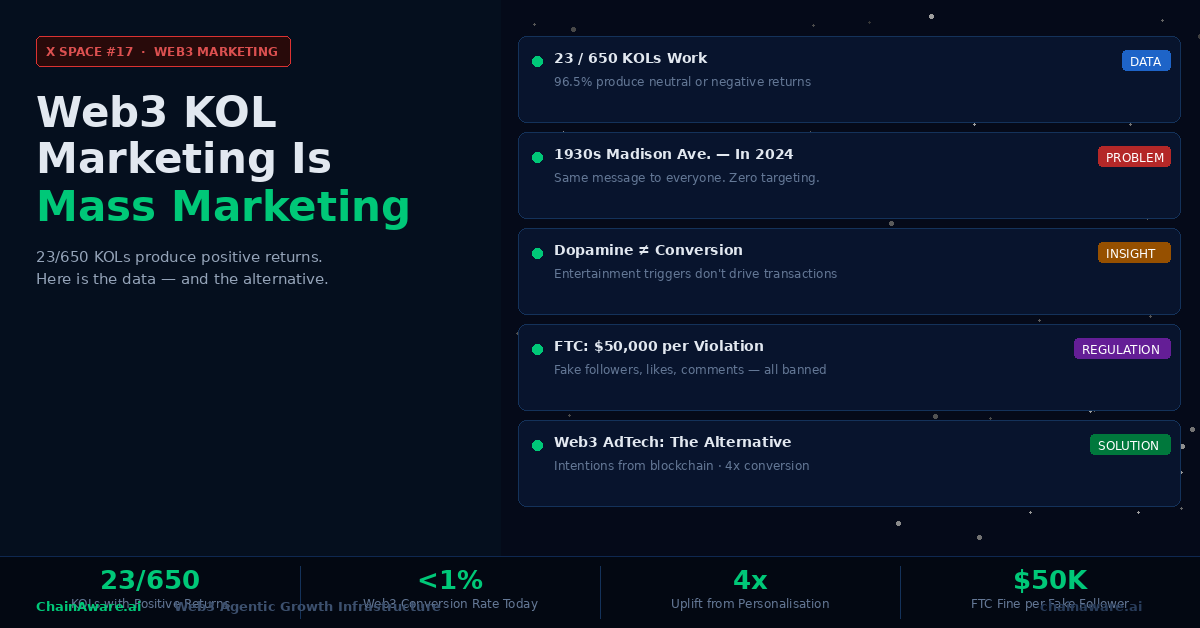
X Space #17 — Web3 KOL Marketing Is Mass Marketing: The Data, the Neuroscience, and the Personalized Alternative. Watch the full recording on YouTube ↗ · Listen on X ↗
X Space #17 asks a question that most Web3 founders are afraid to ask out loud: does KOL marketing actually work? Martin and Tarmo answer with data from AlphaScan, a framework from neuroscience, a regulatory update from the US Federal Trade Commission, and a precise historical analogy that reframes the entire industry. The conclusion is uncomfortable but actionable: Web3 KOL marketing is structurally identical to 1930s mass media advertising — a model that was innovative 100 years ago and is now a certified conversion failure. The alternative exists, it is live, and it is built on the same data that Web3 projects already generate for free every day.
In This Article
- Why Do You Need Marketing? The Answer That Changes Everything
- Conversion Ratio: The Only Number That Determines Whether Marketing Works
- KOL Marketing Is 1930s Mass Marketing — Not Innovation
- The Travelling Salesman, Madison Avenue, and Web3
- The AlphaScan Data: 23 Out of 650 KOLs Produce Positive Returns
- The Double Loss: Paying for Campaigns That Destroy Token Value
- The Dopamine Problem: Why KOL Entertainment Never Converts
- Continuous Activation: The Treadmill That Builds No Loyalty
- The Alternate Marketing Universe: KOLs, Media, Banners, Agencies
- The VC and Exchange Trap: Why KOL Dependence Is Systemic
- FTC Regulations 2024: The End of Fake Influencer Marketing
- Einstein’s Insanity Definition: What Web3 Is Currently Doing
- The Personalized Marketing Alternative: How Web2 Actually Works
- Two Steps to Higher Conversion: External Targeting and On-Site Personalisation
- Why Blockchain Data Makes Web3 AdTech Possible — Right Now
- KOLs Are the Dinosaurs — Web3 AdTech Is the Replacement
- Comparison Tables
- FAQ
Why Do You Need Marketing? The Answer That Changes Everything
Martin opens X Space #17 with a question that almost nobody in Web3 stops to answer explicitly before spending their marketing budget: why do you need marketing at all? The instinctive answers — awareness, community growth, token price support — are all wrong. The correct answer determines everything about how marketing should be structured, measured, and evaluated.
Marketing exists for one specific purpose: to convert visitors into transacting users. Everything else is either a means to that end or an expensive distraction. Awareness without conversion is a brand expense. Community without conversion is a support cost. Token price promotion without conversion to platform users is hype that evaporates the moment payments stop. As Martin states clearly: “We need marketing to convert users. We founders create super effective business processes. But we have to bring this business process to real users.”
The Unit Cost Equation Every Founder Must Understand
This purpose-first definition immediately connects marketing to the unit economics that determine whether a business is viable. Every company has two critical unit costs: the cost of delivering its core product or service, and the cost of acquiring each user who generates revenue. DeFi protocols have achieved extraordinary efficiency on the first cost — smart contracts automate lending, trading, and settlement at a fraction of the cost of equivalent traditional finance operations. However, the second unit cost destroys this advantage entirely when marketing fails to convert efficiently. Martin makes the point directly: “If you create a business process which is super effective, but the unit cost of acquisition is $10,000 per acquisition — where is the point? Your unit cost of acquisition has to come down too. It is not only creating a business process. It is bringing down the unit cost of acquisition.” For the full unit economics context, see our intention-based Web3 marketing guide.
Conversion Ratio: The Only Number That Determines Whether Marketing Works
The metric that determines whether any marketing activity is working or wasting money is conversion ratio — the percentage of visitors who complete a target action. Tarmo provides benchmarks that put Web3’s current performance in brutal historical context.
Before AI-powered targeting arrived in Web2, e-commerce conversion ratios averaged 2-3%. After Web2 platforms adopted AI microsegmentation — targeting users based on their behavioural intentions rather than demographics — conversion ratios rose to 10-15%. When platforms went further and implemented adaptive user interfaces that dynamically adjusted content based on real-time individual behaviour, conversion ratios reached 30%. Each step represented a qualitative improvement in matching messaging to the specific intentions of each visitor.
Web3 Is Below Pre-AI Web2 Performance
Web3 operates with conversion ratios below 1% — worse than pre-AI Web2 e-commerce performance from two decades ago. Tarmo is precise: “Call based marketing — it is absolute mass marketing, it is pre-Web2 marketing. It is marketing like 100 years ago. And this is the de facto marketing we have today in Web3. And your conversion ratio — it is before Web2 and it is below 1%.” The consequence is that innovative Web3 projects with genuinely superior products cannot reach profitability because every acquired user costs far more than they generate in lifetime revenue. Fixing this requires increasing conversion ratio — which requires moving from mass marketing to personalised, intention-based targeting. For the full acquisition cost mathematics, see our crossing the chasm in Web3 guide.
Find Out What Your Real Conversion Rate Is — Free
ChainAware Free Analytics — Intentions Profile of Every Connecting Wallet
Before fixing conversion you need to know who is arriving and what they intend to do. ChainAware’s free analytics pixel reveals the intentions distribution of every connecting wallet — borrowers, traders, yield farmers, newcomers. 2-minute GTM setup. Free forever.
KOL Marketing Is 1930s Mass Marketing — Not Innovation
The central argument of X Space #17 is that KOL marketing — the dominant promotional approach across Web3 — is structurally identical to 1930s mass media advertising. Grasping this equivalence is essential for understanding why KOL campaigns consistently fail to convert at meaningful rates.
Mass marketing delivers one message to the largest possible audience and relies on a small percentage responding. A New York Times shoe advertisement in 1930 reached every newspaper subscriber regardless of whether they needed shoes, could afford the price, or cared about that brand. Of every 10,000 readers, perhaps one bought the shoes. The cost per acquisition was enormous, but the media reach was the only available technology, so it was used. Tarmo describes it directly: “You publish in New York Times — I have shoes, do you want to buy shoes? And then you hope that every one reader from 10,000 comes and buys shoes. It worked this way 100 years ago. It was expensive and resulted in very low conversion ratio, very high acquisition cost.”
KOLs Replicate This Structure Exactly
KOL marketing replicates the 1930s structure precisely. A crypto influencer with 100,000 followers posts about a DeFi lending protocol. Every follower receives the same content regardless of their DeFi experience, their current financial goals, their risk tolerance, or whether they would ever use a lending platform. The experienced yield farmer, the NFT collector, the complete newcomer, and the user already on a competing protocol all see identical messaging. None of it is personalised for any of them specifically. The outcome — low conversion, high cost, frustrated founders — is exactly what mass marketing mathematics predicts. As Martin observes: “It is the same message for everyone. But people have different buyer intentions. What are their motivations? What do they need?” For how this plays out across the full Web3 marketing landscape, see our AI marketing for Web3 guide.
The Travelling Salesman, Madison Avenue, and Web3
Martin and Tarmo place KOL marketing in its correct historical sequence — not as a modern innovation but as one step in a long marketing evolution that Web3 has failed to follow to its current state.
Before mass media advertising, companies hired travelling salespeople who walked door-to-door and delivered the same pitch to every household they visited. Acquisition costs were astronomical — each sale required physical labour, geographic travel, and considerable time per prospect. The innovation of 1930s mass media advertising was genuine: a newspaper advertisement reached thousands of potential customers at far lower cost per impression than any door-to-door salesman could achieve. Madison Avenue’s rise represented a real step forward for its era.
Innovation of Its Era, Obsolete in Ours
Martin acknowledges the 1930s innovation explicitly — and then makes the point that Web3 ignores: “It was an innovation 100 years ago. But why should I use this innovation now? This innovation was created 100 years ago to substitute the travelling salesman. And we are using it now in Web3 — our most innovative technology sector.” The irony is precise and uncomfortable. Web3 projects build 100% digitally-automated financial infrastructure that outperforms traditional banking on every unit cost metric, then market it using the same broad-audience broadcast methods that were introduced before television existed. The sophistication gap between product and marketing is enormous — and it is entirely responsible for the conversion ratios that prevent Web3 from reaching mainstream adoption. For the full historical context on why this gap needs closing, see our Web3 crossing the chasm analysis.
The AlphaScan Data: 23 Out of 650 KOLs Produce Positive Returns
Rather than relying on qualitative criticism, Martin and Tarmo bring a specific, verifiable data source to the discussion: AlphaScan, a tool that tracks the performance of 650 crypto KOLs and measures the average token price return for projects they promote within a defined time window. Checking the free version — which uses 10-day delayed data — immediately before recording X Space #17, they found a striking result.
Of 650 tracked KOLs, 23 had produced positive 30-day returns for the tokens they promoted. That is a 3.5% positive rate. The remaining 627 — 96.5% of the total — produced either neutral or negative returns within 30 days of their promotional activity. Martin and Tarmo express genuine surprise at the severity: “23 out of 650 today. It is very, very sad story. It shows that you have very low conversion ratio. But the other thing is you make the situation of a company even worse if you have a negative effect — and here we are speaking about negative effect for customers who order call actions.”
Verifiable and Repeatable
Critically, Martin invites listeners to verify this independently: “If you don’t believe it, please go to AlphaScan, use the free version. It is 10 days delayed data. Check it yourself.” The invitation to verify reflects the broader methodological approach of ChainAware — grounding claims in accessible, reproducible data rather than anecdotal case studies. The 23/650 figure is not a permanent constant; market conditions vary and some KOLs genuinely outperform. However, a 3.5% positive rate across 650 tracked influencers over a 30-day measurement period represents a strong empirical signal that KOL marketing as a category fails to deliver reliable positive outcomes. For context on how this compares to intention-based alternatives, see our Web3 AdTech comparison guide.
The Double Loss: Paying for Campaigns That Destroy Token Value
The 96.5% failure rate creates a specific financial damage pattern that goes beyond merely wasting the campaign fee. When a KOL promotion produces negative token price action — meaning the token price declines following the promoted campaign — the project experiences two simultaneous losses.
First, the project pays the KOL fee upfront regardless of outcome. KOL contracts are typically structured as flat fees or cost-per-post arrangements with no performance guarantees. The payment occurs whether the campaign generates positive, neutral, or negative results. Second, the negative token price impact directly destroys value for the project’s existing token holders — potentially including the founding team, early investors, and the treasury. Martin summarises: “You pay the calls and the impact was negative. You get negative results. It is a double loss. If you had not paid the calls, you would have saved the money — and maybe the negative result would have been even bigger, we do not know. But point being: you are paying for negative outcomes.” This dynamic makes KOL marketing not just ineffective but actively harmful for most Web3 projects that use it.
The Dopamine Problem: Why KOL Entertainment Never Converts
Beyond the statistical evidence, Tarmo provides a neuroscientific explanation for why KOL marketing fails to convert even when it successfully generates attention and engagement. The explanation lies in understanding what a KOL tweet actually does to a follower’s brain — and why that neurological response is fundamentally disconnected from the action of transacting with a platform.
When a KOL presents new information about a project, the follower’s brain forms new neural connections. The human brain rewards new connection formation with a dopamine release — the same mechanism that drives curiosity, learning, and the pleasure of discovering something interesting. Followers experience a genuine positive emotional response: an “aha” moment, a feeling of having learned something valuable, a sense of excitement about potential. As Tarmo explains: “If you create new connections, your brain is rewarding you with dopamine. And that is why you like to create new connections. If someone is talking to you, some call presenting — you get these new connections. You are like wow, aha effect. And you like it because you get rewarded with dopamine in your brain.”
Entertainment Is Not Conversion
The critical distinction is that this dopamine reward comes from the information itself — not from the product being promoted. Followers like the KOL. They like the experience of learning. However, they do not necessarily like the product, and the emotional state that the KOL trigger creates does not translate into the deliberate evaluation and action required to connect a wallet and transact on a DeFi platform. Martin makes the connection explicit: “You will get dopamine shot from entertainment. You are not getting it from using an application. The call creates entertainment. And one very small percentage of users really goes to these applications. But it is more entertainment.” Furthermore, because KOLs rotate through different projects each month, the positive association a follower develops is with the KOL — not with any specific project. For how personalised messaging creates genuine resonance rather than transient entertainment, see our personalisation in Web3 guide.
Continuous Activation: The Treadmill That Builds No Loyalty
KOL marketing has a structural dependency problem that compounds the conversion failure: it requires continuous payment to maintain any effect at all, and it builds zero lasting loyalty regardless of spend level.
When a project pays a KOL to promote it for one month, the KOL’s followers receive promotional content for that month. The following month, the KOL promotes a different project. The month after that, yet another. Followers move their attention with the KOL — from one topic to the next, generating dopamine from the novelty of each new discovery and forming no lasting connection to any specific project. Martin describes the pattern: “If Call is tweeting one month about your product and next month about some other product — do you think all these 100,000 followers are still remembering your product? No, they do not. They are getting new information units. They are getting new entertainment. So they had entertainment one month, they have entertainment next month. They are moving from one topic to the next topic. You are not getting any loyalty.”
The Pay-to-Stay Problem
The consequence is a marketing model that delivers no compounding value. Every month without payment is a month of zero impact from that KOL’s audience. There is no residual brand recognition, no ongoing word-of-mouth, and no user base that continues growing organically. The only way to maintain any KOL-driven awareness is to keep paying indefinitely — creating a treadmill that drains budget without building sustainable user acquisition. Contrast this with personalised marketing that converts visitors into loyal users: those users generate ongoing revenue, refer others, and create genuine platform growth. The economics of loyalty-building acquisition are compounding; the economics of continuous KOL activation are flat at best. For the full analysis of sustainable user acquisition, see our behavioral analytics guide.
Replace KOL Spend with Intention-Based Conversion
ChainAware Marketing Agents — 1:1 Targeting from Blockchain Intentions
Stop paying for entertainment. Calculate each connecting wallet’s behavioral intentions from on-chain history — borrower, trader, yield farmer, newcomer — and deliver resonating messages that convert. Self-learning from day one. 4 lines of JavaScript. Enterprise subscription.
The Alternate Marketing Universe: KOLs, Media, Banners, Agencies
KOL marketing is one component of a broader ecosystem that Martin calls the “alternate marketing universe” — a self-contained promotional infrastructure that Web3 projects use in place of the intention-based targeting available in Web2. Understanding this ecosystem as a system reveals why individual project marketing decisions reinforce structural problems across the entire space.
The ecosystem has four main components. First are KOLs — paid influencers who broadcast to undifferentiated audiences for upfront fees. Second is crypto media: publications like CoinDesk, Bitcoin.com, and Cointelegraph that charge for promotional articles, delegating their publication credibility to the featured project while delivering mass-broadcast content to all readers regardless of individual relevance. Third are banner advertisements on high-traffic crypto platforms — CoinGecko, Etherscan, CoinMarketCap — that display identical creative to every visitor with no targeting whatsoever. Fourth are marketing agencies that act as gatekeepers between projects and all three channels, collecting fees for coordination while providing no performance accountability.
No KPIs, Pay in Advance, Cry Later
The defining characteristic of every component in this ecosystem is the same: upfront payment with no outcome accountability. Marketing agencies do not guarantee conversion rates. KOLs do not refund fees when campaigns produce negative price action. Crypto media charges per article regardless of reader engagement. Banner providers charge per impression regardless of clicks, wallet connections, or transactions. Martin’s description of the standard arrangement has become a running observation: “Pay in advance, slash cry later. You get some offering, KPI — there are no KPIs. If you want a contract and technically your marketing agencies are gatekeepers.” The result is that 50,000-70,000 Web3 projects collectively burn enormous resources in this alternate universe while their actual need — getting the right visitors to the right platforms and converting them — remains entirely unmet. For more on the agency incentive problem, see our AdTech vs mass marketing guide.
The VC and Exchange Trap: Why KOL Dependence Is Systemic
A natural question arises: if KOL marketing delivers 3.5% positive outcomes and drains budget without building loyalty, why do Web3 founders continue using it? Martin and Tarmo identify a structural trap that makes KOL marketing feel mandatory even when founders suspect it is ineffective.
Both VCs evaluating investment opportunities and centralised exchanges evaluating listing applications use a project’s KOL relationships as a signal of legitimacy and growth potential. Exchanges look at Twitter scores — tools that measure how many influential accounts follow or engage with a project — as a proxy for marketing capability and community strength. VCs ask which KOLs are promoting a project as part of their diligence process. As Martin explains: “Exchanges are looking on which calls are following your projects. VCs are looking at this. Both are using the Twitter score. If calls are not following your project, you will have a very big issue getting listed.” This creates a structural demand for KOL marketing that exists independently of its actual effectiveness in acquiring users.
The Deadlock Scenario
Tarmo describes the resulting situation as a “deadlock scenario”: projects that understand KOL marketing is ineffective at acquiring users still feel compelled to pay for it because the external validation signals it provides are required for funding and exchange listings. Opting out of KOL marketing means potentially losing VC investment and exchange access — even if the marketing itself produces negative returns. The only escape from this deadlock is a shift in what VCs and exchanges use as quality signals — a shift that will come, as Martin and Tarmo argue, when Web3 AdTech provides better conversion metrics that are more valuable than Twitter follower counts as growth indicators. For context on how this connects to broader Web3 ecosystem dynamics, see our why AI agents will accelerate Web3 guide.
FTC Regulations 2024: The End of Fake Influencer Marketing
External regulatory pressure compounds the structural problems of KOL marketing. Martin references a Federal Trade Commission regulation that took effect in October 2024, covering all influencer marketing across all sectors — not just cryptocurrency specifically.
The FTC rule explicitly prohibits fake social proof in influencer marketing: fake followers, fake comments, fake likes, fake retweets, and any other fabricated engagement signals. Each violation is punishable by fines up to $50,000. When applied to an account with significant fake follower counts, the penalties compound rapidly — an influencer with 10,000 fake followers engaging with a single promotional post faces potential exposure in the hundreds of thousands of dollars. Martin explains the scale calculation: “If you have 10 fake followers, then let’s make a little multiplication — you see the numbers go off very fast.”
90% of KOLs Have Fake Engagement
Martin and Tarmo estimate that approximately 90% of Web3 KOLs have significant fake follower and engagement components — purchased bots, fake accounts, and manufactured social proof that inflate apparent reach without delivering real audience. The 10% with genuinely authentic audiences produce meaningful results occasionally. However, when FTC enforcement begins generating high-profile cases — as Martin predicts will happen as “the first call processes come” — the fake-follower majority of the KOL industry faces legal and financial exposure that will rapidly shrink the available pool of viable influencer partners for Web3 projects. The regulatory shift effectively accelerates the timeline for the transition from mass KOL marketing to intention-based AdTech that Martin and Tarmo argue is coming regardless. For the parallel with how Web2 marketing agencies evolved when AdTech emerged, see our crossing the chasm in Web3 guide.
Einstein’s Insanity Definition: What Web3 Is Currently Doing
Tarmo invokes a well-known observation — attributed to Einstein — to describe Web3’s current marketing behaviour: doing the same thing repeatedly while expecting a different result is insanity. The application to Web3 KOL marketing is precise and pointed.
Despite the AlphaScan data showing 96.5% negative or neutral outcomes, despite the token value destruction that accompanies failed campaigns, and despite the absence of measurable user conversion metrics, Web3 projects continue allocating substantial budgets to KOL campaigns. The psychological mechanism sustaining this behaviour is what Martin calls “hopium” — the hope-driven belief that the next campaign will be the outlier that works, even without any change in the underlying approach. As Tarmo explains: “We repeat something that is not working, we repeat and repeat and repeat. And then we have this opium effect. Maybe it will work, maybe it will be an outlier. But we cannot explain why outliers happen. And it is certainly not because of calls that these positive outliers happen.”
The Herd Mentality Explanation
Martin identifies one concrete explanation for why the insanity loop continues: herd behaviour. When every competing project is using KOL marketing, opting out feels dangerous even if the campaigns produce negative returns — because the alternative (no marketing) seems worse than ineffective marketing. Additionally, many founders have not yet discovered that personalised intention-based marketing is technically achievable with blockchain data right now. As Martin says: “Maybe the reason is just the awareness is not there. Awareness is not yet there that the personalised marketing technologies have emerged in Web3.” The solution to the insanity loop is not willpower — it is awareness of the available alternative combined with the data to justify switching.
The Personalized Marketing Alternative: How Web2 Actually Works
Having systematically dismantled the KOL marketing model, Martin and Tarmo turn to the working alternative — the intention-based personalised marketing system that drives all successful Web2 platforms. Understanding this system explains both why Web2 acquisition costs are 50-100x lower than Web3, and precisely what Web3 needs to replicate.
Web2 personalised marketing starts from a principle that Tarmo had already articulated in his master thesis in 1997: effective marketing requires knowing what the individual recipient wants, not broadcasting a generic message to a large undifferentiated group. As Tarmo notes: “I wrote my master thesis about one-to-one marketing in 1997. Everything I predicted happened — and even a little bit more. Huge companies emerged from it.” The companies that emerged — Google, Facebook, Twitter — are all, at their revenue core, intention calculation and targeting businesses. Their social media or search interfaces are the consumer-facing layer; the business is selling access to users whose intentions are known with high precision.
How Web2 Calculates Your Intentions
Google calculates user intentions from search queries and browsing history. Facebook calculates them from social interactions, content consumption patterns, and the data users explicitly provide. Twitter calculates them from engagement patterns and creates a personalised feed specifically designed to keep each user on the platform longer — because longer engagement means more data points, more targeting precision, and more ad revenue. Each platform generates approximately $5 billion or more annually from this intention-targeting model. As Tarmo explains: “How is Twitter generating revenues? Via ad technology. Facebook the same. They calculate the intentions of the users and based on these intentions the users are targeted.” Web2 is not social media or search that happens to run ads — it is intention calculation businesses that use social or search interfaces as data collection mechanisms. For the full parallel and how it applies to Web3, see our how ChainAware is doing for Web3 what Google did for Web2 guide.
Two Steps to Higher Conversion: External Targeting and On-Site Personalisation
Martin distils the personalised marketing framework into two concrete sequential steps that any Web3 project can implement — the same two steps that Web2 platforms execute at massive scale every day.
Step one is bringing the right visitors to the platform. Personalised targeting calculates user intentions from available data and uses those intentions to route only relevant visitors toward the platform. A DeFi lending protocol targets users whose behavioral profile indicates high borrowing intent — not gamers, not NFT collectors, not complete newcomers who will need extensive onboarding before their first transaction. This matching dramatically increases the probability that any given visitor will find the platform relevant and convert. Importantly, even if external targeting is difficult for financial service projects due to advertising platform restrictions, on-site personalisation is immediately achievable and delivers substantial conversion gains on its own.
Step Two: Convert with Resonating On-Site Messages
Step two is converting visitors on the platform through intention-matched messaging. Most Web3 platforms today deliver identical content to every visitor regardless of their profile — the same hero text, the same value proposition, the same call-to-action. Martin challenges this directly: “Think on your website. Probably you designed this magical website with the super coolest designer. And this magic message is the same for everyone. Why are you giving the same message for everyone on your website? Create personalised messages based on user intentions.” A borrower-profile visitor should see loan terms and yield comparisons. A newcomer should see safety information and getting-started guides. An experienced DeFi user with a leverage-trading profile should see advanced features. Personalised on-site messaging increases conversion ratio by at least 4x according to Martin — a conservative estimate based on Web2 personalisation benchmarks applied to Web3’s starting below-1% baseline. For the complete implementation approach, see our personalisation in Web3 guide.
Why Blockchain Data Makes Web3 AdTech Possible — Right Now
The natural objection to personalised Web3 marketing is that the data required for intention calculation — the equivalent of Google’s search history or Facebook’s social graph — doesn’t exist in Web3. Martin and Tarmo argue that this objection is incorrect: blockchain data provides exactly the intention signals needed, and it is available for free, publicly, to anyone who can process it.
Every wallet’s complete transaction history is public on every major blockchain. This history contains deliberate financial decisions — borrowing, lending, trading, staking, purchasing NFTs, providing liquidity — each of which required conscious evaluation and real financial commitment. Unlike search queries that reflect momentary curiosity or social behaviour that reflects peer influence, on-chain financial transactions represent the highest-confidence behavioral signals available anywhere. As Tarmo explains in previous X Spaces, 12 on-chain transactions from a single wallet produce intention predictions with over 98% accuracy — more precise than years of Google browsing data because the underlying signals are so much stronger.
ChainAware Predicts Future Intentions — Not Past Behaviour
Critically, ChainAware’s intention calculation goes beyond attribution — describing what a wallet has done in the past — to actual prediction: what will this wallet do next? Tarmo explains the distinction: “If you buy a BMW yesterday, you will not buy it next year probably. So it is your next action which matters. What is your next intention after you buy a BMW? And this is what we calculate. We take blockchain history and we can calculate what are your next intentions — not your past intentions from two weeks or two years ago. No — what are your new intentions in the coming weeks or days or coming months.” This forward-looking prediction is exactly what marketing requires: not who the user was but who they are about to become. ChainAware’s system then connects this prediction to a one-to-one targeting system that delivers matched messages for each identified intention profile. For the full product overview, see our behavioral user analytics guide and the guide to how any Web3 project can benefit from AI agents.
KOLs Are the Dinosaurs — Web3 AdTech Is the Replacement
Martin and Tarmo close X Space #17 with a prediction about the trajectory of the KOL industry — framed through an evolutionary analogy. The current KOL marketing ecosystem in Web3 is the dinosaur: dominant, deeply entrenched, apparently powerful, but structurally unfit for the environment that is emerging. Web3 AdTech is the mammal: smaller now, less visible, but fundamentally better adapted for the conditions ahead.
The extinction event comes from two directions simultaneously. From within the industry, the AlphaScan data and other performance evidence is gradually building founder awareness that KOL spending does not deliver reliable returns. From outside the industry, FTC regulations are applying legal pressure that will eliminate the fake-engagement infrastructure on which most KOLs depend. Together, these forces are creating what Martin calls a “pre-revolutionary situation” — conditions where the old model is failing and a replacement is ready but not yet widely adopted.
The Same Transition Web2 Already Made
The transition is not unprecedented — it is the same one Web2 made when Google AdWords and its successors replaced 1930s-style mass advertising with intention-based targeting. Web2 marketing agencies that previously charged for broad media placements either disappeared or transformed into AdTech consultants who helped clients use the new targeting tools. The projects that adopted intention-based targeting gained sustainable acquisition economics. Those that stayed with mass marketing fell behind permanently. As Tarmo summarises: “Web2 was created by Web2 AdTech. This is how Web2 got strong. The same is what will happen in Web3. Web3 AdTech will bring the Web3 revolution. We are now in a situation that all pieces are ready for this revolution. Even regulators say: calls — it is enough. We have technology from ChainAware. Now it is just a question of time until the industry will adapt.” For the ecosystem transformation analysis, see our guide to AI-based fraud detection and Web3 growth.
Comparison Tables
Web3 KOL Marketing vs Intention-Based Web3 AdTech
| Dimension | KOL / Mass Marketing (Current Web3) | Intention-Based AdTech (ChainAware) |
|---|---|---|
| Historical equivalent | 1930s New York Times shoe ad | Web2 Google AdWords microsegmentation |
| Targeting basis | Follower count, demographics | On-chain behavioral intentions — next action |
| Message personalisation | Zero — same tweet for 100,000 followers | 1:1 — unique message per wallet profile |
| Conversion ratio | Below 1% | Target 4x+ improvement from personalisation alone |
| KOL positive return rate | 23/650 = 3.5% (AlphaScan data) | Not needed — direct wallet-level targeting |
| Payment structure | Upfront, no performance accountability | Subscription — aligned with conversion outcomes |
| Loyalty generated | None — followers move to next topic monthly | High — resonating experience creates returning users |
| Neurological mechanism | Dopamine from novelty → entertainment, not conversion | Resonance → intention match → deliberate transaction |
| FTC regulatory risk | High — 90% of KOLs have fake engagement | None — no fake engagement component |
| Data source | Social follower counts, bot-inflated metrics | Public on-chain transaction history |
Marketing Evolution: Travelling Salesman → 1930s → Web2 → Web3 AdTech
| Era | Method | Personalisation | Conversion Rate | Acquisition Cost | Scalability |
|---|---|---|---|---|---|
| Pre-1900s | Door-to-door salesman | High (one-to-one) but inefficient | High per contact | Enormous | Very low |
| 1930s–1990s | Mass media — newspapers, TV, radio | Zero | ~1% | High | High reach, low efficiency |
| Web2 early | Digital banners, early AdWords | Low — demographics only | 2-3% | Medium | High |
| Web2 mature | AI microsegmentation, intention targeting | High — behavioural microsegments | 10-15% | $15-30 | Very high |
| Web2 advanced | Adaptive UIs, real-time intention response | Very high — individual-level | Up to 30% | $10-20 | Very high |
| Web3 today | KOLs, crypto media, banners — all mass | Zero | Below 1% | $1,000+ | Structurally broken |
| Web3 AdTech (ChainAware) | Blockchain intention calculation + 1:1 targeting | Very high — wallet-level | Target 4x+ current | Target $50-150 | High — scales with blockchain |
Frequently Asked Questions
Why do 96.5% of KOL campaigns produce negative or neutral results?
Because KOL marketing is mass marketing — delivering the same message to undifferentiated audiences regardless of individual intentions. The probability that any given follower has the right profile, the right timing, and the right motivation to transact with a promoted platform is very low. Additionally, approximately 90% of KOLs have fake follower components, meaning the apparent audience size vastly overstates the real human reach. AlphaScan’s data — 23 out of 650 KOLs producing positive 30-day returns — reflects both the inherent inefficiency of mass marketing and the fake engagement problem that inflates apparent but not actual reach. For more, see our Web3 AdTech vs mass marketing guide.
Why does a KOL tweet create dopamine but not conversion?
The brain rewards new neural connection formation with a dopamine release — the same mechanism that drives curiosity and learning. A KOL presenting new information about a project creates new connections and delivers a genuine positive emotional response. However, that response is tied to the information itself, not to the product. The follower experiences pleasure from learning something interesting about a project — but that pleasure does not translate into the deliberate evaluation, wallet connection, and transaction commitment required to become a platform user. The conversion path from dopamine-entertainment to transacting user is long and requires specific, relevant, well-timed messaging that mass KOL content cannot provide.
What do FTC regulations mean for Web3 KOL marketing?
The FTC’s 2024 regulations covering influencer marketing apply to all sectors including crypto and carry fines of up to $50,000 per violation for fake followers, fake likes, fake comments, and fake retweets. Since an estimated 90% of Web3 KOLs have significant fake engagement components, the first high-profile enforcement actions will likely trigger widespread review of KOL authenticity and a rapid contraction of the fake-follower ecosystem that most KOL reach depends on. The regulatory pressure accelerates a transition to performance-accountable marketing — which means intention-based AdTech — that market forces were already beginning to drive. See the FTC’s official guidance on endorsements ↗ for full details.
How does ChainAware calculate wallet intentions if there is no Google-equivalent data in Web3?
Blockchain transaction history is the Web3 equivalent of — and arguably superior to — Google’s search and browsing history. Every on-chain transaction represents a deliberate financial decision made with real money at stake. This produces far stronger behavioral signals than passive browsing or incidental search queries. ChainAware’s AI models process a wallet’s complete transaction history across 2,000+ Ethereum protocols and 800+ BNB Smart Chain protocols to predict the wallet owner’s next behavioral intentions — not what they did in the past, but what they are likely to do next. This prediction achieves over 98% accuracy from as few as 12 transactions, enabling marketing personalisation more precise than anything available in Web2.
Why do founders keep using KOL marketing if it clearly does not work?
Three structural reasons sustain KOL spending despite poor performance. First, herd behaviour — every competitor uses KOLs, so opting out feels more dangerous than participating in an ineffective system. Second, the VC and exchange validation trap — investors and listing gatekeepers use KOL relationships and Twitter scores as quality signals, making KOL spend feel mandatory for fundraising and exchange access. Third, awareness gap — many founders do not yet know that blockchain-native intention-based marketing is technically available and deployed right now. Once all three of these factors shift — as FTC regulations, performance data, and increasing ChainAware adoption address them — the transition to Web3 AdTech will accelerate rapidly.
The Web3 AdTech That Replaces KOL Spend
ChainAware Prediction MCP — Intentions, Fraud, Credit. One API.
Intention calculation + 1:1 targeting + fraud detection + credit scoring — all via one MCP API. 98% accuracy. 31 MIT-licensed open-source agent definitions. ETH, BNB, BASE, POLYGON, TON, TRON, HAQQ, SOLANA. Stop paying for entertainment. Start paying for conversion.
This article is based on X Space #17 hosted by ChainAware.ai co-founders Martin and Tarmo. Watch the full recording on YouTube ↗ · Listen on X ↗. For questions or integration support, visit chainaware.ai.