
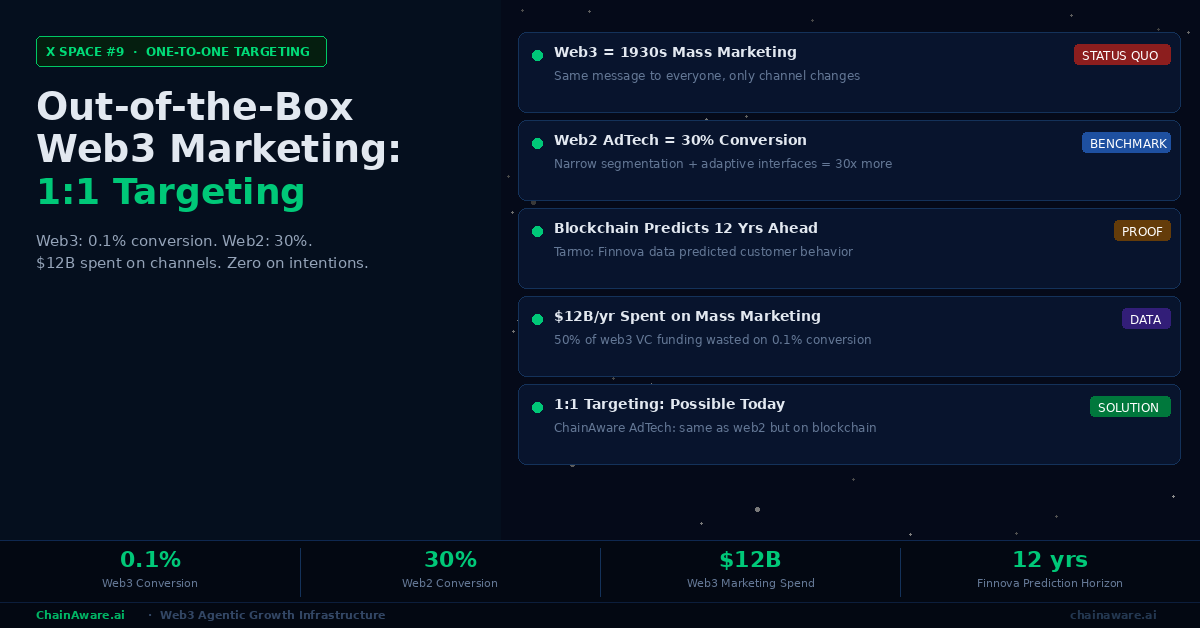
X Space #9 — Out-of-the-Box Web3 Marketing: How 1:1 Targeting Transforms Conversion. Watch the full recording on YouTube ↗ · Listen on X ↗
X Space #9 tackles the uncomfortable truth at the heart of Web3’s growth crisis: the marketing approaches every Web3 founder uses are not just ineffective — they are 300 times less effective than the approaches Web2 companies have been running for two decades. Co-founders Martin and Tarmo trace the root cause to a single structural problem that every Web3 marketing channel shares, introduce the two-component solution that drove Web2’s conversion rates to 30%, and explain why blockchain data gives Web3 an even stronger foundation for implementing those solutions than anything Google or Facebook has access to. Tarmo draws on his experience as chief architect of Finnova — the banking platform running 251+ Swiss banks — where financial data proved capable of predicting customer behaviour 12 years into the future. The session’s core message is direct: Web3 marketing is stuck in 1930, the tools to escape it already exist, and the only obstacle is founders’ unawareness that the problem is solvable.
In This Article
- Web3 Marketing Is 1930s Marketing: The Channel Illusion
- Every Web3 Channel Has the Same Structural Flaw
- Quest Systems: The Fake Usage Base Factory
- The $12 Billion Problem: Who Really Benefits from Web3 Marketing Spend
- How Web2 Solved It: The Two-Component Formula
- Narrow Segmentation: Intention-Based Targeting vs Channel Selection
- Adaptive User Interfaces: Why Amazon Shows You a Different Website Than Your Friend
- Google Is Not a Search Company: Understanding the AdTech Revenue Model
- Web2’s Data Quality Problem: Why Browsing History Is Unreliable
- Blockchain Data: The Goldmine — 12-Year Prediction Horizon from Finnova
- Every Wallet Is a Complete Behavioral Profile — Free and Public
- Why Web3 Can Exceed 30%: Tarmo’s 40%+ Conversion Hypothesis
- The Industry Transformation: How AdTech Displaced Marketing Agencies in Web2
- Web3 Founders as Victims: The Agency Knowledge Problem
- Comparison Tables
- FAQ
Web3 Marketing Is 1930s Marketing: The Channel Illusion
Tarmo opens X Space #9 with an assessment that is designed to provoke immediate disagreement from every Web3 marketer listening — and then to make that disagreement impossible to sustain: Web3 marketing, despite operating on cutting-edge blockchain infrastructure, functions at exactly the same sophistication level as advertising did a hundred years ago. The specific definition matters. 1930s mass marketing is characterised by a single structural property: one message broadcast identically to all potential customers across whatever channels the advertiser has access to.
As Tarmo states: “Web three marketing today — conversion ratio is 0.1% around. And when we go over to Web two, conversion ratio goes up to 30%. These are facts, not opinions. And what happens in Web three marketing is that all this marketing is just selection of a channel. And poor Web three founders think that oh, I have to select a channel, I have to buy this media channel, I have to buy this second channel. And that is marketing. Web three founders are misled by marketing companies. They are not told that it is actually about conversion ratio.”
The Channel Selection Trap
The channel illusion operates as follows: marketing agencies present Web3 founders with a menu of channels — crypto influencers, banner advertising, community management, media articles, quest systems — and position channel selection as the primary strategic decision in marketing. This framing reduces the entire marketing function to “which channel should I put my message on?” while leaving entirely unaddressed the more fundamental question: “what message should I send, to whom, and based on what knowledge of their individual intentions?” As Martin observes: “Web three marketing is reduced to channel selection. Nothing else. Channel selection. And every crypto influencer you can consider as one channel. And in every channel you send the same message to every channel audience.” For how this compares to the full marketing framework, see our KOL marketing analysis.
Every Web3 Channel Has the Same Structural Flaw
Martin systematically audits every major Web3 marketing channel and demonstrates that regardless of the channel’s apparent sophistication, all of them share the same structural flaw: the message is identical for every recipient. No channel in the current Web3 marketing ecosystem applies any knowledge of the recipient’s individual intentions to customise what they receive.
Crypto influencers broadcast the same promotional content to all their followers regardless of each follower’s behavioral profile or investment intentions. Buying articles on CoinDesk or Cointelegraph places the same article in front of every reader regardless of whether any specific reader’s profile matches the promoted project’s value proposition. Banner advertising on crypto platforms serves identical creatives to every visitor. Community management on Telegram and Discord sends the same messages to the entire community membership regardless of individual engagement levels or interests.
The Nightclub Test
Martin introduces an analogy that makes the conversion failure of mass messaging immediately intuitive. Try an experiment: on one Friday evening, approach everyone at a social gathering with the exact same opening line regardless of who they are. The following Friday, approach each person with a message tailored to something observable about them individually. Make statistics. As Martin frames it: “If you go to a nightclub and talk to girls, you don’t talk with every girl the same way. But this is what Web three marketing today is. Like you go to the nightclub and you approach everyone with the same message. Of course you know what happens. We can recommend to everyone to try to do this experiment.” The result of the experiment is obvious before running it — because everyone already knows that personalised, intention-aware communication works dramatically better than identical mass messaging. Yet the same founders who would never try identical nightclub openers continue accepting Web3 marketing agencies’ recommendation to send the same message to everyone on every channel. For more on why this happens, see our KOL alternatives guide.
Stop Selecting Channels — Start Targeting Intentions
ChainAware Free Analytics — See Who Is Actually Connecting
Before you can target intentions, you need to know what intentions are connecting to your platform. ChainAware’s free analytics pixel reveals the behavioral profile of every connecting wallet — borrower, trader, gamer, NFT collector, newcomer. Foundation for 1:1 targeting. Free forever.
Quest Systems: The Fake Usage Base Factory
Quest systems occupy a special position in Web3 marketing because they appear to solve a problem that pure mass advertising cannot: they bring users to a platform and get them to perform specific actions, generating activity metrics that look like genuine engagement. Martin’s analysis demonstrates that quest systems are not a solution to the mass marketing problem — they are mass marketing with incentive payments added, producing fake usage rather than genuine users.
Quest platform users — participants who complete quests on Magic Square, Taskon, and similar platforms — move through multiple projects in a single day, completing the minimum required actions on each to earn reward points and then immediately moving on. They have no genuine interest in or intention to use any specific platform. They are attracted by the reward rather than the product. The retention rate among quest-acquired users is near zero because the incentive that brought them is the reward, not the product’s value. As Martin explains: “Quest systems means that users are coming, they get reward or reward points, and they go away to go the next one. Maybe in one day they’re visiting 20, 30 different platforms. Are we creating some loyalty with this approach? Loyalty is only via intention-based marketing. Resonating is not via mass media messages.” Furthermore, Martin notes explicitly that VCs who ask “where are your users?” are being shown quest system completions as usage metrics — manufactured numbers rather than genuine adoption. For more on sustainable acquisition, see our unit costs and acquisition guide.
The $12 Billion Problem: Who Really Benefits from Web3 Marketing Spend
Martin quantifies the scale of the Web3 marketing misdirection with a specific figure that contextualises the problem: Web3 projects spend approximately $12 billion annually on marketing, representing roughly half of all VC funding that flows into the sector. This figure makes the stakes concrete — and immediately raises the question of who actually receives this capital and what they deliver in return.
The beneficiaries are marketing agencies, crypto media platforms, and influencers — not founders. Marketing agencies charge management and coordination fees for assembling channel mixes that deliver 0.1% conversion. Crypto media companies charge for article placements that deliver mass reach with no targeting. Influencers charge for promotional posts that deliver their existing audience (largely bots and unqualified followers) with no behavioral segmentation. Founders receive the 0.1% conversion that results. As Tarmo states: “Who benefits from current mass media style Web three marketing? These are all existing marketing organisations who just do 1930s marketing where success rate or conversion ratio of customers to transacted customers is almost non-existent. And what is interesting is everybody knows it is not working, but it is still used.” For the complete VC-agency-founder triangle analysis, see our conversion without KOLs guide.
How Web2 Solved It: The Two-Component Formula
Having established the problem’s scale and persistence, Martin and Tarmo turn to the solution — which they argue is not an invention still to be built but a formula that Web2 developed over twenty years and that has been proven at the largest possible scale. Web2’s 30% conversion rate is not magic. It results from combining two specific technological components that Web3 has not yet adopted.
The first component is narrow segmentation, also called intention-based targeting or one-to-one targeting at its most refined. Rather than broadcasting a message to everyone on a channel, this approach calculates each individual user’s behavioral intentions from available data and routes only those users whose profile matches the platform’s value proposition toward it. A DeFi lending platform should attract users who have borrower intentions — not gamers, NFT speculators, or passive stakers who have no lending history and no lending intention. The second component is adaptive user interfaces — the mechanism that converts narrowly targeted visitors once they arrive on the platform by showing them content matched to their specific intention profile rather than a generic interface designed for a hypothetical average user. Together, these components produce the 30% conversion rate that Web2 platforms achieve.
Why Neither Component Exists in Web3 Today
Web3’s near-total absence of both components explains the 300x gap between Web2 and Web3 conversion rates. No major Web3 marketing channel applies intention-based targeting — every channel delivers the same message to everyone. No major Web3 platform deploys adaptive user interfaces — every visitor sees the same onboarding flow, the same feature layout, the same calls-to-action regardless of their behavioral profile. The gap is not inherent to Web3’s architecture; it is a consequence of a marketing culture that has never demanded these capabilities. As Martin argues: “Web three founders have actually very high quality data that they can use to apply the same approach like in Web two. Web three founders can do narrow segments, they can do intention-based marketing, they can do adaptive applications, and they can achieve this way a conversion ratio similar to 30% in Web two marketing.” For the full implementation pathway, see our Web3 AdTech guide.
Narrow Segmentation: Intention-Based Targeting vs Channel Selection
The specific mechanism that distinguishes Web2’s narrow segmentation from Web3’s channel selection is the data used to determine who receives what message. Channel selection asks: “which channel should I broadcast on?” Narrow segmentation asks: “which individuals, on any channel, have behavioral intentions that match my platform’s value proposition?” The questions sound similar but generate fundamentally different marketing approaches.
Web2 platforms build microsegments — highly specific sub-populations of users who share similar behavioral intentions — and target each microsegment with messages designed for that specific profile. A financial services platform targeting users who have recently searched for investment opportunities, browsed risk-management content, and shown consistent financial site engagement is targeting a microsegment with high conversion probability. The same platform targeting all visitors to a general finance news site is doing mass marketing with lower targeting precision.
Why Intentions Trump Demographics
Critically, Web2’s microsegmentation is built on behavioral intentions rather than demographic attributes. Knowing that a user is male, 30-45 years old, and college-educated is far less predictive of whether they will transact on a DeFi lending platform than knowing that they have actively researched lending rates, recently deposited funds across multiple protocols, and shown increasing leverage activity over the past three months. Intentions are what people are preparing to do. Demographics are what category of person they are. As Martin explains: “Narrow targeting means people are targeted with the messages, what they are looking for with the intentions, what they are looking for — their internal intentions. And this is narrow targeting. Microsegments are built on the intentions. Not built like there’s a channel: crypto influencer one, channel crypto influencer two. No. It’s built on the intentions.” For the complete intention calculation methodology, see our intention-based marketing guide.
Adaptive User Interfaces: Why Amazon Shows You a Different Website Than Your Friend
The second component of Web2’s conversion formula is adaptive user interfaces — a technology so ubiquitous in Web2 that most users don’t consciously notice it, even though it shapes every major platform interaction. Martin introduces a simple test that demonstrates the technology’s prevalence and explains precisely why it drives conversion rates.
Open Amazon.com. Ask a friend to simultaneously open Amazon.com on their device. Take screenshots of your respective homepages and compare them. They are different — completely different product recommendations, different featured categories, different promotional banners. Your Amazon homepage reflects your specific purchase history, browsing patterns, wishlist additions, and inferred future purchase intentions. Your friend’s homepage reflects theirs. Amazon’s algorithm calculates each visitor’s most likely next purchase and presents a landing experience optimised for that specific prediction. As Martin describes: “If you’re going on Amazon and you ask your friend to go on Amazon, and if you’re comparing your Amazon and his Amazon — you both have 100% guaranteed we can make a fully different user interface, fully different screen. Why? Because your intentions are different, your buying histories are different, you’re different persons.”
The Myth of the Perfect User Interface
Martin and Tarmo challenge directly the belief that a sufficiently talented UX designer can create an interface that works well for all users — a belief that drives enormous Web3 product development investment. The fundamental problem is not design quality. No single design can simultaneously resonate with a conservative yield farmer, an aggressive leverage trader, a gaming-native newcomer, and an experienced DeFi protocol developer. People’s information processing styles, decision-making patterns, and risk tolerances vary in ways that make a single optimal interface architecturally impossible. As Martin argues: “There’s nothing like a user experience. There’s a personalized user experience for everyone. But this is based on adaptive user interfaces. You have to create adaptive user interfaces.” The 16 Myers-Briggs personality types represent just one dimension of this variation — and meaningful personalisation requires responding to behavioral signals rather than static personality classifications. For how ChainAware implements this in Web3, see our personalisation guide.
Google Is Not a Search Company: Understanding the AdTech Revenue Model
Martin and Tarmo make a pointed observation about the dominant Web2 technology platforms that reframes how Web3 founders should think about the competitive landscape they operate in. Google and Facebook are commonly understood as a search engine and a social media platform respectively. This understanding is incorrect in the most important economic sense.
Google generates approximately 95% of its revenue from advertising technology — specifically from the AdWords and Display advertising systems that use search history and browsing data to match advertisements to predicted user intentions. The search product is the data collection mechanism that feeds the AdTech product; it is not the business. Similarly, Facebook generates approximately 95% of its revenue from advertising technology that uses social interaction data to calculate user intentions and target advertisements. The social media product is the data collection mechanism. As Martin states directly: “Google is not the search engine. Google makes 95% of the revenues with the AdTechnology. Facebook is not the social media. Facebook makes 95% plus of the revenues via the AdTechnology. It’s an AdTech company.” Understanding this reframes the competitive environment: Web3 projects are not competing with search engines and social networks for user attention. They are competing with the most powerful intention prediction and advertising delivery machines ever built.
The Industry Transformation Template
This context establishes why the Web1→Web2 marketing transformation is the relevant historical template for understanding what will happen in Web3. Before Google and Facebook, marketing agencies controlled the majority of advertising budgets — they held the relationships, the media placements, and the creative expertise. When AdTech emerged, marketing agencies lost their dominant position to the platforms that could deliver measurably superior conversion rates. As Martin predicts: “The same transformation that we had now in the Web one, Web two, when it converted to the AdTech based marketing — Google makes money with the AdTech, 95%, Facebook makes money with the AdTech, 95%, not with your social media — the same transformation will happen in Web three.” For the full transformation analysis, see our crossing the chasm guide.
The Web3 AdTech That Replaces Channel Selection
ChainAware Marketing Agents — 1:1 Intention-Based Targeting
Calculate each connecting wallet’s behavioral intentions from on-chain history. Deliver matched messages for each persona in real time. Narrow segmentation + adaptive interface — both components of Web2’s 30% conversion formula, implemented for Web3 via free public blockchain data. 4 lines of JavaScript.
Web2’s Data Quality Problem: Why Browsing History Is Unreliable
Despite Web2 AdTech’s remarkable effectiveness at producing 30% conversion rates, Martin and Tarmo point out that it achieves this performance while working with fundamentally low-quality data. Understanding exactly why Web2’s data is unreliable is the prerequisite for understanding why blockchain data is superior and what that superiority implies for potential conversion rates in Web3.
Google collects two primary data sources for intention calculation: search queries and browsing history. Search queries are highly volatile — someone can search anything in response to an external stimulus (a conversation, a news article, a social media post) without that search reflecting any genuine purchase intention. Martin explains the mechanism: “Search history is what you are searching. Let’s say in the process it’s just a mood. Bad evening mood, good evening mood, or vice versa in some people. Browsing history is very much trigger-based. I’m reading, I’m seeing some social media feed and something is triggered. I go on this website, some other talk is triggered, I go on another website. So it’s very much externally driven.” Browsing history accumulates these externally triggered visits, creating a profile that is at least partly a record of which topics other people directed the user toward rather than what the user genuinely intends to do with their money or time.
How reCAPTCHA Collects Browsing Data
Martin identifies the specific mechanism by which Google collects browsing data without requiring explicit user disclosure: the ubiquitous reCAPTCHA verification widget. When a user clicks the checkbox to confirm they are human, the terms and conditions they accept include consent to transmit their browsing history to Google. This mechanism enables Google to collect cross-site browsing data from essentially every major website that uses reCAPTCHA verification — which is an enormous portion of the web. Additionally, thousands of advertising tracking pixels embedded in websites by Google’s advertising network collect page visit data. The combination creates a comprehensive browsing profile, but the data remains low quality because browsing behaviour is easily influenced by external triggers rather than reflecting genuine intentions. For the comparison with blockchain data quality, see our predictive AI guide.
Blockchain Data: The Goldmine — 12-Year Prediction Horizon from Finnova
Tarmo introduces the most compelling empirical evidence in X Space #9 for blockchain data’s superior prediction quality: his direct experience as chief architect of Finnova, the banking platform running 251+ Swiss banks in Switzerland. The Finnova experience provides a real-world demonstration of financial data’s prediction power at institutional scale — and the comparison with blockchain data is stark.
As chief architect of Finnova, Tarmo worked with bank-grade financial transaction data covering millions of customers across hundreds of institutions. The analysis he describes is specific: from a customer’s financial transaction history, the platform could predict when that customer would take a car lease, when they would make a significant investment, which investment products they would purchase, and when they would apply for a mortgage — with prediction horizons of up to 12 years. As Tarmo explains: “When I was chief architect of the largest Swiss banking platform, what I learned was that from financial data, what you have in your fiat currency, you could predict twelve years ahead when a customer is doing — when he’s going to take leasing for a car, when he’s doing an investment, which products he’s going to invest in, when he’s doing a mortgage. We could predict everything. And this was from financial data. And now, in blockchain, we have 100 times bigger data set.”
Why Blockchain Exceeds Traditional Financial Data
Traditional banking data is rich but limited by the number of transactions any individual customer generates across a single banking relationship. Blockchain data compounds two advantages on top of this. First, the proof-of-work property of Ethereum transactions (gas fees) means every on-chain action represents a deliberate, financially committed decision — the same quality signal that makes bank transaction data so predictive, but now free and publicly accessible. Second, the scale is unprecedented: over 10 billion transactions across major blockchains, accessible without any data licensing agreements, platform relationships, or GDPR compliance infrastructure. As Tarmo states: “Now we have 100 times bigger data set. You can predict everything about a customer using this data set. You can predict all intentions that the customer has.” For the complete data quality analysis, see our behavioral analytics guide.
Every Wallet Is a Complete Behavioral Profile — Free and Public
The practical implication of blockchain data quality is something every Web3 user already carries but most Web3 marketers have not yet started using: every user’s wallet address is simultaneously their complete financial behavioral history, available publicly and free of charge to anyone with the technical capability to read and analyse it.
When a user connects their wallet to a Web3 platform, they are providing — without any additional disclosure, consent mechanism, or data collection system — a complete record of every financial decision they have made on-chain: every protocol they have interacted with, every asset they have held, every transaction they have executed, and every behavioral pattern that emerges from the history of those decisions. This record encodes their experience level, their risk tolerance, their financial goals, and their predicted next actions with far more precision than any browsing history or social media profile. As Martin explains: “Every web three user is dragging his wallet with him. In a wallet you have a full history. By analysing this history, you see as well what this user will do in the future. This is future analytics of him.” For ChainAware’s implementation of this wallet-as-profile concept, see our analytics guide.
Why Web3 Can Exceed 30%: Tarmo’s 40%+ Conversion Hypothesis
Tarmo advances a specific prediction that goes beyond arguing Web3 can match Web2’s 30% conversion benchmark: given the superior quality of blockchain behavioral data compared to Google’s browsing and search data, Web3 AdTech should be able to exceed that benchmark rather than merely replicate it.
The logic is direct. Web2 achieves 30% conversion using data that Tarmo characterises as unreliable, trigger-driven, and easily manipulated. Blockchain financial transaction data — proof-of-work filtered, representing deliberate committed decisions, free of the external noise that corrupts browsing data — provides a qualitatively superior input for intention prediction models. Better input data produces better intention predictions. Better intention predictions produce better targeting. Better targeting produces higher conversion rates. As Tarmo states: “If you take this very high quality data and you start using it for marketing, your conversion ratio will not just rise to 30% — it will go even higher. It means you get 100 users to your website, your conversion is 30, 35, 40 of them doing transactions.” This hypothesis is consistent with ChainAware’s documented 8-10x reduction in customer acquisition cost versus KOL-based approaches. For the supporting analysis, see our Web3 AdTech deep dive.
The Industry Transformation: How AdTech Displaced Marketing Agencies in Web2
Martin and Tarmo situate the Web3 marketing crisis in its historical context by tracing the industry transformation that already happened once — when AdTech displaced traditional marketing agencies in the Web1→Web2 transition. This history is the direct template for what is coming in Web3, and understanding it explains both why the current situation persists and why it will inevitably change.
Before the internet era, marketing agencies controlled the majority of advertising budgets. They held the media relationships, the creative expertise, and the placement capabilities that brands needed to reach audiences. The marketing agency was the essential intermediary. When digital marketing emerged in the Web1 era, agencies initially maintained this position by replicating their mass marketing model on digital channels. When AdTech matured in the Web2 era, it began delivering measurably superior conversion rates through intention-based targeting. Numbers don’t lie: if one approach delivers 30% conversion and another delivers 0.1% conversion, budget flows toward the higher-performing approach.
Why Marketing Agencies Moved to Web3 Without Changing Approach
As Web2 AdTech displaced traditional marketing agencies in their original market, those agencies faced a strategic choice: adapt to intention-based, quantitative marketing or find a new market where the old approach still worked. Many chose the latter — bringing the same 1930s mass marketing methodology to Web3, where the ecosystem was young enough and awareness low enough that the approach’s ineffectiveness was not yet broadly understood. As Martin states: “The marketing agencies in Web three sell founders approaches which are not working. And the Web three marketing agencies themselves know it very well. It is not working, but they sell it.” For how to ask the right questions of any Web3 marketing agency, see our conversion guide.
Web3 Founders as Victims: The Agency Knowledge Problem
Tarmo frames the current situation with a specific characterisation that clarifies the power dynamic at work: “Web three founders are victims of marketing agencies.” The framing is deliberate and precise — it positions founders not as making an informed choice to use ineffective marketing but as being actively misled by the people they hire to guide their marketing strategy.
The knowledge asymmetry is structural. Marketing agencies understand their own business model: generate retainer revenue by providing channel selection services to founders who don’t know to ask whether channel selection is the right framework. Founders — overwhelmingly technically skilled builders who chose to build blockchain products because of their technical interest — typically lack the marketing sophistication to ask the right questions. They don’t know to demand quantitative analytics, predictive AI-based intention calculation, or evidence of adaptive interface deployment. Instead, they accept whatever the agency presents as the standard approach. As Martin argues: “Probably founders even don’t have awareness to ask these questions. Web three is technically driven, so maybe founders even don’t know to ask these questions: Are you quantitative driven? Are you predictive? Do you have predictive data analytics? Do you have adaptive user interfaces?”
The Questions Every Founder Should Ask
Martin closes with the specific diagnostic questions that will determine whether a marketing agency or approach is operating in the 1930s mass marketing paradigm or the Web2 intention-based paradigm. The key questions are: Do you calculate user intentions quantitatively? Do you use predictive analytics to forecast user behaviour? Do you provide adaptive user interfaces that change based on each visitor’s behavioral profile? Can you show historical conversion rate data from comparable projects? If the answers are no or vague, the agency is selling channel selection — not marketing effectiveness. As Martin summarises: “At the end it’s about the unit cost. You need to get your unit cost down. And you get the unit cost down in the same way as you’re getting them in Web two — with quantitative analytics, with one to one targeting, with predictive analytics, with adaptive user interfaces.” For the complete unit cost framework, see our unit costs guide.
Comparison Tables
Web3 Mass Marketing vs Web2 AdTech vs ChainAware 1:1 Targeting
| Property | Web3 Mass Marketing (Today) | Web2 AdTech | ChainAware 1:1 Targeting (Web3) |
|---|---|---|---|
| Marketing era equivalent | 1930s Madison Avenue | Modern digital AdTech | Modern digital AdTech + superior data |
| Primary activity | Channel selection | Intention-based targeting | Wallet intention-based targeting |
| Message type | Same for everyone, all channels | Matched to each user’s intentions | Matched to each wallet’s intentions |
| Conversion rate | 0.1% | Up to 30% | Target 30-40%+ (superior data) |
| Customer acquisition cost | $1,000-$2,000 per transacting user | $15-35 per transacting user | 8-10x lower vs current Web3 channels |
| Data source | None — undifferentiated audiences | Search + browsing history (low quality) | On-chain financial transactions (high quality) |
| Prediction horizon | None | Days to weeks | Months to years (Finnova: 12 years) |
| User interface | Same for all visitors | Adaptive — unique per visitor (Amazon) | Adaptive — matched to wallet profile |
| Annual Web3 spend | ~$12 billion | N/A | Fraction of current channel spend |
| Who benefits | Agencies, media, influencers | Platform + advertiser (Google/Facebook) | Web3 founder (conversion improvement) |
Web2 Data Sources vs Blockchain Data for Intention Prediction
| Property | Google Search History | Browsing History (Trackers/CAPTCHA) | Blockchain Financial Transactions |
|---|---|---|---|
| Cost to generate | Zero — free to search | Zero — passive data collection | Gas fees — real financial commitment |
| Trigger source | External triggers — mood, social media | External triggers — links, feeds | Internal decision — deliberate action |
| Signal reliability | Low — highly variable by day | Low — easily influenced externally | High — committed, costly to fake |
| Fake signal risk | Medium | Medium | Low — gas fees filter fake actions |
| Prediction horizon | Days to weeks | Days to weeks | Months to 12+ years (Finnova proof) |
| Data access cost | Only via Google’s ad platform (indirect) | Requires tracker network or CAPTCHA | Free — publicly on blockchain |
| Tarmo’s assessment | “Very unexact data” | “Very much trigger-based” | “Very high prediction power data” |
| Web2 conversion achieved | Up to 30% (both sources combined) | Target 30-40%+ (higher quality) | |
Frequently Asked Questions
Why does Web3 marketing achieve only 0.1% conversion?
Web3 marketing achieves 0.1% conversion because it uses mass marketing — sending the same message to every recipient regardless of their individual intentions or behavioral profile. All major Web3 marketing channels share this structural flaw: crypto influencers broadcast to undifferentiated follower bases, crypto media delivers identical articles to all readers, banner advertising serves the same creatives to all visitors, and community management messages all members identically. The 0.1% conversion represents the small fraction of recipients who happen to be looking for exactly what the mass message describes. Web2 achieves 30% conversion using intention-based targeting that routes only relevant users to relevant platforms and serves each visitor personalised content. For more, see our unit costs guide.
What are the two components of Web2’s 30% conversion formula?
Web2’s 30% conversion results from combining two components. First, narrow segmentation (intention-based targeting): calculating each potential user’s behavioral intentions from available data and routing only those whose profile matches the platform toward it, rather than broadcasting to everyone on a channel. Second, adaptive user interfaces: serving each arriving visitor content matched to their specific intention profile rather than a generic interface designed for a hypothetical average user (as Amazon does — every user sees a different homepage). Neither component alone achieves the full conversion improvement. Both together drive the 300x advantage over Web3’s current mass marketing approach.
Why can blockchain data predict customer behaviour 12 years ahead?
Tarmo’s Finnova experience demonstrated that bank-grade financial transaction data predicted customer behaviour (car leasing, investment decisions, mortgage applications) up to 12 years ahead because financial decisions are deliberate and committed — unlike browsing history which reflects external triggers and momentary curiosity. Blockchain transactions share this property at a larger scale: every on-chain action required conscious evaluation and real financial cost (gas fees), making it a high-quality behavioral signal. With over 10 billion blockchain transactions available for analysis (100x the scale of Finnova’s banking data), the prediction power is correspondingly greater. ChainAware’s 98% fraud detection accuracy demonstrates this prediction quality in practice — and the same methodology applies to intention prediction for marketing.
Why is Google an AdTech company, not a search company?
Google generates approximately 95% of its revenue from advertising technology — specifically the Google AdWords and Display network systems that use search history and browsing data to match advertisements to predicted user intentions. The search product is the data collection mechanism: every search query and every reCAPTCHA completion transmits behavioral data to Google that feeds the AdTech product. The same applies to Facebook: the social media platform collects behavioral data that feeds the AdTech product generating 95%+ of revenue. Understanding this makes the Web3 marketing landscape clearer: Web3 projects are not competing for attention on social channels — they are competing against the most sophisticated intention prediction and ad delivery platforms in existence.
What questions should Web3 founders ask their marketing agencies?
Martin recommends asking five specific diagnostic questions. First: do you calculate user intentions quantitatively from behavioral data? Second: do you use predictive analytics to forecast each user’s probable next action? Third: do you provide adaptive user interfaces that dynamically adjust content based on each visitor’s profile? Fourth: can you show conversion rate data (not just impressions or engagement) from comparable projects? Fifth: what is the measurable difference in conversion rate between your approach and a mass marketing baseline? If the answers are no, vague, or absent, the agency is selling channel selection — not conversion improvement. The correct marketing objective is conversion ratio improvement, not channel diversification.
The Web3 1:1 Targeting Infrastructure
ChainAware Prediction MCP — Intentions, Fraud, Credit. One API.
Intention calculation + narrow segmentation + adaptive messaging + fraud detection + credit scoring. Free blockchain data. 98% accuracy. The two-component Web2 formula implemented for Web3. 8-10x lower acquisition cost. 14M+ wallets. 8 blockchains. 31 MIT-licensed agents.
This article is based on X Space #9 hosted by ChainAware.ai co-founders Martin and Tarmo. Watch the full recording on YouTube ↗ · Listen on X ↗. For questions or integration support, visit chainaware.ai.