
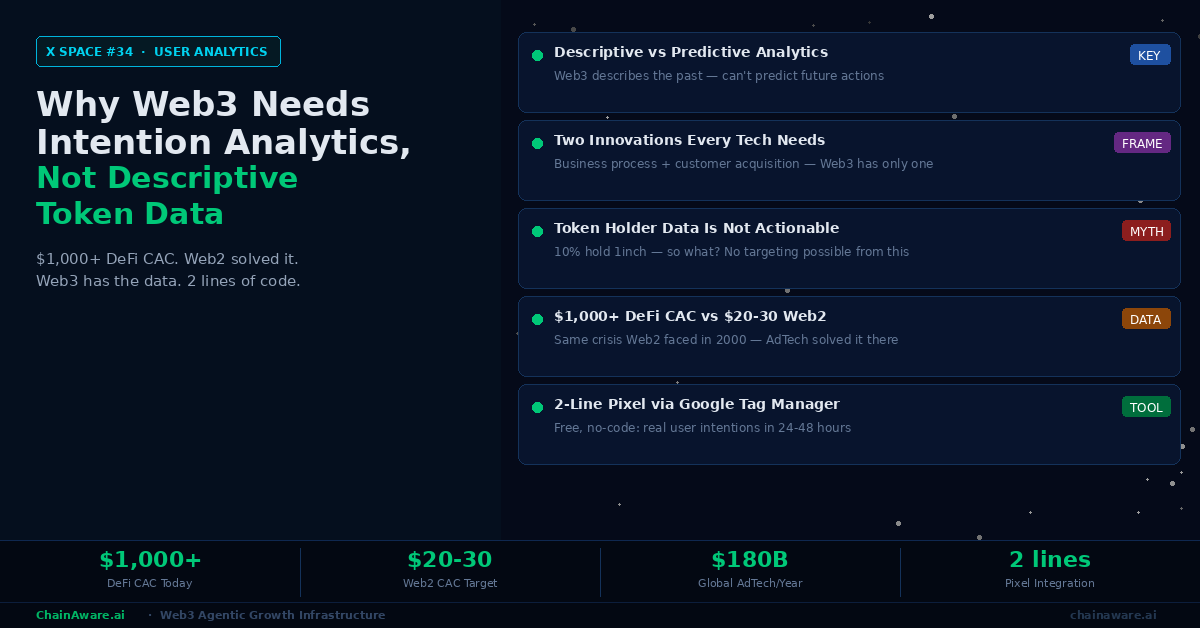
X Space #34 — Why Web3 Needs Intention Analytics, Not Descriptive Token Data. Listen to the full recording on X ↗
X Space #34 tackles the analytics problem at the root of Web3’s growth crisis. Co-founders Martin and Tarmo open with a framework observation that most Web3 founders have never heard articulated clearly: every new technology paradigm requires two distinct innovations, not one. The first is business process innovation — building the product, the protocol, the smart contract logic. The second is customer acquisition innovation — developing the tools to find the right users, understand them, and convert them at sustainable cost. Web3 has invested enormously in the first and almost nothing in the second. The result is a DeFi customer acquisition cost of $1,000 or more per transacting user — a figure that makes every business model structurally unviable and drives founders toward token-based exit strategies instead of sustainable growth. The session explains why current Web3 analytics tools make this problem worse (by providing descriptive token data that looks like insight but enables no action), what intention analytics actually is and why blockchain data makes it more powerful than anything in Web2, and how any Web3 founder can get started with two lines of code in Google Tag Manager — free, today.
In This Article
- Two Innovations Every Technology Needs — Web3 Has Only One
- Web3 Today Is Web2 in 2000: The Same Crisis, The Same Playbook
- Descriptive Analytics vs Predictive Analytics: The Fundamental Difference
- Why Token Holder Data Is Not Actionable
- Why Blockchain Data Produces Better Predictions Than Web2’s Behavioral Data
- The User-Product Mismatch: Your Real Users Are Not Your Marketing Persona
- Risk Willingness: The Credit Suisse Model Applied to Web3 Audiences
- Mass Marketing in Web3: The 50/50 Problem Nobody Admits
- How Web2’s $180 Billion AdTech Industry Solved the Same Problem
- Intention Analytics: The First Step Toward Sustainable Web3 Growth
- Two Lines of Code: How to Get Started with ChainAware Analytics
- The Feedback Loop: From Imaginary Persona to Real User Profile
- From Analytics to Action: Fully Automated Web3 AdTech
- Comparison Tables
- FAQ
Two Innovations Every Technology Needs — Web3 Has Only One
Martin opens X Space #34 with a structural observation that reframes the entire Web3 growth debate. Every successful technology paradigm, he argues, requires two independent innovations to achieve mainstream adoption. Neither one alone is sufficient, and building only the first while ignoring the second will eventually kill even the most technically superior product.
The first innovation is business process innovation — the core technical contribution that the new paradigm enables. For Web3, this means smart contracts, decentralised protocols, non-custodial finance, trustless settlement, and all the genuine architectural improvements over legacy financial infrastructure. Web3 has invested billions in this dimension and produced real, valuable innovation: automated market makers, lending protocols, yield optimisation, decentralised governance, and more. The second innovation is customer acquisition innovation — developing the tools, methods, and infrastructure to find the right users, communicate with them effectively, and convert them to active participants at sustainable unit cost. Web3 has barely begun this second innovation. As Martin states: “Every new technological paradigm will need as well innovation of customer acquisition. You need always two innovations. There is innovation on the business process and there is innovation of customer acquisition. In Web3 there has been massive innovation with full heart in the business process innovation. But there has to be as well innovation in customer acquisition.”
Why Both Innovations Are Non-Negotiable
The reason both innovations are necessary is straightforward: a better product that nobody can find or afford to acquire is not a better business. Web3’s technical innovations are real, but they exist largely inside an ecosystem of 50 million technical enthusiasts. Reaching the remaining billions of potential users requires the second innovation — customer acquisition tools that make it economically viable to identify, target, and convert mainstream users. Without that second innovation, even genuinely superior products will remain trapped serving the early-adopter segment. For more on the growth dynamics, see our Web3 growth restoration guide.
Web3 Today Is Web2 in 2000: The Same Crisis, The Same Playbook
Martin and Tarmo anchor the entire session in a historical parallel that makes the current Web3 situation both less alarming and more solvable than it appears. Web3 in 2025 is not experiencing a unique crisis — it is experiencing the same crisis that Web2 experienced at the beginning of the 2000s internet era, with the same root causes and the same available solutions.
In the early 2000s, Web2 faced two specific barriers to mainstream adoption. First, fraud was rampant: credit card fraud was so prevalent that many consumers refused to enter payment details online, stifling e-commerce growth entirely. Second, customer acquisition costs were catastrophic: dot-com companies spent enormous sums on billboard advertising, TV spots, and mass media campaigns (the famous “pets.com” highway billboards became a symbol of the era’s marketing waste) with customer acquisition costs in the thousands of dollars — and no way to measure which half of the spend was working. As Martin recalls: “People were afraid to transfer their credit card as a payment means over Internet because the fraud was so high. And e-commerce companies, half of the developer power went into fraud detection. Acquisition costs of users were enormous.” Both problems were eventually solved: fraud through better detection systems, and CAC through Google’s AdTech innovations. Web3 faces identical structural challenges and has access to the same solution blueprint. For more on the fraud detection parallel, see our Web3 fraud and growth guide.
The Secret Everyone Knows But Nobody Admits
Martin makes a pointed observation about why the Web3 CAC crisis receives so little public discussion despite being universally known among founders. Admitting a $1,000+ customer acquisition cost to a venture capital investor essentially ends the conversation — it signals that the business model cannot become cash-flow positive regardless of how good the product is. Consequently, founders avoid discussing it publicly while silently dealing with the consequences: burning treasury on ineffective mass marketing, failing to hit growth targets, and eventually pivoting toward token-based revenue extraction rather than genuine product growth. As Martin puts it: “It’s a secret everyone knows but no one is speaking about this. No one wants to admit it — no one wants to say it loud — how difficult it is to acquire users in Web3.”
Descriptive Analytics vs Predictive Analytics: The Fundamental Difference
The core technical argument in X Space #34 is the distinction between descriptive analytics and predictive analytics — and the specific reason why Web3 analytics tools have remained stuck in the descriptive category while Web2 moved to predictive analytics over 15-20 years ago.
Descriptive analytics documents what happened. It tells you which tokens users held last month, which protocols they interacted with historically, and how transaction volumes changed over time. This data is backward-looking by definition. Crucially, it cannot tell you what a user will do next — which is the only information that matters for targeted acquisition and conversion campaigns. Predictive analytics uses behavioral pattern data to calculate forward-looking probabilities: what is the likelihood that this specific wallet will borrow in the next 30 days? Will this user stake, trade, or exit? Is this address behaviorally aligned with a high-leverage product or a conservative yield strategy? As Tarmo explains: “Today the most analytics in Web3 is descriptive — it just describes what happened in the past. The difficulty is past actions don’t predict what is going to happen. What is the user going to do in future?” For the full framework, see our behavioral analytics guide.
Why Web2 Made the Jump and Web3 Has Not
Web2 completed the transition from descriptive to predictive analytics in the early 2000s, driven by Google’s development of intention-based advertising technology. Google’s core insight was that search and browsing history, despite being lower-quality than financial transaction data, contained enough behavioral signal to calculate user intentions with sufficient accuracy for targeted advertising. The result was a dramatic reduction in customer acquisition costs: Web2 businesses that adopted Google’s AdTech moved from spending thousands of dollars per customer with no idea whether it was working, to spending $10-30 per transacting customer with measurable ROI at every step. Web3 has access to behavioral data that is qualitatively superior to anything Google uses — and has still not made the transition. That gap is precisely what ChainAware’s analytics tools address.
Stop Guessing. Start Knowing.
ChainAware Web3 Analytics — Free, 2 Lines of Code, Results in 24 Hours
Add ChainAware’s pixel to Google Tag Manager. No code changes to your application. Within 24-48 hours, see the real intentions of every wallet connecting to your platform — borrowers, traders, stakers, gamers, NFT collectors — aggregated and actionable. Not token holder data. Intention data. The difference between descriptive and predictive analytics, free.
Why Token Holder Data Is Not Actionable
Martin introduces a specific critique of the most common form of “analytics” offered by current Web3 data platforms — token holder overlap analysis — and explains precisely why this data type, despite appearing informative, cannot drive any marketing or growth action.
Token holder analytics tells a protocol that, for example, 10% of their users also hold a specific token from another protocol, or that a percentage of their wallet addresses have previously interacted with a competing platform. This type of data describes the current composition of a user base at a superficial level. However, it answers none of the questions that matter for acquisition and conversion: What does this user intend to do next? Are they a borrower or a trader? Do they have the experience level to use this product? Are they likely to convert, or are they purely exploratory? As Martin challenges: “Let’s imagine you’re a founder and now you see this data — 10% of the people who hold your token have as well Uniswap. What do you do? How does it help you to get more users to your platform?” The honest answer is: it does not. Token holder data describes a static snapshot with no forward-looking signal. For more on what actionable data looks like, see our intention-based marketing guide.
Protocol Usage Data vs Token Holding Data
ChainAware deliberately focuses on protocol interaction patterns rather than token holdings. Protocol interactions reveal behavioral intentions: a wallet that has repeatedly used lending protocols is a behaviorally confirmed borrower or lender. A wallet that consistently interacts with high-leverage trading products has a demonstrated risk appetite. A wallet whose protocol history shows only simple swaps and staking is likely in an early lifecycle stage. These behavioral protocol patterns, combined with transaction frequency, timing, and counterparty analysis, produce the intention profiles that make targeting possible. Token holding tells you what someone owns. Protocol behavior tells you what someone does — and what they are likely to do next.
Why Blockchain Data Produces Better Predictions Than Web2’s Behavioral Data
Tarmo returns to the proof-of-work data quality argument that distinguishes blockchain behavioral data from the social media and browsing data that Web2’s AdTech systems rely on. The argument is foundational: Web3’s predictive analytics advantage is not just equivalent to Web2’s — it is structurally superior because the data quality is higher.
Web2’s behavioral data — search queries, page views, app usage — is generated at zero cost per interaction. A user can search for “DeFi borrowing” once because a friend mentioned it, then never engage with the topic again. That single search creates a behavioral signal that Google’s algorithms will interpret as a genuine interest, serving DeFi-related advertisements for weeks. The signal is noisy because the cost of generating it is zero. Blockchain transactions, by contrast, require real money (gas fees) and deliberate action. Nobody accidentally executes a DeFi lending transaction. Every transaction represents a considered, intentional financial commitment that reveals genuine behavioral priorities. As Tarmo explains: “When you have to pay cash for every transaction, you don’t just fool around. You think twice before you do your transactions. Financial transactions have very high prediction power because users think twice or three times before they submit.” For how this applies to prediction accuracy, see our predictive AI guide.
The User-Product Mismatch: Your Real Users Are Not Your Marketing Persona
One of X Space #34’s most practically useful arguments addresses a problem that many Web3 founders privately suspect but have no way to confirm: the users actually connecting to their platform may be fundamentally different from the users their marketing was designed to attract. This user-product mismatch is, according to Martin and Tarmo, one of the most common root causes of poor conversion rates — more common than actual product quality problems.
Every marketing team creates user personas — fictional representative characters who embody the ideal target customer. “Our persona is a DeFi-experienced borrower with 50+ on-chain transactions, comfortable with 150% collateralisation, seeking fixed-rate lending for predictable financial planning.” This persona guides all acquisition spend: the content, the channels, the messaging, the influencer selection. The problem is that there is currently no way to verify whether the marketing is actually attracting this persona or an entirely different audience. Without intention analytics, a protocol might spend $30,000 per month attracting traders who have no interest in borrowing, or attracting complete DeFi newcomers to a product designed for experienced users. As Martin explains: “Every founder is saying like oh I have 20,000 clicks a month. Cool. From which users? What is their profile? What are their intentions? And usually you don’t know it until now.” For the complete targeting methodology, see our AI marketing for Web3 guide.
The Reality Check: Persona R vs Persona P
Martin frames the user-product mismatch with a memorable shorthand. Founders design their product and marketing for “Persona R” — the imagined ideal user who perfectly matches the product’s value proposition. Analytics reveals that “Persona P” is actually arriving — a different behavioral profile with different intentions, different experience levels, and different risk tolerance. Neither outcome is necessarily catastrophic: sometimes Persona P represents a genuinely valuable market that the founder had not considered. However, it is impossible to respond to the mismatch — either by adjusting the product, refining the marketing, or deliberately targeting Persona R instead of Persona P — without first knowing it exists. Intention analytics creates this feedback loop, replacing the founder’s assumptions with market reality.
Risk Willingness: The Credit Suisse Model Applied to Web3 Audiences
Tarmo introduces the risk willingness dimension — a concept central to private banking client profiling at Credit Suisse and other major institutions — and explains why it is equally essential for Web3 platform design and user acquisition.
Risk willingness describes the level of potential loss a user is psychologically and financially comfortable absorbing. The spectrum is wide: some investors will sleep soundly through a 50% portfolio decline overnight, treating it as a normal fluctuation in a volatile asset class. Others cannot function effectively when facing even a 5% potential loss — the anxiety impairs their decision-making and leads to panic selling or avoidance behavior. Neither profile is wrong; they simply require different products, different communication styles, and different interface designs. As Tarmo explains: “In Credit Suisse, everything is based on the willingness to take a risk. Some people tolerate 50% loss overnight — they even don’t care. Other people cannot sleep if they have 5% possibility of loss.”
Matching Product Risk Profile to User Risk Willingness
The practical implication for Web3 protocols is direct: if a platform offers high-leverage products but its user base consists primarily of risk-averse wallets, the mismatch will produce poor conversion, high churn, and negative user experiences. Risk-averse users who encounter high-leverage products either avoid them entirely (reducing conversion) or engage inappropriately and suffer losses (damaging trust and creating churn). ChainAware’s analytics calculates risk willingness from transaction history — a wallet that has consistently taken large leveraged positions in volatile markets has a demonstrated high risk tolerance; a wallet that holds stable assets and rarely trades has a demonstrated risk-averse profile. Matching acquisition and interface design to these calculated risk profiles dramatically improves both conversion rates and long-term retention. For more on wallet behavioral profiling, see our wallet audit guide.
Mass Marketing in Web3: The 50/50 Problem Nobody Admits
Martin draws on a famous quote from the dot-com era that describes Web3’s marketing situation with uncomfortable precision: “We spend 50% of our marketing budget, but we don’t know which half is working.” This observation — originally attributed to department store magnate John Wanamaker in a pre-internet era — re-emerged as a central frustration of Web2’s early marketing phase, and it perfectly describes Web3’s current state.
Web3 marketing today consists primarily of KOL (Key Opinion Leader) campaigns, crypto media placements, loyalty programs, Discord community management, and airdrop campaigns. These channels all share one characteristic: they reach broad, undifferentiated audiences with identical messages and provide no meaningful feedback on whether the right users were reached. A protocol spending $30,000 per month on 20,000 clicks at $1.50 per click does not know whether those clicks came from wallets that will ever transact, wallets that are exclusively airdrop hunters, wallets that are completely misaligned with the product, or wallets that are genuine prospects. Without intention analytics providing the feedback loop, every optimization decision is guesswork. As Martin states: “At the moment, the Web3 marketing is something in the style — you spend 50%, but you don’t know which part worked.” For more on the mass marketing critique, see our Web3 KOL marketing guide.
How Web2’s $180 Billion AdTech Industry Solved the Same Problem
Martin and Tarmo contextualise the Web3 analytics opportunity by quantifying the industry that Web2 built to solve the identical user acquisition problem. Global AdTech — the technology infrastructure that enables targeted digital advertising based on user behavioral data — represents approximately $180 billion in annual revenue worldwide, with approximately $30 billion in Europe alone. This industry did not exist before Google’s AdWords innovation. It emerged specifically because the combination of user intention data and programmatic targeting reduced customer acquisition costs from thousands of dollars to tens of dollars, making digital business models viable at scale.
The mechanism was straightforward: by calculating user intentions from search and browsing behavior, Google could match advertisements to users whose behavior indicated genuine interest in the product being advertised. The result was dramatically higher conversion rates (users saw ads relevant to their actual intentions), lower cost per click needed for conversion, and measurable ROI that replaced the old 50/50 guesswork. Web3 has not yet built this infrastructure — but the data necessary to build it is available free of charge on every major blockchain. As Martin argues: “The first step, understand who your clients are. Not what you think, who they are, but who they really are. This is not possible without calculating user intentions and aggregating them.” For the complete AdTech framework, see our Web3 AdTech guide.
From Analytics to Automated Targeting
ChainAware Marketing Agents — 100% Automated, Intention-Based
Once you know your users’ intentions, ChainAware Marketing Agents automatically generate resonating content, personalised calls-to-action, and targeted messages matched to each wallet’s behavioral profile. Input: your URLs. Output: fully automated, intention-matched messaging that converts. The next step after analytics.
Intention Analytics: The First Step Toward Sustainable Web3 Growth
Having established both the problem and its historical parallel, Martin and Tarmo turn to the specific solution that ChainAware provides. The solution architecture has two sequential steps — and X Space #34 focuses deliberately on Step 1, because attempting Step 2 without Step 1 is precisely the mistake that most Web3 marketing efforts currently make.
Step 1 is intention analytics: understanding who your users actually are, what they intend to do, and whether they match the profile your product is designed to serve. This step requires no immediate change to marketing strategy, creative, or spend. It requires only adding ChainAware’s tracking pixel to the platform and observing the aggregated intention data that emerges from actual wallet connections. Step 2 — which ChainAware also enables through its Marketing Agents product — is acting on that data: targeting acquisition campaigns at the right behavioral audiences, personalising on-site messaging to match individual wallet profiles, and converting matched users through intention-aligned calls-to-action. Step 2 is impossible to execute correctly without Step 1’s data. As Tarmo concludes: “What ChainAware offers is the key technology — a no-code environment to get a summary of your users of your Web3 applications. It’s free. It doesn’t cost anything. You get this feedback and with this feedback you can start doing actions, real actions which lead to user conversions.” For the complete analytics implementation, see our Web3 analytics guide.
Two Lines of Code: How to Get Started with ChainAware Analytics
Martin emphasises the implementation simplicity of ChainAware’s analytics pixel repeatedly throughout X Space #34, because the perceived complexity of analytics integration is one of the primary barriers preventing Web3 founders from adopting intention-based approaches. The actual integration requires no engineering resources and no changes to the protocol’s existing codebase.
The integration process uses Google Tag Manager — a standard no-code tag management platform that virtually every Web3 project already uses for analytics, tracking pixels, and conversion tools. Adding ChainAware requires two lines of code inserted as a new tag in the existing Google Tag Manager workspace. No application code changes. No engineering deployment. No smart contract modifications. No user-facing changes of any kind. Within 24-48 hours of adding the tag, ChainAware’s dashboard begins populating with aggregated intention profiles of the wallets connecting to the platform: experience levels, risk willingness scores, behavioral intention categories (borrower, trader, staker, gamer, NFT collector), protocol usage history, and predicted next actions. As Martin explains: “From the day after, you see the users, you see the weekly users, you see the monthly users. Two lines of code. If you don’t like it, delete them. You don’t have to change your application.” For the setup guide, visit chainaware.ai/subscribe/starter.
Free for Founders Who Build Real Products
ChainAware’s analytics tier is free. Martin clarifies the offering directly: founders who join before end of May 2025 receive the analytics product free permanently. After that date, ChainAware will revisit pricing — the infrastructure cost of running the intention calculations at scale requires eventual monetisation. However, the current offer represents a genuine opportunity for any Web3 founder to access enterprise-grade intention analytics at zero cost simply by integrating two lines of code. Martin is specific about the target user: founders who are building real products, want real users, and intend to generate real revenue — not founders whose primary goal is token price manipulation or exit strategies. For the complete pricing overview, see chainaware.ai/pricing.
The Feedback Loop: From Imaginary Persona to Real User Profile
Martin introduces a powerful framing for what intention analytics actually delivers to a founder who has been operating on assumed user personas. The moment a founder connects ChainAware’s analytics to their platform and sees real intention data for the first time, they experience what Martin calls a “moment of reality” — the point at which the imaginary persona the marketing team invented is replaced by the actual behavioral profiles of real users.
This reality check is often uncomfortable. Martin acknowledges this directly: “Oh, I designed this Persona R. But here I see totally a Persona P is using my application. And this is like a reality check. It’s very hard probably for all founders to see who really are the users.” However, this discomfort is enormously valuable. A founder who knows their actual user base can make rational decisions: adjust the product to serve the actual audience better, refine acquisition targeting to attract the intended audience instead, or recognise that a product-market fit exists in an unexpected segment worth pursuing. Without this data, every product decision and every marketing investment is based on untested assumptions. Intention analytics replaces those assumptions with market feedback — the most valuable input any product team can receive. For more on the analytics-to-action workflow, see our Web3 growth guide.
From Analytics to Action: Fully Automated Web3 AdTech
X Space #34 deliberately focuses on analytics as Step 1, but Martin briefly introduces the Step 2 product — ChainAware’s Marketing Agents — to give founders a view of the complete growth infrastructure available after establishing the analytics foundation.
ChainAware’s Marketing Agents take the intention profiles calculated from on-chain behavioral data and automate the entire content creation and targeting pipeline. The system analyses each connecting wallet’s behavioral profile, calculates their specific intentions, generates content that resonates with those specific intentions, creates appropriate calls-to-action matched to the user’s likely next action, and delivers the personalised experience automatically — without human intervention for each individual user interaction. The input required from the founder is minimal: a set of URLs describing the platform’s products and value propositions. The output is a fully automated, intention-matched marketing layer that converts identified prospects more effectively than any mass-marketing alternative. As Martin explains: “It is 100% automated. It analyzes users, it calculates their predictions, it creates the content which resonates with user intentions, it creates call to actions. The result is much higher user conversion, user acquisition. The dream of every Web3 founder.” For the complete marketing agent documentation, see our AI marketing guide.
The Role of Marketing Agencies Is Changing
Martin notes a parallel between Web3’s current marketing agency culture and Web2’s pre-AdTech marketing agency culture. In the dot-com era, marketing agencies controlled enormous budgets with no accountability infrastructure — the 50/50 waste was industry standard, and agencies benefited from the opacity. Google’s AdTech innovation changed that permanently: agencies that mastered the new tools thrived, while those who resisted were replaced by programmatic platforms. Web3 is at the equivalent inflection point. Founders who adopt intention analytics will gain the data needed to hold their marketing partners accountable, replace ineffective mass campaigns with targeted intention-based programs, and reduce CAC from the current $1,000+ to the $20-30 range that makes Web3 businesses viable. For more on this transition, see our high conversion without KOLs guide.
Comparison Tables
Descriptive vs Predictive Web3 Analytics: Full Comparison
| Dimension | Descriptive Analytics (Current Web3 Standard) | Predictive Intention Analytics (ChainAware) |
|---|---|---|
| Time orientation | Backward-looking — describes past actions | Forward-looking — predicts next actions |
| Primary data type | Token holdings, historical transaction counts | Protocol behavioral patterns, interaction sequences |
| Example insight | “10% of your token holders also hold 1inch” | “32% of connecting wallets have high borrowing intention probability” |
| Actionability | None — no targeting or messaging action follows | Direct — feeds acquisition targeting and on-site personalisation |
| User persona accuracy | Assumed — based on imaginary marketing persona | Real — based on aggregated behavioral profiles of actual users |
| Feedback loop | None — no connection to acquisition outcomes | Continuous — analytics reflects actual wallet intent patterns |
| CAC impact | None — mass marketing CAC stays at $1,000+ | Targeted — path to $20-30 Web2-comparable CAC |
| Integration effort | Variable — some tools require API work | 2 lines in Google Tag Manager — no code changes |
| Cost | Varies — many paid services | Free (ChainAware starter tier) |
| Risk willingness data | Not available | Calculated from transaction volatility and leverage history |
| Experience level data | Not available | Calculated from protocol diversity and transaction sophistication |
Web3 Marketing Today vs Intention-Based Approach
| Dimension | Web3 Mass Marketing (Today) | Web2 Micro-Segmentation | Web3 Intention-Based (ChainAware) |
|---|---|---|---|
| Targeting approach | Same message to all — KOLs, media, airdrops | Demographics + browsing behavior clusters | Individual wallet behavioral intention profiles |
| CAC | $1,000+ per transacting user (DeFi) | $10-30 per transacting user | Target $20-30 (matching Web2) |
| Data quality | None used — channel audience assumed | Search + browsing (low proof-of-work) | Financial transactions (high proof-of-work) |
| Feedback loop | 50/50 — you don’t know which half works | Measurable CTR and conversion per segment | Real-time intention match → conversion correlation |
| Persona accuracy | Imaginary — defined by marketing team | Statistical cluster approximation | Real — actual behavioral profile per wallet |
| Conversion rate | ~0.1% (1 per 1,000 visitors) | 10-30% for well-matched segments | Target 10-30%+ (better data = better match) |
| Historical parallel | Web2 in 2000 (billboard era) | Web2 post-Google AdTech (2005+) | Web3 post-ChainAware (now) |
Frequently Asked Questions
What is the difference between descriptive and predictive Web3 analytics?
Descriptive analytics documents what happened: which tokens users held, which protocols they used in the past, how transaction volumes changed over time. This data is backward-looking and cannot predict future user behavior. Predictive analytics uses behavioral pattern data from on-chain transaction history to calculate forward-looking probabilities: what is this wallet likely to do next? Are they a probable borrower, trader, or staker? Do they have the experience level and risk tolerance for this product? Predictive analytics is actionable — it directly informs acquisition targeting, on-site personalisation, and conversion strategy. Descriptive analytics, while informative, cannot drive any specific marketing or growth action.
Why is token holder overlap data not useful for marketing?
Token holder data tells you what users own, not what they intend to do. Knowing that 10% of your users also hold a competitor’s token does not tell you whether those users are active traders, passive holders, or protocol explorers. It does not tell you whether they are likely to borrow, stake, or trade. It provides no basis for targeting specific messages, creating personalised interfaces, or allocating acquisition budget to the right channels. Actionable marketing data requires intention data — what will this user do next, and what message or offer is most likely to convert them to a transacting customer? Protocol usage behavioral patterns produce this intention data; token holdings do not.
How does ChainAware’s analytics pixel integrate with a Web3 platform?
Integration requires two lines of code added to Google Tag Manager — a no-code tag management platform already used by virtually every Web3 project. No changes to the application’s codebase, smart contracts, or production deployment are necessary. After adding the tag, ChainAware begins calculating intention profiles for every wallet that connects to the platform. Within 24-48 hours, the ChainAware dashboard shows aggregated data: how many high-probability borrowers connected, how many traders, what the experience level distribution looks like, what the risk willingness profile of the user base is, and what intentions the majority of connecting wallets have signalled. To get started, visit chainaware.ai, navigate to Pricing, select the Starter tier (zero cost), and follow the five-step setup workflow.
Why is Web3 customer acquisition cost so much higher than Web2?
Web3 CAC is high for the same reasons Web2 CAC was high in the early 2000s: mass marketing to undifferentiated audiences with no feedback loop. When every marketing message reaches the same broad population regardless of intention alignment, the vast majority of contacts are not genuine prospects — meaning the cost is spread across mostly irrelevant interactions. Web2 solved this with Google’s micro-segmentation and intention-based AdTech, reducing CAC from thousands of dollars to $10-30 by reaching only users whose behavioral data indicated genuine interest in the product. Web3 has access to behavioral data that is qualitatively superior to Google’s (because blockchain transactions carry higher proof-of-work signal than search queries) but has not yet built the analytics and targeting infrastructure to exploit it. ChainAware’s analytics pixel is the first step in building that infrastructure.
What is risk willingness and why does it matter for Web3 user acquisition?
Risk willingness describes the psychological and financial tolerance for potential losses that a specific user has demonstrated through their transaction history. Users who have consistently made large leveraged positions in volatile markets have demonstrated high risk tolerance; users who hold primarily stable assets and rarely trade have demonstrated risk aversion. This dimension matters for Web3 acquisition because serving high-leverage products to risk-averse users — or conservative products to risk-tolerant users looking for high returns — creates fundamental product-user mismatches that prevent conversion and cause churn. Credit Suisse and other major banks have used risk willingness profiling for decades to match clients to appropriate products. ChainAware calculates equivalent profiles from on-chain behavioral history, making this private-banking-grade insight available to any Web3 protocol through the analytics pixel.
Analytics → Targeting → Conversion
ChainAware Prediction MCP — The Complete Web3 Growth Stack
Start with free analytics (2 lines of code, results in 24 hours). Progress to intention-based audience targeting. Add automated Marketing Agents for fully personalised conversion. Add fraud detection and rug pull prediction to protect every user. The complete infrastructure for Web3 CAC reduction — from $1,000+ to $20-30. 14M+ wallets. 8 blockchains. 31 MIT-licensed agents.
This article is based on X Space #34 hosted by ChainAware.ai co-founders Martin and Tarmo. Listen to the full recording on X ↗. For questions or integration support, visit chainaware.ai.