
Last Updated: February 2026
Every marketer wants to know one thing about their users: what will they do next? In Web2, answering this requires surveys, cookies, demographic proxies, and mountains of inferred data. The signal is noisy, the data decays quickly, and half of it is fabricated by bots and ad fraud.
In Web3, the answer is written directly on the blockchain.
Every wallet address carries a complete, immutable, publicly verifiable record of its owner’s financial behavior — every protocol they interacted with, every risk they took, every asset they managed, every time they borrowed, staked, traded, or bridged. This is not declared preference data. It is not survey data. It is actual behavior, recorded permanently and available to anyone who knows how to read it.
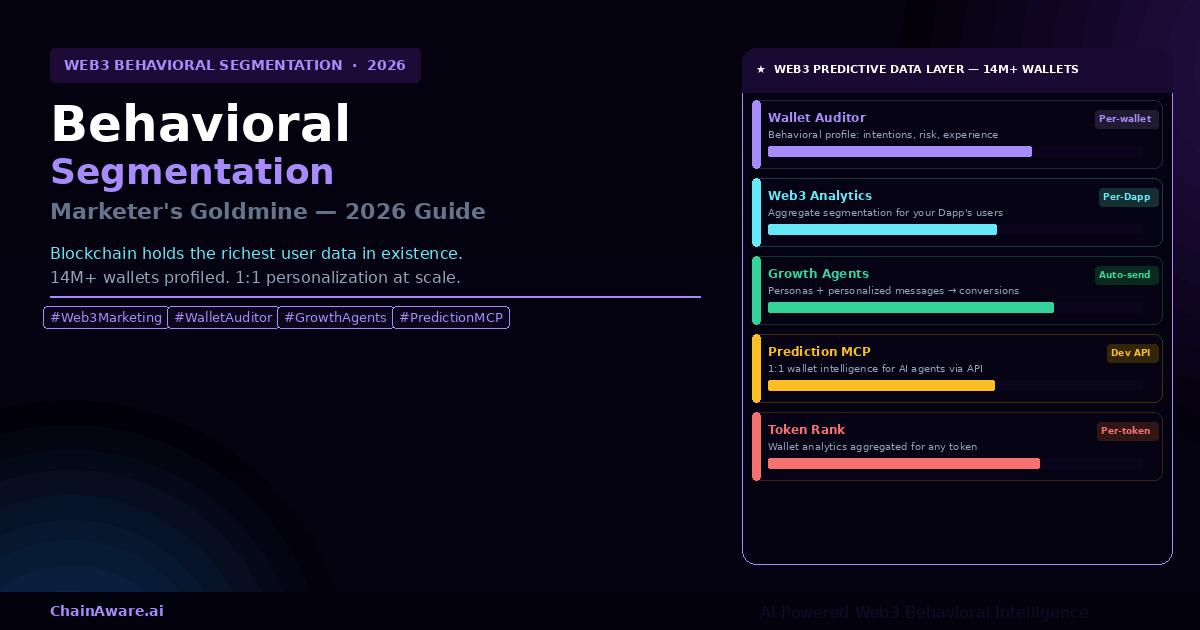
ChainAware has built the Web3 Predictive Data Layer on top of this data — a system that has profiled 14 million+ wallets across 8 blockchains, calculated behavioral segments, predicted intentions, and made all of this accessible for marketing, personalization, and growth. This guide explains how it works and why it is the most powerful user segmentation resource in marketing today.
Why Blockchain Data Is Marketing Gold
The fundamental insight that powers ChainAware’s entire product suite is simple but profound: blockchain data is the highest-quality behavioral signal in the history of marketing.
Consider what traditional marketers work with. Cookie-based behavioral data tracks what pages a user visited — a weak proxy for intent, increasingly unreliable due to ad blockers and cookie deprecation. Demographic data (age, location, income) predicts behavior at a population level but is nearly useless for individual targeting. Purchase history is better, but it’s locked in proprietary systems and decays quickly as preferences change.
Now consider what blockchain data provides. A wallet’s on-chain history is a financial decision log — every transaction represents a real-world decision made with real money. When a wallet borrows $50,000 on Aave, that is not a declared preference or a surveyed intent. That is a demonstrated behavior, completed with actual capital at risk. When a wallet consistently provides liquidity on Uniswap, that is a proven behavioral pattern, not an inferred one.
According to Harvard Business Review research on customer retention, acquiring a new customer costs 5-25x more than retaining an existing one — and the highest-value customers are those whose behavior predicts long-term engagement. Blockchain data identifies exactly these users, with a precision that no Web2 data source can match.
The blockchain data signal has four qualities that make it exceptional for segmentation: it is immutable (cannot be falsified), comprehensive (every financial action is recorded), real-time (updates with every transaction), and actionable (behavioral patterns directly predict next actions). No CRM, no cookie, no survey data comes close.
Understand Any Wallet in 30 Seconds — Free
ChainAware Wallet Auditor: Complete Behavioral Profile
Paste any wallet address and instantly receive a complete behavioral profile: Experience Level, Risk Willingness, Predicted Intentions, Wallet Rank, AML Status, and transaction category breakdown. Free. No KYC. 8 networks. The foundation of Web3 behavioral segmentation.
The Wallet Auditor: Per-Wallet Behavioral Intelligence
The Wallet Auditor is the foundation of ChainAware’s entire behavioral intelligence system. It takes any wallet address across 8 supported blockchains and generates a complete behavioral profile — not from declared preferences but from the actual transaction history encoded on-chain.
The Wallet Auditor produces five core dimensions for every wallet.
Experience Level measures how sophisticated the wallet’s on-chain activity is. A wallet that has used 15+ DeFi protocols, executed complex multi-step yield strategies, and maintained active participation over 2+ years scores very differently from a wallet that has made 3 transactions in 6 months. Experience level is a direct predictor of how a user will respond to product complexity and feature depth — a crucial segmentation variable for product teams deciding which features to highlight.
Risk Willingness measures the wallet’s demonstrated risk appetite from its actual financial decisions — not what it claimed in a survey, but what it actually did with money. Did it use leverage? Provide liquidity in volatile pools? Trade small-cap tokens? Hold large stable positions? This dimension tells you whether a user is a risk-seeker, a risk-manager, or risk-averse — which directly determines what products and messaging resonate.
Predicted Intentions are the most directly valuable dimension for marketing. Based on the wallet’s behavioral pattern, the Wallet Auditor predicts the probability of each of the key next actions: likelihood to borrow, likelihood to stake, likelihood to trade, likelihood to bridge, likelihood to provide liquidity. A high “Prob_Borrow” score identifies users who should receive lending product messaging. A high “Prob_Stake” identifies staking product candidates. This is behavioral intent prediction at a level that Web2 marketers can only dream of.
Wallet Rank is a composite quality score that places the wallet in the context of all 14 million+ profiled wallets — “you are in the top 8% of DeFi wallets by activity and sophistication.” Wallet Rank is the Web3 equivalent of a customer lifetime value score: it identifies your highest-value users objectively, from on-chain data, before you’ve spent a dollar acquiring them.
AML Status verifies fund origins and screens against sanctions lists — ensuring that the users you’re targeting and marketing to are legitimate actors, not fraudsters or sanctioned entities building position in your platform.
The Web3 Predictive Data Layer: 14M+ Profiles
Individual wallet analysis is powerful. But the real strategic asset is scale: ChainAware has applied the Wallet Auditor methodology to 14 million+ wallet addresses across Ethereum, BNB Chain, Base, Polygon, Solana, TON, Tron, and Haqq — building what is effectively the world’s largest behavioral database of crypto users.
This Web3 Predictive Data Layer is what makes ChainAware’s marketing tools uniquely powerful. Most analytics platforms can tell you what happened on your platform. ChainAware can tell you who your users are across the entire Web3 ecosystem — their history, their behavior on other protocols, their risk profile, their experience level, and critically, their predicted next actions.
When a new wallet connects to your Dapp, ChainAware instantly cross-references it against the 14M+ profile database. If that wallet has a history on Aave, Uniswap, and Compound, you know immediately that you’re dealing with an experienced DeFi user — and you can personalize their first experience accordingly. If it’s a brand-new wallet with no history, you know to serve onboarding content rather than advanced product features.
As explained in our complete product guide, the Predictive Data Layer is the shared foundation beneath every ChainAware product — from Web3 Analytics to Growth Agents to the Prediction MCP.
Web3 Behavioral Segments: Who Your Users Really Are
One of the most practical outputs of behavioral segmentation is the identification of user archetypes — consistent behavioral patterns that emerge from the data across millions of wallets. Understanding which segments your user base is composed of is the starting point for any effective Web3 marketing strategy.
ChainAware’s behavioral analysis consistently identifies several core segments in the Web3 user population. DeFi Power Users are experienced, active across multiple protocols, and high Wallet Rank. They respond to feature depth, yield optimization content, and advanced product capabilities. They are your highest-LTV users and deserve a distinct acquisition and retention strategy. Yield Farmers are optimizers who follow incentives — they are highly responsive to APY announcements, liquidity mining campaigns, and reward structures, but churn quickly when incentives end. NFT Collectors have strong community identity and are responsive to exclusivity, artist reputation, and social proof from their network. Casual Holders are lower-activity wallets with significant assets but infrequent engagement — high potential value if activated with the right trigger. New Wallets are in onboarding mode — they need education, trust-building, and low-friction first experiences before they convert to active users.
According to McKinsey research on personalization, companies that excel at personalization generate 40% more revenue from those activities than average players. Behavioral segmentation is the prerequisite — you cannot personalize without first knowing who you’re personalizing for.
Aggregate Segmentation for Your Entire User Base
Web3 Behavioral Analytics: Know Who Is Using Your Dapp
Web3 Behavioral Analytics gives you a live segmentation dashboard for every wallet that has ever connected to your platform — behavioral categories, experience distribution, risk profiles, predicted intentions, and Wallet Rank breakdown. No code beyond the GTM pixel. See who your users actually are.
Web3 Behavioral Analytics: Segmentation for Your Dapp
The Web3 Behavioral Analytics product aggregates the Wallet Auditor data for every wallet that has ever connected to a subscribed Dapp — giving the platform’s team a complete behavioral picture of their user base as a whole.
Think of it as the Web3 equivalent of Google Analytics, except instead of page views and session durations, you see behavioral segments, experience distributions, risk profiles, predicted intentions, and Wallet Rank breakdowns. Instead of knowing that 3,000 people visited your lending page today, you know that 1,200 of them are experienced DeFi users with a high probability of borrowing, 800 are yield farmers likely to provide liquidity, and 1,000 are new wallets who need onboarding content before they’ll convert to active borrowers.
The integration is no-code: install the ChainAware Pixel via Google Tag Manager — the same one-tag approach used across the entire ChainAware suite. From that point forward, every wallet connection is automatically enriched with behavioral intelligence and aggregated into your analytics dashboard.
This segmentation data directly informs four marketing decisions: which landing page variant to show each user segment, which product feature to highlight first based on the user’s predicted intentions, which email or push notification to send based on behavioral profile, and when to send it based on predicted activity windows. As covered in the Web3 Personalized Marketing guide, matching message to behavioral segment consistently outperforms generic messaging by 3-8x on conversion rates in DeFi contexts.
Token Rank: Segmentation for Token Communities
Token Rank applies the Wallet Auditor methodology at the token level rather than the platform level. Instead of segmenting your Dapp’s users, it segments the holders of a specific token — giving token teams, DAOs, and analysts a complete behavioral picture of who actually holds and uses their token.
For a token team preparing a marketing campaign, Token Rank answers questions like: what percentage of our holders are experienced DeFi users vs. casual retail holders? What is the predicted behavior of our top 1,000 wallets — are they likely to hold, stake, or sell? What behavioral segments make up our community, and which ones are at risk of churn?
Token Rank also surfaces the quality of a token’s holder base relative to the broader market — a high average Wallet Rank among holders signals an engaged, experienced community; a low average signals a holder base dominated by bots, airdrop farmers, or low-quality wallets. This is a critical due diligence metric for investors, partners, and listing platforms evaluating token quality. For a full breakdown of how Token Rank works, see the Token Rank complete guide.
Growth Agents: From Segments to Personalized Conversion
Behavioral segmentation is only valuable if it drives action. The Growth Agents product is where ChainAware’s segmentation data becomes an automated conversion engine.
Growth Agents work in three stages. First, they calculate Web3 Personas — behavioral archetypes derived from each wallet’s Auditor profile. A wallet with high experience, high risk willingness, and high probability of staking becomes the “DeFi Yield Optimizer” persona. A wallet with moderate experience, low risk willingness, and high probability of holding becomes the “Long-Term Holder” persona. These personas are not demographic labels — they are behavioral predictions backed by on-chain data.
Second, Growth Agents generate personalized messages for each persona using AI. The “DeFi Yield Optimizer” receives a message about your highest-yield vault with APY specifics. The “Long-Term Holder” receives a message about security features, track record, and capital preservation. The “New Explorer” receives an onboarding guide with the simplest entry point. Each message is written specifically for the behavioral profile — not for a demographic bucket.
Third, Growth Agents deliver these messages through the configured channels — email, Telegram, push notification, or in-app banner — at the moment when the behavioral data suggests the user is most likely to engage. Not on a fixed schedule, but triggered by behavioral signals: when a wallet’s predicted intention score for a specific action crosses a threshold, the relevant message fires.
The results documented in the SmartCredit.io case study demonstrate the impact: 8x higher engagement rates and 2x higher conversions compared to generic broadcast campaigns. The difference is not in the channel or the budget — it is entirely in the quality of the behavioral segmentation underneath the messaging.
According to Salesforce research on customer expectations, 73% of customers expect companies to understand their needs and expectations. In Web3, where users are pseudonymous addresses rather than named profiles, the only way to understand those needs is through behavioral data — which is exactly what Growth Agents use.
8x Engagement. 2x Conversions. Proven in Production.
Web3 Growth Agents: AI-Powered Personalized Conversion
Growth Agents calculate Web3 Personas from wallet behavioral data, generate personalized messages with AI, and deliver them at the moment of highest predicted intent. Stop broadcasting to everyone. Start converting the right users with the right message at the right time.
Prediction MCP: 1:1 Wallet Intelligence for AI Agents
The Prediction MCP (Model Context Protocol) takes behavioral segmentation to its logical endpoint: real-time, per-wallet intelligence accessible via API to AI agents and backend systems.
Where Web3 Analytics provides aggregate segment data and Growth Agents automate message delivery, the Prediction MCP provides the raw behavioral intelligence layer that developers and AI agents can query directly. When a user connects their wallet to any application, the application’s AI agent can query the Prediction MCP with that wallet address and receive the complete behavioral profile in milliseconds: Experience Level, Risk Willingness, Predicted Intentions, Wallet Rank, fraud probability, credit score, and behavioral category.
This enables true 1:1 personalization at scale. Not “show this content to the DeFi Power User segment” — but “for this specific wallet address, here is the exact behavioral profile, here are the predicted next actions with probability scores, here is the optimal product to show this user right now.” Every interaction is personalized to the individual wallet, not to a segment that the wallet happens to belong to.
The use cases for AI agents using the Prediction MCP are broad. A DeFi lending protocol’s AI agent queries the MCP when a user connects, receives their credit profile and predicted borrowing intention, and instantly offers personalized loan terms. A GameFi platform’s AI agent queries the MCP to verify a new player is a genuine user rather than a bot farm wallet. An NFT marketplace’s AI agent uses behavioral profiles to surface the specific collections most likely to resonate with each connecting wallet.
For the full breakdown of developer use cases and the five highest-impact applications, see the guide to 5 ways Prediction MCP turbocharges DeFi platforms.
As Deloitte research on customer experience demonstrates, customers who have a highly personalized experience are 6x more likely to be retained and 5x more likely to recommend the product. The Prediction MCP is the infrastructure that makes this level of personalization possible in a pseudonymous Web3 environment.
Web3 Segmentation vs Web2 Segmentation: Why Blockchain Data Wins
It is worth being explicit about why blockchain-based behavioral segmentation is fundamentally superior to traditional Web2 approaches — not just incrementally better, but categorically different in quality.
Signal quality. Web2 behavioral data is inferred — page visits, click patterns, and purchase history are used to guess at intent. Web3 behavioral data is demonstrated — every on-chain transaction is a real financial decision made with real capital. The signal quality difference is enormous. A user who visited your lending page 10 times might be interested in borrowing. A wallet with 15 prior loans on Aave demonstrably borrows. No inference needed.
Decay rate. Web2 behavioral data decays rapidly. A cookie from 6 months ago may represent a completely different intent from today. Blockchain data doesn’t decay — it accumulates. A wallet’s 3-year on-chain history provides richer signal than a 3-year-old cookie from a different device on a different browser that may or may not represent the same person.
Bot resistance. Web2 ad targeting is massively affected by bot traffic. In some campaigns, 30-40% of clicks come from non-human sources. Blockchain behavioral data has a built-in bot filter: bot wallets have no genuine financial history, no protocol diversity, no real on-chain relationships. The Wallet Auditor’s experience scoring immediately distinguishes real users from bot farms — a filter that Web2 analytics can never replicate.
Cross-platform completeness. Web2 data is siloed by platform. Google knows what you search; Facebook knows what you like; Amazon knows what you buy. No one has the complete picture. Blockchain data is cross-platform by design — every interaction with every protocol on the same chain is visible in the same record. ChainAware’s multi-chain coverage extends this across 8 blockchains, providing a genuinely complete behavioral picture.
For a comparison of how forensic analytics differs from AI-based behavioral prediction, see the forensic vs AI-based crypto analytics guide. For the broader context of how Web3 user analytics drives Dapp growth, see our how to use ChainAware as a business guide.
ChainAware.ai — Complete Web3 Behavioral Intelligence Suite
Wallet Auditor · Analytics · Growth Agents · Prediction MCP
14M+ wallets profiled. Behavioral segments, predicted intentions, personalized messages, and 1:1 AI-powered targeting — all from on-chain data. No KYC. No cookies. No guesswork. Just the richest user intelligence in Web3.
Frequently Asked Questions
What is behavioral user segmentation in Web3?
Web3 behavioral user segmentation is the practice of grouping wallet addresses into meaningful categories based on their on-chain transaction history — protocols used, risk behavior, asset management patterns, and predicted future actions. Unlike demographic segmentation, which uses proxies and inferences, Web3 behavioral segmentation uses actual financial decisions recorded permanently on the blockchain.
How is Web3 segmentation different from traditional marketing segmentation?
Traditional segmentation uses cookies, demographics, and declared preferences — all inferred signals with significant noise. Web3 segmentation uses on-chain transaction history — demonstrated financial behavior with real capital at stake. The signal quality is categorically superior. It is also bot-resistant, cross-platform, and doesn’t decay the way cookie data does.
What is the Web3 Predictive Data Layer?
The Web3 Predictive Data Layer is ChainAware’s database of 14M+ wallet profiles, each enriched with Wallet Auditor behavioral intelligence: Experience Level, Risk Willingness, Predicted Intentions, Wallet Rank, and AML Status. It covers 8 blockchains and is the shared foundation beneath all ChainAware products.
What are Web3 Personas?
Web3 Personas are behavioral archetypes calculated by Growth Agents from each wallet’s Auditor profile. Examples include “DeFi Yield Optimizer” (high experience, high risk, likely to provide liquidity), “Long-Term Holder” (low risk, high assets, infrequent activity), and “New Explorer” (new wallet, low experience, high engagement potential with onboarding content). Personas drive the AI-generated personalized messages that Growth Agents deliver.
How does the Prediction MCP enable 1:1 personalization?
The Prediction MCP is an API that AI agents and backend systems query in real time with a wallet address, receiving the complete behavioral profile for that specific wallet. This allows the application to personalize every user interaction at the individual wallet level — not at the segment level. Each user gets an experience calibrated to their specific behavioral history and predicted intentions.
What is Token Rank?
Token Rank applies Wallet Auditor analysis to all holders of a specific token, giving token teams and investors a complete picture of their holder base — behavioral segments, experience distribution, predicted behavior (hold/stake/sell), and quality relative to the broader market. It’s the primary tool for assessing the quality of a token’s community.
How do I integrate ChainAware’s behavioral analytics into my Dapp?
All ChainAware products integrate via a single GTM pixel installation — no-code, compatible with any web-based Dapp frontend. Once installed, every connecting wallet is automatically enriched with behavioral intelligence. API access is available for the Prediction MCP for developers building AI-powered applications. See the complete product guide for full integration details.