
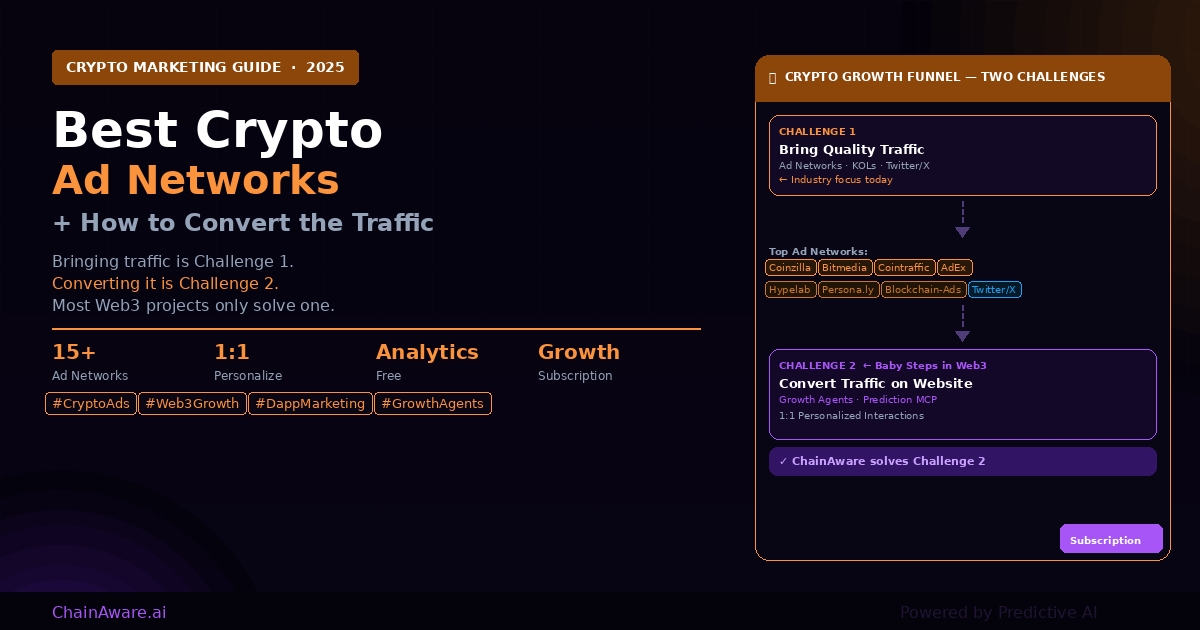
You run a campaign. You pick a crypto ad network, set a budget, write the creatives, and watch the traffic arrive. Wallet connections tick up. Transactions? Flat. Revenue? Unchanged. Welcome to the most common – and most expensive – problem in Web3 marketing in 2026.
The crypto industry has built an impressive ecosystem of advertising networks, KOL agencies, and growth tools – all focused on one goal: bringing traffic to your DApp or AI Agent. They do this reasonably well. But they stop at the door. What happens once a user lands on your platform – whether they stay, understand your product, trust it, and transact – remains almost entirely ignored. This guide covers both sides: every major crypto advertising network you need to know in 2026, and critically, what you must do after the traffic arrives to actually convert it.
In This Guide
- The Two Challenges of Crypto Marketing
- Quick Comparison: All 15 Networks at a Glance
- The Complete 2026 Crypto Advertising Network Reviews
- Best Network by Use Case: DeFi vs NFT vs GameFi vs Exchange
- Twitter/X: Still the Crypto-Native Channel
- Challenge 2: Converting Traffic – The Unsolved Problem
- Why Every Web3 DApp Needs 1:1 Personalization
- Growth Agents: Automated Conversion at Scale
- Prediction MCP: DIY Personalized Interactions
- Web3 Behavioral Analytics: Know Who You’re Attracting
- The Full-Funnel Framework for Web3 Growth
- FAQ
The Two Challenges of Crypto Marketing
Every Web3 marketing strategy must solve two fundamentally different problems. Most teams solve only the first one – and wonder why their unit economics never improve.
Challenge 1: Bring Quality Traffic to Your DApp
This is where the entire crypto marketing industry has focused its energy. Ad networks, KOL campaigns, Twitter/X promotion, Discord community building, Telegram groups, airdrop campaigns, conference sponsorships – all are solutions to Challenge 1. They put your project in front of relevant audiences and drive wallet connections. The ecosystem for Challenge 1 is mature. There are 15+ specialist crypto ad networks in this guide alone, hundreds of KOL agencies, and well-established playbooks for every sub-sector of Web3.
Challenge 2: Convert That Traffic on Your Website
This is where Web3 is still in its infancy. Once a user lands on your DApp and connects their wallet, what happens? In almost every Web3 project, the same thing happens as for every other user. The interface is identical. Messaging is generic. Calls to action are one-size-fits-all. But users are not identical. A wallet with three years of DeFi experience, high risk willingness, and a history of leveraged yield farming is a fundamentally different visitor than a wallet created last month with two token swaps to its name. Showing them the same homepage is a conversion failure for both. According to McKinsey’s personalization research ↗, companies that get personalization right generate 40% more revenue than those that don’t. In Web3, where acquisition costs run $300-$1,000 per transacting user, this gap is even wider – and almost no one addresses it. ChainAware.ai solves Challenge 2. More on that after the network reviews. For the full case, see our personalization guide and our DeFi onboarding guide.
Challenge 2 – Solved
Bringing Traffic Is Only Half the Battle
ChainAware Growth Agents read every connecting wallet, generate resonating personalized content, and deliver the right CTA to the right user – automatically. Convert the traffic you’re already paying for.
Quick Comparison: All 15 Networks at a Glance
In 2026, approximately 560 million known wallets hold cryptocurrency – but only 70 million are considered active. Reaching those active wallets requires choosing the right network for your audience type, budget, and campaign goal. The table below maps all 15 networks across the dimensions that matter most. Scroll right on mobile for full view.
| Network | Best For | Pricing Model | Min. Spend | Targeting | Bot Protection | Monthly Reach |
|---|---|---|---|---|---|---|
| Blockchain-Ads | DeFi / precise wallet targeting | CPM / CPA | $1,000/mo | On-chain wallet behavior, 37 chains | ✅ Strong | 1B+ daily impressions |
| Coinzilla | Brand awareness, broad crypto reach | CPM / CPC | €50/day | Geo, device, category | ✅ Strong | 1B+ monthly impressions |
| Bitmedia | Mid-size campaigns, flexible targeting | CPM / CPC | $20/day | Geo, device, interests, wallet activity | ✅ AI-powered | 5,000+ publisher sites |
| Cointraffic | Premium publishers, token launches | CPM | €100 | Geo, language, device, publisher | ✅ Curated inventory | Premium network |
| HypeLab | Active DeFi users, in-DApp reach | CPM | Contact sales | Wallet behavior, protocol category | ✅ Native environment | DEX/wallet/NFT apps |
| Slise | DeFi users during active sessions | CPM | Contact sales | Wallet activity, DEX users | ✅ In-DApp context | DeFi dashboard inventory |
| AdEx Network | Decentralized, transparent delivery | CPM / CPC | Low entry | Audience segments, publisher targeting | ✅ On-chain verified | 20,000+ users |
| A-ADS | Privacy-conscious audiences, low cost | CPD / CPA | Very low | Category, geo only | Moderate | Since 2011, large network |
| Persona.ly | Mobile app installs, GameFi, exchanges | CPI / CPA | Contact sales | Device, geo, lookalike | ✅ Strong anti-fraud | Mobile-first network |
| Adshares | Metaverse, gaming, Web3-native | CPM | Low | Category, metaverse placements | Blockchain verified | Decentralized network |
| Mintfunnel | Native ads + crypto PR distribution | Performance / CPM | Contact sales | Top-tier crypto media, guaranteed traffic | ✅ Quality publishers | Major crypto media |
| Addressable | On-chain audience targeting, display | CPM | Contact sales | Wallet behavior → programmatic display | ✅ On-chain verified | Web3-native audiences |
| CoinAd | Established brands, premium placement | CPM | Invite only | Publisher-level, premium inventory | ✅ Invite-only vetting | Curated premium sites |
| DOT Audience | Wallet-behavioral programmatic targeting | CPM | Contact sales | On-chain wallet segments → display | On-chain data | Programmatic display |
| Twitter/X Ads | Token launches, community, narrative | CPM / CPC | Flexible | Interests, follower lookalikes, keywords | Moderate | Largest crypto organic audience |
The Complete 2026 Crypto Advertising Network Reviews
1. Blockchain-Ads
Blockchain-Ads is the most sophisticated programmatic platform in crypto advertising – combining on-chain wallet data with traditional programmatic targeting to reach crypto audiences across the broader web, not just crypto media sites. As of 2026, the platform has matched over 23 million wallets to active audience profiles across 37 blockchains, delivering over 1 billion impressions daily across 10,000+ websites and apps.
Best for: DeFi protocols that need to reach specific wallet behavior profiles – DeFi whales, specific protocol users, holders of particular assets – via programmatic display at scale.
Targeting: Wallet holdings, DeFi activity, NFT ownership, chain preferences, standard geo and demographic targeting.
Pricing model: CPM and CPA. CPA campaigns perform best at $50K+ budgets; smaller campaigns work better on CPM.
Minimum spend: $1,000/month.
Bot protection: GDPR and CCPA certified. Strong fraud filtering.
Conversion gap: Blockchain-Ads excels at reaching the right wallets. After those wallets arrive on your DApp, you still need Web3 Behavioral Analytics to understand what they actually want, and Growth Agents to convert them.
2. Coinzilla
Coinzilla is one of the largest and most established crypto-native ad networks – operating since 2016 and now generating over 1 billion impressions monthly across 650+ premium crypto media sites including CoinCodex, with clients including eToro, KuCoin, Bybit, Crypto.com, and Nexo. Remarkably, 50% of all crypto market advertisers have worked with Coinzilla at some point, making it the de facto standard for brand awareness campaigns in Web3.
Best for: Brand awareness and broad reach across mainstream crypto audiences. High-volume campaigns, token launches needing mass crypto investor exposure, and projects wanting content marketplace distribution alongside display.
Targeting: Geo, device, category, and publisher-level targeting.
Pricing model: CPM and CPC with customized plans.
Minimum spend: €50/day.
Notable: Content marketplace enables PR placement on crypto media sites alongside display campaigns – useful for launch sequences.
3. Bitmedia
Bitmedia has served the crypto advertising market since 2014 and built one of the most accessible entry points for mid-size campaigns. The network spans 5,000+ publisher sites with AI-powered fraud filtering, and counts OKX, Bybit, KuCoin, and BitStarz among its major clients.
Best for: Mid-size campaigns requiring flexible targeting without large minimum commitment.
Pricing model: CPM and CPC.
Minimum spend: $20/day – one of the most accessible entry points for smaller projects.
Bot protection: AI-powered fraud filtering.
4. Cointraffic
Cointraffic has served the crypto advertising market since 2014, building a reputation for premium publisher relationships and strict quality controls. With over 4,700 campaigns completed and clients including KuCoin and Bitpanda, Cointraffic focuses on reaching informed crypto investors.
Best for: Token launches, exchange promotions, and DeFi protocol awareness campaigns targeting experienced crypto investors.
Pricing model: CPM.
Minimum spend: €100 minimum deposit.
5. HypeLab
HypeLab is a Web3-native programmatic platform designed specifically for DApps and blockchain products – serving ads directly within Web3 applications rather than crypto news sites. Placements appear inside wallets, DEXs, NFT platforms, and DeFi protocols, reaching users at the moment of active on-chain engagement.
Best for: Reaching users during active DeFi sessions. DeFi protocols targeting active DeFi users rather than spectators.
Notable: In-DApp placement delivers a higher-quality audience than display on news sites. Pairs well with ChainAware conversion tools since the incoming traffic already has strong behavioral signals.
6. Slise
Slise is a Web3-native ad network serving ads inside DApps – DEX interfaces, wallet UIs, and DeFi dashboards – targeting users based on wallet activity at the moment of on-chain interaction.
Best for: Reaching active DeFi and DEX users during live trading and portfolio management sessions.
Notable: In-DApp placements reach higher-quality, more engaged users than display ads on news sites.
7. AdEx Network
AdEx is a decentralized advertising protocol built on Ethereum – offering a trustless, transparent alternative to traditional ad networks. With over 20,000 registered users and billions in micropayments processed, AdEx is the most established decentralized option.
Best for: Web3-native projects that want verifiable, tamper-proof ad delivery. Excellent for DeFi and privacy-focused audiences that distrust centralized ad networks.
Notable: On-chain reporting makes it impossible to fake impressions – directly addressing the 15-25% bot traffic problem endemic to standard crypto networks.
8. A-ADS (Anonymous Ads)
A-ADS is one of the original crypto advertising networks, operating since 2011. It is fully anonymous – no account required to advertise, Bitcoin payments only, and no tracking or cookies.
Best for: Projects targeting privacy-conscious crypto users. Good for low-cost testing before scaling.
Minimum spend: Very low – starting from approximately $0.02 CPM on some formats.
9. Persona.ly
Persona.ly is a mobile-first performance advertising platform with strong coverage in crypto and GameFi. It specializes in user acquisition for crypto apps, exchanges, and play-to-earn games with CPI and CPA pricing.
Best for: Mobile crypto app installs, exchange user acquisition, and GameFi player acquisition.
Bot protection: Strong anti-fraud technology and transparent attribution.
10. Adshares
Adshares is a decentralized advertising ecosystem built on its own blockchain – enabling direct advertiser-to-publisher relationships without intermediaries. It supports display ads, native ads, and metaverse/virtual world advertising placements.
Best for: Projects targeting metaverse, gaming, and virtual world audiences. Strong for Web3 projects wanting decentralized ad infrastructure.
Notable: Dedicated metaverse ad placements – a niche but growing category.
11. Mintfunnel
Mintfunnel has emerged as a strong option for teams that want native ads combined with crypto PR distribution – providing guaranteed levels of qualified traffic with performance-based pricing alongside sponsored placements on top-tier crypto media.
Best for: Native advertising and crypto PR distribution. Particularly effective for teams launching new products who want guaranteed exposure on credible crypto publications.
12. Addressable
Addressable is a Web3 data and advertising platform that builds audience segments from on-chain wallet data and deploys them across programmatic advertising channels – bridging the gap between on-chain identity and real-world display targeting.
Best for: Data-driven campaigns where the advertiser wants to reach specific wallet behavior profiles via standard display advertising.
Notable: On-chain data as the targeting basis rather than cookie-based behavioral proxies. For context on how on-chain wallet targeting fits the growth stack, see our Web3 Growth Platforms comparison.
13. CoinAd
CoinAd is an invite-only display advertising network with a carefully curated set of premium crypto publishers.
Best for: Established projects that can pass the invite-only vetting process. Premium brand placement alongside top-tier crypto content.
14. DOT Audience
DOT Audience is a Web3 data and advertising platform that builds audience segments from on-chain wallet data and deploys them across programmatic advertising channels.
Best for: Data-driven campaigns targeting specific wallet behavior segments via programmatic display.
15. Mintable Ads
Mintable Ads focuses specifically on NFT and Web3 gaming audiences – offering placements across NFT marketplaces, gaming platforms, and creator economy sites.
Best for: NFT projects, Web3 games, and creator tools targeting collectors, players, and digital artists.
Before You Spend on Ads – Know Your Baseline
Are Your Campaigns Bringing the Right Users?
Web3 Behavioral Analytics shows you the real profile of every wallet connecting to your DApp – intentions, experience, risk tolerance, Wallet Rank. Establish your behavioral baseline before any campaign. Measure quality, not just volume. Free, Google Tag Manager setup. Full documentation at the Web3 User Analytics learn guide.
Best Network by Use Case: DeFi vs NFT vs GameFi vs Exchange
No single network wins for every campaign type. The most effective 2026 stacks combine one network strong on reach with one strong on behavioral targeting precision. Here is the recommended pairing by product type.
DeFi Protocols
Primary: Blockchain-Ads or Addressable – both target wallets based on actual DeFi on-chain behavior. Secondary: HypeLab or Slise – in-DApp placements reach active DeFi users mid-session. Awareness layer: Coinzilla for broad crypto investor reach during launch phases. After traffic arrives, ChainAware Growth Agents convert DeFi-experienced wallets into transacting users by surfacing the right product and CTA for each behavioral profile.
NFT Projects and Marketplaces
Primary: Mintable Ads – specialized NFT and creator economy inventory. Secondary: Coinzilla or Bitmedia for broad crypto audience reach. PR layer: Mintfunnel for native placement on crypto media alongside display.
GameFi and Play-to-Earn
Primary: Persona.ly – the strongest mobile-first CPI/CPA network for game installs. Secondary: Adshares – dedicated metaverse and gaming inventory. Awareness: Bitmedia for flexible targeting at accessible entry cost.
Crypto Exchanges and Trading Platforms
Primary: Coinzilla – the broadest premium crypto inventory reach. Secondary: Cointraffic for European premium publisher coverage. Precision layer: Blockchain-Ads for targeting specific trading behavior profiles. Bot protection priority: Prioritize AdEx (on-chain verified delivery) or Bitmedia (AI fraud filtering).
Token Launches
Recommended stack: Mintfunnel (PR + native for credibility) + Coinzilla (broad reach for volume) + Blockchain-Ads (precision wallet targeting for qualified buyers). Time-compressed launch campaigns benefit from parallel channel activation rather than sequential testing – run all three simultaneously and measure behavioral quality through ChainAware Analytics within 48-72 hours.
Twitter/X: Still the Crypto-Native Channel
No guide to crypto advertising is complete without addressing Twitter/X – the de facto home of crypto culture, where projects are made and broken in real time. While not a dedicated crypto ad network, Twitter/X is the single most important paid and organic channel for most Web3 projects in 2026.
Twitter/X Ads allows crypto projects to run promoted tweets, follower campaigns, and app install campaigns targeting crypto and finance audiences. The organic amplification effect is unique: a promoted tweet that gains genuine traction can reach an audience many times larger than the paid distribution alone.
Best for: Token launches, community building, NFT drops, and narrative-driven campaigns.
KOL caution: Before paying for KOL promotion, audit the KOL’s wallet – does their on-chain history match the DeFi expertise they claim?
Challenge 2: Converting Traffic – The Unsolved Problem
Here is the conversion reality for most Web3 projects in 2026: the average DeFi protocol converts fewer than 3% of wallet connections into active transacting users. For many projects, the figure is under 1%. The industry has collectively spent hundreds of millions on driving traffic while almost nothing has been spent on converting it. Three structural reasons create this gap.
Pseudonymity. Web3 users don’t fill out registration forms or create profiles. You have a wallet address and nothing else – no name, no email, no stated preferences. Complexity. DeFi, NFT, and GameFi products are genuinely complex. The difference between a user who understands liquidation risk on a lending protocol and one who has never used DeFi is enormous – yet both arrive at your homepage seeing identical content. Generic interfaces. Every Web3 website looks the same to every visitor regardless of who they are. According to Salesforce research ↗, 73% of customers expect personalized experiences – and in Web3, no platforms deliver them at scale.
Why Every Web3 DApp Needs 1:1 Personalization
The solution to the conversion problem is not a better homepage – it is 1:1 personalization based on who the user actually is, derived from verifiable on-chain behavioral data. When a wallet connects to your DApp, that wallet already has a history. It has traded, staked, borrowed, bridged, and participated in governance across dozens of protocols over months or years. That history reveals everything you need to engage this specific user.
- Experience level – are they a DeFi veteran or a newcomer? The right explanation for a lending protocol is completely different for each.
- Risk willingness – do they seek high-yield leveraged strategies or conservative stable returns? Showing the wrong product to the wrong risk profile guarantees non-conversion.
- Intentions – what are they likely to do next? A wallet with high trading intent landing on a lending product needs a specific bridge.
- Protocol history – have they used your competitors? Do they understand the product category?
None of this data requires registration, cookies, or user consent forms. It is public, verifiable on-chain data – available the moment a wallet connects. For the complete architecture behind how this personalization works at the point of connection, see the Agentic Onboarding Personalisation use case. For the complete personalization case, see our User Segmentation guide and our Behavioral User Segmentation guide.
Growth Agents: Automated Conversion at Scale
ChainAware Growth Agents are the conversion layer that ad networks cannot provide. The full agent catalogue and deployment guide is available at the Growth Agents learn guide. Here is exactly how they work:
- Wallet connects to your DApp – the Growth Agent captures the address instantly.
- Behavioral profile is generated – the agent queries ChainAware’s 18M+ wallet database and receives the full Web3 Persona: experience level, risk willingness, all 12 intention probabilities, protocol history, Wallet Rank, and AML status – in under a second.
- Resonating content is generated automatically – the agent uses this profile to determine which product, which message, and which CTA will resonate with this specific wallet.
- The right CTA is delivered – not a generic “Connect Wallet” button, but a specific personalized call to action matched to this user’s behavioral profile and likely next action.
The result is a DApp that behaves differently for every user – not because you built hundreds of product variants, but because the Growth Agent reads the wallet and dynamically delivers the right version of your message. See the SmartCredit.io case study – 8x engagement and 2x primary conversions from the same traffic after implementing Growth Agents and Behavioral Analytics.
Convert Your Existing Traffic
Growth Agents: 1:1 Personalization for Every Wallet
Every wallet connecting to your DApp gets a personalized experience – automatically. Right message, right product, right CTA, matched to their on-chain behavioral profile. No code changes. No manual segmentation. Subscription plan.
Prediction MCP: DIY Personalized Interactions
For developers who want direct control over the personalization layer, ChainAware’s Behavioral Prediction MCP exposes the full wallet intelligence layer as a real-time API for AI agents and LLMs. The Prediction MCP is ideal for teams building AI Agents for DeFi, NFT, or GameFi where the agent needs to adapt its behavior based on who it’s talking to, not just what they’re saying. Full documentation at the Prediction MCP learn guide. For the complete technical integration guide, see our Prediction MCP developer guide and our 12 blockchain capabilities any AI agent can use. Available on subscription.
Web3 Behavioral Analytics: Know Who You’re Attracting
Before optimizing conversion, you need to understand the baseline: who is your current traffic, really? ChainAware’s Web3 Behavioral Analytics aggregates the behavioral profile of every wallet connecting to your DApp, updated daily. The dashboard shows experience distribution, aggregate risk willingness, dominant intentions, protocol backgrounds, Wallet Rank distribution, and predicted fraud rates. Full methodology at the DeFi Business Analytics learn guide.
Once you know your current traffic is predominantly newcomers with low risk willingness, you know your campaign targeting needs to shift before spending another dollar on the wrong audience. Setup is via Google Tag Manager – no engineering required. Web3 Behavioral Analytics is free via the starter plan at chainaware.ai/subscribe/starter.
The Full-Funnel Framework for Web3 Growth
The most effective Web3 growth strategy combines Challenge 1 tools (ad networks) with Challenge 2 tools (conversion) into a single measurement loop. Here is the five-step framework.
Step 1 – Establish your behavioral baseline. Before any campaign, install the ChainAware Analytics pixel via Google Tag Manager. Let it run for 1-2 weeks. Document your baseline user profile. Web3 Behavioral Analytics is free.
Step 2 – Run your ad network campaigns. Use the networks in this guide. Different networks for different audiences: Blockchain-Ads and HypeLab for wallet-behavioral targeting; Coinzilla and Cointraffic for broad crypto awareness; Slise for active DeFi users; Mintfunnel for PR and native reach; A-ADS for privacy-conscious audiences.
Step 3 – Measure campaign quality, not just volume. After each campaign, check your Behavioral Analytics dashboard. Did new users improve or degrade your quality metrics? A campaign driving 1,000 newcomer wallets is less valuable than one driving 200 experienced DeFi participants. Note that 15-25% of crypto ad clicks are typically bot or invalid traffic – your Behavioral Analytics will surface this immediately as unusually low Wallet Rank and very new wallet ages in campaign cohorts.
Step 4 – Activate Growth Agents or Prediction MCP for conversion. Once traffic arrives, make sure your site converts it. Deploy Growth Agents for 1:1 personalized content and CTAs at every wallet connection (subscription). Alternatively, integrate the Prediction MCP to power personalized AI agent conversations (subscription).
Step 5 – Reallocate ad spend based on behavioral ROI. After 4-6 weeks of data, you will know which channels drive high-quality users and which drive volume without quality. Reallocate budget toward quality. Repeat. For the full platform integration playbook, see our Web3 Marketing Analytics guide.
ChainAware.ai – Solve Challenge 2
You’ve Solved Challenge 1. Now Convert the Traffic.
Growth Agents and Prediction MCP are available on subscription. Web3 Behavioral Analytics – which shows you who your users really are – is free to start via Google Tag Manager.
Frequently Asked Questions
Which crypto ad network has the best ROI in 2026?
ROI depends heavily on your product type, target audience, and what you measure. HypeLab and Slise deliver the highest-quality users (active DeFi participants in-session) but at higher CPMs. Blockchain-Ads and Addressable offer the best precision wallet targeting for DeFi protocols. Coinzilla provides the broadest reach for brand awareness campaigns. A-ADS and Bitmedia offer the lowest entry cost for testing. The most important variable is measuring user quality alongside volume – use ChainAware Behavioral Analytics to compare Wallet Rank distribution and intention profiles across campaigns from different networks before making budget allocation decisions.
What is the minimum budget to start with crypto ad networks?
Entry points vary significantly across networks. A-ADS starts at effectively $0 for very small tests. Bitmedia allows campaigns from $20/day. Cointraffic accepts deposits from €100. Coinzilla runs from €50/day. Blockchain-Ads requires $1,000/month minimum. For most teams new to crypto advertising, starting with Bitmedia or Coinzilla at $500-$1,000 for a 2-week test campaign is a reasonable way to gather baseline data before scaling to higher-precision options like Blockchain-Ads.
How do I prevent wasting budget on bot traffic?
Bot traffic averages 15-25% of clicks across crypto ad networks. Three approaches reduce exposure: first, choose networks with verified fraud protection (Bitmedia’s AI filtering, AdEx’s on-chain verification, Persona.ly’s attribution technology). Second, measure post-click behavioral quality through ChainAware Analytics – a sudden spike of very new wallets with near-zero Wallet Rank scores after a campaign launch is a strong bot signal. Third, use CPA pricing models where available.
What is the difference between in-DApp networks and crypto news site networks?
Crypto news site networks (Coinzilla, Cointraffic, Bitmedia) place ads on websites where people read about crypto. In-DApp networks (HypeLab, Slise) place ads inside DeFi applications while users are actively transacting. In-DApp placements consistently deliver higher-quality audiences because users are already engaged with Web3 infrastructure. However, in-DApp reach is smaller and CPMs are generally higher. The practical stack for most DeFi protocols in 2026 is news-site networks for awareness volume plus in-DApp networks for high-intent reach.
What is Growth Agents and how is it different from a CRM?
A CRM requires users to register and provide data. Growth Agents work with pseudonymous wallets – no registration required. The behavioral profile comes entirely from on-chain history the moment a wallet connects. It is not CRM; it is real-time on-chain behavioral intelligence applied to conversion. Every connecting wallet gets a personalized experience automatically based on their Web3 Persona – experience level, risk willingness, and 12 intention probabilities – without the user ever submitting any information. Growth Agents are available on subscription.