
Last Updated: February 2026
When a bank approves a mortgage, it doesn’t just check your credit score once and forget about you. It monitors your account continuously — watching for signs of financial distress, missed payments on other accounts, new debt accumulation, or income changes that might predict repayment problems. This ongoing surveillance is how traditional lenders manage portfolio risk at scale. They don’t wait for a default to discover that a borrower’s financial situation had deteriorated months earlier.
DeFi lending protocols have lacked this capability entirely. The standard practice has been to assess creditworthiness at the moment of loan origination — either through overcollateralization (no assessment needed) or, increasingly, through one-time credit checks before loan approval. What happens to that borrower’s creditworthiness after the loan is extended? Most protocols have no idea. They find out when the borrower defaults.
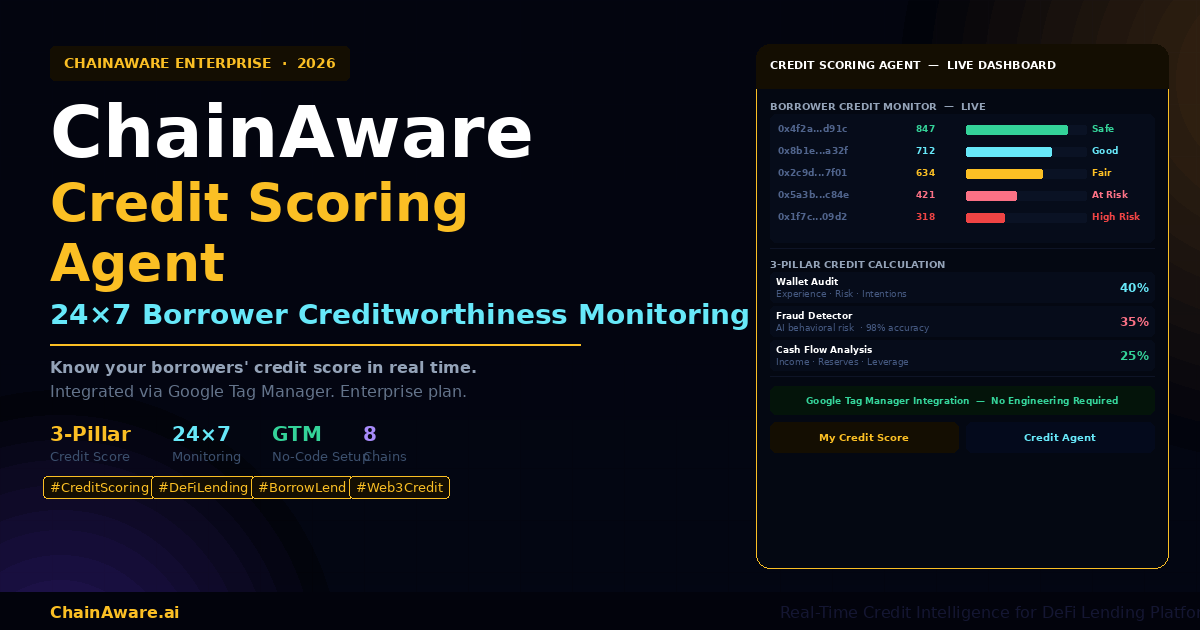
ChainAware’s Credit Scoring Agent closes this gap. It is an always-on monitoring system that continuously tracks the AI credit scores of every wallet in your lending platform’s borrower base — 24 hours a day, 7 days a week — and alerts your team the moment a borrower’s creditworthiness profile changes significantly. Built for DeFi lending protocols on the Enterprise plan, it integrates via Google Tag Manager with no engineering work required.
This guide explains what the Credit Scoring Agent does, how its 3-pillar credit scoring engine works, how it differs from one-time credit checks, how to integrate it, and why continuous creditworthiness monitoring is the missing infrastructure layer in every DeFi lending protocol operating in 2026.
The Missing Layer: Why One-Time Credit Checks Are Not Enough
The fundamental flaw in how most DeFi lending protocols currently handle credit risk is timing. Even protocols that have adopted sophisticated credit scoring at origination — checking a borrower’s Wallet Audit profile, fraud score, and behavioral history before approving a loan — are only capturing a snapshot of creditworthiness at a single moment in time. The borrower’s actual financial situation on the day of the check may be completely different from their situation 30, 60, or 90 days later.
In traditional finance, this is well understood. Credit bureaus update scores monthly. Banks review account holders’ credit profiles on a regular cadence. Risk management systems flag accounts when spending patterns change, new delinquencies appear elsewhere, or debt-to-income ratios shift. The entire infrastructure of traditional lending is built around the insight that creditworthiness is dynamic, not static.
On-chain, creditworthiness changes continuously and often faster than in TradFi. A borrower’s DeFi positions can change dramatically in days. A wallet that was managing risk conservatively when it took out a loan can be overleveraged three weeks later. A borrower with a clean fraud profile at origination can begin exhibiting behavioral risk patterns that predict default within weeks. Cash flows from yield farming or protocol fees — a core component of on-chain repayment capacity — can evaporate with a market move or protocol incident overnight.
According to research from the Bank for International Settlements on crypto market surveillance, behavioral risk patterns that precede defaults in DeFi lending typically develop over days to weeks before the default executes — meaning that platforms with continuous monitoring have a meaningful early-warning window that one-time-check systems entirely miss.
The Credit Scoring Agent provides exactly this continuous monitoring capability — applying ChainAware’s full 3-pillar credit scoring engine to every wallet in your borrower base, continuously, and alerting your team when scores change materially.
Know Your Borrowers’ Credit Score Right Now
Check Any Wallet’s AI Credit Score — Free
Before deploying the Credit Scoring Agent across your platform, check individual wallet credit scores with ChainAware’s free Wallet Credit Score tool. Instant 0–1000 score based on Wallet Audit + Fraud Detector + Cash Flow Analysis. No KYC. 8 networks.
What the Credit Scoring Agent Does
The Credit Scoring Agent is a persistent monitoring system that runs ChainAware’s AI credit scoring algorithm continuously across a defined set of wallet addresses — specifically, the borrowers and active users of a DeFi lending protocol. It is the automated, always-on version of the credit check a lending team would otherwise have to run manually, repeatedly, across potentially thousands of borrower addresses.
The Agent operates in four stages. First, when a wallet connects to your Dapp, the Agent immediately calculates its full credit score using the 3-pillar algorithm — Wallet Audit, Fraud Detector, and Cash Flow Analysis — and records the baseline score in your dashboard. Second, the Agent continuously re-scores every wallet that has ever connected to your platform, running the full credit calculation at regular intervals 24 hours a day, 7 days a week. Third, when any wallet’s credit score changes materially — either improving or deteriorating — the Agent logs the change and triggers an alert to your configured notification channel. Fourth, your team reviews the alert and takes action: adjusting loan terms, requesting additional collateral, limiting new borrowing, or flagging the account for enhanced monitoring.
The result is a live credit risk dashboard for your entire borrower portfolio — equivalent to what a bank’s risk management desk monitors manually, fully automated and powered by on-chain behavioral AI. For context on how the underlying credit scoring algorithm works, see our complete guide to ChainAware Credit Scoring.
The 3-Pillar Credit Score: Wallet Audit + Fraud + Cash Flow
The Credit Scoring Agent’s power comes from the sophistication of the underlying credit score it monitors. This is not a simple fraud flag or a single-dimension risk score — it is a composite credit assessment modeled closely on how TradFi credit scoring works, but built entirely from on-chain behavioral data with no KYC, no personal data, and no off-chain inputs.
The score ranges from 0 to 1000 and is calculated from three weighted components.
Pillar 1: Wallet Audit (40% Weight)
The Wallet Auditor provides the behavioral profile component — the equivalent of TradFi’s credit history and payment behavior. It analyzes: Experience Level (how long and how actively the wallet has participated in DeFi), Risk Willingness (the demonstrated risk appetite from actual financial decisions, not self-reported preferences), Predicted Intentions (what behavioral AI assesses the wallet is likely to do next), and Wallet Rank (the composite quality percentile among 14M+ profiled wallets). A wallet with high experience, moderate and consistent risk behavior, and a top-percentile Wallet Rank has the behavioral profile of a reliable long-term borrower. For a deep dive into what each dimension measures, see the Wallet Rank complete guide.
Pillar 2: Fraud Detector (35% Weight)
The Predictive Fraud Detector contributes the most heavily weighted single component — because a borrower who intends to default is a categorically different risk from a borrower who might struggle to repay. The Fraud Detector achieves 98% accuracy in predicting fraudulent behavior before it occurs, analyzing behavioral patterns including wallet preparation sequences, interaction patterns with known risky protocols, mixing service usage, sybil signatures, and fund movement timing. For credit scoring purposes, this generates a Trust Score (1 minus Fraud Score) that directly weights the credit assessment. A wallet with a 95% Trust Score is a very different credit risk than a wallet with a 60% Trust Score, even if their cash flows look similar.
Critically — as documented in our Transaction Monitoring Agent guide — fraud is frequently committed with clean funds. AML checks will not catch a borrower who intends to default because their funds are clean. The behavioral Fraud Detector catches the risk signal that AML entirely misses.
Pillar 3: Cash Flow Analysis (25% Weight)
Cash flow analysis is the most direct measure of repayment capacity — the on-chain equivalent of income verification in TradFi lending. ChainAware’s AI models analyze: Income consistency (are there regular, predictable inflows, or erratic spikes?), Source diversity (is income derived from multiple protocol sources or a single fragile position?), Liquidity management (how much reserve is maintained, how is leverage deployed, how are emergencies handled?), and Trend direction (is the wallet’s financial position improving or deteriorating over time?).
A borrower with consistent yield farming income across three protocols, maintained stablecoin reserves, and conservative leverage management scores very differently from a borrower with a single concentrated position and 90% of capital deployed. The cash flow component makes these distinctions quantitatively, continuously.
The Formula
Credit Score (0–1000) = (Wallet Audit × 0.40) + (Fraud Risk × 0.35) + (Cash Flow × 0.25)Because all three components are derived from on-chain data that updates with every transaction, the credit score is effectively live — not a monthly snapshot but a continuously recalculated assessment. The Credit Scoring Agent monitors this live score for every wallet in your portfolio and triggers alerts whenever the composite score changes by a meaningful threshold.
Monitor Every Borrower — 24×7, Automated
Credit Scoring Agent: Live Portfolio Risk Intelligence
The Credit Scoring Agent continuously re-scores every wallet in your lending protocol’s borrower base using the full 3-pillar credit algorithm. When a borrower’s score drops materially, you get an immediate alert — before they default. Enterprise plan. Google Tag Manager integration.
Credit Scoring Agent vs Transaction Monitoring Agent
ChainAware offers two always-on monitoring agents, and understanding the distinction helps clarify when each is the right tool for your platform.
The Transaction Monitoring Agent is powered by the Fraud Detector alone. It monitors every wallet that connects to your Dapp and continuously re-screens them for fraud risk — answering the question: will this wallet commit fraud against my platform or my users? It is the right tool for any Dapp that wants to protect its user base from fraudulent actors — NFT marketplaces, GameFi platforms, exchanges, and general DeFi protocols. It is available on standard plans.
The Credit Scoring Agent is powered by the full 3-pillar credit algorithm: Wallet Audit + Fraud Detector + Cash Flow Analysis. It monitors your borrower base specifically for creditworthiness changes — answering the question: are my borrowers still able and willing to repay their loans? It is the right tool for lending and borrowing protocols where loan repayment risk — not just fraud — is the primary concern. The credit calculation is significantly more complex than the fraud-only calculation, reflecting the higher stakes of lending relationships. It is available on the Enterprise plan.
The two agents are complementary, not competing. A DeFi lending protocol ideally runs both: Transaction Monitoring for broad fraud protection across all connecting wallets, and Credit Scoring Agent for deep creditworthiness monitoring of the specific subset of wallets with active loan positions.
How It Works: From GTM Pixel to Live Dashboard
The Credit Scoring Agent’s integration architecture is identical to the Transaction Monitoring Agent — both use the ChainAware Pixel deployed via Google Tag Manager. This means no engineering work, no smart contract changes, and no backend modifications are required. The Pixel is a lightweight tag added to your GTM container that detects wallet connection events and registers every connecting address with the ChainAware monitoring system.
Step 1: Deploy the ChainAware Pixel via Google Tag Manager
Log into your ChainAware Enterprise account and navigate to the Credit Scoring Agent setup. Copy the ChainAware Pixel tag and add it to your Google Tag Manager container, configured to fire on wallet connection events. This is the same GTM integration used for Web3 Behavioral Analytics — if you already have the ChainAware Pixel deployed, activating the Credit Scoring Agent is a configuration change, not a new integration.
Step 2: Activate the Credit Scoring Agent
In the ChainAware Enterprise dashboard, activate the Credit Scoring Agent for your Dapp. Configure your alert thresholds — for example, alert when a wallet’s credit score drops by more than 80 points, or when any borrower crosses below the 550 score threshold. Connect your Telegram channel for real-time alert delivery. The Agent immediately begins scoring every wallet that connects, and retroactively scores your existing connected wallet database.
Step 3: Initial Score Baseline
The Agent calculates baseline credit scores for your entire existing borrower portfolio. This initial scoring run gives you an immediate credit risk snapshot of your current book: how many borrowers are in the Excellent range (850+), how many are in Good standing (650–749), how many are in Fair territory (550–649), and how many have already dropped below 550 into the high-risk zone. This baseline is the foundation against which all future score changes are measured.
Step 4: Continuous 24×7 Re-Scoring
From this point, every wallet in your borrower portfolio is continuously re-scored around the clock. The re-scoring frequency is designed to catch meaningful score changes as they develop — giving your team an early-warning window before a deteriorating borrower’s position reaches crisis level. According to FATF guidance on virtual asset risk management, continuous behavioral monitoring is the emerging standard for DeFi platforms — and the Credit Scoring Agent provides exactly this for the creditworthiness dimension.
Step 5: Alerts and Dashboard
When a borrower’s credit score changes materially, an alert is delivered to your configured Telegram channel, including the wallet address, previous score, current score, the direction and magnitude of change, and which pillar drove the change. Simultaneously, the dashboard updates to reflect the new portfolio credit distribution. Your team can drill into any flagged wallet for the full credit breakdown — which pillar changed and why.
Real-Time Credit Risk — Catch Deterioration Before Default
Credit Scoring Agent: The Risk Desk Your DeFi Protocol Never Had
In TradFi, banks monitor borrower portfolios continuously. DeFi lending has had no equivalent — until now. The Credit Scoring Agent gives your protocol a live credit risk desk powered by 3-pillar AI scoring across your entire borrower base. Enterprise plan. GTM integration. No engineering required.
Alerts: When and How Your Team Gets Notified
The alert system is the operational core of the Credit Scoring Agent — the mechanism that turns continuous background monitoring into actionable intelligence for your team. Alerts are delivered via Telegram, the communication channel most DeFi teams already use for operations and community management.
Alerts are triggered by three conditions. The first is a threshold breach — a borrower’s credit score drops below a configured floor score (e.g., 550 or 650). This is the most critical alert type: it means a borrower has crossed into a materially higher risk tier and requires immediate review of their loan position. The second is a significant score drop — a borrower’s score declines by more than a configured number of points (e.g., 80+ points) within a monitoring period, regardless of absolute level. A borrower dropping from 820 to 720 may still be in Good standing, but the velocity of the decline is an early warning signal worth investigating. The third is a pillar-specific change — a sharp deterioration in a specific component, such as a Fraud Detector score spike indicating new behavioral risk patterns, even if the composite score hasn’t yet crossed an alert threshold.
Alert configuration is flexible: teams can set different thresholds for different borrower tiers (larger loan positions warrant more sensitive alerting), configure quiet hours for non-critical alerts, and assign alerts to different Telegram channels for different team functions (risk management vs. collections vs. executive).
What to Do When Credit Scores Deteriorate
When the Credit Scoring Agent surfaces a materially deteriorating borrower, your team has several response options depending on the severity and pattern of the decline.
Enhanced monitoring is the first step for moderate score declines — wallets that have dropped significantly but remain above critical thresholds. Add the wallet to a higher-frequency monitoring tier and watch for continued deterioration. No borrower-facing action is taken yet, but the signal is logged and tracked.
Collateral adjustment request is appropriate for borrowers whose scores have crossed from Good into Fair territory (below 650). If your protocol’s smart contracts support dynamic collateral requirements, this is the time to trigger a margin call or collateral top-up request — before the situation has deteriorated to the point where the borrower may not be able to comply.
Borrowing limit reduction is appropriate for borrowers showing continued deterioration. Reducing the maximum available credit for a wallet whose score is trending downward limits your protocol’s exposure without requiring immediate loan recall.
Loan position flagging for manual review by your risk team is appropriate for borrowers who have crossed below 550 or whose Fraud Detector component has spiked sharply — indicating the possibility that the borrower has shifted from creditworthy-but-struggling to potentially-fraudulent.
Position liquidation or acceleration is the last resort for borrowers whose scores have dropped below critical thresholds and whose on-chain behavior indicates high probability of intentional default. This decision should involve your legal and operations teams, but the Credit Scoring Agent gives you the early warning that makes the difference between a managed exit and an unrecoverable loss.
The key operational advantage of continuous monitoring is that all of these responses can be taken at a stage when they are still effective — before the borrower has missed a payment, before their collateral has been drained, and before the fraud has executed. According to IMF research on fintech lending risk, early intervention on deteriorating borrowers dramatically improves recovery rates compared to reactive post-default action — a dynamic that applies equally to DeFi lending.
Use Cases: Who Needs Credit Scoring Agent
Undercollateralized DeFi Lending Protocols
This is the primary use case for which the Credit Scoring Agent was built. Protocols offering undercollateralized or lightly-collateralized loans — where borrower creditworthiness genuinely determines platform solvency — need continuous credit monitoring to manage portfolio risk at scale. Without it, they are flying blind between loan origination and default. With the Credit Scoring Agent, they have a live view of every borrower’s creditworthiness trajectory, enabling proactive risk management at the individual account level.
As documented in our complete Web3 credit scoring guide, platforms using ChainAware credit scoring at origination have demonstrated 43% higher borrower acquisition and 68% lower default rates compared to overcollateralized-only approaches. The Credit Scoring Agent extends this advantage into the post-origination lifecycle.
RWA (Real-World Asset) Lending Platforms
Tokenized real-world asset lending — where on-chain borrowers receive financing against off-chain or tokenized assets — requires ongoing borrower monitoring because the loan-to-value dynamics can change significantly as asset values shift. The Credit Scoring Agent provides the continuous credit health tracking that RWA lending platforms need to manage their portfolios responsibly.
DAO Treasury Credit Lines
DAOs that have extended credit lines to partner DAOs, ecosystem projects, or contributors need to monitor the ongoing creditworthiness of their counterparties. A DAO treasury that extended a credit line based on a strong credit profile six months ago should know if that counterparty’s on-chain financial position has deteriorated since. The Credit Scoring Agent provides this ongoing visibility with no manual intervention required.
DeFi Yield Vaults with Credit-Based Strategies
Yield vault strategies that involve lending to other protocols or counterparties based on their credit profiles need continuous credit monitoring to know when their counterparty risk has changed. A vault that allocated capital based on a borrower’s 800+ credit score needs to be alerted when that score drops to 620 — so it can rebalance the allocation before the deterioration reaches the point of default.
B2B Web3 Payment and Trade Finance
Web3-native businesses extending net payment terms or trade credit to counterparties face the same ongoing credit risk as traditional trade finance — but without TradFi’s monitoring infrastructure. The Credit Scoring Agent provides the continuous credit surveillance that makes extended payment terms manageable in a pseudonymous Web3 environment.
Integration: Google Tag Manager, No Code Required
One of the Credit Scoring Agent’s key design principles is zero-friction integration. Like all ChainAware monitoring tools, it integrates via the ChainAware Pixel deployed through Google Tag Manager — the same no-code deployment model used for Web3 Behavioral Analytics and the Transaction Monitoring Agent.
This means: no smart contract modifications, no backend API integration, no frontend code changes, and no engineering team resources required to deploy. A DeFi protocol with an existing Google Tag Manager setup can have the Credit Scoring Agent live across their entire platform within 30 minutes of activating the Enterprise plan.
For teams that want deeper programmatic access — querying credit scores directly in smart contract logic, building automated collateral adjustment systems, or integrating credit intelligence into AI agent decision workflows — the Prediction MCP provides full API access to the ChainAware credit scoring engine. AI agents can query any wallet’s real-time credit score, fraud probability, and behavioral profile programmatically. For the full developer integration guide, see the Prediction MCP complete guide.
The GTM integration model also means that a single Pixel deployment activates multiple ChainAware capabilities simultaneously. Teams deploying the Pixel for Web3 Behavioral Analytics get transaction monitoring as an additional layer at no integration cost; teams on Enterprise additionally get Credit Scoring Agent monitoring across the same deployed infrastructure. There is no incremental integration effort for each additional capability.
Enterprise Plan: What’s Included
The Credit Scoring Agent is an Enterprise plan feature, reflecting the computational complexity of continuous 3-pillar credit scoring across large borrower portfolios. The Enterprise plan is designed for DeFi protocols with significant active user bases and meaningful financial exposure that justifies institutional-grade monitoring infrastructure.
The Enterprise plan includes: Credit Scoring Agent with continuous 24×7 portfolio monitoring, configurable alert thresholds with Telegram delivery, full credit score breakdown by pillar for every monitored wallet, portfolio-level credit distribution analytics, historical score trend data for individual borrowers, and priority support from the ChainAware team. It also includes full access to Transaction Monitoring Agent, Web3 Behavioral Analytics, the Prediction MCP API, and all other ChainAware capabilities — providing the complete Predictive Intelligence Stack in a single subscription.
For protocols evaluating the business case, the calculation is straightforward: the cost of a single prevented significant default on an undercollateralized loan position typically exceeds the annual cost of the Enterprise plan many times over. The Credit Scoring Agent is not an overhead cost — it is a risk mitigation tool whose return on investment is measured in defaults prevented and losses avoided. As the CFPB’s research on credit scoring benefits has established in TradFi, the value of credit infrastructure accrues primarily through the losses it prevents rather than the revenue it directly generates.
How It Connects to the ChainAware Product Ecosystem
The Credit Scoring Agent sits within ChainAware’s broader Predictive Intelligence Stack as the specialized lending risk layer. Understanding where it fits clarifies how lending protocols should deploy the full stack.
The Wallet Auditor is the on-demand tool for checking individual wallet profiles — useful for manual due diligence before loan approval or investigating a specific flagged address. The Credit Scoring Agent automates this at portfolio scale continuously.
The Fraud Detector powers the Transaction Monitoring Agent for general fraud protection and forms 35% of the credit score. Both monitoring agents share the same underlying behavioral AI — the Credit Scoring Agent’s assessment is deeper because it adds two additional pillars.
The Web3 Behavioral Analytics dashboard gives lending teams a portfolio-level view of their user base’s behavioral characteristics — experience levels, risk willingness distribution, predicted intentions — complementing the credit risk view with the full behavioral intelligence picture.
For the complete picture of how ChainAware’s products work together as an integrated system, see the ChainAware complete product guide. According to World Bank data on financial inclusion and credit access, the expansion of credit scoring infrastructure is the single most impactful factor in unlocking lending markets for previously underserved populations — a dynamic that applies directly to DeFi’s potential to become a genuinely inclusive financial system as tools like the Credit Scoring Agent mature.
ChainAware.ai — Complete DeFi Lending Risk Stack
My AI Credit Score · Credit Scoring Agent · Prediction MCP
Check individual wallet credit scores free. Monitor your entire borrower portfolio 24×7 with the Credit Scoring Agent. Integrate credit intelligence into AI agents via Prediction MCP. The complete credit risk infrastructure for DeFi lending in 2026.
Check My AI Credit Score Free ↗
Frequently Asked Questions
What is the Credit Scoring Agent?
The Credit Scoring Agent is a ChainAware Enterprise feature that continuously monitors the AI credit scores of every wallet in a DeFi lending protocol’s borrower base — 24 hours a day, 7 days a week. It applies the full 3-pillar credit algorithm (Wallet Audit + Fraud Detector + Cash Flow Analysis) continuously and alerts the lending team via Telegram when any borrower’s creditworthiness changes materially. It is the DeFi equivalent of a bank’s live portfolio credit risk monitoring desk, fully automated.
How is the Credit Scoring Agent different from the Transaction Monitoring Agent?
The Transaction Monitoring Agent monitors for fraud risk using the Fraud Detector alone — it answers “will this wallet commit fraud against my platform?” The Credit Scoring Agent monitors for creditworthiness using the full 3-pillar credit algorithm — it answers “can and will this borrower repay their loan?” The credit calculation is more complex, covering wallet behavioral profile, fraud risk, and cash flow analysis. The Credit Scoring Agent is the right tool for lending protocols; the Transaction Monitoring Agent is the right tool for any Dapp with general fraud exposure.
Does integration require smart contract changes?
No. The Credit Scoring Agent integrates via the ChainAware Pixel deployed through Google Tag Manager — no smart contract modifications, no backend engineering, no frontend code changes. Setup typically takes under 30 minutes. For deeper programmatic integration, the Prediction MCP API provides full developer access.
What plan is required?
The Credit Scoring Agent is available on the Enterprise plan, reflecting the computational intensity of continuous 3-pillar credit scoring across large borrower portfolios. The Enterprise plan also includes Transaction Monitoring Agent, Web3 Behavioral Analytics, Prediction MCP, and all other ChainAware capabilities.
What blockchains are covered?
Ethereum, BNB Chain, Base, Polygon, Solana, TON, Tron, and Haqq — covering the major networks where DeFi lending activity is concentrated.
How quickly does the initial portfolio scoring run?
The initial scoring run across your existing connected wallet database begins immediately upon Credit Scoring Agent activation. Most lending protocol portfolios are fully baseline-scored within hours, after which continuous re-scoring begins.
Can I check an individual wallet’s credit score without the Agent?
Yes. The free My AI Credit Score tool allows anyone to check any wallet’s full 3-pillar credit score instantly — no account required. The Credit Scoring Agent automates this across your entire borrower portfolio continuously. For individual due diligence before loan approval, the free tool is the right starting point; for portfolio-level ongoing monitoring, the Agent is the right tool.
How does this relate to the ChainAware Credit Score guide?
The ChainAware Credit Score complete guide covers the underlying credit scoring methodology in depth — what the three pillars measure, what score ranges mean, and how to interpret results for individual wallets. The Credit Scoring Agent is the continuous monitoring system built on top of that methodology, designed specifically for lending protocols that need portfolio-level credit surveillance at scale.