Chainalysis alternatives for DeFi compliance teams 2026 — ChainAware.ai

Chainalysis Alternatives Exposed: The Full Truth for DeFi Compliance Teams in 2026

Chainalysis, TRM Labs, and Elliptic were built for a different era—one where compliance meant chasing stolen Bitcoin through darknet markets. But DeFi teams in 2026 face fundamentally different challenges: autonomous AI agents interacting with your pools, thousands of daily transactions across eight or more chains, and MiCA compliance obligations with real teeth. Legacy address blacklists are reactive by design, incapable of scoring behavioral patterns in real time or evaluating agent trustworthiness. ChainAware’s behavioral intelligence platform bridges this gap with predictive fraud detection and real-time KYT scoring that legacy tools simply weren’t built for. Discover how the four leading compliance platforms stack up against your actual operational needs, where each excels, and which might leave your DeFi protocol exposed to emerging risks.
Enterprise KYA compliance teams building AI agent trust frameworks — ChainAware.ai

Enterprise KYA: Proven Truth About Why Compliance Teams Fail to Build Agent Trust

Compliance teams face an uncomfortable truth: the 1.6 million autonomous agents operating on-chain today are screened by exactly zero compliance tools built for the purpose. When an AI agent initiates a payment or executes a smart contract, legacy KYC infrastructure treats it as either a human user or an anonymous API call—neither assessment captures the agent’s on-chain identity, funding provenance, operator history, or behavioral fingerprint. Know Your Agent (KYA) represents a categorical shift from static identity verification to continuous behavioral trust assessment using on-chain evidence. ChainAware’s indexed data reveals the scale of this exposure, but also what production KYA stacks actually look like. Discover how forward-thinking compliance teams are building defensible risk decisions before regulatory mandates arrive—and why waiting puts you 18 months behind peers who moved early.

Agent trust score vs traditional KYC comparison — ChainAware.ai why old tools fail

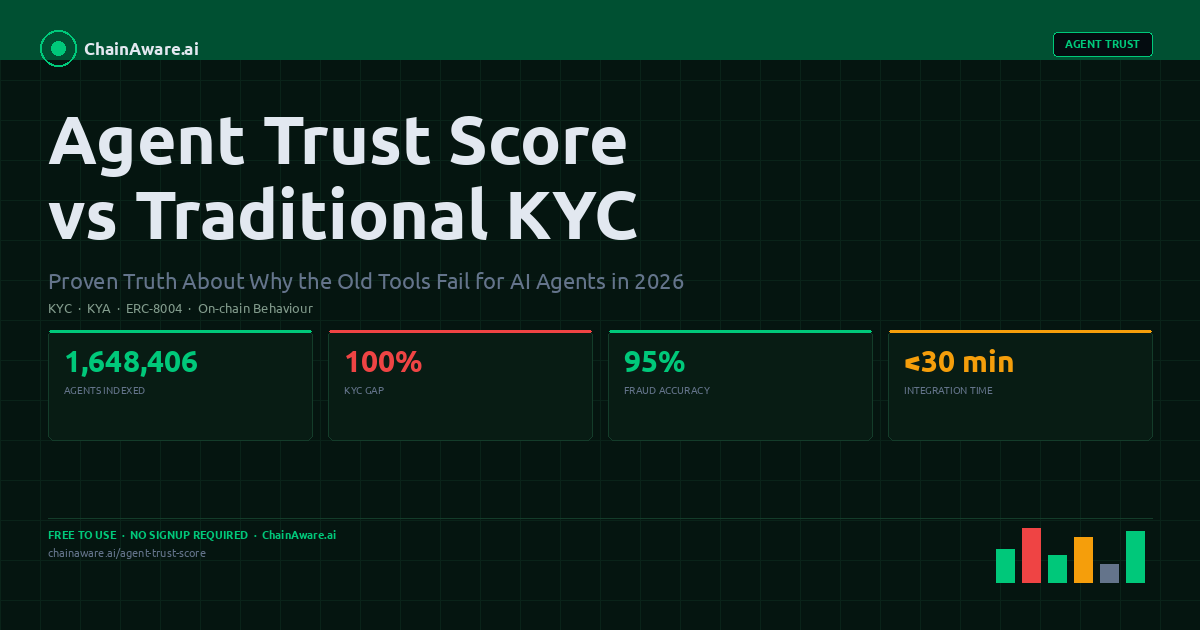
Agent Trust Score vs KYC Exposed: The Full Truth About Why the Old Tools Fail in 2026

Traditional KYC was built for humans, not software. As autonomous agents proliferate—1.6 million ERC-8004 agents are now active on-chain—compliance teams face a fundamental problem: identity verification tells you nothing about what an agent will actually do. KYC fails across three structural gaps: delegation chains that hide downstream risk, behavioral drift that rewires agent logic without changing its identity, and fleet Sybil attacks that exploit operator relationships. This article reveals why existing tools are insufficient and introduces ChainAware’s Agent Trust Score—a purpose-built framework designed to monitor autonomous agents across their full lifecycle. Discover what compliance leaders need to add to KYC to manage the agentic economy and how behavioral intelligence fills the gap that identity verification alone cannot.

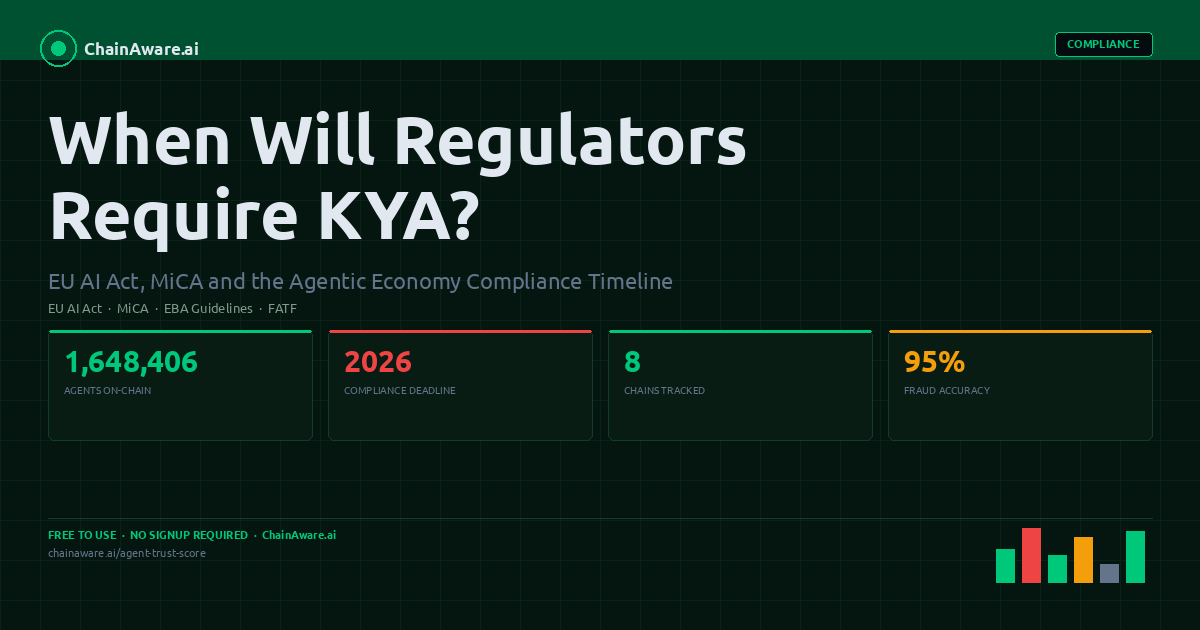
KYA regulations EU AI Act MiCA agentic economy compliance timeline — ChainAware.ai

KYA Regulations Exposed: Proven Truth About the EU AI Act, MiCA and Agentic Economy

Regulators haven’t yet mandated Know Your Agent protocols — but three separate regulatory frameworks are converging to make it inevitable. The EU’s MiCA Article 68 is creating screening gaps for AI agent wallets, whilst the EU AI Act Article 50 establishes identity disclosure as a legal requirement. Meanwhile, the FATF Travel Rule is closing in on the agent originator problem. With 1.6 million ERC-8004 agents already indexed on-chain and funding chains traceable to known bad actors, compliance teams face enforcement exposure today, long before formal agent-specific rules land. This article maps the three regulatory tracks, identifies the grey areas where agents currently operate, and provides a realistic timeline for when mandatory agent registration becomes law. Learn what your team needs to do now to stay ahead of the curve — and why ChainAware’s agent behaviour scoring is becoming essential compliance infrastructure.

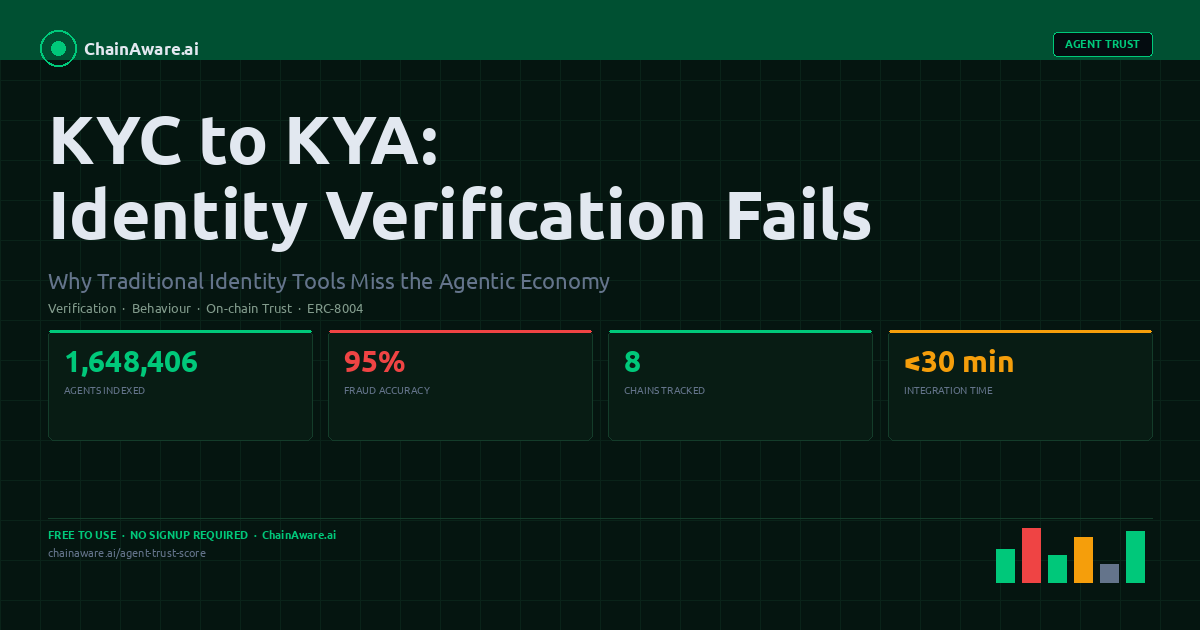
KYC to KYA identity verification evolution for AI agents — ChainAware.ai agent trust score

KYC to KYA Exposed: Proven Truth About Identity Verification in the Agentic Economy

Traditional Know Your Customer protocols were built for humans—but AI agents operating autonomously across blockchains expose three critical gaps that KYC cannot close alone. When software holds wallets and executes transactions without human oversight for each action, the delegation chains, behavioral drift and fleet Sybil attacks multiply compliance blind spots. ChainAware’s analysis of the ERC-8004 agent ecosystem reveals the scale: 1.6 million registered agents across eight chains, with 82.5% of scored agents showing elevation risk signals that static identity checks never catch. This article explains precisely where KYC breaks under agent volume, what Know Your Agent adds to close those gaps and what on-chain behavioral intelligence reveals about the agentic economy’s real compliance challenge. Discover why continuous behavioral scoring, not point-in-time verification, is now essential for Web3 compliance teams.

AI fraud prevention market map featuring ChainAware.ai in the CB Insights landscape — Web3 fraud detection — ChainAware.ai

Web3 Fraud Exposed: The Full Truth About ChainAware.ai’s Place on CB Insights’ Map

CB Insights named ChainAware.ai in its AI Fraud Prevention Market Map – placing it in the On-Chain Intelligence subcategory alongside Chainalysis, Elliptic, and TRM Labs. 200+ companies selected. One mission: building the trust and intelligence infrastructure the worldwide AI revolution demands.

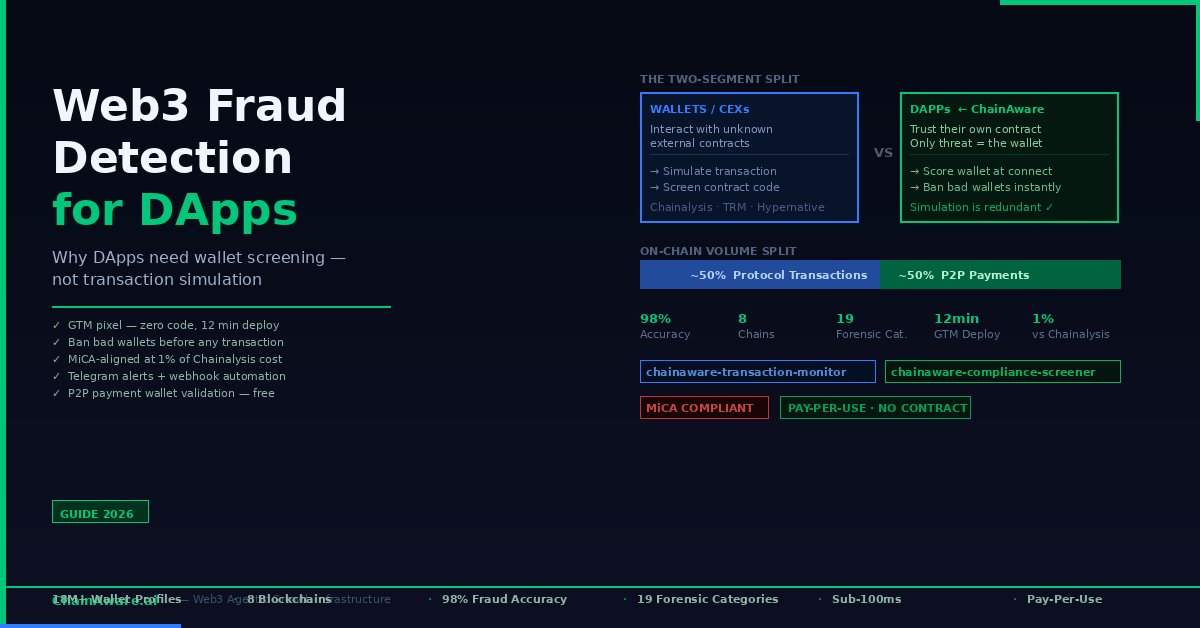
Wallet screening vs transaction simulation for DApp fraud detection in 2026, illustrated with blockchain security graphics —

Web3 Fraud Detection Exposed: The Full Truth About Wallet Screening for DApps

Web3 lost $4 billion to fraud in 2025. Most fraud detection tools were built for wallet providers and CEXs – not DApps. ChainAware is the only platform purpose-built for DApps: behavioral wallet screening at connection, zero-code GTM deploy, 98% fraud accuracy, MiCA-aligned at 1% of Chainalysis cost.

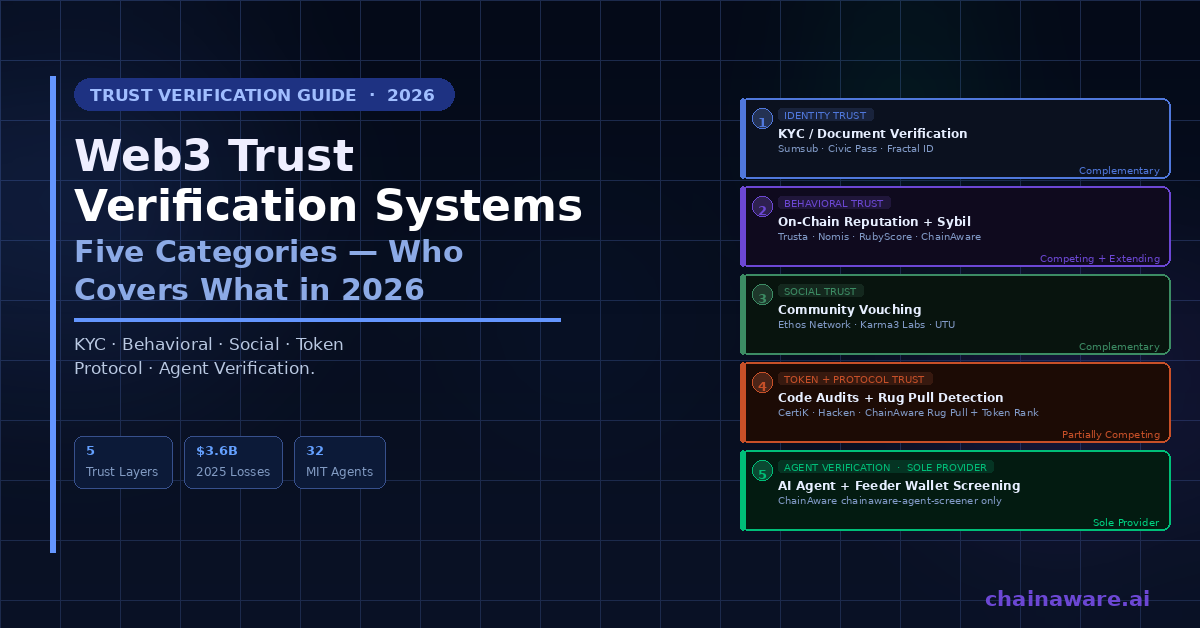
Five-category Web3 trust verification landscape diagram — Web3 trust verification systems 2026 — ChainAware.ai

Web3 Trust Verification Systems Exposed: The Full Truth for 2026

Web3 lost over $3.6 billion to fraud in the first three quarters of 2025 – and 57.8% of those losses came not from smart contract bugs but from access-control failures. Trust in Web3 is not one problem. It is five distinct problems requiring five distinct solutions, and most protocols are only covering one.

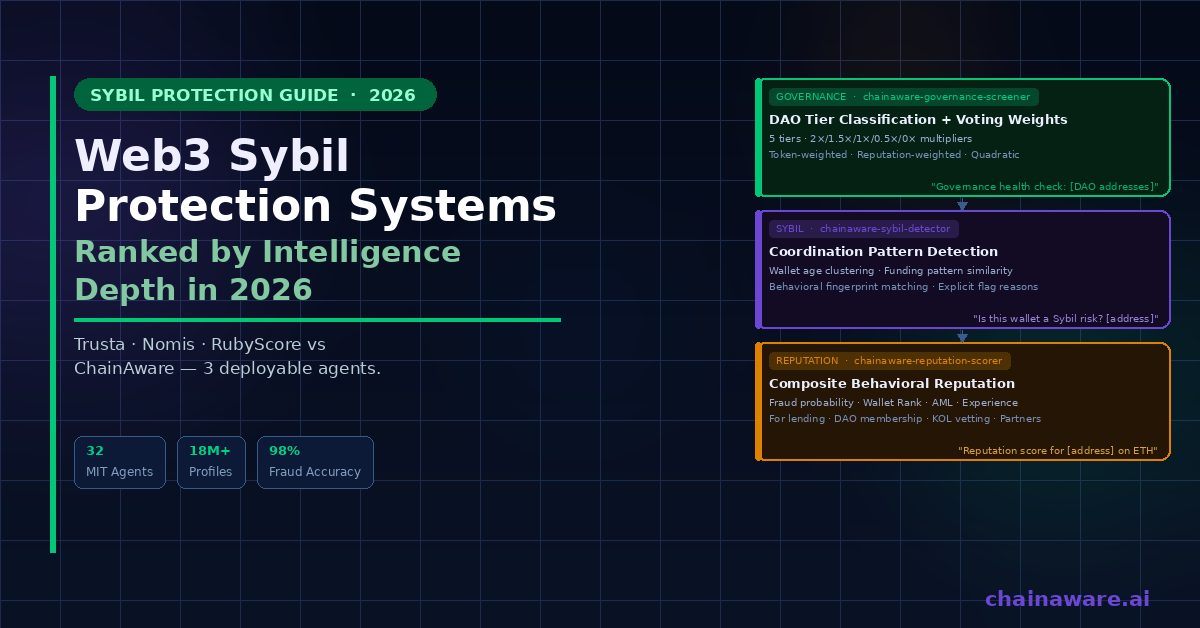
Ranked comparison of Web3 Sybil protection providers with on-chain behavioral scoring — Sybil protection 2026 — ChainAware.ai

Web3 Sybil Protection Systems Exposed: The Full Truth About On-Chain Providers

Sybil attacks cost Web3 protocols billions annually in fake airdrop claims, manipulated governance votes, and inflated engagement metrics. This guide ranks and compares every major on-chain behavioral Sybil protection provider in 2026 – from GNN/RNN graph detection to behavioral scoring – and explains where each approach works and where it falls short.

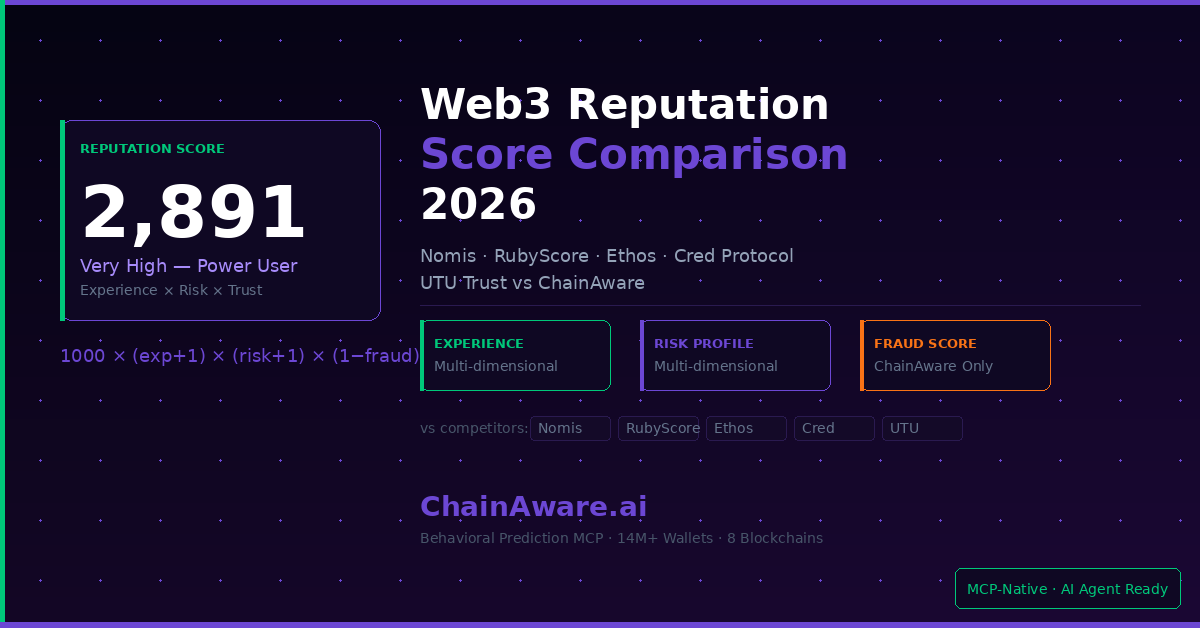
Web3 reputation score comparison chart ranking six protocols: Nomis, RubyScore, Ethos, Cred Protocol, UTU, ChainAware — Chain

Web3 Reputation Scores Exposed: The Full Truth About Nomis, RubyScore, Ethos and ChainAware

Web3 reputation scoring in 2026 compared across 7 platforms: Nomis, RubyScore, Ethos Network, Cred Protocol, UTU Trust, Whitebridge, and ChainAware. Most platforms measure activity. ChainAware is the only one that incorporates predictive fraud probability into the formula – producing an actionable 0-4000 score requiring no user action and callable by any smart contract or AI agent.