
Last Updated: February 2026
In traditional business, a business card tells people who you are. It shows your name, your title, your company, your contact details. It is a compressed credential — a starting point for trust. When you hand someone a business card, you are saying: here is verifiable proof that I am who I say I am.
In Web3, wallets are pseudonymous. Anyone can create a wallet address, give themselves any name, and present any credentials. There is no central authority verifying who anyone is. This creates a fundamental trust problem that affects every Web3 interaction: how do you know the KOL promoting a token has genuine DeFi experience? How do you know the business partner proposing a deal has a legitimate track record? How do you know the contractor you are hiring has the on-chain credentials they claim?
The answer is already on the blockchain. Every wallet address carries a complete, immutable, publicly verifiable record of every on-chain decision its owner has ever made — every protocol interacted with, every risk taken, every loan repaid or defaulted, every liquidity position managed. This history cannot be faked, cannot be deleted, and cannot be misrepresented. It is the most reliable credential in Web3.
ChainAware’s Share My Audit turns this history into a shareable trust passport. Connect your wallet at chainaware.ai/audit/my, receive a unique link associated with your wallet address, and share it with any counterparty as verifiable proof of your Web3 identity, experience, and trustworthiness. One link. Complete transparency. No lies possible.
The Trust Problem in Web3
Trust is the foundational resource in any economic system. In traditional finance, trust is built through institutional intermediaries — banks verify identities, credit bureaus track payment histories, professional licensing boards certify credentials, and contracts are enforced by legal systems. These systems are slow, expensive, and centralized — but they work because they provide verifiable claims about who someone is and how they have behaved.
Web3 eliminates the intermediaries. This is its greatest innovation and its most significant challenge simultaneously. Without banks, there is no central identity verification. Without credit bureaus, there is no standardized credibility scoring. Without licensing boards, there are no verified professional credentials. The result is a system where anyone can claim anything and the social cost of being wrong is low.
The consequences are visible everywhere in Web3. KOLs promote tokens they have never researched to audiences who trust their apparent expertise. Business partners claim development experience they don’t have. Contractors present GitHub profiles that don’t represent real work. Lenders have no way to assess borrower credibility without requiring overcollateralization so extreme it defeats the purpose of borrowing.
According to FTC research on crypto fraud, trust-based scams — where the fraud depends on the victim trusting the identity or credentials of the scammer — are the dominant category of crypto losses. The solution is not more trust; it is verifiable transparency. And verifiable transparency is exactly what on-chain transaction history provides.
The blockchain solves the trust problem in a way no intermediary can: it makes behavior permanently visible. You don’t need to trust what someone says about their DeFi experience — you can see their exact protocol interactions, loan history, trading behavior, and risk management decisions on-chain. You don’t need to trust their claimed Wallet Rank — you can verify it against 14 million+ profiled wallets. You don’t need to trust their word that they are a legitimate actor — you can check their fraud probability score with AI accuracy of 98%.
Share My Audit makes this verification frictionless. Instead of requiring every counterparty to know how to read blockchain data, it packages the complete analysis into a single shareable link that anyone can read in seconds.
Your Web3 Business Card — Free, Instant, Verifiable
Create Your Share My Audit Link Now
Connect your wallet at chainaware.ai/audit/my and receive a unique shareable link with your complete Web3 behavioral profile — Experience Level, Risk Willingness, Wallet Rank, Protocols Used, and Fraud Score. Share it with partners, clients, or employers as proof of your on-chain credentials. Free. One click.
The Wallet Audit: What Your On-Chain History Reveals
Before understanding Share My Audit, it helps to understand what the underlying Wallet Auditor actually measures. The Auditor takes any wallet address across 8 supported blockchains and applies ChainAware’s AI behavioral analysis — trained on 14 million+ wallet profiles — to generate a comprehensive behavioral and risk assessment.
The result is not a simple score. It is a multi-dimensional behavioral profile that captures who this wallet’s owner actually is based on what they have actually done with real capital on-chain. No self-reporting. No claimed credentials. Only demonstrated behavior.
Experience Level measures how sophisticated and active the wallet’s DeFi engagement has been — the breadth of protocols used, the complexity of strategies executed, the duration of active participation. A wallet that has interacted with 20+ protocols across multiple chains over 3 years is categorically different from a wallet created last month with 5 transactions.
Risk Willingness captures the wallet’s demonstrated risk appetite from its actual financial decisions — not what the owner says about their risk tolerance, but what they have actually done. High leverage use, volatile yield farming, aggressive small-cap trading, and complex multi-step DeFi strategies all indicate high risk willingness.
Predicted Intentions use behavioral AI to forecast what the wallet is likely to do next: probability of borrowing, staking, trading, bridging, or providing liquidity. For potential partners evaluating alignment, this signals whether the wallet owner is currently in accumulation mode, yield-seeking mode, or active trading mode.
Wallet Rank is the composite quality score that places the wallet among all 14M+ profiled wallets globally. A Wallet Rank in the top 5% identifies a verified power user of Web3 — someone whose on-chain activity places them among the most active and sophisticated participants in the ecosystem.
Protocols Used and Transaction Categories show the specific DeFi protocols, DEXs, NFT platforms, and blockchain bridges the wallet has interacted with — giving a counterparty a detailed picture of where the wallet owner actually operates in Web3. Someone claiming to be a DeFi expert whose wallet shows no Aave, Uniswap, or Compound interactions is immediately exposed.
Fraud Probability and AML Status complete the picture: what is the AI-assessed probability that this wallet has or will commit fraud, and have its funds passed through sanctioned or criminal addresses? As covered in our Fraud Detector complete guide, the fraud probability score operates at 98% AI accuracy across 8 networks.
Share My Audit: How It Works
Share My Audit is built on a simple but powerful insight: proving that you own a wallet is easy (connect it to a dApp), but packaging the resulting audit into a form that anyone can verify has historically been cumbersome. Share My Audit removes that friction entirely.
The process has three steps. First, go to chainaware.ai/audit/my and connect your Web3 wallet (MetaMask, WalletConnect, or any supported wallet). The connection proves you are the owner of that wallet address — without revealing your private keys, without any KYC, and without any registration. Second, ChainAware runs the full Wallet Auditor analysis on your connected wallet, generating your complete behavioral profile across all tracked on-chain activity. Third, you receive a unique shareable link permanently associated with your wallet address.
The link is wallet-bound. Because it was generated through a wallet connection that proves ownership, anyone viewing the link knows they are seeing the verified profile of the wallet’s actual owner — not a profile someone claimed to have, but one they demonstrably own. This is the verification layer that transforms a Wallet Audit from an analytical output into a trust credential.
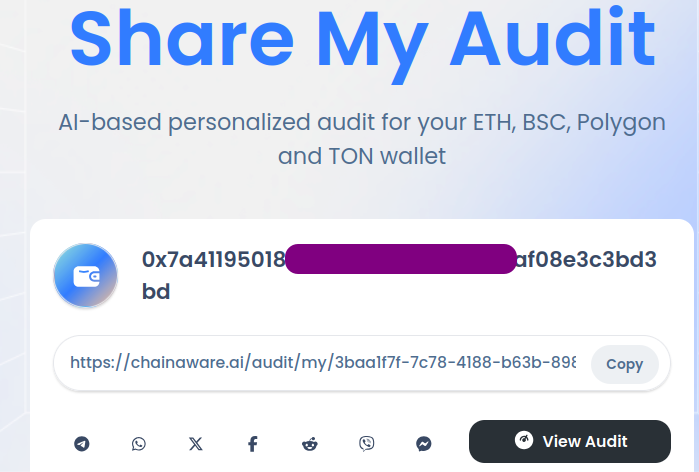
The profile is live — it updates as your on-chain activity evolves. This means your Share My Audit link always reflects your current behavioral status, not a static snapshot. As you build more experience, your Experience Level improves. As you maintain clean behavior, your Fraud Score stays low. The link is always current.
What Your Audit Shows: The Complete Profile
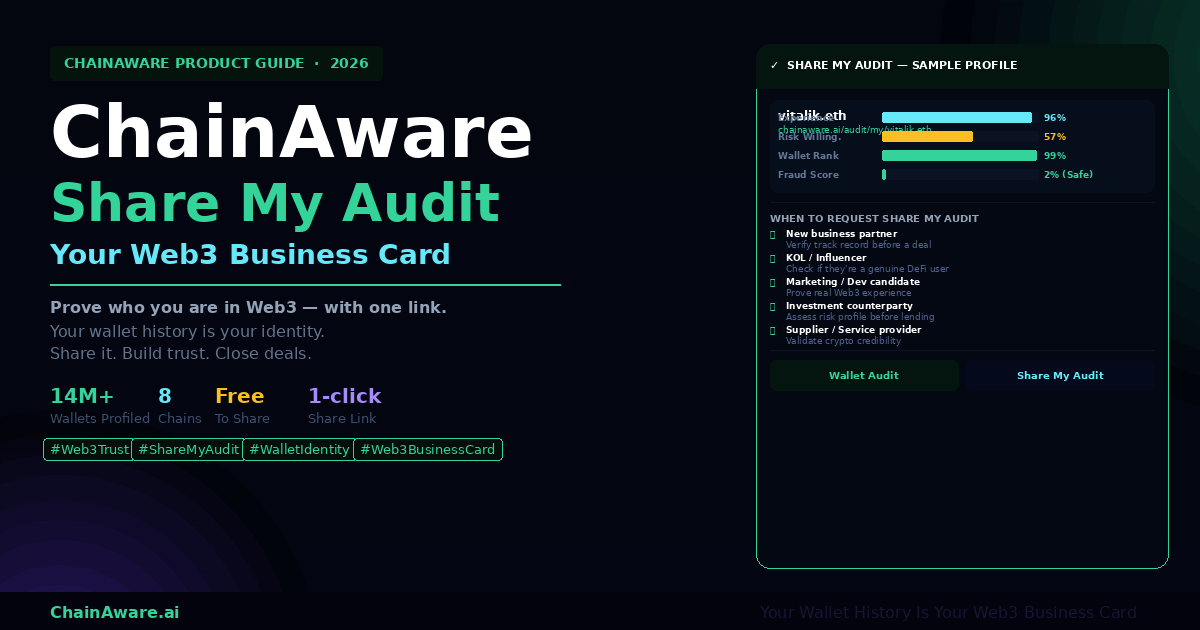
When a counterparty opens your Share My Audit link, they see your complete Wallet Auditor profile — the same analysis available to any Wallet Auditor user, but with the critical addition that this profile is verified as belonging to the person sharing it. The profile includes your Experience Level and Wallet Rank — where you sit among 14M+ profiled wallets globally. Your Risk Willingness — the demonstrated risk profile from your actual financial decisions. Your Predicted Intentions — what behavioral AI assesses you are likely to do next. The Protocols and Categories you have interacted with — a complete map of your Web3 activity. Your Fraud Probability Score and AML Status. And the Networks covered: Ethereum, BNB Chain, Base, Polygon, Solana, TON, Tron, and Haqq.
The counterparty reading this profile gets an immediate, objective assessment of who they are dealing with — with no possibility of the data being fabricated. Unlike a LinkedIn profile or a CV, a Wallet Audit cannot be inflated with false experience or misleading credentials. Either the on-chain activity is there, or it isn’t.
As explained in the broader context of our Web3 behavioral segmentation guide, on-chain data is the highest-quality behavioral signal in Web3 precisely because it represents actual decisions made with actual capital — not declared preferences or self-reported credentials.
Audit Any Wallet Before You Trust Them
ChainAware Wallet Auditor: Verify Any Counterparty in 30 Seconds
Whether you received a Share My Audit link or want to check a wallet address yourself — the Wallet Auditor gives you the full behavioral picture: experience, risk profile, predicted intentions, fraud probability, AML status, and Wallet Rank. Free. No KYC. 8 networks. 14M+ profiles.
10 Real Use Cases: When to Ask for Share My Audit
The Share My Audit link is most powerful as a standard expectation in Web3 business interactions. Here are ten specific situations where asking for — or sharing — a Wallet Audit link creates genuine value.
1. Evaluating a KOL or Influencer. A KOL approaches your project offering promotion to their 200,000 Twitter followers. Before engaging, ask: “Can you share your Wallet Audit?” A genuine DeFi KOL with real expertise will have an on-chain history that reflects years of active protocol engagement. A fake KOL or paid shill may have a wallet with no genuine DeFi activity — or worse, a wallet linked to pump-and-dump operations. See our analysis of why KOL marketing in Web3 underperforms for the broader context.
2. New business partnership. A company proposes a joint venture, liquidity partnership, or protocol integration. In Web3, the equivalent of financial due diligence is the Wallet Audit: verify the proposing team’s on-chain track record, assess their experience level and risk profile, and check their fraud probability before committing to any financial relationship.
3. Hiring a crypto-native contractor or developer. A developer claims 5 years of DeFi protocol experience. Their Share My Audit link will confirm or refute this: do they have years of active on-chain engagement across relevant protocols? On-chain credentials cannot be falsified.
4. Evaluating a marketing candidate. You are hiring a Web3 marketing manager who claims expertise in DeFi user acquisition. Ask for their Share My Audit. A marketer who genuinely understands DeFi from the user perspective will have a wallet that reflects real DeFi participation — not just familiarity with the language.
5. DeFi lending and borrowing counterparty. For undercollateralized lending protocols, the borrower’s creditworthiness is the key risk variable. A borrower who shares their Wallet Audit demonstrates their complete financial behavior history: loan repayment track record, risk management approach, and cash flow patterns. This is what the ChainAware Credit Score formalizes — Share My Audit is the human-readable version of the same underlying data.
6. NFT deal or high-value P2P transaction. You are buying or selling a high-value NFT through direct negotiation. The counterparty claims to be a serious collector. Their Share My Audit — showing NFT transaction history, wallet quality, and fraud probability score — tells you whether you are dealing with a legitimate collector or a potential scammer.
7. DAO contributor or governance participant verification. A DAO is considering giving significant governance weight or funding to a contributor who claims expertise in DeFi protocol design. Share My Audit verifies their actual on-chain engagement with the types of protocols they claim expertise in.
8. Investment syndicate or group participation. You are joining or forming a crypto investment group where members pool resources or share alpha. Requiring Share My Audit from all participants establishes a baseline of verified experience and risk profile alignment — and flags any member whose wallet shows fraud risk signals.
9. Vendor or service provider assessment. A crypto-native service provider — a trading desk, an OTC broker, a yield management service — claims institutional-grade experience. Their Wallet Audit reveals the actual on-chain behavior behind the claim.
10. Personal trust-building in the Web3 community. If you are building a reputation in Web3 — as a developer, researcher, trader, or community leader — sharing your Wallet Audit proactively is a powerful credibility signal. It says: I have nothing to hide. My on-chain behavior speaks for itself.
KOL Vetting: Why Share My Audit Matters for Influencer Marketing
KOL vetting deserves its own section because it is one of the highest-value and most widely applicable use cases for Share My Audit — and because the cost of trusting the wrong KOL in Web3 is enormous.
The Web3 influencer ecosystem is heavily populated with accounts that have large followings but no genuine DeFi expertise. Some promote tokens they have never researched in exchange for payment, without disclosure. Some are coordinated networks of accounts that amplify each other’s content to create artificial social proof. Some are outright scam operations that build followings specifically to exploit them in pump-and-dump schemes.
Identifying genuine KOLs from fake ones is notoriously difficult using social metrics alone — follower counts can be purchased, engagement can be bot-generated, and the language of DeFi expertise can be convincingly mimicked by anyone who reads the right blogs. What cannot be mimicked is on-chain history.
A genuine DeFi KOL who has spent years in the space will have a wallet that reflects it: multiple DeFi protocols used over an extended period, a Wallet Rank in the upper percentiles of the 14M+ profile database, an Experience Level consistent with their claimed tenure, and a fraud probability score that confirms they are not connected to known scam operations. When you ask a KOL to share their Wallet Audit link and they can produce one with genuine credentials, you can engage with confidence.
According to McKinsey research on marketing ROI, influencer marketing campaigns with verified audience quality significantly outperform campaigns based purely on follower count metrics. In Web3, Share My Audit is the verification tool that makes quality-first KOL selection operationally possible.
Verify Before You Trust — 98% AI Accuracy
ChainAware Fraud Detector: Is the Wallet You’re Dealing With Safe?
Before any significant business interaction in Web3, run the counterparty’s wallet through the Fraud Detector. AI-powered behavioral analysis predicts fraud probability with 98% accuracy — catching bad actors with clean funds that AML tools miss. Free to check any address across 8 networks.
The Fraud Detector: The Other Side of Trust Verification
Share My Audit is the tool you use to share your own credentials. The Fraud Detector is the tool you use to verify the credentials of anyone sharing with you.
Even when a counterparty shares their Wallet Audit voluntarily, running their address through the Fraud Detector adds a critical layer: behavioral AI analysis that detects fraud patterns the surface-level Wallet Audit profile might not immediately surface. The Fraud Detector is trained on confirmed fraud cases across 14M+ wallet profiles and predicts fraud probability based on behavioral signals — not just whether the wallet has been previously flagged, but whether its behavioral patterns match known fraud typologies.
The combination of Share My Audit and Fraud Detector covers both directions of trust verification: the counterparty voluntarily shares their credentials (Share My Audit), and you independently verify those credentials against behavioral AI analysis (Fraud Detector). This is the complete due diligence stack for any significant Web3 interaction.
For the complete picture of how fraud detection, AML screening, and transaction monitoring work together as a compliance and trust stack, see our guide on Crypto AML vs Transaction Monitoring. For context on how trust score metrics work across the ChainAware product suite, see our Crypto Trust Score guide.
Web3 Business Card vs Traditional Business Card
The business card analogy is useful but understates how much better the Share My Audit profile is as a trust credential compared to its traditional equivalent.
A traditional business card contains: your name, title, company, email, phone number, and sometimes a LinkedIn URL. All of this information is self-reported. There is no verification of any claim on a business card — anyone can print any title they want. The business card creates a starting point for investigation, not a verification of claims.
A Share My Audit link contains: your verified wallet address (proven through wallet connection), your Experience Level calculated from actual on-chain activity, your Risk Willingness derived from actual financial decisions, your Wallet Rank among 14M+ real wallets, your Fraud Probability score from AI behavioral analysis, your AML Status from fund origin screening, the specific protocols you have genuinely interacted with, and your transaction category history. None of this information is self-reported. All of it is derived from verifiable on-chain data that cannot be altered.
According to Harvard Business Review research on trust in business relationships, verified credentials create faster relationship formation and lower transaction costs. In Web3, where pseudonymity creates friction in every new relationship, a Share My Audit link achieves exactly this: it collapses the verification process that would otherwise take hours of independent research into a 30-second link review.
The Share My Audit link is also persistent and updatable. A traditional business card becomes stale when you change roles or companies. Your Share My Audit link always reflects your current on-chain status — because it is generated live from your evolving blockchain history. As your experience grows, your profile improves. As you maintain clean behavior, your fraud score stays low. The credential grows with you.
As the ChainAware complete product guide explains, the Wallet Auditor and Share My Audit are part of a comprehensive Web3 intelligence suite — tools that together make trust verifiable, fraud detectable, and user behavior predictable in a way that no traditional credential system can match. According to Deloitte research on trust and customer experience, businesses that successfully signal trustworthiness see significantly higher engagement and conversion rates. In Web3, Share My Audit is that trust signal.
ChainAware.ai — Your Complete Web3 Trust Stack
Wallet Audit · Share My Audit · Fraud Detector
Your wallet history is your business card. Create your shareable trust passport with Share My Audit, audit any counterparty with the Wallet Auditor, and verify fraud risk with the Fraud Detector. The complete Web3 trust verification stack. All free to start.
Frequently Asked Questions
What is Share My Audit?
Share My Audit is a ChainAware feature that allows wallet owners to generate a unique shareable link at chainaware.ai/audit/my by connecting their wallet. The link is permanently associated with the connected wallet and displays the wallet’s complete Auditor profile — Experience Level, Risk Willingness, Predicted Intentions, Wallet Rank, Fraud Probability, AML Status, and Protocols Used. Because the link is generated through a verified wallet connection, anyone viewing it knows the profile belongs to the person sharing it.
How is Share My Audit different from a regular Wallet Audit?
A regular Wallet Audit allows anyone to analyze any wallet address — but the analysis alone doesn’t prove that the person sharing it actually owns the wallet. Share My Audit adds wallet ownership verification through the wallet connection process. This turns the audit from an analytical output into a verified credential: the viewer knows they are seeing the profile of the wallet’s actual owner, not a profile someone is borrowing or fabricating.
Is it safe to share my Wallet Audit?
Yes. The Wallet Audit only reveals information that is already publicly visible on the blockchain — your transaction history, protocol interactions, and behavioral patterns are public data by the nature of blockchain technology. Sharing your audit does not reveal your private keys, your identity, or any non-public information. The wallet connection to generate your link is read-only and does not grant ChainAware or any viewer any access to your funds.
What blockchains are covered?
Ethereum, BNB Chain, Base, Polygon, Solana, TON, Tron, and Haqq — covering the major networks where DeFi activity and on-chain credentials are most meaningful.
Can someone fake a Share My Audit link?
No. The Share My Audit link is generated by connecting a wallet — which cryptographically proves ownership. Someone cannot generate a Share My Audit link for a wallet they do not own, because the connection process requires a cryptographic signature from the wallet’s private key.
How does Share My Audit help with KOL vetting?
When a KOL shares their Wallet Audit link, you can immediately verify whether their claimed DeFi expertise is reflected in their on-chain history. A genuine DeFi KOL will have years of active protocol engagement, a high Wallet Rank, and a low fraud probability. A paid promoter with no genuine expertise will have minimal on-chain DeFi activity inconsistent with their claimed knowledge.
How is this related to the ChainAware Credit Score?
The ChainAware Credit Score uses the same underlying Wallet Auditor data to generate a formal creditworthiness score (0-1000) for DeFi lending decisions. Share My Audit is the human-readable, relationship-focused version of the same underlying data — designed for trust-building across all Web3 interactions, not just lending.