
Before you sign a business deal, send a large crypto payment, evaluate a KOL, or invest in a token — you can now audit the wallet behind it in 30 seconds, for free.
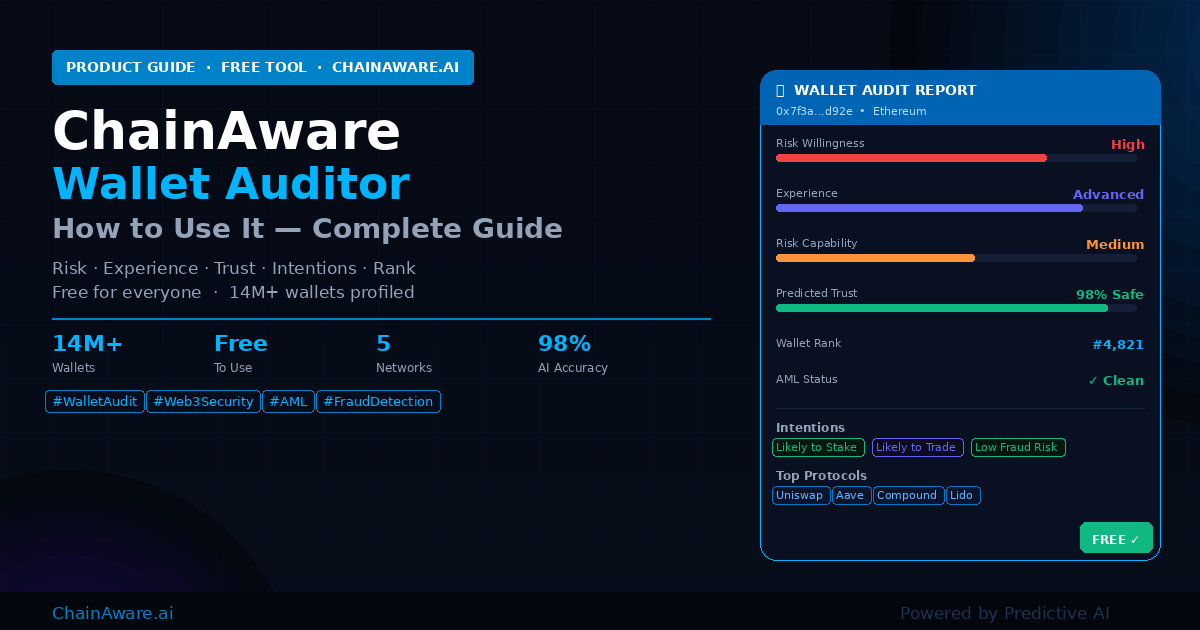
The ChainAware.ai Wallet Auditor is the most comprehensive free wallet intelligence tool in Web3. Paste any Ethereum, BNB Smart Chain, Solana, Base, or Haqq address and receive a complete behavioral and risk profile: risk willingness, experience level, risk capability, predicted trust score, likely next intentions, transaction category breakdown, protocol usage history, AML analysis, and Wallet Rank.
It’s not a block explorer. It’s not a simple balance checker. It’s a predictive behavioral intelligence report — the same data layer that powers enterprise products like the Behavioral Prediction MCP and Web3 Behavioral Analytics — available to anyone, instantly, at no cost.
This guide explains every parameter the Wallet Auditor measures, what each one means in practice, and — most importantly — the real-world situations where auditing a wallet before you act could save you money, protect your platform, or give you a decisive edge.
What Is the ChainAware Wallet Auditor?
The Wallet Auditor is the foundational product of ChainAware.ai’s Web3 Predictive Data Layer — a continuously updated intelligence database covering 14M+ wallet profiles across 8 blockchains, built from over 1.3 billion predictive data points.
Every other ChainAware.ai product — the Behavioral Prediction MCP, Web3 Behavioral Analytics, Token Rank, Growth Agents — is built on top of the Wallet Audit. The audit is the atom. Everything else is the molecule.
What makes it fundamentally different from a block explorer like Etherscan is the layer of intelligence applied to the raw transaction data. Etherscan shows you what a wallet did. The Wallet Auditor tells you who the wallet is, how experienced they are, how risky their behavior is, whether they’re trustworthy, and what they’re likely to do next.
That predictive layer — powered by AI models trained on 14M+ wallets — is what makes the Wallet Auditor genuinely useful for real-world decisions.
Supported networks: Ethereum, BNB Smart Chain, Solana, Base, Haqq
Cost: Free — no account required, no rate limits for individual use
Free — No Signup Required
Audit Any Wallet Right Now
Paste any Ethereum, BNB Smart Chain, Solana, Base, or Haqq address. Get a complete risk, experience, trust, and behavioral profile in seconds.
The 9 Parameters Explained
The Wallet Auditor calculates nine distinct parameters for every wallet. Understanding what each one measures — and why it matters — is the key to using the tool effectively.
1. Risk Willingness
What it measures: How psychologically ready the wallet owner is to take on financial risk, based on their on-chain behavioral history.
Risk Willingness is one of the most important psychometric parameters in behavioral finance — and it’s one that traditional Web2 platforms spend enormous resources trying to measure through surveys, questionnaires, and user interviews. The Wallet Auditor derives it directly from on-chain behavior: a wallet that consistently engages with high-leverage DeFi positions, volatile assets, and experimental protocols signals high risk willingness through its actions, not its words.
Why it matters: Risk Willingness determines which products and messages are appropriate for a given user. A high risk-willingness wallet is a candidate for leveraged strategies and aggressive yield products. A low risk-willingness wallet should never be shown those same products — it will either ignore them or, worse, engage with something misaligned with its tolerance and churn or lose money. For platforms, getting this match right is the difference between conversion and abandonment.
According to CFA Institute’s research on investor risk profiling, behavioral-based risk assessment significantly outperforms self-reported questionnaires in predicting actual investment behavior. The Wallet Auditor applies this principle to on-chain data at scale.
2. Experience
What it measures: How long and how deeply the wallet has been active in Web3 — across protocols, chains, and transaction types.
Experience is calculated from the wallet’s full on-chain history: how many protocols it has interacted with, how long it has been active, the complexity of its transaction patterns, and its activity across multiple chains. A wallet that has been actively DeFi farming across 6 protocols for 3 years scores very differently from one that connected last week and made two swaps.
Why it matters: Experience determines the appropriate communication register, product complexity, and onboarding depth for a given user. Expert users are insulted by beginner explanations. Novice users are confused by advanced tooling. The Experience parameter gives platforms and individuals an instant read on where any wallet sits on the Web3 knowledge spectrum — without any user registration or self-reporting.
3. Risk Capability
What it measures: How financially capable the wallet is of absorbing risk — based on asset size, diversification, historical drawdown behavior, and portfolio composition.
Risk Capability is distinct from Risk Willingness. A wallet may be psychologically willing to take on significant risk but financially incapable of sustaining losses — this is a red flag for lending platforms and a key data point for risk management. Conversely, a high-net-worth wallet may have the capability for significant risk exposure while historically preferring conservative strategies.
Why it matters: For DeFi lending protocols, Risk Capability directly informs appropriate loan sizing and collateral requirements. For any counterparty doing business with a wallet, it provides an objective read on financial resilience that is impossible to fake through on-chain behavior.
4. Predicted Trust (Fraud Score)
What it measures: The probability that this wallet is a legitimate, non-malicious actor — calculated by ChainAware.ai’s Predictive Fraud Detector AI algorithm.
Predicted Trust is the Wallet Auditor’s most critical safety parameter. Powered by the same AI model that achieves 98% accuracy on Ethereum and 96% accuracy on BNB Smart Chain, it assesses the wallet’s connections to known fraud addresses, behavioral patterns consistent with exploit preparation, wash trading signals, sybil attack indicators, and AML red flags.
Why it matters: A 98%-accurate fraud prediction means that of every 100 wallets flagged as high-risk, 98 are genuinely problematic. This is not a heuristic or a blacklist check — it’s a predictive behavioral model that catches bad actors before they act, based on patterns in their historical on-chain behavior. For anyone considering a business transaction, smart contract interaction, or platform access decision involving an unknown wallet, this is the single most important number to check.
5. Intentions
What it measures: The wallet’s probable next on-chain actions, expressed as probability scores for different behavior types: likely to trade, likely to stake, likely to borrow, likely to bridge, likely to buy NFTs, etc.
Intentions are derived from the wallet’s recent behavioral trajectory — the direction of its activity, not just its history. A wallet that has been gradually building a staking position across multiple protocols over the past 30 days has a high probability of continuing to stake. A wallet that has been liquidating positions has a high probability of bridging out.
Why it matters: Intentions transform the Wallet Auditor from a retrospective tool into a predictive one. For businesses, knowing what a wallet is likely to do next enables proactive engagement: surface the right product at the right moment, before the wallet acts. For individuals, understanding their own wallet’s predicted intentions can surface blind spots in their portfolio behavior.
6. Transaction Categories
What it measures: A breakdown of the wallet’s historical transactions by category — DeFi lending, DEX trading, NFT activity, bridging, staking, governance, and more — showing how many transactions fall into each category.
Why it matters: Transaction Categories reveal a wallet’s on-chain identity at a glance. A wallet with 80% of transactions in NFT categories and 20% in DeFi is a very different user than one with the inverse. This breakdown enables precise behavioral segmentation without any self-reported data.
7. Protocols
What it measures: The specific protocols the wallet has interacted with, ranked by frequency and recency.
Why it matters: Protocol usage reveals sophistication level, product preferences, and competitive landscape intelligence. Knowing that a wallet is a heavy Aave user tells you they understand overcollateralized lending — relevant if you’re pitching a competing product. Knowing they’ve never used a DEX tells you they may need basic education before any trading-focused pitch.
8. AML Analysis
What it measures: Anti-Money Laundering risk assessment — connections to sanctioned addresses, darknet markets, mixer services, known exploit wallets, and other AML red flags, drawn from multiple on-chain data sources.
Why it matters: AML exposure is a compliance and reputational risk that affects any business transacting with or platform serving a flagged wallet. The AML Analysis parameter surfaces this risk explicitly, enabling informed decisions before engagement. For regulated businesses in particular, this check is not optional — it’s a legal requirement. According to FATF’s guidance on virtual assets, businesses operating in the crypto space are expected to conduct AML due diligence on counterparties.
9. Wallet Rank
What it measures: A single unified rank for the wallet, calculated by combining all other parameters — risk willingness, experience, risk capability, predicted trust, behavioral history, and protocol engagement — and ranking the wallet against all 14M+ wallets in ChainAware.ai’s database.
Why it matters: Wallet Rank is the simplest possible summary of a wallet’s overall quality and trustworthiness. Lower rank number = higher quality wallet. It’s designed to be the single number you check when you don’t have time to read the full report — a quick signal for whether a wallet is worth deeper engagement.
Wallet Rank is also the basis of ChainAware.ai’s Token Rank product: by calculating the Wallet Rank of every holder of a token and taking the median, Token Rank provides an objective measure of a token’s holder quality. The lower the median Wallet Rank of a token’s holders, the better the Token Rank — meaning a token whose holders are predominantly high-quality, experienced wallets scores better than one dominated by low-quality or bot-heavy addresses.
See It In Action
Audit Your Own Wallet First
The fastest way to understand the Wallet Auditor is to run it on an address you know well — your own. See your risk profile, experience score, predicted intentions, and Wallet Rank instantly.
How to Use the Wallet Auditor (Step by Step)
The Wallet Auditor is designed to be as frictionless as possible. No account. No API key. No rate limits for individual use. Here’s the process:
- Go to chainaware.ai/audit — the tool opens immediately with no login required.
- Select your network — choose Ethereum, BNB Smart Chain, Solana, Base, or Haqq from the dropdown.
- Paste the wallet address — any valid address for the selected network.
- Click Audit — the report generates in seconds, pulling from ChainAware.ai’s 14M+ wallet database. If the wallet is new to the database, the system calculates its profile on the fly.
- Read the report — the dashboard displays all 9 parameters. Each parameter includes a visual indicator (score bar, risk level, or category breakdown) as well as a plain-language summary.
- Export or share — the report can be shared via link for due diligence workflows where multiple stakeholders need to review the same wallet.
The entire process takes under 60 seconds for known wallets. The output gives you more actionable intelligence about a counterparty than most Web2 background check tools provide — and it’s entirely derived from verifiable on-chain data.
8 Real-World Use Cases
The Wallet Auditor is a general-purpose intelligence tool. Here are the eight highest-value situations where auditing before acting makes a material difference.
Use Case 1: Vetting a New Business Partner Before Signing a Deal
Web3 business relationships — investments, token swaps, partnership agreements, co-marketing deals — frequently involve counterparties you’ve met online, whose real-world identity you cannot verify. The wallet they transact with, however, tells a verifiable story.
Before entering any significant business arrangement, audit the wallet of your prospective partner. What does their on-chain history reveal? Are they an experienced Web3 operator (high Experience score) or a newcomer claiming otherwise? Is their AML status clean? Is their Predicted Trust score high? A high-quality Wallet Rank from a long-established address is a meaningful signal of legitimacy that cannot be faked retroactively.
A partner whose wallet shows three months of activity, a low Experience score, and a below-average Predicted Trust score warrants significantly more due diligence — regardless of how polished their pitch deck is. Conversely, a wallet with years of sophisticated DeFi activity, a strong Wallet Rank, and clean AML status provides meaningful confidence that your counterparty is who they say they are.
Use Case 2: Checking a Wallet Before Sending a Large Payment
Crypto payments are irreversible. Once sent, funds cannot be recalled — and social engineering attacks that substitute a real recipient’s wallet address with a fraudulent one are among the most common and devastating crypto scams. Before sending any significant payment to a wallet address you’ve received via email, Telegram, or any other potentially compromised channel, audit it first.
The AML Analysis will immediately flag if the destination address has connections to known fraud wallets. The Predicted Trust score will signal if the behavioral pattern of the address is consistent with legitimate activity. A receiving wallet that has never interacted with any protocol, was created last week, and has received several large deposits from multiple senders is a red flag pattern the Wallet Auditor will surface instantly.
This 30-second check before a significant outbound payment costs nothing and could prevent an irreversible loss. According to Chainalysis’s 2024 crypto crime report, social engineering and address substitution attacks accounted for billions in losses — nearly all of which were preventable with pre-transaction wallet verification.
Use Case 3: Verifying a KOL’s (Key Opinion Leader’s) Actual Web3 Experience
The Web3 space has a KOL problem. Influencers frequently claim expertise, credentials, and track records that their on-chain history doesn’t support. Someone who presents as a DeFi expert may have never actually used a DeFi protocol. Someone claiming to be a long-term crypto investor may have a wallet that’s six months old.
The Wallet Auditor makes these claims verifiable. Ask any KOL, advisor, or community expert for their primary wallet address and run an audit. Their Experience score will tell you exactly how active they’ve been in Web3. Their Transaction Categories will show whether they’ve actually participated in the sectors they claim expertise in. Their protocol history will reveal whether their DeFi knowledge is theoretical or operational.
This is especially important before paying a KOL for a promotion, bringing an advisor onboard with a token allocation, or inviting someone to speak at your event as a Web3 expert. An audit takes 30 seconds and replaces weeks of unverifiable credential checking.
Use Case 4: Evaluating Investor Quality Before a Token Sale or IDO
Not all investors are equal. A token sale that fills its allocation with high-quality, experienced DeFi wallets has a very different secondary market outcome than one dominated by airdrop farmers and bot addresses. The former group tends to hold, provide liquidity, and engage with governance. The latter dumps on listing day.
Before accepting allocations in a private round or whitelist, audit the wallets of applicants. Wallet Rank provides an instant quality signal. Experience and Risk Capability tell you whether this investor can actually support the position they’re requesting. Intentions tell you whether they’re likely to hold or rotate immediately post-TGE. Building an investor base from high-Wallet-Rank addresses is a compounding advantage that shows up in price stability, governance participation, and community quality.
Use Case 5: Protecting Your Platform from Fraudulent Users
For DeFi protocols, NFT marketplaces, GameFi platforms, and any other Web3 application that allows wallet connections, understanding who is connecting matters enormously. Wash traders inflate volume metrics. Bot farms game reward systems. Sybil attackers exploit airdrops. Exploit probers test vulnerabilities before attacking.
The Wallet Auditor’s Predicted Trust and AML Analysis parameters identify all of these patterns. For platform teams, integrating wallet auditing into the connection flow — either manually for high-value users or automatically via the Behavioral Prediction MCP — provides a real-time quality gate that protects platform integrity without creating friction for legitimate users.
For automated, real-time fraud detection integrated directly into your platform without engineering overhead, see the ChainAware.ai business product guide covering Transaction Monitoring & AML via Google Tag Manager.
Use Case 6: Token Research — Evaluating Holder Quality Before Investing
The quality of a token’s holder base is one of the most underused signals in crypto investment due diligence. A token whose top 100 holders are all high-Wallet-Rank, experienced DeFi participants signals genuine organic adoption. A token whose holder base is dominated by low-rank, newly created wallets signals bot activity, wash trading, or airdrop farming.
ChainAware.ai’s Token Rank product automates this analysis by auditing every holder of a token and computing the median Wallet Rank — but you can get a fast read manually by auditing a sample of the largest holders of any token you’re researching. A few minutes of wallet auditing on a token’s top holders will surface more signal than hours of reading tokenomics documents.
Use Case 7: Risk-Profiling Your Own Users as a DeFi Protocol
If you run a DeFi lending protocol, a DEX, or any financial application, understanding the risk profile of your user base is not optional — it’s foundational to product design, liquidity management, and regulatory compliance. The Wallet Auditor gives you that understanding at the individual wallet level.
Risk Willingness and Risk Capability together tell you whether a user is appropriate for the products you’re offering. A user with high Risk Willingness but low Risk Capability is a candidate for financial harm — and potentially a liability for your platform. Proactively identifying this profile enables you to serve those users appropriately: with educational content, conservative product suggestions, or additional verification before high-risk transactions.
For automated, aggregate-level user profiling across your entire Dapp user base, see why personalization is the next big thing for AI agents in Web3 and our guide on 5 ways Prediction MCP turbocharges DeFi platforms.
Use Case 8: Vetting Grant Recipients, Hackathon Winners, or DAO Proposal Authors
DAOs, foundations, and grant programs distribute significant capital to pseudonymous recipients. The risk of grant fraud — applying with fabricated credentials, submitting copycat proposals, or receiving grants with no intent to deliver — is real and growing. The Wallet Auditor provides an objective, non-gameable credentialing layer.
A grant applicant whose wallet shows years of genuine contribution to open-source Web3 projects, meaningful governance participation, and a high Wallet Rank is demonstrably different from one whose wallet was created last month and has never interacted with the protocols they claim to have built. Auditing the wallet of every grant applicant adds a verifiable signal that complements but doesn’t replace qualitative review.
The Predictive Fraud Detector: Going Deeper on Trust
While the Wallet Auditor’s Predicted Trust parameter gives you a high-level fraud score, the ChainAware.ai Predictive Fraud Detector provides a dedicated, deeper analysis focused specifically on fraud and AML risk.
Supported networks: Ethereum, BNB Smart Chain, Base, Polygon, TON, Haqq, Tron (7 chains vs. the Wallet Auditor’s 5)
Cost: Free
The Fraud Detector goes beyond the summary score in the Wallet Auditor to provide detailed forensic analysis: specific AML flags, suspicious transaction patterns, connections to flagged addresses in the fraud graph, and a full breakdown of the risk factors contributing to the fraud score.
Use the Wallet Auditor as your first-pass intelligence tool for any wallet across all 9 parameters. Use the Fraud Detector when Predicted Trust raises a concern that warrants deeper investigation — or when fraud and compliance risk is your primary concern and you need the most detailed possible analysis.
Together, the two free tools give individuals and businesses a complete due diligence workflow for any counterparty wallet — at no cost, in under two minutes.
When Trust Is the Priority
Run a Deep Fraud Analysis — Free
The Predictive Fraud Detector gives you detailed forensic AML and fraud analysis across 7 chains: Ethereum, BSC, Base, Polygon, TON, Haqq, and Tron. 98% accuracy. No account required.
The Wallet Auditor Ecosystem: Part of Something Bigger
The Wallet Auditor is free and standalone — but it’s also the entry point into ChainAware.ai’s full Web3 Predictive Data Layer. Understanding how the Wallet Audit connects to the broader ecosystem helps you see where the free tool ends and where enterprise capabilities begin.
Web3 Behavioral Analytics
When you integrate ChainAware.ai’s pixel into your Dapp, every wallet that connects is automatically audited and aggregated into a behavioral dashboard for your platform. Instead of seeing individual wallet reports, you see the aggregate profile of your entire user base: the distribution of risk willingness, experience levels, behavioral categories, and intentions across all your users. This is how platforms answer the question “who are our users?” at scale. Free to integrate via pixel. See our full guide on how to use ChainAware.ai as a business.
Behavioral Prediction MCP
The MCP exposes the Wallet Audit as a real-time API endpoint for AI agents and LLMs. When your AI agent connects via MCP and passes a wallet address, it receives the complete Wallet Audit payload back as structured context — which it can use immediately to personalize its response. This is how developers build 1:1 personalized interactions at scale, without any manual segmentation. See the complete Prediction MCP developer guide.
Token Rank
Token Rank runs a Wallet Audit on every holder of a given token and computes the median Wallet Rank across all holders. The resulting Token Rank score gives investors, exchanges, and launchpads an objective measure of a token’s holder quality — independent of price, volume, or marketing narratives. The lower the median Wallet Rank of a token’s holders, the higher quality the holder base, and the better the Token Rank.
Growth Agents
Growth Agents use the Wallet Audit as the foundation for personalized outreach: the moment a user connects their wallet, Growth Agents calculate their full behavioral profile and automatically generate content that resonates with their specific risk willingness, experience level, and predicted intentions. The Wallet Audit is the input; the personalized content is the output. See the SmartCredit.io case study for a real-world example of the results this drives.
According to Salesforce research, 73% of consumers expect personalized experiences — and the wallet behavioral data from the Wallet Audit is the only way to deliver true personalization to pseudonymous Web3 users.
Frequently Asked Questions
Is the Wallet Auditor really free?
Yes. The Wallet Auditor at chainaware.ai/audit is completely free for individual use, with no account required and no rate limits for reasonable personal use. Enterprise API access and platform integrations are available on paid plans.
How accurate is the Predicted Trust / fraud score?
ChainAware.ai’s Predictive Fraud Detector achieves 98% accuracy on Ethereum and 96% accuracy on BNB Smart Chain. This is a predictive model trained on 14M+ wallets — it identifies behavioral patterns associated with fraud, not just known bad addresses. This means it can flag wallets that haven’t been publicly identified as malicious yet.
What if a wallet isn’t in the database yet?
For wallets not yet in ChainAware.ai’s 14M+ database, the system calculates a profile on the fly from available on-chain data. The profile may be less comprehensive than for established wallets, but will still include AML analysis, transaction categorization, and experience assessment.
Can the Wallet Auditor be gamed?
The Wallet Rank and all behavioral parameters are derived from genuine on-chain activity accumulated over time. Unlike follower counts, self-reported credentials, or social metrics, on-chain history cannot be fabricated retroactively. A high Wallet Rank from an established wallet is a meaningful signal that cannot be purchased or manufactured quickly.
How does this differ from Etherscan?
Etherscan shows raw transaction data — what a wallet did, when, and for how much. The Wallet Auditor applies predictive AI to that data to tell you who the wallet is, how trustworthy it is, and what it will likely do next. They’re complementary tools: Etherscan for raw verification, Wallet Auditor for behavioral intelligence.
Can I integrate the Wallet Audit into my own platform?
Yes — via the Behavioral Prediction MCP for AI agent integration, or via the Enterprise API at swagger.chainaware.ai. See our Prediction MCP developer guide for full integration instructions.
ChainAware.ai — Free Web3 Intelligence Tools
Start Auditing. Know Who You’re Dealing With.
Wallet Auditor and Predictive Fraud Detector — both free, no account required. Risk profiles, experience scores, AML analysis, fraud predictions, and Wallet Rank for any address on Ethereum, BSC, Solana, Base, Haqq, Polygon, TON, and Tron.