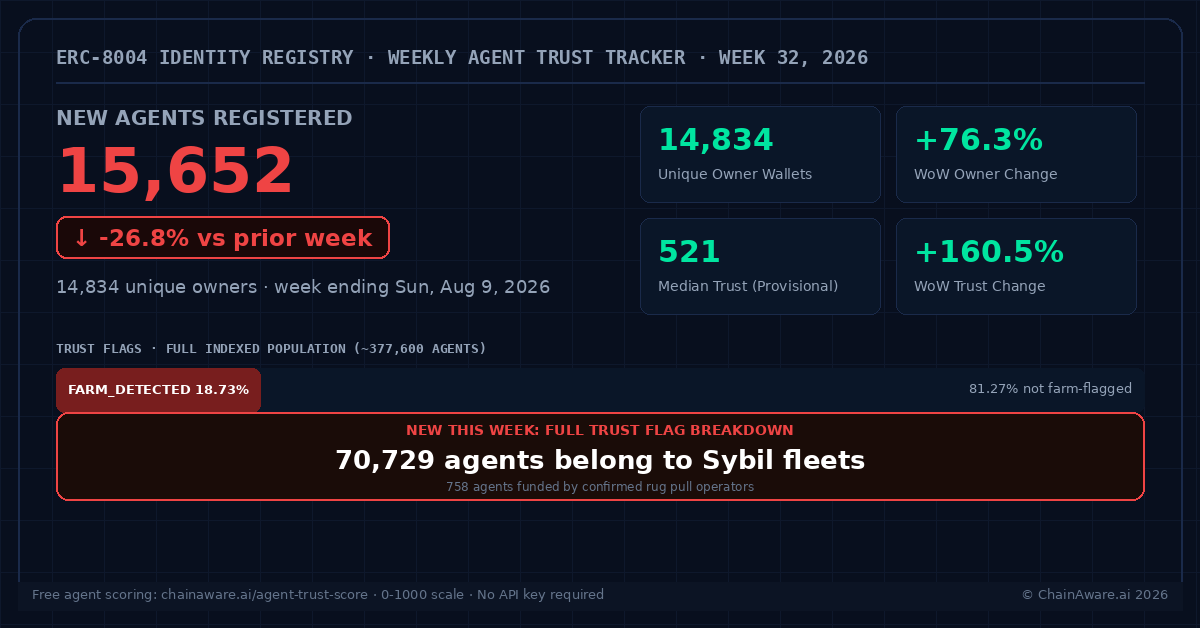
ERC-8004 Agent Trust Tracker Week 32 2026 – Registrations Fall as Median Trust Rebounds, Farm Detection Flags 1 in 5 Agents

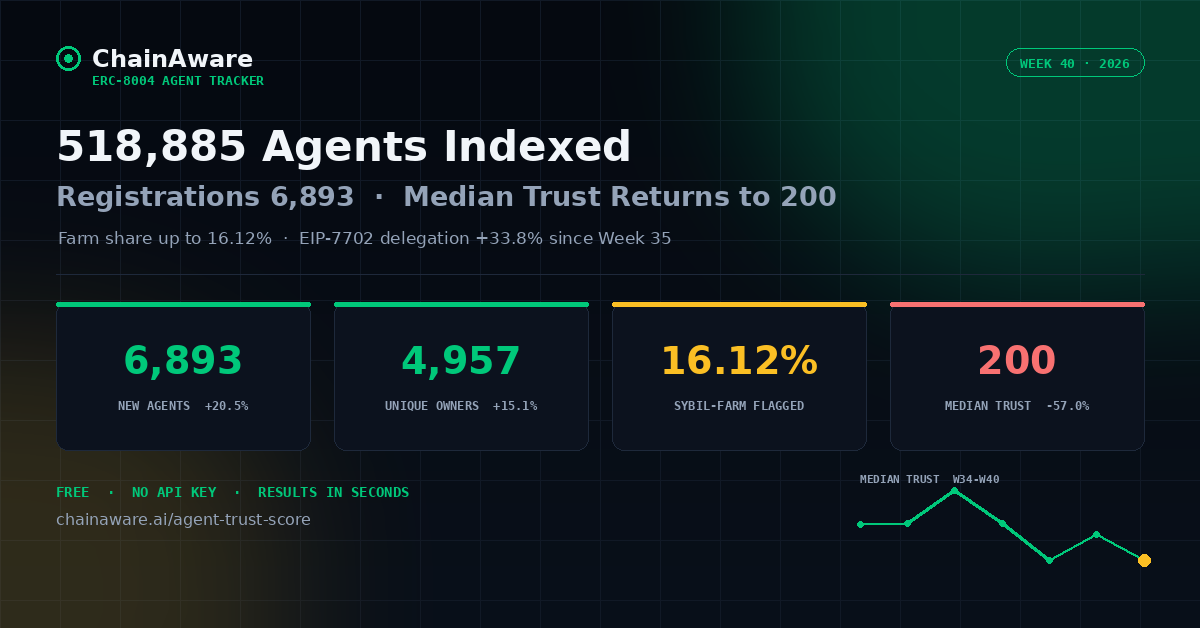
Week 32, 2026: 15,652 new ERC-8004 agents registered – down 26.8%, but unique owners rose 76.3%, reversing last week’s concentration spike. Median trust rebounded 160.5% to 521 (Provisional tier). New this week: a full trust flag breakdown shows 18.73% of all indexed agents are Sybil-farm flagged.

ERC-8004 Agent Trust Tracker Week 31 2026 – Unique Owners Collapse 58.7% as Registrations Concentrate and Trust Hits Floor

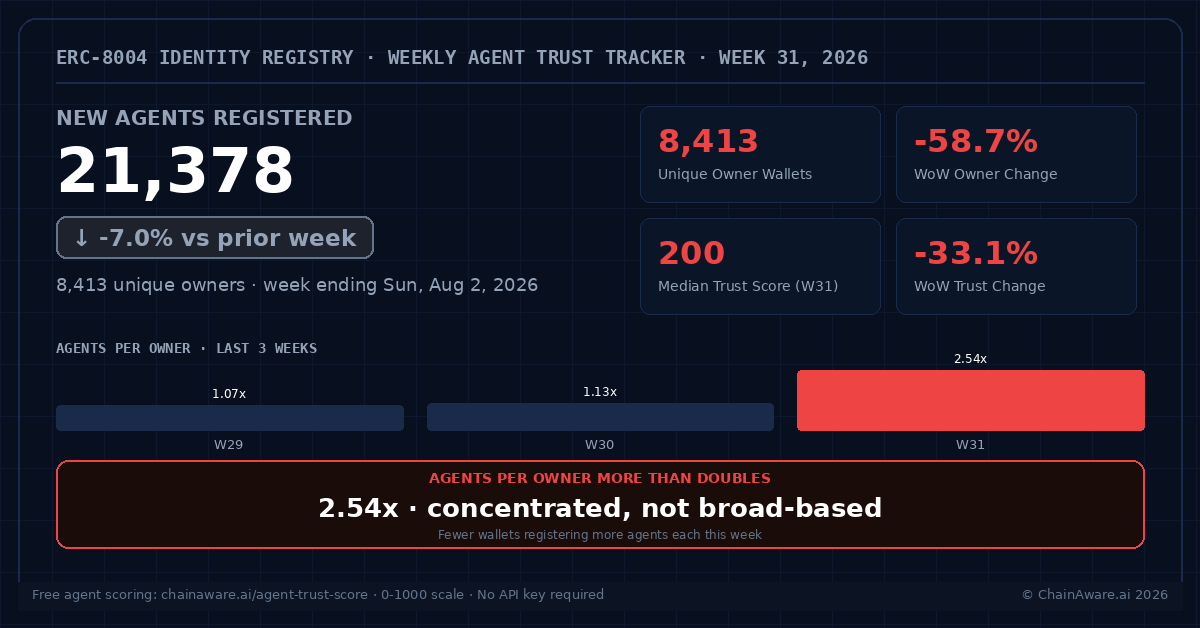
Week 31, 2026: 21,378 new ERC-8004 agents registered – down only 7.0%, but unique owner wallets collapsed 58.7% to 8,413. Agents per owner more than doubled to 2.54, signaling concentrated rather than broad-based growth. Median trust score fell 33.1% to 200, the floor of the Elevated Risk tier.

ERC-8004 Agent Trust Tracker Week 30 2026 – Registrations More Than Double to 22,989 as Median Trust Falls to Elevated Risk

Week 30, 2026: 22,989 new ERC-8004 agents registered – more than double Week 29’s 11,026. Unique owner wallets grew nearly as fast (+96.9%), showing broad-based rather than concentrated growth. Median trust score fell 26.4% to 299, dropping into the Elevated Risk tier – the lowest since Week 20.

ERC-8004 Agent Trust Tracker Week 29 2026 – Registrations Fall 54.9% as Most Agents Score Either Very Low or Very High

Week 29, 2026: 11,026 new ERC-8004 agents registered – down 54.9% from Week 28. Median trust score of new registrations fell 12.5% to 406. Across all 317,589 indexed agents, most score either very low (27.5% Untrusted) or very high (21.3% Sovereign) – few land in between.

ChainAware Launches Agent Trust Score — On-Chain Trust Scoring for the Agentic Commerce Era

ChainAware launches Agent Trust Score – the first on-chain trust scoring system for ERC-8004 registered AI agents. 274,792 agents indexed. 26% score Untrusted. 21.1% are farm-detected Sybil operations. Free, no signup required.

ChainAware Launches Agent Trust Score – On-Chain Trust Scoring for the Agentic Commerce Era

ChainAware launches Agent Trust Score – the first on-chain trust scoring system for ERC-8004 registered AI agents. Analysis of 274,792 indexed agents reveals 51.8% carry Elevated Risk or Untrusted scores, 21.1% are farm-detected Sybil operations, and 741 agents were funded by confirmed rug pull operators. Score owner wallet fraud probability, feeder address, and rug pull criminal record before granting autonomous execution access. Named in CB Insights AI Fraud Prevention Market Map. Free, no signup required.

The Agent Trust Infrastructure Race: Who Is Building the Trust Layer for Agentic Commerce?

Six platforms are competing to become the trust layer for agentic commerce in 2026 – ERC-8004 native, RNWY, SkyeProfile, AXIS T-Score, DJD, and ChainAware. Each answers a fundamentally different question. This guide maps every methodology, every blind spot, and the five signals only one platform provides, with a decision matrix for DeFi builders, agent creators, and investors.

The First Step in Agentic Commerce Isn’t Integration. It’s Trust.

The ERC-8004 registry tells you an agent exists. It does not tell you whether to trust it. This guide explains why Know Your Agent (KYA) is the missing trust layer for DeFi protocol builders in 2026 – and how scoring the owner wallet, feeder address, and rug pull history closes the gap before funds move.

ChainAware.ai’s 32 Claude Sub-Agents – Fraud Tech and Growth Tech for the Agentic Economy

ChainAware.ai operates on 32 Claude sub-agents – each one a specialist wrapping ChainAware’s Prediction MCP with precise decision logic and behavioral reasoning. This article classifies all 32 agents into Fraud Tech (17 agents) and Growth Tech (15 agents), with use case and trigger conditions for every agent.

Web3 Trust Verification Systems in 2026 – The Complete Five-Category Landscape

Web3 lost over $3.6 billion to fraud in the first three quarters of 2025 – and 57.8% of those losses came not from smart contract bugs but from access-control failures. Trust in Web3 is not one problem. It is five distinct problems requiring five distinct solutions, and most protocols are only covering one.