
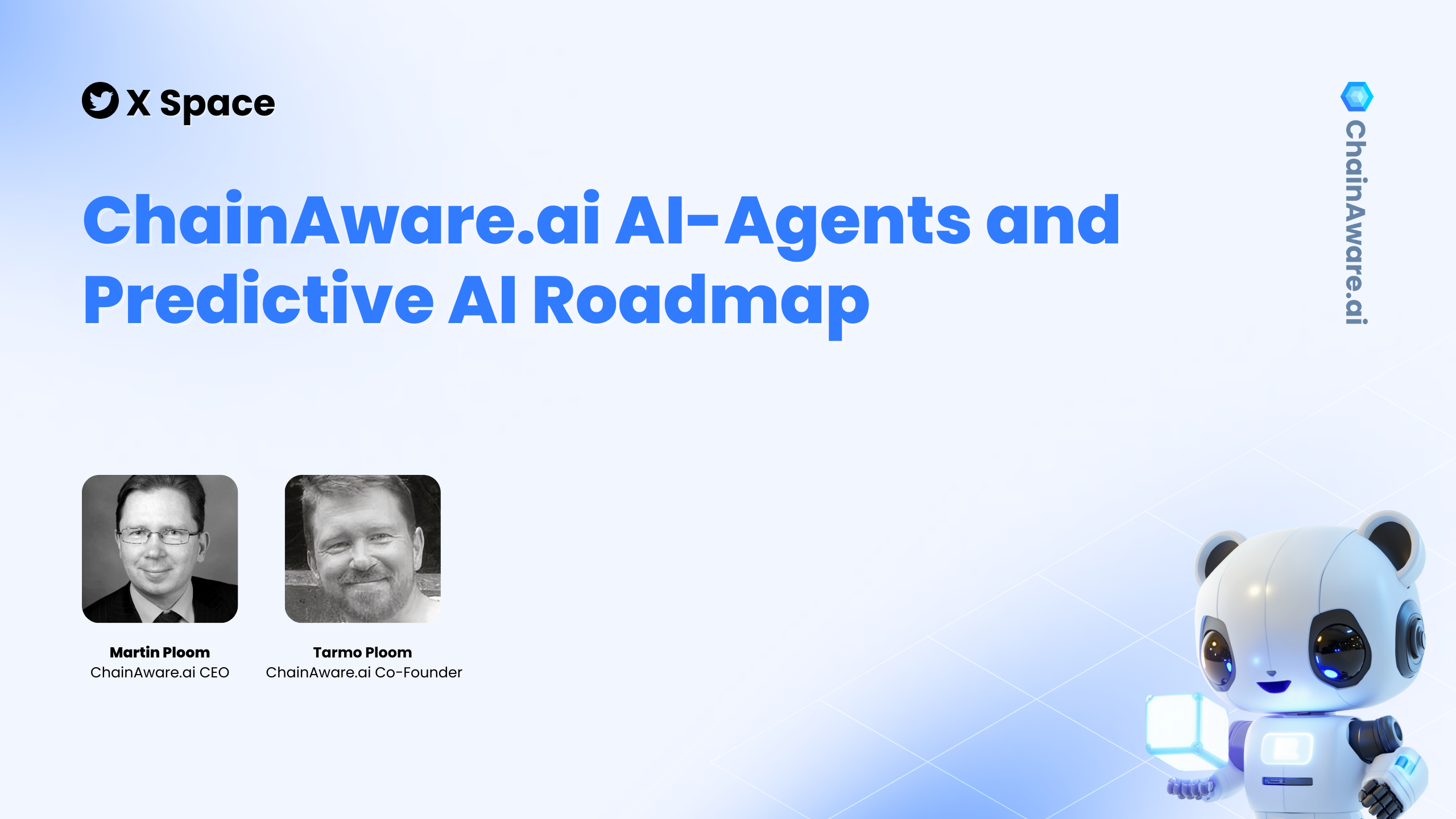
X Space #27 — ChainAware AI Agents and Predictive AI Roadmap. Watch the full recording on YouTube ↗ · Listen on X ↗
X Space #27 is ChainAware’s most comprehensive product and roadmap session to date. Co-founders Martin and Tarmo walk through every live product, every chain in development, the Google Cloud compute partnership, and the strategic vision that ties everything together — the thesis that Web3 needs the same two technologies that took Web2 from 50 million users to global scale. This article covers the full session: the product architecture, the technical distinction between transaction monitoring and AML, the marketing agent roadmap, the chain expansion plan, and the grand ambition of pushing Web3 past the chasm from linear to exponential growth.
In This Article
- Origin Story: From SmartCredit to ChainAware
- The Core Discovery: Predicting Behaviour from 10–20 Transactions
- Live Products: What Exists Right Now
- Trust Products for Individual Users
- Transaction Monitoring vs AML: The Critical Distinction
- Web3 Marketing Agents: The Google AdTech Parallel
- Free User Analytics: Intentions, Not Token Holdings
- Google Cloud Partnership: Real-Time Pre-Calculation at Scale
- Chain Expansion Roadmap: ETH, BNB, TON, Polygon, Tron, Base
- Crossing the Chasm: Web3’s Path to Exponential Growth
- Comparison Table: ChainAware Full Product Portfolio
- FAQ
Origin Story: From SmartCredit to ChainAware
ChainAware did not emerge from a white paper or a funding round. It grew out of a real problem encountered while building SmartCredit.io — a fixed-term, fixed-interest DeFi lending platform that Martin and Tarmo launched before the term “DeFi” was widely used. While building SmartCredit, they needed to assess borrower creditworthiness. Consequently, they developed credit scoring algorithms. Developing credit scoring, in turn, required calculating fraud probabilities — because a credit score that ignores fraud risk is fundamentally incomplete.
The fraud models they built for SmartCredit turned out to be far more interesting than the credit score itself. As Tarmo explains in X Space #27: “We thought that all Web3 community actually needs these algorithms to build up the trust and to identify fraudsters. And this was the start of ChainAware.” The public launch came on February 4, 2023 — with predictive fraud detection as the flagship product.
One important context point for X Space #27: ChainAware had just completed its TGE (Token Generation Event) on MEXC and PancakeSwap (V2 and V3 pools) days before the recording. Martin and Tarmo open the session by thanking investors and noting something unusual about their TGE — unlike most projects, ChainAware listed on MEXC without having a white paper. When MEXC asked for one, the team’s response was direct: “We don’t have a white paper. We have products. We can demo our products to you.” MEXC was confused — but listed them anyway.
The Core Discovery: Predicting Behaviour from 10–20 Transactions
The foundational insight behind ChainAware’s entire product portfolio is a discovery the team made while training their fraud models: from public blockchain data, you can predict behavioral characteristics of wallet addresses with remarkable accuracy — and you don’t need extensive history to do it. As Tarmo states in X Space #27: “You need maybe 10, 15, 20 transactions in a blockchain. And from these transactions you can predict the future.”
This discovery has several important implications. First, it means that even newly active wallets are assessable — you don’t need years of transaction history to generate useful predictions. Second, it means the model generalizes across blockchain behaviors — the patterns that predict fraud on Ethereum transfer, with retraining, to BNB Smart Chain, and the cross-chain training actually improves accuracy on both networks simultaneously. Third, it means predictions are genuinely forward-looking: not documenting what has already happened, but anticipating what will happen next.
Why Blockchain Data Is Uniquely Valuable
Tarmo describes blockchain data as “pure gold” in earlier X Spaces — and X Space #27 reinforces why. Unlike browsing history or search queries, blockchain transactions reflect deliberate financial decisions. Because people think carefully before executing financial transactions, their on-chain history carries extraordinarily high signal about their intentions and likely future behavior. Additionally, the data is permanent, public, and free — no licensing fees, no API agreements, no privacy walls. Furthermore, the proof-of-work and proof-of-stake mechanisms that validate transactions create data quality guarantees that no other data source provides.
This combination — high signal quality, permanence, public availability, and zero cost — makes blockchain data uniquely suited to predictive ML models. ChainAware builds proprietary neural networks trained on this data. The team explicitly does not use OpenAI, LLMs, or any third-party AI services for its prediction models. As Martin notes: “We are not using OpenAI, we are not using LLM. We have trained our own AI models.” This proprietary foundation is what creates the four-year competitive moat that no prompt-engineering competitor can replicate. For the full technical explanation of why proprietary models matter, see our guides on attention AI vs real utility AI and predictive AI for Web3.
Live Products: What Exists Right Now
A recurring theme in X Space #27 is the gap between ChainAware’s actual product portfolio and its public visibility. Martin and Tarmo acknowledge that they have been building faster than they have been announcing — there are products in production that haven’t been formally communicated to the community. The session is partly a correction to this: a systematic walkthrough of everything that is live, battle-tested, and scaling.
ChainAware’s product architecture divides into two layers. The base layer is a prediction engine — proprietary ML models processing blockchain data to produce behavioral scores, fraud probabilities, intention classifications, experience levels, risk profiles, and credit assessments. On top of this prediction engine sit APIs. On top of the APIs sit two categories of products: individual user tools (mostly free) and enterprise tools (subscription-based, revenue-generating). Both product categories call the same underlying prediction engine — they are different interfaces to the same intelligence. For the full enterprise product guide, see our AI agents for Web3 businesses guide.
Trust Products for Individual Users
Tarmo describes the individual user products as “trust enabling products” — tools that allow individuals to verify the trustworthiness of wallets, contracts, and counterparties before engaging with them. The philosophy is rooted in Bitcoin’s “don’t trust, verify” principle, updated for the on-chain data era: instead of verifying through reputation or identity documents, you verify through on-chain behavioral history.
Fraud Detector — 98% Accuracy, Real-Time
The flagship individual tool is the predictive fraud detector: enter any wallet address, receive a real-time fraud probability score within 0.5–2 seconds. The 98% accuracy is backtested against CryptoScamDB — an independent database of confirmed crypto fraud addresses — using held-out data the model had never seen during training. Supported chains at the time of X Space #27 include Ethereum, BNB Smart Chain, Polygon, and TON, with Base in beta. The key property — and the one that distinguishes it from every AML-based alternative — is that the score reflects predicted future behavior, not documented past incidents. For the complete guide, see our Fraud Detector guide.
Rug Pull Detector — Predicting Contract Behaviour
The rug pull detector applies the same predictive logic to smart contracts rather than wallet addresses. Tarmo notes that over 90% of new liquidity pools are destined to be rug pulls — and that number aligns with ChainAware’s monitoring of PancakeSwap pools, where 95% of daily new pools (1,400–1,800 created every day) end in rug pulls. The detector is particularly valuable for early-stage pool investments, where the risk of total loss (not 5–10%, but 100%) is highest. Furthermore, Tarmo mentions a specific real-world validation: fraudsters created fake ChainAware token pools to scam the community — and ChainAware’s own rug pull detector correctly identified these pools as rug pulls immediately upon creation. For the full methodology, see our Rug Pull Detector guide.
Wallet Auditor and Share My Wallet
The wallet auditor produces a comprehensive behavioral profile for any address: fraud probability, experience level, risk willingness (how much risk the wallet owner typically accepts, not just how much they hold), behavioral intentions (will they borrow, lend, trade, stake?), protocol category history, and hundreds of additional attributes. Particularly valuable is the Share My Wallet feature — a cryptographically signed link proving wallet ownership that any counterparty can share to establish trust in a peer-to-peer context. The implication Martin draws is the “I Googled you” dynamic: in Web2, people routinely check each other’s online presence before meeting. In Web3, checking someone’s wallet audit is the equivalent — and it’s far more informative. For more, see our behavioral analytics guide.
AI Credit Score
ChainAware’s credit score uses advanced ML algorithms that “go into very, very deep computation” — Tarmo’s description reflects the model’s complexity relative to the fraud detector. The credit score incorporates on-chain data plus social network data, producing a composite financial ability assessment. Currently underutilised in DeFi (because DeFi is still predominantly overcollateralised), the credit score’s importance will grow as undercollateralised lending matures. See our complete Web3 credit scoring guide for the full methodology.
Telegram Mini App, Bots, and Discord
All individual user functionality is accessible via Telegram Mini App (TMA), Telegram bot, and Discord bot — allowing checks without leaving the conversation environment where most Web3 users actually operate. Martin notes that the TMA was live but hadn’t been formally announced at the time of X Space #27: “We forgot to announce it.” The TMA is particularly relevant given Telegram’s new terms requiring all TMAs to support the TON chain — a requirement that filters out the many non-genuine TMAs and positions ChainAware’s tool prominently in the compliant ecosystem.
All Trust Tools — Free to Use Right Now
Fraud Detector · Rug Pull Detector · Wallet Auditor · Credit Score
ChainAware’s individual user tools are free: predict fraud (98% accuracy), predict rug pulls, audit any wallet, share your wallet proof. ETH, BNB, MATIC, TON, BASE. Real-time. No signup required. Don’t trust — verify.
Transaction Monitoring vs AML: The Critical Distinction
One of the most technically important segments of X Space #27 is the extended discussion distinguishing transaction monitoring from AML monitoring. These two terms are frequently used interchangeably in the industry — and that conflation leads to significant misunderstanding of what protection is actually being provided.
What AML Monitoring Actually Does
AML (Anti-Money Laundering) monitoring has a specific, legally defined mandate: ensure that “bad money” — funds associated with criminal activity, sanctions violations, or mixer services — does not enter or move through a platform alongside clean funds. AML systems maintain databases of known bad addresses and track the flow of funds from those addresses through the blockchain. Their job is to answer one question: does money associated with these known bad actors appear in this transaction? AML is backward-looking and deterministic. As Martin and Tarmo emphasise, it is fundamentally a documentation and accounting technology — not a fraud prevention technology.
What Transaction Monitoring Actually Does
Transaction monitoring, by contrast, is predictive. Rather than asking “has this address been associated with bad money?”, it asks “is this address beginning to exhibit the behavioral patterns that precede fraud?” The distinction is crucial because sophisticated fraudsters specifically avoid triggering AML flags. They fund new wallets through legitimate routes — centralized exchanges, clean on-ramps — giving those wallets zero AML exposure. However, their behavioral patterns on-chain may still match the pre-fraud signatures that ChainAware’s models have learned to recognize.
Martin puts it plainly: “AML monitoring is not saying that someone is taking good money and will fraud in the future. That’s transaction monitoring.” Furthermore, many major AML providers are now marketing their products as “transaction monitoring” — when what they’re actually providing is AML documentation. Tarmo is direct about this: “These AML companies, they are selling the AML logic as a transaction monitoring logic. But no, no — transaction monitoring is predictive.” For the full breakdown, see our crypto AML vs transaction monitoring guide, the DApp integration guide, and our analysis of forensic vs AI-based analytics.
MiCA Compliance Context
The regulatory context for transaction monitoring is growing rapidly. Under MiCA (Markets in Crypto-Assets Regulation) and MiFID, virtual asset service providers operating in the EU are required to monitor their client base continuously. Both Martin and Tarmo have 10+ years of Credit Suisse banking experience, where transaction monitoring and AML were core operational requirements — giving them unusually deep insight into how these mechanisms work in practice. ChainAware’s transaction monitoring agent allows platforms to upload their client address list and receive continuous behavioral monitoring with real-time notifications when risk patterns emerge. Additionally, the roadmap includes enhanced notification mechanisms so compliance teams receive immediate alerts rather than periodic reports. For the full compliance architecture, see our complete KYT and AML guide for DeFi.
Web3 Marketing Agents: The Google AdTech Parallel
The second major product category — Web3 marketing agents — receives extensive discussion in X Space #27, with Martin providing a detailed technical walkthrough of how they work and a clear articulation of why they represent the same transformation that Google AdWords created for Web2.
The Conversion Problem
Martin opens the marketing agent discussion by identifying the core problem precisely: it is not about bringing users to a website — point-based loyalty systems and token incentives already do this effectively. The problem is converting visitors into transacting users. He describes a real client example: 3,000 monthly website visitors → 600 connected wallets → 6–8 transacting users. At 0.2% conversion, the unit economics of user acquisition are structurally broken regardless of how much traffic a project generates. DeFi acquisition costs reach $1,000–$3,000 per transacting user specifically because the same message goes to everyone and almost nobody resonates with it.
How Marketing Agents Work
The marketing agent addresses this by personalising the on-site experience at the wallet connection event. The process has three steps. First, when a user connects their wallet, ChainAware’s prediction engine calculates their behavioral intentions from on-chain history — who will borrow, who will lend, who will trade, who will stake, what experience level they have, what risk appetite they carry. Second, these calculated intentions map to content templates that resonate specifically with those intentions. Third, the agent delivers that personalized content within the platform’s interface — showing a high-experience yield farmer something different from what a first-time DeFi user sees, showing a risk-taker different messaging from what a conservative holder receives.
The setup is deliberately simple: four lines of JavaScript (same as Google Analytics), URL inputs pointing to existing blog content, and one HTML div tag placed where the personalized content should appear. No CSS knowledge required, no design team involvement. The formatting generation roadmap will additionally automate visual styling — matching content formatting (color intensity, visual weight) to the user’s risk profile. Risk-tolerant users receive stronger visual formatting; conservative users receive softer presentations. All of this runs automatically, 24/7, without marketing team intervention. For the full setup guide, see our behavioral user analytics guide and our analysis of why personalization is the next big AI agent opportunity.
The Google Parallel
Martin returns repeatedly to the Google AdWords parallel as the clearest illustration of what marketing agents represent. Google is not, fundamentally, a search engine — it is an ad tech company. Google’s innovation was micro-segmentation: using search and browsing history to understand user intentions and deliver targeted advertising at the moment of peak relevance. This collapsed Web2 acquisition costs from unsustainable levels to $10–$30 per transacting user, enabling Web2 businesses to become cash-flow positive and scale. ChainAware is doing the same with blockchain transaction history — which, as discussed, is a higher-quality signal than browsing data. For the measured impact of this approach on a live DeFi platform, see our SmartCredit case study.
Stop Showing Every User the Same Message
ChainAware Marketing Agents — 1:1 Personalisation at Wallet Connection
4 lines of JavaScript. Automatic 1:1 content personalisation based on each wallet’s on-chain behavioral intentions. No design team. No CSS. Self-running 24/7. The same technology that Google applied to search history — now applied to blockchain transaction history.
Free User Analytics: Intentions, Not Token Holdings
The free user analytics dashboard is ChainAware’s entry point for Web3 businesses — a no-cost intelligence layer that gives any project visibility into who is actually visiting their platform and what those visitors are likely to do next.
Martin identifies a systematic flaw in most Web3 analytics: they focus on token holdings. Tools show which tokens users hold, in what quantities, from which protocols. This data tells a project almost nothing useful about conversion potential or acquisition strategy — because, as Martin states explicitly: “Behavior follows intention. Behavior does not follow token holding.” A wallet holding 10 ETH and a wallet holding 0.1 ETH can have identical behavioral intentions. A wallet holding governance tokens from five protocols might be a passive yield farmer who never interacts with your specific product. Token holdings are a lagging indicator of past behavior, not a forward-looking signal of future action.
Intention Distribution — The Metric That Matters
ChainAware’s user analytics shows intention distribution: across all wallets connecting to a platform, what percentage are likely borrowers, lenders, traders, NFT collectors, gamers, yield farmers? This tells a project whether the users it is attracting match the users it needs. Martin describes a specific client revelation: “One of our clients is a trading platform. But their users are actually NFT users in terms of intention.” The platform had been targeting and messaging for traders — but its actual user cohort was dominated by NFT-oriented wallets. No amount of trading-focused messaging would convert them. With this intelligence, the platform could either adjust its acquisition channels to attract genuine traders or create messaging that converts NFT users into cross-protocol DeFi participants. Furthermore, the user analytics dashboard is continuously enriched as ChainAware adds more computed attributes — hundreds of behavioral dimensions that give progressively deeper insight into cohort composition. For the complete guide, see our Web3 behavioral user analytics guide and the DeFi onboarding guide.
Google Cloud Partnership: Real-Time Pre-Calculation at Scale
The most significant infrastructure announcement in X Space #27 is the Google Cloud Web3 Startup Program partnership — and Tarmo provides more detail on the compute allocation and planned usage than in any subsequent X Space.
ChainAware was selected for the program — described as a “very light club” with very few startup recipients. The initial offer was $100,000 in compute credits. The team then made the case that ChainAware combines both Web3 and AI, making it doubly relevant to Google’s strategic priorities. The result: $250,000 in compute credits, plus additional co-investment arrangements where Google subsidises a portion of ongoing compute costs beyond the initial grant period. As Tarmo notes: “Every single cent will be used of this computing power.”
What Pre-Calculation Enables
The strategic significance of this compute power is the shift from on-demand calculation to pre-calculation. Currently, when a user queries a wallet address, ChainAware calculates the fraud and behavioral scores in real time — 0.5–2 seconds for most addresses. With pre-calculation, ChainAware processes every transacting address on Ethereum and BNB Smart Chain continuously, updating scores each time a new transaction appears in a block. The result: every query returns a pre-computed, maximally accurate score instantaneously. Moreover, the compute power unlocks the use of more sophisticated model classes — algorithms that achieve 99%+ accuracy but require approximately 57 times more computation than the current real-time models. Tarmo explains: “We have several classes of algorithms which have accuracy 99% plus. And we calculate with the stronger algorithms. Everything will be pre-calculated.”
Cohort and Macro-Level Intelligence
Beyond individual address scoring, the pre-calculation capability enables a qualitatively new type of analysis: cohort and macro behavioral intelligence. With pre-calculated intention data for all transacting addresses on Ethereum and BNB, ChainAware can detect shifts in ecosystem-wide behavioral patterns — trends in borrowing intent, shifts in trader vs holder distributions, emerging concentration of high-risk behavior in specific protocol categories. Tarmo describes the potential: “We can predict behavior of cohorts, of addresses, of clusters of addresses, we can group behavior. When we aggregate them and look at them in specific views — you can do miracle stuff.” This is the difference between knowing that one specific wallet will commit fraud and being able to see that the distribution of pre-fraud behavioral signatures across the entire Ethereum network is increasing — a macro early-warning system. The technology stack used is Google Cloud Vertex AI and Google BigQuery, leveraged through the startup program partnership. For more on the prediction infrastructure, see our Prediction MCP developer guide.
Chain Expansion Roadmap: ETH, BNB, TON, Polygon, Tron, Base
X Space #27 provides the most detailed chain expansion roadmap ChainAware had published to that point. Martin walks through each chain, its current support level, and the reasoning behind prioritisation decisions.
Ethereum — The Foundation
Ethereum was the first chain ChainAware supported and remains the training baseline for all ML models. Fraud detection, rug pull detection, wallet auditing, marketing agents, transaction monitoring, user analytics, and credit scoring are all fully operational on Ethereum. However, Martin acknowledges an important limitation: Ethereum transaction costs are high, which constrains activity volume and, consequently, the pool of data available for training. More activity on lower-cost chains is actually advantageous for model training.
BNB Smart Chain — Full Feature Parity
BNB Smart Chain has achieved full feature parity with Ethereum across the entire ChainAware product portfolio. Tarmo emphasises a key technical insight: the behavioral patterns learned on Ethereum transfer to BNB Smart Chain, and retraining on BNB data improves Ethereum model accuracy simultaneously. This cross-chain learning effect means that each new chain added strengthens the models on all existing chains. Furthermore, BNB Smart Chain’s lower transaction costs produce higher activity volume — making it an excellent data source for model enrichment. The BNB Smart Chain team retweeted ChainAware’s BNB launch announcement to 3+ million followers just before X Space #27.
TON — The Telegram Blockchain
TON support dates to November or December 2023 — ChainAware was an early beta tester of the TON API, collaborating directly with the TON API team to stabilise their APIs. Predictive fraud detection on TON is operational. The motivation is strategic: crypto is de facto on Telegram, and Telegram Mini Apps (TMAs) provide the most friction-free access to ChainAware’s tools for Telegram users. TON support is required for TMAs under Telegram’s updated terms of service, which also filters out many non-genuine TMAs.
Polygon — Partial Support
Polygon has fraud detection operational at the time of X Space #27. Rug pull detection on Polygon is not yet available — rug pull analysis requires more computation and chain-specific model training than fraud detection alone. Wallet auditing is in progress.
Tron — Next Roadmap Priority
Tron is the next major chain expansion at the time of X Space #27. Martin explains the prioritisation logic: Tron is primarily a payments platform — a high volume of user payment transactions flows through Tron’s network. Consequently, predictive fraud detection for payment transactions is the specific use case being ported. Marketing system support is a longer-term objective on Tron because it requires a rich protocol ecosystem; Tron’s strength is in payments rather than diverse DeFi protocols.
Base — In Beta Testing
Base chain is in beta testing at the time of X Space #27, with fraud detection nearly ready for production launch. Client demand is the driver: “When clients are screaming for Base, we format to the clients.” Base’s position in the Coinbase ecosystem makes it increasingly important for DeFi projects targeting mainstream adoption. For the current state of all chain support, visit chainaware.ai/fraud-detector.
Crossing the Chasm: Web3’s Path to Exponential Growth
The closing section of X Space #27 brings the full product discussion into strategic focus with a framework that explains not just what ChainAware is building but why it matters at an ecosystem level. The reference point is Geoffrey Moore’s “Crossing the Chasm” — the technology adoption model that describes the gap between early adopters (technology enthusiasts) and the early majority (pragmatists who need proven solutions before adopting).
Martin and Tarmo draw the parallel: Web3 today has the same structure as Web2 at the pre-chasm phase — approximately 50 million technically oriented early adopters who are comfortable with the technology, surrounded by a much larger potential user base that has not yet crossed the trust and usability threshold required for adoption. Web2 crossed its chasm when two specific problems were solved: the trust problem (credit card fraud eliminated by predictive transaction monitoring) and the acquisition problem (user conversion enabled by Google AdWords micro-segmentation). The technology crossed the chasm not because it became more technically sophisticated but because it became safe and economically viable for ordinary users and businesses.
The Two Technologies That Drive Crossing
Web3’s crossing moment requires the same two technologies. Trust technology — ChainAware’s predictive fraud detection, rug pull detection, and transaction monitoring — removes the fear of financial loss that keeps new users from engaging deeply with Web3 platforms. Ad technology — ChainAware’s marketing agents and user analytics — makes it economically viable for Web3 businesses to acquire users and become cash-flow positive. Without both, the ecosystem remains stuck in linear growth, cycling through the same early adopter population without expanding. With both, the conditions for exponential growth are in place.
Tarmo articulates the vision: “Increase the trust in ecosystem with predictive AI, and increase the engagement of users so they are getting the right users. Get customer acquisition cost down. Engagement up with marketing agents. And it’s not just that these products are just talked about. These products are there to solve the core issue. The core issue is: how do we get growth in the Web3 ecosystem.” Martin’s closing words reflect genuine conviction: “Technology is here. Future is bright. We can transform Web3 over into exponential growth.” For more on how this plays out across DeFi specifically, see our DeFAI explained guide and our complete guide to real AI use cases for Web3 projects.
Access the Full Prediction Engine via API
ChainAware Prediction MCP — All Products in One API
Fraud detection, rug pull detection, behavioral profiling, credit scoring, AML monitoring — all via the Prediction MCP server. 31 MIT-licensed open-source agent definitions on GitHub. ETH, BNB, BASE, POLYGON, TON, TRON, HAQQ, SOLANA. API key required.
Comparison Table: ChainAware Full Product Portfolio
| Product | Target User | What It Predicts | Chains | Accuracy | Pricing |
|---|---|---|---|---|---|
| Fraud Detector | Individual / Enterprise | Future fraudulent wallet behaviour | ETH, BNB, MATIC, TON, BASE | 98% | Free (individual) |
| Rug Pull Detector | Individual / Enterprise | Whether a contract will rug pull | ETH, BNB | High | Free (individual) |
| Wallet Auditor | Individual / Enterprise | Intentions, experience, risk, categories | ETH, BNB, MATIC, TON, BASE | Real-time | Free |
| Share My Wallet | Individual | Cryptographic wallet ownership proof | ETH, BNB, MATIC, TON, BASE | Real-time | Free |
| AI Credit Score | Individual / Enterprise | Financial ability and creditworthiness | ETH | 4+ years | Free (individual) |
| Telegram Mini App | Individual | All individual tools inside Telegram | ETH, BNB, TON | Same as web | Free |
| Marketing Agents | Enterprise (DApps) | User intentions → personalised content | ETH, BNB, MATIC, TON, BASE | Measurable CVR | Subscription |
| Transaction Monitoring | Enterprise (VASPs) | Pre-fraud behavioral patterns | ETH, BNB, MATIC, TON, BASE | 98% | Subscription |
| User Analytics | Enterprise (DApps) | Cohort intentions distribution | ETH, BNB, MATIC, TON, BASE | Real-time | Free |
| Credit Scoring Agent | Enterprise (Lenders) | Borrower creditworthiness at scale | ETH | 4+ years | Subscription |
| Prediction MCP API | Developers / AI Agents | All predictions via MCP protocol | 8 chains | 98%+ | API key |
Frequently Asked Questions
How did ChainAware emerge from SmartCredit?
SmartCredit.io, ChainAware’s predecessor project, required credit scoring algorithms to assess borrower quality in its DeFi lending platform. Building credit scoring required building fraud models, because a credit score that ignores fraud risk is incomplete. The fraud models turned out to be far more valuable and broadly applicable than the credit score itself — ChainAware was created to offer these predictive tools to the entire Web3 community, not just SmartCredit’s lending users. The credit scoring model predates ChainAware’s public launch and has been in production for over four years. See our DeFi credit score platform comparison for market context.
What is the difference between AML and transaction monitoring?
AML (Anti-Money Laundering) monitoring checks whether “bad money” — funds from known criminal sources, sanctioned entities, or mixer services — is present in a transaction. It is backward-looking and documentation-based. Transaction monitoring is predictive: it analyzes behavioral patterns to forecast whether a currently clean address is beginning to exhibit pre-fraud signatures. In Web3, where transactions are irreversible, only transaction monitoring provides real protection — AML documentation is too late. For full details, see our AML vs transaction monitoring guide.
What does the Google Cloud partnership provide?
ChainAware was accepted into the Google Cloud Web3 Startup Program, receiving $250,000 in compute credits plus additional co-investment arrangements. This compute power enables pre-calculation of fraud and behavioral scores for all transacting addresses on Ethereum and BNB Smart Chain, unlocking 99%+ accuracy model classes that are too computationally intensive for on-demand real-time use. Additionally, it enables cohort and macro-level behavioral intelligence — detecting ecosystem-wide behavioral trends rather than just individual address scores. Google Vertex AI and BigQuery power the computation infrastructure.
Why does ChainAware support some chains but not others?
Chain expansion follows a structured approach: development testing → beta testing → production launch. Priority is determined by client demand and the chain’s suitability for specific use cases. BNB Smart Chain achieved full feature parity because of high client demand and high transaction volume (excellent for model training). TON was prioritised for its Telegram integration and TON API collaboration. Tron is next for its payment transaction volume. Base is in beta due to strong demand from Coinbase ecosystem projects. Each new chain also improves models on existing chains through cross-chain learning — behavioral patterns that predict fraud on Ethereum transfer and strengthen BNB models, and vice versa.
Why does ChainAware have products but no white paper?
ChainAware deliberately prioritises building working products over writing documentation about planned products. When MEXC requested a white paper as part of the listing process, the team responded: “We don’t have a white paper. We have products. We can demo our products.” This philosophy reflects the co-founders’ conviction that running software delivering measurable value is more credible evidence of capability than any document. It also reflects the distinction between attention AI (projects that create narratives for investors) and real utility AI (projects that build tools for users). For more on this distinction, see our attention AI vs real utility AI guide.
How do Web3 marketing agents differ from regular Web3 marketing?
Conventional Web3 marketing shows every website visitor the same content regardless of who they are — a mass broadcast approach. ChainAware’s marketing agents calculate each connecting wallet’s behavioral intentions from on-chain history and deliver personalised content matched to those intentions. A yield farmer sees yield farming messaging. A first-time DeFi user sees educational onboarding content. A credit-oriented borrower sees lending product information. This one-to-one resonance increases conversion rates substantially — the same effect Google AdWords created in Web2 by replacing mass banner advertising with intent-matched search advertising. For measured results, see our SmartCredit case study.
Start with Free Analytics — Then Scale to Marketing Agents
ChainAware.ai — Web3 Agentic Growth Infrastructure
Free user analytics (pixel integration, 2 minutes) → understand your cohort’s intentions → deploy marketing agents → measure conversion improvement. Trust tools free for all users. Enterprise tools subscription. 14M+ wallets. 8 blockchains. 98% fraud accuracy.
This article is based on X Space #27 hosted by ChainAware.ai co-founders Martin and Tarmo. Watch the full recording on YouTube ↗ · Listen on X ↗. For questions or integration support, visit chainaware.ai.