
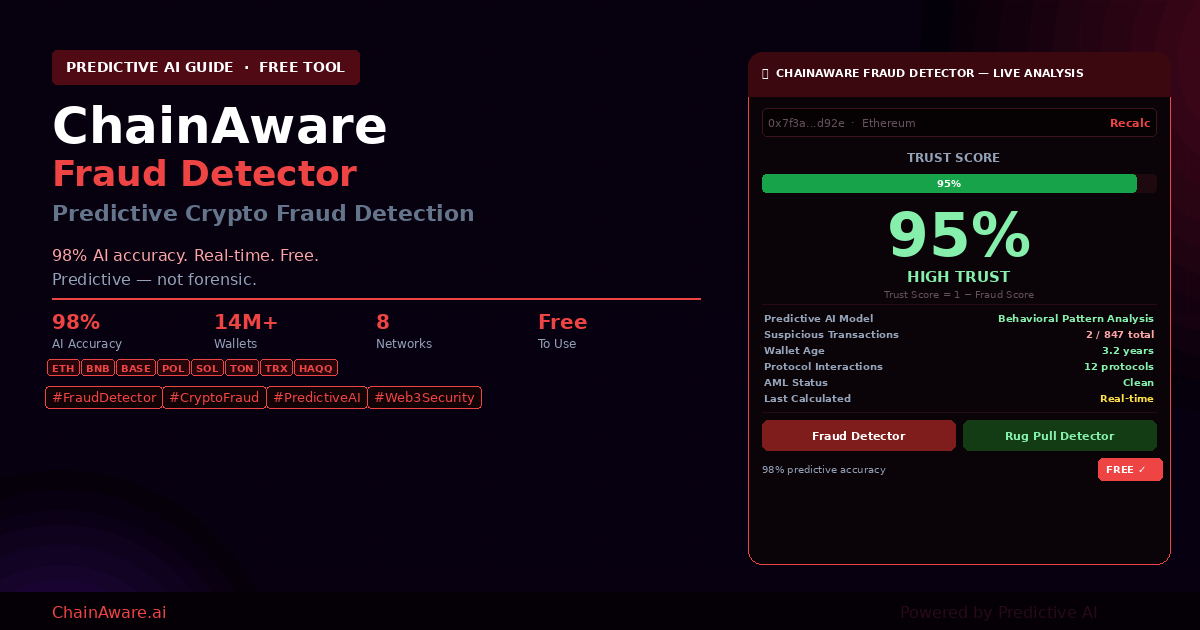
Most crypto fraud detection tools work by looking backwards. They maintain databases of known bad addresses — addresses already caught committing fraud, flagged by exchanges, or listed in blockchain forensics databases. If an address appears on the list, it’s flagged. If it doesn’t, it passes.
The problem with this approach is obvious: every fraudster starts with a clean address. By the time an address makes it onto a forensic database, the damage is done.
ChainAware’s Predictive Fraud Detector works differently. Instead of checking whether an address is already known to be bad, it analyzes the address’s on-chain transaction history to identify behavioral patterns characteristic of fraudulent activity — and predicts whether fraud is likely to occur in the future. The result is a fraud risk score that flags dangerous addresses before they cause harm, not after.
This guide covers everything you need to know: how the Fraud Detector works, what makes it different from AML and traditional forensics, when to use it, and where it fits in the broader crypto security stack.
What Is the ChainAware Fraud Detector?
The ChainAware Fraud Detector is a free, real-time predictive AI tool that analyzes any regular wallet address on supported blockchain networks and outputs a fraud probability score between 0 and 1. A score close to 0 indicates low fraud risk. A score close to 1 indicates high fraud risk.
The current predictive accuracy of the underlying AI model is 98% — meaning the algorithm correctly identifies 98 out of every 100 fraud cases. This is not a forensic algorithm based on already-listed bad addresses or blockchain analytics flags. It is a predictive algorithm trained to recognize the on-chain behavioral patterns that precede fraudulent activity.
Key facts about the Fraud Detector: it is free to use (connect your wallet and run the check); real-time (reads live blockchain history, analyzes it, and returns results instantly); predictive, not forensic (identifies future risk from behavioral patterns, not past database entries); part of the Predictive Data Layer with 14M+ wallets pre-calculated; and supports 8 networks — Ethereum, Binance Smart Chain, Base, Polygon, Haqq, Solana, TON, and Tron.
Free Fraud Check — Real-Time
Check Any Wallet Address Before You Transact
Enter any Ethereum, BNB, Base, Polygon, Solana, TON, Tron, or Haqq wallet address and get an instant AI-powered fraud risk score. 98% accuracy. Free. No registration required — just connect your wallet.
How It Works: Predictive AI vs Forensic Lookup
Understanding the distinction between predictive fraud detection and forensic fraud detection is essential to understanding the Fraud Detector’s value.
Forensic Fraud Detection (Traditional)
Traditional blockchain fraud detection tools are forensic: they maintain curated databases of addresses that have already been linked to fraudulent activity — stolen funds, sanctioned entities, phishing operations, exchange hacks, and other known criminal incidents. When you query an address, the tool checks whether that address appears in its database. If yes, flagged. If no, clean.
The fundamental limitation is temporal: every fraudster starts with a fresh address. Before they commit fraud, they are invisible to forensic tools. The database only catches them after the harm is done — and only if the incident was reported, investigated, and added to the relevant database, which can take weeks or months.
Predictive Fraud Detection (ChainAware)
ChainAware’s Fraud Detector takes a fundamentally different approach. It does not check a database of known bad actors. Instead, it reads the entire transaction history of the address being queried — every interaction, every counterparty, every timing pattern — and runs that history through a predictive AI model trained to recognize the behavioral signatures of fraudulent activity.
The core insight is this: every scam is unique, but scammers follow recognizable interaction patterns. Fraud is not random. It involves specific sequences of behavior — wallet preparation patterns, interaction with mixing services, timing of fund movements, relationships with other flagged addresses, protocol interaction patterns, and dozens of other behavioral signals that appear consistently in the transaction histories of addresses that eventually commit fraud.
The ChainAware AI model was trained on two data sets: confirmed fraud addresses (with known fraudulent histories) and confirmed legitimate addresses (with verified clean histories). By learning to distinguish the behavioral patterns of these two sets, the model can classify new addresses based on their behavioral fingerprint — before any fraud has been publicly reported.
According to Chainalysis’s crypto crime research, illicit on-chain activity follows identifiable behavioral patterns that persist across different types of fraud and different market cycles. Predictive models trained on these patterns consistently outperform purely forensic approaches in early fraud detection.
Pre-Calculated vs Real-Time Results
The ChainAware Predictive Data Layer contains pre-calculated fraud scores for over 14 million wallet addresses. When you query an address that’s already in the database, the result is returned instantly — the last calculated score is shown immediately. Users can choose to request a fresh real-time recalculation. For addresses with extensive transaction histories, this real-time analysis typically takes 3–4 seconds as the algorithm reads the full blockchain history and runs the predictive model against it.
Fraud Detector vs AML: Understanding the Difference
Crypto AML (Anti-Money Laundering) and fraud detection are often conflated, but they address fundamentally different problems with different methods and different objectives.
What Is Crypto AML?
AML focuses on verifying the origin of funds — specifically, ensuring that money entering a financial service or protocol has come from declared, legal sources. The distinction AML enforces is between “white money” (funds with a verifiable, legal origin) and “black money” (funds derived from criminal activities or hidden from tax authorities).
The scale of the problem AML addresses is significant. According to the United Nations’ FACTI Panel report, global money laundering flows are estimated at approximately 2.7% of global GDP annually — trillions of dollars flowing through financial systems while disguising their criminal origins.
AML looks backwards: it asks where money came from.
What Is Fraud Detection?
Fraud detection focuses on predicting whether an address is likely to engage in fraudulent behavior in the future — not whether its funds are clean in the present. The ChainAware Fraud Detector is not asking “are these funds from a legal source?” It is asking “based on this address’s behavioral history, is it likely to commit fraud?”
Fraud Detection looks forward: it asks what an address will do next.
AML and fraud detection are complementary rather than substitutable. A complete crypto security posture requires both: AML ensures funds are clean, fraud detection identifies dangerous counterparties before you transact with them. The ChainAware Wallet Auditor combines both dimensions — showing Predicted Trust (the inverse of Fraud Score), AML status, and the full behavioral profile — in a single view.
What Is Crypto Transaction Monitoring?
Transaction monitoring is a compliance and security discipline that applies both AML and fraud detection continuously to every transaction in real time. In traditional financial institutions, every transaction is routed through real-time monitoring systems before settlement — analyzing the parties involved, the amount, the timing, and historical patterns of both sender and receiver.
Crypto transaction monitoring faces a different data environment: pseudonymous addresses, no personal data, no device fingerprints, no declared income. What it does have is a complete, public, immutable transaction history for every address — which is precisely what ChainAware’s predictive AI uses. The behavioral fingerprint encoded in an address’s on-chain history is, in many respects, more reliable than self-reported identity data.
The ChainAware Fraud Detector is a core component of crypto transaction monitoring. The relevance of this use case is substantial: according to Artemis Analytics’ analysis of Ethereum transactions, approximately 50% of all Ethereum transactions are stablecoin payment transactions — real-world value transfers between parties. Most fraud detection tools focus on protocol interactions. The ChainAware Fraud Detector focuses specifically on the payment transaction layer: verify the recipient before you send.
Before You Send — Verify the Recipient
50% of Ethereum Transactions Are Payments. Check the Recipient First.
The ChainAware Fraud Detector runs a real-time AI analysis of any wallet address in seconds. Free. Supports ETH, BNB, Base, Polygon, SOL, TON, TRX, HAQQ. Connect your wallet and check.
How to Use the Fraud Detector — Real Example: vitalik.eth
Using the ChainAware Fraud Detector is straightforward. Navigate to chainaware.ai/fraud-detector, connect your wallet, and enter the address you want to check. Here’s a real example using vitalik.eth — Vitalik Buterin’s public Ethereum address, one of the most analyzed wallets on-chain.
Step 1 — Connect your wallet. The Fraud Detector is free but requires wallet connection for access. This is a one-time step per session.
Step 2 — Enter the address and select the network. Paste the wallet address or ENS name (e.g. vitalik.eth) and select Ethereum.
Step 3 — View the result. The screenshot below shows the live ChainAware analysis of vitalik.eth. You can run the same check yourself at chainaware.ai/fraud-detector/eth/vitalik.eth.
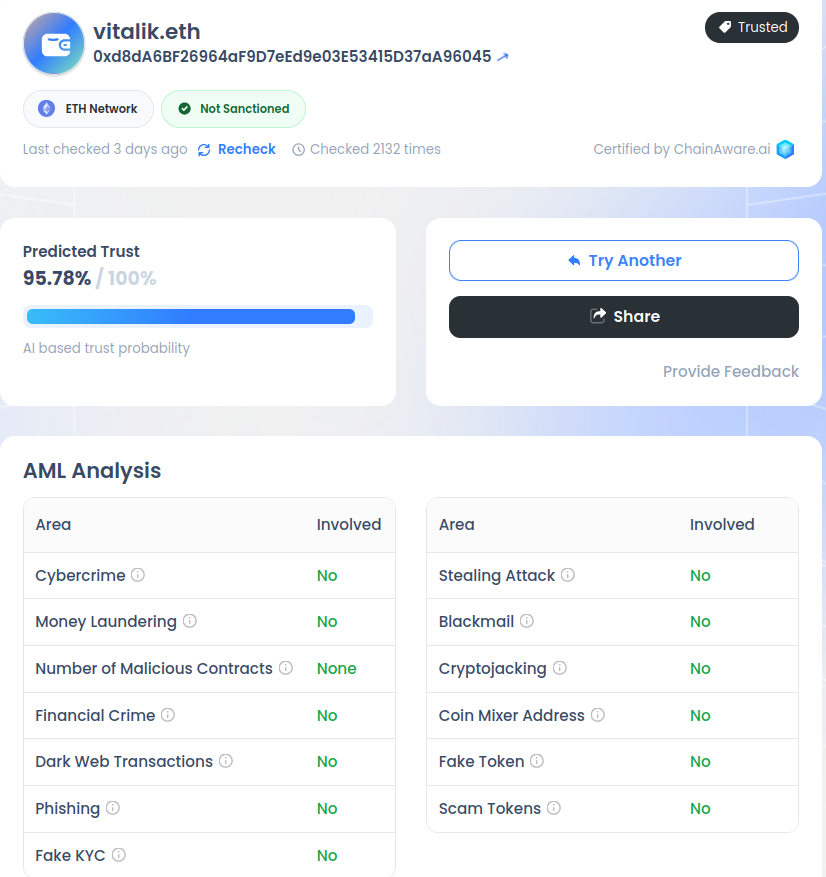
The result for vitalik.eth illustrates the algorithm at work: a wallet with years of legitimate, high-volume, multi-protocol interaction produces a very low fraud score. The behavioral fingerprint — diverse protocol usage, long wallet age, consistent interaction patterns, no suspicious counterparty clusters — is the opposite of what fraudulent addresses typically show.
Step 4 — Request a real-time recalculation (optional). You can request a fresh recalculation at any time. For addresses with extensive transaction histories like vitalik.eth, this takes approximately 3–4 seconds as the algorithm reads the full current blockchain history and runs the predictive model in real time.
Step 5 — Interpret the result. A score close to 0 indicates low predicted fraud risk. A score close to 1 indicates high predicted fraud risk. Use the score as one input in your risk assessment alongside other available data.
Limitations: When the Fraud Detector Does Not Apply
The Fraud Detector is a powerful tool, but it has specific use conditions that are important to understand.
Contract Addresses
The ChainAware Fraud Detector works exclusively on regular wallet addresses (externally owned accounts / EOAs). It does not work on smart contract addresses. If you need to assess the risk of a smart contract or liquidity pool, use the ChainAware Rug Pull Detector instead.
New Addresses with Fewer Than 10–15 Transactions
The predictive AI model requires a minimum transaction history to generate a reliable score. Addresses with fewer than 10–15 transactions do not have sufficient behavioral data for the model to identify meaningful patterns. Treat new low-activity addresses with appropriate caution by default.
Already-Flagged Forensic Addresses
If an address has already been flagged in forensic databases as a confirmed fraud address, the Fraud Detector will surface this forensic flag. At this point, the predictive value is moot — the address is already a known bad actor. The tool is most valuable for addresses that have not yet been forensically flagged — the vast majority of potentially dangerous addresses — where the predictive AI’s forward-looking analysis provides actionable risk intelligence that no forensic database can.
Contract Addresses: Use the Rug Pull Detector
While the Fraud Detector covers wallet addresses, ChainAware’s Predictive Rug Pull Detector covers smart contract addresses — specifically liquidity pools, DeFi protocol contracts, and token contracts that may be designed to execute a rug pull.
A rug pull occurs when the developers of a DeFi project withdraw all liquidity or exploit a contract backdoor to drain user funds — typically after attracting significant investment through promotion and artificial price appreciation. According to Immunefi’s Web3 security research, rug pulls and exit scams account for a significant share of total crypto losses annually — making pre-investment contract screening one of the highest-ROI security practices available.
The Rug Pull Detector analyzes contract-level behavioral patterns — ownership concentration, liquidity lock status, contract upgrade mechanisms, wallet interaction patterns around the contract — to predict the probability of a rug pull before it occurs.
Use case guidance: checking a wallet address before sending payment → Fraud Detector. Checking a smart contract / liquidity pool before investing → Rug Pull Detector. Full behavioral audit of a wallet → Wallet Auditor. For more on rug pulls vs other fraud types, see our guide on Pump and Dump vs Rug Pull.
Investing in DeFi? Check the Contract First
Rug Pull Detector: AI-Powered Smart Contract Risk Assessment
Before you provide liquidity, stake, or invest in any DeFi contract, run a Rug Pull prediction. Predictive AI identifies rug pull risk patterns in smart contract behavior before the exit happens. Free to use.
Supported Networks
The ChainAware Fraud Detector currently supports eight blockchain networks covering the vast majority of active on-chain transaction volume: Ethereum (ETH) — approximately 50% of all transactions are stablecoin payments, making fraud detection here particularly high-value; Binance Smart Chain (BNB) — high-volume, low-cost transactions with a large retail user base; Base — Coinbase’s L2 network, growing rapidly for DeFi and payments; Polygon (POL) — widely used for gaming, NFTs, and DeFi; Haqq — Islamic finance-aligned blockchain; Solana (SOL) — high-throughput network with significant payment and DeFi activity; TON — Telegram’s blockchain with rapidly growing payment activity; and Tron (TRX) — one of the largest stablecoin transfer networks by volume, particularly for USDT.
Where Fraud Detector Fits in the ChainAware Ecosystem
The Fraud Detector is one component of ChainAware’s broader Predictive Intelligence Stack. The Wallet Auditor is the most comprehensive single-wallet intelligence tool — it includes Predicted Trust (= 1 minus Fraud Score) alongside AML status, experience level, risk willingness, behavioral intentions, and Wallet Rank. The full AML and Transaction Monitoring suite combines forensic fund-flow tracing with predictive behavioral scoring into a continuous monitoring layer. The Rug Pull Detector is the contract-address counterpart to the wallet-focused Fraud Detector.
For Dapp teams, the fraud intelligence also powers the conversion tools: Web3 Behavioral Analytics uses aggregate fraud scores as one of its 10 dashboard dimensions, and the Prediction MCP allows AI agents to query fraud scores programmatically in real time. For the complete product overview, see the ChainAware complete product guide.
Real-World Use Cases
1. Payment Sender: Verifying a New Counterparty
You’re about to send USDT to an address you’ve never transacted with before — a new supplier, service provider, or trading counterparty. Before confirming, run the address through the Fraud Detector. A high score (close to 1) is a strong signal to pause and ask more questions. Given that the tool is free and takes seconds, this is one of the highest-ROI security checks available in crypto.
2. Exchange / Protocol: Screening Depositing Wallets
Exchanges, lending protocols, and payment processors face significant exposure to fraudulent wallets that deposit funds, exploit services, and withdraw before detection. Integrating the Fraud Detector API into deposit workflows provides a real-time risk signal on every depositing wallet. For automated integration, see the Prediction MCP developer guide.
3. DeFi Investor: Assessing Liquidity Partners
In DeFi liquidity pools, co-investors matter. A pool with a significant share of high-fraud-risk liquidity providers is a potential target for coordinated exit attacks. Checking the fraud scores of major LPs before committing capital provides meaningful intelligence about pool composition and counterparty risk.
4. NFT Buyer: Verifying Seller Addresses
NFT marketplace fraud — wash trading, counterfeit collections, fraudulent royalty manipulation — often involves addresses with recognizable behavioral patterns. Running a fraud check on a seller address before a significant purchase provides a fast, objective risk signal.
5. Airdrop Campaign: Filtering Farmers
Airdrop farming — where bad actors create multiple wallets to claim incentive distributions — is one of the most common fraud patterns in Web3. Fraud scores provide one filtering dimension: wallets with high fraud scores should be excluded from incentive eligibility. For the full framework, see our guide on using Wallet Rank to identify low-quality wallets.
ChainAware.ai — Predictive Fraud Intelligence
Check Before You Transact. Predict Before You Invest.
Fraud Detector for wallet addresses. Rug Pull Detector for smart contracts. Both free. Both predictive. Both real-time. 98% accuracy across 14M+ wallets on 8 networks.
Frequently Asked Questions
Is the Fraud Detector really free?
Yes — the ChainAware Fraud Detector is free to use. You need to connect your wallet for access, but there is no subscription, no credit card, and no fee per lookup. The Rug Pull Detector is also free.
How accurate is the fraud score?
The current predictive accuracy of the AI model is 98% — meaning it correctly identifies 98 out of every 100 fraud cases in testing. No model is 100% accurate; use the fraud score as a strong probabilistic signal rather than a definitive verdict.
Can I use the Fraud Detector on a contract address?
No. The Fraud Detector works exclusively on regular wallet addresses (EOAs). For smart contract addresses, use the Rug Pull Detector.
What happens if an address has very few transactions?
Addresses with fewer than 10–15 transactions do not have sufficient behavioral history for the model to generate a reliable score. New addresses should be treated with appropriate caution by default.
How is this different from checking an address on Etherscan?
Etherscan is a block explorer — it shows transaction history but has no predictive capability and no AI-powered behavioral analysis. The ChainAware Fraud Detector adds a predictive risk score on top of the raw transaction history — the analysis layer that Etherscan doesn’t provide.
How is the Fraud Score related to Predicted Trust in the Wallet Auditor?
Predicted Trust = 1 − Predicted Fraud Score. A wallet with a Fraud Score of 0.15 has a Predicted Trust of 0.85 (85%). The Wallet Auditor displays both alongside the full behavioral profile, AML status, experience level, and Wallet Rank.
Can I integrate the Fraud Detector into my platform?
Yes — ChainAware exposes the full Predictive Data Layer via API and MCP. The Prediction MCP allows AI agents and developers to query fraud scores programmatically in real time.