Token Audit at Scale: 15,000 EVM Tokens Across CoinGecko + CoinMarketCap (2026)

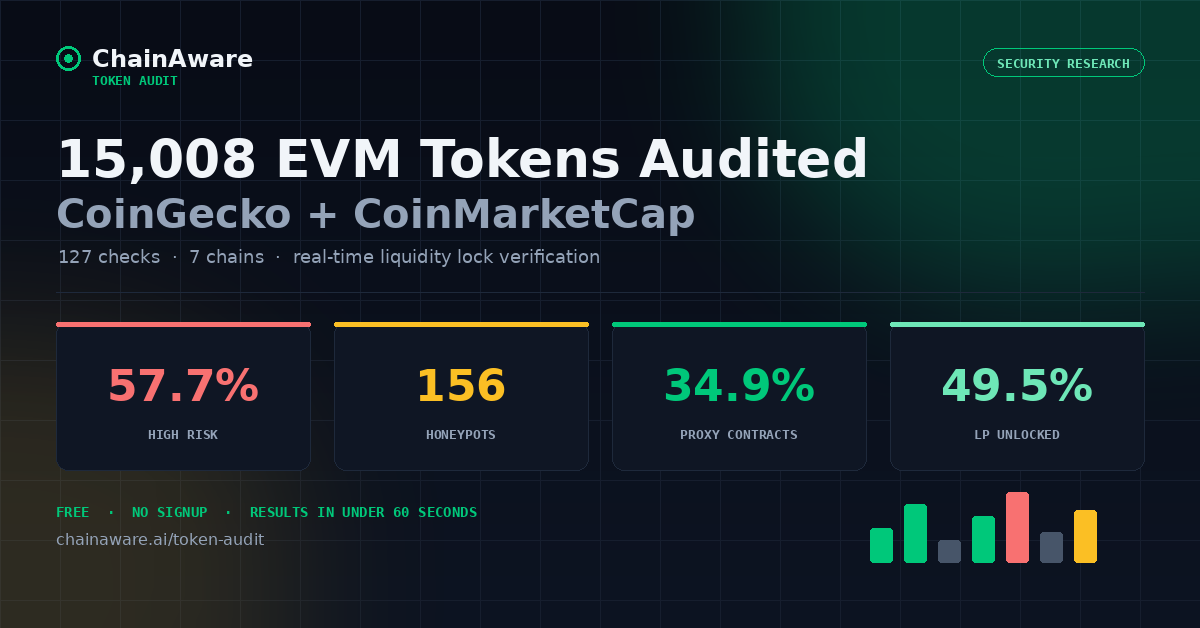
ChainAware expanded its Token Audit study from 10,000 CoinGecko tokens to 15,008 tokens combining CoinGecko and CoinMarketCap’s full EVM listings across 7 chains (Ethereum, BSC, Base, Polygon, Arbitrum, Optimism, Avalanche). Results: 57.7% high risk, 24.9% suspicious, 16.3% clean, and 156 confirmed honeypots via simulation analysis. 35.3% of tokens have no enforceable mint cap and 35.8% have no timelock on privileged functions – the two findings driving 77.4% of all risk verdicts, consistent with the original study. The biggest change is liquidity lock detection: now covering V2 and V3 pools across six chains and five DEX families (Uniswap, PancakeSwap, QuickSwap, SushiSwap, Trader Joe), with a new real-time recalculation feature that lets anyone verify current lock status on demand in under 5 minutes. Proxy contract detection also expanded to near-complete coverage, revealing 34.9% of tokens use upgradeable proxy patterns – including 118 controlled by a single private key with no multisig or timelock protection. Free Token Audit tool: 127 checks, deep code analysis, results in under 60 seconds, no signup required.
How Should Investors Evaluate AI Trading Agents? A New Study Has Answers

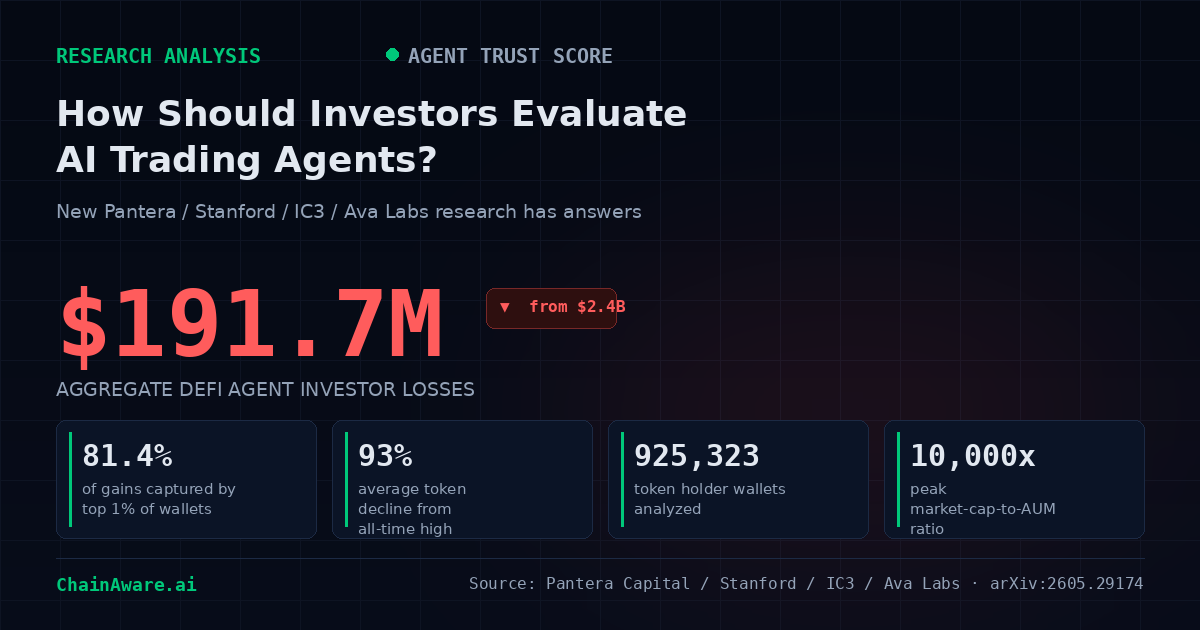
A May 2026 study from researchers affiliated with Pantera Capital, Stanford, IC3, and Ava Labs analyzed 1,900+ AI-tagged crypto projects to answer a practical question: how can investors tell a genuinely autonomous AI trading agent from a speculative wrapper? The research found even agents with fully public wallets couldn’t be verified as autonomous, and documents $191.7M in aggregate token holder losses across 925,323 wallets, with the top 1% of wallets capturing 81.4% of all gains ($1.81B). The paper’s proposed evaluation framework maps directly onto ChainAware’s Agent Trust Score, which screens both an AI agent’s wallet and its feeder wallet, giving investors a concrete way to check before they commit capital.

ChainAware Launches Agent Trust Score – On-Chain Trust Scoring for the Agentic Commerce Era

ChainAware launches Agent Trust Score – the first on-chain trust scoring system for ERC-8004 registered AI agents. Analysis of 274,792 indexed agents reveals 51.8% carry Elevated Risk or Untrusted scores, 21.1% are farm-detected Sybil operations, and 741 agents were funded by confirmed rug pull operators. Score owner wallet fraud probability, feeder address, and rug pull criminal record before granting autonomous execution access. Named in CB Insights AI Fraud Prevention Market Map. Free, no signup required.

ChainAware Token Audit Launched – We Tested 10,000 CoinGecko Tokens. Here Are the Results.

ChainAware Token Audit is live – 127 automated security checks across 9 modules, tested against the top 10,000 CoinGecko tokens by market cap. The results: 55.2% high risk, 131 confirmed honeypots, 13.2% upgradeable proxy contracts – including 139 controlled by a single private key. ChainAware catches threats invisible to GoPlus, CertiK Skynet, and TokenSniffer: transitive approve() analysis, phantom balanceOf, EIP-2612 permit correctness, reentrancy detection, and asymmetric pause – powered by behavioral intelligence across 20M+ wallet personas on 8 blockchains. Free at chainaware.ai/token-audit.

The Agent Trust Infrastructure Race: Who Is Building the Trust Layer for Agentic Commerce?

Six platforms are competing to become the trust layer for agentic commerce in 2026 – ERC-8004 native, RNWY, SkyeProfile, AXIS T-Score, DJD, and ChainAware. Each answers a fundamentally different question. This guide maps every methodology, every blind spot, and the five signals only one platform provides, with a decision matrix for DeFi builders, agent creators, and investors.

The First Step in Agentic Commerce Isn’t Integration. It’s Trust.

The ERC-8004 registry tells you an agent exists. It does not tell you whether to trust it. This guide explains why Know Your Agent (KYA) is the missing trust layer for DeFi protocol builders in 2026 – and how scoring the owner wallet, feeder address, and rug pull history closes the gap before funds move.

ChainAware.ai’s 32 Claude Sub-Agents – Fraud Tech and Growth Tech for the Agentic Economy

ChainAware.ai operates on 32 Claude sub-agents – each one a specialist wrapping ChainAware’s Prediction MCP with precise decision logic and behavioral reasoning. This article classifies all 32 agents into Fraud Tech (17 agents) and Growth Tech (15 agents), with use case and trigger conditions for every agent.

ChainAware.ai Named in CB Insights AI Fraud Prevention Market Map – The Only Web3 AI Token in the List

CB Insights named ChainAware.ai in its AI Fraud Prevention Market Map – placing it in the On-Chain Intelligence subcategory alongside Chainalysis, Elliptic, and TRM Labs. 200+ companies selected. One mission: building the trust and intelligence infrastructure the worldwide AI revolution demands.

$284M+ in Rug Pulls on PancakeSwap V2 in 20 Weeks – Rug Pull Detector V3 Launched With 90.1% Accuracy

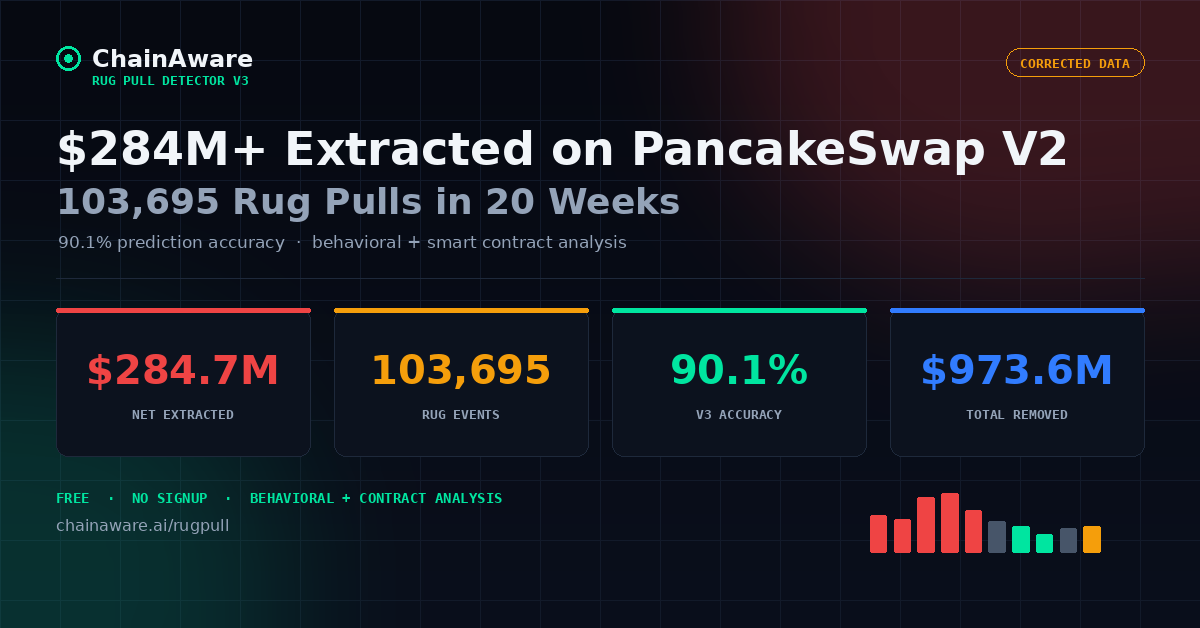
$284,694,192. That is not a headline from a dramatic DeFi hack. No Twitter threads trended. No security firms issued emergency advisories. No mainstream crypto media ran front-page coverage. That is the total value extracted from retail investors on PancakeSwap V2 alone – across just 20 weeks in 2026 – through a mechanism so normalized it barely registers as news: the rug pull. 103,695 separate rug pull events. $973,588,405 removed. $688,894,213 added before removal. ChainAware simultaneously launches Rug Pull Detector V3, combining behavioral analysis of contract creators with full smart contract inspection to reach 90.1% prediction accuracy, up from 68% in V2.

Web3 Fraud Detection for DApps in 2026 – Why Wallet Screening Beats Transaction Simulation

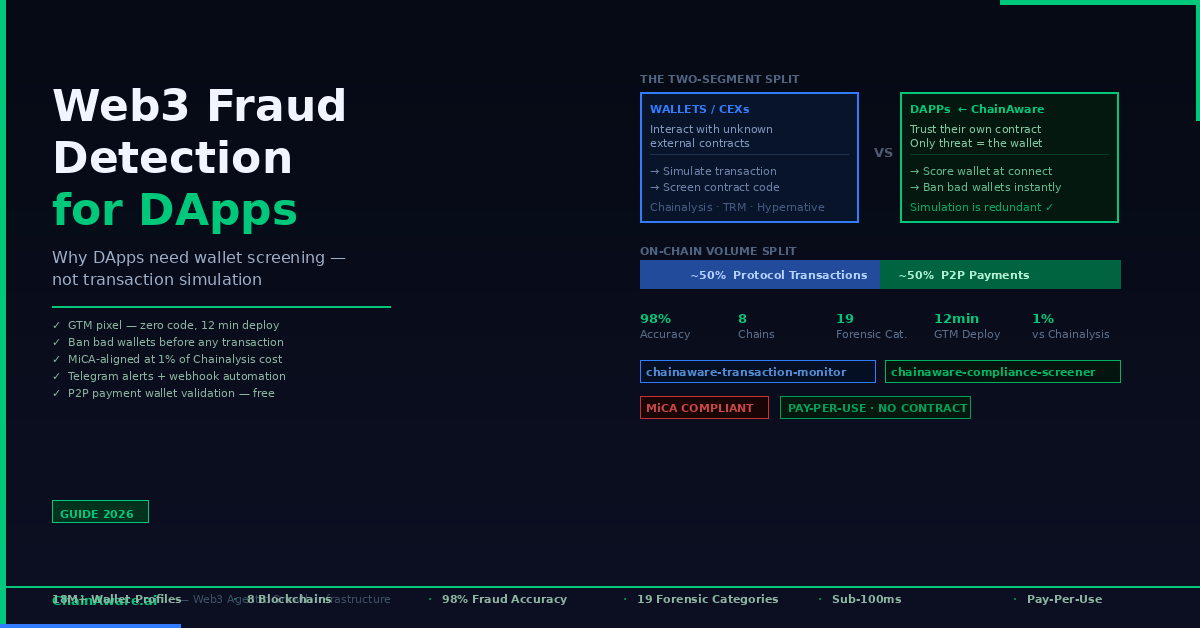
Web3 lost $4 billion to fraud in 2025. Most fraud detection tools were built for wallet providers and CEXs – not DApps. ChainAware is the only platform purpose-built for DApps: behavioral wallet screening at connection, zero-code GTM deploy, 98% fraud accuracy, MiCA-aligned at 1% of Chainalysis cost.