
Source data in this piece comes from “Paper Agents, Paper Gains: An Empirical Analysis of DeFi Investment Agents” (arXiv:2605.29174, May 2026), authored by researchers affiliated with Pantera Capital, Stanford University, IC3, and Ava Labs.
The industry’s own numbers just confirmed the problem Agent Trust Score exists to solve
For the last two years, “AI agent” has been one of the most valuable labels a crypto project could attach to itself. Combined AI-agent token valuations peaked above $3 billion in early 2025, built on a simple pitch: autonomous, on-chain trading systems that manage pooled capital better than a human could.
A new academic study puts real numbers behind that pitch for the first time, and the numbers are not kind. Researchers surveyed over 1,900 AI-tagged crypto projects, narrowed the field to 1,035 that actually function as DeFi investment agents, and then ran a deep architectural analysis of the two dominant frameworks in the space, ElizaOS and Virtuals Protocol, alongside a quantitative performance study of 11 Solana-based agent treasuries covering 925,323 token holders.
The core finding is not that these agents are unprofitable. It is that almost nobody, including the researchers themselves, can actually verify what these agents are doing, which is exactly the gap ChainAware’s Agent Trust Score was built to close.
The scale of the survey is worth sitting with for a moment. The combined dataset pulled from CoinGecko and Messari covered 1,900 projects with recorded token market capitalizations and 182 venture-funded entities totaling $1.87 billion across 229 funding rounds. After applying strict inclusion criteria, filtering out infrastructure plays, data and oracle layers, and traditional robo-advisors that merely touch digital assets, 1,035 projects remained classifiable as genuine DeFi investment agents. From that pool, the researchers selected 10 projects spanning passive, advisory, and active-trading strategies for deep analysis, and found a pattern: projects funded through public token launches consistently showed higher observability, since the token itself creates an on-chain footprint and community incentive for scrutiny, while projects funded through individual user wallets remained largely opaque by default. Observability, in other words, was mostly a side effect of the fundraising mechanism, not a deliberate design choice toward transparency.
Transparency is not the same thing as verifiability
The study’s most important conclusion has nothing to do with returns. It is a methodological wall the researchers hit while trying to do their job: even among the agents with fully public, on-chain wallet addresses, autonomy could not be confirmed.
Of the 10 representative projects examined in depth, only 3 showed clear evidence of autonomous trade execution. Developer interviews with the ElizaOS and Virtuals Protocol teams suggested that a large share of visible deployments amount to basic API integrations rather than genuine autonomous decision-making. And critically, even the 4 highest-observability projects in the study, ones with public wallet addresses that any outsider could audit, could not be independently confirmed as autonomous versus manually operated. A wallet address shows what transaction happened. It does not show who or what decided to make it.
This is the exact distinction ChainAware has been making publicly about agent trust: a score predicts, a record proves. On-chain data alone gives you the record of execution. It does not give you proof of who or what initiated that execution, and without that proof, “autonomous AI agent” is a marketing claim rather than a verifiable fact.
The framework builders say the same thing
The researchers did not have to speculate about this gap. They interviewed core contributors from both ElizaOS and Virtuals Protocol directly, and both teams independently converged on the same conclusion: trust remains the central barrier to adoption, and current-generation LLM agents cannot trade well without human-supplied insight and domain expertise sitting behind them.
Part of why verification is so difficult comes down to how these frameworks are actually built. ElizaOS runs on a plugin architecture: an LLM receives context from data providers, such as wallet balances or price feeds, selects an action from a registry of over 90 available plugins, including token swaps on Solana or spot trading on Hyperliquid, and an evaluator updates memory afterward. The framework itself is open source, but which plugins a specific deployed agent has enabled is not publicly auditable. Virtuals Protocol works differently, mints each agent as an ERC-6551 token-bound account on Base and routes decision-making through a hierarchical planner that delegates to specialized workers, but plugin and strategy selection is similarly developer-controlled and opaque from the outside. In both cases, the framework gives you a wallet address and a record of what it did. It does not give you a way to confirm that a human did not simply sign each transaction manually.
The Virtuals team pointed to founder-side trading expertise, not the underlying framework, as the actual differentiator between agents that perform and agents that fail. That is a notable admission from the team running a platform that has launched over 17,000 agents: the framework itself is not what makes an agent trustworthy or profitable. Something else has to establish that, and today, nothing systematically does, which is the exact gap our suite of AI agent trust and verification tools is built to close.
What that trust gap costs, in dollars
The paper’s performance analysis puts a number on what happens when trust and verification are absent from a market that is otherwise moving billions of dollars.
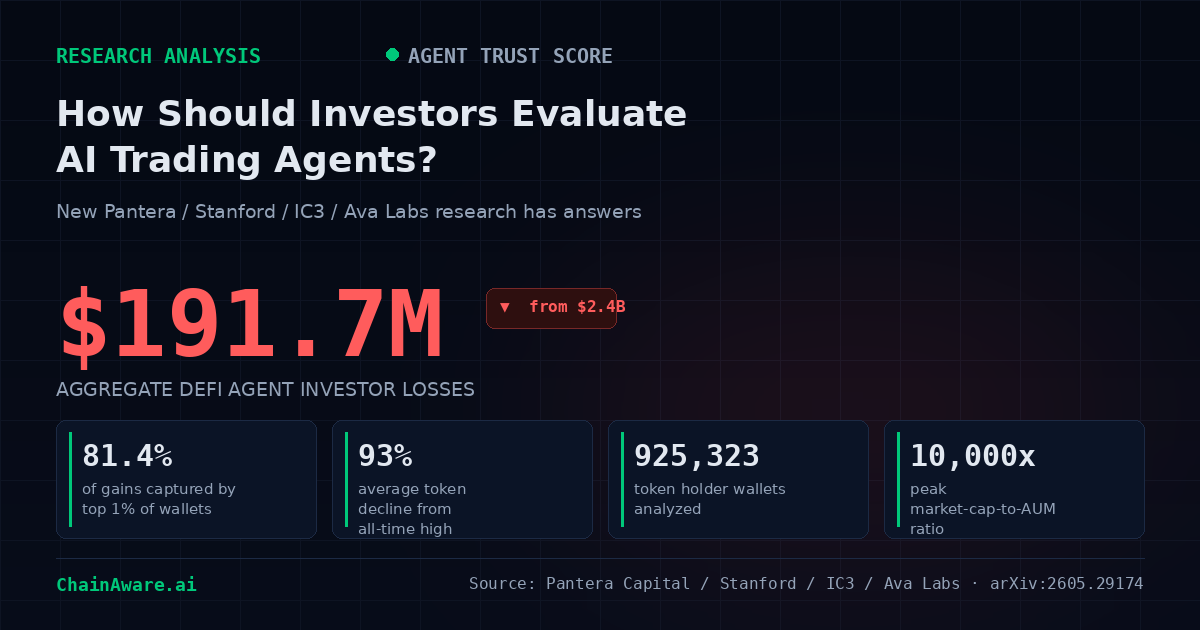
At their peak, DeFi investment agent token holders across the 11 platforms studied were sitting on more than $2.4 billion in paper gains. By the study’s latest snapshot, that had collapsed into a collective loss of $191.7 million across 925,323 wallets. Only two of the eleven platforms studied still showed positive aggregate user returns.
The distribution of who actually profited is sharply skewed. Across all platforms, the top 1 percent of profitable wallets, just 2,590 out of 259,016 winners, captured 81.4 percent of all gains, or $1.81 billion. The remaining 62.2 percent of participants realized losses. Median returns were negative or effectively zero on every single platform studied, meaning the typical participant in a typical agent token lost money regardless of which platform they chose.
Token price action tells a similar story. Agent tokens declined 93 percent on average from their all-time highs, nearly double the 54 percent peak-to-trough drawdown of a simple SOL buy-and-hold position over the same window. Meanwhile, market-cap-to-AUM ratios for these agent platforms exceeded 10,000x at points, compared to a ratio below 1x for established DeFi protocols like Aave, Curve, and Uniswap. The researchers read this gap as evidence that valuations were being driven by narrative around AI capability rather than by what the treasuries actually held or earned.
The authors are careful to note this is a descriptive finding, not an accusation. They are not arguing these platforms were built to extract value from later entrants. But they do note the resulting payoff structure, early participants capturing outsized gains while the majority of later entrants lose money, resembles the distributional pattern documented in prior research on Ponzi and pyramid schemes in blockchain contexts. The mechanism is different. The shape of who wins and who loses is not.
There is also a timing pattern in the data that reinforces how disconnected these valuations were from underlying agent activity. Market capitalizations across nearly every platform peaked within the same narrow window, late 2024 into early 2025, which points to a shared narrative cycle driving prices rather than individual project fundamentals or trading performance. More tellingly, peak assets under management in agent treasuries tended to arrive after each token’s all-time high, sometimes by weeks, with Virtuals-based agents showing the longest lag. Capital flowed into these treasuries only after the speculative peak had already passed, a reflexive pattern where narrative drove price first and fresh capital followed the narrative rather than the other way around. Treasury and portfolio composition tell a related story: essentially every agent studied held at least one position under $10 million in market cap among its top holdings, a sharp contrast to established DAO treasuries such as Uniswap, Aave, and Arbitrum, whose largest positions all exceed $50 million. Agent treasuries were concentrated in the same small-cap, high-volatility tokens driving the broader speculative cycle, not diversified away from it.
A maturity framework that maps directly onto what Agent Trust Score already does
Rather than stopping at diagnosis, the researchers propose three criteria for what a mature, production-grade DeFi investment agent would need to satisfy:
- Verifiable autonomous execution: observers should be able to determine whether a transaction was initiated by declared agent logic, a human operator, or some other off-chain process, not just that a transaction occurred.
- Sustained risk-adjusted performance: returns benchmarked against passive alternatives across multiple market regimes, not a single favorable cycle.
- Transparent stakeholder alignment: a clear, explicit relationship between what an agent earns, what a treasury retains, and what actually flows back to token holders.
The first criterion is where ChainAware’s Agent Trust Score already operates today. Rather than taking a public wallet address at face value, the score evaluates both the agent wallet and the wallet funding it, the feeder, since a clean-looking deployment wallet funded from a compromised or unknown source is exactly the kind of gap a naive audit would miss. This is a distinct problem from identity verification or social-graph trust, which is why it sits alongside, not in place of, the other layers covered in our five-category breakdown of Web3 trust verification systems. Trust delegation lets an established, well-behaved owner wallet extend a credibility floor to a fresh agent wallet it controls, while a fraud-flagged or unknown feeder drags the score down regardless of how new or old the agent wallet itself is. None of this requires exposing the underlying identity behind either wallet. It requires only that the behavioral signals feeding the score are real, checkable, and resistant to the kind of surface-level gaming a purely public wallet address invites, a distinction we unpack further in our comparison of Web3 reputation scoring approaches.
Put simply: the paper’s Criterion 1 asks the market to stop treating “public wallet address” as a proxy for “verifiable autonomy.” Agent Trust Score was built around that same premise before this paper existed to confirm it, which is precisely why an independent, Pantera-affiliated academic study arriving at the same conclusion matters. It is not ChainAware making the case for itself. It is the market’s own data making it.
Check before you trust an agent, not after
The $191.7 million in aggregate losses documented in this study did not happen because retail participants were reckless. It happened because there was no reliable, independent way to check whether the agent or the wallet behind it deserved trust in the first place, until after the fact, when the paper gains had already turned into real losses.
FREE — NO SIGNUP REQUIRED
Check an AI agent’s trust score before you interact with it
Screen the agent wallet and its feeder wallet together, and get a trust score grounded in real on-chain behavior, not a public address alone.
None of the three maturity criteria the researchers propose are solved by a bigger treasury, a louder narrative, or a longer track record on Crypto Twitter. They are solved by making the thing that actually matters, whether this agent and its owner have earned trust, checkable before capital moves rather than after it disappears.
LEARN MORE
How Agent Trust Score actually works
Trust delegation, feeder analysis, and the formula behind the score, explained in full.