
Last Updated: February 2026
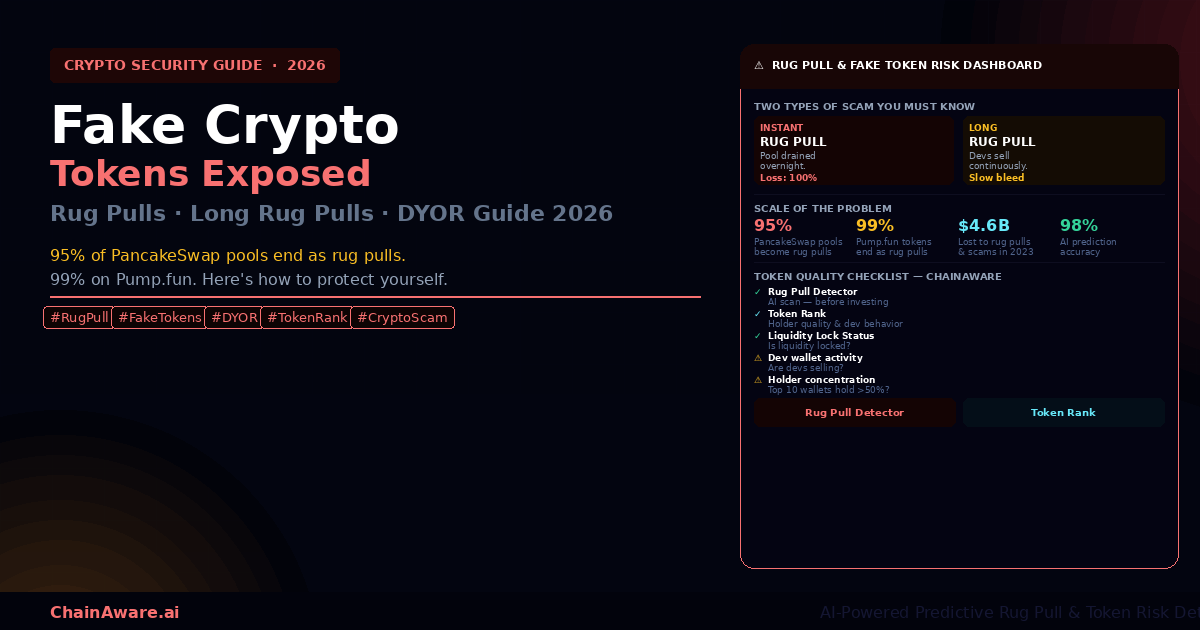
The numbers are worse than you think. On PancakeSwap, 95% of new liquidity pools end as rug pulls. On Pump.fun, the token launch platform that spawned hundreds of viral memecoins, 99% of launched tokens are designed to extract money from buyers. The crypto token market is not a market with some bad actors. It is an industry dominated by organized scam operations that treat retail investors as the product.
Understanding why this happens — and more importantly, how to protect yourself — requires understanding both types of token scam, the social engineering tactics that make them work, and the AI-powered detection tools that can identify both before you invest a single dollar.
This guide covers everything: instant rug pulls, long rug pulls, the DYOR framework that actually works, and how ChainAware’s Rug Pull Detector and Token Rank identify both scam types before the damage is done.
In This Guide
- The Scale of the Problem: 95% and 99%
- Instant Rug Pulls: How They Work
- Long Rug Pulls: The Slow Bleed
- The Social Engineering Playbook
- DYOR: The Due Diligence Checklist That Works
- ChainAware Rug Pull Detector: AI Detection Before It Happens
- Token Rank: Detecting Long Rug Pulls via Holder Quality
- Prediction MCP: Rug Pull Detection for AI Agents and Developers
- Red Flag Reference: What to Check Before You Buy
- FAQ
The Scale of the Problem: 95% and 99%
These figures are not exaggerations. They reflect the structural reality of permissionless token creation. On any chain where launching a token costs less than $50 and takes less than 10 minutes, the economics strongly favor scammers.
A rug pull operation works like a factory. A team creates a token with a compelling narrative — usually tapping into a current trend (AI, memecoins, celebrity culture, a viral event). They seed the liquidity pool with a small amount of capital, buy some of their own tokens to create price action, then use coordinated social media campaigns, paid influencers, and Telegram pump groups to generate FOMO among retail investors. When enough retail capital has entered the pool, they drain the liquidity and move on to the next token. Total operation time: 24–72 hours. Total profit: potentially hundreds of thousands of dollars. Total accountability: essentially zero.
According to Chainalysis Crypto Crime Report research, rug pulls and exit scams represent one of the largest categories of crypto fraud by volume, with billions lost annually. The FTC reported that Americans alone lost over $1 billion to crypto scams in 2022, with token scams representing a significant share.
The 95% figure for PancakeSwap reflects the BSC chain’s extremely low token creation cost and high speed — conditions that attract scammers disproportionately. The 99% on Pump.fun reflects a platform specifically designed for rapid token creation where the majority of launches are purely speculative and most devolve into rug pull dynamics within hours of launch.
AI Rug Pull Detection — 98% Accuracy
ChainAware Rug Pull Detector: Check Any Pool Before You Invest
Don’t invest in a pool you haven’t checked. ChainAware’s Rug Pull Detector uses AI to predict rug pull probability before it happens — analyzing liquidity lock status, dev wallet behavior, holder concentration, and contract risk signals. 98% accuracy. Covers ETH, BNB, Base, and more. Free to check.
Instant Rug Pulls: How They Work
An instant rug pull follows a predictable playbook. Understanding each stage is the first step to recognizing one before it executes.
Stage 1: Token creation. A new token is deployed on a DEX — typically PancakeSwap (BSC), Uniswap (ETH), or a Pump.fun launch (Solana). The token has a name designed to ride a current narrative: a meme, a celebrity, an AI trend, a political figure. The smart contract may include hidden functions: a mint function that allows unlimited token creation, a blacklist function that can block holders from selling, or a maximum transaction size that prevents large sells but allows the dev wallet to exit freely.
Stage 2: Initial liquidity and price action. The scammer seeds the liquidity pool with a small amount of capital (often $1,000–$10,000) to establish an initial price. They then buy their own token in small increments to generate organic-looking price appreciation — creating a chart that shows steady upward movement and building the appearance of genuine demand.
Stage 3: Coordinated promotion. The pump campaign begins. Paid promoters post in Telegram groups and Discord servers. Influencer accounts post about the token (often without disclosing payment). Twitter bots amplify reach. The narrative is always the same: this is the next 100x, early investors are already up 200%, the window is closing fast.
Stage 4: Retail FOMO entry. Inexperienced investors, seeing price movement and social proof, enter the pool. Price continues to rise as more buyers enter. The token appears to be a genuine success. Volume looks real because new buyers are creating it.
Stage 5: Exit and drain. When the liquidity pool contains enough retail capital, the scammer executes the exit. They remove all liquidity from the pool — the pair of tokens and the underlying currency (ETH, BNB) — in a single transaction. Price drops to zero instantly. Everyone who bought is left holding worthless tokens with no way to sell. Total time from launch to exit: 24 to 72 hours in most cases. Some run for weeks to maximize the amount extracted.
The key technical enabler is unlocked liquidity. In a legitimate project, liquidity is locked in a time-locked contract — the developers cannot remove it for a defined period (commonly 6–12 months). In a rug pull, liquidity is held directly in the developer’s wallet and can be removed at any moment. This is the most important single check you can do before buying any new token.
Long Rug Pulls: The Slow Bleed
Long rug pulls are more dangerous than instant rug pulls in one critical way: they look legitimate. The project has a website, a whitepaper, an active community, regular updates, and a development team that appears engaged. The token has been around for months. It has institutional-looking backers. It appears, by every surface metric, to be a real project.
The mechanism is different but the outcome is the same. Instead of draining liquidity in a single transaction, the developers and early insiders continuously sell their token holdings — often disguised through multiple wallets, OTC desk sales, or gradual liquidation — while maintaining the appearance of ongoing development to keep retail holders from selling.
The price chart of a long rug pull has a characteristic shape: a strong initial pump (often engineered), followed by a gradual but relentless decline punctuated by short relief rallies that attract more buyers before the descent continues. Holders lose 80–90% of their investment not in a moment but over weeks or months, during which they are repeatedly told that development is progressing, the team is building, and the dip is a buying opportunity.
Detecting a long rug pull requires on-chain analysis that most investors never do. The key signals are all visible in the blockchain data: are the team wallets selling regularly? Are the top holder addresses changing over time as insider distribution continues? Is the wallet quality of holders improving (genuine DeFi users accumulating) or declining (experienced users exiting, being replaced by new retail)? Is there meaningful protocol revenue, or is volume entirely manufactured?
This is precisely what ChainAware’s Token Rank was built to detect — by analyzing the behavioral quality of a token’s holder base rather than just its quantity.
The Social Engineering Playbook
Token scams are not primarily technical operations. They are social engineering operations that use technical infrastructure. Understanding the psychological levers used is essential for recognizing manipulation before it affects your decisions.
FOMO (Fear Of Missing Out) is the primary weapon. Every message in a token pump campaign is designed to create urgency: “already 500% up from launch”, “still early”, “window closing”, “last chance before exchange listing”. The urgency is artificial but the emotional response it triggers is genuine. Experienced investors have trained themselves to treat urgency as a red flag rather than a signal to act.
Social proof manipulation is the second major lever. Paid Telegram groups show hundreds of members. Fake Twitter accounts amplify posts. KOL promotions create the appearance of community validation. According to SEC guidance on pump-and-dump schemes, this coordinated promotion is a defining characteristic of securities fraud — and in the crypto context, it is industrialized at a scale regulators have struggled to address.
Authority and celebrity fabrication. Scam tokens routinely use AI-generated images of celebrities “endorsing” the token, fake screenshots of mainstream media coverage, and invented advisor relationships with recognized names in the industry. None of these endorsements exist, but their visual presentation is sophisticated enough to fool investors who don’t verify claims independently.
The targets are systematically inexperienced investors — people new to crypto who don’t yet understand that on-chain contract checks, liquidity lock verification, and wallet behavior analysis are prerequisites for any DeFi investment. This is not an accident. The scam industry specifically designs its messaging to reach beginners before they develop the skills to recognize manipulation. As covered in our guide to rug pull detection, the best protection is combining DYOR skills with AI-powered detection tools.
Detect Long Rug Pulls Before They Happen
ChainAware Token Rank: On-Chain Holder Quality Analysis
Token Rank analyzes the behavioral quality of every wallet holding a token — are holders experienced DeFi users accumulating, or are insiders exiting while retail replaces them? Detect the slow-bleed pattern of long rug pulls before you’re down 80%. Free to check any token.
DYOR: The Due Diligence Checklist That Actually Works
DYOR — Do Your Own Research — is the most frequently given advice in crypto and the least frequently followed. Most people who lose money in rug pulls knew they should have researched more. The problem is not motivation; it is knowing specifically what to check and where to find it. Here is the complete due diligence checklist for any new token.
1. Liquidity Lock Verification
This is the single most important check. If liquidity is not locked in a third-party time-locked contract (verifiable on DEXTools, Unicrypt, or similar), the developers can drain the pool at any moment. Check the lock duration — a lock of 30 days is meaningless for a project claiming a 3-year roadmap. Look for locks of 6 months or more. Verify the lock on-chain, not just from the project’s claims.
2. Smart Contract Audit Status
Has the contract been audited by a reputable firm? Audits don’t guarantee safety — many audited contracts still contain rug pull mechanisms — but the absence of any audit for a token asking for significant investment is a strong warning signal. Check whether the audit was performed by a recognized firm and whether it covers the specific functions most commonly used in rug pulls (mint functions, blacklist functions, max transaction limits).
3. Developer Wallet Analysis
Who holds the dev allocation, and what are they doing with it? Use a block explorer (Etherscan, BscScan) to find the wallet that deployed the contract. Check how much of the token supply it holds. Check whether it has been selling. Check whether it has moved tokens to multiple wallets — a common technique for distributing insider holdings before a coordinated exit. As detailed in the Wallet Auditor guide, on-chain wallet behavior tells you far more than any team announcement.
4. Holder Concentration Analysis
What percentage of the token supply is held by the top 10 wallets? If the top 10 wallets hold more than 40–50% of the supply, a coordinated exit by those wallets can crash the price regardless of how much liquidity is locked. Healthy tokens have distributed holder bases with no single wallet controlling enough supply to manipulate price unilaterally.
5. Contract Code Review
Read the contract code on the block explorer, or use a tool that summarizes key functions. Look specifically for: mint functions (can new tokens be created arbitrarily?), pause functions (can trading be stopped?), blacklist functions (can specific addresses be blocked from selling?), and owner privilege functions (what can the contract owner do unilaterally?). Any of these can be used to trap buyers.
6. Team and Project Verification
Is the team doxxed (publicly identified)? Anonymous teams are not automatically scams — Bitcoin was created by an anonymous team — but anonymous teams have no reputational accountability if they exit. Verify any claimed team credentials independently. Search the project name on Twitter and Telegram for scam reports. Check whether the project’s GitHub has genuine commit history or is a copied repository with superficial changes.
7. Token Rank and Rug Pull Detector Check
These two AI tools together cover what manual DYOR cannot: behavioral prediction based on on-chain data patterns across millions of wallets. Run both before investing in any token you are not certain about. The combination catches both instant rug pull setups (Rug Pull Detector) and long rug pull dynamics (Token Rank).
ChainAware Rug Pull Detector: AI Detection Before It Happens
Traditional rug pull detection tools are reactive — they flag contracts after fraud is confirmed. ChainAware’s Predictive Rug Pull Detector is forward-looking: it analyzes contract and pool characteristics to predict rug pull probability before any exit occurs.
The Rug Pull Detector evaluates a set of on-chain signals that, in combination, are predictive of rug pull risk with 98% accuracy. These signals include liquidity lock status and duration, smart contract code flags (hidden mint functions, sell restrictions, owner privileges), developer wallet concentration and historical behavior patterns, trading pattern anomalies (coordinated buys from linked wallets, artificial volume creation), and holder distribution characteristics.
The output is a risk score from Safe through Watchlist to High Risk, with a probability score and a breakdown of the specific risk factors detected. A High Risk rating means the pool’s characteristics match the pattern of confirmed rug pulls with high statistical confidence — not that fraud has already been confirmed, but that the structural setup matches the template.
Critically, the Rug Pull Detector catches what manual research misses: it processes the full on-chain history and contract code simultaneously, identifying subtle combinations of risk factors that individually appear innocuous but together strongly predict a rug pull outcome. A contract with slightly elevated developer wallet concentration, a short liquidity lock, a few hidden functions, and wash-trading-like volume patterns may not raise a red flag from any single check — but the AI model recognizes the combination as high risk from training on thousands of confirmed rug pull cases.
For a complete breakdown of how the Rug Pull Detector works, the forensic signals it analyzes, and how to interpret results, see the complete Rug Pull Detector guide. For the broader context of how predictive fraud detection compares to forensic approaches, see our analysis of forensic vs AI-based crypto analytics.
Don’t Invest Before You Check
Run Both Checks: Rug Pull Detector + Token Rank
The Rug Pull Detector catches instant rug pull setups. Token Rank catches long rug pull dynamics. Together they cover both scam types with AI-powered predictive accuracy. Check any token contract or pool address — free, instant results, no account needed.
Token Rank: Detecting Long Rug Pulls via Holder Quality
Token Rank addresses the detection problem that rug pull detectors don’t cover: the long rug pull, where the project looks legitimate but insider distribution is destroying holder value over time.
Token Rank applies ChainAware’s Wallet Auditor methodology to every wallet that holds a specific token. Instead of just counting holders, it profiles them: are they experienced DeFi users with diversified protocol histories and strong Wallet Ranks? Or are they new, low-quality wallets — potentially linked to the project team — or retail buyers who have replaced exiting insiders?
The key signals Token Rank surfaces for long rug pull detection are the following.
Holder quality trend: Is the average Wallet Rank of holders increasing (smart money accumulating) or decreasing (smart money exiting, retail replacing it)? This single signal is a powerful leading indicator — experienced DeFi users accumulate before breakouts and exit before collapses. When high-rank holders are consistently leaving a token, the long rug pull pattern is often already underway.
Developer and insider wallet behavior: Token Rank identifies which wallets among the top holders are likely insider positions based on behavioral patterns — early receipt of tokens, consistent small-scale selling, and counterparty relationships with the deployer wallet. A project where identified insider wallets are selling while publicly promoting the project is exhibiting the defining characteristic of a long rug pull.
Holder concentration dynamics: Is the token becoming more distributed over time (a healthy sign) or is concentration increasing as small holders exit and large wallets consolidate? Increasing concentration in unidentified wallets combined with declining high-quality holder ratio is a strong long rug pull signal.
Token Rank provides the on-chain perspective that no amount of reading whitepapers or following project Twitter accounts can give you. The blockchain doesn’t lie. When experienced on-chain investors are quietly exiting while the project’s social media celebrates milestones, Token Rank shows you both sides of that picture simultaneously. As noted in our broader guide to crypto trust score metrics, behavioral on-chain data is the only source that cannot be fabricated by a motivated scam team.
Prediction MCP: Rug Pull Detection for AI Agents and Developers
The Rug Pull Detector and Token Rank are built for individual investors checking contracts manually. But what if you’re building a DeFi protocol, a trading bot, a portfolio tool, or an AI agent that needs to screen contracts automatically — at scale, in real time, without human intervention?
This is exactly what the ChainAware Prediction MCP was built for.
What Is the Prediction MCP?
MCP stands for Model Context Protocol — an open standard created by Anthropic that allows AI agents and LLMs (Claude, GPT, custom models) to call external tools via natural language. ChainAware’s Behavioral Prediction MCP server exposes its AI models — including the Rug Pull Detector — as callable tools that any MCP-compatible agent can use without writing custom API integrations.
In plain terms: your AI agent can ask “Is this contract address a rug pull risk?” and get back a structured risk score, probability, and forensic breakdown in under 100ms — the same intelligence that powers the free web tool, accessible programmatically.
The chainaware-rug-pull-detector Agent
ChainAware publishes a ready-to-use open-source agent definition on GitHub specifically for rug pull detection: the chainaware-rug-pull-detector agent. This is a pre-built Claude agent configuration that combines the predictive_rug_pull MCP tool with guided reasoning — so you can deploy a rug pull screening agent in minutes without writing prompts from scratch.
The agent accepts a contract address and network, calls the predictive_rug_pull tool, interprets the output (status, probabilityFraud, forensic_details), and returns a human-readable risk assessment. It can be embedded into any MCP-compatible workflow: a DeFi frontend, a Telegram bot, an automated investment screener, or a compliance pipeline.
Direct API Integration: predictive_rug_pull Tool
For developers who want full control, the predictive_rug_pull tool is directly accessible via the MCP server. The tool takes three inputs — API key, network (ETH, BNB, BASE, HAQQ), and contract address — and returns:
- status: Safe, Watchlist, or HighRisk
- probabilityFraud: decimal score from 0.00 to 1.00
- forensic_details: full breakdown of the on-chain risk signals detected
- lastChecked: timestamp of the last prediction run
This makes it straightforward to build automated screening into any system that processes token addresses — for example, automatically flagging high-risk contracts before they appear in your platform’s listing, or alerting LP providers when a pool they hold a position in crosses a risk threshold.
Example Use Cases for AI Agent Integration
- DeFi protocol listing screening: Before listing a new token or liquidity pool, run every contract address through the rug pull detection agent automatically. Reject or flag High Risk contracts without manual review.
- Telegram and Discord bots: Users paste a contract address, the bot calls the MCP tool and returns an instant risk score with forensic breakdown — giving your community a self-serve due diligence tool.
- AI-powered investment assistant: An AI agent advising on DeFi positions calls
predictive_rug_pullas part of its research workflow before any recommendation involving a new token. - Portfolio monitoring: Periodically re-check contract addresses in a user’s portfolio — if a previously Safe contract moves to Watchlist or High Risk, trigger an alert.
- Compliance pipeline: Automate token contract screening as part of a broader AML and fraud prevention stack alongside the
predictive_fraudandaml_scorertools.
Getting Started with the Prediction MCP
The MCP server is live at https://prediction.mcp.chainaware.ai/sse. Integration takes under 30 minutes:
- Get an API key via chainaware.ai/mcp
- Add the server to your Claude, Cursor, or custom MCP client configuration
- Use the open-source agent definitions on GitHub as a starting point: github.com/ChainAware/behavioral-prediction-mcp
- Call
predictive_rug_pullwith any contract address on ETH, BNB, BASE, or HAQQ
The 12 pre-built open-source agent definitions cover the full ChainAware intelligence stack — fraud detection, AML scoring, wallet behavioral analysis, onboarding routing, and rug pull detection — giving you a complete on-chain intelligence layer for any AI agent you’re building. See the full MCP integration guide for complete setup instructions.
Build Rug Pull Detection Into Your AI Agent
ChainAware Prediction MCP — Open Source Agent Definitions
The chainaware-rug-pull-detector agent is ready to deploy. Connect any AI agent to ChainAware’s rug pull detection model via MCP — get structured risk scores, probability scores, and forensic breakdowns in real time. 12 open-source agent definitions on GitHub. API key required.
Red Flag Reference: What to Check Before You Buy
Here is a quick-reference summary of the most important warning signals across both instant and long rug pull types. Consider this a pre-investment checklist.
Instant Rug Pull Red Flags
- Liquidity not locked or locked for less than 3 months
- Contract has mint, blacklist, or sell-restriction functions
- Developer wallet holds more than 15% of supply
- Token launched less than 7 days ago with no audit
- Volume is dominated by a small number of coordinated wallets
- Telegram/Discord group was created days before launch
- Price is up more than 300% with no product or utility
Long Rug Pull Red Flags
- Developer wallets selling regularly while team publicly bullish
- Top holder list changing over time with high-Wallet-Rank wallets consistently exiting
- Revenue metrics don’t match claimed traction — volume is real but protocol fees are minimal
- Team compensation structure rewards token sales rather than protocol performance
- Roadmap milestones completed slowly while token allocation vests on schedule
- Token Rank shows declining holder quality over consecutive weeks
General Red Flags for Both Types
- Anonymous team with no verifiable credentials or accountability
- Guaranteed return claims or minimum price guarantees
- Heavy reliance on KOL promotion without product demonstration
- Whitepaper that describes a product but has no working code or verifiable development
- Community that aggressively attacks skeptics rather than engaging with technical questions
For broader context on crypto security risks and protective measures, the hardware wallets guide covers the infrastructure layer of crypto security, while the Fraud Detector guide explains how behavioral AI detects fraudulent wallets — useful for due diligence on counterparties as well as tokens. According to Europol’s Internet Organised Crime Threat Assessment, crypto fraud has become one of the most profitable categories of organised cybercrime globally — the operations behind these token scams are professional businesses, not amateur opportunists.
ChainAware.ai — Protect Yourself Before You Invest
Rug Pull Detector + Token Rank
95% of new pools are rug pulls. Don’t trust social media. Trust the blockchain. ChainAware’s AI detects instant rug pull setups before they happen, and Token Rank identifies long rug pulls through holder behavior analysis. Both free. Both essential. Check before you buy.
Frequently Asked Questions
What is a rug pull in crypto?
A rug pull is a type of DeFi scam where developers create a token, artificially inflate its price through coordinated promotion, attract retail investor capital, then suddenly drain the liquidity pool — taking all deposited funds and leaving token holders with worthless assets. The term comes from the expression “pulling the rug out” from under investors. The loss is typically 100% and occurs in a single transaction.
What is a long rug pull?
A long rug pull (or “slow rug”) is a scam where the project appears legitimate but developers and early insiders continuously sell their token allocations over weeks or months while maintaining the appearance of ongoing development. Unlike an instant rug pull, the loss occurs gradually — investors lose 80–90% of their investment over time rather than immediately. Long rug pulls are harder to detect without on-chain holder analysis tools like Token Rank.
Why are 95% of PancakeSwap pools rug pulls?
PancakeSwap on BSC (BNB Smart Chain) has extremely low token creation costs and fast transaction speeds, making it the preferred platform for token scam operations. The barrier to creating and launching a fraudulent token is under $50 and 10 minutes. The 95% figure reflects that the vast majority of new BSC token pools are created by scam operations rather than genuine projects.
How does the ChainAware Rug Pull Detector work?
The Rug Pull Detector uses AI trained on thousands of confirmed rug pull cases to evaluate on-chain signals: liquidity lock status, smart contract code flags, developer wallet concentration, trading pattern anomalies, and holder distribution. It calculates a risk score and probability before any exit occurs — detecting the structural setup of a rug pull rather than waiting for the fraud to complete. Accuracy is 98%. See the complete guide for full methodology.
How does Token Rank detect long rug pulls?
Token Rank profiles every wallet that holds a specific token using the Wallet Auditor behavioral methodology. It then tracks whether high-quality wallets (experienced DeFi users with strong Wallet Ranks) are accumulating or exiting. When experienced holders consistently leave while less experienced retail buyers replace them, this matches the pattern of insider distribution in long rug pull scenarios. The trend in holder quality is a leading indicator that can identify the scam weeks before the price decline becomes obvious.
What is the most important check before buying a new token?
Liquidity lock verification is the single most important manual check. If the liquidity pool is not locked in a third-party time-locked contract, the developers can drain it at any moment. Beyond this, run the ChainAware Rug Pull Detector for instant risk assessment, check Token Rank for holder quality, and verify developer wallet activity on the block explorer. Never invest based solely on social media promotion or KOL endorsement without doing these checks first.
Can I integrate rug pull detection into my own AI agent or platform?
Yes. ChainAware’s Prediction MCP exposes the same rug pull detection model via the Model Context Protocol standard. Any MCP-compatible AI agent (Claude, GPT, custom LLMs) can call the predictive_rug_pull tool with a contract address and receive a structured risk score, probability, and forensic breakdown in real time. A ready-to-use open-source agent definition is available on GitHub at github.com/ChainAware/behavioral-prediction-mcp. API key required — get access at chainaware.ai/mcp.
Disclaimer: This article is for educational purposes only and does not constitute financial or investment advice. Cryptocurrency investments carry significant risk. Always conduct thorough due diligence before investing in any crypto asset.