AI-Based Predictive Fraud Detection in Web3: The Missing Key to Mainstream Adoption

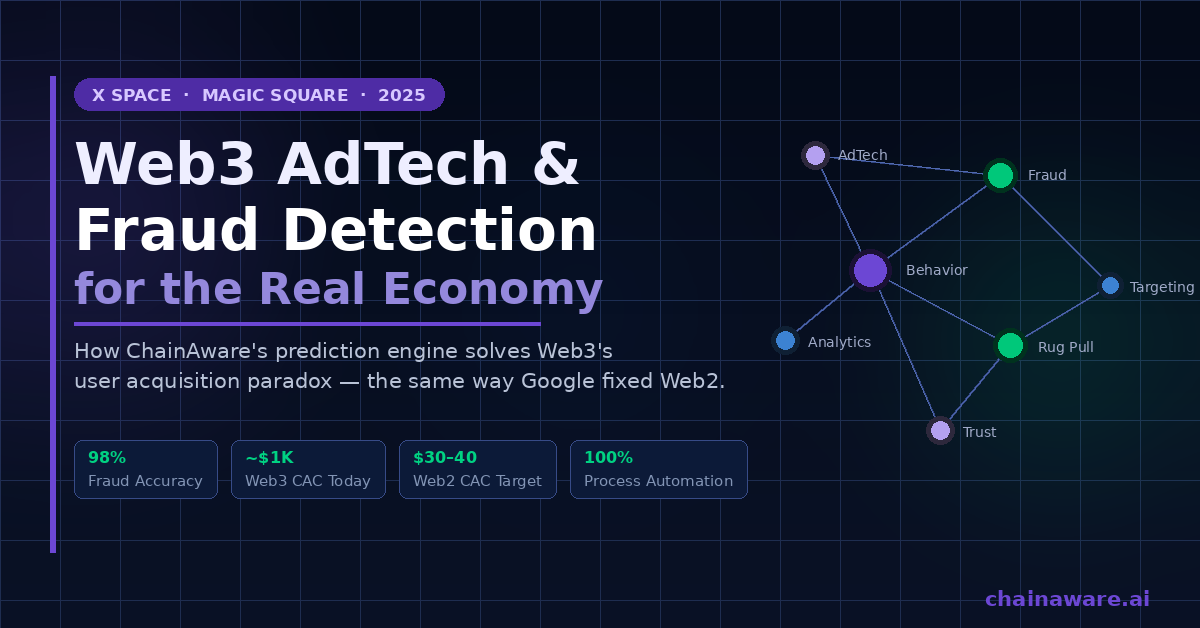
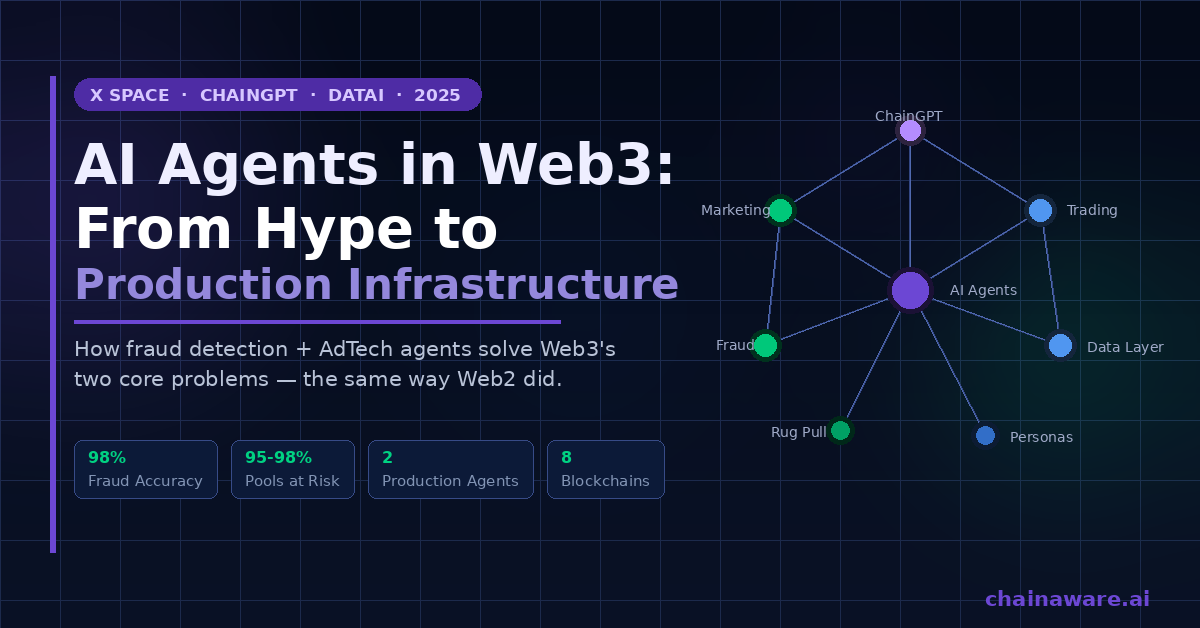
AI-based predictive fraud detection in Web3: the missing key to mainstream adoption. Web3 suffers from high fraud rates and low user trust. Traditional static rule-based systems fail — fraudsters bypass rules within days, false positive rates stuck at 30-70%. Just as Web2 overcame early fraud with real-time AI-driven monitoring, Web3 must follow suit. ChainAware.ai’s ML models: trained on 14M+ wallets across 8 blockchains, 98% fraud prediction accuracy (F1 score on held-out test data), under 100ms inference latency. Tools: Fraud Detector (free), AML Scorer, Transaction Monitoring Agent (GTM integration). chainaware.ai. Published 2026.

ChainAware.ai Secures Strategic Investment from ChainGPT Labs

ChainAware.ai secures strategic investment from ChainGPT Labs. ChainGPT Labs, leading Web3 incubator, partnered with ChainAware.ai to revolutionize Web3 marketing and security via personalized targeting and AI-driven fraud prevention. The investment validates ChainAware’s approach: using on-chain behavioral intelligence (14M+ wallets, 8 blockchains, 98% fraud prediction accuracy) to enable DeFi protocols to grow revenue, reduce fraud losses, and personalize user experiences at scale. Key products backed: Growth Agents, Prediction MCP, Wallet Auditor, Transaction Monitoring Agent. chainaware.ai. Published 2024.

Intention-Based Web3 AdTech: The Invisible Hand That Will Take Web3 Mainstream

Intention-based marketing in Web3: the key to user acquisition and conversion. 99% of Web3 marketing is still mass marketing — same message to every wallet, high CAC, low conversion. ChainAware.ai’s intention-focused marketing reads each wallet’s on-chain behavioral history to predict: will this wallet trade, stake, lend, or farm? Then delivers the right message automatically. Key intentions detected: Prob_Trade, Prob_Stake, Prob_Lend, Prob_Farm, Prob_Bridge. No-code Growth Agents via Google Tag Manager. Developer API via Prediction MCP. 14M+ wallet profiles, 8 blockchains. Result: 40-60% connect-to-transact rates vs 10% industry average. chainaware.ai. Published 2026.

Do You Still Believe in Web3 KOL Marketing? Why Mass Marketing Fails and Web3 AdTech Wins

X Space #16 — Do You Still Believe in Web3 KOL Marketing? Why Mass Marketing Fails and Web3 AdTech Wins. Watch the full recording on

Web3 KOL Marketing Is Mass Marketing — And Why It Is Destroying Your Project

X Space #17 — Web3 KOL Marketing Is Mass Marketing: The Data, the Neuroscience, and the Personalized Alternative. Watch the full recording on YouTube ↗

AI-Based Predictive Rug Pull Detection: Why Static Analysis Fails and Behavioral AI Wins

X Space recap: personalized marketing in Web3 instead of KOLs. KOL marketing (Key Opinion Leader) relies on mass marketing — same message to everyone, high cost, low ROI. Personalized marketing targets each wallet individually based on on-chain behavioral profile. ChainAware approach: Growth Agents read each wallet’s Wallet Rank, experience, and intentions at connection and deliver the right message automatically. No KOL budget required. 14M+ wallet profiles, 8 blockchains. Result: 40-60% connect-to-transact rates vs 10% industry baseline. chainaware.ai.

Crossing the Chasm in Web3: How AdTech Will Take Web3 Mainstream

X Space recap: Web3 KOL marketing vs Web3 AdTech. Is KOL marketing still effective in Web3? ChainAware.ai and guests compare: KOL marketing (mass reach, untrackable ROI, airdrop farmer traffic) vs Web3 AdTech (wallet-behavioral targeting, trackable conversion, quality user acquisition). The sustainable path: identify wallet intentions before spending, use behavioral data to target high-value segments, measure ROI by wallet quality not click volume. ChainAware products: Web3 Behavioral Analytics, Growth Agents, Prediction MCP. chainaware.ai.

AI-Based Web3 AdTech: How to Cross the Chasm and Slash Customer Acquisition Costs

X Space #15: AI-Based Web3 AdTech — How to Cross the Chasm and Slash Customer Acquisition Costs. ChainAware co-founders Martin and Tarmo. Core thesis: Web3 AdTech built on blockchain behavioral data is structurally superior to Web2 AdTech (cookies/search history) and is the specific mechanism that will take Web3 from 50 million to mainstream adoption. Key insights: global AdTech market is $180 billion annually ($30B in Europe alone) — built entirely on intention-based behavioral targeting; Web2 AdTech reduced CAC from $500-2,000 to $15-30 by matching advertisements to users’ stated behavioral intentions; Web3 has not built this infrastructure despite having higher-quality data than Google (gas-fee-filtered financial transactions vs zero-cost search queries); blockchain behavioral data advantage: every transaction is a deliberate financial commitment — produces 98%+ prediction accuracy on behavioral classification; real-time bidding (RTB) Web2 parallel: programmatic ad serving based on behavioral profiles; Web3 equivalent: ChainAware Growth Agents serve personalised messages at wallet connection based on 18M+ Persona profiles; attribution vs intention: current Web3 analytics describe past behavior (attribution), ChainAware predicts future behavior (intention); no cookies, no identity, no privacy risk — public wallet data only. ChainAware Prediction MCP enables any developer to build Web3 AdTech applications. 32 open-source agents · 8 blockchains · chainaware.ai

Unit Costs: The Formula That Wins Markets — Why Web3 Must Solve Acquisition Cost to Survive

X Space #14: Unit Costs — The Formula That Wins Markets and Why Web3 Must Solve Acquisition Cost to Survive. ChainAware co-founders Martin and Tarmo. Core thesis: every Web3 project has two unit costs that determine whether it can survive — unit cost of business process (DeFi has solved this brilliantly) and unit cost of customer acquisition (nobody is solving this). Web3 acquisition math: $5 CPC × 200 website visitors × 5% wallet connection rate × 10% transaction rate = $1,000+ per transacting user; to become cash-flow positive, revenue per user must exceed $1,000 — structurally impossible for most DeFi protocols at current volumes. Web2 parallel: same dual problem in early 2000s — credit card fraud destroying trust + $500-2,000 CAC from mass marketing; Web2 solved it with AI fraud detection (mandated by regulators) + Google AdTech (microsegmentation). Web3 AdTech solution: behavioral wallet targeting reduces CAC from $1,000+ to $20-30 by reaching only wallets whose intention profile matches the product. LTV must be 3x CAC: current Web3 unit economics are inverted — LTV/$200 vs CAC/$1,000+. ChainAware Growth Agents + Behavioral Analytics: same budget, 8x more transacting users, 3x LTV/CAC ratio achievable. Free analytics tier · 2-line GTM integration · Prediction MCP · 18M+ Web3 Personas · chainaware.ai

AGI vs LLM: Why Bigger Models Won’t Get Us to Artificial General Intelligence

X Space: AGI vs LLM — Why Bigger Models Won’t Get Us to Artificial General Intelligence. ChainAware co-founders Martin and Tarmo. Core thesis: AGI (Artificial General Intelligence) does not exist and scaling LLMs will not produce it — Web3 founders and investors must understand this distinction to evaluate which AI projects have real utility vs narrative. Key distinctions: AGI = AI with human-level reasoning across all domains (does not yet exist); LLM = large language model trained on text prediction (statistical autocomplete, not reasoning); narrow predictive AI = purpose-built models for specific classification tasks (fraud detection, behavioral prediction); LLMs hallucinate on numerical on-chain data, cannot make deterministic fraud classifications, run at 1-5 second latency (100x too slow for real-time); real competitive advantage in Web3 AI requires: proprietary training data, domain-specific model architecture, iterative accuracy improvement; the diagnostic question for any Web3 AI project: what specifically does it predict? If it cannot answer with a metric (98% accuracy, sub-second response) it is narrative AI not utility AI. ChainAware uses narrow predictive AI: ML models trained on 14M+ on-chain wallet behavioral histories, 98% fraud prediction accuracy, real-time response, 8 blockchains. Not ChatGPT. Not a wrapper. Proprietary. Prediction MCP · 32 open-source agents · chainaware.ai