1.6M ERC-8004 agents reveal fraud patterns threat landscape — ChainAware.ai

Agent Fraud Patterns: The Full Truth From 1.6M ERC-8004 Agents Exposed in 2026

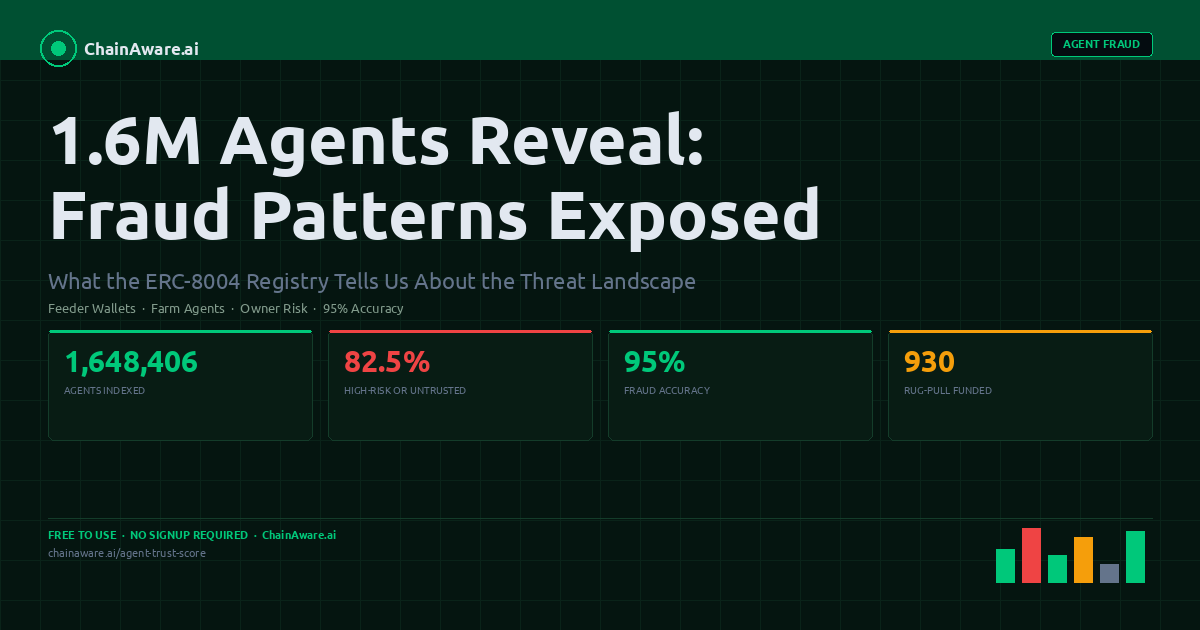
Across 1.6 million ERC-8004 agents indexed on eight chains, fraud and obfuscation are not edge cases — they are structural features of the ecosystem. ChainAware’s live trust scoring pipeline reveals that 67.2% of all registered agents carry unknown funding provenance, whilst fewer than 3,000 agents achieve verified CEX-funded status. Base chain, the platform with highest deployment volume, shows the poorest funding chain transparency at 96.5% unresolved feeder origins. This investigation exposes five distinct fraud patterns that distinguish systematic exploitation from isolated incidents, analysing real data from ChainAware’s multi-signal agent evaluation framework rather than extrapolation. Discover what platform builders, protocol integrators, and AI agent marketplaces must understand before the next deployment wave.
Base Chain 71 percent of all ERC-8004 agents global registry — ChainAware.ai

Base Chain Agent Economy Exposed: The Full Truth About Why It Leads ERC-8004 in 2026

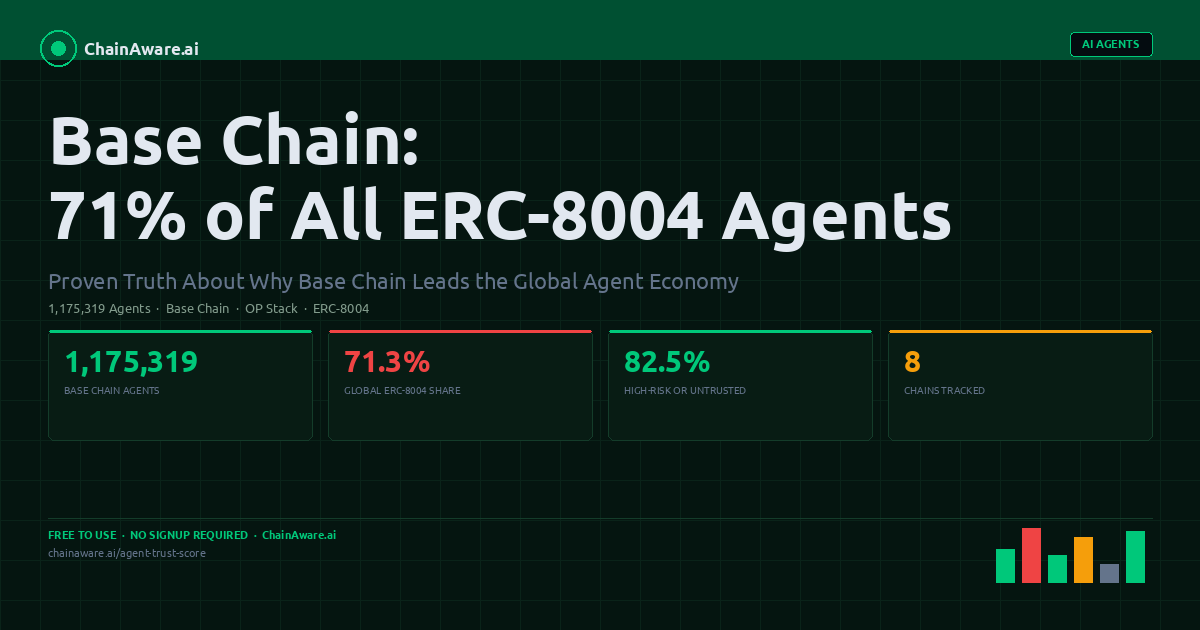
Base Chain dominates the global AI agent economy with 71.3% of all ERC-8004 registrations, but that scale creates unprecedented trust challenges. Of the 1.17 million agents registered on Base, centralcity.ai alone operates 63.8% of the entire global registry, with average trust scores that place them squarely in elevated risk territory. ChainAware’s analysis of Base’s agent data reveals why this concentration matters: when agent registration costs fractions of a cent and a single platform can flood the network with hundreds of thousands of entries in weeks, distinguishing legitimate operators from manipulation becomes essential. Discover what Base’s trust distribution actually shows, why week 43 of 2026 saw nearly 900,000 registrations in seven days, and how developers can use AI Agent Trust Scoring to build safely on the world’s largest ERC-8004 registry.

ChainAware credit bureau for AI agents first-mover advantage — ERC-8004 trust scoring

ChainAware: Proven Credit Bureau for AI Agents — First-Mover Advantage Exposed

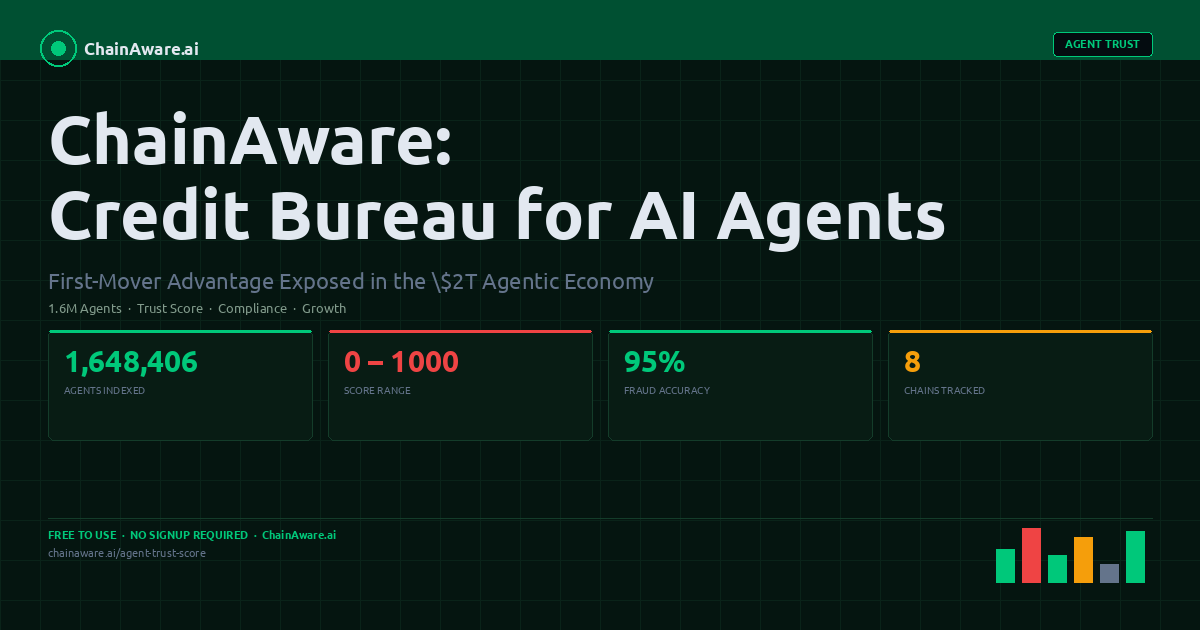
AI agents are becoming autonomous economic actors—transacting, holding funds, and executing smart contracts without conventional identity or track record. Yet counterparties have no standardised way to assess their trustworthiness. ChainAware is building the credit bureau for this moment: a behavioral trust infrastructure indexed across eight chains, scoring 1.6 million agents, and trained on over 23 million wallet personas. Like Equifax or Experian for traditional finance, this layer sits invisibly between every transaction, translating on-chain behaviour into a queryable risk signal that protocols, payment gateways, and enterprise platforms can rely on. The parallel is not metaphorical—it is structural. Discover how first-mover advantage in agent infrastructure mirrors the inevitable consolidation of credit reporting, and why the question “who owns the bureau?” may define the entire AI agent economy.

Agent trust data moat first-mover wins — ChainAware.ai 1.6M agents indexed

Agent Trust Data Moat Exposed: The Full Truth About Why First-Mover Wins in 2026

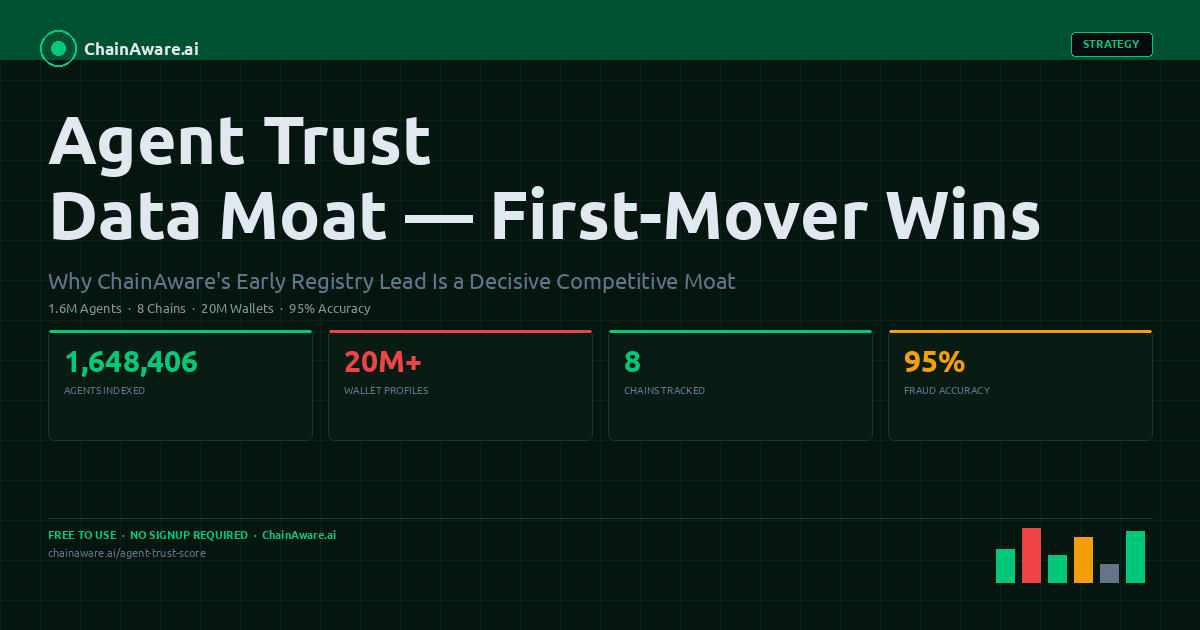
The first mover in AI agent trust infrastructure doesn’t just collect more data—they collect data that cannot be replicated. ChainAware.ai has indexed 1.6 million agents with behavioural histories stretching back months, creating a scoring advantage that grows stronger with every new registration. Learn why trust scoring requires population-level baselines built over time, how relational density between agents compounds accuracy, and why the lag time inherent in behavioural analysis creates an irreversible moat that early entrants will almost certainly maintain. Discover what separates a true data advantage from vanity metrics, and why being present at scale from the beginning determines who owns agent trust infrastructure.

Agent trust economy market sizing to 2030 — ChainAware.ai ERC-8004 registry

Agent Trust Economy: Proven Market Sizing Exposed — the $2030 Opportunity

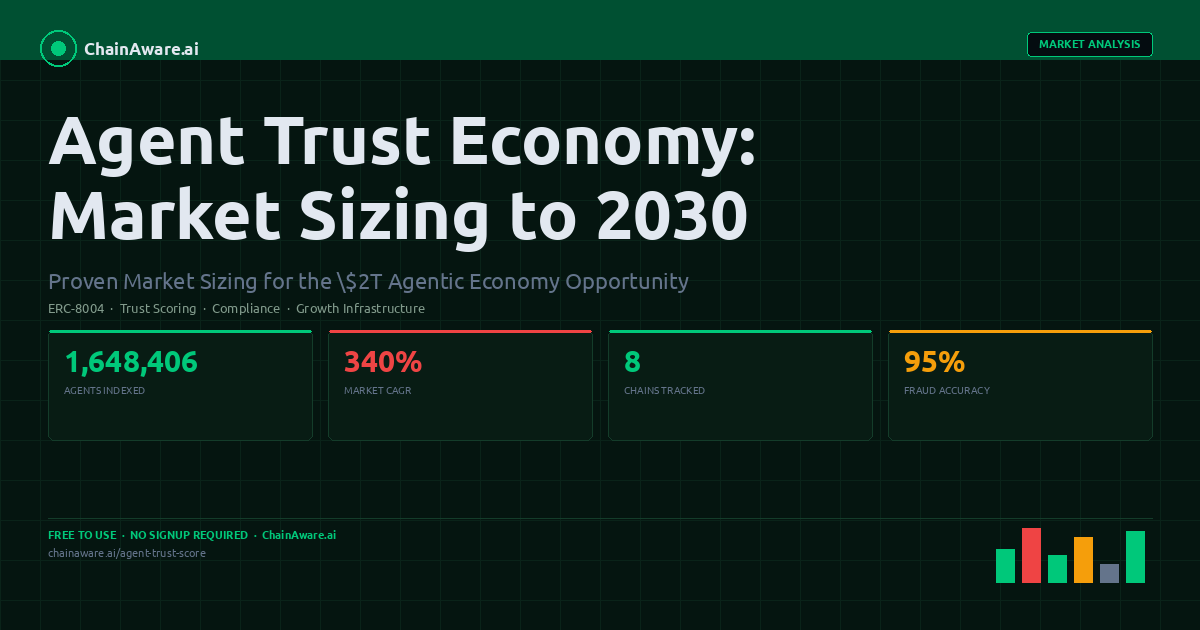
The agent economy isn’t emerging—it’s already here. ChainAware has indexed 1.65 million ERC-8004 agents across eight major chains, with weekly registrations exceeding 892,924 in October alone. Yet an alarming 82.5% score in elevated risk or untrusted tiers, driven by unknown feeder addresses and payment-adjacent operations. As Gartner projects 15% of enterprise transactions will be agent-initiated by 2027—implying nearly $2.2 trillion in annual agent-driven volume against Visa’s $14.8 trillion baseline—compliance and risk teams face an urgent question: does infrastructure exist to assess agents before they transact? Discover how the ERC-8004 standard is reshaping trust assessment at scale, why this is a winner-take-most market by architecture, and what the real market sizing numbers reveal about positioning timelines narrowing rapidly.

Payment networks agent trust stack fails — ChainAware.ai fraud detection for AI agents

Payment Networks Exposed: The Full Truth About Why the Agent Trust Stack Fails

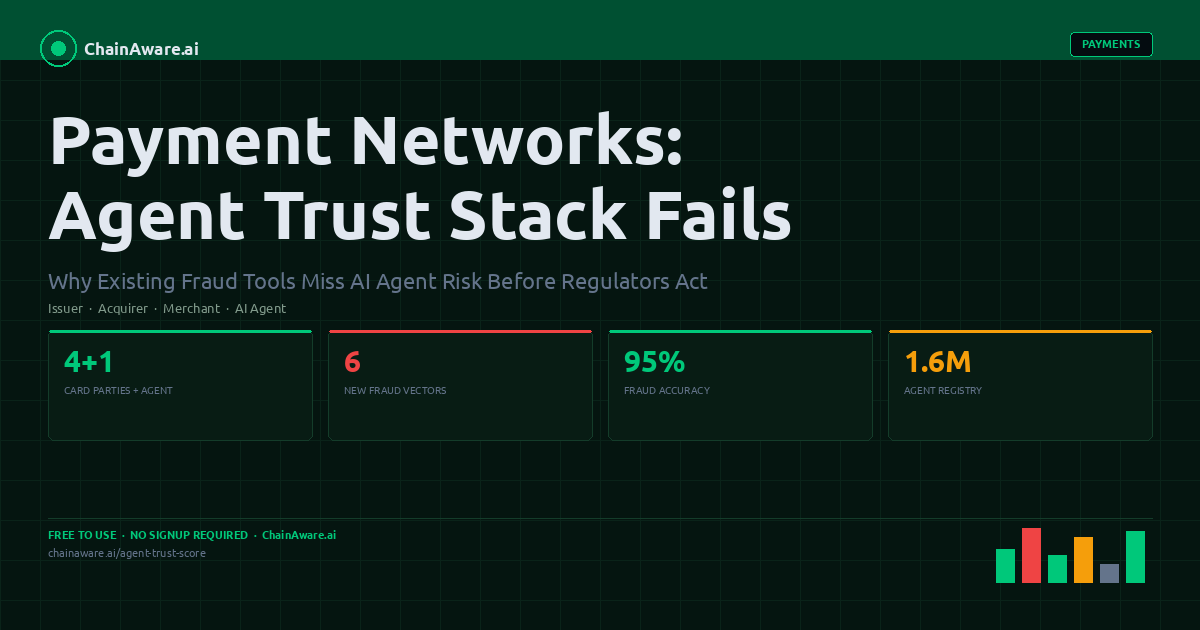
Payment networks built their fraud defences on a single assumption: humans are on the other side of every transaction. But Gartner estimates that 15 percent of enterprise transactions will be agent-initiated by 2027, and AI agents are already transacting today—booking travel, purchasing API credits, settling invoices and triggering recurring orders. The problem is urgent: velocity rules flag legitimate high-frequency agent activity as fraud, device fingerprinting loses all signal on shared cloud infrastructure, and behavioral biometrics has nothing to measure when software is the buyer. ChainAware’s research reveals how payment networks can retrofit their fraud stacks before agentic volume scales to levels that make retrofitting prohibitively expensive. Discover the three critical failure modes breaking today’s detection frameworks and what a practical fix looks like for acquirers and infrastructure architects.

KYA regulations EU AI Act MiCA agentic economy compliance timeline — ChainAware.ai

KYA Regulations Exposed: Proven Truth About the EU AI Act, MiCA and Agentic Economy

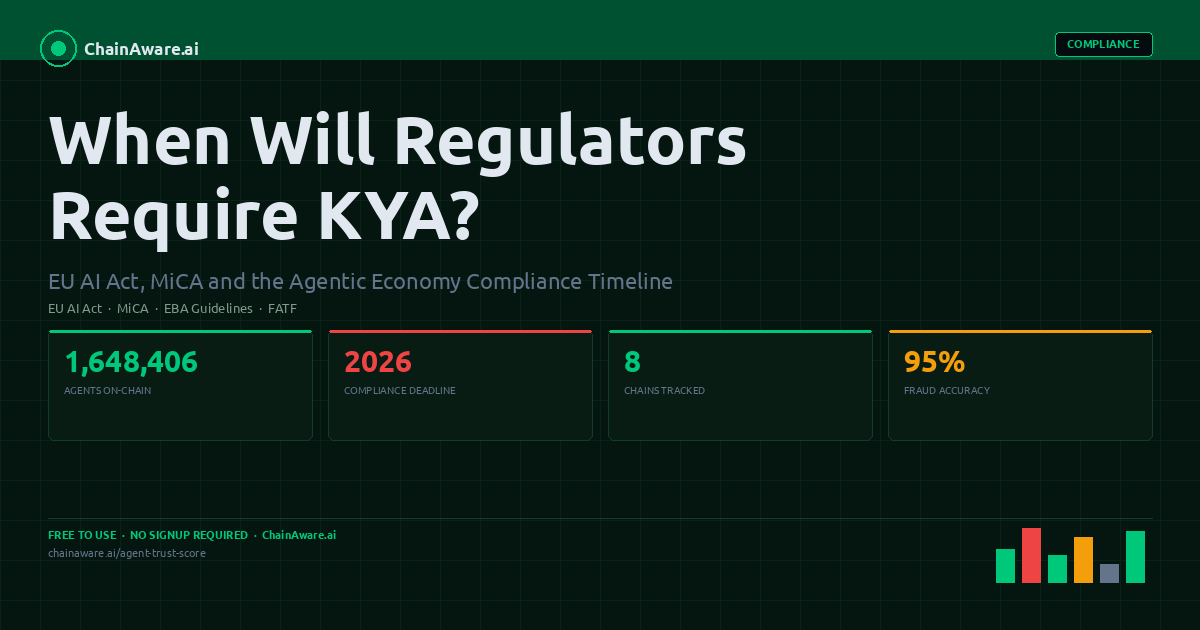
Regulators haven’t yet mandated Know Your Agent protocols — but three separate regulatory frameworks are converging to make it inevitable. The EU’s MiCA Article 68 is creating screening gaps for AI agent wallets, whilst the EU AI Act Article 50 establishes identity disclosure as a legal requirement. Meanwhile, the FATF Travel Rule is closing in on the agent originator problem. With 1.6 million ERC-8004 agents already indexed on-chain and funding chains traceable to known bad actors, compliance teams face enforcement exposure today, long before formal agent-specific rules land. This article maps the three regulatory tracks, identifies the grey areas where agents currently operate, and provides a realistic timeline for when mandatory agent registration becomes law. Learn what your team needs to do now to stay ahead of the curve — and why ChainAware’s agent behaviour scoring is becoming essential compliance infrastructure.

Verifying AI agents at checkout tokens mandates and behavioural trust — ChainAware.ai

Verifying AI Agents at Checkout Exposed: The Full Truth About Tokens and Behavioural Trust

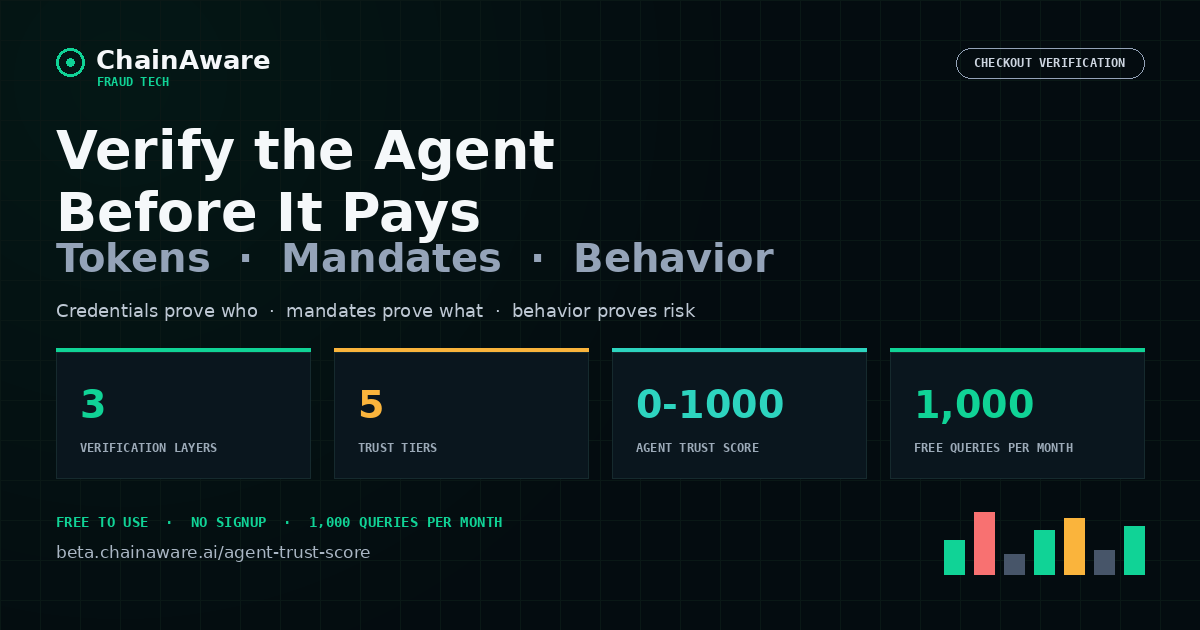
A checkout page used to ask one question: is this customer who they say they are? With AI agents, it must ask three. Who is this agent, what did the user allow it to do, and how risky is the operator behind it? This guide walks merchants, payment providers and platforms through the three-layer verification stack for AI agents at checkout. Layer one – credentials and payment tokens (OpenAI/Stripe Agentic Commerce Protocol, Google AP2, Trulioo Digital Agent Passport, ERC-8004) – proves who the agent is and how it pays. Layer two – signed mandates – proves what the user allowed, covering AP2 intent, cart and payment mandates and what to check at authorization time. Layer three – behavioral evidence – is the only layer that separates a trustworthy agent from a well-documented bad one: owner wallet fraud probability, feeder funding chain, creator rug pull and honeypot history, and fleet-level farm detection. At launch, 51.8% of 274,792 indexed ERC-8004 agents sat in the Elevated Risk or Untrusted tiers despite holding valid credentials. ChainAware’s Agent Trust Score supplies the behavioral layer as a 0 to 1,000 score with five tiers and named flags. The guide includes a six-step decision flow, a flag reference table, attack scenarios, merchant-type playbooks and a 60-day rollout plan. Free tier covers 1,000 queries per month with no signup.

Agentic commerce fraud four-party card model who bears the loss — ChainAware.ai

Agentic Commerce Fraud Exposed: The Full Truth About Who Bears Loss in Four-Party Payments

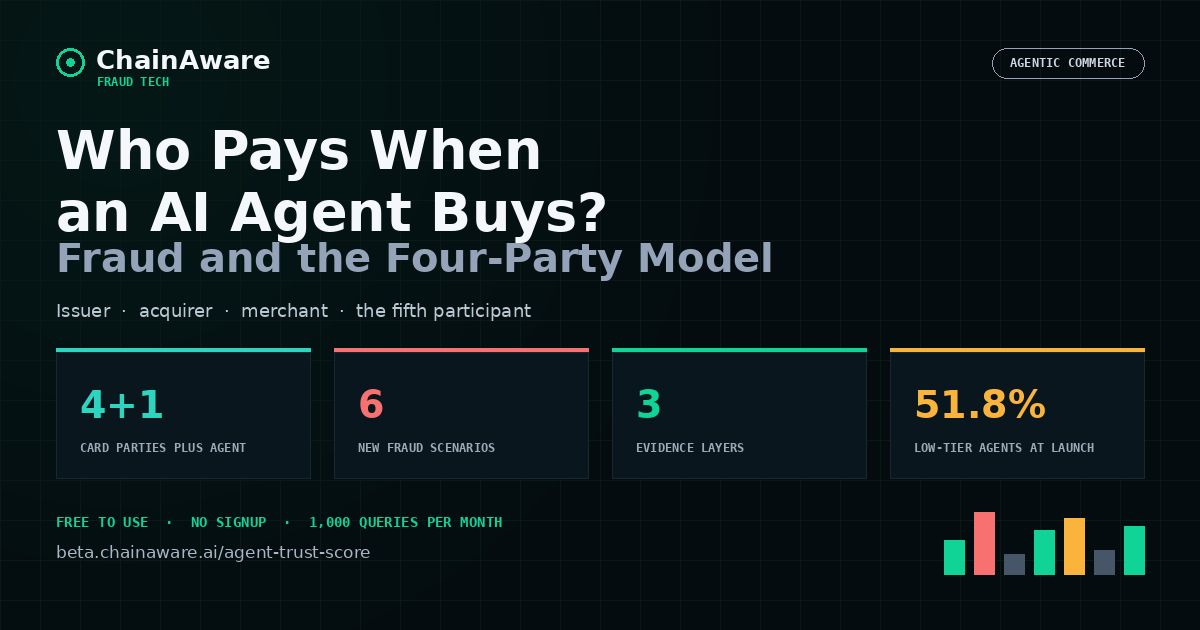
The four-party card model assumes a human at checkout – device fingerprints, typing rhythm and session history feed every fraud engine on that assumption. AI agents remove all of it. This guide explains what agentic commerce fraud looks like inside the issuer-acquirer-merchant-network model, why liability for agent-initiated transactions is still unsettled, and what a behavioral trust layer adds to the credential and mandate rails already being built by OpenAI, Stripe, Google AP2, Visa and Mastercard. Six new fraud scenarios follow from the lost human signal: agent impersonation, mandate abuse, agent drift, fleet abuse, friendly-fraud alibi disputes and compromised agents. McKinsey estimates agent-mediated commerce could reach $3-5 trillion by 2030, yet the open ERC-8004 registry already shows what happens without behavioral scoring: 51.8% of 274,792 indexed agents sat in the two lowest tiers, 21.1% carried the farm flag, and the Week 41 median trust of new registrations fell to a record-low 101. ChainAware’s Agent Trust Score supplies the behavioral layer for on-chain agents – owner wallet fraud probability, feeder funding chain, creator rug pull and honeypot history, and fleet-level farm detection – as a 0 to 1,000 score with five tiers and named flags. Free tier covers 1,000 queries per month with no signup.

Agent fraud patterns from the ERC-8004 weekly tracker threat landscape — ChainAware.ai

Agent Fraud Patterns Exposed: A Complete Picture of the ERC-8004 Weekly Tracker

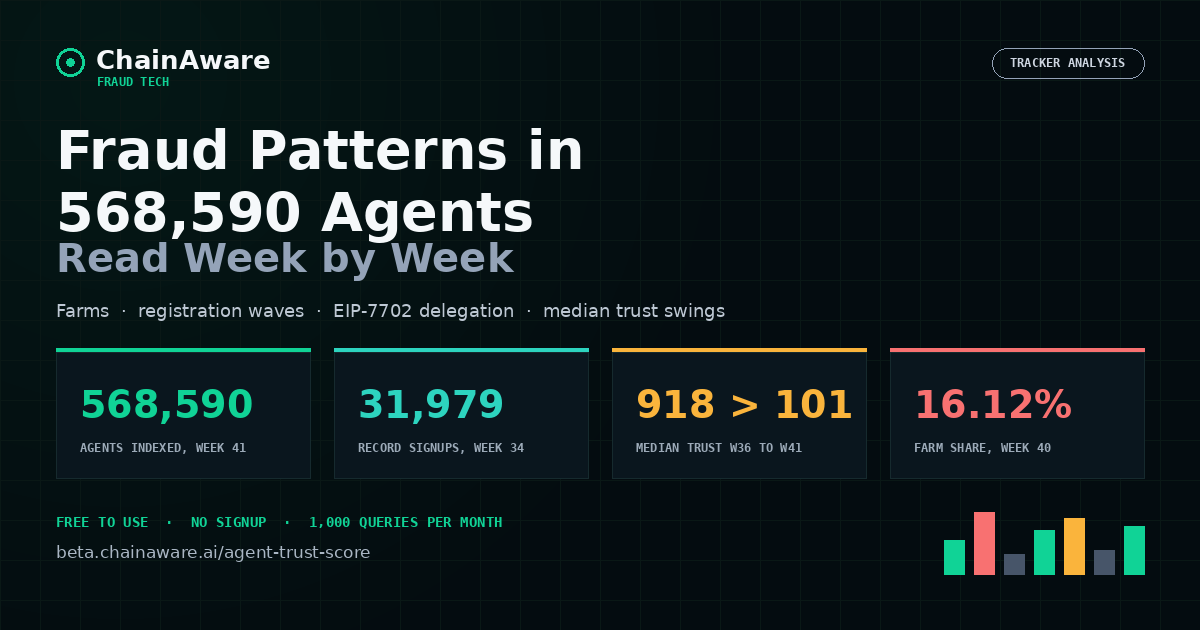
ChainAware’s weekly Agent Trust Tracker has indexed ERC-8004 agents since the registry launched in January 2026. Read one week at a time, the reports show registrations and scores. Read together across Weeks 29 to 41, they reveal four repeating fraud patterns that single reports hide. Pattern one: volume and quality move independently – Week 34 set the registration record at 31,979 agents with a median trust of 563, while Week 41 hit a record-low median of 101 on 10,706 agents. Pattern two: concentration bursts – Weeks 31 and 38 both saw agents-per-owner ratios above 2.0 and median trust drop to 200, as few operators drove bulk registrations. Pattern three: persistent Sybil farms – the farm flag covered 21.1% of agents at launch and 16.12% by Week 40 across a 568,590-agent index. Pattern four: funding that gets harder to trace – the FEEDER_UNKNOWN share nearly doubled to 12.84% in Week 41. A fifth signal, EIP-7702 delegation, rose 33.8% between Weeks 35 and 40. This guide explains what drives each pattern, how the patterns feed each other, and how defenders can use the agents-per-owner ratio, tier thresholds and flag overrides to respond. The Agent Trust Score is free for 1,000 queries per month with no signup.