
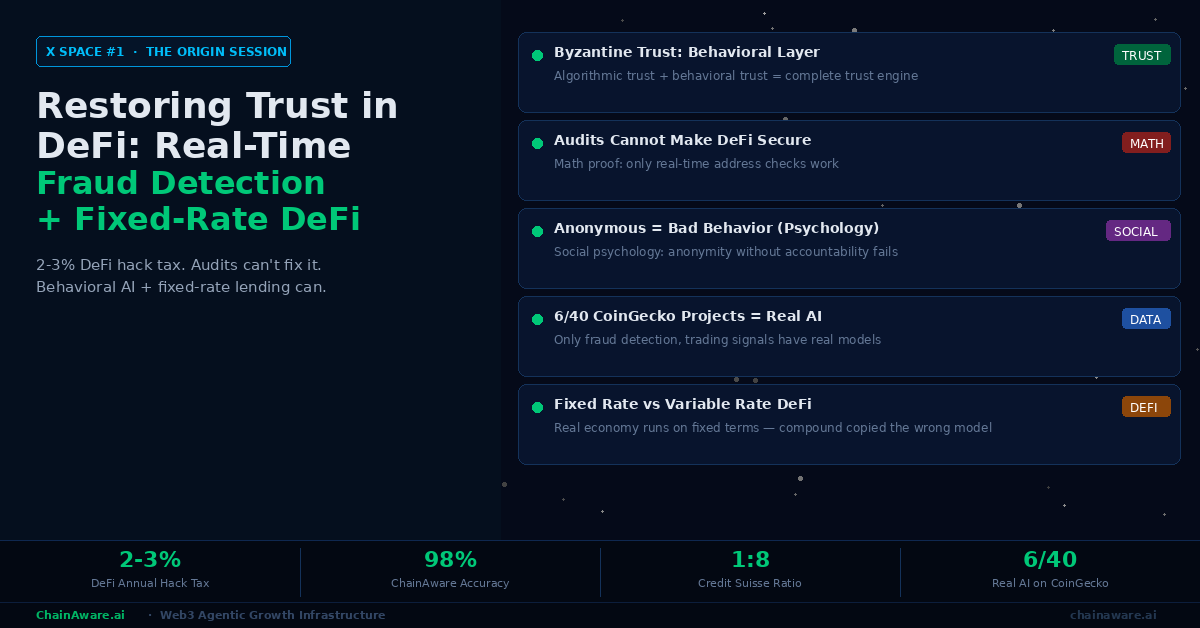
X Space #1 — Restoring Trust in DeFi: Real-Time Fraud Detection, Fixed-Rate Lending, and the Byzantine Trust Layer. The session that launched the ChainAware X Space series, originally hosted on the SmartCredit.io account. Watch the full recording on YouTube ↗ · Listen on X ↗
X Space #1 is the session that started everything — the origin conversation that introduced both SmartCredit and ChainAware to the community, explained the thinking behind each product, and laid out the two foundational arguments that every subsequent session has built on. Co-founders Martin and Tarmo open by asking why DeFi went wrong in the same direction twice: variable-rate variable-term lending (when the real economy runs on fixed rates) and AML-only fraud detection (when real financial security requires behavioral AI transaction monitoring on top). Both missteps happened for the same reason — easier to copy and implement, regardless of whether the result matches how real economies and real security architectures work. X Space #1 then introduces ChainAware’s solution to the trust problem at its deepest level: not just fraud scoring, but a complete behavioral intelligence layer built on top of blockchain’s algorithmic trust, addressing the social psychology reality that anonymous systems generate bad behavior without accountability mechanisms.
In This Article
- SmartCredit’s Origin: Why DeFi Got Fixed-Rate Lending Wrong
- The Compound Copy Problem: When DeFi Copied the Wrong Model
- How Credit Scoring Led to Fraud Detection — And ChainAware Was Born
- Real AI vs Using AI: What It Actually Means to Build Models
- The 2-3% Annual DeFi Hack Fee: Why Current Solutions Cannot Fix It
- The Two-Pillar System: AML + Transaction Monitoring in Traditional Finance
- Why Smart Contract Audits Cannot Make DeFi Secure: The Mathematical Proof
- Byzantine Trust and the Behavioral Layer: Two Trust Engines in One
- Social Psychology of Anonymity: Why Blockchain Needs Accountability Tools
- The Wallet Auditor: Beyond Fraud Score to Risk Willingness and Intentions
- Share My Wallet: Cryptographic Proof of Identity in a Pseudonymous Ecosystem
- Real Cases: Ledger Hack and the ChainAware Clone
- The Telegram Bot: Real-Time Checks Where Crypto Users Actually Are
- Comparison Tables
- FAQ
SmartCredit’s Origin: Why DeFi Got Fixed-Rate Lending Wrong
Before explaining ChainAware, Martin and Tarmo explain SmartCredit — because ChainAware grew directly out of SmartCredit’s development. Understanding SmartCredit’s founding premise also establishes the analytical framework that runs through everything they build: the question of whether a product matches how the real economy actually works, or whether it simply implements whatever was easiest to copy.
SmartCredit’s premise is that DeFi lending went wrong at its foundation. Approximately 99% of DeFi borrow-lend platforms operate on variable rates and variable terms — meaning both the interest rate and the loan duration can change without the borrower’s control. This structure is technically convenient to implement in smart contracts, but it does not reflect how the real economy finances anything of importance. Mortgages, business loans, consumer credit, corporate bonds — all of the debt instruments that fund actual economic activity use fixed terms and fixed (or at minimum predictably structured) rates. The reason is predictability: borrowers need to know exactly what they will pay and for how long, while lenders need to know exactly when they will receive repayment.
Fixed Rate for Real Economic Predictability
Tarmo and Martin bring specific financial analysis expertise to this observation — both are Chartered Financial Analysts who spent a decade at Credit Suisse. As Tarmo explains: “If you work in real economy, you don’t find variable terms. You don’t want variable interest rate. Variable term and variable interest rate — these are special products for investment banking, for traders, for highly educated people. If you have variable rate, you have very high probability of loss. And we have in DeFi, most of it in an area where you, as a user, will lose.” SmartCredit addresses this by implementing fixed-term, fixed-rate lending — offering lenders a fixed-income fund with mixed maturities and yield curves, and offering borrowers the predictable repayment structure that real economic participation requires. For more on SmartCredit’s approach, see our SmartCredit case study.
The Compound Copy Problem: When DeFi Copied the Wrong Model
Martin introduces a structural observation about DeFi’s development that explains how the entire sector ended up implementing a model unsuited to the real economy. The observation applies to both DeFi’s lending structure and its fraud detection approach — in both cases, the ecosystem copied an initial implementation without asking whether the underlying model was correct.
Compound Finance implemented the first significant DeFi lending protocol — a variable-rate, variable-term system that was straightforward to implement as an Ethereum smart contract. The protocol worked well enough to attract users and capital. Then, rather than building alternative lending architectures better suited to different use cases, every subsequent protocol simply copied Compound’s approach. Aave copied Compound (and added some modifications). Then other protocols copied Aave or Compound, modifying variables but maintaining the core variable-rate structure. As Martin notes: “99% of DeFi borrow-lend is a variable rate, variable term. All of them copied Compound, and then some one of them changed the compound internal utility function. The major innovation was changing from a linear to two linears. Okay, well done. But it’s still a variable rate, variable term.” The result is that the entire DeFi lending ecosystem optimised for one use case — speculation and trading — while failing to serve the 80-90% of economic activity that runs on fixed terms.
The Same Pattern in Fraud Detection
The identical dynamic played out in DeFi’s approach to fraud detection. Chainalysis and similar platforms built AML-based analysis tools — based on a well-understood, codified algorithm that tracks the flow of known-illicit funds through the system. These tools were technically correct for their original use case (helping centralised exchanges comply with regulations) but fundamentally unsuited to Web3’s real-time, irreversible transaction environment. Nonetheless, the industry adopted AML as the standard for blockchain fraud detection — because it was established, marketed well (Martin explicitly references Chainalysis’s “FBI” branding), and easier to implement than the more powerful but more difficult AI transaction monitoring approach. For more on why this matters, see our Web3 security guide.
The Trust Layer That DeFi Is Missing
ChainAware Fraud Detector — 98% Real-Time Accuracy
Not AML. Not forensics. Not static analysis 48 hours after the loss. Behavioral AI trained on blockchain interaction patterns — the same transaction monitoring methodology that traditional finance uses as its second mandatory fraud pillar. 98% accuracy. Sub-1-second response. Free for individual checks. The product that ChainAware was built to create.
How Credit Scoring Led to Fraud Detection — And ChainAware Was Born
ChainAware’s origin is a direct consequence of SmartCredit’s fixed-rate lending architecture. Building a fixed-term lending platform requires credit scoring — unlike variable-rate protocols where under-collateralised positions simply get liquidated automatically, a fixed-term loan requires evaluating whether the borrower will meet their obligations at maturity.
Developing a credit scoring model for DeFi requires confronting the fraud problem immediately. A strong cash flow history in a blockchain wallet suggests creditworthiness — but only if the wallet owner is genuine rather than a fraudster using clean-looking transaction patterns to extract capital. As Tarmo explains: “If the address being a borrower is a fraudster, then independently of how good its cash flows are, the regular rate of cash flows and so on, the regular cash flow algorithm for the credit scoring — he will get the bad score.” Credit scoring and fraud scoring, in this architecture, are inseparable: fraud scoring overrides credit scoring, because a fraudulent address with perfect cash flows is still a fraudulent address.
The Realisation: Fraud Detection Is a Standalone Product
As Martin and Tarmo developed the fraud detection subsystem of SmartCredit’s credit scoring, they realised the fraud detection capability had value independent of credit scoring — and far broader demand. The DeFi ecosystem does not primarily need credit scores (because most lending is over-collateralised and liquidation-based). However, every DeFi user, every protocol interaction, and every wallet-to-wallet transaction involves a trust question: can I trust the counterparty I’m interacting with? ChainAware launched in February 2024 (initially under a different name) as the standalone product that answers this question. The community later proposed the name “ChainAware” — and it stuck. For the full product history, see our behavioral analytics guide.
Real AI vs Using AI: What It Actually Means to Build Models
Martin draws a sharp distinction between real AI and AI usage that applies to evaluating every blockchain AI claim. Real AI means building and training proprietary models — assembling training data, selecting algorithms, iterating through training cycles, backtesting against held-out data, and deploying to production with verified performance guarantees. Using AI means wrapping an existing model (typically OpenAI’s GPT) in a user interface and calling it an AI product.
ChainAware’s fraud detection model illustrates what real AI development looks like in practice. The initial model achieved approximately 60-70% accuracy — useful as a proof of concept but insufficient for production deployment. Through iterative training, the team progressed to 99% accuracy. However, the 99% model required 23-24 seconds to process large addresses (using Vitalik Buterin’s address as the benchmark test case) — making it practically useless for real-time pre-transaction checking. A deliberate decision to downscale to 98% accuracy in exchange for sub-1-second response times produced the current production model. As Martin explains: “98% and real time are much more important parameters than 99% and near real time.” For the full AI development methodology, see our real AI vs using AI analysis.
The 2-3% Annual DeFi Hack Fee: Why Current Solutions Cannot Fix It
Martin and Tarmo present the DeFi hack fee as the single most important statistic for understanding why DeFi adoption has plateaued. Approximately 2-3% of total DeFi value locked disappears annually through hacks, exploits, and fraud. This figure has remained stable for years despite massive investment in smart contract auditing firms, the growth of AML analytics companies, and the proliferation of security-focused tooling.
The stability of this figure is the argument. If current security approaches were effective, the hack fee would be declining. It is not declining. As Tarmo explains: “You can earn on Ethereum maybe 0.17% annually. But your risk of hackers fee per annum is 3%. Nobody’s going to invest. And this current solution — you make audits, you make two audits, eleven audits, some make seventeen audits. And you think they are secure? No, they are not secure. There is mathematically no possibility in a real-time system to prove that the contract is secure.” The economic consequence is direct: a user who earns 0.17% in DeFi yield while paying 2-3% in expected hack losses has a systematically negative expected return. This calculation alone explains why 450 million of the 500 million crypto users remain in custodial centralised platforms rather than engaging with DeFi directly. For more on the adoption implications, see our DeFi growth guide.
The Two-Pillar System: AML + Transaction Monitoring in Traditional Finance
Traditional finance regulators require two distinct fraud detection mechanisms from every licensed bank — a requirement that reflects decades of experience with what actually works in practice. Crypto has adopted only one of the two mandatory mechanisms, and it has done so in a form that is structurally inadequate for the blockchain environment.
The first pillar is AML (Anti-Money Laundering) monitoring — tracking the flow of known-illicit funds through the financial system using a weighted contamination algorithm. This approach is so standardised that in some jurisdictions, like Switzerland, the exact algorithm is codified in law. The second pillar is transaction monitoring — real-time AI-based evaluation of every incoming and outgoing transaction to identify behavioural patterns associated with fraud. Transaction monitoring is what catches sophisticated fraudsters who have learned to avoid using traceable blacklisted funds. As Martin states: “100% of transaction monitoring systems in traditional finance — they’re AI based. It’s pattern matching. If someone is a fraudster, he knows he cannot use black money. If the fraudster gets a little experience, we need pattern matching.”
Why AML Alone Fails in DeFi
AML’s inadequacy in DeFi has two components. First, it is retrospective — it identifies that bad money has flowed through an address after the fact, which provides no protection when transactions are irreversible. Second, it only catches unsophisticated fraudsters who use previously blacklisted funds. Experienced fraudsters bridge to fresh addresses, mixing their history until the AML contamination ratio drops below detection thresholds. The pattern-matching of transaction monitoring catches these actors because their behavioural signatures persist regardless of which addresses they use. DeFi adopted AML without transaction monitoring — not because the two-pillar requirement was unknown, but because AML was easier to build and easier to market. For the full regulatory comparison, see our transaction monitoring guide.
Why Smart Contract Audits Cannot Make DeFi Secure: The Mathematical Proof
Tarmo introduces an argument that challenges the dominant security paradigm in DeFi — the belief that comprehensive smart contract auditing can produce secure protocols. The argument is mathematical rather than technical, and it applies regardless of how thorough or expensive the audit is.
A smart contract audit evaluates the code of a specific contract at a specific point in time. It identifies vulnerabilities in the logic, the data structures, and the external interactions of that particular contract. What it cannot evaluate is the behavioural profile of every address that will interact with the contract after deployment. Dynamic DeFi systems do not operate in isolation — they interact with user wallets, liquidity pools, oracle feeds, other smart contracts, and flash loan providers, all of which change continuously after deployment. The only way audit-based security could guarantee protection would be to audit every contract in the entire blockchain simultaneously — a computational and organisational impossibility. As Tarmo states: “There is mathematically no possibility in a real-time system to prove that the contract is secure. If you want to make a secure ecosystem, what you need is to check addresses. If you want to have security in blockchain, you need a real-time check of your partner: is it a bad Byzantine general, or is it a good general?” For more on why this matters for DeFi security architecture, see our fraud detection guide.
Multi-Layer Security: Why DeFi Needs More Than One Line of Defence
Security architecture in any domain — cybersecurity, physical security, financial security — operates as a multi-layer system where each layer addresses a distinct threat vector. Traditional banking combines AML monitoring, transaction monitoring, KYC procedures, regulatory compliance, insurance, and fraud operations teams into a layered defence. DeFi currently operates with essentially one layer: smart contract audits. Even the best single-layer security system fails against attackers who have identified and probed that specific layer. Real security requires adding the missing layers — starting with the most impactful one that currently does not exist at scale in DeFi: real-time AI-based address and transaction verification before interaction occurs.
Byzantine Trust and the Behavioral Layer: Two Trust Engines in One
Martin introduces the Byzantine Generals Problem as the conceptual framework for understanding blockchain’s original trust guarantee — and for understanding why a second trust layer is necessary. The Byzantine Generals Problem asks: how can a distributed network of participants reach consensus on the state of a shared system when some participants may be dishonest or compromised? Blockchain’s consensus mechanisms (proof-of-work, proof-of-stake) solve this problem algorithmically — they ensure that the blockchain’s transaction ledger reflects the honest majority’s view of reality, even if a minority of participants act maliciously.
However, the Byzantine consensus algorithm tells you nothing about which specific participants are the dishonest ones. It ensures the system reaches correct consensus despite bad actors — but it does not identify or exclude bad actors from future interactions. As Tarmo explains: “We have in blockchain, one third or two thirds who are bad guys. Blockchain is a trust engine. But we can say — who are the bad guys? We can say, don’t transact with this address or don’t use this contract. If you see where the industry is working: smart contract audits. It’s mathematically impossible. If you want to have security, you have to check addresses.” ChainAware’s behavioral AI adds the second trust layer — identifying which specific addresses are bad generals — on top of blockchain’s existing algorithmic trust layer. Together, they form a complete trust architecture. For more on this framework, see our AI blockchain use cases guide.
Social Psychology of Anonymity: Why Blockchain Needs Accountability Tools
Tarmo introduces a dimension of the trust problem that goes beyond technical architecture: social psychology. The argument draws on well-documented findings from experimental psychology about how anonymous systems affect human behaviour.
Research in social psychology — including the Stanford Prison Experiment and related studies on anonymity and deindividuation — consistently demonstrates that when individuals operate anonymously without accountability mechanisms, bad behaviour increases substantially. The reduction of personal responsibility that comes with anonymity removes the social and reputational incentives that normally constrain harmful actions. Blockchain’s pseudonymous structure — where addresses, not identities, interact — creates exactly this environment. As Tarmo explains: “In social psychology, it is common understanding that if we have an anonymous system, then people start behaving badly. And as soon as you don’t have a balancing power, it turns bad. Now when we come to blockchain, it motivates this internal mechanism in people to start behaving badly if they are anonymous.”
Accountability Without Disclosure: The ChainAware Solution
ChainAware addresses this social psychology problem without compromising the pseudonymity that makes blockchain valuable. The approach does not require users to disclose their identity. Instead, it introduces behavioral accountability — the knowledge that every address’s transaction history is analysable and that patterns of bad behaviour are detectable and predictable. This shifts the risk calculation for would-be fraudsters: acting fraudulently creates a persistent, immutable record that ChainAware’s models can detect and that will follow the address (or behaviorally clustered set of addresses) indefinitely. The accountability mechanism works through consequence prediction rather than identity disclosure. For more on how this changes DeFi’s trust dynamics, see our wallet audit guide.
The Behavioral Trust Layer — Free to Start
ChainAware Wallet Auditor — Risk, Experience, Intentions, Trust Score
Beyond fraud score: risk willingness (are they a risk-taker or risk-avoider?), experience level (does their history match their claimed track record?), behavioral intentions (borrower, lender, trader, gamer?), and predicted future actions. The complete behavioral profile of any address — the second trust layer that DeFi has been missing.
The Wallet Auditor: Beyond Fraud Score to Risk Willingness and Intentions
ChainAware’s wallet auditor extends far beyond a simple fraud/trust binary. While fraud detection is the most urgently needed capability — a binary signal about whether to interact with a counterparty — the wallet auditor computes a complete behavioral profile that enables much richer applications.
The wallet auditor calculates four primary dimensions. First, the fraud score (or trust score): a probability from 0 to 100 indicating the likelihood of fraudulent behaviour, where 50% is the default threshold above which an address is considered trustable. Second, risk willingness: whether the address owner is risk-tolerant (comfortable with high volatility, large position swings, aggressive strategies) or risk-averse (conservative positions, stable yield preferences, low leverage). Third, experience level: how long has the address been active, which protocols has it used, and how does its transaction sophistication match its claimed history? Fourth, behavioral intentions: what is the address likely to do next — borrow, lend, trade, game, hold NFTs? As Martin explains: “We calculate the willingness to take a risk based on the blockchain history. We calculate his experience. We calculate intentions — what will the address do as next?” These four dimensions, combined with the fraud score, make it possible to evaluate any address as a counterparty, partner, user, or investor — all without the address owner disclosing any personal information.
The Influencer Test: Verifying Claimed Track Records
Martin illustrates the practical power of the wallet auditor with a specific use case he applies personally. When crypto influencers approach him via Telegram to sell services — claiming years of DeFi experience and a track record of successful calls — he requests their wallet address and runs it through the auditor. If an influencer claims five years of blockchain activity but their wallet shows minimal transactions, no experience with the protocols they claim expertise in, and a high fraud probability, the mismatch speaks for itself. As Martin notes: “That’s where 95% are stopping — dropping off when asked for their address.” The willingness to share an auditable address is itself a trust signal. For more on the wallet auditor product, see our wallet audit guide.
Share My Wallet: Cryptographic Proof of Identity in a Pseudonymous Ecosystem
The Share My Wallet feature addresses a specific trust problem that arises when wallet auditor results need to be communicated between parties: how do you know that the audit result someone shows you corresponds to their actual wallet, rather than someone else’s wallet they are presenting as their own?
The solution uses cryptographic wallet signing. A user connects their wallet to ChainAware and signs a message with their private key — a cryptographic action that proves beyond doubt that the signer controls the wallet address, since only the holder of the private key can produce a valid signature. ChainAware generates a unique shareable link tied to this verified address. When the user shares this link, the recipient can see not just the wallet’s behavioral audit but the cryptographic proof that the person sharing the link is the genuine owner of that address — not someone cherry-picking a clean-looking address to present as their own. As Martin explains: “You connect your wallet and paste your own address into the wallet auditor, and then you get a share link. Because it’s your own address, this share link is unique and you can share it. It’s proof that this is your address, not that Vitalik’s address.” For the complete Share My Wallet feature, see our wallet audit guide.
Real Cases: Ledger Hack and the ChainAware Clone
Martin presents two specific real-world incidents that demonstrate ChainAware’s pre-transaction detection capability compared to traditional forensics systems, and that illustrate the broader challenge of getting the industry to act on early warnings.
The Ledger Connect Kit exploit involved a supply chain attack that injected malicious code into a widely-used web component library. The malicious “drainer” address — which received the stolen funds — was identifiable by ChainAware as a high-fraud-probability address based on behavioural patterns before the exploit was widely known. Traditional AML and forensics systems took 6-24 or more hours to mark the same address as bad. As Martin notes: “It took kind of ages for the traditional systems to mark these addresses as bad.” The delays are not incidental — they reflect the structural latency of forensics-based approaches that wait for enough data to be confirmed before updating their databases.
The ChainAware Website Clone: When No One Acts
The ChainAware clone case is more personal and illustrative of a different problem: even when predictive tools identify a fraud in advance and report it to the right parties, the ecosystem may not act in time. An unknown actor copied ChainAware’s entire website, created a fake token, launched a liquidity pool, and executed a rug pull. ChainAware immediately analysed the pool creator’s address and identified it as a near-certain fraudster (approximately 3% trust score). The team reported the pool as a fraud in progress to Etherscan, CoinGecko, and DeFi Llama. As Martin describes: “We contacted Etherscan, we sent them a message. We contacted CoinGecko, we sent them a message. No replies. No replies. We contacted DeFi Llama — they did react, and we were very happy about that. Others didn’t.” The rug pull proceeded as predicted. The lesson is twofold: the technology to identify fraud in advance exists, but the ecosystem infrastructure for acting on early warnings in time is still being built. For more on protecting against rug pulls, see our rug pull detection guide.
The Telegram Bot: Real-Time Checks Where Crypto Users Actually Are
One of X Space #1’s practical announcements is ChainAware’s Telegram bot — a product decision that reflects where crypto users actually conduct due diligence rather than where security tools typically exist.
The insight is behavioural: crypto users communicate and receive wallet addresses primarily through Telegram. When a DeFi project approaches you, when an influencer sends you an address, when someone pitches you an investment opportunity — the interaction typically happens in Telegram. A security tool that requires copying an address, switching to a web browser, navigating to a separate website, and pasting the address creates friction that users avoid. A Telegram bot that provides the same analysis within the workspace where users already operate removes that friction entirely. As Martin explains: “In Telegram, which is like a singular workspace — you work in Telegram, you make calls in Telegram, you get an address. You just verify directly there. You don’t need this context switching — copy-pasting address from one place to another.” The Telegram bot enables real-time address checks, wallet audits on Ethereum and BNB, and the Share My Wallet flow directly from any Telegram conversation. For the full product, visit chainaware.ai.
Comparison Tables
AML Forensics vs ChainAware Behavioral AI: Trust Architecture Comparison
| Dimension | AML Forensics (Chainalysis / Coinfirm) | Smart Contract Audits | ChainAware Behavioral AI |
|---|---|---|---|
| Mechanism | Tracks contaminated fund flows from blacklisted addresses | Evaluates contract code for vulnerabilities at deployment | Analyses behavioral patterns of addresses in real time |
| Timing | Retrospective — 6-48+ hours after event | Pre-deployment — cannot predict runtime behaviour | Real-time — sub-1-second before transaction |
| Fraud type covered | Unsophisticated fraud (traceable blacklisted funds) | Known code vulnerabilities in specific contract | All fraud patterns including sophisticated actors |
| Traditional finance equivalent | Pillar 1 (AML) — mandatory but insufficient alone | No direct equivalent | Pillar 2 (Transaction Monitoring) — 100% AI in TradFi |
| DeFi hack fee impact | Stable at 2-3% TVL/year despite widespread deployment | Stable at 2-3% TVL/year despite widespread deployment | Could reduce significantly if widely deployed |
| Ledger hack response | 6-48+ hours to mark drainer address | N/A — runtime exploit, not code vulnerability | Identified drainer as fraudulent pre-hack |
| Reversibility assumption | Designed for reversible fiat transactions | N/A | Designed for irreversible blockchain transactions |
| Cost | Very high licence fees (enterprise only) | High audit fees per contract | Free for individual checks; API for platforms |
| Byzantine trust layer | No — identifies contamination, not bad actors | No — evaluates code, not actors | Yes — identifies which actors are bad generals |
Fixed-Rate vs Variable-Rate DeFi: Real Economy Fit
| Dimension | Variable-Rate Variable-Term DeFi (Compound model) | Fixed-Rate Fixed-Term DeFi (SmartCredit model) |
|---|---|---|
| Real economy match | Investment banking, speculation, active traders | SME loans, mortgages, consumer credit, corporate bonds |
| Borrower predictability | None — rate and term can change at any time | Full — exact repayment amount and date known at signing |
| Lender product | Variable yield pools | Fixed-income fund with maturity-mixed yield curve |
| Credit scoring requirement | Not needed — liquidation handles default automatically | Required — fixed term needs creditworthiness assessment |
| Fraud scoring requirement | Not embedded — separate add-on | Integral — fraud score overrides credit score |
| Origin | Compound (2018) — easier to implement, widely copied | SmartCredit — built for real economy use cases |
| Population served | ~5-10% of borrowers (sophisticated traders) | ~80-90% of economic activity (predictable repayment needed) |
Frequently Asked Questions
Why did ChainAware emerge from SmartCredit?
SmartCredit’s fixed-rate lending model required a credit scoring system — unlike variable-rate DeFi where over-collateralisation and automatic liquidation eliminate the need to assess borrower creditworthiness. Building credit scoring required building a fraud scoring subsystem, because a fraudulent address with perfect cash flows still represents a bad credit risk. As Martin and Tarmo developed the fraud detection component, they realised it had standalone value far broader than credit scoring — every DeFi user needs to assess counterparty trustworthiness before any transaction. ChainAware launched as the standalone product in February 2024.
Why does DeFi have a 2-3% annual hack fee if so much money has been invested in security?
The hack fee remains stable because the dominant security approaches — smart contract audits and AML forensics — are architecturally wrong for DeFi’s real-time irreversible environment. Audits evaluate code at deployment but cannot predict runtime interactions with malicious actors. AML forensics identifies contaminated funds after they have already moved. Neither approach identifies bad actors in real time before a transaction executes. The correct approach — AI transaction monitoring that checks behavioural patterns of counterparties before interaction — is what traditional finance’s two-pillar regulatory framework mandates but DeFi has not adopted. ChainAware’s 98% accuracy real-time fraud detection addresses this gap directly.
How does the Byzantine Generals Problem relate to ChainAware?
The Byzantine Generals Problem asks how a distributed network reaches correct consensus when some participants may act maliciously. Blockchain’s consensus mechanisms solve this at the algorithmic level — they ensure the ledger reflects the honest majority’s view regardless of bad actors. However, the algorithm does not identify which participants are bad. ChainAware adds a behavioral trust layer on top: identifying which specific addresses are bad actors based on their transaction history patterns, enabling users to exclude them from interactions. Together, blockchain’s algorithmic trust (Byzantine consensus) and ChainAware’s behavioral trust (pattern-based actor identification) form a complete trust architecture.
What does the wallet auditor calculate beyond fraud score?
The wallet auditor computes four primary dimensions from blockchain transaction history. First, fraud/trust score: probability of fraudulent behaviour (above 50% = trustable). Second, risk willingness: whether the address owner is risk-tolerant or risk-averse, calculated from position sizing, leverage history, and portfolio volatility patterns. Third, experience level: how deep and broad the address’s protocol interactions are, enabling verification of claimed expertise. Fourth, behavioral intentions: what the address is predicted to do next — borrow, lend, trade, game, hold NFTs — enabling both personalised product recommendations and counterparty assessment. The Share My Wallet feature allows cryptographic verification that an audit result corresponds to the actual owner of the address.
Why is real economy DeFi lending fixed-rate rather than variable-rate?
Variable-rate, variable-term loans are specialised financial products designed for institutional investors, hedge funds, and sophisticated traders who have the tools and expertise to manage interest rate risk continuously. They are not appropriate for small businesses, retail consumers, or any borrower who needs to plan their finances around predictable repayment obligations. Approximately 80-90% of real economic lending — mortgages, SME loans, consumer credit, corporate bonds — uses fixed or predictably-structured terms specifically because predictability enables economic planning. SmartCredit’s fixed-rate model matches this real economy requirement. DeFi adopted variable rates not because they serve borrowers better, but because they were technically easier to implement in the initial Compound design — which every subsequent protocol then copied.
The Complete Trust Stack — One Platform
ChainAware Prediction MCP — Fraud, Audit, Rug Pull, Intentions
Real-time fraud detection + wallet behavioral audit + rug pull prediction + intention calculation — the complete behavioral trust layer for DeFi. Built on blockchain data. No identity disclosure. 98% accuracy. The product that emerged from SmartCredit’s credit scoring infrastructure in 2024. 14M+ wallets. 8 blockchains. 31 MIT-licensed agents.
This article is based on X Space #1 hosted by SmartCredit.io / ChainAware.ai co-founders Martin and Tarmo — the first session in the ChainAware AI and Web3 series. Watch the full recording on YouTube ↗ · Listen on X ↗. For questions or integration support, visit chainaware.ai.