
Your Security Stack Was Built for Human Attackers. What Happens When the Adversary Is AI?
Rules-based security frameworks were built for a specific adversary: a human being operating at human speed, exploiting known vulnerability classes, and constrained by cognitive limits. NIST, WAFs, smart contract audits — every major framework assumes the attacker can be caught by rules written in advance. That assumption held for three decades. It no longer does.
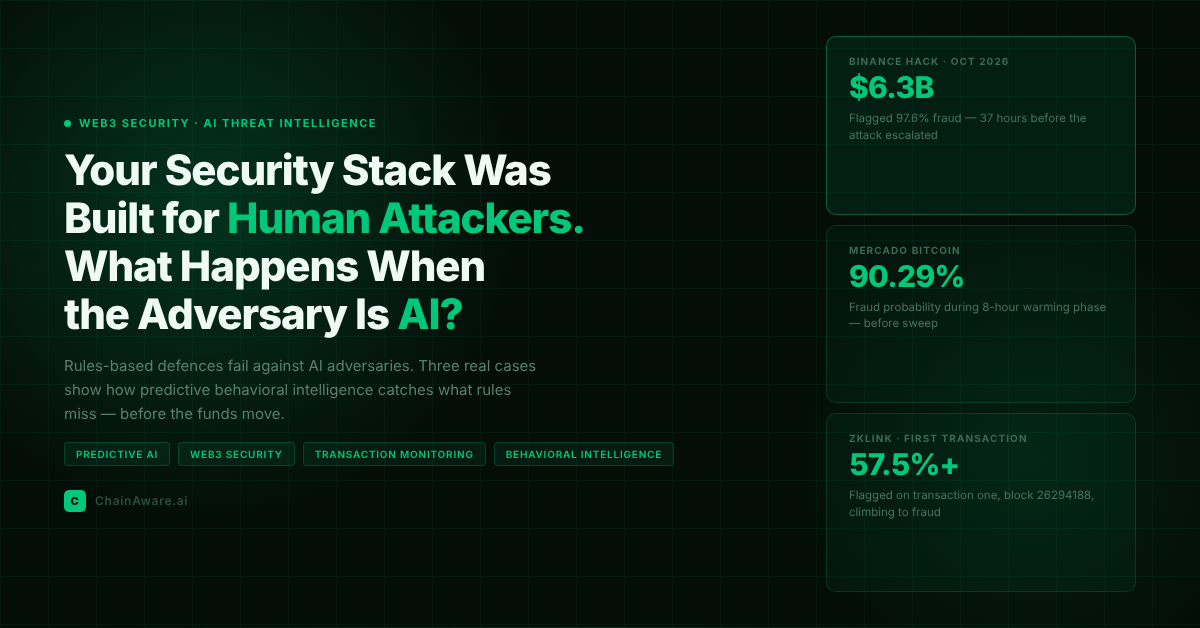
AI adversaries generate novel attack vectors at machine speed, build warming phases that evade every threshold rule, and chain hundreds of smart contract interactions in sequences no human auditor reviewed. The $6.3 billion Binance hack of October 2026 moved funds across 10 blockchains in 20 minutes. ChainAware’s predictive model had flagged the attacker wallet at 97.6% fraud confidence 37 hours earlier — at the moment of first Binance interaction. The warming phase at Mercado Bitcoin ran for eight hours; the model scored it at 90.29% fraud probability throughout. The zkLink attacker was flagged on the first transaction, block 26294188, before any exploit executed.
The spam filter analogy is exact: rule-based email filters collapsed when spammers adapted, and only statistical behavioral classifiers won. Web3 is at the same inflection point. Behavioral models learn the statistical shape of threat-actor activity and generalise to novel attacks — warming phases change the surface, not the shape. This article explains the mechanics, documents the three cases with on-chain block numbers, and sets out a practical transition roadmap from signature-based detection to pre-transfer behavioral screening.