
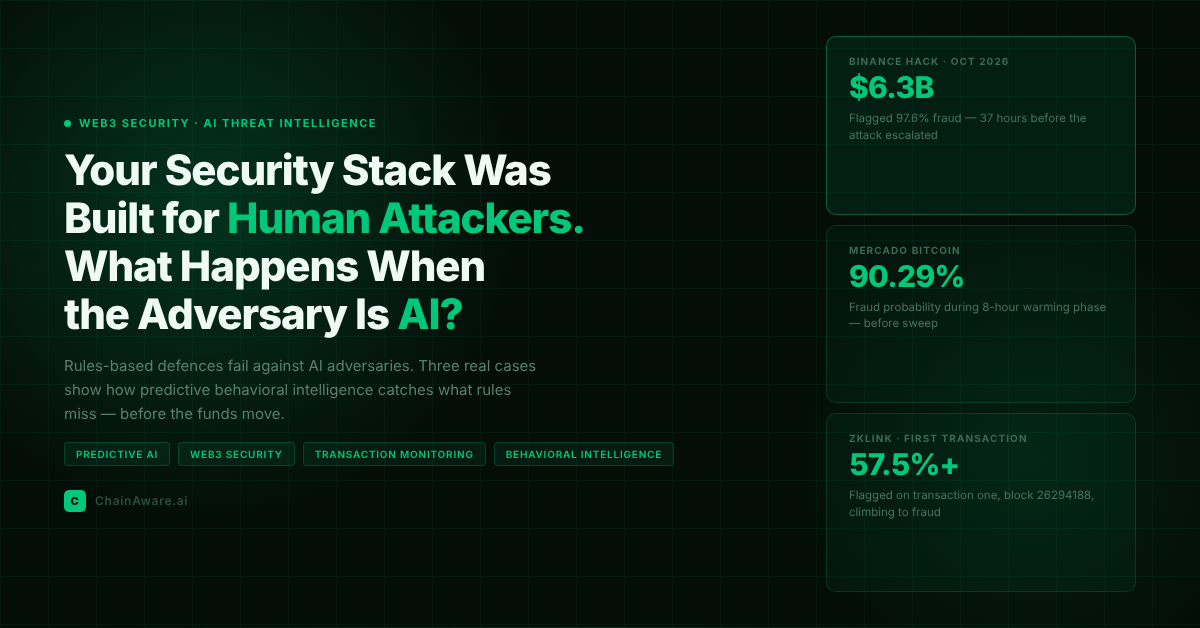
The $6.3 billion Binance hack of October 2026 was not a surprise attack. The attacker wallet had been building its operation for 37 hours. ChainAware’s predictive AI flagged that wallet as fraud – at 97.6% confidence – the moment the first Binance deposit landed. Nobody checked. This article explains why that gap exists, why it is growing, and what it takes to close it.
Security teams have spent 30 years building frameworks for a specific kind of adversary: a human being with limited time, imperfect knowledge, and cognitive constraints. NIST, OWASP, ISO 27001, smart contract audits, Web Application Firewalls – every major security framework assumes the attacker operates at human speed, exploits known vulnerability classes, and can be caught by rules written in advance. That assumption held for three decades. It no longer does.
AI adversaries do not operate at human speed. They generate billions of novel attack vectors per second. They build warming phases that look indistinguishable from legitimate activity for hours or days. They chain hundreds of smart contract interactions in sequences that no human auditor ever reviewed. They move $6.3 billion in 20 minutes across 10 blockchains. Moreover, they learn. Each failed attempt refines the next one.
The defence has not kept pace. Most security teams still rely on signatures, blocklists, threshold rules, and static audits – tools designed for human attackers. Against an AI adversary, these tools share one fatal weakness: they can only catch what they already know. AI attacks by definition produce novelty at scale. Rules cannot catch what has never been seen before.
This article makes a single argument. To fight an AI adversary, you need AI defence. It explains what that means in Web2, what it means in Web3, and how three real cases – Binance, Mercado Bitcoin, and zkLink – show what happens when predictive behavioral intelligence fires before the exploit executes.
Free Tool
Check Any Wallet Before You Transact
Paste any wallet address and get a fraud probability score, tier, and risk flags in seconds. 24.7M+ scored wallets. 8 blockchains. No signup required.
Try the Free Fraud Scorer ↗The Era That Rules-Based Security Was Built For
To understand why the current approach is failing, start with why it succeeded. Rules-based security frameworks were extraordinarily effective against the adversaries of the 1990s and 2000s. Human attackers had to research vulnerabilities manually, write exploit code by hand, and test against specific target configurations. Discovery took weeks. Development took months. Execution required specialist knowledge that existed in a small community of practitioners.
NIST’s Cybersecurity Framework, published in 2014 and updated through 2024, reflects this reality. Its five core functions – Identify, Protect, Detect, Respond, Recover – describe a cycle that assumes reasonable latency between attack stages. Identify the asset landscape. Apply protective controls. Detect anomalies against known baselines. Respond to incidents. Recover normal operations. The model works when attackers move at human speed, because human speed allows time for each stage.
Web Application Firewalls followed the same logic. A WAF maintains a ruleset of known attack signatures – SQL injection patterns, XSS payloads, path traversal strings, known malicious IP ranges. When a request matches a signature, the WAF blocks it. The model assumes that known attack patterns repeat, that the signature library covers the meaningful threat surface, and that novel attacks emerge slowly enough that the library can be updated before damage occurs.
Smart contract audits operate identically. An auditor reviews Solidity or Rust code for known vulnerability classes – reentrancy, integer overflow, access control failures, flash loan attack vectors. The audit produces a report covering everything the auditor knows to look for. Well-known vulnerability classes are caught reliably. Unknown attack paths – those requiring novel combinations of contract interactions, state changes across multiple protocols, or exploitation of emergent properties of DeFi composability – are not.
These frameworks are not broken. Against human adversaries operating at human speed with human cognitive constraints, they remain valuable. The problem is that the adversary has changed, and the frameworks have not.
The Human Adversary Model in Practice
A human attacker targeting a Web2 application in 2015 followed a predictable kill chain. Reconnaissance meant reading documentation, browsing public code repositories, and running automated scanners against the target. Weaponisation meant selecting or writing exploit code targeting specific discovered vulnerabilities. Delivery meant sending the exploit via a chosen attack vector. Exploitation meant achieving initial execution. Persistence, lateral movement, and exfiltration followed at human pace over days or weeks.
At each stage, human limitations created detectable latency. Reconnaissance produced scanner traffic patterns that IDS systems flagged. Development happened off-network, creating a gap between discovery and attack. Execution used known techniques that signature-based systems recognised. Post-exploitation activity – lateral movement, privilege escalation, data staging – generated log anomalies that SIEM systems detected over hours or days.
Rules worked because the adversary had to work within rules of their own – the rules of human cognition, human bandwidth, and the finite body of publicly known vulnerability knowledge. When the adversary no longer operates within those constraints, the defence framework built to exploit them fails.
What Changes When the Adversary Is AI
AI adversaries break every assumption that rules-based security rests on. Understanding exactly how they break each assumption is the first step toward building a defence that works.
Speed: From Days to Milliseconds
The Binance hack of October 29, 2026 moved $6.3 billion across 10 blockchains in approximately 20 minutes. Five Binance hot wallets transferred 233.46 million XRP to a single attacker-controlled address in just four minutes. By the time Binance detected the breach and halted withdrawals, most of the funds had already moved. The final unauthorised transfer arrived nearly four hours after the first – but the core heist was complete in under a quarter of an hour.
No human incident response process operates at that speed. By the time an analyst receives an alert, reviews logs, escalates to a senior responder, and authorises a response action, the attacker has already finished. Rules-based detection systems that require human review to trigger response are structurally incompatible with AI-speed attacks. The detect-to-respond cycle must be measured in milliseconds, not minutes.
Consider what that timeline actually demands. A blockchain block on Ethereum closes every 12 seconds. The attacker’s wallet was classified at 97.6% fraud confidence at block 26300753 — the moment of first Binance interaction. If a pre-transfer screening system had been in place, the following sequence would have been possible: destination wallet submitted for scoring; model returns fraud classification in under one second; transfer authorisation withheld automatically; alert fired to security team. Total human involvement required before the funds were protected: zero. That is the operational requirement for AI-speed defence. Not a faster human review process. Not a shorter escalation chain. No human in the loop at all — at least not in the first gate.
This is a structural point, not a process improvement recommendation. When an AI adversary can drain $6.3 billion in 20 minutes, the response SLA required to prevent loss is measured in seconds. No human organisation has ever operated at second-level SLAs for incident response decisions. The defence must be an AI system that makes the initial block-or-allow decision automatically, with humans reviewing flagged transactions rather than approving every individual transfer. The human role shifts from gatekeeper to auditor. The machine becomes the first gate.
Web2 security made this transition years ago in adjacent domains. Email systems do not ask a human to approve every inbound message before delivery. Spam filters run at the speed of message receipt, automatically classify, and route to the inbox or the spam folder — without human review per message. Payment networks do not ask a human to approve every card transaction before authorisation. Fraud models score every transaction in real time and approve, decline, or flag for review automatically. Web3 security is reaching the same inflection point: the transaction volume, the attack speed, and the financial stakes have all crossed the threshold where human-gated review is not viable as a first line of defence.
Novelty: Generating What Rules Have Never Seen
AI systems can generate attack vectors at scale that have never been used before. Large language models trained on vulnerability databases, protocol documentation, and historical exploit code can enumerate combinatorial attack paths across complex systems faster than any human researcher. Each generated path is novel – not a mutation of a known signature but a genuinely new approach to achieving a goal.
Signature-based detection cannot catch what it has never seen. A WAF rule that blocks SQL injection cannot block a novel prompt injection technique. A smart contract auditor reviewing code for known reentrancy patterns cannot flag a vulnerability class that did not exist when their training data was compiled. AI attackers deliberately target the edge of known vulnerability space, where defences are thin.
The Binance attack used EIP-7702 delegation at scale on Ethereum – a relatively new account abstraction mechanism that lets an ordinary account delegate execution to contract code. In a single transaction, the attacker submitted 50 authorisations signed with a compromised Binance key, one of which was valid. This created a persistent delegation that allowed the attacker to drain funds that arrived after the initial exploit. The technique worked precisely because it combined a new Ethereum feature with a compromised key in a way that no existing detection rule had anticipated.
Why Behavioral Models Generalise — and Rules Never Can
The fundamental limitation of rules is not that they are slow to update, though they are. It is that they cannot generalise. A rule encodes a specific observation: “block addresses that sent funds to Tornado Cash within the last 24 hours,” or “flag transactions above $500,000 from new wallets.” Each rule is a closed statement about a known pattern. It is true of the past cases that generated it. It says nothing about cases that look different.
A statistical behavioral model works differently. Rather than encoding specific observations as rules, it learns the latent structure of threat-actor behavior across thousands of historical cases. It learns that wallets with certain funding patterns, combined with specific interaction sequences and timing characteristics, tend to precede attacks — not because any single one of those signals is definitive, but because the combination produces a statistical signature that separates threat actors from legitimate users with 95%+ accuracy at scale. That learned structure generalises to new cases that look different on the surface but share the same underlying behavioral shape.
This is why ChainAware’s model classified the Mercado Bitcoin attacker at 90.29% fraud probability during an eight-hour warming phase of small, individually normal-looking transactions. No rule would have fired. The individual transactions were unremarkable. The behavioral signature of the entire sequence — funding source, timing intervals, transaction type distribution, interaction target profile — matched the statistical shape of wallets that had executed attacks in the past. The model had never seen that specific wallet before. However, it had seen thousands of wallets with similar behavioral signatures, and it knew what they went on to do.
The analogy to spam filtering is exact and instructive. In the late 1990s, email spam filtering was entirely rule-based. Rules blocked messages containing certain words (“Viagra,” “casino,” “FREE MONEY”), from known spam IP ranges, or matching header patterns associated with bulk senders. For several years this worked acceptably. Then spammers adapted. They introduced misspellings (“V1agra”), rotated sending infrastructure, and generated novel message text that no existing rule matched. The spam rate climbed. By the mid-2000s, rule-based spam filters were failing badly — false negative rates were high, and the arms race of rule updates versus evasion adaptations was clearly going in the wrong direction.
The transition that fixed email spam was the same transition that Web3 security now needs. Bayesian and machine learning classifiers replaced rule lists as the primary filter. Instead of asking “does this message contain a known spam phrase?”, the model asked “does this message exhibit the statistical properties of spam messages, as learned from millions of training examples?” The answer to that question generalises to novel messages that have never been seen before, because statistical patterns are robust to surface-level variation in a way that rules are not. A new evasion technique that works against rules fails against a model trained on the underlying behavioral structure — because the structure persists even when the surface changes.
Web3 is at exactly the same inflection point that email was in 2004. Rule-based systems are increasingly failing against adversaries — both human and AI — who understand how the rules work and design around them. The warming phase is the crypto equivalent of the spam misspelling: a deliberate adaptation to known rule-based detection logic. Behavioral models that learn the statistical shape of threat-actor activity are not evadable by warming phases, because warming phases do not change the underlying behavioral signature. They change the surface. The shape stays the same.
Scale: Operating Across Hundreds of Contracts Simultaneously
DeFi’s composability – the ability for smart contracts to call other smart contracts – is its greatest technical strength and its most dangerous attack surface. An AI adversary can enumerate the entire interaction graph of a DeFi ecosystem, model the state changes produced by sequences of transactions across multiple protocols, and identify attack paths that traverse dozens or hundreds of contract boundaries. No human auditor can manually review every possible multi-contract interaction sequence across a live ecosystem.
Flash loan attacks are the clearest illustration of this dynamic. A flash loan attack borrows an enormous sum within a single transaction block, uses that capital to manipulate price oracles or liquidity pools across multiple protocols simultaneously, extracts profit from the resulting price discrepancies, and repays the loan before the block closes – all in a single atomic transaction. The attack exists entirely within a space that static code review cannot see, because the vulnerability is not in any individual contract but in the emergent behavior of the entire system under unusual capital conditions.
Evasion: The Warming Phase as Deliberate Deception
Perhaps the most dangerous capability of AI adversaries is systematic evasion of threshold-based detection. Human attackers evade detection through operational security practices – using VPNs, rotating infrastructure, timing attacks to avoid monitoring windows. AI attackers evade detection by understanding how detection systems work and generating behaviour that stays below every detection threshold.
The warming phase is the clearest example. The Binance attacker’s operator wallet received three small withdrawals from Tornado Cash starting the morning of October 28 – 36 hours before the theft. These transactions served two purposes. They funded the operator wallet with enough gas to execute the attack. They also began building a transaction history that made the wallet look less suspicious. Small transactions, normal-looking activity, gradual history accumulation – the goal is to stay below the threshold of rule-based detection long enough to position for the real attack.
Mercado Bitcoin’s attacker ran an eight-hour warming phase, generating a clean-looking history through small transactions and a contract deployment. Standard threshold rules – which ask “has this address been seen before?” or “is this transaction amount above a suspicious threshold?” – would not flag a wallet in its first hours of operation executing small, normal-looking transfers. The pattern that makes the wallet suspicious is not any individual transaction but the behavioral shape of the whole sequence.
Why Web2 Security Must Make the Same Transition
Web2 security teams are facing the same adversary upgrade, arriving through different channels. AI-powered offensive tools now automate every stage of the traditional attack kill chain at speeds and scales that invalidate rules-based defences.
AI-Generated Vulnerability Discovery
Fuzzing – the technique of sending malformed or unexpected inputs to a system to discover crashes or unexpected behavior – has been automated for decades. AI-powered fuzzing changes the equation entirely. Where traditional fuzzers generate random or mutation-based inputs, AI fuzzers use large language models trained on vulnerability databases, source code, and protocol specifications to generate semantically meaningful inputs that are far more likely to trigger vulnerabilities.
Google’s Project Zero team has documented cases where AI-assisted fuzzing discovered vulnerabilities in widely deployed software within hours that manual review had missed for years. The implication for defenders is severe: vulnerability discovery now happens faster than patch deployment cycles. A WAF that relies on signatures for known vulnerability classes is permanently behind the curve against an adversary using AI-assisted discovery to generate unknown vulnerability classes on demand.
LLM-Driven Social Engineering at Scale
The Binance hack began with social engineering. Hackers used a bogus job interview and software hidden in an advertisement to compromise the computers of two Binance software engineers. This is not a novel attack vector – spearphishing via fake job opportunities has been a North Korean hacking signature since at least 2019. What AI changes is the scale and sophistication at which such campaigns can be deployed.
An AI system can generate thousands of personalised, contextually accurate spearphishing communications simultaneously. It can scrape LinkedIn, GitHub, and company websites to identify employees with the right access levels. It can generate fake interview questions, technical assessments, and onboarding materials that are indistinguishable from legitimate employer communications. It can conduct extended back-and-forth communication that builds rapport before delivering the malicious payload.
Email filtering rules, anti-phishing training, and human judgment are collectively insufficient against AI-generated social engineering campaigns that adapt to every individual target. The defence must move from “can a human recognise this as suspicious?” to “does this communication pattern exhibit behavioral indicators inconsistent with legitimate employer contact?”
Automated Exploit Chain Construction
AI systems can now chain together multiple individually low-severity vulnerabilities into end-to-end exploit paths that achieve high-impact outcomes. Where a human penetration tester might identify a SQL injection vulnerability and an SSRF vulnerability as separate findings, an AI system can model how those two vulnerabilities can be chained – using the SQL injection to extract internal network topology, then using the SSRF to pivot to internal systems, then using discovered credentials to escalate privileges.
NIST’s vulnerability scoring system (CVSS) rates individual vulnerabilities in isolation. Chained exploits routinely achieve effective impact scores far higher than the sum of their components. Rules that look for known attack signatures cannot catch dynamically assembled exploit chains, because the chain itself is novel even when each component is known. AI-powered attack systems deliberately construct chains that evade detection at every individual step while achieving objectives that any single step could not.
The defence transition required is from signature matching to behavioral anomaly detection. Not “does this request match a known attack pattern?” but “does this sequence of requests exhibit behavioral characteristics consistent with an attacker building toward a goal?” That question requires machine learning models that have been trained on the behavioral signatures of attack preparation – not human-written rules that describe what attacks have looked like in the past. According to NIST’s Cybersecurity Framework documentation, the latest revisions increasingly emphasise continuous monitoring and adaptive response – acknowledging that static rule sets are insufficient against evolving threats.
Book a Demo
See Predictive Fraud Detection Applied to Your Protocol
Walk through how ChainAware’s behavioral intelligence would have flagged the Binance, Mercado Bitcoin, and zkLink attackers – and how it integrates with your own transaction flow.
Book a ChainAware Demo ↗Web3’s Specific Vulnerability to AI Adversaries
Web3 combines the AI adversary problem with structural features that make it uniquely dangerous. Transactions are irreversible. Smart contract code is public. The attack surface expands with every new protocol integration. And the financial stakes are measured in billions, not millions.
The Composability Attack Surface
DeFi’s composability creates an attack surface of combinatorial complexity. Any smart contract that calls other contracts can be used as a component in an attack chain. Any protocol that reads an on-chain price oracle can be manipulated if the oracle can be moved. Any protocol that trusts the balance of another token contract can be drained if that balance can be artificially inflated within a single transaction block.
An AI system can enumerate the full interaction graph of a DeFi ecosystem – every contract, every public function, every trust relationship – and model the state changes produced by arbitrary transaction sequences. This is not a hypothetical capability. It is exactly what AI-assisted smart contract auditing tools now do on the defensive side. The same capability deployed offensively generates novel attack paths at a rate that defensive auditing cannot match.
Static smart contract audits review code that has already been written. They cannot audit the system state that emerges when multiple protocols interact under conditions that did not exist when each individual contract was reviewed. AI adversaries specifically target this gap – the space between individually audited contracts and the emergent behavior of their interactions. For a detailed analysis of how existing Web3 security systems compare against AI-generated threats, see our Web3 Trust Verification Systems guide.
Irreversibility and the Prevention Imperative
Web2 security breaches are damaging, but they are frequently reversible. Stolen credentials can be invalidated. Compromised systems can be reimaged. Exfiltrated data, while serious, often cannot be immediately monetised without additional steps that create intervention opportunities. Recovery is difficult but possible.
Blockchain transactions are irreversible by design. Once funds leave a hot wallet to an attacker-controlled address, they are gone. Tether and Circle froze approximately $3 billion of the $6.3 billion stolen from Binance – but only because the stablecoin issuers acted within hours and because a significant portion of the stolen assets were stablecoins subject to issuer control. The $3.3 billion that was not frozen remains with the attacker. Binance covered losses from its SAFU fund and company reserves – an option available to the world’s largest exchange but not to most DeFi protocols.
This irreversibility makes prevention the only viable strategy in Web3. Detection after exploitation produces a forensic report, not asset recovery. The defence must fire before the transaction executes. As our guide to Web3 fraud detection for DApps explains, screening wallets before they interact beats simulating transactions after the fact – because after the fact, the funds are already gone.
Public Code as a Research Resource for Attackers
Smart contract code is public by necessity – deployed on public blockchains and verifiable by anyone. This transparency serves legitimate purposes: users and auditors can inspect exactly what they are interacting with, without trusting claims made by the protocol team. However, the same transparency that enables trust also enables adversarial research at scale.
An AI system can continuously monitor every contract deployment on every major chain, automatically decompile and analyse deployed bytecode, compare new contracts against known vulnerability patterns, and identify novel attack paths in newly deployed code faster than any human audit team. Protocol launches are particularly vulnerable: the period between deployment and widespread use is when the gap between AI-speed analysis and human-speed auditing is widest.
The EIP-7702 Vector: New Mechanics, New Attack Surface
The Binance hack’s most technically novel element was its use of EIP-7702, the Ethereum improvement that allows ordinary accounts to delegate execution to contract code. EIP-7702 enables legitimate use cases: account abstraction, gas sponsorship, transaction batching. It also creates a new attack surface that did not exist before the upgrade.
By submitting a single transaction containing 50 authorisations signed with a compromised key, the attacker created a persistent delegation that allowed continued draining of funds as they arrived in the compromised wallet – even after the initial exploit. Standard security monitoring that watches for large outflows would catch the first sweep; it would not catch the continuing delegation that harvested subsequent deposits. The EIP-7702_DELEGATED flag in ChainAware’s Agent Trust Score specifically tracks this pattern, as the ERC-8004 trust signals article explains in depth. New Ethereum mechanics create new attack surfaces at a rate that rules libraries cannot match, because rules require time to write after the technique has been observed.
The Two-Layer Defence Framework
Against AI adversaries in Web3, two layers of defence are necessary. Neither is sufficient alone. Together, they create a framework that matches the speed, novelty, and behavioral sophistication of AI-driven attacks.
Layer One: Structural Limits on Exposure
The first layer reduces the maximum possible loss from any single exploit. Hot wallet limits, withdrawal velocity caps, multi-signature requirements for large transfers, and circuit breakers that pause withdrawals when anomalous outflow patterns are detected all serve this function. These controls do not prevent attacks, but they limit their scale.
The Mercado Bitcoin case illustrates the value of this layer. The attacker’s wallet held 106 BTC in a hot wallet, with less than 25% moving daily – poor risk management that allowed the full balance to be swept in a single transaction. Tighter hot wallet limits would not have prevented the attack, but they would have reduced the loss. The LinkedIn analysis of the Mercado Bitcoin case noted: “Hot wallet limits matter – 106 BTC in hot wallet with less than 25% of it moving daily was poor risk management. But even with tighter limits, the funds still go somewhere. Transaction Monitoring verifies where funds go before the transfer is authorised.”
Structural limits are necessary but not sufficient. They reduce exposure when defences fail. They do not prevent the attack from succeeding against whatever exposure remains within the limits.
Layer Two: Predictive Behavioral Screening Before Transfer Authorisation
The second layer answers the question that rules cannot: does this address behave like a threat actor? Not “is this address on a list?” but “does the behavioral pattern of this wallet – its funding source, its activity history, its relationship to known fraud operators – match the behavioral signature of wallets that have executed attacks?”
This layer requires machine learning models trained on the behavioral signatures of fraudulent addresses. Specifically, it requires models that can detect threat-actor behavior during the preparation phase – before the attack executes – because in Web3, post-execution detection produces forensics, not prevention.
The key operational insight is that transaction monitoring must fire before the transfer is authorised, not after. Web2’s equivalent is anomaly-based intrusion detection that blocks suspicious requests before they reach the application layer. Web3’s equivalent is behavioral scoring of destination wallets before a hot wallet authorises an outbound transfer. If the destination wallet scores above a fraud probability threshold, the transfer is held for review. The attacker’s wallet is flagged. The funds do not move.
This is not a theoretical capability. It is what ChainAware’s models did – in real time – for Binance, Mercado Bitcoin, and zkLink. The question is not whether the technology works. The question is why it was not deployed in the transaction path.
Free Tool
Score Any Wallet Before Your Protocol Interacts With It
ChainAware’s Agent Trust Score gives you a 0-1,000 behavioral risk score, tier, and named flags for any ERC-8004 agent or wallet. Free tier: 1,000 queries per month, no signup.
Open the Free Agent Trust Score ↗Three Cases: Predictive Intelligence in Practice
The following three cases are not retrospective analysis designed to make a point. They are documented real-time outputs from ChainAware’s predictive fraud models, applied to real attacker wallets at the moment they became active. Each case demonstrates a different aspect of how behavioral intelligence catches what rules miss.
Case One: The Binance Hack – $6.3B, 37 Hours of Warning
On October 29, 2026, the largest cryptocurrency theft in history drained $6.3 billion from Binance across 10 blockchains in approximately 20 minutes. TRM Labs, Chainalysis, and multiple blockchain intelligence firms produced detailed forensic reports in the days that followed. Those reports documented exactly where every dollar went. They were published after the funds had moved.
ChainAware’s models were watching the attacker’s wallet in real time throughout its preparation. The table below shows what the system recorded at each key event:
| Event | Block | End Block | Status | Fraud Probability |
|---|---|---|---|---|
| 1st Tornado Cash withdrawal | 26289786 | 26289787 | New Address | – |
| 2nd Tornado Cash withdrawal | 26290156 | 26290157 | New Address | – |
| 3rd Tornado Cash withdrawal | 26297174 | 26297175 | New Address | – |
| 1st Binance deposit | 26300753 | 26300754 | Fraud | 97.6% |
| 2nd Binance deposit | 26300770 | 26300771 | Fraud | 97.7% |
| NETIZEN | 26301908 | 26301909 | Fraud | 99.7% |
Three observations stand out. First, the Tornado Cash withdrawals alone were not sufficient to trigger a fraud classification – a new address receiving funds from a mixer is suspicious but not conclusive. Second, the moment the first Binance deposit landed, the model reclassified the wallet as Fraud at 97.6% confidence. The behavioral context – Tornado Cash funding followed by an interaction with a major exchange wallet – matched the pattern of wallets that had executed previous attacks. Third, within two more blocks the confidence reached 97.7%, and by the NETIZEN interaction it had reached 99.7%.
The first Binance deposit occurred at block 26300753. The actual theft did not escalate until approximately 37 hours later. If Binance’s transaction monitoring had been configured to screen destination wallets for behavioral fraud scores before authorising outbound transfers – and if any transfer to a wallet scoring above 95% fraud probability had been held for review – the system would have caught the attacker wallet 37 hours before the funds moved.
ChainAware posted this analysis publicly on X: x.com/ChainAware/status/2116156584980287619. The documentation is on-chain and verifiable – block numbers, transaction hashes, timestamps. This is not a claim about what the model might have done. It is a record of what it did.
Case Two: zkLink – $786K, Flagged on Transaction One
On October 29, 2026 – the same day as the Binance hack – attackers exploited zkLink Nova’s L1 escrow by injecting a forged batch root on Ethereum through a public relayer, then finalised withdrawals to attacker-controlled wallets. The loss was $786,000 – not $6.3 billion, but $786,000 is real money, and the attack pattern was structurally identical to the Binance hack at a smaller scale.
ChainAware flagged the attacker’s wallet as fraud after the very first transaction – a 22.43 ETH internal transfer at block 26294188. At that moment, the fraud probability score was 57.5% and climbing. Everything that followed was tagged as FRAUD at increasing confidence levels.
The key insight from the zkLink case is different from the Binance case. At Binance, the signal emerged after the third Tornado Cash withdrawal combined with the first Binance deposit – a combination of funding source and interaction target that produced a high-confidence classification. At zkLink, the signal emerged from the very first transaction – because the behavioral signature of the wallet’s initial activity matched the pattern of threat-actor wallets at the moment of first on-chain appearance.
Every hack has a first transaction. That is where prevention happens. A transaction monitoring system that screens destination wallets before authorising transfers, using a model that can flag suspicious wallets from their first on-chain appearance, would have held the zkLink withdrawal for review. The forged batch root would have attempted to execute; the transfer authorisation to the attacker wallet would not have cleared.
Full documentation is available on X: x.com/ChainAware/status/2116652433464242509.
Case Three: Mercado Bitcoin – $36.3M and the Eight-Hour Warming Phase
The Mercado Bitcoin case demonstrates the most sophisticated evasion technique in the AI adversary toolkit: the deliberate construction of a clean-looking behavioral history before executing the attack. The attacker’s wallet spent eight hours building transaction history – small transfers, a contract deployment, normal-looking activity – designed specifically to stay below the threshold of rule-based detection.
Standard rule-based systems ask predictable questions. Is this address on a blocklist? Have we seen this address before? Is this transaction amount above a suspicious threshold? Is this address associated with a known scam? An address in its first hours of operation, executing small transactions and deploying contracts, answers no to every one of those questions. It looks normal. That appearance of normality is the attack.
ChainAware’s behavioral model asks a different question: does this address behave like a threat actor? The answer does not depend on whether the address has been seen before, or whether it appears on a list, or whether any individual transaction is above a suspicious threshold. The answer depends on whether the behavioral signature of the entire activity sequence – funding source, timing patterns, transaction types, interaction targets – matches the behavioral profile of wallets that have executed attacks in the past.
During the eight-hour warming phase, ChainAware flagged the attacker’s wallet at 90.29% fraud probability. The warming phase was an active evasion of rules-based detection. It did not evade behavioral detection, because behavioral patterns cannot be faked by simply executing a sufficient number of normal-looking transactions. The model read the shape of the preparation, not just the content of individual transactions.
Full documentation: x.com/ChainAware/status/2118396298504118662.
What These Three Cases Prove
Three different attacks. Three different protocols. Three different loss scales. The same predictive model flagged all three – before or during the exploit preparation phase, not after the funds moved. The cases are not cherry-picked successes from a larger sample of mixed results. They are three consecutive major hacks, all occurring within days of each other, all caught by the same behavioral intelligence system running in real time.
Chainalysis, TRM Labs, and Elliptic produced excellent post-incident forensic analysis of all three cases. Their reports documented where the money went, reconstructed the attack path, and attributed the Binance hack to North Korea’s TraderTraitor group with high confidence. That work is valuable for law enforcement, regulatory compliance, and security research. It does not recover funds. It does not prevent the next attack. Forensic tools document what happened. Predictive tools stop it before it happens. For a detailed comparison of the two approaches, see our forensic versus AI-based crypto analytics guide.
Book a Demo
Add Predictive Screening to Your Transaction Flow
Talk to the ChainAware team about deploying behavioral fraud scoring before transfer authorisation in your protocol. Bring your architecture and leave with an integration plan.
Schedule a ChainAware Demo ↗Forensic vs Predictive: The Category Distinction That Decides Losses
The most important conceptual shift in Web3 security is the transition from forensic tools to predictive tools. Understanding the difference is not a technical question – it is a strategic one that determines whether a security investment produces post-incident documentation or pre-incident prevention.
What Forensic Tools Do
Forensic blockchain intelligence tools – Chainalysis, TRM Labs, Elliptic, Nansen’s investigation features – are built around a specific problem: reconstructing what happened after funds have moved. They maintain databases of entity labels, clustering algorithms that group addresses likely controlled by the same party, and transaction graph tools that trace fund flows across multiple hops and chains.
These tools are genuinely excellent at what they do. The forensic reconstruction of the Binance hack published by TRM Labs identified the full attack path, traced funds across multiple chains and mixing services, and produced attribution evidence strong enough for the FBI to publicly name North Korea’s TraderTraitor group as responsible. That work represents thousands of hours of model training, database building, and analytical refinement. It is indispensable for law enforcement investigations and regulatory compliance reporting.
Forensic tools share one structural limitation: they operate on the past. They answer “where did this money come from?” and “where did it go?” They cannot answer “is this wallet about to execute an attack?” They produce reports, not interventions. In an asset class where transactions are irreversible and attacks complete in minutes, reports produced after the event have no bearing on the financial outcome.
What Predictive Tools Do
Predictive behavioral intelligence tools operate on a fundamentally different model. Rather than tracing what has happened, they estimate the probability of what will happen next. They train machine learning models on the behavioral signatures of fraudulent wallets – funding patterns, activity sequences, interaction histories, relationship networks – and use those models to score new wallets in real time.
The critical difference is not technical but operational. A forensic tool is consulted after an incident to understand what happened. A predictive tool is embedded in the transaction path to intercept transactions before they execute. The former produces intelligence. The latter produces prevention.
ChainAware’s fraud detection model has been trained on 24.7 million scored wallets across 8 blockchains. Its per-address fraud accuracy is 95%, validated against the public CryptoScamDB database that anyone can inspect at chainaware.ai/scam-db. Its rug pull model predicted 90.1% of rug pulls before they completed in a documented PancakeSwap test on the rug pull verification page. These numbers matter not because they are impressive statistics but because they determine whether the model is useful in a real transaction screening context. A model that is 95% accurate at scale, running in real time, embedded in the transfer authorisation path, would have flagged the Binance, Mercado Bitcoin, and zkLink attacker wallets before the funds moved.
The Operational Integration Question
The transition from forensic to predictive is not purely a tool selection question. It is an architectural question about where in the transaction flow intelligence is applied. For exchange and protocol security teams, the relevant question is: at what point in the transfer authorisation process does a behavioral score get checked?
Three integration points exist. First, pre-onboarding screening evaluates every wallet that attempts to register, connect, or receive funds from a new address. Second, pre-transfer authorisation screening evaluates every destination wallet before an outbound transfer is signed. Third, continuous monitoring tracks changes in the behavioral scores of counterparties the protocol has existing relationships with.
All three are valuable. Pre-transfer authorisation is the most critical for preventing hacks of the Binance scale, because the attack requires a transfer from the exchange’s hot wallets to the attacker’s wallet. If that transfer is screened against a behavioral fraud model before the signing key is used, an attacker wallet scoring at 97.6% fraud probability would trigger a hold. The funds would not move. ChainAware’s fraud detection API supports all three integration patterns. The Prediction MCP exposes the same behavioral intelligence to AI agents, allowing automated screening that runs at machine speed without human review for every individual transfer.
The Agentic Connection: When the Attacker Is an AI Agent
The three cases above involve human-directed AI attacks – North Korean operators using AI-assisted tools to plan and execute sophisticated exploits. The next phase of AI adversarial threats involves fully autonomous agents executing attacks without human direction at every step.
AI Agents as Attack Infrastructure
AI agents – autonomous software systems that pursue goals by planning and executing sequences of actions – are increasingly capable of operating across the full attack kill chain independently. An attack agent can monitor DeFi protocol deployments for new vulnerabilities, generate exploit code when a vulnerable pattern is detected, construct the multi-contract transaction sequence required to exploit it, and execute the attack – all without human intervention at each step.
This capability already exists in research settings. AI systems have been demonstrated to autonomously discover and exploit vulnerabilities in test environments. The transition to production deployment against real protocols is not a question of whether the technology exists but of when adversarial actors choose to deploy it at scale. As our guide to the Web3 agentic economy explains, AI agents are already managing DeFi positions, executing trades, and operating protocol infrastructure. The same architectural patterns that enable legitimate agent activity also enable adversarial agent activity.
The ERC-8004 Attack Surface
ERC-8004, the Ethereum standard for on-chain agent identity, creates a new attack surface specifically designed for the agentic threat. By Week 41 of 2026, ChainAware’s index held 568,590 registered ERC-8004 agents. At launch analysis, 51.8% of 274,792 indexed agents sat in the Elevated Risk or Untrusted tiers. 21.1% carried the FARM_DETECTED flag. 741 agents were funded by confirmed rug pull operators.
These are not registration anomalies. They are behavioral signatures of coordinated adversarial activity using the agent registry as infrastructure. Farms of cheap agents can be deployed to claim incentives, manufacture reputation, execute coordinated attacks across multiple protocols simultaneously, and conduct reconnaissance that is indistinguishable from legitimate agent activity at the individual agent level.
Defending against agentic attacks requires the same behavioral intelligence approach as defending against human-directed AI attacks, applied at the agent level rather than the wallet level. The Know Your Agent (KYA) framework that ChainAware has developed applies behavioral scoring to ERC-8004 agents – owner wallet fraud probability, feeder funding chain, creator rug pull and honeypot history, and fleet-level farm detection. The same principle applies: rules ask “is this agent registered?”. Behavioral intelligence asks “does this agent behave like a threat actor?”
For teams that interact with AI agents – whether as counterparties in DeFi, as checkout agents in commerce, or as participants in governance – screening agents before granting access is the same imperative as screening wallets before authorising transfers. The agentic commerce fraud guide covers how this applies to payment flows specifically, and the KYA vs agent identity article explains why registration is not sufficient.
Machine-to-Machine Trust at AI Speed
When both attacker and defender operate at machine speed, the trust verification layer must also operate at machine speed. A human compliance analyst reviewing a suspicious transfer cannot operate in the millisecond window between a DeFi transaction being submitted and being included in a block. The defence must be automated, embedded in the transaction path, and capable of making a risk decision in the same timeframe as the attack.
This is exactly what the Prediction MCP enables. An AI agent operating a protocol’s compliance function can call ChainAware’s behavioral intelligence through the MCP, receive a fraud probability score and tier classification for any wallet or agent address, and make a block-or-allow decision in real time – without human intervention, without introducing meaningful latency, and with 95%+ accuracy across 24.7 million scored addresses. For a full architecture of how AI agents can conduct compliance screening autonomously, see the autonomous compliance screening use case guide.
Free Tool
Check Any Agent or Wallet in Seconds
The Agent Trust Score tool gives you instant behavioral risk scoring for any ERC-8004 agent or wallet address. See the tier, the fraud probability, and the named risk flags. Free, no signup, 1,000 queries per month.
Check an Agent Now – Free ↗What Security Teams Should Do: A Practical Transition Roadmap
The transition from rules-based to behavioral security is not a single product purchase. It is an architectural shift in how security controls are positioned relative to the transaction flow. The roadmap below applies to DeFi protocols, centralised exchanges, and any Web3 platform that handles user funds.
Step One: Audit Your Current Detection Architecture
Map every point in your transaction flow where a security decision is made. For each decision point, identify whether the control is signature-based (blocklist, threshold rule, known vulnerability pattern) or behavioral (ML model, anomaly detection, pattern matching against fraud signatures). Most teams discover that their entire detection architecture is signature-based. That discovery is the starting point for the transition.
Specifically, identify where in your authorisation flow outbound transfers are signed. This is the highest-value integration point for pre-transfer behavioral screening. If no behavioral check exists at this point, every outbound transfer to an attacker-controlled wallet is authorised without any fraud signal having been evaluated.
Step Two: Implement Pre-Transfer Behavioral Screening
Add behavioral fraud scoring to the transfer authorisation path. Before any outbound transfer is signed by a hot wallet, the destination address should be scored against a behavioral fraud model. Transfers to addresses scoring above a risk threshold should be held for review; transfers above a higher threshold should be automatically declined pending investigation.
The ChainAware fraud detection API integrates at this point with a single API call per transfer destination. The call returns a fraud probability score, a tier classification, and named risk flags (FEEDER_UNKNOWN, FEEDER_RUG_HISTORY, FARM_DETECTED, CREATOR_RUG_HISTORY) that explain the score. For high-volume contexts where API latency would affect throughput, the Prediction MCP provides the same scoring interface optimised for agent-to-agent and machine-to-machine use cases.
Set initial thresholds conservatively. A fraud probability above 80% holds the transfer for human review; above 95% triggers an automatic decline and an alert. Tune thresholds based on your false-positive tolerance and the value of transfers being screened. Higher-value transfers deserve lower thresholds; routine small transfers can tolerate higher thresholds to reduce friction.
Step Three: Add Hot Wallet Structural Limits
Implement the structural exposure limits discussed in the two-layer framework. Set maximum hot wallet balances appropriate to operational requirements – no more than is needed for the expected transaction volume in a defined time window. Implement velocity limits on outbound transfers that require additional authorisation steps for transfers above a threshold. Add circuit breakers that pause all transfers and trigger an alert when cumulative outbound volume in a defined window exceeds a threshold.
These controls do not stop attacks. They limit the maximum loss when an attack succeeds despite the behavioral screening layer. The goal is to ensure that no single exploit – whether a compromised key, a novel contract vulnerability, or a successful social engineering campaign – can drain more than a defined maximum before circuit breakers engage.
Step Four: Deploy Continuous Counterparty Monitoring
Static screening at the moment of first interaction is necessary but not sufficient. Counterparty behavioral profiles change over time. A wallet that scored clean at initial onboarding may develop risk indicators weeks later – new funding from a suspicious source, farm detection as it registers multiple agents, association with an emerging fraud cluster.
Continuous monitoring re-scores counterparties on a defined schedule and triggers alerts when scores change materially. Any wallet or agent that your protocol has an existing relationship with – registered users, recurring counterparties, integrated protocols – should be re-scored regularly. For compliance-critical contexts, the ChainAware Investigation tool produces structured seven-section forensic reports on demand, covering identity, activity, counterparties, risk assessment, AML exposure, and circular flow analysis. For the operational context of compliance screening in DeFi, see our DeFi compliance guide.
Step Five: Extend Screening to Agent Interactions
If your protocol accepts interactions from AI agents – either directly through smart contract calls or through API-layer integrations – apply the same behavioral screening framework to agent addresses as to wallet addresses. Use ChainAware’s Agent Trust Score to evaluate ERC-8004 registered agents before granting access. Set tier-based access policies: Sovereign and Trusted tier agents receive standard access; Provisional tier agents receive limited access with monitoring; Elevated Risk and Untrusted tier agents are declined or held for review.
Aggregate limits by operator, not by individual agent. Farm attacks specifically exploit per-agent limits by distributing activity across many low-activity agents controlled by a single operator. Tracking shared funding sources and registration patterns allows operator-level aggregation that closes this loophole. The ERC-8004 agent fraud patterns guide documents the specific patterns to watch for in agent traffic, including concentration bursts, persistent farms, and untraceable funding trends.
Aligning Your Security Architecture With Regulatory Requirements
Beyond the operational security imperative, predictive behavioral screening aligns with the direction of regulatory requirements in ways that pure forensic tools do not.
FATF and the Real-Time Screening Mandate
The Financial Action Task Force’s guidance on virtual assets requires Virtual Asset Service Providers to implement risk-based transaction monitoring that can identify and report suspicious activity. FATF’s recommendations do not prescribe specific technology, but their intent is clear: monitoring should identify suspicious transactions before or at the moment they occur, not days later when forensic analysis is complete.
MiCA, the EU’s Markets in Crypto-Assets Regulation, imposes similar requirements on crypto-asset service providers operating in Europe. Transaction monitoring that fires after funds have moved does not satisfy the spirit of regulations that require proactive risk management. Behavioral screening embedded in the transfer authorisation path satisfies both the letter and the spirit of FATF and MiCA requirements in a way that post-incident forensics cannot. For teams building MiCA-compliant transaction monitoring, our DeFi compliance tools comparison provides a detailed framework.
OFAC Sanctions Screening in Real Time
The OFAC sanctions list service maintained by the U.S. Treasury requires that covered entities screen transactions against sanctioned addresses before execution. Blockchain transactions to sanctioned addresses are themselves sanctions violations, regardless of whether the VASP knew the address was sanctioned at the time of transfer.
ChainAware’s behavioral scoring incorporates OFAC screening alongside predictive fraud scoring – so a single pre-transfer API call returns both the behavioral fraud probability and any sanctions exposure. Teams do not need to maintain separate integrations for predictive fraud and sanctions compliance. The autonomous compliance screening use case documents how both capabilities can be deployed together in an automated screening pipeline.
Evidence Standards for Incident Response
When an attack occurs despite screening – as it sometimes will – teams that have been running behavioral monitoring have a significant advantage in incident response. Pre-transfer screening logs capture the behavioral state of destination wallets at the moment of each transfer authorisation. If an attacker wallet evaded detection at transfer time, the logs show exactly what the model scored and why.
This evidence is valuable in regulatory investigations, insurance claims, and legal proceedings. It demonstrates that the team exercised reasonable care in transaction screening. It identifies precisely when and how the attacker’s behavioral profile changed. It supports post-incident forensic analysis by providing a time-stamped behavioral record that complements the on-chain transaction record. The ChainAware Investigation tool produces structured AML reports that satisfy regulatory evidence requirements in a form that compliance teams and law enforcement can act on.
The Port Filtering Analogy: Why Every Channel Needs AI Defence
Web2 security teams are familiar with port filtering – the practice of closing network ports that do not need to be open, restricting traffic to and from known sources, and monitoring traffic on open ports for anomalous patterns. Port filtering is not a complete security solution, but it represents the right architectural principle: limit the attack surface, monitor what crosses it, and block anomalous traffic before it reaches the application layer.
Transaction monitoring is the Web3 equivalent of port filtering. Every channel through which value can flow into or out of a protocol is a “port” that needs to be monitored. Hot wallet outflows are the highest-value channel. Protocol smart contract interactions are another. Agent API endpoints are a third. Each channel deserves behavioral monitoring that screens traffic against fraud signatures before it completes.
The Web2 analogy goes further. Modern Web2 security has largely moved from signature-based IDS to behavioral anomaly detection – systems that learn what normal traffic looks like for a specific application and flag deviations, rather than checking traffic against a list of known attack signatures. This transition happened because AI-assisted attackers generate novel attack patterns faster than signature libraries can be updated. The same transition is now necessary in Web3, for the same reason.
Web3’s specific challenge is that the “ports” are on-chain – visible to everyone, accessible to anyone with gas, and irreversible once traffic completes. The monitoring layer must be embedded in the authorisation path, not in a network layer that can intercept and inspect traffic before forwarding. That architectural difference makes the pre-authorisation screening model uniquely important in Web3 security. For a detailed examination of how behavioral intelligence applies across Web3 trust verification contexts, see our comprehensive Web3 trust verification systems guide.
The Proof Point: 24.7 Million Wallets, 95% Accuracy, Verifiable
Claims about predictive AI security need to be verifiable, not just asserted. ChainAware provides two independent verification mechanisms for its fraud detection accuracy.
ScamDB: Public Validation Against Independent Data
CryptoScamDB maintains a public database of confirmed fraudulent addresses across multiple chains, contributed by independent security researchers, exchange compliance teams, and community reporters. ChainAware validates its fraud model accuracy against this external database – not against its own training data. The result is a 95% accuracy figure that can be independently verified by any team that runs the same comparison. The validation page is publicly accessible at chainaware.ai/scam-db. Teams can verify the accuracy claim before committing to any integration.
PancakeSwap Rug Pull Test: 90.1% Pre-Completion Prediction
ChainAware’s rug pull prediction model was tested against historical PancakeSwap liquidity events on BNB Smart Chain, covering weeks 10 through 20. The model predicted 90.1% of rug pulls before they completed – meaning the warning fired while the liquidity was still in the pool, when intervention was still possible. The test methodology and results are documented at chainaware.ai/resources/rugpull-verification. This is not a lab test; it used real historical market data with real financial outcomes as ground truth.
CB Insights Recognition
ChainAware appears on CB Insights’ AI Fraud Prevention Market Map alongside the largest names in blockchain security. Market map inclusion reflects independent validation by one of the most respected technology research firms in the industry. It is not a performance claim, but it does confirm that ChainAware’s approach is recognised by independent analysts as a meaningful contribution to the AI fraud prevention category – not a niche tool but a platform that belongs in the same conversation as enterprise-grade security infrastructure.
The On-Chain Record: Block Numbers as Evidence
The three case studies in this article are not marketing claims. Every data point in the Binance case table has a block number and a transaction hash. Block 26300753 is on-chain and verifiable by anyone. The fraud classification at 97.6% confidence at that block is documented in ChainAware’s public X post at the timestamp recorded on the platform. The on-chain record is immutable. The behavioral classification is timestamped. The case that the model fired 37 hours before the Binance attack escalated is verifiable by any team that accesses the data.
This verifiability distinguishes predictive behavioral security claims from marketing. Rules-based security vendors can claim their tools would have caught an attack without proof. Behavioral models that run in real time and log their outputs create a verifiable record that either supports or refutes the claimed detection capability.
Book a Demo
Verify the Claims Before You Commit
The ChainAware team will walk you through the Binance, zkLink, and Mercado Bitcoin case data in detail, show you the API integration architecture, and help you design a pilot for your own protocol.
Schedule a Technical Demo ↗Frequently Asked Questions
Does behavioral fraud scoring replace smart contract audits?
No. Smart contract audits and behavioral fraud scoring address different attack surfaces and serve complementary functions. Smart contract audits review code before deployment to identify implementation vulnerabilities. Behavioral fraud scoring evaluates the wallets and agents that interact with deployed contracts in real time. Both are necessary. Audits catch code-level vulnerabilities that exist regardless of who the counterparty is. Behavioral scoring catches counterparty-level fraud risk that exists regardless of how well the code is written. The Binance hack was not primarily a smart contract vulnerability – it was a compromised key combined with a novel account abstraction technique. Smart contract audits would not have caught it. Behavioral scoring of the destination wallet would have.
Can behavioral models be evaded?
Yes, over time and at significant cost. That is the correct comparison to make. Rules-based systems can be evaded immediately and at essentially zero cost – a new attack technique that has never been seen before evades every existing rule by definition. Behavioral models can be evaded by attackers who build genuine, long-term behavioral histories that match the profile of legitimate users – but that takes weeks or months of real activity, real transactions, and real financial commitment. The evasion cost is not zero; it is substantial. Moreover, behavioral models continuously update as new attack patterns are observed, raising the evasion cost further. The warming phase executed by the Mercado Bitcoin attacker took eight hours. It did not evade behavioral detection. Building a behavioral profile sophisticated enough to fool a well-trained model takes months – which means attackers have months less time to execute attacks before detection capability catches up.
What is the difference between ChainAware and Chainalysis for security purposes?
Chainalysis is a forensic intelligence platform optimised for post-incident investigation, regulatory compliance reporting, and law enforcement support. It answers “where did this money come from and where did it go?” after funds have moved. ChainAware is a predictive intelligence platform optimised for pre-transaction screening. It answers “is this wallet likely to be involved in fraud?” before funds move. Both have value in a comprehensive security stack. Neither replaces the other. For the full comparison of approaches, see our forensic versus AI-based analytics guide.
How does the Prediction MCP integrate with existing security tooling?
The Prediction MCP exposes ChainAware’s behavioral intelligence to any AI agent or LLM-based system through the Model Context Protocol standard. An AI agent that handles compliance decisions, transfer authorisation, or access control can call the MCP server with a wallet address and receive a structured response containing fraud probability, tier classification, and named risk flags in under one second. The MCP is compatible with Claude, GPT, and any LLM system that supports the MCP standard. For teams building autonomous compliance agents, the MCP eliminates the need to build custom ML pipelines for fraud detection – the model is pre-trained, continuously updated, and callable through a standard interface. See the Prediction MCP documentation for the full integration specification.
What blockchain networks does ChainAware cover?
ChainAware’s fraud detection models cover Ethereum, BNB Smart Chain, Base, Polygon, TON, Tron, HAQQ, and Solana – 8 blockchains in total, with Mantle support in progress. The 24.7 million scored wallets and 95% fraud accuracy figures apply across this multi-chain coverage. The Agent Trust Score specifically covers ERC-8004 agent registrations on Ethereum, BNB Smart Chain, Base, and Avalanche C-Chain. For protocols operating across multiple chains, the multi-chain coverage ensures that cross-chain attack preparation – like the Binance hack’s coordinated movement across 10 blockchains – produces fraud signals across the full attack surface rather than only on the chains that happen to be monitored.
Can a small protocol afford predictive behavioral security?
Yes. ChainAware offers a free tier that provides 1,000 behavioral scoring queries per month with no signup. For protocols with limited transaction volume, the free tier covers the full pre-transfer screening use case at zero cost. The Agent Trust Score tool provides instant behavioral risk scoring for any wallet or agent address through a web interface, also at no cost. Paid API tiers scale with query volume for protocols with higher throughput requirements. The enterprise security tooling from Chainalysis costs between $100,000 and $500,000 annually. Behavioral fraud screening at the level demonstrated in the Binance, zkLink, and Mercado Bitcoin cases is available to protocols of any size.
Key Facts at a Glance
- The Binance hack of October 29, 2026 moved $6.3 billion across 10 blockchains in 20 minutes. Preparation started 37 hours earlier. ChainAware flagged the attacker wallet at 97.6% fraud confidence at the first Binance deposit.
- Mercado Bitcoin lost $36.3 million. The attacker built an 8-hour warming phase designed to evade threshold-based rules. ChainAware flagged the wallet at 90.29% fraud probability during the warming phase.
- zkLink lost $786,000. ChainAware flagged the attacker’s wallet as fraud after the first transaction – block 26294188, 22.43 ETH – before any exploit executed.
- Rules-based security was designed for human-speed adversaries. AI adversaries generate novel attack vectors at machine speed, build deliberate evasion of threshold-based detection, and execute across multiple systems in minutes.
- Forensic tools (Chainalysis, TRM Labs, Elliptic) document what happened after funds move. Predictive tools (ChainAware) flag threat actors before funds move. Prevention and documentation are complementary, not competing, functions.
- Behavioral intelligence asks “does this address behave like a threat actor?” rather than “is this address on a list?” That question cannot be evaded by a warming phase, a fresh wallet, or a novel attack technique.
- ChainAware covers 24.7M+ scored wallets across 8 blockchains with 95%+ fraud accuracy, validated against the independent CryptoScamDB dataset. Free tier: 1,000 queries per month, no signup.
Conclusion: The Adversary Has Upgraded. So Must the Defence.
Three decades of security frameworks were built for a specific adversary: a human being with limited time, imperfect information, and cognitive constraints. Those frameworks served their purpose. They are now being applied against adversaries that have none of those limitations.
AI adversaries move at machine speed, generate novelty at scale, build deliberate evasion of every rule you have written, and chain attack steps across systems in ways that no human analyst anticipated. The $6.3 billion Binance hack is not an outlier event that exposed a unique weakness. It is a demonstration of what AI-speed preparation, AI-speed execution, and AI-speed evasion look like when applied to a rules-based target.
The defence transition is straightforward in principle and actionable today. Move behavioral anomaly detection into the transaction path, not just into the post-incident log review. Screen destination wallets before authorising transfers – not for known fraud addresses but for behavioral patterns that match threat actors. Apply the same logic to AI agents: not “is this agent registered?” but “does this agent behave like a threat actor?”
ChainAware’s models caught three major attacks in a single week. The technology exists. The integration is straightforward. The free tier removes the cost barrier for every protocol regardless of size. The only remaining question is whether your security architecture will make the transition before the next attack targets your protocol – or after.
Start with one integration: pre-transfer behavioral screening on outbound hot wallet transfers. That single change, applied consistently, would have held the Binance attacker’s wallet for review 37 hours before the funds moved. For the full integration architecture, start with the fraud detection API documentation. For the broader context of how behavioral intelligence fits into a complete Web3 security stack, the guide to Web3 rug pull detection tools and the Web3 Sybil protection systems comparison cover the adjacent capabilities that complete the picture.