
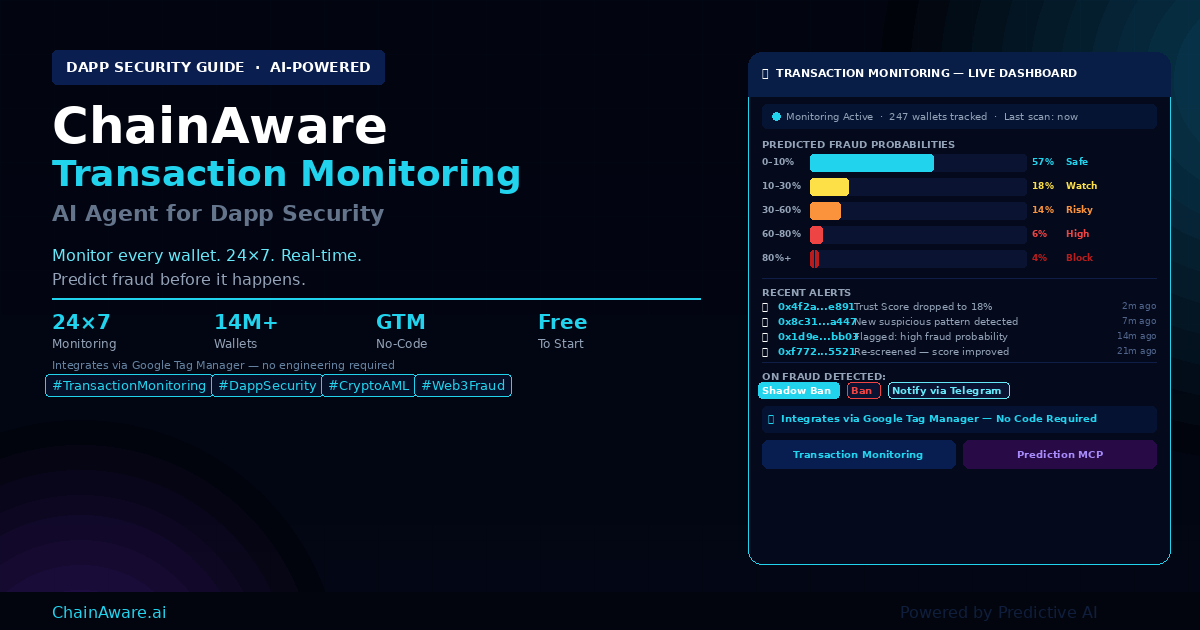
Most Dapp teams think about security in terms of smart contract audits and AML compliance. These matter — but they leave a critical gap: the wallets actively interacting with your platform right now. Who are they? What are their behavioral risk profiles? Have any of them turned fraudulent since they first connected?
Traditional crypto AML tools answer one question: where did these funds come from? ChainAware’s Transaction Monitoring Agent answers a different and more operationally urgent question: which of your active users are likely to commit fraud in the future — and when did that risk change?
This guide explains what crypto transaction monitoring is, why AML alone is not sufficient for fraud protection, how ChainAware’s monitoring agent works, and how to integrate it into your Dapp in minutes via Google Tag Manager — no engineering required.
In This Guide
- What Is Crypto Transaction Monitoring?
- AML vs Transaction Monitoring: A Critical Distinction
- Why AML Alone Is Not Enough to Fight Fraud
- The Regulatory Mandate: Both Are Required
- How ChainAware Transaction Monitoring Works
- Reading the Predicted Fraud Probabilities Dashboard
- Continuous 24×7 Monitoring: Beyond First Connection
- Telegram Alerts: Real-Time Notifications When Risk Changes
- What to Do When Fraud Is Detected
- Integration: Google Tag Manager, No Code Required
- Ecosystem: How It Connects to ChainAware’s Other Tools
- Use Cases by Platform Type
- FAQ
What Is Crypto Transaction Monitoring?
Crypto transaction monitoring is the continuous, real-time process of analyzing wallet addresses that interact with a platform — screening them for fraud risk, tracking changes in their behavioral profiles over time, and triggering alerts or automated actions when risk thresholds are crossed.
In traditional finance, transaction monitoring is mandatory and universal. Every bank, payment processor, and financial institution routes 100% of transactions through real-time monitoring systems before settlement. These systems analyze the parties involved, the transaction amounts, timing patterns, historical behavior, and dozens of other signals simultaneously. The goal is both reactive (detect fraud that is occurring) and proactive (prevent fraud before it completes).
In the crypto context, transaction monitoring faces a different data environment: pseudonymous addresses, no personal data, no device fingerprints. What exists is a complete, public, immutable on-chain transaction history for every address — and it is precisely this behavioral history that predictive AI can analyze to identify fraud risk patterns.
According to the FATF (Financial Action Task Force) guidance on virtual assets, effective crypto compliance requires not just AML controls but ongoing transaction monitoring that identifies suspicious behavioral patterns — not just the provenance of funds. The regulatory direction is clear: transaction monitoring is becoming as mandatory in crypto as it is in traditional finance.
AI-Powered Dapp Security — No Code Required
Monitor Every Wallet That Connects to Your Dapp — 24×7
ChainAware Transaction Monitoring integrates via Google Tag Manager in minutes. Every connecting wallet is screened with predictive AI and monitored continuously. Get Telegram alerts when risk changes. Free to start.
AML vs Transaction Monitoring: A Critical Distinction
AML (Anti-Money Laundering) and transaction monitoring are frequently conflated in crypto compliance discussions, but they address fundamentally different problems and provide different types of protection.
What Crypto AML Does
AML focuses on the origin of funds. Its core task is verifying that money entering a financial service comes from declared, legal sources — the distinction between “white money” (funds with a verifiable legal origin) and “black money” (funds derived from criminal activities or undeclared income).
In practice, crypto AML tools trace the on-chain history of funds through a network of prior transactions — identifying whether any funds in a wallet’s history have passed through sanctioned entities, darknet markets, ransomware payment addresses, exchange hack proceeds, or other criminal sources. The scale of money laundering that AML addresses is substantial: according to the United Nations FACTI Panel report, global money laundering flows are estimated at 2.7% of global GDP annually.
AML looks backward: it asks where money came from.
What Transaction Monitoring Does
Transaction monitoring focuses on predicting future behavior. Rather than asking where funds originated, it asks: based on this wallet’s behavioral patterns, is it likely to commit fraud against our platform or its users?
Transaction monitoring is not a one-time check at the point of connection. It is a continuous process that runs against every wallet in your user base — screening for behavioral changes that indicate elevated fraud risk, even in wallets that passed AML checks when they first connected.
Transaction Monitoring looks forward: it asks what a wallet will do next.
The Key Difference in Operational Scope
AML is typically run once, at onboarding. Transaction monitoring is continuous — it keeps running after a wallet has been admitted. A wallet that passes AML screening today can develop fraudulent behavioral patterns tomorrow. Without ongoing monitoring, the platform has no visibility into this change until the fraud has already occurred.
Why AML Alone Is Not Enough to Fight Fraud
The most important and underappreciated truth in crypto fraud protection is this: fraud is frequently committed with clean funds.
Sophisticated fraudsters understand that using funds with any connection to criminal activity is operationally dangerous — it creates a traceable link that can alert AML systems, trigger exchange flags, and expose their identity. So they don’t. Professional fraud operations use clean wallets funded through legitimate sources, often with carefully constructed transaction histories designed to appear legitimate.
This is the fundamental limitation of AML as a fraud prevention tool: it is designed to catch money laundering, not fraud. A scammer who has carefully funded their wallet through legitimate channels will pass any AML check. The AML system will show clean funds — because the funds are clean. The fraud hasn’t happened yet.
Transaction monitoring catches what AML misses. It does not look at where funds came from — it looks at how the wallet behaves. The behavioral patterns of a fraud operator — wallet preparation sequences, interaction patterns with known risky protocols, timing of fund movements, relationships with other flagged addresses — are identifiable through predictive AI analysis even when the funds themselves are clean.
According to Elliptic’s DeFi risk research, the most sophisticated crypto fraud operations specifically invest in creating clean-funded, operationally legitimate-appearing wallets as part of their attack infrastructure. These wallets are invisible to AML tools and only identifiable through behavioral pattern analysis.
The conclusion is clear: AML and transaction monitoring are not alternatives — they are complements. AML ensures funds are clean. Transaction monitoring protects against fraudsters who operate with clean funds. A complete security posture requires both.
The Regulatory Mandate: Both Are Required
Regulators around the world are increasingly explicit that crypto platforms must implement both AML controls and ongoing transaction monitoring — not as optional best practices but as compliance requirements.
The FATF’s updated guidance for virtual asset service providers (VASPs) explicitly requires risk-based transaction monitoring as part of a compliant AML/CFT program. The EU’s Markets in Crypto Assets (MiCA) regulation, which took effect in 2024, incorporates transaction monitoring requirements alongside AML obligations for crypto businesses operating in Europe. The US Financial Crimes Enforcement Network (FinCEN) applies similar requirements to money services businesses dealing in crypto.
For DeFi protocols and Dapp teams, the regulatory direction is clear even if specific mandates are still evolving: the standard of care is moving toward the requirements already applied to traditional financial services, which have always mandated both fund source verification (AML) and ongoing behavioral monitoring (transaction monitoring).
Implementing ChainAware’s Transaction Monitoring now — before regulatory mandates are finalized — positions Dapp teams ahead of the compliance curve rather than scrambling to catch up. For a complete view of how ChainAware’s tools map to compliance requirements, see the guide to using ChainAware as a business.
Regulators Require Both AML + Transaction Monitoring
Don’t Leave the Gap That AML Can’t Cover
AML checks fund origins. Transaction Monitoring predicts fraud from behavior — including fraudsters using clean funds. ChainAware gives you both. Integrate in minutes via Google Tag Manager.
How ChainAware Transaction Monitoring Works
ChainAware’s Transaction Monitoring Agent is built on the same predictive AI engine as the Fraud Detector — but applied continuously and at scale to every wallet that interacts with your Dapp.
Step 1: Integration via ChainAware Pixel
Integration starts with the ChainAware Pixel — a lightweight tracking snippet deployed through Google Tag Manager. No engineering work is required: the Pixel is added to your GTM container in the same way as any analytics tag. Once deployed, it automatically detects wallet connection events on your Dapp and registers every connecting address with the ChainAware monitoring system.
This no-code integration means that security teams and product managers can deploy transaction monitoring without waiting for developer resources. From GTM setup to active monitoring typically takes less than 30 minutes.
Step 2: Initial Fraud Screening on Every New Connection
The moment a wallet connects to your Dapp, the Transaction Monitoring Agent runs it through the Fraud Detector. This generates an initial Trust Score (1 minus Fraud Score) for the address, drawing on ChainAware’s Predictive Data Layer of 14M+ pre-calculated wallet profiles. If the address is already in the database, the result is instant. If it’s a new address requiring fresh analysis, the real-time calculation completes in seconds.
This initial screening gives you an immediate fraud risk signal for every new user — before they have taken any significant action on your platform.
Step 3: Continuous 24×7 Re-Screening
This is where transaction monitoring differs fundamentally from one-time fraud checks. After the initial screening, every address that has ever connected to your Dapp is continuously re-screened — 24 hours a day, 7 days a week. The monitoring agent regularly re-runs the Fraud Detector analysis on your entire connected wallet database, not just new connections.
This continuous re-screening catches behavioral changes that occur after initial connection — the wallet that looked clean at signup but has since begun exhibiting fraudulent interaction patterns, the address whose Trust Score has dropped significantly, the user who has started transacting with known fraudulent counterparties.
Step 4: Aggregate Analytics Dashboard
The Transaction Monitoring dashboard aggregates the fraud probability distribution across your entire connected wallet base. The Predicted Fraud Probabilities view visualizes what percentage of your users fall into each risk category — giving your team an immediate read on the overall security health of your user base.
For a full breakdown of the 10-dimension analytics dashboard — including experience distribution, risk willingness, wallet intentions, and protocol categories — see the Web3 Behavioral Analytics complete guide.
Reading the Predicted Fraud Probabilities Dashboard
The Predicted Fraud Probabilities chart is the core security health metric of the Transaction Monitoring dashboard. It shows the distribution of Trust Scores across your entire connected wallet base, bucketed into risk tiers.
A healthy Dapp user base typically shows the vast majority of wallets in the low-risk bucket (Trust Score above 70%), a small proportion in the medium-risk watch zone, and a very small tail of high-risk addresses. If your distribution shows an unusually high proportion of wallets in the elevated-risk buckets, this signals either that your acquisition channels are attracting low-quality wallet traffic or that your platform has been specifically targeted by fraud operations.
The distribution also changes over time — monitoring the trend of your fraud probability distribution is as important as the snapshot. A distribution shifting toward higher risk over weeks indicates emerging fraud exposure that needs to be addressed before it manifests in actual attacks.
This aggregate view connects directly to ChainAware’s Web3 User Analytics platform, which provides the full behavioral intelligence picture: not just fraud probability distribution but also wallet experience levels, risk willingness, predicted intentions, protocol categories, and Wallet Rank distribution — giving Dapp teams a complete picture of who is actually using their platform.
Continuous 24×7 Monitoring: Beyond First Connection
The most operationally significant feature of ChainAware’s Transaction Monitoring is its continuous re-screening capability. Most fraud detection implementations check wallets once — at connection or registration — and never revisit them. This creates a critical blind spot: a wallet’s risk profile is not static.
Consider these scenarios that one-time screening would miss entirely:
A wallet connects to your lending protocol with a Trust Score of 85% — clean, established, apparently legitimate. Over the following three weeks, this wallet begins accumulating positions with other DeFi protocols in a pattern consistent with a coordinated liquidity attack. Its Trust Score drops to 42%. Without continuous monitoring, your platform has no visibility into this change until the attack executes.
A wallet connects to your NFT marketplace with a moderate Trust Score. Two months later, it begins engaging with known wash-trading rings, and its behavioral profile shifts significantly. A continuous monitoring system catches this change and flags the wallet for review. A one-time screen never would.
This is the fundamental value proposition of 24×7 monitoring: fraud risk is a dynamic property of wallets, not a static one. The monitoring system that only checks at connection will always be behind the threat. Continuous re-screening keeps your platform’s risk intelligence current.
According to research from the Bank for International Settlements on crypto market surveillance, behavioral patterns that precede fraud typically develop over days to weeks before the fraud executes — making continuous monitoring the only approach capable of catching risk before harm occurs.
Know Your Users — All of Them, All the Time
Web3 Behavioral Analytics: The Full Picture of Your User Base
Beyond fraud monitoring — see experience levels, risk willingness, predicted intentions, wallet quality, and protocol categories across your entire user base. 10-dimension dashboard. Free starter plan. Google Tag Manager integration.
Telegram Alerts: Real-Time Notifications When Risk Changes
Continuous monitoring is only actionable if it generates timely alerts when risk thresholds are crossed. ChainAware’s Transaction Monitoring Agent delivers alerts via Telegram — a channel that Dapp teams are already using for community management and operational communications.
When a wallet’s Trust Score drops below a configured threshold — or changes significantly from its last recorded score — the monitoring agent sends an immediate Telegram notification to the designated channel or user. The alert includes the wallet address, the current Trust Score, the direction of change, and the network.
This alert architecture means your security team has real-time visibility into risk changes across your entire user base, regardless of whether they are actively monitoring the dashboard. A wallet that went from 78% Trust Score to 31% overnight triggers an alert the moment the re-screening detects the change — giving your team time to act before the wallet has taken any harmful action on your platform.
Configuring Telegram integration is straightforward — connect your Telegram bot to the ChainAware dashboard and set your risk threshold preferences. Alerts can be configured for different severity levels: a watch alert for moderate Trust Score declines, and a critical alert for wallets crossing into high fraud risk territory.
What to Do When Fraud Is Detected
When the Transaction Monitoring Agent identifies a high-risk wallet — either at initial connection or through continuous re-screening — your team has three options. Each has different operational implications.
Option 1: Shadow Ban
A shadow ban allows the flagged wallet to continue using your platform normally from their perspective — they can browse, interact, and navigate as usual. However, behind the scenes, the platform blocks or delays their ability to execute transactions. This is the most operationally nuanced option: it prevents harm without alerting the potentially fraudulent actor that they have been flagged, which can prevent them from immediately switching to a new wallet and reconnecting.
Shadow banning is particularly useful when you have a moderate-confidence fraud signal (Trust Score in the elevated-risk range but not conclusively high) and want to limit exposure while gathering more information.
Option 2: Ban
An outright ban blocks the flagged wallet from accessing the platform entirely. This is the appropriate response to high-confidence fraud signals — wallets with Trust Scores indicating very high fraud probability or wallets that have already triggered transaction-level fraud alerts.
The justification for banning is straightforward: if your monitoring system has identified that a wallet is highly likely to commit fraud, and you have that information, the responsible action is to prevent access. Continuing to allow a known high-risk wallet to interact with your platform exposes your legitimate users to risk and may create compliance liability.
Option 3: Do Nothing
The monitoring system supports a “do nothing” action option — but it is explicitly not recommended. If your platform knows that a connected wallet has a high probability of committing fraud, taking no action means knowingly accepting that risk. This creates both direct financial exposure (the fraud your platform facilitates or suffers) and potential regulatory exposure (failure to act on known risk signals).
The appropriate use of “do nothing” is for wallets in the low-to-moderate risk range where the signal is not yet strong enough to justify restriction — combined with continued monitoring so that if the risk score increases, the automated alert pipeline triggers a review.
Integration: Google Tag Manager, No Code Required
The ChainAware Transaction Monitoring Agent integrates into any Dapp through the ChainAware Pixel, deployed via Google Tag Manager. The integration process requires no smart contract changes, no backend engineering, and no frontend code modifications.
The setup process involves: creating a ChainAware account at chainaware.ai; adding the ChainAware Pixel tag to your Google Tag Manager container; configuring the trigger (typically “Wallet Connected” events); and connecting your Telegram channel for alert delivery.
This GTM-based integration model is the same approach used for Web3 Behavioral Analytics — a single Pixel deployment activates both the analytics dashboard and the transaction monitoring system simultaneously. Teams that have already deployed the ChainAware Pixel for analytics get transaction monitoring as an additional layer at no additional integration cost.
For teams who want deeper programmatic integration — querying fraud scores via API, building custom alerting logic, or integrating behavioral profiles directly into AI agent workflows — the Prediction MCP provides full developer access to the ChainAware Predictive Data Layer. See the Prediction MCP developer guide for integration details.
Ecosystem: How It Connects to ChainAware’s Other Tools
The Transaction Monitoring Agent is one layer in ChainAware’s broader Predictive Intelligence Stack. Understanding how it connects to the other tools clarifies which to use when.
The Fraud Detector is the on-demand tool for checking individual wallet addresses — useful for manual due diligence before a specific transaction or business relationship. Transaction Monitoring is the automated, always-on version of the same capability applied to your entire user base continuously.
The Wallet Auditor provides the deepest single-wallet intelligence — Trust Score, AML status, experience level, risk willingness, intentions, and Wallet Rank — in a single view. When a Transaction Monitoring alert flags a specific wallet, the Wallet Auditor is the natural next step for deep investigation.
The Rug Pull Detector covers the contract-address dimension — assessing whether pools and contracts your users are interacting with represent rug pull risk. Together with Transaction Monitoring, it covers both the user side and the contract side of fraud exposure.
For Dapp growth teams, the same behavioral intelligence that powers fraud monitoring also powers personalization: Growth Agents use wallet behavioral profiles to deliver personalized experiences to legitimate users — the security and growth use cases share the same underlying data layer.
Use Cases by Platform Type
DeFi Lending Protocol
Lending protocols face exposure to fraudulent borrowers who take out loans with no intention to repay — particularly as undercollateralized or social-collateral lending models become more common. Transaction Monitoring screens every wallet that connects to your protocol and continuously monitors their risk profiles. When a borrower’s Trust Score drops significantly after taking a loan position, an alert triggers — giving your team early warning of potential default risk from fraudulent actors, not just creditworthiness signals.
NFT Marketplace
NFT marketplaces are targets for wash trading, fraud, and manipulation. Transaction Monitoring identifies wallets with behavioral patterns associated with wash trading rings, coordinated bid manipulation, and counterfeit collection operations — and monitors their activity on your platform continuously. Shadow banning high-risk wallets allows the platform to limit their transactional impact while gathering evidence before a full ban.
GameFi Platform
Play-to-earn and GameFi platforms attract bot farms and exploit operations that drain rewards designed for genuine players. Transaction Monitoring identifies wallet behavior inconsistent with genuine gameplay — bot-like transaction patterns, relationships with known airdrop farming operations, and low Trust Scores — and flags these wallets for review or automated restriction.
Crypto Exchange or On-Ramp
Exchanges face regulatory requirements for both AML and transaction monitoring. ChainAware’s system provides the transaction monitoring layer that complements existing AML tooling — screening depositing wallets with predictive AI and monitoring all connected accounts for risk score changes that should trigger enhanced due diligence or account restrictions.
ChainAware.ai — Complete Dapp Security Stack
Monitor. Alert. Act. Protect Your Users 24×7.
Transaction Monitoring for continuous wallet screening. Web3 Analytics for behavioral intelligence. Prediction MCP for developer integration. All powered by 14M+ wallet profiles and real-time predictive AI.
Frequently Asked Questions
What is the difference between AML and transaction monitoring?
AML (Anti-Money Laundering) verifies the origin of funds — it asks where money came from and whether it has any connection to criminal sources. Transaction monitoring predicts future behavior — it analyzes wallet behavioral patterns to identify fraud risk before the fraud occurs. Both are required for complete protection. AML misses fraud committed with clean funds; transaction monitoring catches behavioral risk signals regardless of fund origin.
Does the ChainAware Pixel require changes to my smart contract?
No. The ChainAware Pixel is a frontend integration deployed via Google Tag Manager — it requires no changes to your smart contracts, no backend modifications, and no frontend code changes beyond adding the GTM tag. Setup typically takes less than 30 minutes.
What happens when a wallet’s risk score changes?
If you have connected your Telegram channel, you receive an immediate notification when a monitored wallet’s Trust Score drops below your configured threshold. You can then choose to shadow ban (block transactions while allowing browsing), ban (block platform access entirely), or continue monitoring. Doing nothing when a high-risk signal is detected is not recommended.
How often are wallets re-screened?
Every wallet that has connected to your Dapp is continuously re-screened 24×7. The re-screening frequency is designed to catch behavioral changes as they develop — giving you early warning before fraud executes rather than forensic information after the fact.
What is shadow banning and when should I use it?
Shadow banning allows a flagged wallet to continue using your platform normally from their perspective while blocking or delaying their ability to execute transactions behind the scenes. It is best used for moderate-confidence fraud signals where you want to limit exposure without alerting the potentially fraudulent actor — who might immediately switch to a new wallet and reconnect if they knew they were flagged.
Can I integrate this into my own AI agent or backend system?
Yes. The Prediction MCP provides full programmatic access to ChainAware’s Predictive Data Layer — including fraud scores, Trust Scores, behavioral profiles, and wallet intentions — via API. See the Prediction MCP developer guide for integration details and code examples.
Is transaction monitoring only for compliance, or does it have business value too?
Both. From a compliance perspective, transaction monitoring addresses regulatory requirements that are already in force for traditional finance and increasingly being applied to crypto. From a business perspective, protecting your platform from fraud protects your legitimate users’ experience, your platform’s reputation, and your team’s time spent on fraud remediation. The same ChainAware Predictive Data Layer that powers fraud monitoring also powers growth tools — so the security investment directly enables personalization and conversion improvements.