
X Space #4 — Speeding Up Web3 Growth: Real-Time Fraud Detection and 1:1 Marketing. Watch the full recording on YouTube ↗ · Listen on X ↗
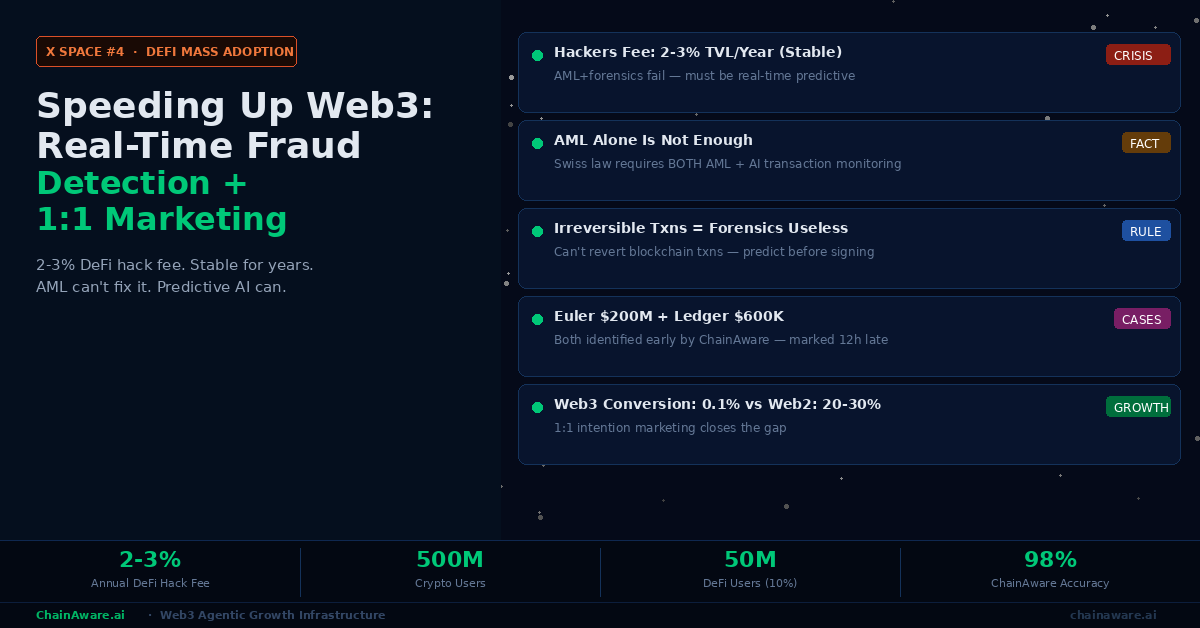
X Space #4 addresses the question that determines whether DeFi achieves mass adoption or remains a niche product for the technically sophisticated: why do 500 million crypto users exist while only 50 million use Web3 applications — and what precisely would it take to change that ratio? Co-founders Martin and Tarmo identify two independent barriers that together explain the 10x gap. The first is trust: DeFi’s annual hack fee of 2-3% of total value locked has remained stable for years despite enormous investment in fraud detection companies, because the entire industry applies the wrong technological paradigm. The second is discovery and resonance: Web3 marketing still operates like 1930s newspaper advertising — same message for everyone — while Web2 companies have been running intention-based, one-to-one marketing since before the internet era. Tarmo wrote his master thesis on this topic in 1996. Both barriers have specific, deployable solutions. This session explains both barriers in technical detail and presents the architectural changes required to overcome them.
In This Article
- 500 Million vs 50 Million: The DeFi Adoption Gap
- The 2-3% Hackers Fee That Never Drops
- The AML Wine-and-Water Problem: Why Retrospective Systems Fail
- Traditional Finance Requires Two Algorithms — DeFi Only Uses One
- Irreversible Transactions: Why Banking-Licence Logic Cannot Apply in DeFi
- Real Cases: Euler $200M, Ledger $600K, and the ChainAware Clone
- Shadow Banning vs Hard Banning: Two Approaches to Bad Wallets
- Why Only Predictive AI Solves the Problem
- 1930s Marketing in a 2025 Ecosystem — The Second Barrier
- Tarmo’s 1996 Master Thesis: 1:1 Online Marketing
- Intention-Based Marketing for Web3: How to Calculate User Intentions from Blockchain Data
- Adaptive Applications: Gartner’s 70% Projection and Web3’s 0%
- Banks Are Data Organisations — And DeFi Has Forgotten This
- From Linear to Exponential: The Innovation Web3 Needs
- Comparison Tables
- FAQ
500 Million vs 50 Million: The DeFi Adoption Gap
Martin opens X Space #4 with the statistic that frames the entire discussion. Approximately 500 million people interact with blockchain assets in some form — through exchanges, wallets, token holdings, and speculation. Of those 500 million, only about 50 million use genuine Web3 applications: DeFi protocols, DEXes, lending platforms, and smart contract interactions that involve self-custody and on-chain transactions. The remaining 450 million interact with crypto exclusively through custodial intermediaries — Binance, Coinbase, and similar centralised platforms that are, as Tarmo notes, simply traditional finance applied to a different asset class.
This 10x gap is not new. The ratio has been roughly stable for years despite the enormous expansion of the crypto ecosystem, the proliferation of DeFi protocols, and the billions invested in Web3 development. As Tarmo observes: “Even if they know enormous risks of centralised finance platforms, people better stay in centralised finance. They don’t come over to DeFi. They don’t come over to Web three. And the question is why?” The answer, Martin and Tarmo argue, has two components: perceived risk (justified by the real and stable hack rate) and poor user experience (caused by the absence of personalised discovery and resonating interfaces). Both components are solvable. Neither has been adequately addressed. For the broader context of this gap, see our Web3 growth restoration guide.
The 2-3% Hackers Fee That Never Drops
The trust barrier has a specific, measurable indicator: the annual DeFi hack fee. Across major DeFi protocols, approximately 2-3% of total value locked is lost to hacks, scams, and fraud every year. This figure has remained stable despite massive investment in blockchain security companies, the growth of on-chain analytics platforms, and the deployment of AML systems across centralised exchanges.
The stability of this figure is itself the most damning evidence against current approaches. Security investment has grown substantially. The hacker fee has not dropped. As Tarmo explains: “In hacker score, hackers percentage, hackers fee — it is stable. Over the last years, when all these AML and static algorithms are used from traditional finance, the hackers fee is stable. It is two to three percent per annum from total value locked. And it means all these technologies which are used today to fight fraud are not working.” Consequently, new users who investigate DeFi before committing funds discover this statistic and make a rational decision to remain in custodial environments where, at minimum, their counterparty is a regulated entity with insurance and compliance obligations. For more on the protection tools available, see our fraud detection guide.
The AML Wine-and-Water Problem: Why Retrospective Systems Fail
Tarmo introduces a precise analogy that explains both how the current dominant fraud detection approach works and why it is structurally incapable of solving the DeFi fraud problem. The analogy is wine and water: imagine a glass containing a small amount of red wine (representing tainted funds from known fraudulent addresses) mixed with clean water (representing legitimate funds). As more clean water is added, the wine becomes increasingly diluted. The ratio of wine to total liquid at any given point in the system represents the AML score for any specific address that receives or transmits those funds.
This AML algorithm starts from a set of known-bad addresses — blacklisted wallets associated with sanctioned entities, previous hacks, or known criminal activity (Tornado Cash is one well-known example of a blacklisted protocol). The algorithm then traces how funds from these addresses flow through the system, calculating the proportion of “bad” funds in any given address’s balance. A high AML score indicates significant contamination from known-bad sources. As Tarmo describes: “For every address, you know the percentage of bad money on this address. AML score zero is absolutely best. AML score ten is like, oh, there is pretty much bad money — better not interact with this address.” This approach has two fundamental structural limitations that make it inadequate for DeFi’s real-time protection requirements.
Why AML Is Always Delayed and Incomplete
First, AML analysis is inherently retrospective — it traces the flow of funds from addresses that are already known to be bad. Before an address is identified as fraudulent and added to the blacklist, it can operate freely. A new hacker or rug pull operator who has never previously been flagged will have a clean AML score right up until the moment they execute the fraud. Second, AML only covers the specific subset of fraud that flows through already-blacklisted addresses. Entirely new fraud operations with no connection to previously identified bad actors are invisible to AML analysis. As Tarmo summarises: “There is only so much that you can do with the AML algorithm. Only so much. Why? Because it addresses only a small subset and it’s always delayed information.” For the full comparison of fraud detection approaches, see our transaction monitoring guide.
Real-Time Predictive — Not Retrospective AML
ChainAware Fraud Detector — 98% Accuracy Before the Transaction
Analyses blockchain behavioral patterns — not AML wine-and-water flow. Identifies fraudulent addresses before you interact, not after you’ve lost funds. 98% accuracy. Real-time. Free for individual address checks. Used to identify the Euler and Ledger hacker addresses before traditional systems marked them.
Traditional Finance Requires Two Algorithms — DeFi Only Uses One
Tarmo introduces a regulatory framework observation that reveals a critical gap in how DeFi has implemented fraud prevention compared to what traditional finance regulators actually require. The observation is specific: in traditional finance jurisdictions globally, regulators mandate not one but two distinct fraud detection mechanisms. Banks that operate without both mechanisms cannot hold a banking licence.
The first mechanism is AML scoring — the wine-and-water algorithm described above. This is the mechanism that the blockchain analytics industry has focused on building and that centralised crypto exchanges have implemented in response to regulatory pressure. The second — and more important — mechanism is transaction monitoring. Transaction monitoring evaluates every individual incoming and outgoing transaction in real time using AI-based pattern recognition. Rather than tracing the historical flow of known-bad funds, transaction monitoring identifies anomalous behavioral patterns that indicate fraudulent intent regardless of whether the counterparty address has been previously flagged. As Tarmo explains: “Every transaction coming into the bank, going out of the bank is going through transaction monitoring. And these are 100% AI-based systems. AI-based systems that know bad patterns — they recognise bad patterns, they predict future things.”
DeFi Implements AML Without Transaction Monitoring
The current crypto ecosystem — both centralised and decentralised — has focused almost exclusively on AML scoring while largely ignoring AI-based transaction monitoring. Regulators have pushed exchanges toward AML compliance because it is codified in existing legislation. Transaction monitoring is equally mandated but far harder to implement on blockchain data — and the major blockchain analytics companies have built their businesses primarily around the more straightforward AML product. The result is a compliance posture that satisfies one of two required mechanisms while leaving the more effective one unimplemented. As Tarmo notes: “The regulator is saying AML and transaction monitoring both. But no one is doing transaction monitoring. No one is using AI.” For more on how predictive compliance works in DeFi, see our Web3 transaction monitoring guide.
Irreversible Transactions: Why Banking-Licence Logic Cannot Apply in DeFi
The most fundamental argument in X Space #4 for why the current fraud detection paradigm is structurally wrong for DeFi involves a property unique to blockchain: transaction irreversibility. This property transforms the strategic logic of fraud detection from retrospective investigation to pre-transaction prediction.
In traditional banking, when a customer sends funds to a fraudulent address, the bank has the ability to reverse the transaction — returning the funds to the sender. This reversal capability is not optional: in Switzerland, for example, all 251 licensed banks must be technically capable of reversing transactions. This capability is a precondition for the banking licence itself. The existence of this reversal mechanism means that retrospective AML analysis provides genuine protection — if a transaction is identified as fraudulent after the fact, the damage can be undone. Tarmo explains: “In Switzerland, each of these bank licence holders, they are holding companies. They get the bank licence only if their IT systems can reverse transactions. So simple. You cannot have a banking licence without reversing transactions.”
Blockchain Transactions Cannot Be Reversed — Period
Blockchain transactions are final. Once a transaction is signed and broadcast to the network, it executes permanently and irrevocably. No bank can reverse it. No regulator can undo it. No forensic investigation can recover the funds. The major blockchain analytics companies — Chainalysis, Elliptic, Coinfirm, DRM Labs — have built AML and forensic products based on the traditional banking model of retrospective investigation. However, since blockchain transactions cannot be reversed, forensic identification of a theft after the fact provides no user protection. It simply confirms that the user has lost their funds permanently. As Tarmo states: “You cannot revert a transaction in blockchain. In fiat world, you can revert transactions. And all these systems that we have now for fraud and AML — they are working like in the fiat world. But you can’t apply it for crypto. And the result is that users are robbed and users are victims.” The correct paradigm for DeFi fraud protection is therefore pre-transaction prediction: evaluating the trustworthiness of a counterparty before executing any transaction, not investigating it afterward. For how this applies to specific products, see our wallet audit guide.
Real Cases: Euler $200M, Ledger $600K, and the ChainAware Clone
Martin and Tarmo present three specific real-world cases that demonstrate both the failure of current fraud detection approaches and the capability of predictive AI to identify threats before they materialise. Each case illustrates a different dimension of the problem.
The Euler Finance hack in 2023 resulted in approximately $197 million in losses — one of the largest DeFi exploits in history. According to Martin, ChainAware’s systems had identified the hacker’s address as a bad actor based on behavioral patterns before the hack occurred. Traditional AML systems took approximately 12 hours or more to mark the same address after the exploit. At the time of the hack, the address was clean by traditional AML standards.
Ledger’s Trainer Address and the ChainAware Clone
The Ledger Connect Kit exploit in late 2023 involved a supply chain attack where malicious code was injected into a widely-used web component library, causing approximately $600,000 in losses across connected dApps. The malicious “drainer” address was identified by ChainAware as a bad actor in advance based on behavioral patterns — while traditional AML systems marked it 12 or more hours after the exploit. Ledger ultimately paid $600,000 back to affected users and suffered significant reputational damage — costs that would have been avoided with pre-transaction predictive detection. As Martin notes: “It would be cheaper for Ledger if they had used our real-time API than to pay back the money.”
The third case is closer to home for ChainAware. An unknown actor copied ChainAware’s entire website, created a replica product called “CqAI,” connected it to ChainAware’s backends so it functioned as a working product, launched a token, and executed a rug pull. ChainAware identified the pool creator’s address as fraudulent before the rug pull occurred and reported it to all relevant parties — exchanges, listing platforms, and monitoring services. None of them acted on the report. The rug pull proceeded exactly as predicted. As Martin describes: “We looked at the creator address of this pool. This secure AI — the scam pool — the creator address is not good. Don’t interact with this pool. We were sending emails everywhere. We report the address everywhere. We even report it to the systems where this pool is listed. Nothing happened. No one put any markers there.” For how to use ChainAware’s rug pull detection to avoid similar outcomes, see our rug pull detection guide.
Shadow Banning vs Hard Banning: Two Approaches to Bad Wallets
Tarmo introduces a practical implementation framework for how Web3 platforms should respond once predictive fraud detection identifies a bad wallet attempting to interact. Two distinct approaches are available, each with different user experience and security tradeoffs.
Hard banning prevents a flagged wallet from proceeding past the wallet connection step. The platform declines to enable any transaction functionality for the identified address and presents a clear notification that the wallet is not eligible to transact. This approach provides maximum security and clear communication but may create friction for false positives — wallets that receive a high fraud score but belong to legitimate users who have interacted with flagged addresses incidentally rather than through direct fraudulent activity.
Shadow Banning: The Subtle Approach
Shadow banning allows a flagged wallet to connect and appear to navigate the platform normally, but silently disables transaction functionality without explicitly informing the user. The wallet holder sees a working interface but cannot execute any actual transactions. This approach prevents the flagged actor from knowing they have been identified, which has security advantages for preventing evasive behaviour, but raises questions about transparency and fairness to potentially legitimate users. As Tarmo frames it: “You let the user connect the wallet, but you don’t enable them to do transactions — shadow banning. Or you do hard banning: after connect wallet, you say I don’t want to deal with you, go away, come back with another wallet.” Both approaches require accurate predictive fraud scoring as their foundation — implementing either approach on inaccurate scores would create false positives at scale, damaging the platform’s legitimate user base.
Why Only Predictive AI Solves the Problem
Having established why AML-only approaches fail and why irreversibility makes retrospective detection useless, Martin and Tarmo explain specifically why predictive AI is the only approach that actually addresses DeFi’s fraud challenge. The explanation connects blockchain data quality to prediction accuracy in a way that shows the solution is not just theoretically possible but practically achievable with existing technology.
Predictive AI for fraud detection analyses the complete behavioral history of blockchain addresses — not the flow of funds from known-bad sources, but the patterns of interaction, timing, counterparty relationships, and transaction structures that characterise fraudulent behavior. These patterns are distinct from legitimate activity in ways that persist across different fraud operations, because human behavioral tendencies leave consistent traces regardless of whether the actor is specifically trying to avoid detection. ChainAware’s fraud detection model achieves 98% accuracy in real time — processing an address query in approximately half a second to one second — because it is trained specifically on blockchain behavioral patterns rather than on linguistic data or retrospective AML flows. As Tarmo explains: “We are using AI models to analyse the blockchain history of the addresses. Behind every address we have a human behaving in certain ways. All this thinking that humans have will be stored on the blockchain as little markers. From these blockchain markers, transactions, blockchain indications — we trained our AI, and based on this past history we predict which addresses are trustable.” For the full technical methodology, see our fraud detection methodology guide.
1930s Marketing in a 2025 Ecosystem — The Second Barrier
The second barrier to DeFi mass adoption is independent of fraud — it affects users who are not worried about security and who actively want to participate in Web3. These potential users are unable to find the specific applications that match their individual intentions because Web3 marketing treats all users as interchangeable and serves every potential user the same generic content regardless of their behavioral profile.
Martin characterises current Web3 marketing with a historically precise comparison: “What’s the difference to 1930s, 94 years ago? There’s no difference. You put out the same message for everyone. Mass marketing with the same messages.” In the 1930s, a company would place an advertisement in a newspaper — reaching every reader identically — and then welcome every customer to a shopping floor that presented the same displays and messages to everyone. Web3 marketing in 2025 replicates this structure exactly. Crypto media placements reach all readers identically. Token incentive campaigns attract all participants identically. DeFi protocol websites present identical interfaces to every visitor regardless of whether they are experienced DeFi traders or first-time wallet users. For the full analysis of this problem, see our one-to-one targeting guide.
Tarmo’s 1996 Master Thesis: 1:1 Online Marketing
One of X Space #4’s most striking moments is Martin’s revelation that Tarmo wrote his master thesis on one-to-one online marketing in 1996 — before the internet hype era, before e-commerce existed as a mainstream concept, and nearly 30 years before Web3 adopted the internet marketing approaches of the 1920s. The temporal irony underscores the severity of Web3’s marketing innovation gap: a framework that was theorised before the commercial internet existed has still not been implemented in the supposedly cutting-edge blockchain ecosystem.
One-to-one marketing, as Tarmo conceptualised it in 1996, means tailoring every marketing message and every product experience to the specific intentions, preferences, and behavioral profile of each individual customer. The theoretical framework was ahead of its practical implementation — Web2 only developed the infrastructure to operationalise it at scale from the 2000s onward through Google AdWords, Facebook advertising, and subsequently programmatic advertising platforms. Web3 has not developed this infrastructure at all. As Martin notes: “It’s the same innovation that was there when self custody was created. Same innovation has to be there in the marketing layer. And this will bring the upward sloping curve.”
Intention-Based Marketing for Web3: How to Calculate User Intentions from Blockchain Data
The technical foundation for implementing intention-based marketing in Web3 is the same blockchain behavioral data that powers fraud detection — but applied to understanding positive user intentions rather than predicting fraudulent behavior. Every wallet’s transaction history reveals their trading style, DeFi experience, risk appetite, product preferences, and likely next actions with a precision that no search history or browsing data can match.
Martin describes the specific intention categories ChainAware calculates: “What will the user be as next? Is he a gamer? Is he a short-term trader? Is he an investor? Is he a leverage trader, a high-risk trader? What is his willingness to take a risk — is he a risk taker or a risk avoider? Which categories of protocols has the user used? Is it more a DeFi user?” These intention signals enable platforms to build the narrow audience segments that reduce customer acquisition costs by ensuring marketing spend reaches only the people most likely to transact — not the general crypto population. As Tarmo illustrates: “Audience can be people who have been rugged in the past. Audience can be people who will be rugged in the future — they just don’t know it. Audience can be people who have borrowed, creating audience of people who will borrow in the future. They just don’t know it yet, but they will borrow in the future.” For the audience building implementation, see our AI marketing guide and our high conversion guide.
Build Audiences from Blockchain Intentions
ChainAware Marketing Agents — Target Who Will Actually Transact
Calculate behavioral intentions for every connecting wallet. Target borrowers, lenders, gamers, NFT holders — each with a message matched to what they will actually do next. Replace mass marketing with 1:1 intention-based targeting. Reduce CAC 8-20x. Increase conversion toward 30%. The solution Tarmo theorised in 1996 — available in Web3 now.
Adaptive Applications: Gartner’s 70% Projection and Web3’s 0%
Intention-based marketing brings the right users to the right Web3 platforms. However, as Tarmo emphasises, getting the user to the website solves only half the conversion problem. Once a user arrives, the website itself must resonate with their specific intentions — or the targeting investment is wasted on a static interface that serves every visitor identically.
Tarmo cites a Gartner Research projection that 70% of Web2 applications will be adaptive by the end of 2025 — meaning their interfaces dynamically adjust content, messaging, and calls-to-action based on individual user behavioral profiles. This is not a cutting-edge experiment in Web2; it is a near-universal standard being implemented at scale across Fortune 2000 companies. Meanwhile, Web3 applications in 2025 universally present identical interfaces to every visitor regardless of their experience level, risk appetite, or specific intentions. As Tarmo states: “Gartner says 2025 — 70% of Web two applications will have adaptive user interfaces. And in Web three we say, no, we don’t want to do it. We do mass marketing. We don’t do adaptive applications. And then we are surprised that we have so small conversion ratios.”
The Conversion Rate Consequence
The practical consequence of this gap is the conversion rate differential that makes Web3 business models structurally unviable at current marketing costs. Web2 platforms using intention-based targeting and adaptive interfaces convert 20-30% of targeted visitors into transacting customers. Web3 platforms using mass marketing and static interfaces convert approximately 0.1%. At Web3’s typical $5 cost per click, a 0.1% conversion rate produces a $5,000 customer acquisition cost. For most DeFi protocols with modest per-user revenue, this unit economics gap makes sustainable cash flow mathematically impossible — which is why the majority of Web3 projects migrate to token price manipulation as the only achievable positive return. For the complete unit economics analysis, see our unit cost guide.
Banks Are Data Organisations — And DeFi Has Forgotten This
Tarmo closes the marketing section with an observation about the fundamental nature of banks that reframes why intention-based marketing is not optional for financial services — it is the core business model. The observation draws on his decade as chief architect of Finnova, the platform running more than 251 Swiss banks, and his earlier observation that people who worked in banking often do not understand how banks actually generate revenue.
Banks are not fundamentally lending or payment institutions, though those are their visible products. Banks are data processing and sales organisations. Approximately 90% of a bank’s IT infrastructure is dedicated to data processing and analysis — understanding each customer’s financial history, calculating their risk profile, predicting their next financial decision, and using that prediction to determine what product to offer, when to offer it, and how to price it. As Tarmo explains: “Banks are sales organisations. Banks are doing sales based on user intentions, in the same way as marketing organisations are doing marketing based on your intentions. Banks know what the customer really wants. And to know who you can trust, how much you can trust — it’s everything calculated.”
DeFi Founders Forgot What Banking Actually Is
DeFi was largely built by technically excellent developers who understood cryptography, smart contract development, and decentralised architecture. Many, however, did not understand banking as a business model — they built the technical infrastructure without building the intelligence layer that makes banking economically sustainable. As Tarmo notes: “In DeFi we think we don’t need it. All these so-called financial experts who worked in banks and created the DeFi sector — looks like they totally forgot it. Maybe they didn’t know it — how banks are actually generating the money. You have to calculate the intentions of your users. You have to know your user inside out.” Web1 companies do it. Web2 companies do it and are now building adaptive applications on top of it. Web3 companies largely do not do it — despite having access to the highest-quality behavioral data of any ecosystem in existence. For more on how ChainAware provides this intelligence layer for DeFi, see our behavioral analytics guide.
From Linear to Exponential: The Innovation Web3 Needs
Martin and Tarmo close X Space #4 with a framing that situates both barriers — trust and marketing — within a broader narrative about Web3’s growth trajectory. The current state of Web3 is linear growth: the number of users and applications increases slowly and predictably, without the exponential acceleration that characterised Web1 and Web2 at their inflection points.
Linear growth in technology ecosystems, as Martin observes, is effectively stagnation — it means the ecosystem is growing at the same rate as the general population’s awareness and technical confidence, without a catalytic mechanism driving accelerating adoption. Exponential growth requires an innovation that fundamentally changes the value proposition for new users — making the step from custodial crypto to genuine Web3 compelling rather than merely theoretically superior. As Martin argues: “The current approach will bring linear growth. That’s the limit. The same innovation that was there when self custody was created, the first DeFi applications were created — same innovation has to be there. And this will come and will bring this upward sloping curve.” The two components — real-time predictive fraud detection that eliminates the 2-3% annual hack fee, and intention-based marketing with adaptive interfaces that makes DeFi as resonating as Web2 — together create the conditions for that inflection point. Technologies for both exist today. For the complete roadmap, see our AI agents and Web3 acceleration guide.
Comparison Tables
AML-Only vs Predictive AI: Fraud Detection Comparison
| Dimension | AML Score (Chainalysis / Elliptic / Coinfirm) | Predictive AI (ChainAware) |
|---|---|---|
| Mechanism | Traces flow of funds from known-bad addresses (wine/water dilution) | Analyses behavioral patterns of addresses regardless of fund source |
| Coverage | Only addresses connected to previously identified bad actors | Any address — including entirely new fraud operations |
| Timing | Retrospective — marks addresses after fraud is confirmed | Predictive — identifies risk before any transaction occurs |
| Delay | 12+ hours to update after new hack identified | Real-time — half second to one second per query |
| Blockchain compatibility | Designed for fiat (reversible) transactions — misapplied to DeFi | Designed specifically for irreversible blockchain transactions |
| Transaction reversal dependency | Yes — requires reversion capability to be useful | No — operates correctly with irreversible transactions |
| Euler hack applicability | Marked hacker address 12+ hours after $200M loss | Identified hacker address as fraudulent before hack |
| Ledger hack applicability | Marked drainer address 12+ hours after $600K loss | Identified drainer address as fraudulent before exploit |
| Accuracy | Not publicly stated — inherently limited by retrospective design | 98% — backtested and published |
| DeFi hack fee impact | Stable at 2-3% TVL/year despite widespread deployment | Could eliminate majority of hack fee if widely deployed |
| Regulatory equivalence | Covers 1 of 2 required fraud mechanisms (AML only) | Covers the 2nd required mechanism (AI transaction monitoring) |
Web3 Mass Marketing vs Web2/ChainAware 1:1 Targeting
| Dimension | Web3 Mass Marketing Today | Web2 Intention-Based Marketing | ChainAware 1:1 Targeting for Web3 |
|---|---|---|---|
| Era equivalent | 1930s newspaper + shopping floor | 2005+ AdWords → programmatic | Same as Web2 + superior data |
| Message approach | Same for everyone | Matched to individual intentions | Matched to wallet behavioral profile |
| Conversion rate | 0.1% | 20-30% | Target 20-30%+ (better data) |
| Data source | None — channel audiences | Search + browsing history (low quality) | Blockchain transactions (highest quality) |
| Adaptive UI | ~0% of Web3 apps (2025) | 70% of Fortune 2000 by end 2025 (Gartner) | Available via ChainAware |
| Prediction accuracy | N/A — no prediction performed | Moderate — noisy input data | 95%+ from 10-15 transactions |
| Banks use it? | Web3 founders forgot banking is sales+data | Standard in all major banks | Equivalent to bank customer intelligence |
Frequently Asked Questions
Why has the DeFi hack fee not dropped despite years of security investment?
The DeFi hack fee (2-3% of TVL per year) has been stable because the dominant fraud detection approach — AML scoring — is architecturally the wrong tool for DeFi. AML works by tracing the flow of funds from previously identified bad addresses. It requires that fraud operations have historical connections to known-bad actors, and it is inherently retrospective — it identifies threats after they have already acted. In DeFi, where transactions are irreversible, retrospective identification provides no protection. Additionally, sophisticated attackers know how to operate with clean addresses that have no connections to known-bad sources. Predictive AI, which identifies fraudulent behavioral patterns regardless of AML score, is the correct tool — and it is not yet widely deployed across DeFi.
Why does traditional finance require both AML and AI transaction monitoring?
Regulators in most major jurisdictions require financial institutions to implement two distinct fraud detection mechanisms because each covers a different threat vector. AML scoring identifies addresses contaminated by known-bad funds — useful for detecting money laundering from previously identified criminal sources. AI transaction monitoring identifies anomalous behavioral patterns in real-time — useful for detecting new fraud operations with no prior history and for flagging unusual transaction patterns before losses occur. Neither mechanism alone provides comprehensive coverage. Crypto platforms have largely implemented AML while neglecting transaction monitoring, creating a compliance posture that covers only one of the two required protections.
What is the difference between shadow banning and hard banning a bad wallet?
Hard banning prevents a wallet with a high fraud risk score from proceeding past the connection step — the platform declines to offer transaction functionality and may display an explicit message. Shadow banning allows the wallet to connect and appear to navigate normally, but silently disables all transaction functionality without informing the user. Hard banning is more transparent but reveals to the actor that they have been identified, potentially prompting them to switch wallets. Shadow banning conceals the detection, giving platforms more time to gather information and preventing actors from immediately retrying with clean wallets. Both approaches require accurate underlying fraud prediction to be effective — inaccurate scores at scale would harm legitimate users.
How does blockchain transaction data enable better intention prediction than search history?
Financial transaction data ranks highest among all available behavioral data sources for prediction accuracy — above phone call history (Facebook’s rationale for the $19B WhatsApp acquisition) and far above search history. The reason is cost of commitment: a search query costs nothing and can be triggered by any external stimulus with no connection to genuine intention. A blockchain transaction requires deliberate action and real financial cost (gas fees). The resulting data reflects genuine committed behavior rather than casual browsing. From just 10-15 blockchain transactions, ChainAware achieves prediction accuracy above 95% for behavioral profiles including trading style, risk tolerance, product preferences, and intended next actions — accuracy that Web2 cannot match with hundreds of browsing data points.
What would it take for DeFi to grow from 50 million to 500 million users?
Two specific changes would drive this transition. First, deploying real-time predictive fraud detection across Web3 applications would eliminate the majority of the 2-3% annual hack fee, restoring the trust that currently causes the 450 million custodial crypto users to avoid DeFi. Second, implementing intention-based marketing and adaptive user interfaces would ensure that new users are routed to the specific DeFi applications that match their behavioral profile, presented with resonating messages that encourage conversion, and retained through personalised lifecycle management. Both changes require AI infrastructure that already exists — ChainAware provides both. The obstacle is not technical capability but the adoption decision by Web3 platforms still operating on 1930s marketing assumptions.
Both Barriers — One Platform
ChainAware Prediction MCP — Trust + Growth Infrastructure for Web3
Real-time fraud detection (98%) + rug pull prediction + intention-based audience targeting + adaptive messaging. The two barriers to DeFi mass adoption — addressed simultaneously. Free data. Free analytics to start. Enterprise subscription for full targeting. 14M+ wallets. 8 blockchains. 31 MIT-licensed agents.
This article is based on X Space #4 hosted by ChainAware.ai co-founders Martin and Tarmo. Watch the full recording on YouTube ↗ · Listen on X ↗. For questions or integration support, visit chainaware.ai.