
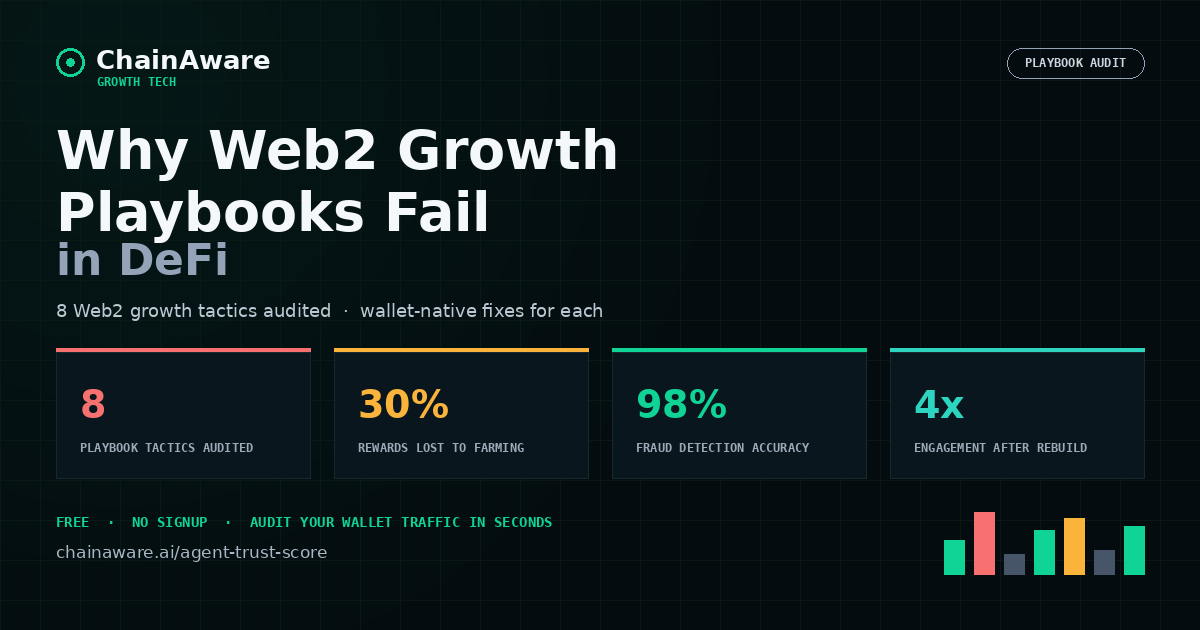
DeFi teams spend more than $100 to acquire every connecting wallet. Fewer than 10% of those wallets ever interact. This article explains why the standard Web2 growth playbook fails completely in Web3 – and what actually works instead.
You launched the campaign. You optimised the creatives. You set up retargeting audiences, built a conversion funnel, and hired a growth lead with a track record in SaaS. Then you looked at your wallet analytics and saw the same number you always see: under 10% connect-to-transact. After spending more than $100 per connecting wallet to get them there, nine out of ten did nothing and left.
This is not a campaign problem. It is not a product problem. It is a structural problem – one that every DeFi team hits when they carry Web2 growth tactics into a Web3 environment without understanding why those tactics worked in the first place. The tools that power modern growth marketing – cookies, login history, email capture, CRM segments, behavioural retargeting – all depend on a single capability that Web3 does not provide: user identity persistence.
This article breaks down why the Web2 growth playbook fails in DeFi, what the alternative looks like, and how Growth Agents solve the problem at the point where it actually hurts most – the moment a wallet connects.
The DeFi Growth Problem Starts With a Number
Before examining why things go wrong, it helps to understand the scale of the problem. DeFi user acquisition is genuinely expensive – not just compared to consumer apps, but compared to almost any other digital product category. The fully loaded cost to bring a wallet to your dApp and get them to connect sits above $100 in most paid acquisition channels. Telegram campaigns, Twitter/X paid posts, crypto media placements, KOL partnerships, and Web3 ad networks all price toward an audience that is small, sophisticated, and heavily competed for by every other protocol launching that week.
That figure alone is not the crisis. The crisis is what happens next. Fewer than 10% of the wallets that connect go on to transact. Consequently, your effective cost per acquiring a user who actually does something – your real CAC – is not $100. It is $1,000 or more. Most DeFi teams do not calculate it this way because the 90% who leave without interacting are easy to ignore in the dashboard. However, ignoring them does not make them cheaper. It just makes the unit economics invisible until the runway runs out.
Furthermore, Web3 LTV curves look different from SaaS. DeFi users churn fast when the incentives run out, when a competing protocol launches with better rates, or when market conditions shift. The window in which a user provides meaningful lifetime value is short – often measured in weeks rather than months. That compression makes high CAC catastrophically expensive in a way that the same number would not be in a product with multi-year retention. Understanding why CAC is high and LTV is short is the prerequisite for fixing either one.
What CAC Actually Measures in DeFi
Customer Acquisition Cost has a precise definition in SaaS: total sales and marketing spend divided by the number of new customers acquired in a period. In DeFi, the “customer” definition is where things get complicated. Most teams define acquisition as wallet connect – a low-friction action that costs the user nothing and signals nothing about intent. Consequently, they measure CAC against a denominator that includes wallets that connected by mistake, wallets that were farming an airdrop, wallets that were checking whether your product is real before deciding anything, and wallets that connected while exploring a dozen other dApps the same afternoon.
None of those wallets were customers. They were visitors. Counting them as acquisitions inflates your denominator and makes CAC look more manageable than it is. The moment you redefine acquisition as “a wallet that completed at least one meaningful interaction” – a trade, a deposit, a borrow, a stake – your acquisition count collapses and your real CAC becomes visible. That is the number you need to manage, and it is almost always more than $1,000 per user at typical DeFi conversion rates.
According to Messari’s State of DeFi Report ↗, the average DeFi protocol retains fewer than 15% of new users past their first month. That retention figure, combined with acquisition costs above $100 per connecting wallet, produces unit economics that make sustainable organic growth essentially impossible without either massive treasury subsidies or a genuine product differentiation that drives word-of-mouth. Most DeFi teams are subsidising growth without realising it – and the subsidy ends when the token price falls or the treasury runs low.
Why LTV Is Also Broken in DeFi
Lifetime Value in DeFi has three structural problems that do not exist in Web2, and understanding all three is necessary before you can address any of them.
Problem 1 – You Cannot Identify High-LTV Users Until They Have Already Churned
In SaaS, you can identify a high-value user from their plan tier, their login frequency, their feature usage, and their support history – all of which accumulate over time in your CRM. You use that data to run targeted retention campaigns before they churn. In DeFi, you have a wallet address. Until that address has already demonstrated high activity on your protocol, you have no information about whether they are a high-LTV user or a one-time visitor. By the time the on-chain history is clear enough to act on, the user has often already left.
The workaround that ChainAware’s Web3 User Analytics makes possible is to profile the wallet at the moment of connection – before any interaction history has accumulated on your protocol – using their full cross-chain behavioral record. A wallet that has borrowed $2M on Aave, provided liquidity on Curve for 18 months, and never been associated with fraud is almost certainly a high-LTV user for your lending or liquidity protocol. You can identify them at connection, not retrospectively. That identification window – the first 200 milliseconds after connect – is the most valuable moment in DeFi growth, and almost every team wastes it by showing the same generic homepage to everyone.
Problem 2 – Incentive-Driven LTV Is Temporary by Design
Much of what DeFi protocols count as lifetime value is incentive-driven activity – yield farming, liquidity mining, token reward programmes. These produce engagement that looks like retention but disappears the moment a better rate appears elsewhere. Protocols have spent years discovering this the hard way: launch an incentive programme, watch TVL surge, cut the incentives, watch TVL collapse. The users who stayed for the incentives were never customers in the meaningful sense. They were mercenary capital following the highest yield.
Real LTV – the kind that survives the end of an incentive programme – comes from users who chose your protocol for reasons other than the incentive. They chose it because the UX was right for their experience level. They chose it because the copy spoke to their specific situation. They chose it because the onboarding flow matched what they actually needed. Those choices are driven by relevance, and relevance in Web3 requires knowing who the user is before they have told you anything. That is a personalisation problem – and it is one that standard Web2 tools cannot solve in an anonymous-wallet environment.
Problem 3 – Re-engagement Is Nearly Impossible Without Identity
SaaS re-engagement relies on email. You have the user’s address, you know what they did in the app, and you send them a targeted message based on their specific drop-off point. DeFi has none of this by default. A wallet that connected, browsed for three minutes, and left has given you nothing you can use to contact them. You cannot email them. You cannot retarget them with meaningful precision because advertising platforms do not support wallet address targeting at the precision required. You cannot send them a Telegram message unless they explicitly opted in.
Moreover, even when re-engagement is technically possible – through email capture, Telegram bots, or push notifications – the message is almost always generic. “Come back and trade” reaches the expert trader and the first-time DeFi user with identical copy, which means it is optimised for neither. The result is re-engagement rates that look better than zero but drive little actual behaviour change. Genuine re-engagement requires knowing not just that a user left but who they were when they left – what they intended, what they were capable of, and what message would be relevant to that specific person. That knowledge requires wallet-level behavioral intelligence.
FREE – NO SIGNUP REQUIRED
See Who Is Actually Connecting to Your DApp
ChainAware Agent Trust Score gives you the behavioral profile behind every wallet that connects – experience level, fraud probability, intention signals, risk profile. Free to use, no API key needed. ETH, BNB, BASE, POLYGON, SOLANA and more.
Why the Web2 Growth Playbook Fails in DeFi
Web2 growth marketing is extraordinarily sophisticated. Modern growth teams have access to pixel tracking, cookie pools, CRM data, email sequences, push notifications, in-app messaging, A/B testing frameworks, cohort analysis, and attribution modelling tools that took decades to develop. Together, these tools produce a remarkably complete picture of every user – what they did, what they clicked, where they came from, how long they stayed, and what message brought them back. The DeFi growth lead who inherits this toolkit and tries to apply it to a Web3 protocol hits a wall immediately, because every one of these tools depends on a capability that Web3 fundamentally does not provide.
Cookies Do Not Work Across Wallets
Cookie-based tracking ties browser sessions to a persistent user identity. In Web2, this works because the same person uses the same browser, and their session history accumulates across visits. In Web3, a user’s identity is their wallet address – not their browser. A DeFi user who clears their cookies, switches browsers, uses a VPN, or simply uses a different device appears as a completely new visitor even if they connected the same wallet address yesterday. Consequently, all the session history you accumulated from their previous visits is disconnected from their current session, and the personalisation that should be powered by that history is impossible.
The wallet address, by contrast, is a permanent and public identity that persists across every browser, device, and session. It carries a complete behavioral history on-chain – every transaction, every protocol interaction, every token holding. However, standard Web analytics tools do not know what to do with a wallet address. They cannot read on-chain history. They cannot derive behavioral profiles from transaction patterns. They treat the wallet as an opaque identifier rather than the rich data source it actually is.
Email Capture Does Not Scale in DeFi
Email remains the highest-ROI channel in Web2 digital marketing, according to HubSpot’s annual marketing benchmarks ↗. The reason is straightforward: you own the relationship, the message is delivered directly, and the audience has explicitly opted in. DeFi protocols that try to replicate this run into immediate resistance. Web3 users are often anonymous by preference – they connect their wallet without providing any identity information, and many actively avoid linking their wallet activity to a real-world identity like an email address.
Protocols that do capture email addresses typically see opt-in rates well below 5% of connecting wallets. Furthermore, the users most likely to opt in are often the least valuable – beginners who want guides and help, rather than experienced DeFi participants who are the primary revenue drivers. The result is an email list that represents a tiny, non-representative fraction of your actual user base, and a re-engagement channel that systematically misses the users you most want to reach.
Retargeting Audiences Are Structurally Weak
Facebook, Google, and Twitter retargeting work because these platforms maintain persistent user identities across the open web, matching pixel events back to accounts with known demographics, interests, and behavioural histories. When you install a Facebook pixel on your site, you get access to audience matching that reflects years of accumulated behavioural data across billions of users. DeFi protocols can install the same pixels and run the same campaigns – but the quality of the audience match degrades significantly because the overlap between Web3 wallet users and the advertising platforms’ identity graphs is thin.
Additionally, the retargeting audiences you build from DeFi traffic include airdrop farmers, bot wallets, and Sybil addresses that connected specifically to claim incentives rather than to use the product. These wallets look identical to genuine users in a retargeting pixel – they are just browser sessions that visited your URL. Retargeting them wastes budget on addresses that will never convert legitimately, inflating your effective retargeting CAC without improving actual user quality. The solution is not a better ad platform. The solution is knowing which wallets are genuine users before you decide whether to retarget them.
A/B Testing Optimises for the Average, Not the Individual
A/B testing is a powerful tool for identifying which message performs better across a population. However, it optimises for the average – the variant that converts the most people across a random traffic split. In DeFi, the difference between a beginner wallet and an expert wallet is so large that the optimal message for one is actively wrong for the other. Showing advanced yield strategy copy to a first-time DeFi user confuses and deters them. Showing simplified beginner onboarding to a professional DeFi trader signals that you do not understand their needs and wastes their time.
Traditional A/B testing cannot solve this because it does not know, at the moment of the test, which type of user it is showing the variant to. It assigns variants randomly and measures aggregate outcomes. The signal is population-level. What DeFi growth actually requires is individual-level personalisation – identifying at wallet connect exactly who this user is and serving them the exact message and experience that matches their specific profile. That is not an A/B testing problem. It is a behavioral intelligence problem.
CRM Data Does Not Exist for Anonymous Wallets
CRM systems are the operational backbone of Web2 growth and retention. They store every interaction a user has had with your product, their demographic profile, their support history, their purchase history, and their engagement score. Sales teams use CRM data to prioritise outreach. Retention teams use it to identify at-risk accounts before they churn. Marketing teams use it to build lookalike audiences and personalised campaigns. None of this is available in DeFi by default, because anonymous wallet addresses carry no demographic data, no contact information, and no product-specific history until they have already interacted with your specific protocol.
The substitution that makes DeFi CRM possible is on-chain behavioral history. A wallet address that has been active on-chain for three years, has used 15 different DeFi protocols, has maintained positions worth $500K in stablecoins, and has never been associated with fraud carries an extraordinarily rich behavioral profile – richer, in many ways, than the typical SaaS CRM record, because every action is verified on-chain and cannot be manipulated. The challenge is accessing that profile in real time, at wallet connect, and translating it into actionable intelligence that your dApp can use to personalise the experience. That is precisely what ChainAware’s Web3 Persona system provides.
BOOK A DEMO
See Growth Agents Running on Your Actual DApp
Book a 30-minute demo and we will walk through your specific conversion funnel, show you what wallet personalisation looks like for your traffic mix, and demonstrate how Growth Agents would change what each wallet sees when they connect. No commitment required.
What Web3-Native Growth Actually Looks Like
The fundamental insight behind Web3-native growth is simple: the wallet address is not just an anonymous identifier. It is a complete behavioral record. Every transaction a wallet has ever made is public, permanent, and readable. Therefore, the moment a wallet connects to your dApp, you have access to more behavioral data about that user than a Web2 app typically accumulates after months of logged-in usage – provided you have the infrastructure to read it, interpret it, and act on it in real time.
Web3-native growth tools are built around this insight. Instead of relying on cookies and sessions, they profile wallets. Instead of building CRM records over time, they read on-chain behavioral history at connect. Instead of sending generic re-engagement emails to a list, they generate personalised messages anchored to the specific behavioral profile of the wallet they are targeting. The architecture is fundamentally different from Web2 growth tools – not an adaptation of existing tools to a new environment, but a ground-up rebuild that takes the wallet address as its starting point.
The On-Chain Behavioral Profile: What You Know at Wallet Connect
When ChainAware profiles a wallet, the output is a 22-dimension Web3 Persona that covers three categories: behavioral predictions, identity profile, and compliance status. Together, these dimensions give you a complete picture of who just connected and what they are likely to do next.
Behavioral predictions include 12 intention categories – Borrow, Lend, Trade, Stake, NFT, Gamble, Leverage Long, and more – scored as High, Medium, or Low based on ML models trained on 23M+ wallet profiles. These are not simple transaction counts. A wallet that made 50 Uniswap trades three years ago but has been inactive since does not get a High Trade intention score. The model weighs recency, volume, complexity, and consistency to produce a probability that reflects likely future action, not historical activity volume.
Identity profile dimensions include experience level (scored 1-10), risk willingness (also 1-10), wallet rank (a percentile position across all profiled wallets), wallet age, transaction count, and current balance. These dimensions tell you who this user is as a DeFi participant – whether they are a beginner who needs hand-holding or an expert who needs to be taken seriously, whether they prefer conservative positions or actively seek high-risk opportunities.
Compliance dimensions include fraud probability (98% accuracy, backtested against CryptoScamDB), AML attributes, OFAC status, and sanctions flags. These run in the same call as the behavioral profile, meaning personalisation and compliance screening happen simultaneously at wallet connect rather than as separate systems. For the complete technical reference on Web3 Personas, see our What Are Web3 Personas guide and the predictive_behaviour MCP tool documentation.
The 200-Millisecond Personalisation Window
Timing matters enormously in DeFi personalisation. The window between wallet connect and first screen render is approximately 200 milliseconds – enough time to execute a fast API call, receive a behavioral profile, and update the UI before the user sees anything. Miss that window and the user sees the generic version of your page. Their first impression of your product is that it treats them identically to everyone else – which is a signal, even if it is not an intentional one, that your product does not understand who they are.
ChainAware’s Prediction MCP returns a full Web3 Persona in under 100 milliseconds because the profiles are pre-computed. There is no real-time on-chain data fetch at query time – the behavioral analysis runs continuously against 23M+ wallet records, and the result is available as a structured API response the moment a wallet address is submitted. That latency profile makes personalisation at wallet connect practically possible in a way that real-time on-chain computation could never achieve. See the Prediction MCP guide for the full technical architecture.
Intent Data vs Transaction History: Why Prediction Beats Description
Most Web3 analytics tools that use on-chain data are descriptive – they tell you what a wallet has done. ChainAware’s behavioral intelligence is predictive – it tells you what a wallet is likely to do next. This distinction is the difference between reading a user’s bank statement and predicting their next purchase. Description is useful for post-hoc analysis and compliance audit trails. Prediction is useful for real-time growth decisions.
The intention analytics approach that drives ChainAware’s behavioral model treats transaction history as input data, not as output. The model identifies behavioral patterns across 23M+ wallet profiles – the sequences of actions, the timing of activity, the mix of protocols used, the size and frequency of positions – and maps them to forward-looking intention probabilities. A wallet with a specific pattern of lending behavior over 24 months has a predictable probability of wanting to borrow on a new protocol. A wallet with a specific pattern of DEX trading with consistently small position sizes has a predictable probability of being risk-averse even if their total transaction volume looks substantial.
For the deeper argument on why intention data outperforms descriptive transaction analytics for growth use cases, see our Generative vs Predictive AI guide and our Forensic vs AI-Powered Analytics comparison.
How Growth Agents Work: The Five-Step Personalisation Flow
Growth Agents are ChainAware’s implementation of real-time wallet personalisation. They take the behavioral intelligence described above and deploy it directly into your dApp UI – automatically, at wallet connect, without requiring backend changes or manual configuration per user. The integration is a single JavaScript pixel tag. The output is a personalised headline and CTA that your front end renders before the user has scrolled past the fold.
Understanding how Growth Agents work requires understanding five steps, each of which happens in the background within 200 milliseconds of wallet connect. For the complete technical integration reference, see the Growth Agents documentation.
Step 1 – The ChainAware Pixel Fires on Page Load
The pixel loads from a single script tag added to your page header. It fires immediately on page load – before any wallet connects – and begins capturing page-behaviour signals: which tool the user is on, how long they have been there, whether they have scrolled, whether they have clicked anything. These signals are passed to the message API as context, enabling personalisation even for anonymous visitors who have not connected a wallet yet.
A user who has spent 90 seconds on your fraud check page without connecting is not the same as a user who just arrived. Both are technically anonymous at that point, but the dwell time and interaction pattern reveal something about their decision-making process. Growth Agents uses that signal to generate copy that meets them where they are: a long-dwell anonymous visitor gets “Take your time – run the check whenever you are ready” rather than a generic “Connect your wallet” prompt.
Step 2 – Wallet Connect Is Detected Automatically
The pixel listens for wallet connect events across MetaMask, WalletConnect, Coinbase Wallet, Phantom, Solflare, and other major wallet libraries – covering both EVM and Solana wallets. No changes to your dApp code are required. The detection hooks into the wallet connection events that your existing integration already fires, intercepting them without interfering with your existing connection flow.
This zero-code-change integration model is one of the key reasons Growth Agents can be live in 30 minutes. There is no SDK to integrate, no API authentication to wire up in your front end, and no wallet connection logic to modify. The pixel handles everything autonomously once it is loaded.
Step 3 – ChainAware Derives a Behavioral Persona in Under 100ms
The moment a wallet address is detected, the pixel sends it to ChainAware’s Prediction MCP. The response comes back in under 100 milliseconds because the behavioral profile is pre-computed. The persona captures experience level, risk willingness, risk capability, all 12 intention probabilities, trust score, wallet rank, and fraud probability – everything needed to make an informed personalisation decision in a single structured API response.
Simultaneously, the fraud probability is evaluated. High-risk wallets – those flagged as fraud operators, Sybil farmers, or addresses with rug pull history – are identified at this step. The same call that produces the behavioral profile for personalisation also produces the fraud signal for exclusion. This means you do not need a separate fraud detection integration to protect your campaigns from bot wallets and airdrop farmers. The Growth Agents pixel handles both functions in a single operation.
Step 4 – Claude Haiku Generates Copy for This Exact Wallet
The behavioral persona, page context, and current tool are passed to Claude Haiku. The model generates two fields: a headline (a personalised greeting anchored to the wallet’s behavioral profile) and a toolCta (an outward-facing action pointing to the most relevant next step for this user). Both fields are generated specifically for this wallet at this moment on this page – not selected from a library of pre-written variants, but generated fresh from the behavioral data.
The generation rules are deliberately constrained to produce copy that feels warm and relevant rather than data-driven or surveillance-like. The headline never includes raw numbers, percentages, or wallet ranks. It reads as a professional observation about the user’s DeFi experience rather than a recitation of their on-chain statistics. A wallet with expert-level DeFi experience and a high lend intention gets: “Your DeFi depth opens up more than most wallets see here.” A first-time DeFi user gets: “Your first steps on-chain are already working in your favour.” Same page, same moment, completely different messages – because the users are completely different people.
Step 5 – Your Page Renders the Personalised Copy in Place
The headline and toolCta are returned to your front end via the message API. Your page renders them in whatever location you have designated – hero section, sidebar, modal, in-app notification, or anywhere else that makes sense for your specific UX. No reload is required. No redirect happens. The personalisation is invisible to the user; they simply see a page that speaks directly to their situation from the moment they connect.
Beyond the headline and CTA, the behavioral persona drives additional personalisation decisions that your front end can implement based on the API response: which feature highlights to show first, which trust signals are most relevant, whether to show advanced metrics or simplified onboarding, what re-engagement message to use if the user does not transact. The Growth Agents framework is the input layer; your product team decides how deeply to implement the personalisation based on what your specific user journey requires. For the complete Agentic User Onboarding architecture, including how routing logic works at wallet connection, the use case documentation covers the full reference implementation.
FREE AGENT TRUST SCORE
Score Any ERC-8004 Agent or Wallet Address Now
Paste any wallet address or ERC-8004 agent ID. Get the full behavioral profile – experience level, fraud probability, intention scores, trust tier – in under one second. Free, no API key required. The same intelligence that powers Growth Agents, available immediately.
Reducing CAC With Growth Agents: The Mechanics
Growth Agents reduce CAC through two distinct mechanisms, and it is important to understand both because they operate on different parts of the acquisition funnel.
Mechanism 1 – Improving Connect-to-Transact Conversion
The most direct way Growth Agents reduce effective CAC is by converting more of the wallets you already paid to acquire. If your current connect-to-transact rate is 10% and Growth Agents raises it to 40%, you get four times as many actual users from the same acquisition spend. Your nominal CAC (cost per connecting wallet) stays the same. Your real CAC (cost per interacting user) drops by 75%. No other lever in the growth toolkit produces this kind of improvement without increasing spend, because it works on the conversion rate rather than the traffic volume.
The 40-60% connect-to-transact rate that Growth Agents produces – compared to the industry baseline below 10% – comes from one source: relevance. When a wallet connects and immediately sees a headline that speaks to their specific experience level and a CTA that points to the tool most relevant to their intentions, the friction between connection and first action drops sharply. The user does not need to figure out where to start. The page tells them where to start – and it tells them the right thing because it knows who they are.
According to Nielsen Norman Group research on personalisation ↗, relevant content at the point of first exposure reduces time-to-first-action by 35-50% across digital products. In DeFi, where most users arrive with significant uncertainty about what to do next, that reduction translates directly into higher conversion rates – because the primary barrier to first interaction is not friction in the transaction flow but uncertainty about where to start.
Mechanism 2 – Excluding Non-Converting Wallets From Campaigns
The second mechanism is less obvious but equally important: Growth Agents identify wallets that will never convert legitimately and suppress them from your retargeting campaigns. Every airdrop farmer who connects your dApp gets profiled by the ChainAware pixel. Their Sybil pattern, their farm detection flag, and their fraud probability are all computed at the moment of connection. That information can then be used to exclude them from your retargeting audiences – preventing you from spending $100+ to bring them back a second time when they never intended to be genuine users in the first place.
This mechanism also protects token incentive programmes. When an airdrop farmer connects to claim an incentive, the Growth Agents pixel detects the Sybil pattern and flags the wallet before any incentive is distributed. Your campaign serves them nothing – no reward offer, no personalised copy, no re-engagement trigger. They see the standard page and leave. Genuine users see the personalised experience. The discrimination happens invisibly, at connection, without any manual review or whitelist management.
For the complete picture of how fraud detection integrates with growth campaigns, see our Rug Pull Detection guide and the Web3 Wallet Auditing Providers guide, which covers wallet intelligence at the protocol level.
Increasing LTV With Growth Agents: The Mechanics
Growth Agents increase LTV through three mechanisms that operate at different stages of the user lifecycle. Understanding each one helps teams prioritise which implementation to tackle first based on where their biggest retention gaps are.
Mechanism 1 – Right User Into Right Product Flow From Day One
The most common cause of DeFi churn in the first session is a mismatch between what the user expected and what they encountered. An expert DeFi user who connects to a lending protocol and is immediately presented with “Welcome! Let us explain what borrowing is” churns because the product has signalled that it does not understand them. A first-time user who connects to the same protocol and sees advanced collateralisation ratio controls with no explanation also churns – but for the opposite reason.
Growth Agents solve this by routing users into the appropriate product flow at the moment of connection. Expert wallets skip the tutorial, see advanced metrics first, and receive copy that assumes DeFi competence. Beginner wallets enter the guided flow, see simplified UI, and receive copy that explains concepts without condescending. Neither group had to select their own path or answer onboarding questions. The routing happened automatically based on their on-chain behavioral history.
Users who enter the right flow from their first session are significantly more likely to complete that session successfully. Completed first sessions correlate strongly with return visits, and return visits correlate strongly with long-term retention. For the DeFi-specific data on why first-session experience drives retention, see our DeFi Onboarding 2026 guide.
Mechanism 2 – Behaviorally Targeted Re-engagement
When a wallet connects but does not transact, Growth Agents capture the behavioral profile that was computed at connection and make it available for re-engagement campaigns. Instead of sending a generic “come back” message, your re-engagement trigger fires with copy written for the specific wallet persona that did not convert.
An expert wallet that did not transact gets: “You checked the fee tiers but did not trade. Here is how your current DEX compares to what we offer.” A beginner wallet gets: “No rush. Here is a two-minute walkthrough – we will take it step by step.” The same event – failure to transact – produces two completely different messages because the wallets behind the event are completely different people with completely different reasons for not acting.
Re-engagement effectiveness scales directly with message relevance. Generic re-engagement messages in DeFi typically produce single-digit return rates. Behaviorally targeted messages – anchored to the specific persona and the specific tool the user was exploring – routinely outperform generic messages by 3-5x in click-through rate, because they reference something specific to the user’s actual session rather than making a generic value proposition they have already seen and ignored.
Mechanism 3 – Progressive Personalisation as User History Accumulates
Growth Agents are not a one-time onboarding tool. They are active on every session – recalculating the behavioral persona each time a wallet connects, updating the copy based on what the user has done since their last visit, and progressively deepening the personalisation as more interaction history accumulates both on your protocol and on-chain generally.
A user who borrowed on your protocol three months ago and has since increased their position significantly on Aave returns to find copy that acknowledges their growing DeFi sophistication and points them toward advanced features they were not ready for at first. A user who was classified as a beginner on first visit but has been active across multiple DeFi protocols in the intervening weeks returns to find a more advanced experience that matches their current capability level. The personalisation evolves with the user rather than remaining fixed at the point of first contact – which is the structural property that drives long-term LTV improvement rather than just first-session conversion.
For the complete picture of how progressive personalisation integrates with Web3 user segmentation and long-term retention strategy, see our segmentation guide and the DeFi Business Analytics documentation.
The SmartCredit.io Case Study: What the Numbers Actually Look Like
SmartCredit.io is a DeFi lending platform that integrated Growth Agents via the ChainAware pixel. Before the integration, every connecting wallet – whether a first-time DeFi user or a seasoned borrower with $1M in on-chain lending history – saw the same homepage, the same hero text, the same CTAs, and the same onboarding flow. The platform had no way to distinguish between them at the moment of connection, so it served them identically.
After integrating ChainAware in under 30 minutes – a single pixel tag addition and API wiring in their existing front end – SmartCredit.io began delivering personalised copy to each wallet type across their lending, borrowing, and staking tool pages. Expert wallets with lending history saw copy anchored to yield optimisation and risk-adjusted returns. Beginner wallets saw simplified explanations of how DeFi lending works and guided flows through their first position. Fraud-flagged wallets saw nothing special – they got the standard experience without any incentive triggers.
The Six-Month Results
Over six months, the results were measurable across three dimensions. Engagement increased 8x. Primary conversions – wallets that completed at least one meaningful lending or borrowing action – improved 2x. Attribution also improved: SmartCredit.io gained visibility into which wallet personas converted at which rates, which messages worked for which segments, and which tools in their product needed different copy angles to reduce drop-off.
The 8x engagement increase is worth examining carefully because it understates the efficiency gain. SmartCredit.io did not increase their acquisition spend to produce that engagement lift – they improved the conversion rate of traffic they were already acquiring. Their nominal CAC (cost per connecting wallet) was unchanged. Their real CAC (cost per engaged user) fell by 8x because 8x as many connecting wallets became engaged users. That is the unit economics improvement that makes Growth Agents the highest-leverage growth investment available to a DeFi protocol with a fixed acquisition budget.
For the complete case study with full methodology, see the SmartCredit.io case study documentation. For the broader context of how ChainAware’s growth tech stack supports DeFi business outcomes, see our Growth Tech for DeFi Businesses guide.
The Fraud Problem Inside the CAC Problem
There is a fraud layer inside the DeFi CAC problem that most growth teams do not account for explicitly, and ignoring it makes the economics worse than the headline numbers suggest.
Airdrop Farmers Are Inflating Your CAC
Every DeFi protocol that runs a token incentive programme attracts a population of wallets whose sole purpose is to claim the incentive and leave. These airdrop farmers are sophisticated – they use multiple wallets, they mimic legitimate user behavior patterns to pass basic Sybil filters, and they move to the next target the moment the incentive ends. They never become real users, and they never contribute to LTV. However, they do connect to your dApp, which means they appear in your wallet analytics as acquired users and inflate your denominator in the CAC calculation.
The result is that your apparent CAC is lower than your real CAC, because your user count includes wallets that will never convert. When you correctly exclude airdrop farmers from your user count, your effective CAC rises – often substantially. More importantly, when you stop paying to re-acquire them through retargeting campaigns, your actual acquisition spend becomes more efficient because it is no longer partially allocated to addresses that will never produce revenue.
Fraud Detection and Growth Personalisation Share One Integration
The Growth Agents pixel handles both fraud detection and personalisation in the same call. When a wallet connects, the behavioral profile is computed – and that profile includes fraud probability, Sybil detection flags, and farm detection signals. Your integration can use the fraud signals to suppress incentive offers for flagged wallets, exclude them from retargeting audiences, and route them to a standard experience rather than the personalised one.
This integration means you do not pay for two separate systems to solve two separate problems. The same pixel that improves your conversion rate on genuine users also protects your incentive programme from exploitation. According to a16z Crypto’s State of Crypto 2025 report ↗, Sybil farming and airdrop manipulation remain among the top three threats to DeFi protocol growth economics. Protocols that do not actively screen for Sybil wallets at the point of incentive distribution typically allocate 20-40% of their incentive budget to addresses that contribute no genuine activity – which translates directly into wasted acquisition spend and inflated apparent CAC.
Tool-Specific Personalisation: Journey-Aware Copy at Every Step
Most personalisation systems treat the dApp as a single entity – they generate one personalised experience for each user and apply it uniformly across the product. Growth Agents take a more granular approach: they are journey-aware, generating different copy for the same wallet depending on which specific tool they are currently using.
How Tool-Specific Copy Works
When you call the Growth Agents message API, you pass the name of the current tool the user is on – your risk checker, your lending calculator, your portfolio analyser, your swap interface. The model generates copy anchored to what that specific tool surfaces, not a generic welcome message. Critically, the toolCta always points to a different tool – moving the user forward in their journey rather than looping them back to what they are already looking at.
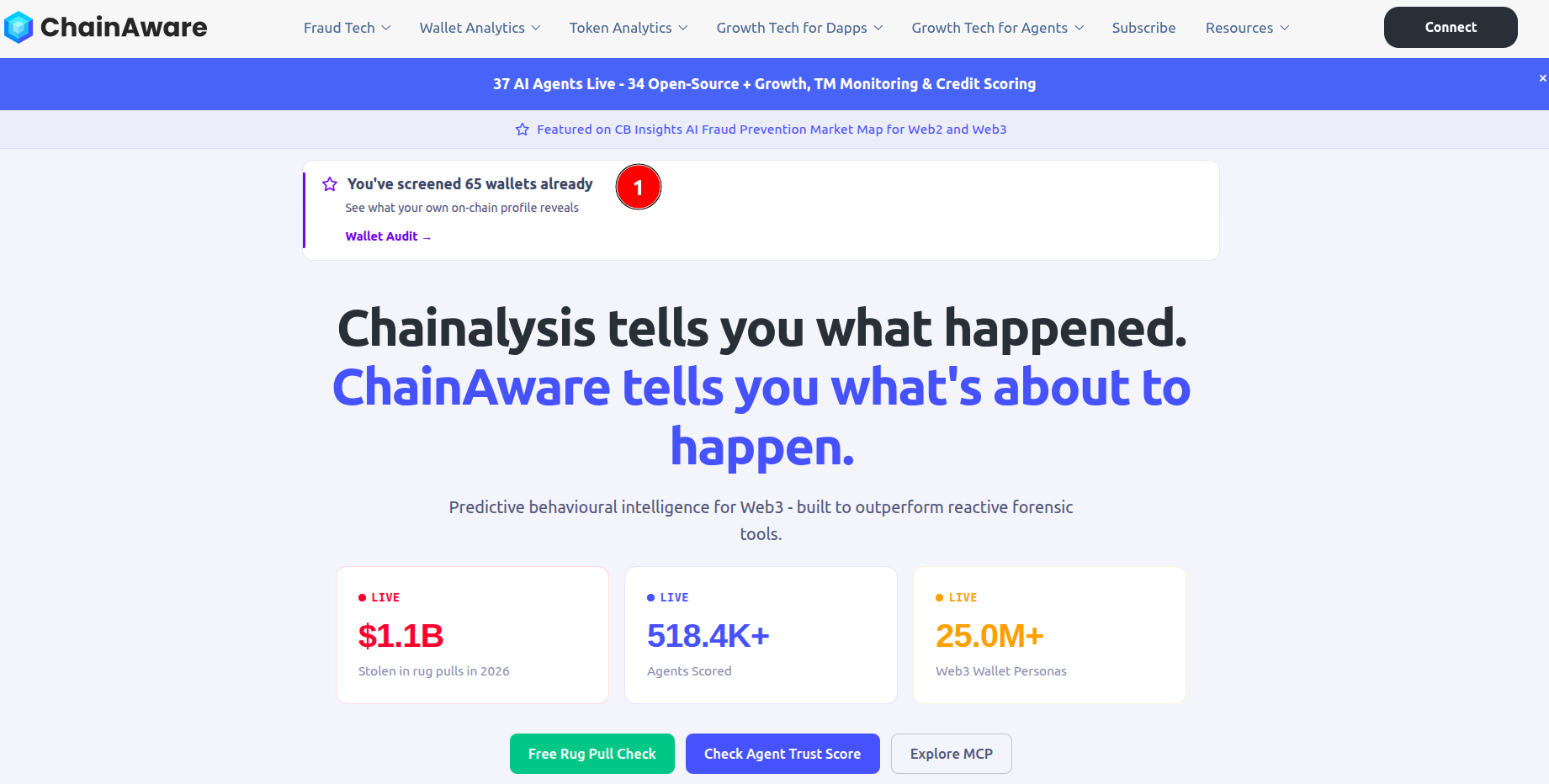
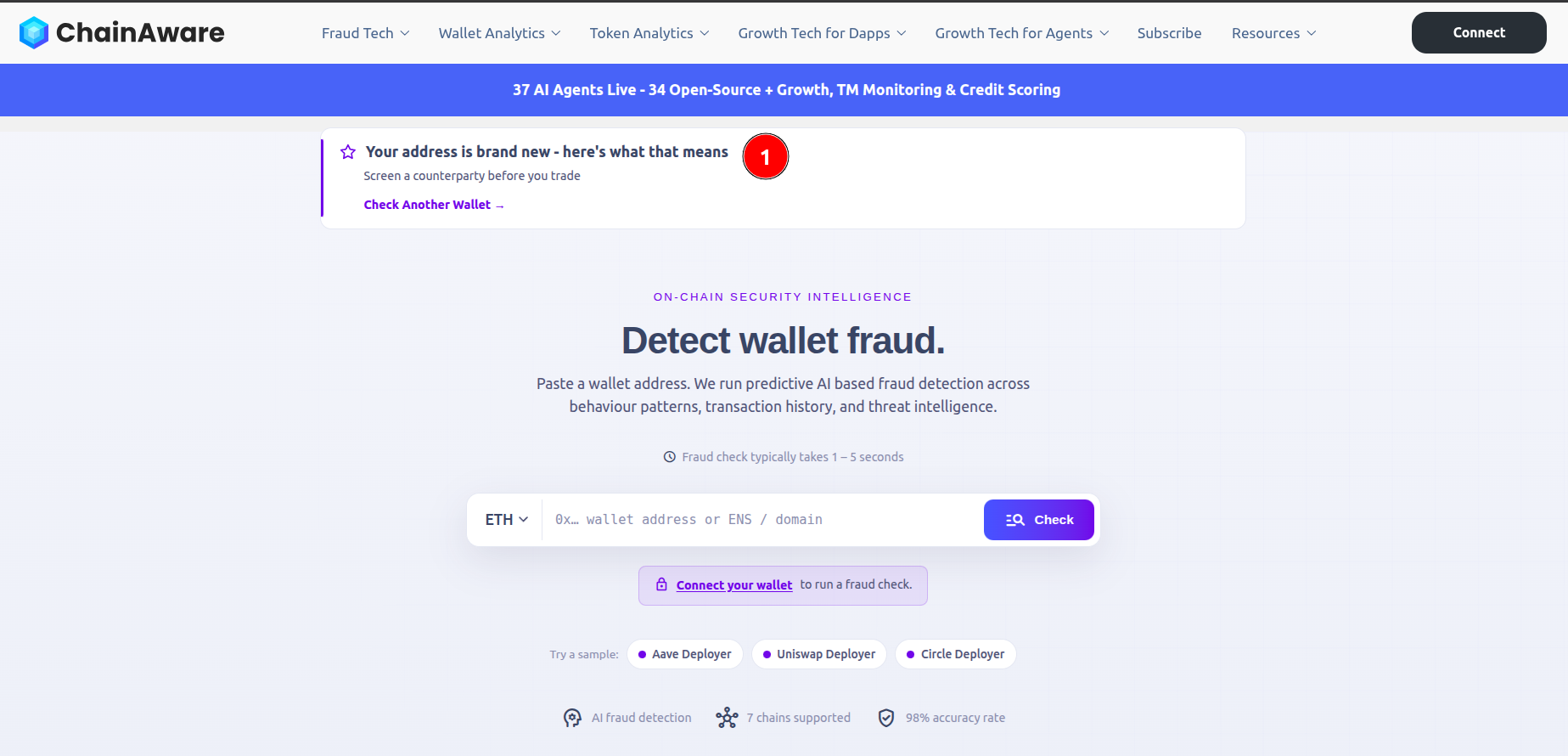
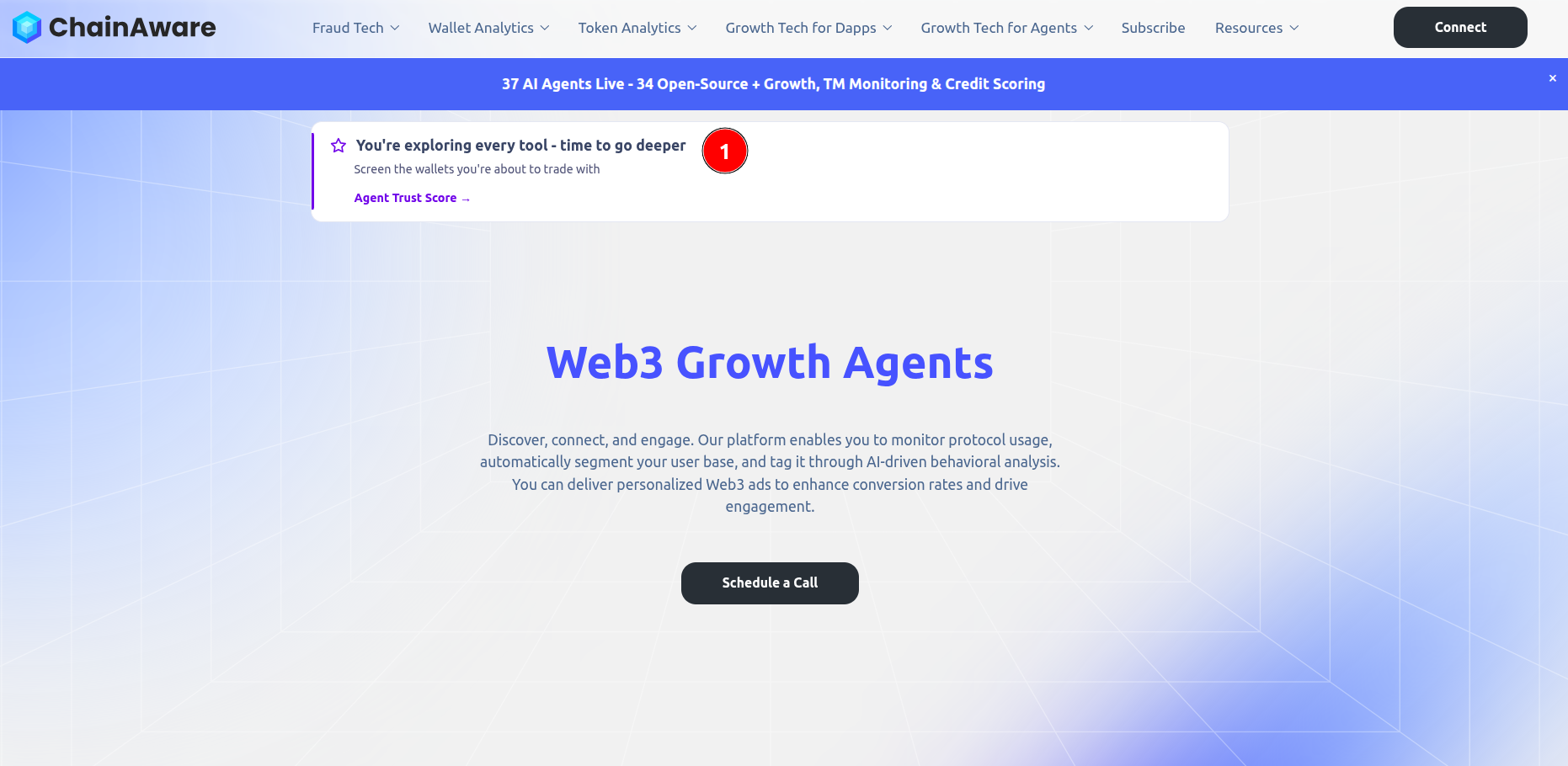
Consider the same expert wallet on two different pages of the same dApp. On the Rug Pull Detector page, they see: “Your portfolio has positions worth a closer look for contract risk” with a CTA pointing to the full wallet audit. On the Portfolio Overview page, they see: “Your on-chain history shows you know how to hold through volatility” with a CTA pointing to risk exposure analysis. Same wallet, same session, different page – completely different copy because the message is anchored to what the user is doing right now, not who they are in the abstract.
The three examples below come from the live ChainAware website. Each card combines session context with wallet data, and each one points the user toward a different next tool.
Pre-Connect Personalisation for Anonymous Visitors
Growth Agents do not require a wallet connection to begin personalising. The pixel captures page-behaviour signals from the moment the page loads – dwell time, scroll depth, tool interactions, click patterns – and passes them as context to the message API. An anonymous user who has spent two minutes on your fraud check page without connecting has told you something useful about their decision process, even without connecting a wallet. Growth Agents uses that signal to generate copy that meets them where they are rather than treating them as a generic new visitor.
When that anonymous user eventually connects their wallet, the persona updates automatically and the copy refreshes to incorporate the full behavioral profile. The transition is seamless – the user sees increasingly relevant copy as more is known about them, without any visible jump or page reload. This continuity of personalisation across the connect event is one of the properties that makes Growth Agents feel significantly different from standard A/B testing frameworks, which reset their experience at wallet connect because they have no way to carry page-behaviour context forward into a wallet-authenticated session.
The Share Hook: Turning Successful Users Into Acquisition Channels
One of the most underused features of Growth Agents is the share hook – a mechanism that generates a personalised, shareable sentence after a user completes a tool and sees their result. The output is a first-person statement ready for Twitter, Telegram, or a “Share your result” button in your dApp.
Word-of-mouth acquisition in DeFi is structurally different from Web2 because the user base is concentrated in communities where peer recommendations carry significant weight – Twitter/X crypto communities, Telegram groups, Discord servers, and protocol-specific forums. A genuine user sharing their result from your tool reaches an audience far more likely to be genuine DeFi participants than any paid advertising audience you can construct, because the sharer’s network self-selects for people interested in the same type of DeFi activity.
Consequently, one successful user who shares their result can generate acquisition events that cost you nothing beyond the Growth Agents integration. The share hook makes this happen systematically rather than relying on users to write their own posts – it generates the shareable sentence automatically, personalised to their specific result, ready to paste into whatever channel they use. The share hook is also automatically suppressed for wallets flagged as reward hunters – protecting the signal value of the social sharing channel. For how Growth Agents integrates with the broader 32 Claude Sub-Agents system, including the wallet-marketer and onboarding-router agents, see the sub-agents guide.
Integration: Getting Growth Agents Live in 30 Minutes
One of the distinctive properties of Growth Agents is the integration speed. Most meaningful growth infrastructure takes weeks to integrate, test, and deploy. Growth Agents requires a single script tag, a call to init(), and API wiring to render the returned headline and toolCta in your front end. Most teams are live in 30 minutes without any backend changes.
Step One – Add the Pixel to Your Page Header
<script src="https://pixel.chainaware.ai/v2-track.js" defer></script>Step Two – Initialise After the Browser Is Ready
The initialisation syntax varies slightly by framework. React uses a useEffect hook. Angular uses afterNextRender for SSR safety. Plain JavaScript uses a DOMContentLoaded listener. All three are documented in the Growth Agents integration guide with copy-paste examples.
// React
useEffect(() => {
  window.chainAwareTrack?.init('your-client-id');
}, []);

// Angular (SSR-safe)
afterNextRender(() => {
  (window as any).chainAwareTrack?.init('your-client-id');
});

// Plain JS
document.addEventListener('DOMContentLoaded', () => {
  window.chainAwareTrack.init('your-client-id');
});
Step Three – Call the Message API and Render the Result
Call the message API whenever you want to update copy – on page load, on wallet connect, or on tool navigation. The API returns the headline and toolCta fields ready to render. Wire those two fields into your existing UI components and the personalisation is live.
POST /v2/message
{
  "clientId": "your-client-id",
  "sessionId": "...",
  "walletAddress": "0x...",
  "network": "ETH",
  "currentTool": "rug_pull_detector"
}

// Response
{
  "headline": "Your wallet history shows you know how to spot a bad contract",
  "toolCta": "Run a full wallet audit →"
}
Supported Networks and Wallet Libraries
Growth Agents currently support ETH, BNB, BASE, HAQQ, and SOLANA. The pixel detects both EVM and Solana wallets automatically. Wallet library coverage includes MetaMask, WalletConnect, Coinbase Wallet, Phantom, Solflare, and other major libraries. No changes to your existing wallet connection logic are needed – the pixel hooks into the connection events that your integration already fires.
For Solana-only applications, pass networks: [‘SOLANA’] to the init() call to skip EVM probing and reduce initialisation latency. The API also supports async mode for latency-sensitive paths – you can enqueue the personalisation job and poll for the result rather than waiting for a synchronous response.
Ready-Made Agent Alternatives for Claude Code Pipelines
For teams building AI agent workflows rather than dApp front ends, Growth Agents functionality is also available through ChainAware’s 32 ready-made agent definitions. The chainaware-onboarding-router, chainaware-wallet-marketer, and chainaware-platform-greeter agents wrap the same behavioral intelligence for use in Claude Code pipelines – enabling AI agents to make personalisation decisions for DeFi users without any front-end integration. These agents are open-source, MIT-licensed, and freely available. See the Growth and Marketing Agents documentation for the complete reference.
Measuring the Impact: What to Track After Integrating Growth Agents
Integrating Growth Agents without measuring the right metrics is a common mistake that leads teams to underestimate the impact or misattribute it. The metrics that matter most are different from the vanity metrics that most DeFi dashboards surface by default.
Primary Metrics
Connect-to-transact rate is the most important single metric. Measure it as the percentage of connecting wallets that complete at least one meaningful interaction within the session. Track it by persona segment – expert wallets, intermediate wallets, beginner wallets – because the absolute rate will differ significantly between segments, and the improvement after personalisation will also differ. If expert wallets were already converting at 25% before personalisation and rise to 50% after, that is a different story than beginners rising from 3% to 15%.
Real CAC is the second primary metric – total acquisition spend divided by wallets that completed at least one meaningful interaction, not total connecting wallets. Track this monthly and watch it fall as your connect-to-transact rate improves. The relationship is direct: a 4x improvement in connect-to-transact rate produces a 4x reduction in real CAC from the same spend.
Secondary Metrics
Session depth – the number of tools or pages a user visits before leaving – is a strong early indicator of personalisation quality. Properly personalised users explore more of your product because each step feels relevant to them. A rising session depth metric, especially for first-time users, correlates strongly with improving long-term retention.
Persona-segment conversion rates give you visibility into which wallet types your product serves well and which need more work. If expert wallets convert at 50% but intermediate wallets convert at 12%, that gap signals a product-fit issue in the intermediate segment that personalisation is surfacing but not fixing. Fixing it requires product changes – but Growth Agents gives you the segmented data to identify the gap in the first place.
Re-engagement return rate – the percentage of non-converting wallets that return after a behaviorally targeted re-engagement message – is the LTV metric most directly influenced by the Growth Agents re-engagement module. Track it against a control group that receives generic re-engagement messages to isolate the contribution of personalisation. According to FATF guidance on virtual asset service providers ↗, understanding user behavioral patterns is also increasingly important for compliance purposes – making behavioral analytics doubly valuable as both a business intelligence and a regulatory asset.
The Broader Web3 Growth Tech Stack
Growth Agents are the real-time personalisation and deployment layer of ChainAware’s growth tech stack. They work best as part of a broader set of tools that cover the full user acquisition and retention cycle. Understanding where Growth Agents fit in the stack helps teams prioritise which components to deploy first based on their specific growth bottlenecks.
Web3 User Analytics: Understanding Your Traffic Before Personalising It
Before personalising at the individual level, it helps to understand the aggregate behavioral profile of your connecting wallet traffic. ChainAware’s Web3 User Analytics provides a persona distribution of your entire connecting audience – what percentage are beginners vs experts, what their dominant intention categories are, what their fraud rate looks like. Two lines of Google Tag Manager code deliver this analysis within 24 hours. The output tells you which segments to prioritise in your personalisation implementation and which product areas need different copy angles.
Analytics and Growth Agents are complementary: analytics tells you who your traffic is at the population level, Growth Agents personalise for each individual in that population. Starting with analytics is particularly valuable for teams that have not yet characterised their wallet traffic, because it reveals audience composition issues – for example, a traffic mix that is 60% beginners when your product is built for experts – that personalisation alone cannot fix. For the complete analytics guide, see our Web3 Behavioral User Analytics guide.
On-Chain Marketing Analytics: Attribution That Actually Works in Web3
Standard marketing attribution in DeFi is broken for the same reasons that retargeting is broken: without persistent user identity, you cannot reliably connect an acquisition touchpoint to a conversion event. ChainAware’s On-Chain Marketing Analytics solves attribution by anchoring it to wallet addresses rather than browser sessions. Because the wallet address is persistent across devices and browsers, you can trace which acquisition channel brought a specific wallet to your dApp, how that wallet behaved once it connected, and whether it eventually converted – even if the conversion happened in a different session weeks later.
This attribution capability closes the measurement gap that makes DeFi marketing budgets so difficult to optimise. When you can see which channels bring high-quality wallets – not just high volumes – you can reallocate spend toward channels that produce genuine users rather than airdrop farmers and bots. Combined with Growth Agents’ conversion improvements, proper attribution typically reveals that the effective ROI on the best acquisition channels is substantially higher than it appeared before wallet-level attribution was available.
The Prediction MCP: Growth Intelligence for AI Agent Pipelines
For teams building AI-powered growth workflows, the Prediction MCP provides the same behavioral intelligence that Growth Agents use, available to any MCP-compatible AI agent via natural language queries. An agent can ask “What will this wallet do next on a DeFi lending platform?” and receive a complete behavioral profile in under one second – without any blockchain expertise, without data pipelines, and without custom ML infrastructure.
The Prediction MCP enables growth automation workflows that were previously impossible: AI agents that monitor connecting wallets and generate personalised outreach campaigns in real time, agents that route users into appropriate product flows without human configuration, and agents that identify high-LTV wallets from their behavioral profiles before they have interacted with the protocol. For the architecture detail, see our 32 Claude Sub-Agents guide.
ENTERPRISE DEMO
Get Growth Agents Running on Your DApp in 30 Minutes
Book a 30-minute technical walkthrough. We will install Growth Agents on your actual landing page or dApp during the demo, show you live personalisation for your wallet traffic mix, and walk through the SmartCredit.io results in full detail. No commitment, no sales process – just a working integration you can keep.
Common Questions About Growth Agents
How Is Growth Agents Different From A/B Testing?
A/B testing optimises for the average user across a random traffic split. Growth Agents personalise for the specific wallet that just connected, based on their individual behavioral history. A/B testing tells you which variant performs better on your average visitor. Growth Agents tell you what message to show this specific visitor right now. The two are complementary rather than competing – A/B testing is useful for identifying which overall product direction to pursue, while Growth Agents are useful for maximising the effectiveness of whichever direction you have chosen at the individual level.
Does the Pixel Require Changes to Our Existing Wallet Connection Code?
No. The pixel is a single script tag that detects wallet connect events autonomously across all major wallet libraries. Your existing connection logic is unchanged. The pixel hooks into the wallet connection events that your dApp already fires, without interfering with them. This is why most integrations complete in 30 minutes rather than requiring an engineering sprint.
What Happens to Wallets Not in the 23M+ Profile Database?
New wallets with limited on-chain history receive a persona based on the behavioral signals that are available – wallet age, initial funding source, transaction patterns from their first interactions. The model is designed to produce useful output even from sparse data, using population-level priors to fill gaps. As the wallet accumulates more on-chain history, its persona deepens automatically. Growth Agents handle new wallets gracefully rather than defaulting to a generic experience – they generate copy appropriate to a new wallet rather than attempting to apply expert-level personalisation to an address with insufficient history to support it.
How Does Fraud Detection Work Alongside Personalisation?
Fraud detection and personalisation run in the same API call. When a wallet connects, ChainAware computes both the behavioral persona (for personalisation) and the fraud probability (for exclusion) simultaneously. Your integration receives both signals and can act on them independently: serve personalised copy to genuine users, and suppress incentive offers or retargeting triggers for fraud-flagged wallets. The dual function means you do not need a separate fraud detection integration alongside Growth Agents. For the detailed compliance and fraud detection architecture, see our DeFi Compliance Tools guide.
Is There a Free Way to Test the Underlying Intelligence?
Yes. The ChainAware Agent Trust Score is free to use and requires no API key. Paste any wallet address and immediately receive the behavioral profile – experience level, fraud probability, intention signals, and trust tier – that powers Growth Agents. This lets you evaluate the quality of the behavioral intelligence before committing to an integration. The Prediction MCP and 34 ready-made agent definitions are also free to test without credentials. For teams that want to see the full Growth Agents stack running on their actual dApp traffic before signing a commercial agreement, a demo booking takes 30 minutes and delivers a working integration.
The Structural Advantage of Acting Now
DeFi is in a consolidation phase. The protocols that built sustainable growth engines during the high-incentive era are discovering that organic retention is harder than it looked when token rewards were doing most of the work. The protocols building sustainable growth now – without relying on incentive subsidies – are developing structural advantages that compound over time.
Wallet-level personalisation is one of those structural advantages. A protocol that knows, from the first session, whether a connecting wallet is a beginner or an expert, whether they are likely to borrow or to provide liquidity, and whether they are a genuine user or an airdrop farmer, is operating with significantly better information than a protocol that treats all wallets identically. That information advantage translates directly into better conversion rates, lower real CAC, higher LTV, and more efficient allocation of growth spend.
Furthermore, the network effects of behavioral data accumulate over time. ChainAware’s 23M+ wallet profiles represent years of on-chain behavioral observation across multiple chains and market cycles. The behavioral patterns that drive accurate intention prediction are not visible from a single chain or a single market phase – they require observing how wallets behave across bull markets and bear markets, across multiple protocol generations. That accumulated observation is the moat that makes the predictions accurate, and it is not something a new entrant can replicate quickly regardless of engineering investment.
For the complete strategic argument about why behavioral data moats compound in Web3, see our Web3 Agentic Economy guide.
Getting Started With Growth Agents
Three paths lead to a working Growth Agents integration, depending on how your team prefers to evaluate new infrastructure.
The self-serve path is fastest: add the pixel to your site, call init() after DOM ready, and wire up the message API to render the headline and toolCta in your existing UI. Most teams complete this in 30 minutes. The Growth Agents documentation includes copy-paste code examples for React, Angular, and plain JavaScript, plus the complete message API reference.
The demo path is most thorough: book a 30-minute session and we will walk through your specific funnel, show you live personalisation for your wallet traffic mix, and demonstrate the integration on your actual landing page or dApp. This path is recommended for teams that want to see the SmartCredit.io results replicated on their own traffic before committing to an integration.
The AI agent path serves teams building autonomous growth workflows: use the Prediction MCP or the ready-made growth agent definitions to integrate wallet behavioral intelligence into Claude Code pipelines, without any front-end integration required. The chainaware-onboarding-router and chainaware-wallet-marketer agents are documented in full in the Growth and Marketing Agents guide.
Regardless of which path you choose, the starting point is the same: profile your first wallet. The Agent Trust Score is free, requires no API key, and delivers the full behavioral profile behind any wallet address in under one second. Seeing it for your own wallet, or for a few wallets from your recent traffic, is the fastest way to understand why wallet-level personalisation produces conversion improvements that no other DeFi growth tool matches.
START NOW – FREE
Two Ways to Get Started With Growth Agents Today
Try the Agent Trust Score free – no signup, no API key, paste any wallet address and see the behavioral profile that powers personalisation. Or book a 30-minute demo and get Growth Agents running on your actual dApp during the call.
External sources: Messari State of DeFi Report ↗ · HubSpot Marketing Benchmarks ↗ · a16z Crypto State of Crypto 2025 ↗ · Nielsen Norman Group Personalisation Research ↗ · FATF Virtual Assets Guidance ↗
Related ChainAware reading: What Are Web3 Personas · DeFi Onboarding 2026 · Web3 User Segmentation · Intention Analytics · Prediction MCP Guide · Web3 Wallet Auditing Providers · Web3 Behavioral User Analytics · Generative vs Predictive AI · Forensic vs AI-Powered Analytics · 32 Claude Sub-Agents · DeFi Compliance Tools · Web3 Agentic Economy