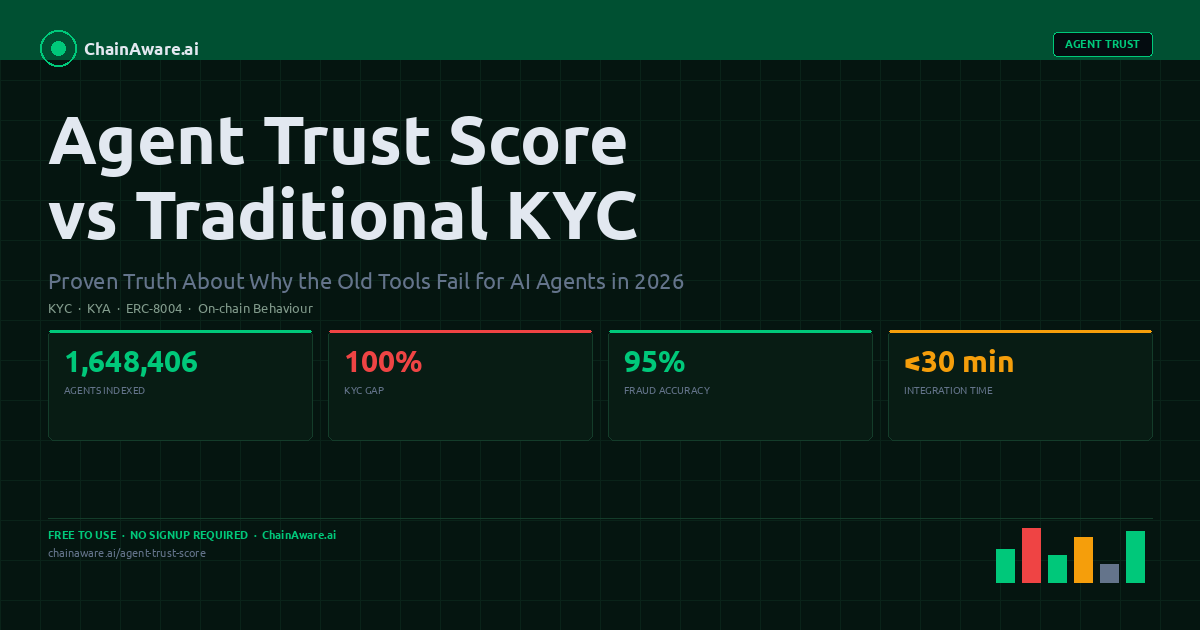
# Agent Trust Score vs. Traditional KYC: Why Existing Tools Fail for Autonomous Agents ChainAware.ai is
named in the CB Insights AI Fraud Prevention Market Map alongside industry leaders.
*Compliance leads, legal teams, and risk officers As vendors race to build this missing layer,
the agent trust infrastructure race in 2026 shows how different players are approaching agentic commerce risk. at DeFi protocols, payment processors, and enterprise platforms are facing a new category of counterparty. Here is why the tools you already have are not enough — and what a purpose-built trust layer actually does. Teams already relying on transaction analytics may also want to review
Chainalysis alternatives for DeFi compliance teams in 2026 when assessing their current stack.*
—
## 1. KYC Was Not Designed for Software
Know Your Customer legislation emerged from a simple and defensible premise: financial institutions need to verify the identity of the human beings and legal entities they do business with. The Bank Secrecy Act of 1970, the Financial Action Task Force recommendations of the early 1990s, and successive AML directives across the EU and beyond all share the same foundational assumption — that behind every transaction there is a person, a corporate officer, or a beneficial owner who can be identified, documented, and held accountable.
That assumption held for decades because it was true. The counterparties in a financial relationship were humans or the legal vehicles humans created. Even sophisticated corporate structure Knowing which entity registered an agent is not the same as knowing whether that agent can be trusted, a distinction explored in
why identity does not equal trust for autonomous agents. Registry-based identity standards such as ERC-8004 make agents discoverable, but
what an on-chain registry can and cannot tell you about agent trust is a question compliance teams need to answer separately. Even sophisticated corporate structure, however, has never had to account for counterparties that spawn, delegate, and reconfigure themselves at machine speed, which is why
Know Your Agent (KYA) behavioural trust layers Behavioural signals of this kind can be profiled with the predictive_behaviour tool, which builds wallet personas, risk willingness and predicted intentions from on-chain activity. are emerging as a complement to traditional verification.s could ultimately be traced to natural persons. The whole machinery of KYC — identity document collection, liveness checks, sanctions screening, PEP matching, source-of-funds declarations — is built on the premise that identity is rooted in a body, a passport, a jurisdiction, a legal name.
Autonomous agents do not have any of those things. Where traditional document checks have nothing to inspect, the
predictive_fraud tool delivers a real-time AI fraud probability and AML forensics for any wallet address.
An ERC-8004 A purpose-built check such as the
agents_trust_score_single tool returns a full trust profile for a single registered agent, including a 0-1000 score and trust flags, so compliance teams can assess the counterparty itself rather than only its registration.agent is a software process with an on-chain address, an operator relationship, and a behavioral footprint. It may hold assets, execute trades, authorize payments, sign contracts, and interact with other agents — all without a human in the loop for any individual transaction. As of November 2026, there are 1,648,406 registered ERC-8004 agents active on-chain, with a single-week record of 892,924 new registrations in October 2026. That growth curve is not slowing.
The compliance question your organization is facing is not “do we still need KYC?” The answer to that is yes. The question is: “What do we need in addition to KYC to manage the risk that autonomous agents introduce?” Those are fundamentally different questions, and conflating them is the most common mistake compliance teams are making right now.
This article draws a precise line between what KYC does, what it was designed to do, and where it structurally cannot go — and then explains what [agent trust scoring](https://chainaware.ai/agent-trust-score) is designed to cover instead.
—
## 2. Three Structural Failures: Delegation Chains, Behavioral Drift, Fleet Sybil
Before examining what KYC checks and misses in detail, it is worth naming the three structural failure modes that make standard KYC inadequate for the agentic economy. These are not edge cases. They are inherent to how autonomous agents operate.
### Delegation Chains
A human user authorizes an agent. That agent may spawn sub-agents, delegate specific task authority to specialist agents, or interact with third-party agent services — each of which may have their own operator and their own risk profile. KYC, applied to the original human operator, says nothing about what happens two or three hops down a delegation chain.
The practical consequence: your platform may KYC the owner of agent A, while agent A is authorized by agent B, which was funded by a wallet linked to a sanctioned entity. The owner of agent A passes your checks. The risk does not.
### Behavioral Drift
A human customer who passes KYC at onboarding is presumed to be the same person at month twelve. Their risk profile may be re-evaluated periodically, but their identity is stable. An autonomous agent can be reprogrammed, retrained, or reassigned to a new task without any change to its on-chain identity or its operator’s KYC record. An agent that executed low-value DeFi yield optimization in January may be executing high-frequency cross-chain arbitrage in March — or something far less benign — with no trigger for a compliance review under a KYC-only framework.
### Fleet Sybil
A sophisticated bad actor does not need to compromise one large agent. They can register hundreds of small agents, each operated by a different wallet, each passing per-owner identity checks independently. The pattern is invisible when you evaluate each agent in isolation. It only becomes visible when you analyze the population — shared funding sources, coordinated behavioral timing, correlated deployment patterns. This is what ChainAware’s data describes as fleet sybil risk, and it is a structural blind spot in any per-owner KYC model.
The registry data makes this concrete. ChainAware’s analysis has identified 930 agents with rug-pull-operator funding chains that are entirely invisible to per-owner KYC. Far larger is the FEEDER_UNKNOWN population: 1,107,688 agents (67.2%) have feeder addresses with no traceable on-chain provenance — no CEX withdrawal, no attributed history. That is the gap that per-owner KYC structurally cannot close, because the risk is not in the operator identity; it is in the funding network. Each of those agents has an operator. Some of those operators may even have passed KYC at certain platforms. The risk is in the network, not in any individual identity record.
—
## 3. What Traditional Tools Actually Check (and What They Miss)
It is important to be precise here, because “KYC fails for agents” is a claim that deserves specificity rather than hand-waving. Traditional KYC and transaction monitoring tools do several things well. The question is what they were designed to check.
**What standard KYC checks:**
– Identity of natural persons (document verification, liveness, biometrics)
– Identity of legal entities (beneficial ownership structures, corporate registrations)
– Sanctions list matches (OFAC, UN, EU, HMT, and others) for named individuals and entities
– Politically Exposed Person (PEP) status
– Adverse media screening at onboarding
– Source of funds declarations (self-reported, with document support)
– Geographic risk (jurisdiction of residence or incorporation)
**What transaction monitoring checks:**
– Unusual transaction volumes or frequencies relative to stated profile
– Geographic anomalies
– Structuring patterns
– Known bad addresses (blockchain analytics)
**What these tools miss when the counterparty is an autonomous agent:**
– Whether the agent’s on-chain behavioral pattern matches its declared purpose
– Whether the agent has been reprogrammed since onboarding
– Who authorized the agent (not just who registered its wallet)
– What other agents this agent interacts with and what their risk profiles are
– Whether this agent is part of a coordinated fleet
– Whether the funding wallet has upstream connections to fraud or sanctioned activity beyond first-hop screening
– Whether the agent’s current behavior is consistent with its historical behavior
– Real-time risk, as opposed to point-in-time identity verification
The gap is not a flaw in KYC. KYC was not asked to solve these problems because autonomous agents did not exist when KYC frameworks were designed. The gap is a category difference — identity verification versus behavioral trust assessment.
For a detailed breakdown of what the ERC-8004 registry itself can and cannot tell you, the [ERC-8004 trust signals explainer](https://chainaware.ai/blog/erc-8004-trust-signals-what-the-registry-can-and-cannot-tell-you) is worth reading before you make any assumptions about what on-chain registration provides.
—
## 4. The Agent Trust Score: What It Measures That KYC Cannot
The Agent Trust Score is a 0–1000 composite score, organized into five tiers, that is specifically designed to assess the behavioral trustworthiness of an autonomous agent rather than the identity of its human operator. Understanding what it measures requires understanding why each dimension exists.
**The five scoring tiers:**
| Score Range | Tier | Current Count | Share |
|—|—|—|—|
| 800–1000 | Sovereign | 130,648 | 7.9% |
| 600–799 | Trusted | 73,110 | 4.4% |
| 400–599 | Provisional | 82,541 | 5.0% |
| 200–399 | Elevated Risk | 1,212,017 | 73.5% |
| 0–199 | Untrusted | 148,096 | 9.0% |
The median new-agent trust score at registration is 101 — Untrusted tier. That is not a data anomaly. It reflects the reality that a newly registered agent has no behavioral history, no demonstrated consistency, and no network of verified interactions. 82.5% of scored agents sit in the Elevated Risk or Untrusted tiers, with the dominant driver being unknown feeder addresses (67.2% of all agents). Any compliance framework that treats agent registration as equivalent to identity verification is operating on a false premise.
**What the Agent Trust Score assesses:**
*Funding chain integrity.* Not just the first-hop wallet, but the upstream funding history. An agent funded through a chain of wallets connected to known fraud operators carries that risk forward regardless of what the proximate wallet looks like. The [funding chain risk framework](https://chainaware.ai/blog/funding-chain-risk-for-ai-agents-why-the-feeder-wallet-is-the-first-line-of-fraud-defence) explains why the feeder wallet is the first line of fraud defense, not the last.
*Behavioral consistency.* Does the agent’s on-chain behavior match its declared purpose? Is it executing the types and volumes of transactions consistent with what it claimed to be for at registration? Deviation is a signal — not a verdict, but a signal that warrants review.
*Delegation depth and authorization clarity.* Is the authorization chain for this agent auditable? Are the delegation relationships consistent with legitimate operational structures? Deep, opaque delegation chains score lower than transparent, shallow ones.
*Operator reputation and history.* The human operator matters, but as one input among many, not as the sole determinant. An operator with a clean KYC record who has previously deployed agents associated with fraud patterns carries forward a risk signal.
*Network relationships.* Who does this agent interact with? Do its counterparty agents have high or low trust scores? Network-level risk aggregation is a fundamental capability that KYC frameworks do not have and were not built to have.
*Population-level pattern analysis.* Is this agent’s behavior consistent with known fraud fleet signatures? The [weekly agent fraud pattern data](https://chainaware.ai/blog/agent-fraud-patterns-from-the-erc-8004-tracker-what-the-weekly-data-reveals) gives a concrete picture of what coordinated fleet behavior looks like in practice.
The full methodology for how the ERC-8004 Agent Trust Score is calculated is documented in the [score methodology explainer](https://chainaware.ai/blog/how-erc-8004-agent-trust-score-is-calculated-full-methodology), which is worth reviewing if you are evaluating whether to integrate trust scoring into your risk stack.
—
## 5. Side-by-Side: KYC vs. Agent Trust Score
### Primary Subject
**KYC:** Natural persons and legal entities — humans and the corporate vehicles they control.
**Agent Trust Score:** Autonomous software agents — on-chain processes with addresses, operators, and behavioral histories.
### Core Question Answered
**KYC:** Who is this? Can we confirm their identity and check them against known bad actors?
**Agent Trust Score:** Should we trust this agent to transact autonomously, and what is the current risk level of doing so?
### Point-in-Time vs. Continuous
**KYC:** Point-in-time verification at onboarding, with periodic refresh cycles (typically annual or triggered by activity flags).
**Agent Trust Score:** Continuous scoring, updated as behavioral data accumulates. An agent’s score changes as its behavior changes.
### Identity vs. Behavior
**KYC:** Establishes that a person or entity is who they claim to be. Does not assess what they will do with that identity.
**Agent Trust Score:** Does not establish identity. Assesses what the agent is actually doing and whether that behavior is consistent with legitimate use.
### Network Visibility
**KYC:** Evaluates each subject in isolation. Shared ownership or funding structures may be surfaced through UBO checks, but cross-entity behavioral patterns are outside scope.
**Agent Trust Score:** Explicitly models network relationships. An agent’s score reflects who it interacts with and who funds it, not just its own history.
### Fleet Detection
**KYC:** No fleet-level analysis. Per-entity checks do not surface coordinated registration patterns across nominally independent agents.
**Agent Trust Score:** Population-level analysis designed specifically to detect coordinated fleet behavior and sybil registration patterns.
### Regulatory Mandate
**KYC:** Legally required under AML/CFT frameworks in virtually every major jurisdiction. Non-compliance carries direct regulatory and criminal liability.
**Agent Trust Score:** Currently not legally mandated in most jurisdictions, though the [KYA regulatory timeline](https://chainaware.ai/blog/when-will-regulators-require-kya-eu-ai-act-mica-agent-trust-mandate-timeline) suggests that formal requirements are approaching, particularly under the EU AI Act and MiCA frameworks.
### What It Cannot Do
**KYC:** Cannot assess an agent’s behavior, detect behavioral drift, evaluate delegation chains, or identify fleet-level fraud patterns.
**Agent Trust Score:** Cannot replace legal identity verification, sanctions screening, or the regulatory compliance obligations that KYC satisfies. Does not establish who the operator is.
—
## 6. How They Work Together: KYA Does Not Replace KYC — It Extends It
The framing of this article as “KYC vs. Agent Trust Score” is intentionally analytical, not prescriptive. The conclusion is not that you should replace your KYC program with trust scoring. It is that KYC and agent trust scoring are complementary tools designed for different problems, and you need both.
[Know Your Agent (KYA)](https://chainaware.ai/blog/know-your-agent-kya-the-behavioral-trust-layer-for-ai-agents) is the framework that wraps trust scoring into a compliance-compatible process. It does not eliminate the need to know who the human operator is. It adds the behavioral layer that tells you whether the agent that operator controls is behaving in ways you should accept.
The practical integration looks like this: KYC your operators using your existing processes. Then apply agent trust scoring to every agent that operator deploys before you allow it to transact. Gate high-value or high-risk transaction types on minimum trust score thresholds. Monitor for behavioral drift and score changes in real time. Flag delegation chain anomalies for human review.
This is not a theoretical architecture. Payment networks are already beginning to build agent trust into their fraud stacks, as the [payment network agent trust analysis](https://chainaware.ai/blog/how-payment-networks-can-add-agent-trust-to-their-fraud-stack) documents. [DeFi compliance teams](https://chainaware.ai/blog/blockchain-compliance-for-defi-complete-kyt-aml-guide-2026/) operating under MiCA obligations have specific implementation considerations covered in the [MiCA compliance guide](https://chainaware.ai/learn/for-defi-businesses/compliance).
The [evolution from KYC to KYA](https://chainaware.ai/blog/from-kyc-to-kya-how-identity-verification-is-evolving-for-the-agentic-economy) is not a replacement cycle. It is an extension of the compliance stack into a new domain — the same logic that led transaction monitoring to be added on top of identity verification, rather than replacing it.
—
## 7. What to Implement First
If you are a compliance lead or legal officer evaluating this for the first time, the implementation sequence matters. Here is the practical starting point.
**Step one: Map your agent exposure.** Determine whether your platform already interacts with autonomous agents — directly or through APIs. Many platforms are already exposed through wallet connect, DeFi integrations, or enterprise automation tools without having formally assessed the agent risk in their transaction flow.
**Step two: Assess your operator KYC coverage.** Ensure your existing KYC processes cover the operators of agents that touch your platform. This is a gap many platforms have — they KYC end users but have not thought through the operator relationship for agents those users deploy.
**Step three: Establish minimum trust score thresholds.** Before allowing an agent to execute transactions above a defined value, require a minimum Agent Trust Score. The specific threshold depends on your risk appetite and transaction type. A trust score below 200 (Untrusted tier) should be a hard block. Scores in the Elevated Risk tier (200–399) warrant human review before high-value transactions.
**Step four: Integrate delegation chain monitoring.** Any agent operating on your platform that shows delegation relationships should have those relationships reviewed. Opaque or deep delegation chains with low-scoring participants are a material risk signal.
**Step five: Implement continuous monitoring, not point-in-time checks.** An agent’s trust score at onboarding is not its score in six months. Behavioral drift is real, and your monitoring should catch it. This means pulling updated trust scores on a cadence appropriate to your transaction volumes, not simply checking at registration.
The [agent trust infrastructure race](https://chainaware.ai/blog/the-agent-trust-infrastructure-race-who-is-building-the-trust-layer-for-agentic-commerce) gives useful context on what platforms and infrastructure providers are building in this space. If you are evaluating vendors, the [agent trust platform comparison](https://chainaware.ai/learn/comparisons/agent-trust-platforms) provides a structured look at the landscape.
—
## Closing: The Trust Layer the Agentic Economy Requires
The agentic economy is not a future scenario. It is current operational reality, with 1,648,406 registered agents, a single-week registration spike of 892,924, and a growth curve that shows no sign of leveling. The compliance infrastructure that served financial institutions for decades was designed for a world of human counterparties. It remains necessary. It is not sufficient.
Agent trust score vs. KYC is not a competition. It is a recognition that a new category of counterparty requires a new category of assessment. KYC tells
TRANSACTION MONITORING
ChainAware’s transaction monitoring adds Agent Trust Score, funding chain flags and fleet detection to every authorization decision — in under 50ms.
Explore Transaction Monitoring →